
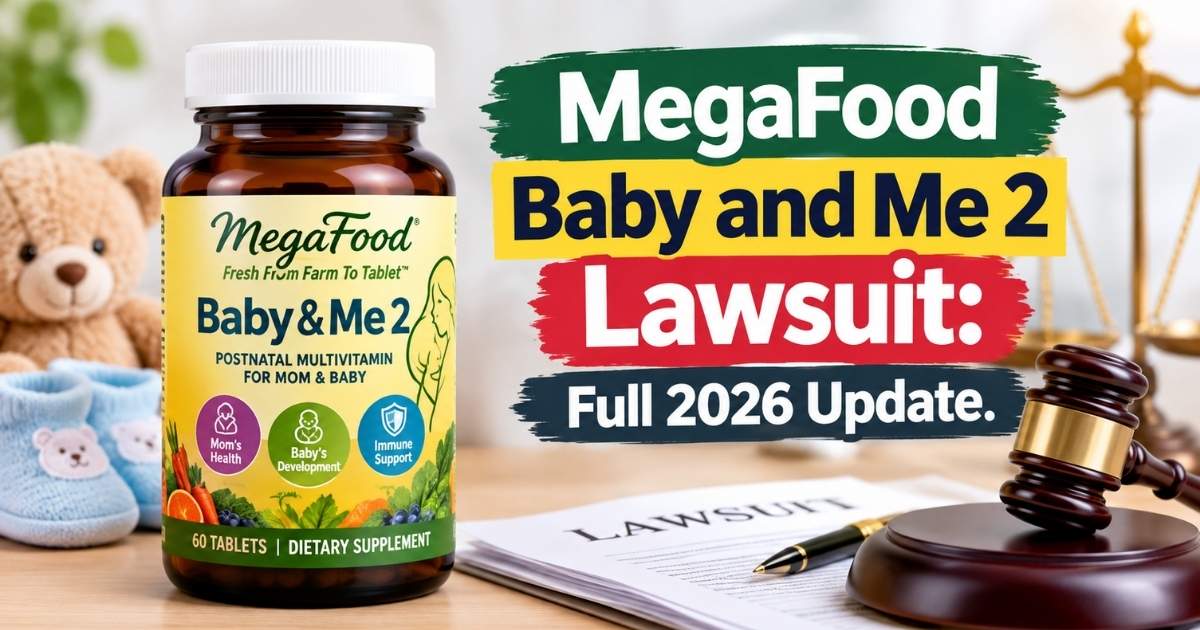

If you have searched for the “MegaFood Baby and Me 2 lawsuit,” you are probably a pregnant woman, a new parent, or someone who has taken this prenatal vitamin and recently came across alarming claims about heavy metals in the product. You want a straight answer: is there really a lawsuit, is the product safe, and what should you actually do next.
This guide gives you that straight answer. We dug into the independent lab testing that started this conversation, checked what real, verifiable litigation looks like for similar heavy metal cases, and separated confirmed facts from the vague “lawsuit update” content that has been circulating online without any court record behind it. No settlement numbers are invented here, and no claim process is described unless it reflects how these cases genuinely work.
What Is the MegaFood Baby and Me 2 Lawsuit?
The phrase “MegaFood Baby and Me 2 lawsuit” refers to consumer concern, and in some cases legal interest, that grew after independent laboratory testing reported detectable levels of heavy metals, including lead, arsenic, cadmium, and mercury, in MegaFood’s Baby & Me 2 prenatal multivitamin. The lab testing was notable because it was only the second prenatal vitamin out of eleven tested that came back positive for mercury, and the mercury level was significantly higher than in the other vitamin that had tested positive.
That single finding is what sparked widespread online discussion, including comment threads where readers directly asked whether a class action should be filed against MegaFood. One reader reaction captured the frustration directly, calling for accountability and noting they had taken the product throughout pregnancy, fertility treatment, and breastfeeding.
Here is the part that matters most for anyone researching this topic in 2026: a number of websites describe a “2023 class action lawsuit” against MegaFood over lead content in Baby & Me 2, but none of them cite a case number, a court, a named plaintiff, or a law firm handling the matter. That is unusual. Real class actions, even ones in early stages, are public record. You can normally find a docket number, a filing date, and a court district within minutes of a genuine case being filed.
For comparison, a genuinely documented heavy metals case, the litigation against Hain Celestial over its Earth’s Best baby food line, has all of that information on record. That litigation was consolidated into a single proceeding in the U.S. District Court for the Eastern District of New York, captioned In re Hain Celestial Heavy Metals Baby Food Litigation. It has specific filing dates, motion histories, and court rulings tied to it, which is exactly what a verifiable lawsuit looks like on paper.
So what should you take from this? The underlying safety concern, heavy metals detected in a prenatal supplement, is real and worth understanding. Whether it has turned into a confirmed, certified class action against MegaFood specifically is, as of this update, not something that can be verified through public court records. This article treats that distinction honestly rather than presenting unconfirmed claims as settled fact.
MegaFood Baby and Me 2 Lawsuit 2026: Where Does the Case Stand?
As of this 2026 update, there is no publicly verifiable, docketed class action against MegaFood specifically tied to Baby & Me 2 that we could confirm through court records. That does not mean nothing is happening behind the scenes, since early-stage investigations by consumer attorneys sometimes happen quietly before a formal complaint is filed. It does mean that any article describing “class certification hearings” or “ongoing discovery” for this specific product should be read with caution unless it links to an actual court filing.
Here is what a legitimate case would typically show at this stage, based on how similar heavy metal litigation has actually unfolded:
- A filed complaint in a specific federal or state court, with a case number
- A named plaintiff or set of plaintiffs
- A defendant’s response, such as an answer or a motion to dismiss
- Public docket entries tracking each stage of the case
If and when a real case is filed against MegaFood, these details would appear on court record systems such as PACER for federal cases, or the relevant state court’s electronic filing system. Until then, treat “2026 update” style content that lacks these specifics as unverified.
MegaFood Baby and Me 2 Lawsuit Update: Latest Court Developments
Because no confirmed docket could be located for a MegaFood-specific case, there are no court developments to report as verified fact. What can be reported accurately is the pattern of similar litigation in the dietary supplement and baby food space, which shows what typically happens once a heavy metals case is actually filed.
In the Hain Celestial baby food litigation, for example, the case moved through recognizable stages over several years. Plaintiffs filed a Consolidated Amended Class Action Complaint, after which the company moved to dismiss it. That motion to dismiss was briefed over several months, with the plaintiffs filing opposition papers and the company filing a reply. The case was later stayed while a related appeal was pending in a similar case involving Beech-Nut. Individual state court cases in places like Hawaii and California moved on their own separate timelines, with amended complaints and company responses filed in each.
Eventually, plaintiffs across the federal cases filed a Master Complaint, defendants moved to dismiss it, and the court granted that motion in part while denying it in part. By 2026, the defendants had moved for summary judgment, and separately in the California personal injury cases, the court entered judgment in the company’s favor.
That timeline is useful context. Real heavy metals litigation, even when it involves a large, well-funded consumer class, typically takes years to move from filing to any resolution, and courts have not automatically sided with plaintiffs. If a MegaFood case is filed, expect a similarly long and contested process rather than a quick payout.
For readers who want to track real updates rather than rely on secondhand blog posts, the most reliable sources are:
- Federal court PACER records searchable by defendant name
- State attorney general consumer protection announcements
- Verified law firm case pages that list an actual court and case number
- SEC filings if MegaFood or a parent company is publicly traded and required to disclose material litigation
MegaFood Prenatal Vitamins and Heavy Metals: What Was Found?
The concern did not come out of nowhere. It traces back to independent laboratory testing conducted by a consumer safety researcher who has tested numerous baby and prenatal products for contaminants. That testing reported detectable lead, cadmium, mercury, and arsenic in the MegaFood Baby & Me 2 prenatal multivitamin, with the mercury reading standing out as unusually high compared to other prenatal products the same lab had tested.
What makes this finding land hard with readers is the disconnect between the marketing and the lab results. MegaFood’s own stated quality commitment describes testing its Baby & Me family of products for more than 125 different herbicides and pesticides, along with heavy metals including lead, arsenic, cadmium, and mercury, plus contaminants like yeasts, molds, and E. coli. When independent testing then reports detectable heavy metals in the finished product anyway, it raises fair questions about testing thresholds, what counts as an acceptable “trace” level, and how clearly that information is communicated to consumers.
It’s worth being precise about what “detected” means here. Heavy metals showing up in a lab report does not automatically mean the product is unsafe at any dose, since trace-level detection is common across many whole food and produce-based products. But it does mean the marketing language around “purity” deserves scrutiny, and it explains exactly why so many pregnant consumers started asking pointed questions about this specific product.
MegaFood Baby and Me 2 Lead and Arsenic: The Science Behind the Claims
To understand why a “whole food” prenatal vitamin can contain heavy metals at all, it helps to understand where lead and arsenic actually come from in the food supply.
- Lead and arsenic are naturally occurring elements in soil, and they are also byproducts of historical industrial pollution, pesticide use, and mining runoff.
- Crops grown in that soil, including fruits and vegetables used in whole food supplement blends, can absorb trace amounts of these metals through their roots.
- Because whole food vitamins are made by concentrating fruits, vegetables, and herbs rather than using purely synthetic nutrient forms, they can carry forward whatever trace contaminants were present in the original produce.
- Rice, sweet potatoes, carrots, and leafy greens are known to be higher-uptake crops for arsenic and cadmium specifically, and these ingredients commonly appear in whole food multivitamin blends.
On the health side, the concern during pregnancy is specific and well documented in toxicology research. Lead exposure during pregnancy is associated with risks to fetal neurological development, and health agencies including the CDC have stated there is no established safe blood lead level, particularly for children and developing fetuses. Arsenic exposure at elevated levels has similarly been linked to developmental and long-term health concerns.
This is also why regulatory bodies have started setting stricter benchmarks. The FDA’s “Closer to Zero” initiative, launched in response to a 2021 congressional report on toxic metals in baby food, set incremental action levels for lead in foods intended for infants and young children. Those action levels apply most directly to baby food rather than prenatal supplements, which sit in a different regulatory category, but they reflect the same underlying science: chronic low-level exposure to heavy metals during critical developmental windows is a legitimate health concern, not fear-mongering.
The key nuance readers should hold onto is dose and context. A trace amount detected by a sensitive lab test is not automatically equivalent to a toxic exposure. But when a product is marketed specifically to pregnant women as tested and pure, and independent testing finds measurable levels of a metal with no established safe threshold, it is reasonable for consumers to want more transparency, not less.
Prenatal Vitamin Heavy Metals Lawsuit: How This Case Fits a Bigger Pattern
MegaFood is not the first company to face this kind of scrutiny, and understanding the broader pattern helps explain both the public reaction and the cautious approach this article takes toward unverified lawsuit claims.
The most significant precedent is the baby food heavy metals litigation that began after a 2019 congressional investigation found concerning levels of arsenic, lead, cadmium, and mercury in numerous baby food products from major manufacturers. That investigation triggered a wave of consumer class actions against companies including Hain Celestial, Beech-Nut, Gerber, and others, several of which are still working through the courts years later. In Hain Celestial’s case alone, there were still around 100 federal cases pending in multidistrict litigation as of 2025, alongside separate state court personal injury cases in California.
That real, well-documented wave of litigation created a media environment where “heavy metals plus baby product plus lawsuit” became a highly searched, highly monetized topic. That environment is also exactly what produces low-quality content farms: pages that borrow the structure and language of real lawsuit reporting and apply it to products, like MegaFood’s prenatal line, where no equivalent verified case actually exists yet.
This matters for you as a reader because it means two things can be true at once. First, the underlying pattern of heavy metals turning up in food and supplement products aimed at infants and pregnant women is a real, serious, and recurring issue worth taking seriously. Second, not every product swept into that conversation online has an actual confirmed lawsuit behind it, and conflating the two can lead people toward unreliable “claim” sites rather than real legal or medical guidance.
Is MegaFood Baby and Me 2 Safe to Take Right Now?
This is a medical question as much as a legal one, and the honest answer is that it depends on factors only you and your OB or midwife can weigh together.
Here is a balanced way to think about it:
- Prenatal vitamins exist because folate, iron, choline, and other nutrients meaningfully reduce risks like neural tube defects and anemia during pregnancy. Stopping a prenatal vitamin abruptly without a replacement plan carries its own real risk.
- Trace heavy metal detection in whole food supplements is common across the category, not unique to one brand, because it stems from soil and crop absorption rather than deliberate contamination.
- If you are currently taking Baby & Me 2 and are concerned, the lowest-risk next step is to bring the specific lab report to your OB or midwife and ask whether switching to a different prenatal formulation, such as a synthetic nutrient-based prenatal rather than a whole food blend, makes sense for your situation.
- Do not make a unilateral decision to stop all prenatal supplementation based on a single lab report without a replacement plan in place, since the nutritional gap can carry its own consequences.
If you want extra reassurance, you can also ask your pharmacist about third-party verification seals such as USP or NSF certification, which involve independent testing for contaminants and label accuracy, though it is worth knowing that not all supplement categories require this kind of certification and coverage varies by brand and product line.
MegaFood Baby and Me 2 Ingredients Lawsuit: What Specific Claims Were Made?
Sites describing a MegaFood lawsuit generally point to a consistent set of allegations, even though none of them cite a filed complaint directly. The claims typically circulating are:
- That the finished product contained heavy metal levels the company knew about or should have discovered through its own testing
- That MegaFood’s marketing, which emphasizes testing for pesticides and heavy metals, created an expectation of purity that the lab results did not match
- That consumers were not adequately warned about the potential presence of trace contaminants
- That the company’s internal testing procedures, if they exist as described, were not sufficient to catch or disclose the levels independent testing found
It’s important to separate allegation from proof here. These are the kinds of claims that typically appear in product liability and consumer protection complaints once one is actually filed, and they mirror the allegations made in the Hain Celestial baby food cases almost point for point. But as discussed earlier, no verified complaint containing these specific claims against MegaFood could be confirmed through court records at the time of this update. If you have seen a specific complaint document with a court name and case number, that is the detail worth verifying directly rather than relying on a summary site.
MegaFood Baby and Me 2 Side Effects: What Consumers Reported
Consumer reports about Baby & Me 2 generally fall into two very different categories, and it helps to keep them separate.
Common, expected prenatal vitamin side effects, which are typical across most prenatal brands and not unique to heavy metal content, include:
- Nausea, especially when taken on an empty stomach
- Constipation, often related to iron content
- A metallic or mineral aftertaste
- Mild stomach upset in the first week of use as the body adjusts
Contamination-related concerns, which are a separate and more serious category, center on the heavy metal testing findings rather than typical digestive side effects. These reports are less about how the body reacted in the short term and more about long-term exposure worry, since heavy metal accumulation is a slow, cumulative concern rather than something that produces an immediate, noticeable symptom.
If you experienced anything beyond typical digestive discomfort, such as unusual fatigue, neurological symptoms, or anything your doctor flags as unexpected, that is worth reporting both to your physician and, formally, to the FDA’s MedWatch adverse event reporting system, which is the correct channel for documenting a supplement-related health concern regardless of where any lawsuit stands.
Who Qualifies for the MegaFood Prenatal Vitamin Lawsuit?
Since no confirmed, certified class action against MegaFood could be verified, there is no official eligibility criteria to report yet. What can be explained accurately is how eligibility typically works once a case like this does get certified, based on comparable heavy metals litigation.
In cases like the Hain Celestial baby food litigation, eligibility to participate as a class member or claimant generally hinged on:
- Having purchased the specific product during a defined time window set by the court
- Being able to show proof of purchase, such as a receipt, order history, or loyalty account record
- Falling within the geographic scope of the certified class, which can be nationwide or limited to certain states depending on how the case was structured
- In personal injury cases specifically, being able to connect a documented health outcome to the product through medical records and expert testimony
If a MegaFood case is eventually filed and certified, expect similar criteria. Save your receipts, retain any product packaging or lot numbers, and keep a simple record of when you started and stopped using the product, since all of that becomes valuable if a real, verified claims process opens up later.
MegaFood Lawsuit Compensation Eligibility: What You Need to Prove
Because there is no confirmed settlement or judgment to report, this section focuses on the general legal standard that any product liability or consumer protection claim would need to meet, rather than fabricated criteria specific to a case that has not been verified.
Typically, a claimant needs to establish:
- Purchase and use, meaning proof you actually bought and used the product, usually through a receipt or purchase record
- Exposure, meaning the product you used actually contained the alleged contaminant, which is usually established through the same testing methodology used in the original allegations or through the manufacturer’s own quality data obtained during discovery
- Causation, meaning a connection between the exposure and a specific harm, which is often the hardest element to prove in trace-contaminant cases
- Damages, meaning a quantifiable harm, whether that’s a documented medical condition, added medical costs, or in consumer protection cases, simply the economic harm of paying for a product misrepresented as free of certain contaminants
That third element, causation, is exactly where many heavy metals cases have struggled in court. In the Hain Celestial California personal injury cases specifically, the court ultimately entered judgment in the company’s favor after hearings on summary judgment motions, which illustrates how difficult it can be to prove that trace-level contamination caused a specific injury, even in a well-documented, heavily litigated case. Keep that in mind before assuming a filed lawsuit automatically means compensation is likely.
Baby and Me 2 Class Action Settlement: Has a Deal Been Reached?
No. As of this update, there is no confirmed settlement between MegaFood and any certified class of consumers. Any page claiming a specific settlement amount, a claims deadline, or a payout schedule for this particular product should be treated as unverified unless it links directly to a settlement administrator’s official website or a court-approved settlement notice.
Legitimate class action settlements are always administered through an official, court-supervised claims process, usually with a dedicated settlement website ending in a domain specific to the case, not a generic app or a social media “DM me for the claim link” offer. If you ever see a settlement claim promoted primarily through social media DMs or third-party apps rather than an official court notice, treat that as a strong warning sign of a scam rather than a real payout opportunity.
MegaFood Prenatal Lawsuit Settlement Amount: How Much Could You Get?
Because no settlement has been confirmed, there is no verified number to report, and any specific dollar figure attached to this product should be treated with skepticism. What can be shared honestly is the general range that comparable consumer class action settlements have produced in the past, purely for context.
Consumer product class action settlements involving food or supplement contaminant allegations have historically resulted in individual claimant payouts ranging from small reimbursement-style amounts, often in the range of the product’s purchase price, up to several hundred dollars per claimant in cases involving stronger documentation of harm. Personal injury components of similar litigation, where an individual can prove a specific medical harm, have occasionally resulted in larger individual awards, but these require far more extensive proof and are decided case by case rather than as part of a blanket settlement fund.
None of these figures should be read as a prediction for a MegaFood case specifically. They are shared only so readers have realistic context if they encounter sites promising guaranteed, specific payout amounts for this product before any settlement has actually been reached.
Baby and Me 2 Prenatal Lawsuit Payout: Breaking Down the Numbers
Since there is no MegaFood-specific settlement fund to break down, it is more useful to explain how real settlement funds are typically structured once they do exist, so you know what to expect if this situation develops further.
Most consumer class action settlements distribute funds using one of these structures:
- A flat per-claimant amount, paid to anyone who submits a valid claim with proof of purchase, regardless of how many units they bought
- A tiered amount based on documentation, where claimants with a receipt receive more than those relying on a sworn statement alone
- A pro rata distribution, where the total settlement fund is divided among all valid claimants, meaning the more people file claims, the smaller each individual payout becomes
- A separate, larger track for personal injury claims, requiring individual proof of harm and often resulting in higher, but individually negotiated, amounts
If MegaFood litigation is eventually filed, certified, and settled, expect a structure resembling one of these models rather than a single flat number applying to everyone equally.
How to File a MegaFood Baby and Me 2 Claim in 2026
Since no verified class action or settlement currently exists for this product, “filing a claim” in the traditional sense is not yet possible. What you can do right now, productively, is the following:
- Preserve your records. Keep receipts, order confirmations, product packaging, and lot numbers from any Baby & Me 2 product you purchased.
- Document your usage timeline. Write down roughly when you started and stopped taking the product, since this becomes important if a claims process opens later.
- Talk to your doctor. If you have any health concerns related to your use of the product, get them documented in your medical record now rather than trying to reconstruct history later.
- Report adverse effects officially. Use the FDA’s MedWatch system to report any suspected adverse reaction tied to a dietary supplement. This creates an official record independent of any lawsuit.
- Consult a product liability attorney directly. A licensed attorney who handles consumer product or mass tort cases can tell you whether an investigation is currently open and whether your situation fits any emerging case, far more reliably than a generic content site can.
- Check official court records periodically. A quick search of federal PACER records or your state court’s online docket system by defendant name will show you definitively whether a real complaint has been filed.
- Avoid third-party “claim” apps and social media DM offers. Legitimate settlements are administered through official, court-approved claims administrators, never through unsolicited social media messages.
Baby and Me 2 Vitamin Safety Concerns: What the Research Shows
Stepping back from the legal question, the safety research picture looks like this. The dietary supplement industry in the United States operates under the Dietary Supplement Health and Education Act of 1994, which means products like prenatal vitamins do not require FDA pre-market approval the way pharmaceutical drugs do. Manufacturers are responsible for ensuring their own products are safe and accurately labeled, and the FDA generally intervenes after a product is already on the market if problems are identified.
This regulatory structure is exactly why independent lab testing organizations play such an important role in this space. Without mandatory pre-market heavy metal screening specific to supplements, third-party testing is often the primary way consumers learn about contaminant levels in a given product before regulators or lawsuits catch up.
The research also shows this is not a single-brand problem. Whole food and produce-based supplement categories generally carry a higher likelihood of trace heavy metal presence than fully synthetic formulations, simply because of how heavy metals move through soil and into crops. That does not excuse a lack of transparency from any individual brand, but it does mean the smartest long-term response for consumers is asking about testing methodology and third-party certification across any supplement category, not just this one product.
MegaFood Class Action 2026: What to Expect the Rest of This Year
Looking ahead, a few realistic scenarios could play out for this specific product:
- No lawsuit materializes, and the conversation remains limited to consumer awareness and individual lab testing reports, similar to how many supplement safety concerns play out without ever reaching formal litigation.
- A formal complaint is filed, at which point it would become a verifiable, trackable case with a real docket number, likely following a pattern similar to the baby food heavy metals litigation described earlier in this article.
- Regulatory attention increases without a private lawsuit, for example through FDA guidance, a state attorney general inquiry, or expanded testing requirements for whole food supplement categories.
The most reliable way to know which path this takes is to check primary sources directly rather than relying on recycled blog content. Bookmark a federal court record search tool, follow a reputable consumer law firm that publicly discloses real case filings, and revisit your doctor if new testing information becomes available.
Baby and Me 2 Lawsuit Status: Current Stage and Next Steps
To summarize the current, honest status as of this 2026 update:
- Independent lab testing has reported detectable heavy metals, including a notably high mercury reading, in MegaFood’s Baby & Me 2 prenatal vitamin.
- No publicly verifiable, docketed class action lawsuit specific to this product could be confirmed through court records.
- Several websites describe a lawsuit using vague, unverified language that does not match how real litigation is documented.
- If you are currently using this product and have concerns, the most productive next steps are a conversation with your OB or midwife, documentation of your purchase and usage history, and if relevant, a direct consultation with a product liability attorney.
Frequently Asked Questions
Is there an official MegaFood Baby and Me 2 lawsuit filed in court?
As of this update, no verifiable, docketed class action against MegaFood specific to Baby & Me 2 could be confirmed through court records.
Has MegaFood recalled Baby and Me 2?
No official, confirmed recall notice specific to this product could be verified as of this update.
What heavy metals were found in MegaFood Baby and Me 2?
Independent lab testing reported detectable lead, cadmium, arsenic, and notably high mercury levels in the product.
Is it safe to keep taking Baby and Me 2 while pregnant?
Talk to your OB or midwife directly, since stopping any prenatal vitamin abruptly without a replacement plan carries its own nutritional risk.
How do I know if I qualify for compensation?
Since no certified class action currently exists for this product, eligibility cannot be determined yet. Keep your receipts and usage records in case that changes.
Where can I check for real lawsuit updates instead of blog claims?
Search federal PACER records or your state court’s online docket system by MegaFood’s name, or consult a licensed product liability attorney directly.
Can I sue a supplement company over heavy metal contamination?
You may have legal options depending on documented purchase, exposure, and harm, but a licensed attorney needs to evaluate your specific situation individually.
Are “claim now” apps and social media DMs for this lawsuit legitimate?
Be very cautious. Real settlements are administered through official, court-approved claims processes, not through social media messages or third-party apps.
Conclusion
The MegaFood Baby and Me 2 story is really two separate threads that have gotten tangled together online. One thread is real and well-documented: independent lab testing found detectable heavy metals, including an unusually high mercury reading, in a prenatal vitamin marketed specifically for its purity and testing standards. That is a legitimate consumer safety concern worth discussing with your doctor and worth continued scrutiny from regulators and researchers.
The other thread, a confirmed, court-verified class action lawsuit against MegaFood over this product, could not be substantiated through public court records as of this update, despite numerous websites describing one in vague, unattributed terms. Rather than repeating that unverified claim as settled fact, this guide gave you the tools to check for yourself: what a real docket looks like, how comparable heavy metals litigation has actually unfolded, and what steps protect you regardless of whether a formal case ever materializes.
If you used Baby & Me 2 during pregnancy and you’re concerned, the most useful things you can do today are practical rather than legal: talk to your healthcare provider, keep your purchase records, and check primary court sources directly if you want to know whether a real case has been filed. That approach protects you far better than relying on any single blog post, including this one, as your final word on the subject.

Daniel Christopher is the founder and administrator of LawsIps.com. He is passionate about making legal information easier to understand through clear, well-researched, and reader-friendly content. His goal is to help readers stay informed about legal topics, court updates, consumer rights, and educational legal resources in simple language.