Purple Mattress Lawsuit: Pricing Case, Fiberglass Myths, and Status
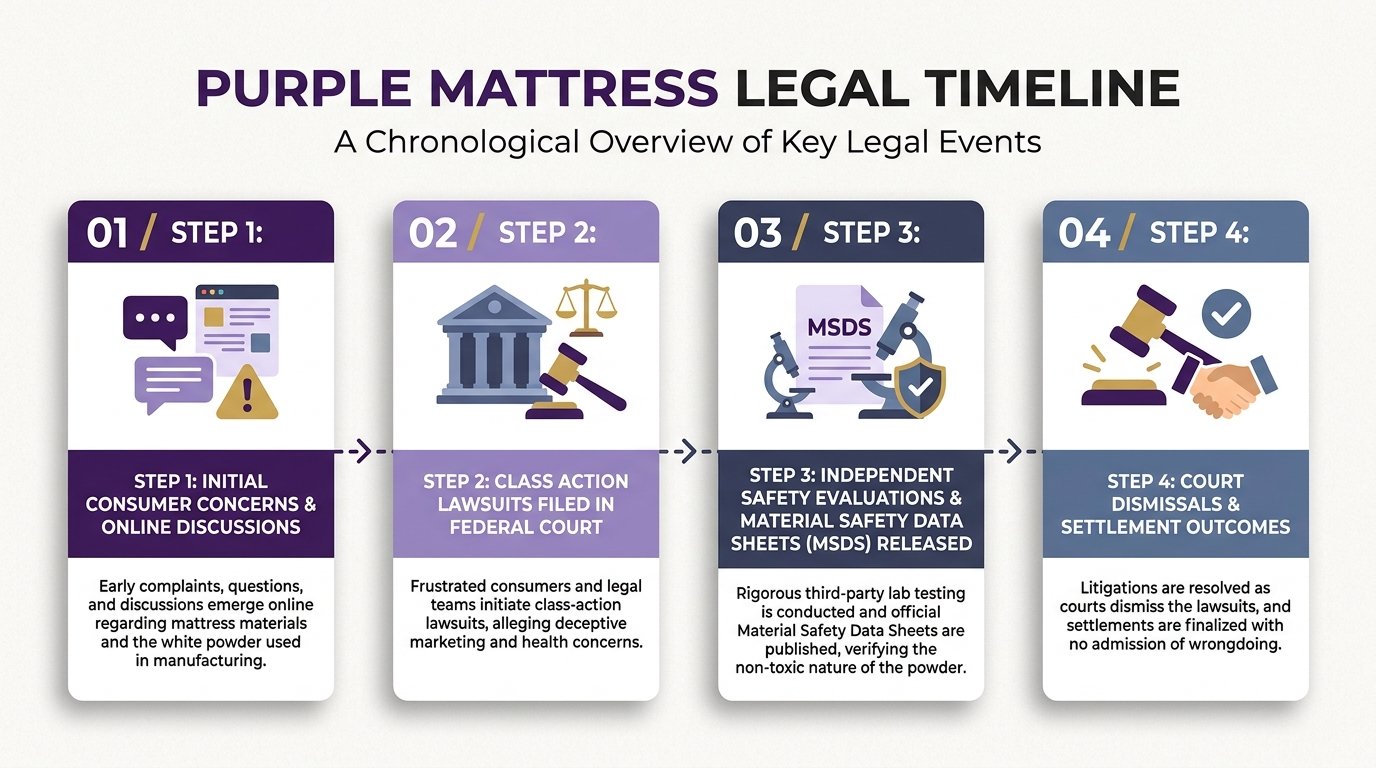
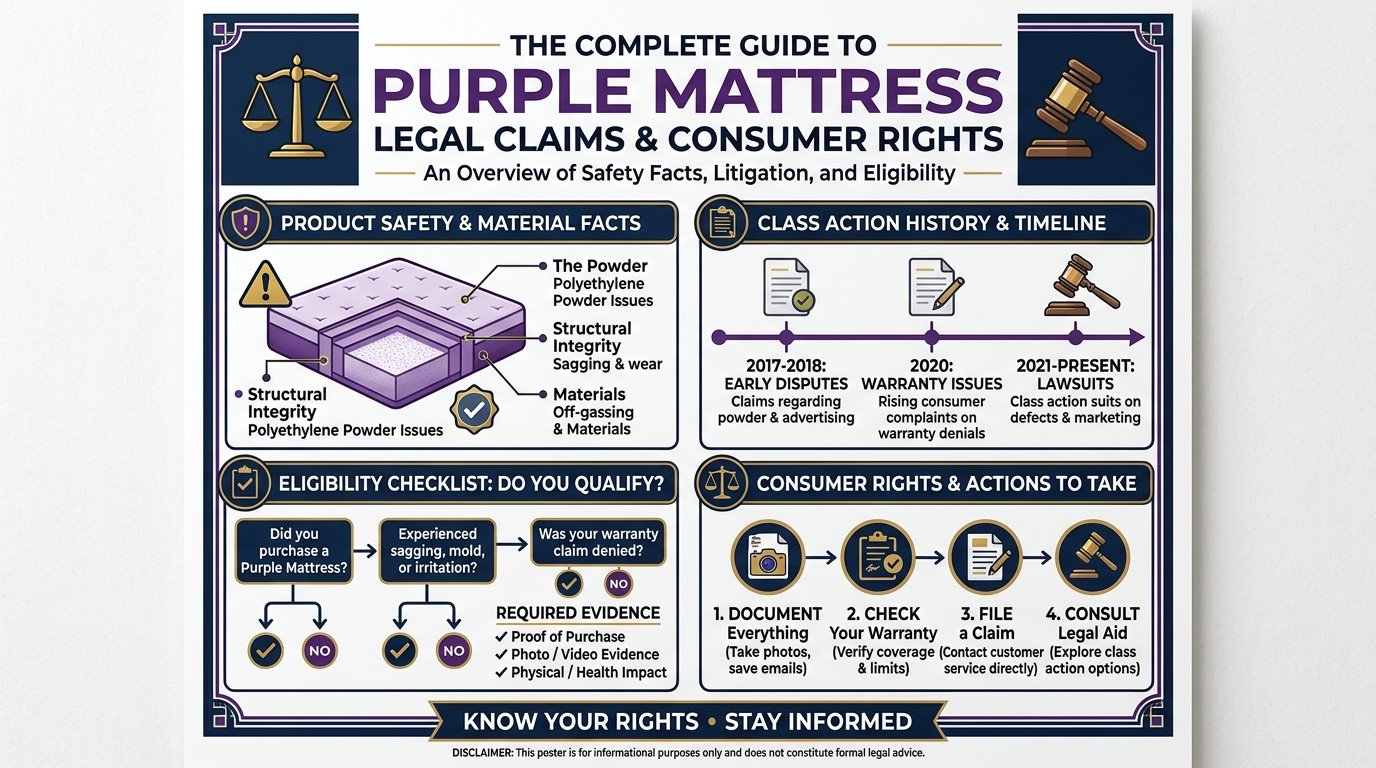
Purple mattress lawsuit searches lead to conflicting stories, and most of that conflict comes from merging separate matters into one story. The confirmed consumer case is about pricing, not fiberglass, and it has no settlement or claim form as of October 2026 research.
That distinction matters for every buyer who wants payment, protection, or peace of mind. Filing on a fake claim site will not help, and waiting for a fiberglass payout that does not exist will waste time.
The confirmed case is Julian et al. v. Purple Innovation, LLC, a California pricing class action. It alleges strikethrough reference prices made ordinary prices look like limited-time deals, and it remains pending with no settlement as of research.
Viral fiberglass claims against Purple are different, and no verified Purple fiberglass class action or settlement was found in the same research. Purple states its fire barrier uses silica-spun yarn woven into the cover, not loose fiberglass in a removable sock.
Two other matters add to the confusion, and both need separation. Powder Gate was a defamation dispute with a reviewer, while the patent cases put Purple as plaintiff against other mattress companies, not as defendant for consumers.
Quick Answer: What Is Real and What Is Not
Confirmed case: Julian pricing class action, California consumer protection claims, pending, no settlement, no claim form, no administrator, no fund as of October 2026 research.

Not verified: A Purple fiberglass class action, a Purple fiberglass settlement, a Purple fiberglass claim form, and a CPSC recall against Purple. None of those was found in the strongest sources checked for this research.
Separate matters: Powder Gate, a 2017 to 2019 review dispute, produced no consumer settlement fund. Patent cases against Intellibed and Tempur Sealy put Purple as plaintiff, so consumers are not parties seeking payment there.
Action now: Save order records, check the Julian docket for certification or settlement, use warranty or return paths for product problems, and ignore any site that charges a fee or promises a Purple payout today.
| Matter | Role of Purple | Consumer relevance | Status as of research |
|---|---|---|---|
| Julian pricing case | Defendant | Possible future payment only if a settlement is approved | Pending, no settlement, no claim form |
| Purple fiberglass case | No verified case found | Do not file a Purple fiberglass claim on a third-party site | No verified class action or settlement |
| Powder Gate | Plaintiff in defamation dispute | No consumer fund, background only | Outcome details conflict, docket check needed |
| Patent cases | Plaintiff | No consumer payment path | Separate technology litigation |
| Zinus fiberglass case | Not Purple | Comparator only, other brand | Settlement figure needs official verification |
| Ashley and Resident Home case | Not Purple | Comparator only, other brands | Voucher fund, claim deadline passed |
Why So Many Pages Disagree
Search results mix four stories because the same brand name appears in pricing litigation, viral health posts, a review dispute, and patent litigation. Readers who follow one headline can easily believe all four stories describe one consumer case.
Low-quality legal pages often copy each other without checking a docket, a complaint, or a settlement site. That copying turns a rumor about one brand into a supposed case against another brand, especially when fiberglass litigation against other companies is real.
Social media shortens the story further, because a video about fiberglass in one mattress can carry a Purple name in the caption, title, or comments. Viewers then search the brand name and land on pages that repeat the viral claim as if it were a court case.
LawFold contradicts itself in a way that shows the problem clearly, because its September 2026 update box says no Purple fiberglass class action appears in tracking databases, while its body still describes fiberglass tracks as active. Readers who skip the update box leave with the wrong conclusion.
DoItYourselves makes stronger claims without citations in the excerpts checked, including thousands of CPSC complaints and hundreds of Purple fiberglass complaints from 2019 to 2023. Those counts should not be copied without a documented CPSC database query, date range, and product filter.
The Confirmed Case: Julian v. Purple Innovation
Filing and Removal
Original filing happened in San Francisco County Superior Court in January 2024, under case number CGC-24-611689. The named plaintiffs were Mason Julian and Alexander Tat, filing for themselves and for other people in a similar position.
Removal to federal court followed on February 22, 2024, when the case moved to the United States District Court for the Northern District of California. The federal case number became 3:24-cv-01078-SK, and that number is the right one for docket checks now.
Court location matters because some pages still list only the original Superior Court filing, without the removal step. A reader who searches the old court alone may miss later federal activity, including scheduling orders and pretrial stipulations.
Early pretrial activity is the status reported in the strongest pages checked, with scheduling stipulations and extended response deadlines described as typical for an early to mid-stage federal class action. No trial date and no settlement were reported as of research.
No final ruling was reported in the September 2026 LawFold update, and Truth in Advertising listed the case as pending. That pending status is the safest description until a docket entry shows certification, dismissal, settlement, or trial.
What Purple Allegedly Did
Strikethrough reference prices sit at the center of the complaint, because plaintiffs allege Purple displayed a higher original price crossed out next to a lower sale price. Shoppers would reasonably read that display as a limited-time saving, even when the higher price was rarely or never actually charged.
Perpetual sale pattern is the broader allegation, because plaintiffs claim the same discount display appeared consistently rather than for a genuine short sale. A price that never changes is not a sale in the ordinary sense, even when a page still calls it one.
False urgency follows from that pattern, because a crossed-out price plus a sale label can push a shopper to buy sooner than planned. Plaintiffs claim that urgency mattered, because bargain seeking shapes mattress purchases for many buyers.
Price premium theory explains the claimed harm in economic terms, because plaintiffs say buyers paid more than they would have paid without the misleading display. Some buyers, the complaint says, would not have bought at all if they had known the true prevailing price.
Quality and value theory adds a second harm claim, because plaintiffs say the products did not carry the higher value implied by the reference price. That theory treats the reference price as a value signal, not just a number on a page.
Injunctive relief is also sought, which means plaintiffs ask the court to stop the alleged pricing practice and require corrective disclosures. Injunctive relief matters even when money damages are uncertain, because it can change future pricing displays.
Punitive damages appear among the relief sought in secondary summaries, along with restitution, interest, fees, and costs. Relief sought in a complaint is a request, not a court award, and it should never be quoted as a payout.
Complaint language is not proof, because every allegation above comes from plaintiffs and must survive certification, discovery, and court review. Purple has not been found liable on these pricing claims in the sources checked, and no settlement admits wrongdoing.
The California Laws Named
California Consumers Legal Remedies Act, often shortened to CLRA, covers unfair or deceptive acts in consumer sales. Plaintiffs use it to challenge advertising that allegedly misleads ordinary shoppers about price, value, or savings.
California False Advertising Law, often shortened to FAL, covers false or misleading statements in advertising. The complaint excerpts cite Business and Professions Code section 17500 for false advertising and section 17501 for former price rules.
Former price rule under section 17501 is specific and useful, because it says no price may be advertised as a former price unless it was the prevailing market price within the three months before the advertisement. An exception applies only when the date that former price prevailed is clearly, exactly, and conspicuously stated.
California Unfair Competition Law, often shortened to UCL, covers unlawful, unfair, or fraudulent business acts. Plaintiffs use it alongside CLRA and FAL to seek restitution and injunctive relief for the same pricing conduct.
Fraud and unjust enrichment are also named in secondary summaries, with fraud focusing on intentional deception and unjust enrichment focusing on money allegedly kept through unfair conduct. Those claims add legal theories, not separate consumer cases.
Federal pricing guidance sits behind the state claims, because the Federal Trade Commission publishes guides against deceptive pricing. The FTC mostly leaves enforcement to states in this area, which helps explain why the Purple case is a California case rather than a federal agency action.
The Pricing Example in the Complaint Summary
Julian queen example comes from a Lawsips complaint summary, not from a court finding, and it should be labeled that way every time it is repeated. Julian allegedly bought a queen-size Purple Mattress for $1,299, shown against a crossed-out price of $1,399.
Alleged saving in that example is $100, because $1,399 minus $1,299 equals $100 on the face of the display. That arithmetic is simple, but the legal question is harder, because the court must decide whether $1,399 was a genuine prevailing price.
Tat purchase followed a similar pattern months later, according to the same summary, which supports the allegation of a pattern rather than one isolated error. Pattern allegations still need proof through price history, sales records, and expert analysis at later stages.
Screenshot evidence matters in pricing cases generally, because buyers who save order pages, sale banners, and confirmation emails preserve the exact display they saw. Price history can change after purchase, so contemporaneous records carry more weight than memory alone.
Who the Proposed Class Covers
Proposed class framing in the strongest pages centers on California consumers who bought Purple products online and saw a discounted price against a higher reference price. That framing is proposed, not certified, so it can narrow or expand before any payment stage.

Online purchase focus matters, because the pricing claims center on Purple e-commerce listings rather than physical retail displays. Lawsips lists physical retail purchases, such as Costco or Mattress Firm, as likely not covered under that framing.
California residence matters, because the claims rest on California consumer protection statutes rather than a national pricing law. Buyers outside California would need a similar suit under another state law, and none is confirmed in the research checked.
Product scope in Lawsips framing includes mattresses, pillows, and bedding products bought online, not only one mattress model. That broader scope still depends on the final class definition, so it should not be treated as a final eligibility rule.
Certification has not been confirmed in the sources checked, and certification is the step where a court decides whether the case can proceed as a class action. Without certification, there is no class payment process, even when a complaint has been filed.
Class definition changes are common in litigation, because courts sometimes narrow a class by product, period, channel, or state. Buyers should watch the docket rather than relying on an early complaint summary for final eligibility.
Fiberglass: The Confusion, Explained
Silica Yarn Versus Loose Fiberglass
Purple company position is that its fire barrier uses silica-spun yarn, also described as silica fiber, woven into the mattress cover fabric. That position treats the barrier as part of the fabric structure, not as a separate loose material inside a sock.
Loose fiberglass inner sock is the construction at issue in real fiberglass cases against other brands, because thin glass fibers sit inside an inner sock that can tear or release particles when a cover is removed. That release pathway is the core harm alleged in those cases.
Bound versus loose is the practical distinction, because bound yarn in fabric and loose fiber in a sock behave differently when a cover is handled, washed, or torn. Material science can group both under a broad glass fiber umbrella, but containment still changes release risk.
Brand statement limits matter, because a brand statement that a product is fiberglass-free is a company claim, not an independent laboratory report. SleepJunkie lists Purple as fiberglass-free per a brand statement, and that source label should stay attached to the claim.
Independent auditor claims also need care, because Lawsips says independent mattress auditors list current Purple lines as fiberglass-free. That statement needs a named auditor, test method, and model list before it can be treated as verified proof for one specific unit.
| Feature | Silica-spun yarn in cover | Loose fiberglass in inner sock |
|---|---|---|
| Form | Yarn woven or knitted into fabric | Loose glass fibers inside a thin sock |
| Containment | Part of the fabric structure | Separate inner layer, easier to tear |
| Release pathway | Lower in normal handling, per company position | Higher when cover is removed or sock tears |
| Check method | Law label plus brand confirmation for the unit | Law label plus settlement product list where applicable |
| Legal status for Purple | Company position, no verified Purple fiberglass case | Real issue for other brands, not proof against Purple |
How to Check Your Own Mattress
Law label is the sewn-in tag that lists materials used in a specific mattress, and it is more reliable for one unit than a general brand page. Photograph the full label, including model, size, manufacture date, and material percentages where shown.
Model and date matter because the same model name can cover different generations, retailer versions, and material changes over time. A current brand statement does not prove the composition of an older unit, and an older complaint does not prove the composition of a current unit.
Cover warning matters for every mattress, because many covers carry a do not remove warning tied to the fire barrier. Removing a cover against that warning can release fibers in brands that use loose fiberglass, and it can also void warranty coverage.
Brand confirmation for one unit should use identifying details, not just a model name, because customer support can check a specific product version when the label details are provided. Keep the support reply with the label photo for future reference.
Used, returned, or retailer-specific units need extra care, because a label that does not match the current product page may reflect a different generation or a different seller version. Match SKU, item name, manufacture date, and label details together before drawing a conclusion.
Independent testing for one unit is rarely practical for ordinary buyers, because laboratory fiber analysis costs time and money and requires proper sampling. For most buyers, law label plus brand confirmation plus warranty records is the realistic check.
CPSC Complaints, Recalls, and Court Findings
CPSC complaints are reports, not findings, settlements, or recalls, and complaint counts without a query method cannot be copied as evidence. A database search needs a date range, product filter, brand filter, and incident description before any count means anything.
No CPSC recall against Purple was reported in the LawFold September 2026 update, which is the strongest recall statement found in this research. That statement should be re-verified on CPSC records at publishing time, because recall status can change.
Thousands of complaints claim appears in LawFold body text and DoItYourselves, but neither excerpt gives a CPSC query, date range, or product filter. Treat that claim as low trust and uncited, and do not repeat it as a verified Purple figure.
Hundreds of complaints claim for 2019 to 2023 appears in DoItYourselves with the same citation problem, and it conflicts with the LawFold update box that finds no verified Purple fiberglass case. When sources conflict, the docket and CPSC record outrank an opinion page.
Court finding versus allegation is the final distinction, because a filed complaint, a viral post, and a CPSC report are not the same as a court decision. Only a docket entry, judgment, or approved settlement shows what a court actually decided.
Fiberglass Symptoms in General
Skin irritation is the most commonly reported general fiberglass effect, including itching, redness, or a rash that does not respond to typical allergy treatment. Those symptoms are general material information, not Purple-specific findings, and they overlap with many other causes.
Eye irritation can include a gritty or burning sensation after exposure to airborne glass particles, and it usually improves once exposure stops and the area is cleaned carefully. Persistent eye pain, vision change, or severe redness needs prompt medical assessment.
Throat and breathing irritation can include a scratchy throat or cough without another obvious illness, with higher concern for people with asthma or existing lung sensitivity. Short-term irritation is common in general exposure reports, but it does not diagnose a specific product cause.
Cleanup difficulty is a practical problem in confirmed fiberglass cases, because fine particles can spread to fabric, carpet, bedding, clothing, and heating and cooling systems. Affected households in other brands cases have reported extensive cleanup costs, which is why cover removal warnings matter so much.
Medical assessment is the right step for persistent, severe, or unexplained symptoms, because only a clinician can assess history, exposure, and other causes. Social media symptom lists cannot diagnose a mattress, an allergy, an infection, or a respiratory condition.
Cancer Claims and Household Exposure
Viral cancer claims go further than the evidence supports, because some posts claim fiberglass exposure from mattresses causes cancer. No peer-reviewed research currently links short-term household mattress exposure to cancer diagnoses in the sources checked.
Occupational classification is often misused in viral posts, because glass fiber has been classified as a possible carcinogen mainly in prolonged, high-level occupational exposure, such as manufacturing environments over years. That classification does not transfer directly to a torn household mattress cover.
Exposure pathway matters for risk reasoning, because long-term inhalation in a workplace differs from brief household exposure after a cover tear. Dose, duration, particle type, and containment all matter, and none of those factors is proven by a viral post alone.
Purple pathway difference follows from the company position, because bound silica yarn in fabric does not present the same loose fiber release pathway as a torn inner sock in other brands. That difference does not prove zero risk for every unit, but it does break the viral logic that all glass fiber cases are identical.
Health questions should go to a physician or occupational health specialist, not to a comment thread, a tracker page, or a lawsuit advertisement. Bring the law label photo, purchase records, and a symptom timeline to that conversation for a useful assessment.
Cleanup for Real Fiberglass Cases in Other Brands
Do not remove the cover in a suspected loose fiberglass case, because further handling can spread particles to more surfaces. Keep the mattress covered, limit access to the room where possible, and avoid shaking bedding or clothing.
Laundering caution matters, because washing contaminated fabric in a shared machine can spread fibers to other loads. Follow the settlement or administrator guidance for the specific case where one exists, and use professional cleaning advice for severe contamination.
Vacuuming guidance in general fiberglass advice often mentions a HEPA-filter vacuum for hard surfaces, with careful emptying and filter handling. That guidance is general material advice, not a guarantee that one pass removes all particles from soft furnishings.
Professional assessment may be needed for severe contamination, especially when particles reach heating and cooling systems, carpet, or large areas. Keep receipts, photos, and cleaning records, because those records support documented loss claims in real settlements where applicable.
Settlement product lists control eligibility in real fiberglass cases, because a brand name alone does not prove a specific unit contained fiberglass. Match SKU, item name, purchase date, and seller against the official settlement list before assuming eligibility.
Powder Gate: The Review Dispute
What the Reviewer Claimed
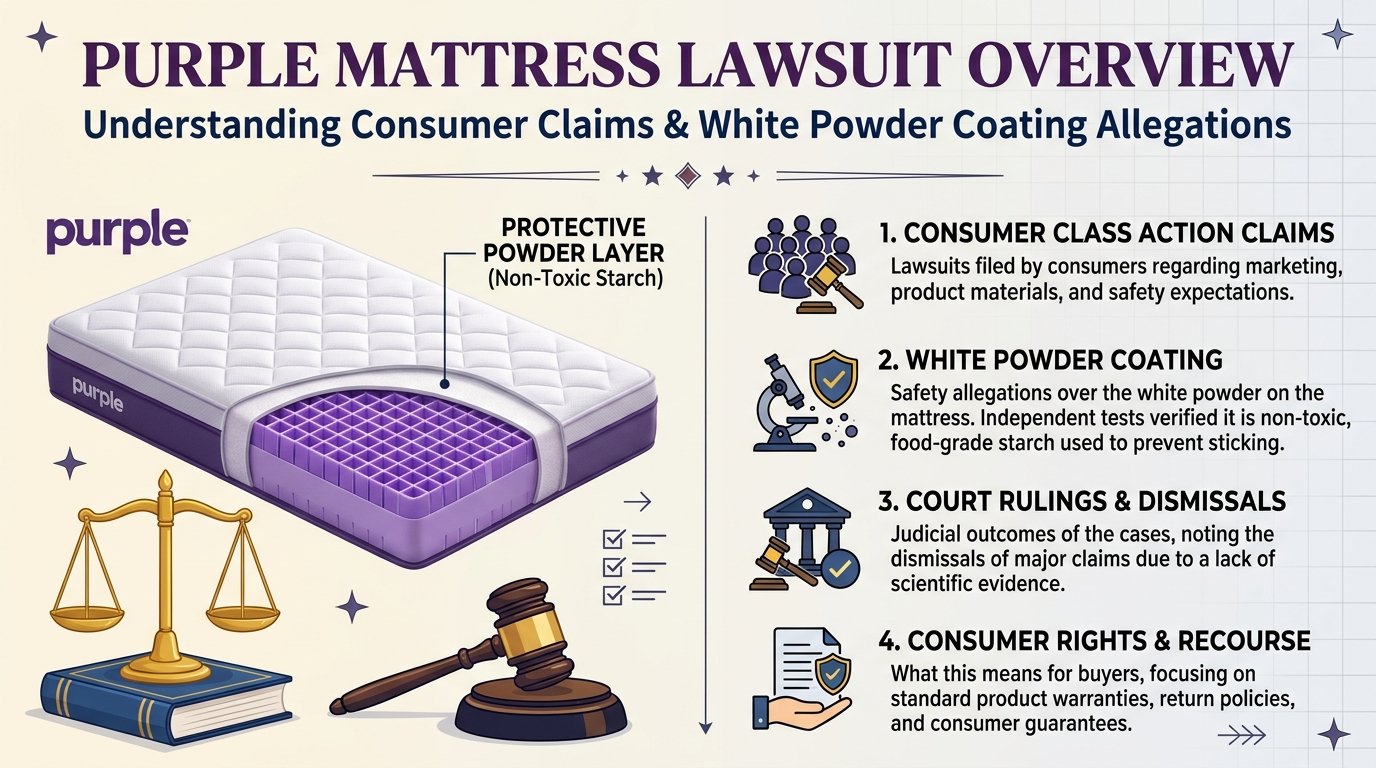
White powder controversy began with a mattress review video and related posts alleging that the white powder coating the Purple Grid layer could be harmful. That powder became the center of the dispute, because viewers could not tell from a video alone what the powder was or how much exposure occurred.
Hyper-Elastic Polymer grid is the Purple Grid layer at issue, because the powder sat on that grid material during packaging and handling. Review posts focused on the powder appearance and on safety implications, rather than on comfort or support performance.

Styrene-butadiene identification appears in LawFold body text, which names Amway Defender Powder as the substance in question. That identification needs a primary source before it can be treated as verified, because other pages describe the powder only as a polyethylene compound.
Harm implication was the disputed point, because Purple said the powder was safe while the reviewer implied a safety risk. Implication matters in defamation cases, because courts look at what ordinary readers would understand, not only at what a post says in literal words.
What Purple Said
Polyethylene anti-tack powder is Purple position in Lawsips and MattressNut summaries, described as a manufacturing byproduct used to stop the grid from sticking to itself. Polyethylene appears in food packaging and consumer plastics, which Purple used to support its safety position.
Safety testing claim appears in Lawsips, which says Purple released toxicology testing to back up its safety claims publicly. That testing claim needs a named test, date, and result before it can be repeated as verified proof, rather than as a company claim.
Defamation lawsuit followed, because Purple sued Honest Mattress Reviews and its owner Ryan Monahan over allegedly false statements about product safety. That suit made Purple the plaintiff, which is the opposite role from the consumer pricing case where Purple is defendant.
GhostBed conflict allegation added a second layer, because Purple alleged Monahan had a brand management role with competitor GhostBed. Techdirt notes that Purple filing admitted Monahan was no longer associated with GhostBed, which complicates any simple conflict story.
Prior Restraint and Court Record
Temporary prior restraint order is documented by Techdirt, because a Utah federal judge initially ordered the review site to publish nothing further about Purple or the lawsuit. Prior restraint orders are rare and controversial, because they restrict speech before a full trial on the merits.
Review site response is also documented, because Honest Mattress Reviews posted about the order and offered to comply with its letter while challenging its spirit. That response shows why prior restraint cases draw attention far beyond the product at issue.
Order challenged is the next key fact, because Techdirt reports the judge later faced challenge to the prior restraint approach and the review was reinstated. A temporary order that is later challenged cannot be quoted as a final finding on defamation or safety.
Lanham Act claims appeared alongside defamation claims, because Purple alleged false advertising and tortious interference in addition to disparagement. Lanham Act cases focus on commercial statements and competition, which is why a review site with a competitor link drew that theory.
Outcome Conflict and Consumer Relevance
Lawsips outcome claim says Purple ultimately prevailed, with a judge finding false statements about product safety and awarding attorney fees and costs. That claim is a secondary summary, and it needs a docket citation before it can be treated as a verified court finding.
LawFold outcome table says the case settled with terms undisclosed, which conflicts with the Lawsips prevailed-with-fees version. Both versions cannot be repeated as fact without checking the Utah docket for a judgment, settlement notice, or fee order.
No consumer fund is the one point both versions support in practice, because neither version describes a payment process for mattress buyers. Powder Gate was a dispute between a company and a reviewer, not a class action for consumers.
Trust lesson from Powder Gate is durable, because it shows how a safety implication, a lawsuit, and a prior restraint order can create distrust that outlives the underlying dispute. That distrust then feeds later rumors, including the fiberglass confusion.
Patent Cases: Purple as Plaintiff
Intellibed Case
Patent infringement framework governs the Intellibed matter, because Purple alleged that another company used its patented GelFlex Grid technology without permission. Patent cases protect technology, not consumer purchase prices, and they follow different rules from consumer class actions.
Consumer relevance is low for the Intellibed case, because buyers are not parties and no consumer payment process exists in a patent infringement suit between companies. A patent win or loss changes business competition, not a buyer claim form.
JudicialOcean distinction is useful here, because it states that verified reporting does not link the consumer pricing case and the patent case procedurally. Courts treat advertising claims and patent claims under separate frameworks, even when the same company name appears in both.
Tempur Sealy FlexGrid Case
Sealy FlexGrid Hybrid launch is the product at issue in the Tempur Sealy patent matter, with a complaint alleging an October 2022 launch that copied Purple GelFlex Grid technology. That allegation comes from Purple as plaintiff, and it must be labeled as an allegation, not a finding.
HexGel and Response Pro Encased Coils appear in a 2025 Southern District of Florida complaint excerpt, describing a blue grid layer over encased coils in Sealy FlexGrid Hybrid products. That complaint lists Purple products using GelFlex technology, including Purple Mattress, Purple Hybrid, Purple Restore, and Purple Rejuvenate lines.
Favorable settlement claim appears in a Lawdragon lawyer profile for Tempur Sealy counsel, which says a favorable settlement was secured for Tempur Sealy and certain subsidiaries in North Carolina federal court. That profile is a lawyer marketing summary, not a court judgment, and it needs a docket check before any outcome is stated.
No consumer payment path applies again, because a patent settlement between companies does not create a claim form for mattress buyers. Readers who merge patent news with pricing news will look for money in the wrong case.
Real Comparators: Other Brands, Not Purple
Zinus Fiberglass Case
Zinus fiberglass settlement figure of $11.2 million appears in LawFold pages, but it was not verified here on the official Zinus settlement site. Treat that figure as a page claim, not as a verified fund, and re-verify it live before publishing it as fact.
Zinus construction change is reported by EachNight, which says Zinus previously used fiberglass but newly manufactured Zinus mattresses use a carbon-rayon sleeve instead. That change matters for buyers, because older and newer units can differ even under the same brand name.
CertiPUR-US certification appears in Zinus context, because Zinus foams carry that certification for foam content, including limits on formaldehyde and other substances. Certification covers foam, not fire barrier material alone, so it cannot settle a fiberglass question by itself.
Comparator lesson from Zinus is narrow, because a real fiberglass settlement for one brand proves that loose fiberglass cases exist in the industry. It does not prove that Purple used the same construction, faced the same claims, or owes the same payments.
Ashley and Resident Home Fiberglass Settlement
Todd v. Ashley Furniture Industries, LLC, case number 3:24-cv-00615-wmc, is a real fiberglass settlement for other brands, with a $9 million voucher fund reported by ClaimDepot and OpenClassActions. Defendants named are Ashley Furniture Industries, Ashley Global Retail, and Resident Home, and all deny wrongdoing.
Class period for Todd runs from October 1, 2017 to June 30, 2024, for United States individual end consumers who bought an affected mattress containing fiberglass as a fire-retardant material in the inner sock. Brand names listed include Ashley, Nectar, DreamCloud, and Siena.
Fund breakdown in ClaimDepot shows administration costs up to $380,000, attorney fees and costs up to $3,000,000, and service awards up to $85,000 total, with the remainder for eligible class member vouchers. Voucher benefits expire one year after distribution on related pages, so timing matters for recipients.
Claim deadline for Todd was July 17, 2026, with opt-out and objection deadlines moved to September 16, 2026 and a hearing on September 24, 2026, per OpenClassActions. No final approval order had been posted as of October 20, 2026 in that snapshot, so final status needs a fresh docket check.
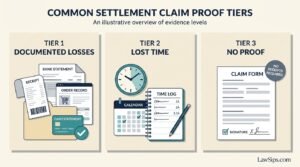
Proof pattern for Todd is useful for comparison, because basic claims needed name, mailing address, and email for administrator verification against purchase records. Receipts, store records, label photos, and purchase details helped where proof was available, but basic filing did not require a receipt.
Molloy Pricing Settlement
Molloy v. Resident Home is a separate false reference pricing settlement for Nectar, DreamCloud, Siena, CloverLane, and Awara websites, with a $30 voucher benefit reported by OpenClassActions. That case covers March 2021 to April 2026 pricing displays, not fiberglass construction.
Opt-out deadline for Molloy was August 18, 2026 on the same OpenClassActions page, which shows how pricing and fiberglass deadlines can differ even for the same parent company. A buyer who qualified for both Todd and Molloy would need separate filings, because one claim does not cover the other case.
Pricing theory parallel is the useful lesson, because Molloy uses the same false reference pricing idea as Julian, but with different defendants, websites, periods, and benefits. A $30 voucher for Molloy says nothing about what Julian might pay, because Julian has no settlement at all.
Separate filing rule matters for future Purple buyers too, because a future Purple pricing settlement would need its own claim form, deadlines, and administrator. Past filings for other brands never transfer automatically to a new case.
Casper and Avocado Pricing and Marketing Cases
Casper false advertising settlement of $2.3 million appears in LawFold comparison tables, but it was not verified here on an official Casper settlement site. Treat it as a comparator page claim, and re-verify any Casper figure before using it as a pricing benchmark.
Avocado organic claims case is listed as pending in LawFold, with no final settlement publicly announced as of mid-2026 in that page. Avocado says it has never used fiberglass and uses certified organic wool as a fire barrier in most mattresses, per SleepJunkie summaries.
Saatva greenwashing case is also listed as pending in LawFold tables, with no verified outcome in the research checked. Pending marketing cases should not be quoted as settlements, because a pending case may end in dismissal, trial, or settlement with very different terms.
Comparator table discipline is the point of this section, because every comparator above proves that mattress litigation is common, while none of them proves a Purple fiberglass case. Keep defendant, allegation, benefit, and status in separate columns for every future update.
| Case | Defendant | Allegation | Benefit or status |
|---|---|---|---|
| Julian | Purple Innovation | False reference pricing, California | Pending, no settlement |
| Zinus | Zinus, other brand | Fiberglass fire barrier | $11.2 million page claim, verify |
| Todd | Ashley, Resident Home | Fiberglass inner sock | $9 million voucher fund, deadline passed |
| Molloy | Resident Home | False reference pricing | $30 voucher, separate case |
| Casper | Casper, other brand | False advertising | $2.3 million page claim, verify |
| Avocado | Avocado, other brand | Organic claims | Pending, no final settlement reported |
What Buyers Can Do Now
Save Pricing Records
Order confirmation is the first record to save, because it shows product, price paid, order date, seller, and shipping address for a specific purchase. Keep the original email and a PDF copy, because email accounts and retailer portals can change over time.
Product page screenshots are the second record, because they show the reference price, sale price, discount banner, and product description as displayed at purchase time. Save the full page, URL, and date, because live pages can change after a sale ends.
Payment records are the third record, because bank or card statements confirm the amount actually charged and the seller name. Redact unrelated transactions before sharing records with anyone, and never share full card numbers or bank logins.
Multiple purchases should be saved separately, because each order can carry a different price display, date, and product version. A future settlement, if one ever exists, will likely ask for purchase details per product rather than one total amount.
Account purchase history can fill gaps where email confirmations are missing, because retailer accounts often list orders, prices, and dates. Export or screenshot that history now, because account access can be lost after an email change or account closure.
No filing yet means records should be stored, not submitted to a third-party claim site, because no official Purple administrator exists for Julian as of research. Submitting personal details to an unofficial site risks identity theft without creating a valid claim.
Watch the Docket
Case number for docket checks is 3:24-cv-01078-SK in the Northern District of California, with the original Superior Court number CGC-24-611689 for filing history. Use the federal number for current activity, because removal moved the case to federal court.
Certification watch is the first docket signal that matters, because certification decides whether the case proceeds as a class action. A certification order, denial, or appeal will change what buyers should expect next.
Settlement watch is the second signal, because a preliminary approval order would open notice, claim, opt-out, and objection periods. No preliminary approval order for Julian was found in the research checked, so no claim period exists yet.
Dismissal or trial watch is the third signal, because a dismissal, summary judgment, or trial verdict would end or reshape the case. Secondary summaries age quickly, so a docket entry outranks a blog update every time.
CourtListener or PACER are the usual public docket routes, with PACER charging per page and CourtListener offering free access where a case is mirrored. Use the case number exactly, because name searches can return unrelated Purple matters, including patent cases.
Update cadence should be monthly for most buyers, because pricing cases move slowly through discovery and motion practice. Weekly checks make sense only after a certification, settlement, or hearing announcement appears.
Warranty and Return Paths
Warranty claim is the practical path for a sagging grid, torn cover, broken seam, or significant deterioration, because warranty terms cover defects within stated periods and conditions. Read the warranty for the specific model and purchase date, because coverage differs by product and generation.
Return path is the practical path for a recent purchase that does not suit sleep needs, because many mattress brands offer trial periods with return terms. Trial length, return shipping, refund method, and condition rules vary, so check the current policy for the exact order.
Retailer versus direct purchase matters, because warranty and return handling can differ for direct orders, Mattress Firm orders, Costco orders, and other retail channels. Keep the seller name and order channel with the warranty claim, because the wrong channel can delay processing.
Damage documentation helps warranty claims, because photos of the defect, measurements where relevant, and a short timeline of when the problem appeared support review. Keep original photos, not only edited or cropped versions, for a complete record.
Legal claim versus warranty claim is a key distinction, because a warranty repair or replacement does not create a pricing class payment, and a pricing class case does not repair a mattress. Use both paths where each applies, rather than waiting for one path to solve the other problem.
Consumer complaint to a retailer, manufacturer, or regulator can help where warranty handling stalls, because a written complaint creates a record with dates and responses. Keep every reply, reference number, and promised action in one folder until the issue resolves.
Health Triage Without Alarm
Stop further exposure where a real fiber release is suspected, because continued handling spreads particles and increases irritation. Cover the mattress, limit room access, and avoid shaking bedding until the situation is assessed.
Clean carefully using general fiberglass guidance, including gloves, eye protection, and careful handling of contaminated fabric, with HEPA vacuuming for hard surfaces where advised. Avoid dry sweeping that can push particles back into the air.
Clinician visit is the right step for persistent skin, eye, or breathing symptoms, especially for people with asthma or existing lung sensitivity. Bring a symptom timeline, law label photo, and purchase records to that visit for a useful assessment.
Do not self-diagnose a product cause from symptoms alone, because allergies, infections, dust, fabric sensitivity, and other household exposures can produce similar irritation. A clinician can assess competing causes and recommend testing or treatment where appropriate.
Scam Check for Fake Purple Claim Sites
Free filing rule is the first scam test, because legitimate class member filing is usually free and administrator costs come from a settlement fund where approved. Any fee, gift card, subscription, or processing charge to file a Purple claim is a strong scam signal.
Guaranteed payout rule is the second test, because no legitimate site can promise a Purple amount today when no settlement exists. A specific dollar figure, instant payment promise, or countdown timer should trigger a docket check before any personal detail is entered.
Document rule is the third test, because a real settlement site posts a long-form notice, settlement agreement, claim form, and court order where available. A site with only a web form, vague promises, and no case number deserves no personal information.
Identifier rule is the fourth test, because legitimate claim forms ask for name, address, email, and purchase details, not for full Social Security numbers, bank logins, card numbers, passwords, or one-time passcodes. Any request for those credentials is a scam signal.
Domain rule is the fifth test, because a real administrator domain ties to the case and administrator name, while a lookalike domain uses extra hyphens, misspellings, or free hosting. Compare the domain against the docket and administrator name before clicking a link from a message.
| Check | Real official site | Likely fake Purple site |
|---|---|---|
| Cost | Free for class members | Fee, gift card, or subscription |
| Payout | Range or ceiling only, with pro rata warning | Guaranteed amount or instant payment |
| Documents | Notice, agreement, court order | No documents, vague promises |
| Identifiers | Name, address, email, purchase details | Bank login, card number, password, passcode |
| Case proof | Case name, court, case number | No court, no case number, no administrator |
Individual Legal Advice Path
Individual claim is different from a class claim, because an individual lawyer assesses one buyer facts, damages, and deadlines rather than a shared class definition. That path suits serious injury, large documented loss, or unique facts that a class case does not cover.
Consultation with a consumer protection or product liability lawyer can clarify whether an individual claim, a warranty claim, or a regulator complaint fits the facts. Many firms offer free initial consultations, but consultation alone does not create representation or a filing.
Limitation periods matter for individual claims, because California consumer and injury deadlines vary by claim type and discovery date. Legal advice should come early for serious cases, because waiting for a class settlement can risk an individual deadline.
Fee structure for individual cases varies, with contingency, hourly, or mixed arrangements depending on case type and lawyer. Ask about fees, costs, and court approval requirements before signing any representation agreement.
Mistakes to Avoid
Filing on a fake site is the most costly mistake, because personal details given to a scam site cannot be recalled. Verify the docket, case number, and administrator name before entering any purchase or contact detail.
Assuming a fiberglass payout is the second mistake, because no verified Purple fiberglass settlement exists in the research checked. Time spent chasing that payout could be spent saving pricing records or using a warranty path.
Merging other brands settlements is the third mistake, because Zinus, Ashley, and Molloy payments belong to other defendants and other cases. A Purple buyer who files an Ashley claim for a Purple mattress will face denial for a non-qualifying product.
Removing a mattress cover to check for fiberglass is the fourth mistake, because removal can release fibers in brands that use loose fiberglass and can void warranty coverage. Use the law label and brand confirmation for the unit instead.
Quoting complaint figures as payouts is the fifth mistake, because a $100 alleged saving in a complaint example is not a payment, and a $9 million fund for other brands is not a Purple fund. Label every figure by source, case, and status.
Waiting for social media updates is the sixth mistake, because viral posts age fast and often repeat outdated or wrong claims. Docket checks, official notices, and reputable case trackers outrank comment threads for status.
Ignoring warranty deadlines is the seventh mistake, because a pricing case that takes years will not repair a mattress that needs help now. Use warranty and return paths on their own timelines, separate from litigation timelines.
Sharing full payment details with a claim helper is the eighth mistake, because no legitimate class claim needs a bank login, full card number, or one-time passcode. Helpers who ask for those credentials should be treated as scams, not as filing services.
Buyer Checklist
- Save order confirmation for every Purple online purchase, with price, date, product, and seller.
- Save product page screenshots showing reference price, sale price, and discount banner at purchase time.
- Save payment records confirming the amount charged, with unrelated transactions redacted before sharing.
- Photograph the law label for the mattress unit, including model, size, date, and materials.
- Record the docket number 3:24-cv-01078-SK for Julian, Northern District of California.
- Check the docket monthly for certification, settlement, dismissal, or trial activity.
- Use warranty or return paths on their own deadlines for product defects or trial returns.
- See a clinician for persistent or severe skin, eye, or breathing symptoms.
- Verify any claim site through case name, court, case number, and administrator name before entering details.
- Never pay a filing fee and never share bank logins, card numbers, passwords, or passcodes for a class claim.
FAQs
Is there a Purple mattress lawsuit?
Yes, a confirmed pricing class action exists, Julian et al. v. Purple Innovation, LLC, in the Northern District of California. It alleges false reference pricing, not fiberglass exposure, and it remains pending with no settlement as of research.
What is the Purple mattress lawsuit about?
The confirmed case alleges strikethrough reference prices made ordinary prices look like limited-time deals for California online buyers. Plaintiffs claim the higher original prices were rarely or never actually charged, which would make the advertised savings misleading.
Is there a Purple mattress settlement?
No Purple pricing settlement was found as of October 2026 research, and no settlement fund, administrator, or claim form exists for Julian in the sources checked. Any site promising a Purple settlement payout today should be verified against the docket before trust.
Can I file a Purple mattress lawsuit claim now?
No official Purple claim form exists for Julian as of research, because no settlement has been approved. Save order records and watch the docket, and do not submit personal details to a third-party site that claims to accept Purple claims today.
How much will the Purple mattress lawsuit pay?
No Purple payout amount can be stated today, because no settlement, allocation plan, or payment tier exists for Julian. Pricing settlements for other retailers vary widely, and a future Purple amount would depend on fund size, class size, and court approval.
Who qualifies for the Purple mattress lawsuit?
Proposed class framing centers on California online buyers who saw a discounted price against a higher reference price, but certification has not been confirmed. Final eligibility will depend on the court-approved class definition, not on an early complaint summary.
Does the Purple lawsuit cover buyers outside California?
No confirmed coverage for buyers outside California was found, because the claims rest on California consumer protection statutes. Buyers in other states would need a similar suit under their own state law, and none is confirmed in the research checked.
Does the Purple lawsuit cover retail store purchases?
Retail store purchases are likely not covered under the Lawsips framing, because the pricing claims center on Purple e-commerce listings. Physical retail displays at Costco, Mattress Firm, or other stores fall outside that online listing theory.
What is the case number for the Purple mattress lawsuit?
Federal case number is 3:24-cv-01078-SK, Northern District of California, after removal from San Francisco County Superior Court case CGC-24-611689. Use the federal number for current docket checks, and the original number for filing history.
Has the Purple pricing case been certified?
No certification was confirmed in the sources checked, and the case was described as pending with early to mid-stage pretrial activity. Certification is a court decision, so it should be verified on the docket rather than assumed from a complaint filing.
Do Purple mattresses contain fiberglass?
Purple states its fire barrier uses silica-spun yarn woven into the cover, not loose fiberglass in a removable sock, and SleepJunkie lists Purple as fiberglass-free per a brand statement. Check the law label for one specific unit, because brand statements do not prove every older unit.
What is the difference between silica fiber and fiberglass?
Silica fiber in this context means yarn woven into fabric, while loose fiberglass in other brands means thin glass fibers inside an inner sock. Both sit under a broad glass fiber umbrella in materials science, but containment changes how easily fibers can release.
How do I check my Purple mattress law label?
Photograph the sewn-in law label showing model, size, manufacture date, and materials, then compare it with brand confirmation for that unit. Match SKU, item name, and date together, because the same model name can cover different generations.
Was there a CPSC recall for Purple mattresses?
No CPSC recall against Purple was reported in the LawFold September 2026 update, which is the strongest recall statement found. Re-verify CPSC records at publishing time, because recall status can change and complaint reports are not recalls.
What is Powder Gate?
Powder Gate was a 2017 to 2019 dispute over white powder on the Purple Grid layer, with a reviewer implying harm and Purple saying the powder was a safe polyethylene anti-tack compound. It was a defamation dispute, not a consumer class action, and it produced no consumer fund.
Did Purple win the Powder Gate lawsuit?
Outcome details conflict and need a docket check, because Lawsips says Purple prevailed with fees while LawFold says the case settled with terms undisclosed. Neither version should be quoted as a verified court finding without a Utah docket entry.
What are fiberglass exposure symptoms in general?
General fiberglass symptoms include skin itching or rash, eye grittiness or burning, and throat or breathing irritation, especially for people with asthma. Those symptoms are general material information, not Purple-specific findings, and persistent symptoms need medical assessment.
Does fiberglass from a mattress cause cancer?
No peer-reviewed research currently links short-term household mattress exposure to cancer in the sources checked, and occupational glass fiber classification does not transfer directly to a torn household cover. Personal health concerns should go to a clinician, not to social media diagnosis.
What is the Purple Tempur Sealy patent case about?
Purple, as plaintiff, alleged Tempur Sealy FlexGrid Hybrid mattresses infringed GelFlex Grid patent technology, with a 2022 launch allegation in complaint summaries. Patent cases between companies do not create a payment path for mattress buyers.
What is the Zinus fiberglass settlement?
Zinus is a separate brand with a reported fiberglass settlement figure of $11.2 million in LawFold pages, but that figure was not verified here on an official Zinus site. Do not attribute Zinus payments, products, or construction to Purple.
What is the Ashley Resident Home mattress settlement?
Todd v. Ashley Furniture is a $9 million voucher settlement for other brands, including Ashley, Nectar, DreamCloud, and Siena, for United States purchases from October 1, 2017 to June 30, 2024 containing fiberglass in the inner sock. Its claim deadline was July 17, 2026, and it is not a Purple case.
How do I verify a Purple mattress claim site is real?
Check case name, court, case number, administrator name, and posted documents before entering any detail, and confirm the domain against the docket. A real site is free, posts a long-form notice and court order, and never asks for bank logins or passcodes.
Should I remove my mattress cover to check for fiberglass?
No, do not remove a mattress cover against its warning, because removal can release fibers in brands that use loose fiberglass and can void warranty coverage. Use the law label, brand confirmation for the unit, and warranty records instead.
Can I sue Purple individually for a mattress injury?
Individual legal advice can assess a serious injury or large documented loss, but an individual claim differs from a class claim in proof, cost, and deadlines. Consult a consumer protection or product liability lawyer early for serious cases, because limitation periods vary by claim type.
Conclusion
Purple mattress lawsuit research points to one clear lesson: separate the matters before acting on any of them. The confirmed Julian pricing case is pending, with no settlement, no claim form, and no payout amount as of October 2026 research, while the viral Purple fiberglass case has no verified class action, settlement, or CPSC recall in the strongest sources checked.
That separation protects buyers in practical ways, because it stops fake claim filings, stops misattribution of other brands settlements, and stops warranty delays while a slow pricing case moves through court. Save pricing records now, photograph the law label for the unit, and watch the Julian docket for certification or settlement activity.
Powder Gate and patent cases belong in background, not in a buyer claim plan, because neither creates a consumer payment process. Real fiberglass help belongs with the brands and settlements that actually cover the unit in question, using official product lists and administrator guidance.
Check the docket monthly, use warranty and return paths on their own deadlines, see a clinician for persistent symptoms, and verify every claim site through case name, court, case number, and administrator name. That careful sequence gives a Purple buyer the best chance of acting on real information, without giving personal details to a fake claim site or waiting for a payout that does not exist.

Dilawar is a dedicated writer and contributor at Lawsips.com, focusing on legal information, business law, consumer rights, legal awareness, and everyday legal matters. He is passionate about simplifying complex legal topics and providing readers with clear, practical, and easy-to-understand information. His goal is to help readers stay informed about legal developments, understand their rights, and make better decisions through informative and well-researched articles.