Employment Lawyer Near Me Costs, Questions & How to Hire Right

An employment lawyer near you is a licensed attorney in your state who represents employees in workplace disputes. Most employee-side lawyers work on contingency, taking 25 to 40 percent of the recovery, with 33 to 40 percent being typical according to the nonprofit Workplace Fairness.
Hourly billing runs about $200 to $600 per hour in 2026, and the Clio legal-trends benchmark puts the national average at $387 per hour. Most firms offer a free 30 to 60 minute consultation, so the first conversation usually costs nothing.
Introduction
Finding an employment lawyer near me is the search you run when work has gone wrong and you need someone local who knows the rules. Maybe you were fired after complaining about harassment. Maybe your overtime pay keeps disappearing from your checks.
Maybe your boss handed you a severance agreement and told you to sign by Friday. In each of these moments, the difference between a good hire and a bad one is measured in thousands of dollars and, sometimes, in rights you can never get back. This guide gives you the full hiring playbook in one place.
You will learn what employment lawyers charge with real reported figures, the 15 questions that separate strong lawyers from weak ones, how to verify a license and disciplinary record, the deadlines that make speed matter, and the red flags that should send you walking out the door. Every fee figure here is labeled with its source and year, because honest numbers beat impressive ones.
What an Employment Lawyer Actually Does
An employment lawyer handles disputes between workers and employers. The employee-side lawyer, sometimes called a plaintiff-side lawyer, represents the worker. This is the type you want when you are the one who was fired, harassed, or underpaid. Employer-side lawyers represent companies, and they almost never take employee cases.
The lawyer’s real job starts before any lawsuit exists. They evaluate whether your facts fit a legal claim, calculate what the case might be worth, and warn you about deadlines that could kill it. Many disputes resolve through a demand letter or negotiation, not a courtroom. A good lawyer tells you when a fight is worth having and when it is not.
Cases They Take
Employee-side employment lawyers commonly handle wrongful termination, discrimination based on protected traits, sexual harassment, and retaliation for complaints. They also take wage and hour claims like unpaid overtime and minimum wage violations, plus severance negotiations and disputes over non-compete agreements.
If your employer punished you for taking legally protected leave, that belongs here too. These lawyers live inside statutes like Title VII of the Civil Rights Act, the Americans with Disabilities Act, the Age Discrimination in Employment Act, the Family and Medical Leave Act, and the Fair Labor Standards Act, plus your state’s own fair employment law.
Cases They Usually Do Not Take
Employment lawyers are not general problem-solvers for every workplace frustration. A rude boss, an unfair schedule, or a bad performance review is not automatically illegal, and a lawyer will tell you so. They usually do not handle unemployment benefit appeals unless the appeal connects to a discrimination or retaliation claim.
They do not handle workers’ compensation injury claims as their main practice, though retaliation for filing a comp claim is squarely in their lane. If you were hurt on the job and then fired for reporting it, see guidance on what employees should know after a workplace injury alongside employment counsel. Immigration status questions belong to an immigration lawyer, and car-crash injuries belong to a personal injury attorney near you.
How Much Does an Employment Lawyer Cost?
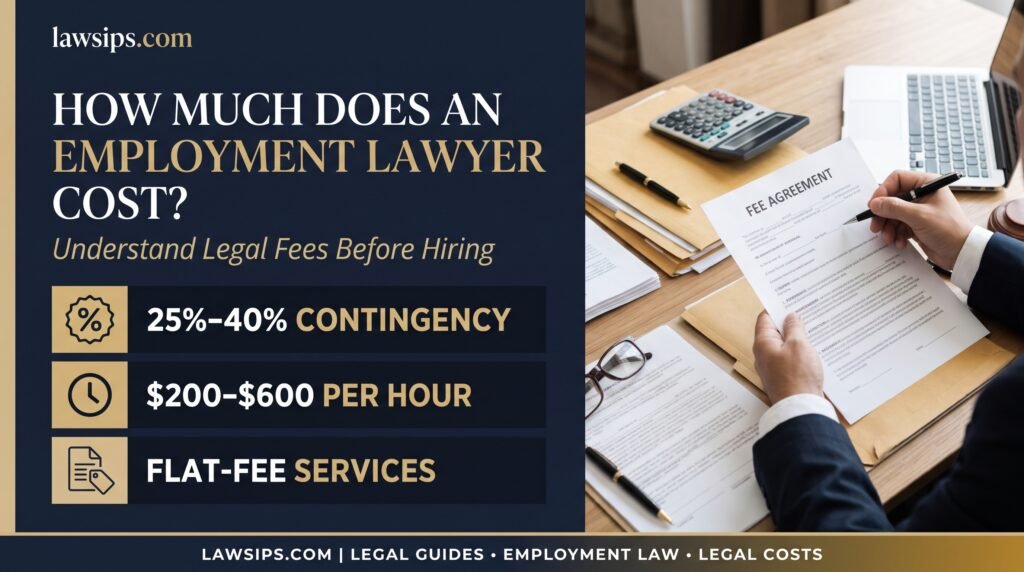
Cost is the question that stops most people from calling, so let us answer it with reported figures instead of guesses. Employment lawyers use three main billing methods: contingency, hourly, and flat fees. The method that fits your case depends on the type of claim, the size of the potential recovery, and how complex the facts are. Every number below comes from a named source, with its year, because fee data ages fast.
Contingency Fees: 25 to 40 Percent
Contingency is the most common structure for employee-side cases, according to Workplace Fairness. The lawyer takes a percentage of your settlement or award and charges nothing upfront. The typical range is 33 to 40 percent, with some sources reporting 25 to 40 percent overall. You pay nothing out of pocket to start, and the lawyer assumes the financial risk of losing. This is why the free consultation exists: the lawyer is deciding whether your case is worth their risk.
One detail changes your take-home pay more than the percentage itself. Ask whether case costs are deducted before or after the percentage is calculated. Under the net recovery method, costs come off first and the percentage applies to what remains.
Under the gross recovery method, the percentage applies to the full amount and costs come off after. Workplace Fairness flags this as a major swing factor. Also ask whether the percentage slides upward as the case progresses. A common reported structure is 33 percent for a pre-litigation settlement, 40 percent after filing, and up to 45 percent on appeal.
Contingency is not available for every matter. Routine advice, document reviews, and small claims usually cannot support it. The American Bar Association’s Model Rule 1.5 requires contingency agreements to be reasonable and in writing, so never accept a handshake percentage.
Hourly Rates: $150 to $800
When lawyers bill by the hour, the range is wide. Workplace Fairness reports $200 to $600 per hour as typical in 2026, with junior associates at $150 to $300, mid-level attorneys at $300 to $450, and senior attorneys or partners at $450 to $800.
Legal pricing data reported through GetCostIdea, based on Clio’s 2025 legal trends research, puts the national average for employment and labor lawyers at $387 per hour. Experience moves the needle sharply: LegalClarity reports that attorneys with 20 to 30 years of experience bill $511 to $606 per hour, while those under four years bill $182 to $212.
Location matters as much as experience. Reported city averages include New York City at $429, Philadelphia at $402, Dallas at $377, Chicago at $255, and Denver at $277 per hour. A senior partner in Manhattan costs roughly double a mid-level lawyer in Chicago. Hourly billing gives you itemized transparency, but complex cases can run 50 to 200 hours, so always ask for a realistic total estimate, not just the rate.
| Attorney Level | Typical Hourly Rate | Best For |
|---|---|---|
| Junior associate | $150 to $300 | Straightforward matters, document review |
| Mid-level attorney | $300 to $450 | Standard cases, negotiations |
| Senior attorney or partner | $450 to $800 | Complex litigation, high-stakes cases |
Flat Fees for Defined Tasks
Some tasks have a predictable scope, so lawyers quote a flat fee. Workplace Fairness reports severance agreement reviews at $500 to $1,500, employment contract reviews at $750 to $2,000, demand letters at $1,000 to $2,500, and initial consultations at $250 to $500 when they are not free. Flat fees give you cost certainty. You know the price before the work starts, which makes them ideal for one-shot tasks like reviewing a severance offer before you sign away your rights.
What You Keep: The Recovery Math
Percentages feel abstract until you run the numbers. A wrongful-termination client survey reported by LegalClarity found an average fee of about $14,200 on an average recovery of about $48,800, measured in 2016 dollars, which means roughly 29 percent went to the lawyer. That survey is dated, so treat it as a historical anchor, not a promise. Run your own estimate with the table below.
| Line Item | Example: $100,000 Recovery |
|---|---|
| Gross recovery | $100,000 |
| Case costs (filing, depositions, records) | -$5,000 |
| Net recovery | $95,000 |
| Attorney fee at 33 percent of net | -$31,350 |
| You keep (before taxes) | $63,650 |
The same case on a gross recovery method would cost you $33,000 in fees plus $5,000 in costs, leaving $62,000. The difference looks small here but grows with larger recoveries. Always confirm the method in writing. Also confirm who pays costs if you lose. Some agreements make you responsible for costs even with no recovery, while others write costs off.
Costs Beyond the Fee
Litigation has expenses separate from the lawyer’s fee. Workplace Fairness reports federal court filing fees of $400 to $500, with state courts varying. Depositions run $500 to $2,000 each. Expert witnesses charge $300 to $600 per hour for preparation and $3,000 to $10,000 per day for trial testimony. Total expert costs of $5,000 to $25,000 or more are common in complex cases. On contingency, the firm usually advances these costs and recoups them from the recovery, but the agreement must say so explicitly.
Retainers deserve a clear explanation. A retainer is an advance deposit, not a flat price. LegalClarity reports an average employment-law retainer of $2,835 in 2023. The lawyer bills hours against the deposit and asks you to replenish it. Ask for monthly statements so the balance never surprises you.
15 Questions to Ask Before You Hire

The consultation is a two-way interview. The lawyer evaluates your case; you evaluate the lawyer. Employment law firms publish question lists for exactly this purpose, including a well-known 15-question guide from the Bourassa Law Group. The questions below combine that guidance with fee and verification questions from Workplace Fairness and attorney-rating services. Bring this list to every consultation and compare answers across two or three lawyers.
1. What percentage of your practice is employment law?
You want a specialist, not a dabbler. A lawyer who spends 80 percent or more of their time on employment cases knows the statutes, the local judges, and the defense firms. A generalist who handles a little of everything will learn on your dime. Ask for the number, not a vague assurance.
2. Do you represent employees or employers?
This is the most important filter in employment law. Lawyers who defend companies rarely switch sides, and their intake process is built for corporate clients. Ask directly which side the firm represents. If the answer is employers, keep looking, even if the lawyer seems impressive.
3. Have you handled cases like mine, and what happened?
Specifics beat slogans. Ask how many cases like yours they have handled in the last two years and what the outcomes were. Settlements, verdicts, and dismissals all count as data. A lawyer who cannot describe a similar case is telling you something.
4. What laws protect me in my situation?
A competent lawyer names the actual statutes on the spot: Title VII, the ADA, the FMLA, or your state’s fair employment law. This question tests substantive knowledge, not salesmanship. Vague answers about “your rights” without naming laws are a warning sign.
5. Do I have a viable case, honestly?
Ask for the weaknesses, not just the strengths. Good lawyers explain what could go wrong: thin evidence, missed deadlines, or damages too small to justify litigation. A lawyer who only sees upside is either inexperienced or telling you what you want to hear.
6. What is your fee structure, and why does it fit my case?
Make them justify the choice. Contingency fits cases with strong liability and real damages. Hourly fits advice, reviews, and small matters. If they recommend contingency, ask the percentage at each stage. If hourly, ask for a total estimate with a cap discussion.
7. Are costs deducted before or after your percentage?
This single question can move thousands of dollars. Get the answer in the written agreement, not just in conversation. Also ask who pays costs if the case loses, and get that in writing too.
8. Who will actually work on my case?
The lawyer you meet may not be the lawyer who does the work. Ask whether a junior associate or paralegal will handle day-to-day tasks, and at what billing rates. You are hiring a team, so meet the team, at least on paper.
9. How will you communicate with me, and how often?
Communication complaints top every client grievance list. Ask for the update schedule: monthly calls, email summaries, or a client portal. Ask who answers when the lawyer is in trial. Set expectations now to avoid frustration later.
10. How long will my case take?
Employment cases commonly run one to three years if they go to litigation, though many settle in months. Ask for a realistic range based on similar cases, including the EEOC or agency phase. A lawyer who promises speed without explaining the process is overselling.
11. Will my case go to trial?
Most employment cases settle. Ask about the lawyer’s trial experience anyway, because the willingness to try a case drives settlement value. Ask how many employment trials they have first-chaired in the last five years.
12. What are the risks of suing my employer?
Honest lawyers discuss retaliation risks, the stress of litigation, and the chance of losing. Federal law prohibits retaliation for asserting your rights, but the process still takes a toll. You deserve a clear-eyed picture before you commit.
13. What evidence will strengthen my case?
Ask what to preserve right now: emails, texts, pay stubs, performance reviews, and a written timeline. Evidence degrades fast after termination, when you lose access to company systems. The best time to preserve it is before the consultation ends.
14. Have you ever faced disciplinary action?
You have every right to ask, and you can verify the answer through your state bar’s public records. A minor decades-old issue differs from a recent suspension. Evasiveness here is disqualifying.
15. Why should I choose your firm over others?
Let them make their case. Listen for specifics: recent similar results, relationships with local mediators, or a niche focus like wage cases. Generic claims about passion and dedication are filler. Specifics are proof.
Contingency vs. Hourly: Which Fits Your Case?
Choosing between contingency and hourly billing is the biggest financial decision in hiring an employment lawyer. The right answer depends on your damages, your evidence, and your cash flow. Neither model is better in the abstract. Each fits a different kind of case, and understanding the fit saves you from paying for the wrong one.
Contingency fits cases with clear liability and meaningful damages: a firing right after a harassment complaint, months of unpaid overtime with time records, or a demotion following medical leave. The lawyer invests their own time and money because the expected recovery justifies it. You risk nothing upfront, but you share 33 to 40 percent of the outcome. Small claims struggle here because the lawyer’s cut of a $5,000 recovery does not cover their hours.
Hourly fits advice and defined-scope work: reviewing a severance agreement, answering whether you have a claim, drafting a complaint letter, or coaching you through an EEOC filing. You keep 100 percent of any recovery, but you pay for every hour win or lose. A $400-per-hour lawyer who spends ten hours reviewing your documents costs $4,000 regardless of outcome. Ask for a written estimate and a cap before work begins.
| Factor | Contingency | Hourly |
|---|---|---|
| Upfront cost | $0 | Retainer, often $2,000 to $5,000 |
| Who bears the risk | The lawyer | You |
| Best for | Strong claims with real damages | Advice, reviews, small matters |
| You keep | 60 to 75 percent of recovery | 100 percent of recovery, minus fees paid |
| Worst case | You owe costs if the agreement says so | You pay the full bill even if you lose |
A hybrid option exists for cases in the middle. Some lawyers take a reduced hourly rate plus a smaller contingency percentage, which lowers your upfront cost while giving the lawyer upside. Ask whether the firm offers this structure. It rarely appears on websites, but many firms use it when asked. Whatever you choose, the fee agreement must be signed and in writing before representation starts, as the ABA’s Model Rule 1.5 requires for contingency arrangements.
State Law Differences That Change Your Case
Federal law sets the floor, but state law often decides how your case actually plays out. Employment protections vary dramatically across state lines, which is another reason “near me” matters: you need a lawyer licensed in the state where you work, not just one with a nice website.
Start with the at-will rule. Every state except Montana defaults to at-will employment, meaning your employer can fire you for almost any reason that is not illegal. But the exceptions differ. Some states recognize an implied-contract exception when the handbook promises progressive discipline. Others recognize a public-policy exception protecting workers fired for refusing to break the law. A few recognize a covenant of good faith. Your lawyer should name your state’s exceptions without hesitation.
California deserves special attention because its employee protections go further than most states. The Fair Employment and Housing Act covers employers with five or more employees, a lower threshold than federal law. California’s Private Attorneys General Act, known as PAGA, lets workers sue over labor violations on behalf of the state and other employees, which has made California the national center for wage class actions. If you work in California, ask prospective lawyers about their PAGA experience specifically.
New York adds its own layer through the New York State and New York City Human Rights Laws, which courts have read more broadly than federal Title VII in several respects. Other states add mini-WARN acts requiring longer layoff notice than the federal 60 days, or broader protected categories than federal law lists. None of this changes the hiring process, but it changes the questions you ask: press every candidate on your state’s specific rules, not just the federal statutes everyone recites.
Employee-Side vs. Employer-Side: The Filter Nobody Mentions

Employment law has two tribes, and they rarely mix. Employee-side firms represent workers on contingency and make money only when workers win. Employer-side firms bill companies by the hour to defend against worker claims. A search result that looks perfect can belong to the wrong tribe. Check the firm’s website for its client list and practice description. If the site brags about defending Fortune 500 companies, it is not your firm, no matter how close the office is.
| Factor | Employee-Side Firm | Employer-Side Firm |
|---|---|---|
| Client | Workers | Companies |
| Typical fee model | Contingency (33 to 40 percent) | Hourly billing |
| Consultation | Often free | Usually billed |
| Right for you if | You are the employee with a claim | You are the business being sued |
How to Find One Near You
Five channels consistently produce good candidates. Use at least two, because each has blind spots. Start with the channels built for employees, then cross-check with ratings and referrals.
1. The NELA Directory
The National Employment Lawyers Association maintains a directory of lawyers who represent individual employees. This is the single best starting filter because membership signals the right tribe. Search by location and case type. Mention of the NELA directory appears in legal cost guides as a trusted referral path.
2. Your State Bar’s Lawyer Referral Service
State and local bar associations run referral programs that match you with licensed lawyers in your area. These services verify active licensure, which directories do not always do. Many offer a low-cost initial consultation, often 30 minutes for a nominal fee.
3. Avvo, Martindale-Hubbell, and Super Lawyers
Attorney-rating platforms help you compare candidates. On Avvo, look for ratings in the 8 to 10 range with client reviews attached. Martindale-Hubbell peer ratings reflect how other lawyers view the attorney. Treat ratings as a starting point, not a verdict, because profiles can be curated.
4. Referrals From People You Trust
Ask friends, family, or a lawyer you know in another field. Referrals from other attorneys are especially valuable because lawyers know who is actually good. Union representatives and worker centers can also point you to trusted employee-side firms.
5. Local Legal Aid and Worker Centers
If money is tight, legal aid organizations and nonprofit worker centers offer free help to qualifying workers. They handle many wage and discrimination matters directly and refer the rest to trusted private lawyers. Income limits apply, so check eligibility early.
How to Verify a License and Disciplinary Record
Verification takes ten minutes and prevents the worst hiring mistake. Follow these steps for every finalist before you sign anything.
Step 1: Find your state bar’s attorney search page and enter the lawyer’s full name. Confirm the license is active and in good standing.
Step 2: Check the disciplinary history on the same site. Look for suspensions, reprimands, or pending complaints, and read what happened.
Step 3: Confirm the lawyer is licensed in your state. A license in another state does not authorize practice where you live, with narrow exceptions.
Step 4: Search the lawyer’s name plus words like discipline, suspension, or complaint to catch news the bar site might not highlight.
Step 5: Ask the lawyer directly about any history you find. An honest explanation beats a discovered surprise every time.
Deadlines That Make Speed Matter
Employment claims die on deadlines more than on merits. The most important one is the EEOC charge deadline. Under federal law, you generally have 180 calendar days from the discriminatory act to file a charge with the Equal Employment Opportunity Commission. If your state or locality has its own fair employment agency covering the same type of discrimination, the deadline extends to 300 calendar days. The EEOC explains the full filing process, including its free online Public Portal, on its official charge-filing page at eeoc.gov.
| Deadline | Time Limit | What Happens If You Miss It |
|---|---|---|
| EEOC charge (no state agency) | 180 calendar days | You lose the right to sue under most federal discrimination laws |
| EEOC charge (state or local agency exists) | 300 calendar days | Same loss of federal filing rights |
| Lawsuit after right-to-sue notice | 90 days | The notice expires and the claim is barred |
| State-law claims | Varies by state | Some states give more time, some give less |
Do not wait for the perfect lawyer while the clock runs. Filing deadlines are strict, and courts rarely forgive a late charge. If a deadline is approaching, file the charge first and keep shopping for counsel. You do not need a lawyer to file an EEOC charge, though having one helps. Wage claims under the Fair Labor Standards Act have their own two-year limit, extended to three years for willful violations, which is another reason to move quickly.
Red Flags: When to Walk Away
1. They guarantee a result. No ethical lawyer promises a win or a dollar amount. Guarantees violate professional conduct rules and signal desperation.
2. They want upfront fees on a contingency case. True contingency means no upfront payment. Large advance fees on a case they claim is contingency-based suggest the firm does not believe in the case.
3. They will not put the fee agreement in writing. The ABA requires contingency terms in a signed writing. A lawyer who resists paperwork will resist accountability later.
4. They will not name who handles your file. If you cannot learn which attorney does the work, you are buying a brand, not a lawyer.
5. They pressure you to sign today. High-pressure intake tactics mirror the employer behavior you are complaining about. A good firm gives you time and the written agreement to review.
6. They dodge the discipline question. Evasion about disciplinary history is disqualifying on its own. Honest lawyers answer directly.
7. They have no employment cases to describe. Vague claims of experience without a single similar case mean you would be the experiment.
What to Bring to Your Free Consultation
Preparation turns a 30-minute consultation into a real case evaluation. The Bourassa Law Group’s consultation guidance and Workplace Fairness both stress the same point: organized documents let the lawyer assess your case instead of spending the meeting on basics. Gather these before you go.
| Document | Why It Matters |
|---|---|
| Termination letter or layoff notice | Establishes the adverse action and its stated reason |
| Pay stubs and offer letter | Proves wages, hours, and what you were promised |
| Performance reviews | Undercuts pretextual firing reasons |
| Emails and texts with supervisors | Shows what was said and when |
| Employee handbook | Reveals the policies the employer claims to follow |
| Timeline of events | Keeps dates straight, which deadlines depend on |
| Names of witnesses | Corroboration wins close cases |
| Severance or separation agreement | Shows what rights you are being asked to waive |
Write a one-page timeline with dates before the meeting. Lawyers think in chronology, and a clear timeline lets them spot the legal issues fast. Do not bring originals; bring copies. And remember the consultation is confidential even if you do not hire the lawyer.
Key Takeaways
Hiring an employment lawyer near you comes down to five decisions.
- First, confirm the firm represents employees, not employers, before you invest any time.
- Second, understand the fee: contingency at 33 to 40 percent is standard for strong cases, hourly at $200 to $600 fits advice and small matters, and flat fees cover defined tasks like severance reviews.
- Third, run the 15 questions in every consultation and compare answers across two or three lawyers.
- Fourth, verify the license and disciplinary record through your state bar.
- Fifth, respect the clock: the EEOC’s 180 or 300-day deadline does not pause while you shop.
A detailed breakdown of current fee data is available in LegalClarity’s employment lawyer cost guide, and GetCostIdea’s fee benchmark analysis anchors the $387 per hour national average.
Frequently Asked Questions
How much does an employment lawyer cost?
Most employee-side lawyers work on contingency, taking 25 to 40 percent of the recovery, with 33 to 40 percent typical. Hourly rates run $200 to $600 in 2026, averaging $387 nationally per Clio data. Flat fees cover defined tasks like severance reviews at $500 to $1,500. Many consultations are free.
Do employment lawyers work on contingency?
Yes, contingency is the most common structure for employee cases with real damages. You pay nothing upfront, and the lawyer is paid from the recovery. Not every matter qualifies, so ask whether your case fits the model.
What percentage do employment lawyers take?
The reported range is 25 to 40 percent, with 33 to 40 percent most common. Many firms use a sliding scale: around 33 percent if the case settles before filing, 40 percent after filing, and up to 45 percent on appeal. Get the scale in writing.
Do employment lawyers offer free consultations?
Most employee-side firms offer a free 30 to 60 minute consultation. Use it to explain your situation and evaluate the lawyer. Bring your documents and timeline to make the time count.
How do I find an employment lawyer near me?
Start with the NELA directory for employee-side lawyers, then check your state bar’s referral service and attorney ratings on Avvo. Ask other lawyers for referrals, and consider legal aid if money is tight. Verify every finalist’s license before hiring.
What does an employment lawyer do?
They evaluate workplace claims, calculate potential damages, negotiate with employers, file agency charges, and litigate when needed. Their work spans discrimination, harassment, retaliation, wage theft, and severance disputes.
What is the difference between an employment lawyer and a labor lawyer?
The terms overlap heavily in everyday use. Traditionally, labor law covers unions and collective bargaining under the National Labor Relations Act, while employment law covers individual workplace rights like discrimination and wages. Most lawyers advertising either term handle both.
Should I hire an employee-side or employer-side lawyer?
Hire an employee-side lawyer if you are the worker with a claim. Employer-side firms defend companies and rarely take worker cases. Ask every firm which side it represents before going further.
How long do I have to file a workplace complaint?
For federal discrimination claims, you have 180 days to file an EEOC charge, or 300 days if a state or local agency covers the same discrimination. State-law deadlines vary. Missing the deadline usually ends the claim.
What is the EEOC deadline?
The Equal Employment Opportunity Commission requires a charge within 180 calendar days of the discriminatory act, extended to 300 days in deferral states with their own fair employment agency. After you receive a right-to-sue notice, you have 90 days to file suit.
Do I need a lawyer before filing an EEOC charge?
No. You can file through the EEOC’s free Public Portal, by phone, or in person. A lawyer helps you frame the charge correctly and preserve related state claims, so consulting one first is wise when time allows.
Can I be fired for hiring an employment lawyer?
Retaliation for asserting your legal rights is unlawful under federal and most state laws. That said, the protection applies to the underlying protected activity, so discuss timing and strategy with your lawyer before acting.
Will my employer know I contacted a lawyer?
Not from the consultation itself, which is confidential. Your employer learns about the dispute when the lawyer sends a demand letter, files a charge, or files suit. Discuss timing with your lawyer.
What should I bring to the consultation?
Bring your termination letter, pay stubs, performance reviews, relevant emails and texts, the employee handbook, a one-page timeline, witness names, and any severance agreement. Bring copies, not originals.
What questions should I ask an employment lawyer?
Ask about their employment-law focus percentage, which side they represent, similar cases and outcomes, the governing laws, fee structure and cost handling, who does the work, communication cadence, timeline, and disciplinary history. The 15-question list above covers all of these.
How do I check if a lawyer is licensed?
Use your state bar’s attorney search page. Enter the lawyer’s full name and confirm an active license in good standing in your state. This takes minutes and is free.
How do I check disciplinary records?
The same state bar site shows disciplinary history: suspensions, reprimands, and pending complaints. Supplement it with a web search of the lawyer’s name plus terms like discipline or suspension.
What is a good Avvo rating?
Look for ratings in the 8 to 10 range with genuine client reviews. Treat ratings as a screening tool, not a credential, and always cross-check with the state bar.
How much does a severance review cost?
Reported flat fees for severance agreement reviews run $500 to $1,500. Given that signing can waive claims worth tens of thousands, it is among the highest-return legal spends available.
Should I sign a severance agreement without a lawyer?
Get a review first. Severance agreements typically require you to waive legal claims in exchange for the payment. A lawyer can often negotiate better terms or spot rights you did not know you had.
What is wrongful termination?
Wrongful termination means being fired in violation of the law, not merely unfairly. In at-will states, which is most of the US, employers can fire for any non-illegal reason. The claim arises when the real reason is discrimination, retaliation, or another protected category.
Is my state an at-will employment state?
Almost certainly yes. Every state except Montana follows at-will employment by default. The exceptions, such as discrimination and retaliation protections, are where employment lawyers earn their fee.
How much is my employment case worth?
Value depends on lost wages, benefits, emotional distress, and punitive damages where available, minus fees and costs. A lawyer evaluates this during the consultation using your documents and comparable outcomes. No honest lawyer quotes a number before seeing evidence.
How long do employment cases take?
Many settle within months through negotiation or mediation. Cases that go through the EEOC process and litigation commonly take one to three years. Ask your lawyer for a range based on similar cases.
Will my case go to trial?
Probably not. The vast majority of employment cases settle. Trial experience still matters because the credible threat of trial drives settlement value upward.
What is a demand letter?
A demand letter is a formal written settlement proposal from your lawyer to the employer, laying out the claims, the evidence, and the amount sought. Many disputes resolve at this stage without any filing.
Conclusion
Searching for an employment lawyer near me is really a search for three things: honest pricing, proven competence, and someone who fights for workers instead of companies. You now have the numbers that matter: contingency fees of 33 to 40 percent on strong cases, hourly rates averaging $387 nationally, flat-fee severance reviews at $500 to $1,500, and free consultations as the industry norm.
You have the 15 questions that expose weak lawyers, the verification steps that take ten minutes, and the deadlines that punish delay. Use them this week. Contact two or three employee-side firms, bring your documents and timeline, compare their answers, and check every license before you sign. The clock on your claim is already running, and the best time to hire the right lawyer is before it runs out.
For a broader view of how hiring a lawyer works in neighboring practice areas, see the guides to finding a personal injury attorney near you and a divorce lawyer near you. If your dispute involves many workers with the same complaint, learn how to file a class action lawsuit and how to claim a class action settlement to understand the group-action path.

Dilawar is a dedicated writer and contributor at Lawsips.com, focusing on legal information, business law, consumer rights, legal awareness, and everyday legal matters. He is passionate about simplifying complex legal topics and providing readers with clear, practical, and easy-to-understand information. His goal is to help readers stay informed about legal developments, understand their rights, and make better decisions through informative and well-researched articles.