
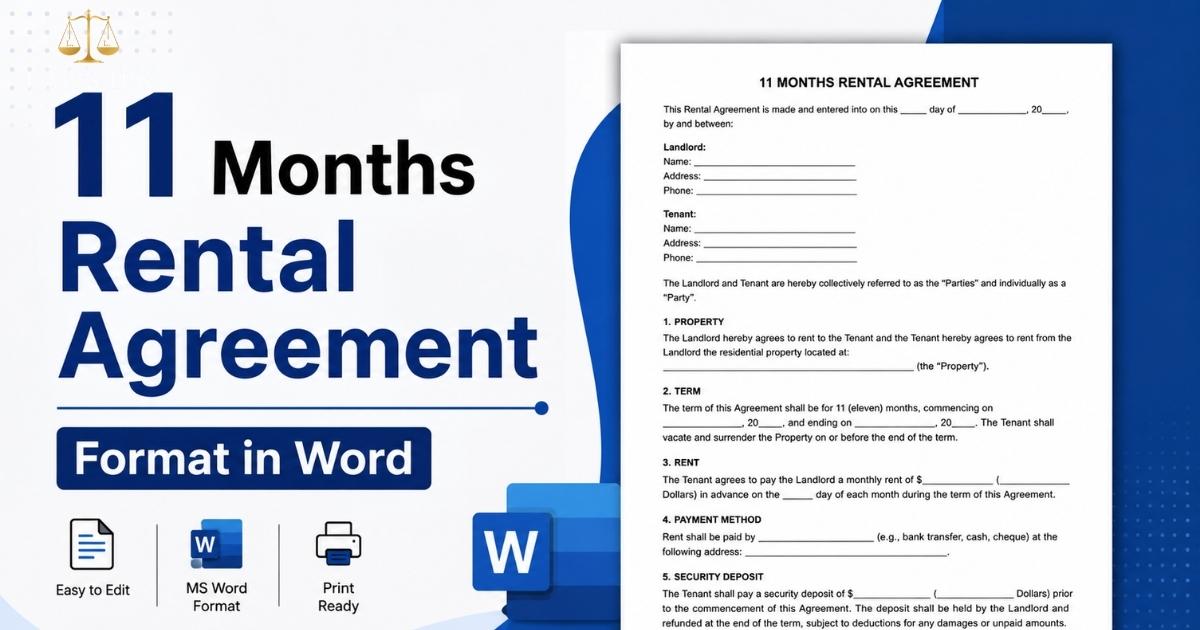

If you have ever rented a flat in India, you already know the drill. The landlord hands over an 11-month agreement, both parties sign on stamp paper, and everyone moves on. But behind that seemingly routine document lies a precise legal strategy rooted in the Registration Act, 1908. Get the format wrong, skip a clause, or misunderstand the stamp duty protocol, and you are looking at an unenforceable agreement and a potential court battle.
This guide walks you through the complete 11 months rental agreement format in Word, the key legal provisions that protect both landlord and tenant, execution protocols, state-specific variations, and the drafting mistakes that routinely destroy tenancy cases in Indian courts.
11-Month Rental Drafting Metrics
Before diving in, here are the core data points every party should know upfront:
| Parameter | Details |
| Agreement Duration | 11 months (leave and license) |
| Registration Required | No (under Section 17, Registration Act, 1908) |
| Stamp Paper Value | Rs. 100 to Rs. 500 (state-dependent) |
| E-Stamping Mandatory | Yes, from July 1, 2025 |
| Security Deposit | Typically 2 to 3 months rent |
| Notice Period Clause | 1 month (standard) |
| Governing Acts | Transfer of Property Act 1882, Indian Contract Act 1872, State Rent Control Acts |
Standard 11 Months Rental Agreement Format in Word
A well-drafted leave and license agreement in Word format must contain the following structured sections. This is the template framework used across Indian cities, adaptable for both residential and commercial premises.
Preamble and Party Details
The agreement opens by identifying both parties in full. The licensor (landlord) and licensee (tenant) must be described with their full legal names, ages, permanent addresses, and Aadhaar or PAN references where applicable. The property address must match the title deed exactly, including survey number, floor, and municipal ward details.
Recitals and Property Description
This section establishes that the licensor holds clear title or lawful possession of the premises and grants a revocable license to the licensee for residential or commercial use. Including a detailed property description, total carpet area, and list of fixtures prevents future disputes over what was originally handed over.
Core Clauses Every Template Must Include:
- Tenancy Period: Explicitly state “commencing from [date] and expiring on [date], being a period of 11 calendar months.” Avoid phrases like “with an option to renew automatically” as courts have treated such language as creating a lease exceeding one year, attracting mandatory registration.
- Monthly License Fee: State the exact rent amount in figures and words. Include the date of payment (e.g., on or before the 5th of each month) and the payment mode.
- Security Deposit: Mention the refundable deposit amount, the conditions for deduction, and the timeline for refund after vacation (typically 15 to 30 days after peaceful handover).
- Permitted Use: Clearly state “residential purposes only” or the specific commercial activity. This prevents subletting disputes and unauthorized alterations.
- Maintenance and Utilities: Define who pays for electricity, water, society maintenance, and minor repairs versus structural repairs.
- Lock-in Period: A 3 to 6 month lock-in clause prevents premature vacation and protects landlord rental income.
- Notice Period: A mutual one-month written notice requirement before termination or vacation.
- Prohibited Activities: No subletting, no structural modification, no running of business without permission.
- Right of Entry: The landlord’s right to inspect the premises with prior notice (typically 24 to 48 hours).
- Termination Clause: Specific grounds for premature termination including non-payment, breach of conditions, or misuse of property.
Execution Block
The agreement must close with signature blocks for both parties, date and place of execution, and spaces for two independent witnesses with their names, addresses, and signatures.
Key Legal Provisions & Registration Act Traps
The 11-month rental agreement strategy is anchored in Section 17(1)(d) of the Registration Act, 1908. This provision mandates compulsory registration for leases of immovable property from year to year, or for terms exceeding one year. By capping the agreement at 11 months, landlords lawfully sidestep this requirement and the associated costs of stamp duty at 2% of annual rent plus registration fees.
However, several Registration Act traps routinely catch poorly drafted agreements:
The Auto-Renewal Trap
Including an automatic renewal clause is the most dangerous drafting error. If your agreement says “this agreement shall stand renewed for a further period of 11 months unless terminated by written notice,” courts can construe this as an intent to create a continuous lease exceeding 12 months. The Bombay High Court and Delhi High Court have both set aside eviction proceedings in cases where auto-renewal clauses defeated the landlord’s position.
The Leave and License vs. Lease Distinction
A leave and license agreement does not transfer any interest in the property from the licensor to the licensee. A lease does. This distinction is critical because rent control laws in most Indian states only protect tenants under lease agreements. Under a leave and license structure, the licensee enjoys no statutory protection against eviction after the license period expires. Always use “licensor,” “licensee,” and “license fee” in the document, never “lessor,” “lessee,” or “rent.”
Section 49 Enforceability
An unregistered document that requires compulsory registration under Section 17 cannot be received as evidence under Section 49 of the Registration Act. For 11-month agreements, registration is not compulsory, so the unregistered document is fully admissible. However, if the agreement exceeds 12 months and is unregistered, it becomes legally unenforceable in court proceedings.
Maharashtra Exception
Under Section 55 of the Maharashtra Rent Control Act, 1999, every leave and license agreement must be registered regardless of duration. This is a critical state-specific exception discussed further below.
Execution Procedure and Stamp Duty Protocols
Executing an 11-month rental agreement correctly is just as important as drafting it properly. A well-worded agreement executed on the wrong stamp paper, or signed without witnesses, can be challenged during eviction proceedings.
Draft Finalization and Review
Before proceeding to stamp paper procurement, both parties should review the draft carefully. Check party names against identity documents, verify the property description against municipal records, and confirm rent and deposit figures in writing. This review step avoids costly corrections later, as alterations on executed stamp paper are legally suspect.
Procurement of E-Stamp Paper
From July 1, 2025, e-stamping is mandatory across India for rental agreements. Physical stamp papers are no longer accepted for new agreements in most states. E-stamp certificates are available through:
- State government portals (iGR portals in Maharashtra, Karnataka, etc.)
- Stock Holding Corporation of India Limited (SHCIL) licensed vendors
- Authorized banks and sub-registrar facilitation centers
The stamp duty value varies by state. Delhi uses a flat Rs. 100 stamp duty for 11-month residential agreements. Maharashtra charges 0.25% of total rent plus deposit consideration for leave and license agreements. Karnataka typically requires Rs. 500 stamp paper for residential agreements up to one year.
Printing and Paging
Print the agreement on the e-stamp paper itself or attach the e-stamp certificate to the first page. Each page must be initialled by both parties. Number all pages consecutively. The agreement must be printed in clearly legible font (minimum 11pt) with no overwriting or corrections. Use blue or black ink for signatures only.
Execution and Witnessing
Both the licensor and licensee must sign in the presence of two witnesses simultaneously. Witnesses must be independent adults (not family members of either party) who can confirm the execution. Each witness signs with their full name and residential address. The place and date of execution must be mentioned on the last page.
Notarization
Notarization is not legally required for 11-month agreements but is strongly recommended. A notarized agreement carries greater evidentiary weight in civil disputes and is widely accepted as address proof for bank accounts, school admissions, and gas connections. Notarization costs between Rs. 50 and Rs. 300 depending on the notary and the city.
State-Specific Variations in Rent Control
Rent control laws and stamp duty obligations differ significantly across India. Using a generic template without accounting for state rules is a common and costly mistake.
Maharashtra: Registration is mandatory for all leave and license agreements regardless of duration under Section 55 of the Maharashtra Rent Control Act. Online registration through the Maharashtra IGR portal is widely used. Stamp duty is 0.25% of total consideration (rent plus deposit). Registration fee is Rs. 1,000 in municipal areas and Rs. 500 in rural areas.
Delhi: The Delhi Rent Control Act applies only to properties with a monthly rent below Rs. 3,500. Most modern rentals fall outside this cap and are governed by the Transfer of Property Act. Stamp duty is Rs. 50 for agreements up to 5 years with annual rent under Rs. 50,000, and 2% of average annual rent for higher values.
Karnataka: The Karnataka Rent Act, 1999 applies to residential premises in certain municipal areas. The stamp duty for 11-month agreements is Rs. 500 for residential properties. Police verification of tenants is practically mandatory in Bengaluru and Mysuru.
Tamil Nadu: The Tamil Nadu Buildings (Lease and Rent Control) Act applies in urban areas. Stamp duty for leave and license agreements is calculated at 1% of the total license fee payable during the agreement period.
West Bengal: The West Bengal Premises Tenancy Act, 1997 governs tenancies in the state. Agreements over 12 months require registration. Stamp duty is assessed on a sliding scale based on annual rent and lease duration.
Common Drafting Mistakes That Lead to Disastrous Litigation
Thousands of eviction cases fail every year not because the landlord lacks rights but because the underlying agreement was poorly drafted. Here are the most damaging errors to avoid:
- Omitting the specific end date: Writing “for a period of 11 months” without stating the exact commencement and expiry dates creates ambiguity about when the license actually expires.
- Using lease terminology: Words like “tenant,” “rent,” “landlord,” and “evict” in a leave and license agreement can allow courts to treat the document as a lease, importing rent control protections.
- No inventory annexure: Failing to attach a signed inventory of fixtures and fittings leads to disputes about damages and deposit deductions that become impossible to resolve fairly.
- Vague maintenance obligations: Leaving maintenance duties undefined results in disputes about who repairs a faulty geyser or a leaking terrace.
- Missing PAN details: For monthly rent exceeding Rs. 50,000, TDS deduction under Section 194-IB of the Income Tax Act is mandatory. Agreements that omit PAN details create tax compliance headaches for both parties.
- Undated or backdated execution: Backdating rental agreements to show longer tenancy periods for other purposes is a fraudulent act that can invalidate the entire document.
- Single witness: Most Indian courts expect at least two independent witnesses. A single witness or a family member witness weakens the document’s evidentiary value.
- No police verification clause: In many cities, including Delhi and Bengaluru, landlords are legally obligated to get tenants police-verified. Not including a clause requiring the tenant to cooperate can create operational difficulties.
Practical Tips for Bulletproof Tenancy Agreements
Following these best practices significantly reduces the risk of disputes and ensures enforceability when it matters most:
- Always use the words “leave and license” and “licensor/licensee” throughout the document, never lease-related terminology.
- Attach a clear property photograph and a floor plan sketch as annexures to eliminate disputes about what was handed over.
- Mention the exact e-stamp certificate number and date on the first page of the agreement.
- Keep the notice period mutual. A clause that only benefits the landlord may be held as unreasonable by a court.
- Include a clear clause that the security deposit is refundable “within 30 days of peaceful vacation and return of keys, subject to deduction for unpaid dues and damages.”
- State that the agreement does not create any tenancy rights, occupancy rights, or interest in the property in favor of the licensee.
- Draft a renewal agreement as a fresh document rather than an addendum to avoid the cumulative period exceeding 12 months in legal interpretation.
- Store both an executed physical copy and a scanned digital copy securely. For high-value rentals, consider using Aadhaar-based e-sign for remote execution.
- Always collect police verification documents before handing over possession.
Final Thoughts
The 11 months rental agreement format in Word is not just a formality. It is a carefully calibrated legal instrument designed to balance the rights of property owners with the practical needs of tenants within India’s complex property law framework. A properly drafted leave and license agreement, executed on valid e-stamp paper with the right clauses, witnesses, and state-specific provisions, gives you a document that will hold up in court if things go sideways.
Whether you are a first-time landlord in Delhi, a working professional renting a flat in Mumbai, or an advocate drafting agreements for clients across Karnataka, taking the time to get the format right is the most cost-effective legal investment you can make. Download the standard template, customize it to your state’s requirements, and execute it properly every single time.

Daniel Christopher is the founder and administrator of LawsIps.com. He is passionate about making legal information easier to understand through clear, well-researched, and reader-friendly content. His goal is to help readers stay informed about legal topics, court updates, consumer rights, and educational legal resources in simple language.