
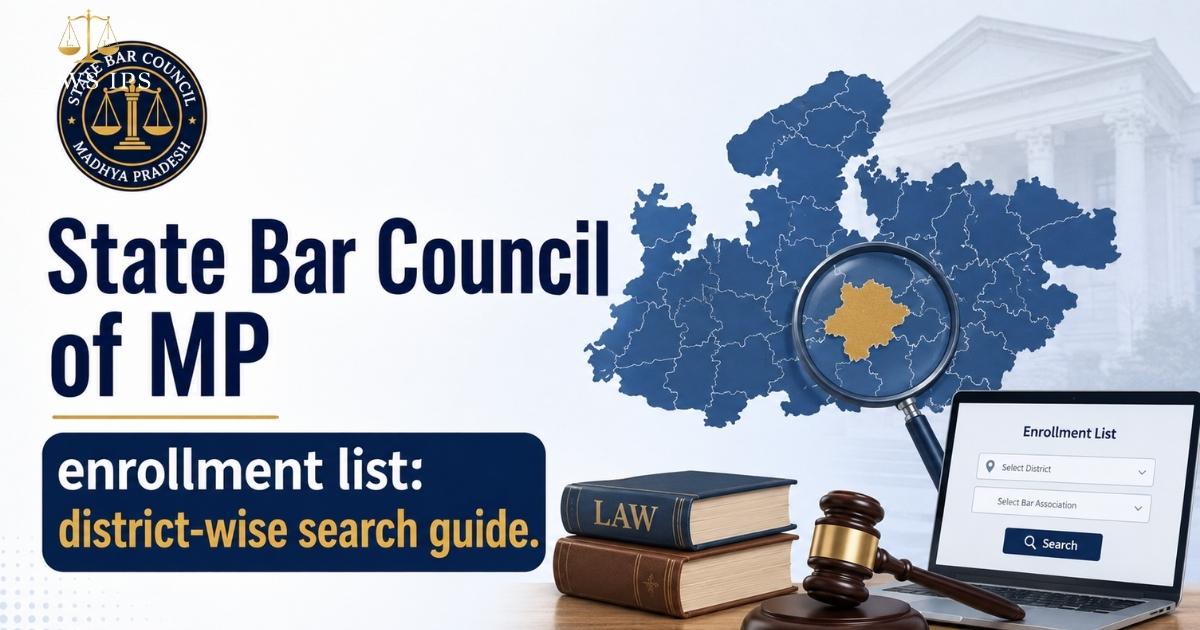

The State Bar Council of MP enrollment list is the legal backbone of advocate verification in Madhya Pradesh. Maintained under Section 17 of the Advocates Act, 1961, this statutory roll covers over 1.1 lakh advocates across 52 districts. Whether you are a litigant hiring counsel or a new graduate confirming enrollment, this list is your first stop for credibility checks.
The Bar Council of Madhya Pradesh (BCMP), headquartered in Jabalpur, has moved this list from dusty paper registers to a live, searchable digital portal at sbc.mponline.gov.in. Today, anyone can verify an advocate’s COP status, enrollment number, and disciplinary record within minutes. This guide walks you through the district-wise search process, the legal framework behind the roll, and the practical steps every advocate and litigant needs to know.
Legal Excellence
The State Bar Council of MP enrollment list is the single most authoritative document in the legal ecosystem of Madhya Pradesh. Whether you are a litigant verifying your lawyer’s credentials, a freshly enrolled advocate confirming your name on the statutory roll, or a senior counsel cross-checking a junior’s COP status, knowing how to navigate this list is a non-negotiable professional skill. With over 1.1 lakh advocates spread across 52 districts, the Bar Council of Madhya Pradesh (BCMP) now offers a live, searchable digital database that has replaced the old paper registers. This guide breaks down every search step, legal framework, and practical tip you need to confidently use the MPBC portal in 2026.
Legal Framework: The MPBC Statutory Roll
The foundation of the entire enrollment system rests on Section 17 of the Advocates Act, 1961, which mandates that every State Bar Council prepare and maintain a roll of advocates. For Madhya Pradesh, this statutory roll is maintained by the Bar Council of Madhya Pradesh, headquartered in Jabalpur, the seat of the MP High Court.
Under Section 6(1-A) of the same Act, the BCMP is required to admit persons as advocates on its roll and to notify any alterations to the Bar Council of India (BCI). This means the MP enrollment list is not a directory; it is a legal instrument. An advocate’s name on this roll is the only statutory proof of their right to practice law anywhere in India.
Key features of the statutory roll include:
- Enrollment Number Format: Every MP advocate carries a unique number in the format MP/[Serial Number]/[Year], such as MP/5000/2018.
- Roll Sections: The roll is divided into senior advocates and other advocates, as prescribed under Section 17(2) of the Act.
- BCI Cross-Linkage: All state rolls are linked to the national Bar Council of India database, enabling multi-state verification.
The MPBC Disciplinary Authority
The BCMP’s Disciplinary Committee holds the power to suspend or debar an advocate from practice. When disciplinary action is taken, the advocate’s enrollment number is flagged in the digital database. This means a litigant or court officer who searches a flagged enrollment number will immediately see the suspension status. This live-update mechanism protects clients from engaging advocates who have been barred from practice, making the enrollment search a tool of consumer protection as much as regulatory compliance.
District-Wise Search Strategy (Indore, Bhopal, etc.)
The BCMP portal uses a structured District Filtering mechanism, making it possible to isolate advocates practicing in a specific geography, whether that is Indore, Bhopal, Gwalior, Jabalpur, Rewa, Sagar, or any of the other 46 districts. Every advocate enrolled with the BCMP is also mandatorily linked to a local District Bar Association (DBA), and that linkage becomes the anchor of the district-wise search.
Here is the complete step-by-step process:
Step 1: Select Secondary Search
Navigate to the official BCMP portal at sbc.mponline.gov.in or the Bar Council’s dedicated search page. On the homepage, look for the “Advocate Search” or “Enrollment Verification” tab. Within the search panel, select the “Secondary Search” option, which unlocks the district-level filtering capability beyond a simple enrollment number lookup.
Step 2: Pick the District Bar Association (DBA)
From the dropdown menu, select your target District Bar Association. The portal lists all 52 district associations alphabetically. For example, selecting “Indore Bar Association” will limit all subsequent results to advocates whose primary seat of practice is registered in Indore. This DBA linkage was implemented by the BCMP to ensure that the state roll accurately reflects where an advocate is actually practicing.
Step 3: Input Name or Father’s Name
In the search fields provided, enter either the advocate’s name or their father’s name. The portal requires a minimum of three characters to initiate the search. Entering just one or two letters will return an error. For common names, adding the father’s name in the second field dramatically narrows results and returns more precise matches.
Step 4: Check ‘Voter Status’
One often-overlooked field in the district search panel is the Voter Status toggle. Advocates who have paid their annual welfare fund dues and are eligible to vote in Bar Council elections are tagged as “Active Voter.” Checking this field helps confirm that an advocate is not just enrolled but is in good professional standing. It is a secondary verification layer beyond the basic enrollment check.
Step 5: Download the ‘Mini-Directory’
After your search results appear, the portal offers the option to download a Mini-Directory for the selected district. This is a PDF compilation of all advocates within the chosen DBA, including enrollment numbers, enrollment dates, and current status. Note that these PDFs are updated periodically and may not reflect changes made in the last 30 days. For the most current disciplinary status, always rely on the live search result rather than the downloaded PDF.
Evolution: From Registers to Digital PDF
The journey of the MPBC enrollment list mirrors the broader digitization of India’s legal infrastructure. Before 2010, advocate verification in Madhya Pradesh required a physical visit to the Bar Council office in Jabalpur. Clerks would manually search handwritten ledgers, and the process could take days.
The shift to digital began when the BCMP partnered with MPOnline, the state government’s e-governance platform. The first iteration was a static PDF published annually on the website. While this was a significant improvement, the PDF became outdated the moment it was published, failing to capture new enrollments, suspensions, or COP renewals.
The current system is a live relational database connected directly to the BCMP’s internal records management system. Each enrollment, renewal, suspension, or removal is reflected in the online search portal within hours. The evolution timeline looks like this:
- Pre-2010: Manual paper registers at Jabalpur headquarters.
- 2010 to 2015: Annual static PDF published on the BCMP website.
- 2015 to 2020: Basic online search by enrollment number introduced via MPOnline.
- 2020 to 2023: District-wise search and DBA linkage added to the portal.
- 2024 to present: Live database with biometric card integration and voter status tracking.
The Biometric Identification Card System
The BCMP has taken advocate verification a step further by implementing a Biometric Identification Card system for all active enrollees. Every advocate in MP, from a district court practitioner in Satna to a High Court counsel in Jabalpur, is issued a smart identity card that is linked directly to their record in the enrollment database.
How the biometric system works:
- When an advocate swipes their card at High Court entry gates or designated courts, the system pings the BCMP enrollment database in real time.
- If the advocate is suspended, has unpaid welfare fund dues, or has a flagged COP status, access is flagged immediately.
- The digital enrollment list allows advocates to upload their photograph and signature, creating a Live Profile that judges and court staff can verify against the person appearing before them.
This system directly addresses the problem of Vakalatnama fraud, where individuals posed as advocates by forging enrollment documents. With biometric linking, any officer of the court can pull up the live profile within seconds. The BCMP is among the first state bar councils in India to implement this level of biometric-to-database integration.
Comparative Jurisprudence: The ‘One Bar’ Rule
India’s Advocates Act, 1961 enforces what is effectively a “One Bar” rule: an advocate can be enrolled with only one State Bar Council at a time. This contrasts with legal systems in other countries and has specific implications for how the MP enrollment list functions.
- United States: American lawyers can gain admission to multiple state bars through reciprocity agreements. An attorney can be on the rolls of New York, California, and Texas simultaneously. India’s single-enrollment model prevents this.
- United Kingdom: The Law Society’s ‘Find a Solicitor’ tool allows geographic searches by postcode. The BCMP’s district-wise search is India’s closest functional equivalent to this model, offering what could be called a postcode-to-professional mapping for Madhya Pradesh.
- Canada: Canadian bar associations conduct Practice Management Reviews. The BCMP is moving toward a similar model by exploring integration of e-Court case data with enrollment records, which could eventually reflect an advocate’s active case volume.
The practical result of the “One Bar” rule for litigants is straightforward: if you find an advocate on the BCMP list, you can be certain they are not simultaneously on another state’s roll. Their accountability remains with a single regulatory body, simplifying the process of filing complaints or verifying credentials.
Practical Tips for Advocates and Litigants
Getting the most out of the BCMP enrollment search requires knowing a few ground-level realities that the portal itself does not explain.
For Advocates:
- Always use the full four-digit year in your enrollment number when searching. Entering “MP/500/05” will return no results; the correct format is “MP/500/2005.”
- After any change in your address, DBA affiliation, or contact details, update the portal within 90 days to avoid mismatch errors during court e-filing.
- New enrollees should verify their name appears in the district-wise search within 60 days of enrollment. If absent, contact the BCMP Jabalpur office with your enrollment receipt.
- Keep your welfare fund payment receipts up to date, as dues arrears can affect your voter status and biometric card validity.
For Litigants:
- Before signing a Vakalatnama, search the advocate’s enrollment number on the BCMP portal and confirm the status reads “Active.”
- If you are hiring a specialist for High Court matters in Jabalpur or Indore, use the district-wise filter to confirm the advocate’s registered seat of practice matches the court where they are appearing.
- A mismatch between the name on the Vakalatnama and the name on the enrollment list is grounds to question representation. Raise it before the court immediately.
Final Thoughts
The State Bar Council of MP enrollment list has evolved from a paper register into one of the most functional advocate verification systems in India. The district-wise search, biometric card linkage, DBA association filter, and live COP status updates make the BCMP portal a reliable tool for both legal professionals and the public they serve.
For advocates, regular self-verification on the portal ensures there are no administrative gaps that could disrupt practice. For litigants, a two-minute search before engaging legal counsel can prevent significant downstream problems. The BCMP’s commitment to digital accountability reflects a broader shift in how India’s legal profession is regulated, moving steadily toward the kind of real-time professional registry standards seen in the UK and Canada.
Your enrollment number is more than an identifier. It is your professional standing, your disciplinary history, and your right to practice, all in a single searchable record.

Daniel Christopher is the founder and administrator of LawsIps.com. He is passionate about making legal information easier to understand through clear, well-researched, and reader-friendly content. His goal is to help readers stay informed about legal topics, court updates, consumer rights, and educational legal resources in simple language.