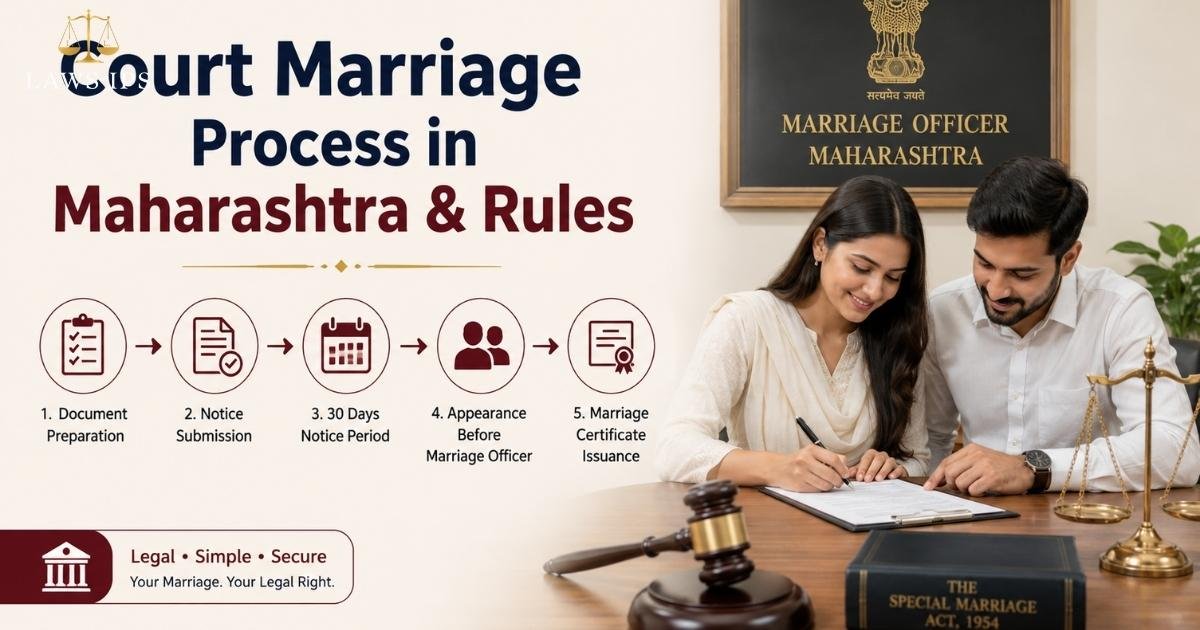

Court marriage in Maharashtra is governed primarily by the Special Marriage Act, 1954, a secular, religion-neutral law that allows any two eligible adults to legally wed irrespective of caste, community, or faith. In 2026, the entire process has been digitized through the IGR (Inspector General of Registration) Maharashtra portal, making it faster, more transparent, and accessible from anywhere in the state.
Whether you are an inter-faith couple in Mumbai, a professional duo in Pune, or an NRI planning a civil union before returning abroad, this step-by-step guide covers everything: eligibility criteria, the mandatory 30-day notice, the eMarriage 2.0 portal workflow, witness requirements, how to handle objections, and the international legal standing of your marriage certificate.
Introduction: The 2026 Union of Hearts
The landscape of marriage registration in Maharashtra has changed dramatically. What once required multiple in-person visits to crowded Sub-Registrar Offices (SROs) can now begin with a few clicks on your smartphone. The state’s Department of Registration and Stamps has pushed hard toward paperless, queue-free services, and court marriage is at the center of that transformation.
In 2026, more urban couples are choosing the court marriage route for its simplicity, legal robustness, and cost-effectiveness. The official fee at the Sub-Registrar’s office ranges between Rs. 500 and Rs. 1,000, making it among the most affordable ways to legally formalize a union in India.
This guide is built on the framework of Google EEAT principles — drawing from official Maharashtra government portals, the Special Marriage Act text, and legal precedents to deliver information you can trust and act on.
Marriage Compliance Dashboard
| Parameter | Detail |
| Governing Law | Special Marriage Act, 1954 |
| Minimum Age (Groom) | 21 years |
| Minimum Age (Bride) | 18 years |
| Mandatory Notice Period | 30 days |
| Witnesses Required | 3 (physically present) |
| Government Fee | Rs. 500 to Rs. 1,000 |
| Total Timeline | 35 to 45 days |
| Portal | adjudication.igrmaharashtra.gov.in |
| Certificate Type | Marriage Certificate under SMA 1954 |
What is Court Marriage? The 1954 Legacy
Court marriage is a civil contract solemnized before a Marriage Officer in the absence of any religious rites or ceremonies. It derives its authority from the Special Marriage Act, 1954, one of India’s most progressive pieces of family law legislation.
Before 1954, inter-caste and inter-faith marriages in India had no coherent legal framework. The 1954 Act changed that permanently. It provides a uniform, secular procedure applicable to:
- Indian nationals of any religion or caste
- Inter-faith and inter-caste couples
- Indian nationals living abroad
- Foreign nationals marrying Indian nationals within India
The marriage is solemnized when each party declares, in the presence of the Marriage Officer and three witnesses: “I, [Name], take thee [Name], to be my lawful wife/husband.” At that moment, the union becomes a legally binding contract recognized across India and, crucially, by most countries abroad.
Court marriage is often confused with a registered religious marriage (such as an Arya Samaj marriage registered later). They are distinct. A court marriage has no religious component whatsoever. It is purely a civil proceeding.
Eligibility: Age, Status & Residence Rules
Before you begin the application process, both partners must satisfy every one of the following conditions under Section 4 of the Special Marriage Act:
Age Requirements
- The groom must be at least 21 years old
- The bride must be at least 18 years old
- Age is calculated on the date of solemnization, not the date of notice filing
Marital Status
- Neither party should have a living spouse from a previous marriage
- Divorcees must produce a valid decree of divorce from a competent court
- Widowed individuals must present the death certificate of the deceased spouse
Mental Capacity
- Both parties must be capable of giving valid, free, and voluntary consent
- Neither should be suffering from an unsoundness of mind that renders them unfit for marriage
Prohibited Relationships
- Parties must not fall within the degrees of prohibited relationship as defined under the Act
- However, if the custom or usage governing either party permits such a marriage, it may be solemnized
Residence Rule
- At least one party must have been a resident of the district of the chosen Marriage Officer for a minimum of 30 days immediately preceding the filing of the notice
The 30-Day Notice: The Statutory Waiting Period
This is the step that surprises most first-time applicants. Under Section 5 of the Special Marriage Act, every couple must file a Notice of Intended Marriage with the Marriage Officer of the chosen district before the ceremony can take place.
Here is what happens after filing:
- The Marriage Officer records the notice in the Marriage Notice Book
- A copy is displayed publicly at the SRO office and, in 2026, also on the IGR Maharashtra Notice Dashboard (mregigr.maharashtra.gov.in/NoticeDashboard)
- The notice remains live for 30 days, during which any person may raise a legal objection
- After 30 days (assuming no unresolved objections), the couple is invited for solemnization
The notice is tied to the residence of either party. You can file at the SRO of the district where the groom lives, the bride lives, or where either has lived for the past 30 days. The couple does not have to live in the same district.
Privacy Note: The public display of the notice has historically been a concern for couples from conservative families. In 2026, High Courts across India have held that while public display is mandatory under the Act, the Marriage Officer has no authority to proactively inform parents or family members. The notice is public information, but it is not the Officer’s job to notify your relatives.
Online Registration: The IGR Maharashtra Guide
Maharashtra’s eMarriage 2.0 portal (adjudication.igrmaharashtra.gov.in) allows couples to complete most of the registration process without physically visiting the SRO initially. Here is the full workflow:
Portal PDE (Public Data Entry)
- Visit the eMarriage 2.0 portal and select “Special Marriage”
- Create your profile and fill in the marriage memorandum with details of both bride and groom
- Select the Sub-Registrar Office (SRO) in the district where at least one party resides
- Enter details of all three witnesses
Verification Visit
- Upload all required documents (scanned copies)
- Complete Aadhaar-based UID authentication and biometric capture (photograph and thumb impression)
- Submit the notice for SRO approval
- If the SRO raises queries, correct and resubmit within 15 days to avoid rejection
Notice Period
- Upon SRO approval, your notice is published on the public dashboard
- The mandatory 30-day waiting period begins
- During this period, monitor the portal for any objection flags
- No further action is needed from your side unless an objection is raised
Solemnization
- After the notice period expires without objection, book your appointment online
- Both partners and all three witnesses must appear physically at the SRO on the scheduled date with original documents
- The Marriage Officer reads out the declaration; both parties and witnesses sign the Marriage Register
- The Marriage Certificate is issued on the same day
Important: The eMarriage 2.0 portal streamlines document submission but does not eliminate the in-person appearance requirement. Both partners must be physically present for solemnization. There are no exceptions.
The Witness Matrix: Roles & Requirements
Three witnesses are mandatory for a court marriage in Maharashtra. This is non-negotiable under the Special Marriage Act. Here is everything you need to know:
Who Can Be a Witness?
- Any Indian adult (18 years or older) of sound mind
- Witnesses do not need to be related to either party
- Friends, colleagues, and neighbors all qualify
- Witnesses can belong to any religion, caste, or community
What Must a Witness Do?
- Be physically present at the SRO on the day of solemnization
- Carry valid government-issued photo ID (Aadhaar, PAN, Passport, Voter ID)
- Sign the marriage declaration form and the Marriage Register
- Provide their address proof if requested by the Marriage Officer
What Witnesses Are NOT Required to Do:
- Witnesses need not attend the notice filing stage
- They do not need to appear during the 30-day notice period
- They are only required on the final day of solemnization
A common mistake is bringing fewer than three witnesses on the day. If even one witness is absent, the marriage cannot be solemnized that day, and the appointment must be rescheduled.
The ‘Objection’ Phase: Handling Section 7 Caveats
Section 7 of the Special Marriage Act gives any person the legal right to file an objection to a proposed marriage during the 30-day notice period. This provision was designed to prevent marriages involving fraud, bigamy, or prohibited relationships — not to give families a veto over adult choices.
What Constitutes a Valid Legal Objection?
- One party is already married to a living spouse (bigamy)
- One party is below the minimum age requirement
- Both parties fall within prohibited degrees of relationship
- One party lacks the mental capacity to consent
What Is NOT a Valid Objection?
- Difference of religion, caste, or community
- Parental disapproval without a legal basis
- Objections based on social, economic, or personal preferences
The Process After an Objection Is Filed:
- The Marriage Officer records the objection in writing
- The Officer has 30 days to inquire into the objection
- If the objection is frivolous or lacks legal merit, it is dismissed and the marriage proceeds
- If the Officer finds a valid legal bar, the marriage is refused
- Either party can appeal the refusal to the District Court within 30 days of the refusal
In 2026, courts have consistently reinforced that Marriage Officers are not authorized to act as moral gatekeepers. Their jurisdiction is strictly limited to the conditions specified under Section 4 of the Act.
Tatkal Marriage: Clarifying the Urgent Myths
One of the most searched questions online is whether Maharashtra offers a Tatkal court marriage service — a fast-track option to get married in 24 or 48 hours.
The short answer: There is no Tatkal facility under the Special Marriage Act.
The 30-day notice period is a statutory requirement embedded in the Act itself. No state government or district officer has the authority to waive it. The notice period exists to protect individuals from coerced marriages and to allow the public to raise legally valid objections.
What Are Your Options If You Need to Marry Urgently?
- Conduct a religious marriage (Arya Samaj ceremony, Nikah, etc.) and register it under the Hindu Marriage Act or respective personal law — this can sometimes be completed in 1 to 3 days
- This is technically a “registered religious marriage,” not a court marriage under the Special Marriage Act
- The resulting marriage certificate has legal validity but is distinct from one issued under the SMA
If timeline is not a constraint, the court marriage route under the SMA remains the most legally robust and internationally recognized option.
Evidence Checklist: Your Marriage Dossier
Organizing your documents before filing saves time and prevents portal rejections. Here is the complete list:
Identity Proof (Both Parties)
- Aadhaar Card
- PAN Card
- Passport (if available)
- Voter ID Card
Age Proof (Both Parties)
- Birth Certificate issued by a Municipal Corporation
- School Leaving Certificate (SSC Marksheet)
- Passport (accepted as combined age and identity proof)
Address Proof (Both Parties — must show residence in chosen district)
- Aadhaar Card
- Electricity or Gas Bill (not older than 3 months)
- Bank Passbook with address
- Rent Agreement (registered)
Photographs
- Recent passport-size photographs of both parties (typically 4 to 6 copies each)
- Joint photograph of the couple
Affidavit
- Self-declaration affidavit by each party stating date of birth, marital status, and willingness to marry
- Must be notarized by a registered Notary Public
Special Cases
- Divorce decree (certified copy) if either party is divorced
- Death certificate of previous spouse if either party is widowed
- NOC from the relevant embassy if a foreign national is involved
Witness Documents
- Government-issued photo ID of all three witnesses
- Address proof of witnesses if requested
The Maharashtra Marriage Roadmap
Portal PDE
Complete the online Public Data Entry on eMarriage 2.0, upload all scanned documents, and authenticate via Aadhaar. This step can be done from home.
Verification Visit
Visit the SRO (if flagged by the portal) to clarify any queries raised. Bring originals for cross-verification. The system may reject incomplete applications after 15 days.
Notice Period
The 30-day mandatory notice period begins after SRO approval. Your notice is publicly displayed on the IGR Maharashtra Notice Dashboard. No action is needed unless an objection is raised.
Solemnization
Both parties and all three witnesses appear at the SRO on the appointed date. Sign the declaration and Marriage Register. Receive your official Marriage Certificate on the same day.
Global Validity: Passports, Visas & Beyond
A Marriage Certificate issued under the Special Marriage Act, 1954 by the Maharashtra IGR carries full legal validity in India and is recognized by the vast majority of countries worldwide. Here is how it works in practice:
Passport Name Change
- Submit the marriage certificate along with Form-1 at the nearest Passport Seva Kendra
- Your passport will be updated to reflect your spouse’s surname if desired
Spousal Visa Applications
- Countries including the USA, UK, Canada, Australia, and EU nations accept SMA marriage certificates as primary proof of marriage for spousal and dependent visa applications
- Some embassies require an apostille on the certificate for legal use abroad
Getting an Apostille on Your Maharashtra Marriage Certificate
- Submit the original certificate to the Maharashtra Home Department for state-level attestation
- Forward the state-attested document to the Ministry of External Affairs (MEA) in New Delhi
- The MEA attaches an apostille sticker, making the document valid in all 124 Hague Convention member countries
Other Uses of the Marriage Certificate
- Adding a spouse as a nominee in insurance policies and bank accounts
- Joint property registration
- Claiming spousal benefits under employer HR policies
- Applying for a joint home loan
Final Thoughts
Court marriage in Maharashtra in 2026 is a streamlined, transparent, and legally solid process. The combination of the Special Marriage Act’s robust framework and Maharashtra’s digital IGR infrastructure means that any two eligible adults can formalize their union with minimal friction, maximum legal protection, and full global recognition.
The key is preparation. Understand the 30-day notice period before you plan any ceremony. Organize your documents into a single dossier. Choose your three witnesses carefully and confirm their availability for the solemnization date. Use the eMarriage 2.0 portal to reduce unnecessary SRO visits.
If you face complications such as objections, adverse SRO queries, or family-related legal pressure, consult a registered family law advocate who practices in Maharashtra. The law is firmly on the side of consenting adults.
