
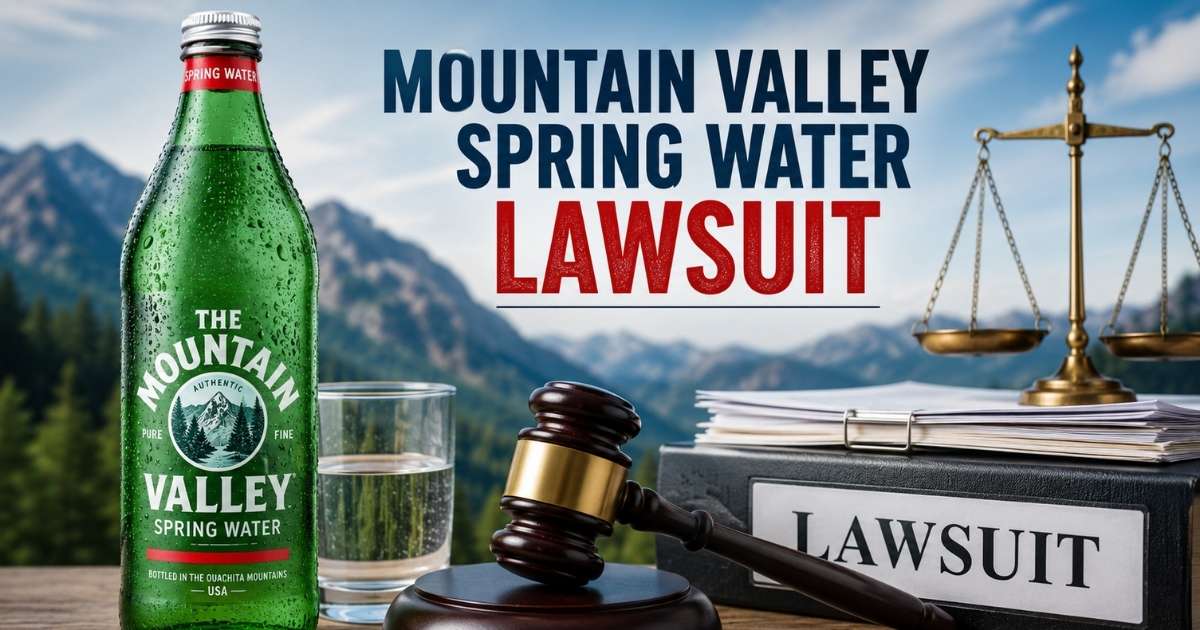

If you keep glass bottles of Mountain Valley Spring Water in your fridge, you have probably seen the headlines by now. A consumer class action filed in federal court claims this premium bottled water brand was not nearly as “pure” as its marketing promised.
This article breaks down exactly what the Mountain Valley Spring Water lawsuit alleges, who filed it, what chemicals are at the center of the dispute, and what it actually means for you as a consumer in 2026. No legal jargon, no scare tactics, just a clear look at where things stand right now.
One quick note before we dive in: this article is for general information only and is not legal advice. If you need guidance on your specific situation, talk to a licensed attorney.
Mountain Valley Spring Water Lawsuit 2026: What’s Actually Happening Right Now
As of mid-2026, the Mountain Valley Spring Water lawsuit is an active case moving through the U.S. District Court for the Southern District of Florida. It has not been dismissed, and it has not settled. The litigation is proceeding through the normal stages of a federal consumer class action.
The case is formally known as Nadel v. Primo Water Corp., et al., Case No. 9:25-cv-80993. It was filed in August 2025 and named three corporate defendants tied to the brand: Primo Water Corporation, Primo Water North America Inc., and Mountain Valley Spring Company, LLC.
Quick Status Snapshot:
| Item | Detail |
| Case name | Nadel v. Primo Water Corp., et al. |
| Case number | 9:25-cv-80993 |
| Court | U.S. District Court, Southern District of Florida |
| Filed | August 2025 |
| Status in 2026 | Active litigation, no settlement announced |
| Core claims | False advertising, fraudulent misrepresentation, consumer protection violations |
| Alleged contaminants | Uranium, arsenic, and bromoform |
Since the filing, dozens of legal news outlets have published updates tracking the case, and consumer complaints continue to surface online. There is a steady stream of commentary from people who say they trusted the brand for years and feel misled.
None of that noise changes the legal reality: this is a proposed class action, meaning it still needs court approval before it can represent the full group of affected buyers.
What Is the Mountain Valley Spring Water Lawsuit About?
At its core, the Mountain Valley Spring Water lawsuit is a false advertising and consumer protection case, not a personal injury lawsuit. The plaintiffs are not claiming the water made them sick in a direct, provable way. They are claiming they paid a premium price for a product marketed as exceptionally pure when it allegedly was not.
Mountain Valley has built its brand identity around being sourced from the Ouachita Mountains near Hot Springs, Arkansas, and marketed with phrases like “the very best bottled water you can drink,” “purely sourced,” and “exceptionally healthful.”
The lawsuit alleges that independent laboratory testing found the water contained detectable levels of uranium, arsenic, and bromoform, substances the Environmental Protection Agency treats as having no safe level of human exposure under its Maximum Contaminant Level Goal framework.
The legal theories raised in the complaint include:
- Fraudulent misrepresentation about the water’s purity
- Unjust enrichment from charging a premium based on allegedly false claims
- Breach of state consumer protection statutes
- Failure to disclose material information about contaminant testing
Here is a simple way to think about it. If you bought a car because the dealership told you it had never been in an accident, and later found out it had significant frame damage, you would feel deceived regardless of whether the car still ran fine. The plaintiffs argue something similar happened here: they paid extra for a promise of purity that testing allegedly could not back up.
The Mountain Valley Water Lawsuit: Who Filed and When
The named plaintiff behind this case is a consumer identified in court filings who purchased Mountain Valley Spring Water and later became aware of third-party testing results that raised concerns. The complaint was filed in August 2025, though public conversation about possible contamination had been building for months before that, fueled partly by testing discussions circulating on social media.
How the timeline has unfolded:
| Period | Development |
| Mid-2025 | Independent lab testing results begin circulating publicly |
| August 2025 | Formal class action complaint filed in federal court |
| Late 2025 | Case docketed, defendants respond, early motions filed |
| Early 2026 | Litigation activity continues, additional news coverage follows |
| Mid-2026 | Case remains active, no trial date or settlement confirmed |
The complaint seeks to represent a defined group of buyers rather than just the named plaintiff. Specifically, it aims to cover people who purchased glass bottles of Mountain Valley Spring Water from a retail store for personal, household, or family use, starting June 7, 2023, through the date the class is eventually certified.
That detail matters a lot. If you bought the plastic bottle version instead of glass, or purchased it exclusively for a business rather than personal use, your situation could fall outside the currently defined class, depending on how the case develops.
Key takeaway: This case traces back to consumer testing concerns raised in 2025, and it remains an open, developing matter in 2026 rather than a closed or resolved one.
Mountain Valley Spring Water Class Action Lawsuit: How It Works
A class action allows a small number of named plaintiffs to sue on behalf of a much larger group of people who experienced a similar harm, instead of forcing thousands of individuals to file separate lawsuits over relatively small amounts of money.
Here is the general path a case like this follows:
- A complaint is filed by one or more named plaintiffs
- The defendant company responds, often filing a motion to dismiss certain claims
- Both sides exchange evidence during discovery
- Plaintiffs’ attorneys ask the court to certify the class
- If certified, the case either proceeds toward trial or settlement talks intensify
- A settlement, if reached, requires court approval before payments go out
Who gets what in a typical class action:
| Party | Role |
| Named plaintiffs | File the case, may receive a modest incentive award |
| Class counsel | Attorneys representing the group, typically paid a percentage of any settlement |
| Class members | Everyone who qualifies and files a valid claim |
| Claims administrator | Neutral party that processes and pays out claims |
You do not need to hire your own attorney to benefit from a class action. If the class is certified and a settlement or verdict results in payments, qualifying consumers can typically file a claim directly through an official claims website.
Mountain Valley Spring Water Contamination Lawsuit: What Chemicals Are Involved
The contamination allegations center on three specific substances named in the complaint: uranium, arsenic, and bromoform. These were reportedly identified through independent laboratory testing conducted before the lawsuit was filed.
What each substance is and why it matters:
| Substance | What It Is | Why Regulators Watch It |
| Uranium | A naturally occurring radioactive metal | Linked to kidney damage and long-term radiation exposure risk |
| Arsenic | A naturally occurring heavy metal | Classified as a known human carcinogen at elevated exposure |
| Bromoform | A chemical byproduct, sometimes formed during water disinfection | Associated with potential cancer risk in long-term studies |
The lawsuit points out that the EPA has set a Maximum Contaminant Level Goal of zero for these three substances, meaning there is technically no level of exposure the agency considers completely without risk. That is different from the legally enforceable limit, which is usually set slightly above zero because completely eliminating trace natural minerals from water is not realistic.
This distinction is exactly where the legal argument gets interesting. The plaintiffs are not necessarily arguing the water broke the law. They are arguing the marketing promised something far cleaner than what regulatory science considers achievable, and that the gap between the promise and the product amounts to deception.
Mountain Valley Spring Water PFAS Lawsuit: The Forever Chemicals Angle
PFAS, short for per- and polyfluoroalkyl substances, has become one of the most talked about topics in bottled water and drinking water litigation nationwide over the past few years. These synthetic chemicals resist breaking down in the environment or the human body, which is why they are commonly nicknamed forever chemicals.
It is worth being precise here. The core complaint against Mountain Valley Spring Water specifically names uranium, arsenic, and bromoform as the tested contaminants, not PFAS. However, PFAS concerns have shaped the broader public conversation around bottled water brands, including Mountain Valley, as independent testing groups and social media users have raised general questions about forever chemicals in spring water sources across the industry.
Why PFAS keeps coming up in this conversation:
- The EPA finalized enforceable drinking water limits for several PFAS compounds in 2024
- PFAS contamination has been documented in groundwater near industrial and agricultural sites in multiple states
- Bottled water brands sourced from natural springs are not automatically immune, since PFAS can migrate through soil and groundwater over time
- Consumers increasingly expect brands marketed as “pure” to test for and disclose PFAS levels
If future testing or discovery in this case turns up PFAS-related evidence, it could expand the scope of the litigation. For now, the confirmed legal claims rest on the three named contaminants, and readers should treat PFAS as part of the broader industry context rather than a confirmed element of this specific complaint.
Mountain Valley Spring Water Arsenic Levels: What the Testing Shows
Arsenic is the contaminant that draws the most consumer attention, largely because it is a well-known carcinogen with clear regulatory benchmarks that make it easy to compare against.
Arsenic standards for context:
| Source | Arsenic Limit |
| EPA Maximum Contaminant Level for tap water | 10 parts per billion |
| FDA standard for bottled water | 10 parts per billion |
| EPA Maximum Contaminant Level Goal | 0 parts per billion (no safe threshold) |
Arsenic occurs naturally in many rock formations, including those found throughout the Ouachita Mountain region where Mountain Valley sources its water. That natural presence is not, by itself, illegal or unusual. Many spring water brands report trace arsenic levels.
The legal dispute is less about whether trace arsenic exists and more about whether the levels detected, combined with the brand’s marketing language, created a misleading impression for consumers who paid a premium price expecting something closer to zero contamination.
Expert witnesses, including toxicologists and water quality scientists, are expected to play a significant role as this case moves through discovery, since the specific detected concentrations and their health significance will likely be contested by both sides.
Is Mountain Valley Spring Water Safe to Drink in 2026?
This is the question most people actually want answered, and it deserves a straight response: based on publicly available information, there is no confirmed evidence that Mountain Valley Spring Water violates current FDA bottled water safety standards. The lawsuit is built on a marketing and disclosure argument, not a claim that the product is unsafe under existing federal thresholds.
That said, “meets the legal minimum” and “as pure as advertised” are two different standards, and that gap is exactly what the case is arguing about.
A balanced look at the factors:
| Factor | What We Know |
| FDA compliance | No confirmed violation of current enforceable limits as of 2026 |
| Lawsuit claim | Alleges marketing overstated purity relative to test results |
| Health risk | Long-term low-level exposure to trace contaminants remains a subject of ongoing scientific study |
| Company position | Has not publicly conceded wrongdoing |
| Consumer behavior | Some buyers have switched brands while litigation continues |
If you are personally concerned, home water filters certified to reduce arsenic, such as reverse osmosis systems, are a reasonable precaution for any drinking water source, bottled or tap. That is general health guidance, not a legal conclusion about this specific brand.
Mountain Valley Spring Water Recall: Is There an Active Recall?
There is no FDA-issued recall of Mountain Valley Spring Water as of 2026. No federal agency has ordered the product removed from shelves.
This is an important distinction that a lot of confused headlines blur together. A recall and a lawsuit are two completely different legal and regulatory processes.
Recall versus lawsuit, side by side:
| Category | Recall | Class Action Lawsuit |
| Triggered by | FDA determination of imminent risk, or voluntary company action | Private attorneys filing on behalf of consumers |
| Legal standard | Immediate health danger | Deceptive marketing, breach of consumer protection law |
| Outcome | Product pulled from shelves | Monetary compensation, possible policy changes |
| Current status | Not active | Active and ongoing |
The absence of a recall does not resolve the lawsuit’s underlying claims. Regulatory agencies and civil courts operate under different standards, and a product can remain legally sellable while still facing a legitimate false advertising claim in court.
Mountain Valley Spring Water Lawsuit: Who Qualifies to File a Claim?
Class membership eligibility, if and when the class is certified, is expected to track closely with the group described in the original complaint. Based on the filing, the proposed class covers people who bought glass bottles of Mountain Valley Spring Water from a retail store for personal, household, or family use, from June 7, 2023 forward.
General eligibility snapshot:
| Requirement | Applies |
| Purchased glass bottle Mountain Valley Spring Water | Yes |
| Purchase made at a retail store | Yes, based on current complaint language |
| Purchase for personal or household use | Yes |
| Purchase date | On or after June 7, 2023 |
| Proof of health symptoms | Not required for class membership |
| Location | U.S. consumers |
You generally do not need to show you got sick to qualify for a consumer class action like this one. The core harm alleged is financial: paying a premium price for a product that allegedly did not match its marketing claims.
Keep in mind these eligibility details could shift as the case develops, particularly if the court narrows or expands the class definition during certification proceedings.
Mountain Valley Spring Water Consumer Rights: What the Law Says
Consumers who purchase food and beverage products are protected by a layered system of federal and state laws designed to prevent deceptive marketing.
At the federal level, the FTC Act prohibits unfair or deceptive business practices, and FDA regulations set specific labeling and safety standards for bottled water. State consumer protection statutes, which vary by state, often go further, allowing individuals to sue directly for damages, attorney fees, and sometimes additional penalties.
Rights relevant to this case:
- The right to accurate marketing claims about what a product actually contains
- The right to know material facts that would affect a reasonable buying decision
- The right to join a class action without paying upfront legal fees
- The right to opt out of a class settlement and pursue an individual claim instead
Class actions exist because individual harm from something like a bottled water purchase might be small, maybe a few dollars per bottle over time, but the collective harm across millions of buyers can be substantial. That collective scale is what gives consumer class actions real legal weight.
Mountain Valley Spring Water Settlement: Where Things Stand Right Now
No settlement has been announced in the Mountain Valley Spring Water lawsuit as of mid-2026. The case remains in active litigation, with the usual pretrial steps, including discovery and pretrial motions, playing out in federal court.
Most consumer class actions settle before reaching trial, since litigation is expensive and unpredictable for both sides. That does not mean a settlement is guaranteed here, but it is a realistic possibility as the case matures.
How settlements in cases like this typically unfold:
- Discovery reveals the strength of each side’s evidence
- Mediation sessions often begin once both sides understand their risk exposure
- A tentative settlement, if reached, requires preliminary court approval
- Class members receive formal notice and a window to file claims or object
- Final court approval is needed before any money is distributed
There is currently no confirmed timeline for when, or if, a settlement will be reached in this specific case. Anyone telling you a payout date with certainty at this stage is getting ahead of the actual court record.
Mountain Valley Spring Water Class Action Settlement Amount: How Much Is On the Table?
No settlement fund amount has been publicly disclosed, because no settlement exists yet. Any specific dollar figure circulating online at this point should be treated as speculation rather than confirmed fact.
That said, looking at comparable bottled water and consumer beverage class actions can offer a useful, general sense of scale.
Comparable settlement ranges from similar past cases:
| Case Type | Typical Settlement Range |
| Smaller bottled water labeling disputes | Roughly $1 million to $10 million |
| Mid-size consumer beverage class actions | Roughly $10 million to $30 million |
| Larger contamination or nationwide class cases | $30 million or more, depending on class size |
These figures come from prior, unrelated consumer product cases and are shared only for context. They are not a prediction of what this particular case will resolve for. Final amounts depend heavily on the strength of the evidence, the size of the certified class, and negotiating leverage on both sides.
Mountain Valley Spring Water Lawsuit Payout: How Much Could You Get?
Because no settlement exists yet, there is no confirmed individual payout amount for the Mountain Valley Spring Water lawsuit. Anyone offering a specific number right now is guessing.
What we can offer is a general explanation of how payouts typically work in consumer class actions once a settlement fund is established, based on common industry patterns.
Typical factors that shape individual payouts:
- The total size of the negotiated settlement fund
- How many eligible class members actually submit valid claims
- Whether you can document your purchases with receipts or records
- Whether the settlement uses a flat payment structure or a tiered one based on purchase volume
A general rule in class actions worth understanding: the more people who file claims, the smaller each individual share tends to be, since the fund is usually fixed. Conversely, fewer claimants can mean a larger payout per person.
If and when a settlement is reached, official claim forms will specify exact payout tiers and how to qualify for each one. Until then, treat any circulating payout estimate as unofficial.
How to File a Mountain Valley Spring Water Claim
There is currently no open claims process, because the case has not settled or reached a final judgment. Filing only becomes possible once a settlement receives preliminary court approval, or the case otherwise resolves in a way that creates a payment fund.
Here is what the process will likely look like once that stage arrives, based on how similar consumer class actions have worked:
- Watch for an official class notice, typically sent by email, mail, or published through a dedicated settlement website
- Visit the official claims administrator website listed in that notice
- Confirm your eligibility based on the defined class period and purchase criteria
- Submit any available proof of purchase, such as receipts or order confirmations
- If you lack documentation, check whether the settlement allows a sworn statement instead
- Submit your claim before the stated deadline
- Watch for confirmation and eventual payment processing
What to start gathering now, just in case:
- Grocery store or retailer receipts showing Mountain Valley Spring Water purchases
- Online order confirmations from retailers or delivery services
- Bank or credit card statements showing purchases at stores that carry the brand
- Any subscription or recurring delivery records
A word of caution: never pay a third party to “register” you for a class action claim before an official settlement exists. At this stage, any site promising guaranteed payouts or requesting payment to file on your behalf should be treated as a red flag.
Mountain Valley Spring Water Lawsuit Update 2026: Latest Developments
As of mid-2026, the case continues to generate regular legal news coverage, reflecting steady activity in the docket rather than a stalled case.
What has been happening:
- The complaint has moved past initial filing into standard pretrial litigation stages
- Legal news trackers have logged updates on the case throughout early and mid-2026
- Public attention, including social media discussion, has kept consumer awareness high
- No class certification ruling, trial date, or settlement has been publicly confirmed as of this writing
What to watch for next:
| Development | Why It Matters |
| Class certification ruling | Determines whether the case proceeds as a full nationwide class action |
| Discovery outcomes | Could reveal internal testing records or company communications |
| Settlement talks | Could produce a resolution without a trial |
| Regulatory action | A future FDA review could independently affect the case’s direction |
Because federal litigation schedules can shift based on court availability, motions, and negotiation progress, the most reliable way to track this case is through official court filings (PACER) or established legal and consumer news outlets rather than social media speculation.
Frequently Asked Questions
Is there a Mountain Valley Spring Water class action lawsuit in 2026?
Yes. The case, Nadel v. Primo Water Corp., et al., remains active in the U.S. District Court for the Southern District of Florida as of 2026, with no settlement finalized yet.
Who qualifies for the Mountain Valley Spring Water lawsuit?
Based on the current complaint, eligibility generally covers people who bought glass bottles of the water from a retail store for personal or household use starting June 7, 2023.
How much money could I get from this lawsuit?
No settlement or payout amount has been confirmed. Any specific dollar figure you see online right now is speculation, not an official number.
What contaminants are named in the lawsuit?
The complaint specifically names uranium, arsenic, and bromoform as substances allegedly detected through independent testing.
Is Mountain Valley Spring Water currently recalled?
No. There is no FDA-mandated recall on the product as of 2026. The lawsuit and a product recall are separate legal processes.
Is PFAS part of the official lawsuit?
Not directly. The core complaint centers on uranium, arsenic, and bromoform. PFAS concerns are part of the broader industry conversation around bottled water but are not the named claims in this specific case.
Do I need a lawyer to join the class action?
No. If the class is certified and a settlement is reached, eligible consumers typically file claims directly without hiring individual attorneys.
When will the case be resolved?
There is no confirmed timeline. Federal class actions commonly take one to several years to reach certification, trial, or settlement.
Final Thoughts
The Mountain Valley Spring Water lawsuit is a real, active case built around a straightforward question: did the marketing match what was actually in the bottle. The court has not yet answered that question, and no settlement or payout has been finalized.
If you have purchased this brand in recent years, the smartest move right now is simply to stay informed and hold onto any receipts or order records you can find. There is no claims process to join yet, and there is no need to pay anyone or rush into anything based on unofficial payout estimates circulating online.
Keep checking verified legal news sources and official court records as this case moves through 2026. When there is real news, meaning a certified class or a confirmed settlement, it will be reported clearly, with actual numbers and actual deadlines attached.

1 thought on “Mountain Valley Spring Water Lawsuit: Latest Updates, Claims & Settlement News (2026) ”