


The crash was over in seconds. Now your neck aches, the car is at a body shop, and a friendly insurance adjuster keeps calling to “check in.”
Then comes the question that keeps people awake at night: do I need a personal injury lawyer, or am I about to spend money I don’t have on a problem I can fix myself?
The honest answer is neither a simple yes nor a simple no. It depends on how badly you were hurt, who was at fault, and how the insurance company is treating you right now.
Some people settle small claims on their own and walk away satisfied. Others sign a quick settlement, discover a month later that their injury is permanent, and learn the door has already closed.
Table of Contents
Do You Need a Personal Injury Lawyer?

You likely need a personal injury lawyer if you have serious injuries, disputed fault, long-term medical needs, lost income, or an insurer that is denying or lowballing your claim.
You may not need one if your injuries were minor, you fully recovered quickly, fault is undisputed, and the settlement covers every bill.
The safest middle path is a free consultation. Most personal injury attorneys offer one, and a single conversation costs you nothing.
Key Takeaways
- Serious or permanent injuries almost always justify hiring an attorney.
- Minor injuries with clear fault can often be handled directly with the insurer.
- Most personal injury lawyers work on contingency, so you pay nothing upfront.
- Deadlines called statutes of limitations can end your claim permanently.
- Early settlement offers are usually lower than what your claim is truly worth.
- A free consultation lets you decide with real information.
What Is a Personal Injury Claim?
A personal injury claim is a request for compensation after someone else’s carelessness or wrongdoing causes you physical or emotional harm.
It usually starts with an insurance claim. If negotiations fail, it can become a lawsuit filed in civil court.
Definition: Personal Injury Law
Personal injury law, also called tort law, lets injured people recover money from the party responsible for their harm. The goal is to make you financially whole again, as far as money can.
The Four Elements You Must Prove
Most injury claims rest on negligence. To win, you generally need to show four things.
- Duty of care: The other party owed you a responsibility to act safely.
- Breach: They failed to meet that responsibility.
- Causation: Their failure directly caused your injury.
- Damages: You suffered measurable losses.
Each element needs evidence. Missing even one can sink an otherwise sympathetic case.
Common Types of Personal Injury Cases
Personal injury covers a wide range of situations. The most common include:
- Car, motorcycle, and truck accidents
- Slip and fall and premises liability accidents
- Dog bites and animal attacks
- Medical malpractice
- Defective products and product liability
- Workplace injuries tied to third parties
- Nursing home abuse and neglect
- Wrongful death
Do I Need a Lawyer for a Personal Injury Claim?
Legally, no. You have every right to represent yourself, and no law forces you to hire an attorney.
Practically, the question is whether you can match the knowledge and resources sitting on the other side. Insurance companies employ adjusters, investigators, and defense lawyers who handle claims every day.
Your claim may be the first one you have ever filed. That imbalance is the main reason people seek representation.
Why Insurers Are Not Neutral
An insurance adjuster may sound kind, but the company’s goal is to resolve claims for as little as reasonably possible. That is business, not a personal attack.
Adjusters are trained to look for reasons to reduce value. They may point to a gap in treatment, a pre-existing condition, or a shared portion of blame.
The Real Cost of Going Without Representation
Handling a claim yourself saves attorney fees. It can also cost you in ways that are hard to see.
You might undervalue future medical care, miss a deadline, or accept a release that ends your rights forever. These errors rarely feel like errors until it is too late to fix them.
When to Hire a Personal Injury Lawyer
Certain situations raise the stakes enough that hiring an attorney becomes the smart default. If any of the following sounds familiar, speak with a lawyer soon.
You Suffered Serious or Permanent Injuries
Broken bones, spinal injuries, traumatic brain injuries, burns, and amputations carry costs that stretch for years. Surgeries, rehabilitation, and lost earning capacity are hard to estimate alone.
A lawyer can work with doctors and economists to calculate what your future will really cost.
Fault Is Disputed or Unclear
If the other driver blames you, or witnesses disagree, the case turns on evidence. Surveillance footage, black box data, and accident reconstruction can decide who wins.
Attorneys know how to preserve this evidence before it disappears.
Multiple Parties Are Involved
Chain-reaction crashes, commercial vehicles, and property owners with contractors create layers of liability. Each party may have its own insurer pointing the finger elsewhere.
Sorting out who owes what is complex work.
The Insurance Company Denied or Lowballed Your Claim
A denial, a sudden silence, or an offer that barely covers your ER bill signals trouble. Lawyers know how to respond and when to push for a lawsuit.
Many insurers raise their offers once they see a serious attorney involved.
You Are Missing Work or Losing Income
Lost wages, reduced hours, and damaged career prospects are recoverable damages. Proving them takes documentation and sometimes expert testimony.
If your injury changes the kind of work you can do, representation becomes even more valuable.
A Loved One Died
Wrongful death claims involve strict rules about who can file and how damages are calculated. Grieving families should not have to learn this alone.
A Government Entity or Large Company Is Involved
Claims against cities, states, or federal agencies often require formal notice within very short windows. Some deadlines are measured in months, not years.
Large corporations also bring teams of defense attorneys.
You Are Being Pressured to Sign Something
Never sign a release, medical authorization, or settlement document you do not fully understand. A release usually ends your claim permanently.
Do I Need a Personal Injury Lawyer for a Car Accident?

Car accidents generate the largest share of injury claims. Whether you need counsel depends on injury severity, fault, and insurance coverage.
When a Car Accident Lawyer Is Strongly Recommended
Consider hiring an attorney if any of these apply:
- You were taken to the hospital by ambulance
- You have ongoing pain, surgery, or physical therapy
- The other driver was uninsured or underinsured
- Fault is being argued
- A commercial truck or rideshare vehicle was involved
- The insurer is delaying or denying your claim
Uninsured and Underinsured Motorist Claims
If the at-fault driver has no insurance, you may need to claim through your own uninsured motorist coverage. That means negotiating with your own insurer, which can become adversarial.
Underinsured motorist coverage applies when the other driver’s limits are too low to cover your losses.
No-Fault vs. At-Fault States
Some states, such as Michigan and New York, use no-fault systems. Your own insurer pays certain medical expenses regardless of who caused the crash.
Lawsuits against the at-fault driver in no-fault states are often limited to more serious injuries. Knowing whether you meet that threshold is a legal question worth asking an attorney.
When a Minor Fender Bender May Not Need a Lawyer
If nobody was hurt and only property was damaged, you can usually handle the repair claim directly. If you felt fine at the scene but pain appears days later, get medical care and reconsider.
Soft tissue injuries often show up slowly.
When You May Not Need a Personal Injury Lawyer
Honest legal advice includes admitting that not every claim needs a lawyer. Handling it yourself can be reasonable in limited situations.
Your Injuries Were Truly Minor
If you had a small bruise or a brief ache that resolved within days, the claim may be simple. Medical bills are low and recovery is complete.
Fault Is Clear and Admitted
When the other party accepts responsibility and their insurer is cooperative, there is less to argue about. The process can be straightforward.
The Offer Covers Everything
A fair offer should cover all medical bills, lost wages, property damage, and some compensation for pain. Compare the number against your total documented losses before accepting.
Your Claim Is Within Small Claims Limits
Small claims court allows people to sue without a lawyer, and each state sets its own dollar cap. If your total losses fall under that limit, self-representation may be practical.
Checklist: Can You Safely Handle It Alone?
Answer yes or no to each item.
- My injuries were minor and I have fully recovered.
- My doctor confirms no future treatment is needed.
- The at-fault party clearly accepted responsibility.
- I have a record of every bill and missed paycheck.
- The insurance company has not denied or delayed my claim.
- I understand what I would be giving up by signing a release.
If you answered no to any of these, speak with a lawyer first.
Personal Injury Lawyer vs. Handling the Claim Yourself
Seeing the two paths side by side makes the decision easier.
| Factor | Hiring a Lawyer | Handling It Yourself |
|---|---|---|
| Upfront cost | Usually none under contingency | None |
| Attorney fee | Commonly a percentage of recovery | None |
| Time commitment | Lawyer manages most tasks | You handle every call and form |
| Claim valuation | Based on current and future losses | Often based on current bills only |
| Evidence gathering | Investigators and experts available | Limited to what you can collect |
| Negotiation | Experienced and prepared to sue | Insurer knows you may not litigate |
| Deadline tracking | Handled by the firm | Your responsibility |
| Best for | Serious, disputed, or complex claims | Minor injuries with clear fault |
What Does a Personal Injury Lawyer Do?
A personal injury attorney manages your claim from the first call until the money arrives. Their work goes far beyond appearing in court.
Investigating the Accident
Lawyers collect police reports, photographs, witness statements, and surveillance video. They may hire experts to reconstruct the scene.
Fast action matters because evidence fades and businesses overwrite footage.
Gathering Medical Records and Bills
Your attorney organizes records that connect your injuries to the accident. They also track billing codes, insurance payments, and balances.
Clear documentation is often what separates strong claims from weak ones.
Calculating Damages
Experienced counsel counts every category of loss, including future care and reduced earning capacity. They also assign a value to pain and suffering using accepted methods.
Dealing With Insurance Adjusters
Once you hire a lawyer, the insurer communicates with the attorney instead of you. That alone protects you from accidental admissions.
Negotiating the Settlement
Most claims resolve through negotiation. Your lawyer sends a demand package and negotiates until the offer reflects the claim’s value.
Filing a Lawsuit When Needed
If talks stall, an attorney can file suit before the deadline. Many cases settle after filing because the insurer must now face discovery and possible trial.
Handling Liens and Medical Bills
Health insurers, Medicare, Medicaid, and hospitals may demand repayment from your settlement. Lawyers negotiate these liens so more of the money stays with you.
How Much Does a Personal Injury Lawyer Cost?

Cost is the biggest worry for most people, and it is often the reason they delay calling.
The good news is that the fee structure is designed to remove that barrier.
Contingency Fees Explained
Most personal injury attorneys work on contingency. You pay no attorney fees unless the case produces a recovery.
If you win or settle, the lawyer takes an agreed percentage. If you recover nothing, you typically owe no fee.
Typical Fee Percentages
Many firms charge around one-third of the recovery. The percentage may rise, often toward 40 percent, if the case goes to litigation or trial.
Fees vary by state, firm, and case type, and some states regulate them. Always read the fee agreement carefully.
Case Costs vs. Attorney Fees
Attorney fees and case costs are different things. Costs include filing fees, medical record charges, expert witnesses, and court reporters.
Ask whether costs come out before or after the fee is calculated, because that changes your final payout.
Sample Settlement Breakdown
This simplified example is for illustration only.
| Item | Amount |
|---|---|
| Gross settlement | $60,000 |
| Attorney fee at 33.3% | $20,000 |
| Case costs | $2,500 |
| Medical liens negotiated | $12,000 |
| Net to client | $25,500 |
Actual numbers depend on your agreement, your state, and your lien holders.
Does a Lawyer Really Pay for Themselves?
That depends on the case. For serious injuries, representation often results in a higher net recovery even after fees.
For minor claims, the fee may eat a large share of a small settlement. This is why an honest attorney will sometimes tell you that you do not need one.
Free Consultation: What to Expect
A free consultation is a no-risk way to get answers. You are interviewing the attorney as much as they are evaluating your case.
What to Bring
Gather what you have before the meeting.
- Photos of the scene, injuries, and property damage
- Police or incident report number
- Medical records and bills
- Insurance information for all parties
- Pay stubs showing lost income
- Any letters or emails from insurers
You can still book the meeting without all of these.
Questions to Ask the Attorney
Use the meeting to learn how the firm operates.
- Have you handled cases like mine?
- Who will actually work on my case day to day?
- What is your fee and how are costs handled?
- What is a realistic timeline?
- How often will you update me?
- Do you take cases to trial if needed?
Warning Signs of a Bad Fit
Walk away if a lawyer guarantees a specific payout, pressures you to sign immediately, or avoids discussing fees. No honest attorney can promise results.
Also be cautious if you cannot reach anyone after the first meeting.
The Statute of Limitations: A Deadline You Cannot Ignore
Every state sets a time limit for filing an injury lawsuit. Miss it, and the court will almost always dismiss your case, no matter how strong it was.
How Long Do You Have?
Deadlines vary widely across the country. Some states allow only one year, while others allow as many as six.
Many states fall in the two to three year range for general personal injury claims. Your state’s exact rule depends on the type of claim.
Exceptions That Change the Clock
Deadlines can shift in special circumstances.
- Minors: The clock often pauses until the child turns 18.
- Delayed discovery: The clock may start when you discover the injury, not when it happened.
- Government claims: Short notice periods may apply before you can sue.
- Medical malpractice: Special rules and shorter windows are common.
Why Waiting Hurts Even Before the Deadline
Evidence disappears, witnesses forget, and medical records get harder to link to the accident. Waiting also gives the insurer a reason to question how serious you really were.
Act early, even if the deadline seems far away.
How Insurance Companies Handle Injury Claims
Understanding the insurer’s playbook helps you protect yourself, with or without a lawyer.
The Quick Settlement Offer
Insurers sometimes offer money within days of an accident. It can feel like relief, but you may not yet know the full extent of your injuries.
Once you accept and sign a release, you cannot ask for more later.
Recorded Statements
An adjuster may ask for a recorded statement. You are generally not required to give one to the other driver’s insurer.
Casual comments like “I’m fine” can be used to argue your injuries are minor.
Common Tactics to Watch For
- Disputing the medical necessity of your treatment
- Blaming a pre-existing condition
- Pointing to gaps in treatment
- Arguing you share fault for the accident
- Requesting broad medical record access
- Stalling until you feel desperate for money
Comparative Negligence and Your Share of Blame
Many states reduce your recovery by your percentage of fault. Under pure comparative negligence, you can still recover even if mostly at fault.
Under modified comparative rules, you may be barred if your fault passes 50 or 51 percent, depending on the state. A few places follow strict contributory negligence, where any fault by you can block recovery.
Types of Injury Cases and Whether You Need a Lawyer
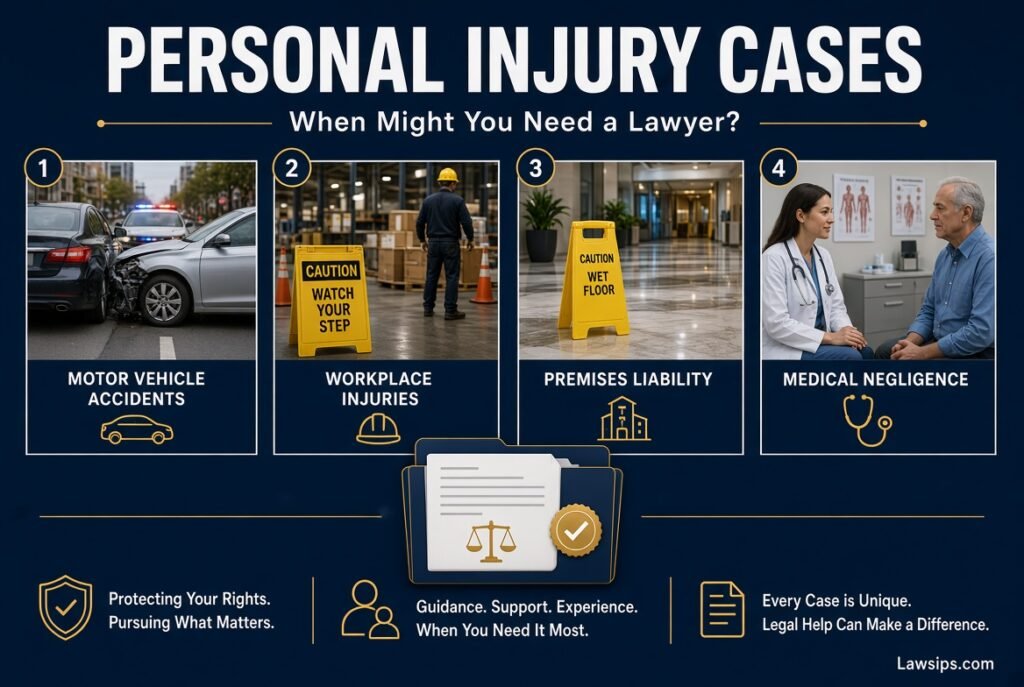
Some case types are more complicated than others. Here is how the most common ones usually play out.
Slip and Fall Accidents
Premises liability claims require proof that the owner knew or should have known about a hazard. Surveillance footage and maintenance logs matter greatly.
Property owners often deny responsibility, so legal help is common for anything beyond a minor injury.
Dog Bite Injuries
Dog bite laws vary by state, with some imposing strict liability and others requiring proof of prior aggression. Homeowner’s insurance often covers these claims.
Scarring and infections can create long-term damages worth discussing with counsel.
Medical Malpractice
These cases are among the hardest. Many states require expert opinions before filing, and the cost of experts can be high.
Because of that complexity, nearly all malpractice victims need a specialized attorney.
Product Liability and Defective Products
When a defective product causes harm, you may have claims against the manufacturer, distributor, or retailer. Large injury cases can become consolidated litigation involving thousands of plaintiffs.
Real examples include the 3M earplug lawsuit, where hearing damage claims were pursued at scale, and consumer product disputes such as the Olaplex lawsuit.
Drug and Medical Device Claims
Injuries from medications often involve mass tort litigation. These cases are expensive to prepare, which is why they are typically handled by firms with major resources.
The Ozempic lawsuit involving Morgan and Morgan shows how large firms get involved in drug injury litigation.
Truck Accidents
Commercial trucking crashes involve federal regulations, driver logs, and company liability. Trucking companies often send rapid response teams to the scene.
These claims almost always warrant professional representation.
Workplace Injuries
Workers’ compensation usually covers on-the-job injuries and generally limits your right to sue your employer. You may still have a third-party claim against a negligent outside company.
A workers’ comp attorney can help if a claim is denied or underpaid.
Wrongful Death
Surviving family members can seek compensation for funeral costs, lost income, and loss of companionship. Rules on who may file vary by state.
Rideshare and Gig Delivery Accidents
Insurance for rideshare and delivery drivers depends on whether the app was active at the time. Coverage layers can be confusing, and companies often dispute responsibility.
Disputes involving app-based companies, like the DoorDash lawsuit, show how contested these relationships can be.
Class Actions vs. Individual Claims
A class action combines many similar claims into one lawsuit. It works well for small, widespread harms like billing or product defects.
Serious personal injuries usually need individual claims because each person’s damages differ. You can see how class action cases work in the Netflix class action lawsuit overview.
What Is Your Personal Injury Claim Worth?
No honest attorney can name a number before reviewing your records. Value depends on the facts of your case.
Economic Damages
These are losses with a clear price tag.
- Emergency and hospital bills
- Surgery and follow-up care
- Physical therapy and medication
- Lost wages and benefits
- Future medical expenses
- Property damage
- Reduced earning capacity
Non-Economic Damages
These cover losses that are real but harder to measure.
- Pain and suffering
- Emotional distress
- Loss of enjoyment of life
- Scarring or disfigurement
- Loss of companionship
Punitive Damages
In rare cases involving reckless or intentional conduct, courts may award punitive damages. They punish the wrongdoer rather than compensate you, and many states cap them.
Factors That Raise or Lower Value
| Factor | Effect on Claim |
|---|---|
| Severity and permanence of injury | Higher |
| Strong medical documentation | Higher |
| Clear liability | Higher |
| Treatment gaps | Lower |
| Shared fault | Lower |
| Low policy limits | Caps recovery |
| Pre-existing conditions | Can complicate |
Are Settlements Taxable?
Compensation for physical injuries is generally not taxed at the federal level, but punitive damages and interest usually are. Rules vary, so confirm with a tax professional.
What to Do Right After an Injury
What you do in the first days can shape the entire claim. These steps help whether or not you hire a lawyer.
Step-by-Step Checklist
- Get medical care immediately. Your health comes first, and records create proof.
- Call the police. An official report documents the facts.
- Take photos and video. Capture the scene, injuries, and property.
- Collect contact information. Get names and numbers for witnesses and drivers.
- Avoid admitting fault. Even polite apologies can be misread.
- Report the incident. Notify the property owner, employer, or your insurer as required.
- Keep a pain journal. Note symptoms, appointments, and missed activities.
- Save every receipt and bill. Organize them in one folder.
- Stay off social media. Posts can be used against you.
- Speak with an attorney. Do this before signing anything.
Why Prompt Medical Treatment Matters
Insurers often argue that delayed treatment means the injury was not serious. Following your doctor’s plan also shows that you take your recovery seriously.
Common Mistakes That Hurt Injury Claims
Avoiding a few simple errors can protect thousands of dollars.
Accepting the First Offer
Early offers rarely include future costs. Wait until you understand your full recovery.
Skipping Doctor Visits
Missed appointments give insurers ammunition. Attend all recommended care.
Posting on Social Media
A vacation photo can undermine a pain claim. Set accounts to private and avoid discussing the accident.
Giving Recorded Statements Without Advice
Unprepared statements can be twisted. Speak with counsel first.
Signing Medical Authorizations Too Broadly
Blanket authorizations let insurers dig through years of unrelated records. Limit access to relevant treatment.
Missing the Deadline
Courts rarely forgive late filings. Mark your state’s statute of limitations as soon as possible.
Exaggerating Your Injuries
Dishonesty destroys credibility and can end a claim. Accurate records are your strongest tool.
How to Choose the Right Personal Injury Lawyer
Not every attorney is equal, and the best fit depends on your case.
Look for Specialization
Choose a lawyer who focuses on injury law rather than a general practitioner. Case type experience matters, whether it involves trucks, malpractice, or products.
Check Credentials and Discipline History
Verify the attorney’s license through your state bar association. The American Bar Association offers resources for finding and evaluating lawyers at americanbar.org.
Review Results and Reputation
Look at verified client reviews and published case results. Remember that past outcomes do not guarantee future results.
Ask About Trial Experience
Insurers watch which firms are willing to go to court. A lawyer with real trial experience carries more negotiating weight.
Evaluate Communication
Responsive communication is a top complaint in the legal field. Ask how updates are delivered and who answers your calls.
Compare Firm Size
| Firm Type | Pros | Cons |
|---|---|---|
| Large firm | Deep resources and experts | May feel impersonal |
| Mid-size firm | Balanced resources and attention | Varies by firm |
| Solo practitioner | Personal service | Limited capacity for huge cases |
How Long Does a Personal Injury Case Take?
Timelines vary widely. Simple claims can resolve in a few months, while complex ones can take years.
Typical Stages
- Medical treatment: Recovery usually must be well underway before a claim is valued.
- Investigation: Evidence and records are gathered.
- Demand letter: Your attorney presents the claim to the insurer.
- Negotiation: Offers and counteroffers are exchanged.
- Lawsuit filing: This begins if negotiation fails.
- Discovery: Both sides exchange information and take depositions.
- Mediation or trial: Most cases settle before a jury decides.
What Slows Cases Down
Ongoing treatment, disputed fault, multiple defendants, and crowded court calendars all stretch timelines. Settling too early to avoid the wait can cost you more than patience would.
Do I Need a Personal Injury Lawyer? Decision Matrix
Use this table as a fast gut check.
| Your Situation | Lawyer Recommended? |
|---|---|
| Minor bruise, fully healed, clear fault | Probably not |
| Soft tissue pain lasting weeks | Consult first |
| Surgery or hospital stay | Yes |
| Permanent injury or disability | Yes |
| Fault disputed | Yes |
| Uninsured at-fault driver | Yes |
| Insurer denied the claim | Yes |
| Commercial vehicle involved | Yes |
| Medical malpractice | Yes |
| Death of a loved one | Yes |
| Government agency involved | Yes |
| Property damage only | Probably not |
Special Situations Worth Knowing About
If You Were Partly at Fault
Shared blame does not always end your claim. Depending on your state, you may still recover a reduced amount.
Because blame percentages are negotiated, legal guidance can make a major difference.
If You Have No Health Insurance
Treatment is still essential. Some providers agree to wait for payment from a settlement, and lawyers can sometimes help arrange this.
If You Are an Undocumented Immigrant
You generally have the right to seek compensation for injuries regardless of immigration status. Concerns about reporting are valid, so speak with an attorney who understands them.
If the Injury Happened Out of State
The law of the state where the accident occurred often applies. Choosing a lawyer licensed there is important.
If You Are Dealing With Medicare or Medicaid
These programs may have repayment rights from your settlement. Failing to address them can create serious problems, and attorneys handle these steps routinely.
If a Child Was Injured
Settlements for minors often require court approval to protect the child’s interests. Special rules may apply to funds and deadlines.
Trusted Resources for Injury Victims
Reliable information helps you make sound decisions. These organizations provide legitimate guidance.
- National Highway Traffic Safety Administration (NHTSA): Crash data and vehicle safety recalls at nhtsa.gov.
- Centers for Disease Control and Prevention (CDC): Injury prevention and public health data at cdc.gov.
- Legal Information Institute at Cornell Law School: Plain-language explanations of legal terms at law.cornell.edu.
- State bar associations: Lawyer licensing, discipline records, and referral services.
- State insurance departments: Consumer complaints and insurer regulation.
Also Read:
- Panera Class Action Lawsuit: Full Guide for 2026
- Blue World Pools Lawsuit 2026: Latest Updates & Claims
- Red Bull Wings Lawsuit 2026: Latest Updates & Claims
- Symple Lending Lawsuit 2026: Latest Updates & Claims
- Chaturbate Lawsuit 2026: Latest Updates & Claims
- DoorDash Lawsuit 2026: Claims, Settlements & Latest Updates
- Facebook Lawsuit Settlement Payments Latest Update 2026
- Hailey Welch Lawsuit 2026: Settlements, Payouts & Deadlines
- Netflix Class Action Lawsuit 2026: Latest Updates & Claims
- Select Home Warranty Lawsuit 2026: Latest Updates & Claims
- Popeyes Lawsuit 2026: Claims, Payouts and How to File
- Fortnite Lawsuit 2026: Claim Guide, Payouts and Deadlines
- Ozempic Lawsuit Morgan and Morgan Update 2026
- ASAP Tickets Lawsuit 2026: Are You Owed a Settlement?
- Affirm Lawsuit 2026: Class Action, Payouts & Your Rights
- Biote Lawsuit 2026: Claims, Risks & How to File
- Spectrum Lawsuit 2026: Eligibility, Payouts & How to File
- Temu Lawsuit 2026: Latest Updates, Claims, Settlement Status & What Consumers Should Know
- 3M Earplug Lawsuit 2026: Latest Updates, Settlement, Payouts & Who May Qualify
- Olaplex Lawsuit 2026: Settlement, Payouts, How to File
- Always Pads Lawsuit 2026: Claims, Payout & Who Qualifies
- Brita Lawsuit 2026: Settlement Payouts and How to File
Frequently Asked Questions (FAQs)
Do I need a personal injury lawyer for a minor accident?
Usually not, if your injuries were minor, you recovered fully, and fault is clear. Still, keep records and think twice before signing a release.
Do I need a personal injury lawyer if the accident was my fault?
You may still have a claim if another party shares blame. Many states reduce your recovery rather than eliminate it, so a consultation is worthwhile.
Can I file a personal injury claim without a lawyer?
Yes. You can negotiate directly with the insurer or file in small claims court. The risk is undervaluing your claim or missing a deadline.
How much does a personal injury lawyer cost?
Most work on contingency and charge a percentage of your recovery, often around one-third. You generally owe no fee if you lose.
What does contingency fee mean?
It means the lawyer is paid only if you recover money. The fee comes out of the settlement or verdict.
Do personal injury lawyers offer free consultations?
Most do. It is a risk-free way to learn whether your claim has merit.
How soon should I hire a lawyer after an accident?
As soon as is practical, ideally before speaking at length with insurers. Early involvement helps preserve evidence.
What if I already talked to the insurance company?
You can still hire a lawyer. Share exactly what was said, and avoid signing anything further until you get advice.
Should I accept the first settlement offer?
Rarely. Early offers often fail to reflect future medical needs or lost income.
How long do I have to file a personal injury lawsuit?
It depends on your state and claim type. Deadlines range from about one year to six years, with two or three years common.
What happens if I miss the statute of limitations?
The court will usually dismiss your case, and you lose the right to compensation. Exceptions are narrow.
Will my case go to trial?
Most cases settle without trial. A lawyer willing to try cases strengthens your negotiating position.
How long does a personal injury case take?
Simple claims may settle in months, while complex cases can take years. Ongoing treatment and disputed fault add time.
How is pain and suffering calculated?
Insurers often use a multiplier of medical costs or a per-day method. There is no universal formula, and results vary.
Can I afford a lawyer if I have no money?
Yes. Contingency arrangements mean you do not pay upfront for attorney fees.
What if the at-fault driver has no insurance?
You may be able to claim under your own uninsured motorist coverage. Review your policy and speak with an attorney.
Do I need a lawyer for a slip and fall?
For anything beyond a minor injury, it is wise. Proving the owner knew about the hazard can be difficult alone.
Do I need a lawyer for a dog bite?
Serious bites with scarring or infection justify legal help. Rules on owner liability vary by state.
Do I need a lawyer for a workers’ compensation claim?
Not always, but denials, disputes, and permanent injuries often call for one. You may also have a separate third-party claim.
Do I need a lawyer for medical malpractice?
Yes, in nearly every case. These claims require expert testimony and detailed medical knowledge.
Can I switch lawyers if I am unhappy?
Generally yes. Review your fee agreement first, because the former lawyer may claim fees for work already done.
Are settlements taxable?
Compensation for physical injuries is generally not federally taxable, but punitive damages and interest usually are. Check with a tax professional.
Will I have to pay my medical bills from the settlement?
Often yes. Health insurers, hospitals, and government programs may have repayment rights, and lawyers can negotiate them down.
Can I still recover if I was partly to blame?
In many states, yes, though your payout is reduced by your share of fault. Some states bar recovery above a certain percentage.
Do I need a lawyer to sue a company?
Suing a corporation is complex because companies have legal teams and insurers. Representation levels the playing field.
What if my injury got worse after I settled?
Typically, a signed release prevents reopening the claim. That is why waiting until your condition stabilizes is so important.
Can a family member file a claim for me?
If you are a minor or legally incapacitated, a parent or guardian may file for you. Otherwise, you generally bring the claim yourself.
What documents do I need to start a claim?
Medical records, bills, an accident report, photos, insurance details, and proof of lost income are the core items.
Can I get a lawyer if the accident happened years ago?
It depends on the deadline in your state and any exceptions. Contact an attorney quickly to find out.
What is a demand letter?
A demand letter outlines your injuries, losses, and the amount you seek. It starts formal settlement negotiations.
What is the difference between a settlement and a verdict?
A settlement is a negotiated agreement. A verdict is a decision made by a judge or jury after trial.
Should I hire a local lawyer or a national firm?
Local lawyers know area courts and judges, while national firms offer resources for large cases. Pick based on your claim’s complexity.
Can I negotiate a lawyer’s fee?
Sometimes, especially in high-value cases. Ask before signing.
Does hiring a lawyer make the insurer treat me worse?
No. Insurers deal with attorneys every day, and representation often leads to more serious engagement.
What if the lawyer drops my case?
Attorneys may withdraw if they believe the case lacks merit. Ask for the reason in writing and watch your filing deadline.
What is a pre-existing condition issue?
Insurers may argue your pain existed before the accident. You can still recover if the accident aggravated the condition.
How do I know if my lawyer is doing a good job?
You should receive clear updates, prompt replies, and honest advice about your case’s strengths and risks.
Is a lawyer worth it for a whiplash injury?
If whiplash lingers for weeks or requires therapy, a consultation is reasonable. Soft tissue claims are often heavily disputed.
Can I get compensation for emotional distress?
Yes, as part of non-economic damages. Documentation from a therapist or doctor strengthens the claim.
Conclusion
If your injuries are serious, your claim is contested, or the insurer is pushing back, the answer is very likely yes. If you bounced back quickly and the offer covers every loss, you may be fine handling it yourself.
The smartest first step costs nothing. Book a free consultation, bring your records, and ask whether your case truly needs representation.
Time matters because evidence fades and deadlines do not wait. Protect your health first, document everything, and decide with facts rather than pressure.
This article provides general information, not legal advice. Laws differ by state, so consult a licensed attorney about your specific situation.

3 thoughts on “Do I Need a Personal Injury Lawyer? What to Know Before You Decide in 2026”