


A postcard arrives in your mailbox. It looks official, but it is covered in legal language, and the first line says you may be entitled to payment from a company you bought something from years ago.
Most people toss it. Some assume it is a scam. A few wonder whether it might be real money.
That small piece of mail is often a class action notice, and it can decide whether you receive a payment, give up a right to sue or do nothing and lose both options.
A class action lawsuit lets one person sue on behalf of thousands, sometimes millions, of people who were harmed in the same way. It is one of the most powerful tools in civil law, and also one of the most misunderstood.
Table of Contents
What Is a Class Action Lawsuit?
A class action lawsuit is a case in which one or a few people, called lead plaintiffs, sue a defendant on behalf of a larger group, called the class, who suffered similar harm. A judge must approve the case as a class action, which is called certification, before it proceeds as a group case.
If the case settles or wins, class members usually receive money or other relief, and they generally do not pay legal fees out of pocket. Lawyers are typically paid from the settlement, with court approval.
Key Takeaways
- A class action combines many similar claims into one case.
- A judge must certify the class before the case can proceed as a group action.
- In many damages cases, you are included automatically unless you opt out.
- You usually must file a claim form to actually receive money.
- Opting out lets you sue on your own but means you give up the class settlement.
- Attorney fees are normally paid from the settlement and approved by the court.
- Deadlines for claims, opt-outs and objections are strict.
What Is a Class Action Lawsuit?
A class action is a type of civil lawsuit that lets a group with a common problem bring one case together. Instead of thousands of separate lawsuits over the same issue, the court handles the dispute once.
It exists for practical reasons. Many harms are too small for one person to justify the cost of suing, such as a hidden fee of a few dollars, but they add up to a large wrong when repeated across a huge number of customers.
Common Terms You Will See
| Term | Meaning |
|---|---|
| Lead plaintiff (class representative) | The person who files and represents the group |
| Class members | People who fit the class definition |
| Class counsel | Lawyers appointed to represent the whole class |
| Defendant | The company or party being sued |
| Certification | The judge’s approval for the case to proceed as a class action |
| Notice | Official communication telling class members about the case |
| Opt-out | A formal request to leave the class |
| Claim form | The document you submit to receive settlement money |
| Settlement fund | The money the defendant agrees to pay |
| Fairness hearing | A court hearing on whether the settlement is fair |
How It Differs from an Individual Lawsuit
| Feature | Individual Lawsuit | Class Action |
|---|---|---|
| Number of plaintiffs | One or a few | One representative for many |
| Who decides strategy | The plaintiff and lawyer | Class counsel, supervised by the court |
| Court approval of settlement | Usually not required | Required |
| Typical payout per person | Can be large | Often modest |
| Cost to participants | Contingency fee or hourly rates | Usually no upfront cost |
| Your control | High | Limited unless you opt out |
Why Class Actions Exist
Courts and lawmakers created class actions to solve a basic problem: wrongs can be widespread but individually small.
Access to Justice
A person who lost $20 to an unlawful fee cannot afford to hire a lawyer. A class action pools those claims so the case makes economic sense.
Efficiency for Courts
Hearing one case instead of thousands saves time and avoids conflicting rulings on the same facts.
Deterrence
When companies know that widespread misconduct can lead to large liability, they have a stronger reason to follow the law.
Consistent Outcomes
A single ruling treats similar victims alike, rather than letting different judges decide the same issue differently.
Types of Class Action Lawsuits
Class actions arise in many areas of law. The most common categories involve consumers, workers, investors and patients.
| Category | Examples of Claims |
|---|---|
| Consumer protection | Deceptive advertising, hidden fees, misleading labels |
| Product liability | Defective or unsafe products |
| Data breaches and privacy | Exposed personal information, improper data sharing |
| Employment | Unpaid wages, misclassification, discrimination |
| Securities | Misleading statements affecting investors |
| Antitrust | Price fixing and anticompetitive practices |
| Financial services | Unfair lending, bank fees, debt collection violations |
| Environmental | Contamination affecting a community |
| Pharmaceutical and medical | Harmful drugs or devices |
| Gig economy and tech | Pay practices and platform policies |
You can see how different cases are covered in our reports on the DoorDash lawsuit, the Panera class action lawsuit and the Facebook lawsuit settlement payments.
Class Action vs Mass Tort vs MDL
People often confuse these terms. They are related but not identical.
| Type | What It Means |
|---|---|
| Class action | One case represents the whole class, and members share one outcome |
| Mass tort | Many individual plaintiffs bring separate claims about the same product or event |
| MDL (multidistrict litigation) | Federal procedure that groups similar cases before one judge for pretrial handling |
In a mass tort, each plaintiff’s injuries and damages are evaluated separately, which often leads to different payouts. In a class action, members typically share a common formula or fund.
How a Class Action Lawsuit Works: Step by Step
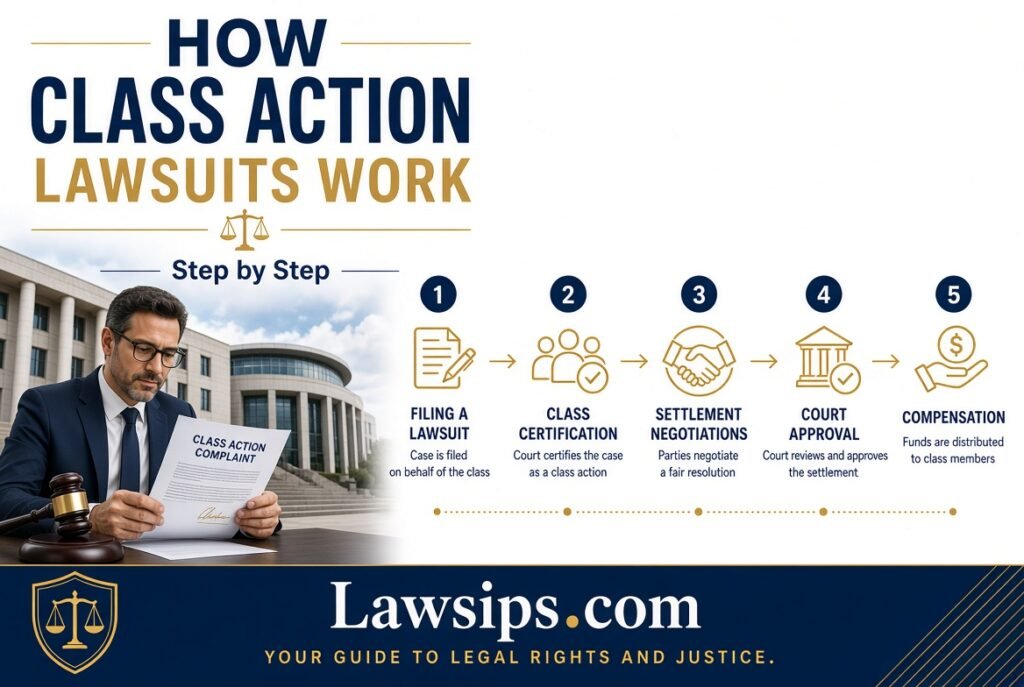
The process has distinct stages. Knowing them helps you understand notices and deadlines when they arrive.
1. Investigation and Filing
Lawyers investigate a pattern of harm and find a person willing to serve as lead plaintiff. They file a complaint on behalf of that person and everyone similarly situated.
2. Motion to Dismiss
The defendant often asks the court to dismiss the case. The judge decides whether the claims are legally sufficient to continue.
3. Discovery
Both sides exchange documents and take depositions. Class discovery focuses on whether the class meets the requirements for certification, and later on the merits.
4. Class Certification
The plaintiffs ask the judge to certify the class. This is often the most important battle, because certification can dramatically raise the stakes and pressure for settlement.
5. Notice to the Class
If the class is certified, members receive notice by mail, email or publication. The notice explains the case and the options available.
6. Settlement or Trial
Most class actions settle. A few go to trial, and the result binds class members who did not opt out.
7. Settlement Approval
A court must review and approve a class settlement. The judge considers whether the deal is fair, reasonable and adequate.
8. Claims and Distribution
After approval, class members submit claims if required, and a settlement administrator distributes payments.
9. Appeals and Final Payment
Objectors may appeal a settlement approval, which can delay payment. Once appeals end, funds are distributed.
Typical Timeline
| Stage | Rough Time Frame |
|---|---|
| Filing to motion to dismiss ruling | Several months |
| Discovery and certification | One to two years or more |
| Settlement negotiations | Varies, often after certification |
| Notice and claims period | Weeks to months |
| Approval and distribution | Months, longer if there are appeals |
Many class actions last years from filing to payment, so patience is part of the process.
Class Certification: The Legal Requirements
Certification is the gatekeeping step. In federal court, Rule 23 of the Federal Rules of Civil Procedure sets the standards, and many states use similar rules.
The Four Prerequisites of Rule 23(a)
| Requirement | What It Means |
|---|---|
| Numerosity | The class is so large that joining everyone individually is impractical |
| Commonality | The claims share common questions of law or fact |
| Typicality | The lead plaintiff’s claims are typical of the class |
| Adequacy | The lead plaintiff and class counsel will fairly and adequately protect the class |
Additional Requirements for Damages Classes
For most money-damages cases, Rule 23(b)(3) adds two more tests. Common questions must predominate over individual questions, and a class action must be superior to other ways of resolving the dispute.
Other Types of Classes
Some classes seek court orders rather than money, such as changing a business practice. Those fall under different parts of the rule and often do not allow opt-outs.
Why Certification Matters
If the judge denies certification, the case may end as a group action even if the claims have merit. If the judge certifies it, the defendant faces much greater exposure and often moves toward settlement.
Challenges to Certification
Defendants may argue that individual issues, such as differences in damages or reliance, overwhelm the common questions. Courts look closely at evidence, not just allegations.
Who Qualifies to Be in a Class Action?
You qualify if you fit the class definition written in the case. That definition usually involves dates, products, locations and types of harm.
Examples of Class Definitions
- All people who purchased a specific product between certain dates
- All users whose personal data was exposed in a specific breach
- All employees who worked certain shifts without proper pay
- All customers charged a particular fee
How to Check If You Are a Member
Read the notice you received and the settlement website. Compare the dates, products and conditions to your own experience.
If you did not receive a notice but think you qualify, search the case name or the settlement administrator’s website. You may still be able to file a claim.
Do You Need Proof?
Some settlements allow you to claim with a simple sworn statement. Others require receipts, account details or other documents, especially for larger payments.
Your Options When You Receive a Class Action Notice
A class action notice offers choices, and each has consequences. Do not ignore it.
| Option | What It Means | What You Gain or Lose |
|---|---|---|
| Do nothing | Stay in the class without filing a claim | You are bound by the result but may receive no payment |
| File a claim | Submit a claim form by the deadline | You can receive settlement benefits |
| Opt out | Exclude yourself from the class | You keep the right to sue separately but get nothing from the settlement |
| Object | Tell the court why you think the settlement is unfair | You remain in the class and can still claim |
| Hire your own lawyer | Get advice on a large or unusual claim | You may choose to opt out or object |
Doing Nothing
In many damages class actions, you are included automatically. If the case settles and you do not file a claim when one is required, you usually receive nothing but still give up the right to sue over the same issue.
Filing a Claim
A claim form often asks for your contact details and a statement that you fit the class definition. Some forms require proof and are signed under penalty of perjury.
Opting Out
Opting out removes you from the class. It preserves your right to pursue an individual claim, but you receive nothing from the settlement.
Opt-outs usually must be submitted by a strict deadline, and some courts require specific written formats or signatures.
Objecting
You can object to a settlement without opting out by following the court’s instructions and deadline. Objections explain why you believe the deal, the fees or the claims process is unfair.
When to Consider Opting Out
Opting out may make sense if your individual losses are much larger than the class settlement or if you have a claim the class does not cover. In most small-claims situations, staying in the class is more practical.
Class Action Notices and Deadlines

Notices contain the information you need to protect your rights. Read them carefully and note every date.
What a Notice Typically Includes
- A description of the lawsuit and the allegations
- The class definition and who is included
- Summary of the settlement terms
- How payments will be calculated
- Deadlines to file a claim, opt out or object
- Information about attorney fees and costs
- The date of the fairness hearing
- Contact details for the settlement administrator
Key Deadlines
| Deadline | Why It Matters |
|---|---|
| Claim deadline | Miss it and you may lose the right to payment |
| Opt-out deadline | Your last chance to leave the class and sue on your own |
| Objection deadline | Your last chance to tell the court your concerns |
| Fairness hearing | The date when the judge considers final approval |
How Much Time Do You Have?
Published guidance suggests the claim window after approval commonly runs about 60 to 180 days, while objection periods often last at least 60 days. Every case sets its own dates, so follow the notice.
Spotting Scams
Real notices come from the court or a court-appointed administrator. Be cautious about emails or texts that demand payment, ask for sensitive details like a Social Security number or push you to click suspicious links.
Never pay a fee to receive a class action payment. Legitimate class members do not pay to claim their share.
How Much Money Do You Get from a Class Action?
Payouts vary widely. Some members receive a few dollars, while others receive hundreds or more.
Factors That Affect Your Payment
- The total size of the settlement fund
- The number of class members who file claims
- Deductions for attorney fees, costs and administration
- The type and extent of your harm
- Whether payments are equal or based on a formula
- Proof you provide, such as receipts
How the Settlement Fund Is Divided
| Item | What Happens |
|---|---|
| Attorney fees | Paid from the fund, subject to court approval |
| Litigation costs | Reimbursed to class counsel |
| Administration costs | Pay for notice, claims processing and distribution |
| Service awards | Modest payments to lead plaintiffs for their time and effort |
| Net fund | Divided among class members who claim |
Why Payments Are Often Small
When millions of people share a fund, each share can be modest. If few people file claims, the per-person amount may rise, depending on how the settlement is structured.
Pro Rata Payments
Many settlements use pro rata distribution, which means the fund is divided proportionally and your payment may increase or decrease based on total claims.
Types of Relief
Class settlements may provide cash, vouchers, product replacements, credit monitoring, refunds or changes in business practices.
Be aware that vouchers and coupons may have limited value, and the court should weigh that in deciding whether a deal is fair.
Unclaimed Funds and Cy Pres
Sometimes money remains after claims are paid. Settlements may distribute leftover funds to additional class members, return it to the defendant or send it to a charity through a doctrine called cy pres, depending on the court’s approval.
Attorney Fees in Class Actions
Class members normally pay nothing upfront. Class counsel is paid from the settlement, with court approval.
How Fees Are Set
Under the federal rules, courts may award reasonable attorney fees and costs authorized by law or agreement. Judges review proposed fees and often compare them to the benefit achieved for the class.
Published guidance commonly cites fee awards of roughly 25 to 33 percent of the settlement fund, though the exact amount varies by case and court.
Two Common Methods
| Method | How It Works |
|---|---|
| Percentage of the fund | Fees are a percentage of the total settlement |
| Lodestar | Fees are based on hours worked multiplied by hourly rates, sometimes adjusted |
Why Courts Scrutinize Fees
Courts review whether a settlement mainly benefits lawyers rather than class members. Settlements with small member payments and large fees may draw objections.
Your Cost to Participate
If you simply claim your share, you typically pay no attorney fee out of pocket. Fees are deducted from the common fund or paid separately by the defendant, depending on the settlement terms.
The Role of the Lead Plaintiff

The lead plaintiff, or class representative, plays a bigger role than most class members. They are the face of the case.
Responsibilities
- Provide documents and information
- Answer questions in discovery
- Sit for a deposition
- Stay informed about the case
- Make decisions with counsel in the class’s interest
- Sometimes appear at hearings or trial
Benefits and Risks
Lead plaintiffs may receive a modest service award for their time. They also face scrutiny from the defense and a commitment that can last years.
Who Makes a Good Lead Plaintiff?
Courts want someone whose claims are typical of the class and who has no conflicts of interest. They should be willing to take an active role.
Class Action Settlements: Approval and Fairness
Unlike private settlements, class action settlements must be approved by a judge. The court acts as a guardian of absent class members.
Stages of Approval
- Preliminary approval. The judge reviews the proposed deal and allows notice to be sent.
- Notice period. Class members can claim, opt out or object.
- Fairness hearing. The judge hears from the parties and objectors.
- Final approval. The judge approves or rejects the settlement.
What the Judge Considers
- How strong the case is and the risks of continuing
- The amount of relief compared to the possible recovery
- The method for distributing payments
- The proposed attorney fees
- Whether class members are treated equitably
- The reaction of the class
Why Settlements Get Rejected
Judges may reject settlements that give too little to the class, pay excessive fees, create hard claim processes or unfairly favor some members over others.
Pros and Cons of Class Actions
Class actions are not perfect. They help many people but come with trade-offs.
| Pros | Cons |
|---|---|
| Lets people with small claims seek justice | Individual payouts may be small |
| No upfront cost for most class members | Cases can take years |
| Efficient for courts and parties | Little individual control over strategy |
| Creates pressure for companies to change | Fees can take a large share of the fund |
| Provides consistent outcomes | You give up the right to sue separately unless you opt out |
| Allows easy participation through claim forms | Claims processes can be confusing |
Benefits for Consumers and Workers
Class actions can recover refunds, unpaid wages or compensation that individuals would never chase alone. They can also lead to changes in business practices.
Criticisms
Critics point to modest payments, high fees, low claim rates and settlements that benefit lawyers more than members. Judges and rules like Rule 23(e) exist partly to address those concerns.
Class Action vs Individual Lawsuit: Which Is Better for You?
The answer depends on how serious your harm is and what the class offers.
| Situation | Better Fit |
|---|---|
| Small loss, many similar victims | Class action |
| Large, unique injury | Individual lawsuit |
| Serious personal injury | Individual claim with a lawyer |
| Unsure whether the claim is worth pursuing | Class action or consultation |
| You want control over strategy and timing | Individual lawsuit |
When an Individual Case Makes More Sense
If you suffered a serious injury, such as hospitalization or long-term harm, a class settlement may not reflect your losses. In that case, talk to a lawyer about opting out and pursuing your own claim.
For personal injury cases, see our guide on whether you need a personal injury lawyer.
Arbitration Clauses and Class Waivers
Many contracts include arbitration clauses and class action waivers, which require individual arbitration instead of group lawsuits. Courts have often enforced them, though exceptions and challenges exist.
If you agreed to terms with such a clause, a company may argue you cannot join a class action. Whether those clauses apply depends on the contract and the law.
How to Find Class Action Lawsuits You May Qualify For
Settlements pay money that often goes unclaimed. A few habits help you catch ones that apply to you.
Where to Look
- Notices sent by mail or email
- Official settlement websites listed in the notice
- Court websites and dockets
- Reliable legal news sites that track settlements
- Company announcements about settlements
You can follow current cases and settlement updates on our law category, which covers lawsuits such as Hailey Welch, Blue World Pools, Symple Lending and Red Bull Wings.
How to Verify a Settlement Is Real
- Find the case name and court in the notice.
- Visit the official settlement website using a link from a trusted source.
- Check that the claim form does not ask for payment or unnecessary sensitive data.
- Confirm deadlines and claim instructions.
Keep Records
Save receipts, account statements and emails. They can help you prove your claim if the settlement requires documents.
How to File a Class Action Claim: Step by Step
Filing is usually simple, but small mistakes can cost you money.
- Read the notice carefully. Confirm the class definition and eligibility.
- Find the official website. Use the web address printed in the notice or confirmed on a court page.
- Gather your information. Collect receipts, account numbers or other proof if required.
- Complete the claim form. Answer truthfully, since many forms are signed under penalty of perjury.
- Choose a payment method. Select check, digital payment or other options offered.
- Submit before the deadline. Online submissions are usually accepted until the date stated.
- Save confirmation. Keep a copy of the confirmation number or email.
- Watch for updates. Payments may take months, and appeals can cause delays.
Common Claim Form Questions
| Question | Why It Is Asked |
|---|---|
| Name and contact details | To identify you and send payment |
| Proof of purchase or use | To verify you are in the class |
| Dates of purchase | To check that you fall within the class period |
| Payment preference | To choose how you want to be paid |
| Signature or electronic attestation | To confirm the information is true |
Taxes on Class Action Payments
Some settlement payments may be taxable, depending on what they replace and the amount. Consult a tax professional if you receive a significant payment.
How to Start a Class Action Lawsuit

If you believe many people were harmed by the same conduct, you may wonder how a class action begins. The process starts with legal assessment.
Step by Step
- Gather evidence. Collect documents, notices, receipts and communications.
- Identify the pattern. Show that others were affected in the same way.
- Consult a class action attorney. Experienced firms evaluate legal and financial viability.
- Decide whether to be a lead plaintiff. Understand the time commitment.
- File the complaint. The lawyers draft and file it in the appropriate court.
- Proceed through certification. The court decides whether the case can continue as a class.
What Lawyers Look For
Law firms consider whether the harm is common, whether the defendant has the ability to pay, whether there are strong legal claims and whether the case is likely to be certified.
Costs for You
Class action lawyers usually work on contingency and advance costs. Ask about the fee agreement, cost responsibility and your duties as a representative.
Class Actions in State Court vs Federal Court
Class actions can be filed in either system. The choice affects rules, speed and strategy.
| Factor | Federal Court | State Court |
|---|---|---|
| Governing rule | Federal Rule of Civil Procedure 23 | State class action rules, often similar |
| Typical cases | Large, multi-state or federal claims | Local or state-law claims |
| Removal | Defendants may seek to move cases to federal court | Some cases qualify for removal |
| Procedure | Often more uniform | Varies by state |
The Class Action Fairness Act
Congress passed the Class Action Fairness Act of 2005 to allow many larger, multi-state class actions to be heard in federal court. Defendants often use it to remove cases from state court.
Common Mistakes People Make with Class Actions
Small errors can cost you money or rights. Avoid these.
Throwing Away the Notice
A class action notice may be your only chance to claim or opt out. Read it before discarding.
Missing the Claim Deadline
Late claims are often rejected. Mark the date on your calendar.
Falling for Scams
Never pay to claim a settlement, and verify websites before entering personal information.
Giving False Information
Claims are often signed under penalty of perjury. Provide accurate details only.
Opting Out Without Understanding the Consequences
Opting out means no settlement payment. Do it only after considering your own claim and getting advice if needed.
Assuming You Are Not Eligible
Check the class definition. Many people qualify without realizing it.
Ignoring Objection Rights
If you think a settlement is unfair, you have a right to object by the deadline.
How to Protect Yourself and Your Rights
A little organization goes a long way. Here are habits that help.
- Keep receipts and account records for major purchases.
- Read class action notices as soon as you receive them.
- Use official websites and verify case information.
- Save copies of claim confirmations.
- Track deadlines for claims, opt-outs and objections.
- Ask a lawyer when your losses are large or unusual.
- Be careful with arbitration clauses and consumer agreements.
Class Action Lawsuit Checklist
Use this list when you receive a notice.
- Identify the case name, court and defendant.
- Read the class definition.
- Confirm whether you qualify.
- Note the claim, opt-out and objection deadlines.
- Decide whether to claim, opt out or object.
- Gather any required proof.
- Submit your claim through the official website.
- Save confirmation and track payment.
Also Read
- Panera Class Action Lawsuit: Full Guide for 2026
- DoorDash Lawsuit 2026: Claims, Settlements & Latest Updates
- Facebook Lawsuit Settlement Payments Latest Update 2026
- Hailey Welch Lawsuit 2026: Settlements, Payouts & Deadlines
- Blue World Pools Lawsuit 2026: Latest Updates & Claims
- Symple Lending Lawsuit 2026: Latest Updates & Claims
- Red Bull Wings Lawsuit 2026: Latest Updates & Claims
- Karl Jobst Lawsuit 2026: Latest Updates & Claims
- Chaturbate Lawsuit 2026: Latest Updates & Claims
- Caitlin Clark Lawsuit 2026: Latest Updates & Claims
- Do I Need a Personal Injury Lawyer? What to Know Before You Decide in 2026
Frequently Asked Questions (FAQs)
What is a class action lawsuit?
It is a case where one or a few people sue on behalf of a larger group with similar claims. A judge must certify the class before the case proceeds as a class action.
How does a class action lawsuit work?
Lawyers file on behalf of a lead plaintiff and the class, the court decides whether to certify, notice goes to members and the case ends through settlement or trial. Class members then claim their share if money is available.
Do I have to join a class action lawsuit?
In many damages cases you are included automatically if you fit the class definition. You can opt out by the deadline if you do not want to be bound.
Do I need a lawyer to join a class action?
No. Class members usually do not need their own lawyer, and class counsel represents the whole group.
How much does it cost to join a class action?
Usually nothing upfront. Attorney fees and costs are typically paid from the settlement, with court approval.
How much money will I get from a class action?
It depends on the settlement size, the number of claims and your harm. Many payments are modest, while some are larger when the fund is big or proof of loss is strong.
Do I have to file a claim to get paid?
Often yes. Even if you are in the class automatically, you generally must submit a claim form by the deadline to receive money.
What happens if I miss the claim deadline?
You may lose the right to payment but still be bound by the settlement. Check the notice for any late-claim rules.
What does opting out mean?
It means you leave the class, receive nothing from the settlement and keep the right to sue the defendant on your own.
Should I opt out of a class action?
Consider it if your individual losses are large or unique, and talk to a lawyer first. For small losses, staying in the class is usually more practical.
What does it mean to object to a settlement?
An objection is a formal statement to the court explaining why you think the settlement, fees or process is unfair. You must follow the court’s instructions and deadline.
How long do class action lawsuits take?
Many take years, from filing through certification, settlement approval and payment. Appeals can add more time.
What is class certification?
It is the judge’s decision that the case meets the legal requirements to proceed as a class action, including numerosity, commonality, typicality and adequacy.
What is a lead plaintiff?
The lead plaintiff, or class representative, is the person who files and represents the class. They may receive a modest service award for their effort.
How are class action attorneys paid?
They are typically paid a percentage of the settlement fund or based on hours worked, as approved by the court. Published guidance often cites around 25 to 33 percent.
Can I sue a company on my own if there is a class action?
Only if you opt out by the deadline. Staying in the class generally means you cannot bring your own claim over the same issues.
What is the difference between a class action and a mass tort?
In a class action, one case represents the group and members share a result. In a mass tort, many individuals sue separately over the same event or product.
What is an arbitration clause or class action waiver?
It is a contract term requiring disputes to be resolved through individual arbitration instead of a class action. Courts often enforce them, though challenges exist.
How do I find out if I am part of a class action?
Check notices you received, official settlement websites, court dockets and reliable legal news sources. Compare the class definition to your situation.
How do I know a settlement notice is real?
Verify the case name and court, use the official website from the notice and never pay a fee to claim. Be wary of messages that pressure you or ask for sensitive details.
Are class action payments taxable?
Some may be, depending on the nature of the payment and the amount. Ask a tax professional about significant settlements.
Can I join a class action for a data breach?
Yes, if you fit the class definition, such as being among those whose data was exposed. You may need to file a claim to receive benefits.
What happens to unclaimed settlement money?
It may be redistributed to class members, returned to the defendant or donated to a charity under cy pres, depending on the settlement and court approval.
Can I be a lead plaintiff in a class action?
Possibly, if your claims are typical of the class and you can serve adequately. Talk to a class action attorney about the role.
Is a class action lawsuit better than suing alone?
For small, widespread harms, yes. For serious or unusual injuries, an individual lawsuit often makes more sense.
Conclusion
A class action lawsuit is a way for ordinary people to hold large organizations accountable when each person’s loss is too small to fight alone. It also comes with rules, deadlines and trade-offs that are easy to miss.
When a notice arrives, read it. Check the class definition, mark the claim, opt-out and objection deadlines and decide whether to claim your share, leave the class or speak up about the settlement.
Use official websites, never pay to claim a settlement and keep records of what you submit. Every case depends on its facts and the court’s rules, so this guide is general information, not legal advice, and a licensed attorney can help if your situation is complex or your losses are large.

2 thoughts on “Class Action Lawsuit: How It Works, Who Can Join, What You Get and How to Protect Your Rights 2026”