


What Is a Personal Injury Lawyer? A personal injury lawyer is a civil litigator who represents people injured by another person’s negligence, carelessness, or wrongful act. The lawyer helps the injured person seek compensation for medical costs, lost wages, pain and suffering, and other losses.
An accident can change a normal week into medical visits, missed work, and calls from an insurance adjuster. Pain makes decisions harder, and early mistakes can reduce a claim before it starts. A personal injury lawyer helps an injured person understand rights, evidence, and deadlines while treatment continues.
That help is practical, not dramatic. Most injury work happens in records, photos, medical bills, and negotiation, not in a courtroom. A lawyer tests whether another person’s carelessness caused the injury, what the losses are worth, and how to prove both.
State law controls the details. Deadlines, fault rules, and fee rules differ by state, and some government claims have much shorter notice periods. Early, state-specific advice protects a claim better than a late, general search.
What Is a Personal Injury Lawyer?
Personal injury lawyer: A US civil litigator who represents people injured by another person’s negligence or wrongful act, and helps them seek compensation for medical costs, lost wages, pain and suffering, and other losses. State law controls deadlines, fault rules, and fee rules.
Personal Injury Lawyer vs Attorney
In US usage, personal injury lawyer and personal injury attorney mean the same role. Both refer to a licensed legal professional who represents injured people. Title matters less than experience with injury claims, insurance negotiation, deadlines, and litigation.
A general lawyer may handle one injury case a year. A personal injury attorney handles injury claims regularly, and knows local insurers, medical experts, and court practice. Case-type fit matters even more for medical malpractice, truck accidents, and product liability.
Tort Law in One Paragraph
Personal injury law is part of tort law, which covers private civil wrongs. The goal is to make the injured person whole, not to punish criminally. A successful claim usually requires proof that someone owed a duty, breached it, caused injury, and caused measurable losses.
What Does a Personal Injury Lawyer Do?
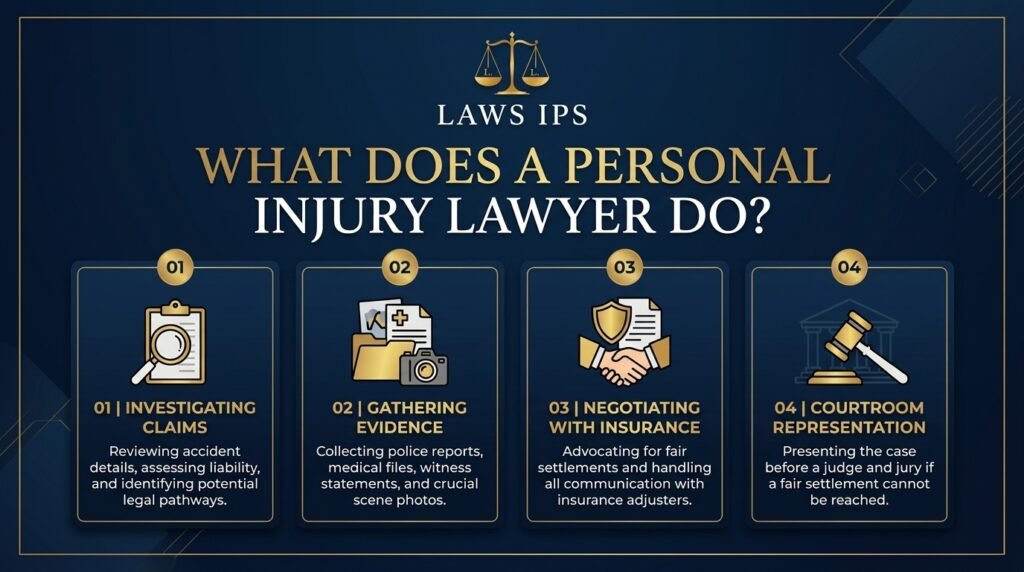
A personal injury lawyer manages the legal side of a claim so the injured person can focus on recovery. Work includes evaluation, investigation, insurance negotiation, damage calculation, and, when needed, lawsuit and trial. Each stage builds on evidence collected earlier.
Case Evaluation and Legal Advice
Every case starts with a case evaluation. The lawyer reviews what happened, medical treatment, insurance coverage, and liability facts. The lawyer then explains realistic options, risks, and next steps in plain language.
Evaluation also tests whether a claim is worth pursuing. Minor injuries with clear liability and fair insurer handling may resolve without a lawyer. Serious injuries, disputed liability, or low offers usually need legal help. A free consultation can clarify that choice without a fee commitment, where the firm offers one.
Investigation and Evidence Preservation
Strong cases rest on strong evidence. A lawyer collects police reports, incident reports, medical records, medical bills, photos, videos, and witness statements. Early investigation matters because surveillance footage can be overwritten, vehicles can be repaired, and witness memories can fade.
Complex cases need experts. Accident reconstruction can explain a crash, a medical expert can link treatment to injury, and a life care planner can estimate future care. A lawyer coordinates those experts and turns clinical findings into legal damages. Evidence preservation letters can also stop a defendant from destroying key records.
Insurance Negotiation and Demand Package
A lawyer handles communication with insurance adjusters and prepares a demand package. That package presents liability facts, medical evidence, lost wages, and a settlement demand. Insurers respond with an offer, a denial, or a request for more records.
Adjusters protect their company’s financial interests, even when they sound sympathetic. They may question treatment, point to a treatment gap, or blame a pre-existing condition. A lawyer answers with records, not emotion, and advises whether an offer reflects full losses.
Filing a Lawsuit, Discovery, and Trial
When negotiation fails, a lawyer files a lawsuit and manages deadlines, motions, and evidence exchange. Discovery includes documents, written questions, depositions, and expert disclosures. Both sides test proof before trial, and many cases settle during this stage.
Trial preparation can affect settlement value. An insurer takes a case more seriously when a lawyer is ready to present evidence to a judge or jury. Trial is not the goal in every case, but readiness is a negotiation asset. A lawyer should explain trial risks, costs, and timeline before filing.
Daily Work Behind a Case
Daily work includes client updates, adjuster calls, medical record review, expert coordination, and deadline tracking. A lawyer also reviews settlement offers, drafts documents, and prepares for mediation or hearing. Good communication prevents common mistakes, such as giving a damaging recorded statement or accepting an early offer.
The Negligence Test: Duty, Breach, Causation, Damages
Most injury claims require proof of four elements. Missing one element can defeat a claim, even when injury is serious. A lawyer tests each element with evidence, not with sympathy alone.
1. Duty of Care
Duty of care means a legal obligation to act reasonably. Drivers must drive safely, property owners must keep premises reasonably safe, and doctors must follow the accepted standard of care. Duty depends on relationship, activity, and state law.
2. Breach of Duty
Breach means the duty was broken. Examples include distracted driving, a wet floor without warning, or a surgical error. Breach is proved with facts, records, photos, and expert opinion where needed. A bad outcome alone does not always prove breach, especially in medical cases.
3. Causation
Causation links breach to injury. The injured person must show the breach caused the harm, not only that harm happened nearby. Medical records, treatment timing, and expert opinion often carry this element. A treatment gap or unrelated condition can weaken causation if not explained.
4. Damages
Damages are measurable losses from the injury. Medical bills, lost wages, future care, pain and suffering, and property damage all count, where proved. Without damages, even a clear breach may not support a valuable claim. Documentation turns injury into a number a court or insurer can evaluate.
Strict Liability and Product Liability
Some cases do not use the same negligence test. Product liability can use strict liability for defective design, manufacturing, or warnings. A manufacturer may be liable even without proving carelessness, depending on state law and defect proof.
Premises Liability: Notice and Condition
Premises liability covers slip and fall and other property injuries. The owner must have known, or should have known, about the dangerous condition. Wet floors, uneven walkways, poor lighting, and unsafe stairways are common examples. Maintenance records and prior complaints often decide notice.
Types of Personal Injury Cases
Case type changes proof, experts, and strategy. A car crash needs different evidence from a medical error or a defective product. Choosing a lawyer whose daily work matches the case type improves fit and efficiency.
Car, Truck, Motorcycle, Pedestrian, and Bicycle Accidents
Car accidents include rear-end collisions, distracted driving crashes, drunk driving crashes, and hit-and-run cases. A lawyer identifies fault, insurance coverage, and damages, including medical treatment and lost income. Police reports, photos, and medical records form the core proof.
Truck accidents can involve multiple parties: driver, trucking company, maintenance contractor, and cargo loader. Federal and state trucking rules, driver logs, and vehicle data add complexity. Motorcycle accidents need extra care because insurers sometimes rely on unfair assumptions about riders.
Pedestrian and bicycle accidents often involve serious injuries and disputed right-of-way facts. Scene photos, traffic signals, and witness statements matter more when the injured person cannot give a full account. A car accident lawyer guide should separate these subtypes, not lump them into one generic page.
Slip and Fall and Premises Liability
Slip and fall cases depend on condition and notice. A wet floor, broken step, or poor lighting must be linked to the owner’s knowledge or failure to inspect. Photos taken at the scene, incident reports, and maintenance logs help, but they disappear fast.
A slip and fall lawyer should explain why “I fell” is not enough. The claim needs a dangerous condition, notice, causation, and damages. Property type also matters: stores, apartments, workplaces, and government property follow different notice and filing rules.
Medical Malpractice: A Specialist Distinction
Medical malpractice requires proof that a healthcare provider violated the accepted standard of care and caused harm. Surgical errors, misdiagnosis, medication mistakes, and birth injuries are common examples. Expert testimony is usually required, and pre-suit requirements vary by state.
Medical malpractice cases often have shorter deadlines, higher expert costs, and a higher trial rate than general injury cases. Some states cap certain damages. A general injury lawyer may not be the right fit, and a medical malpractice lawyer guide should explain that distinction clearly.
Product Liability, Dog Bites, Nursing Home, Workplace, and Wrongful Death
Product liability covers defective products, including faulty design, manufacturing defects, and inadequate warnings. Defendants can include manufacturers, distributors, and retailers. Product preservation is critical, so a defective item should not be discarded or repaired before evaluation.
Dog bites follow state law, which varies from strict liability to negligence and one-bite rules in some states. Nursing home abuse involves medical records, staffing records, and facility inspections. Workplace injuries may involve workers compensation plus a third-party claim against a non-employer.
Wrongful death claims arise when negligence causes a fatal injury. Surviving family members or an estate representative may file, depending on state law. Damages can include funeral costs, lost support, and loss of companionship. A wrongful death lawyer guide should stress state-specific standing, not generic family rights.
Case-Type Comparison Table
| Case type | Main proof challenge | Key experts or records | Common mistake |
| Car accident | Fault and insurance coverage | Police report, medical records | Giving a recorded statement too early |
| Truck accident | Multiple defendants, trucking rules | Driver logs, vehicle data | Losing vehicle and log evidence |
| Slip and fall | Notice of dangerous condition | Maintenance logs, scene photos | No incident report or photos |
| Medical malpractice | Standard of care breach | Medical expert, patient records | Missing pre-suit deadline |
| Product liability | Defect and causation | Product, design records, expert | Discarding the defective product |
| Workplace injury | Workers comp vs third party | Employer records, safety logs | Missing a third-party claim |
| Wrongful death | Standing and damages | Estate records, financial support proof | Missing state filing rules |
What Damages Can You Recover?
Damages are the losses a claim seeks to repay. A lawyer calculates damages before negotiation, because settlement is usually final. Once a release is signed, an injured person generally cannot return for more money if injuries worsen.
Economic Damages
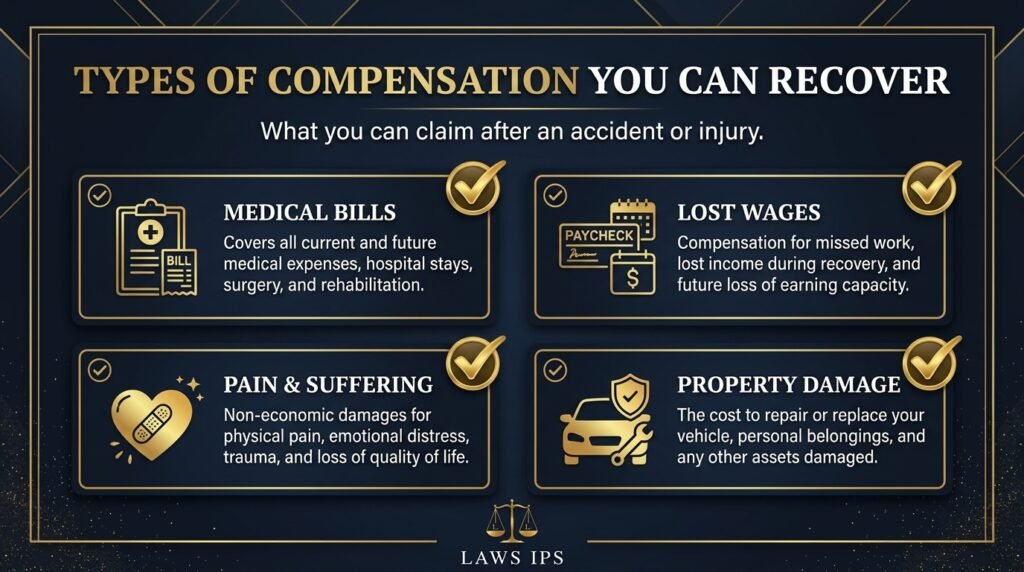
Economic damages are measurable financial losses. They include past and future medical expenses, lost wages, reduced earning capacity, property damage, and out-of-pocket costs. Receipts, pay records, and medical bills support these damages, and future costs need expert or provider estimates.
Non-Economic Damages
Non-economic damages cover pain and suffering, emotional distress, loss of enjoyment of life, and loss of consortium. These losses have no receipt, so medical records, treatment history, and personal impact evidence matter. No fixed formula applies in most states, despite online calculators claiming otherwise.
Punitive Damages
Punitive damages punish especially wrongful conduct and deter similar conduct. They are rare, state-limited, and require a higher proof standard in many states. A lawyer should not promise punitive damages, and a guide should not present them as a normal part of every claim.
Future Costs and Settlement Finality
Future medical care, rehabilitation, home modifications, and lost earning capacity can exceed first hospital bills. A lawyer should estimate those costs before settlement talks begin. Accepting an early offer before the full injury picture is known can leave future costs unpaid.
How Personal Injury Lawyers Get Paid
Cost worries stop many injured people from calling a lawyer. Most personal injury lawyers work on a contingency fee, which means the fee depends on recovery. That model lets an injured person start a claim without upfront attorney fees, but the written agreement still controls every detail.
Contingency Fee Explained
A contingency fee is a percentage of the settlement or verdict. If there is no recovery, the client usually owes no attorney fee. That phrase, “no fee unless you win,” applies to the attorney fee, not always to case costs.
Common reported ranges are 25% to 40% of recovery, often about one-third if the case settles before a lawsuit, and 35% to 40% if litigation or trial is required. Some agreements rise further for appeal. Florida has tiered contingency rules under Florida Bar Rule 4-1.5, which shows why state rules matter.
Gross vs Net Fee Calculation
Fee calculation method changes net recovery. Some agreements take the percentage from the gross settlement, meaning the total amount received. Others take it from the net amount after costs, which can change the lawyer’s fee and the client’s share.
Always ask whether the fee is gross or net, what costs are deducted, and in what order. A written settlement statement should show every deduction, including fee, costs, medical liens, and health insurer reimbursement. Review that statement carefully before signing a release.
Worked Example: Net Recovery
This example is illustrative only, not a promise or an average. It shows why gross settlement and net recovery differ.
| Item | Amount |
| Gross settlement | $90,000 |
| Attorney fee at 33% of gross | $29,700 |
| Case costs, e.g. filing, records, expert | $3,000 |
| Medical liens and insurer reimbursement | $12,000 |
| Net to client in this example | $45,300 |
Change one input and the result changes fast. A higher fee stage, larger liens, or extra expert costs can cut net recovery sharply. A lawyer should explain this math before settlement, not after the release is signed.
Case Costs, Medical Liens, and Letters of Protection
Case costs include filing fees, medical record fees, expert fees, deposition transcripts, and investigation costs. Firms often advance these costs and deduct them from recovery, but agreements differ. Ask who advances costs and what happens on loss.
Medical liens arise when providers, health insurers, Medicare, Medicaid, or letter-of-protection providers claim reimbursement from recovery. A lawyer should negotiate reductions where possible and show liens in the settlement statement. A letter of protection allows treatment on credit, but it creates a lien that affects net recovery.
What Happens If You Lose?
Under most contingency agreements, you owe no attorney fee if you lose. Case expenses are handled differently by agreement: some firms absorb costs on loss, others require reimbursement even without recovery. Ask directly, “If we lose, do I owe anything for expenses?” Get the answer in writing before signing.
How Long Do You Have? Statutes of Limitations and Fault Rules
Deadlines are the most dangerous part of injury law. Missing a deadline can prevent recovery, no matter how serious the injury is. State law controls the deadline, and exceptions are narrow and fact-specific.
Statute of Limitations: State Examples
Many negligence claims have two to three year statutes in competitor summaries, but that range is not a national rule. Georgia allows two years for many personal injury claims under O.C.G.A. § 9-3-33, as cited by Roden Law. South Carolina allows three years under § 15-3-530, with a different fault threshold.

| State example | General personal injury deadline cited by competitors | Fault rule cited by competitors |
| Georgia | 2 years, O.C.G.A. § 9-3-33 | Less-than-50% fault bar in cited summary |
| South Carolina | 3 years, § 15-3-530 | Less-than-51% fault bar in cited summary |
| California | 2 years in competitor summaries | Pure comparative negligence in competitor summaries |
| Other states | 1 year to several years, depending on claim type | Varies: comparative, modified comparative, or contributory |
This table is a starting point, not legal advice for any state. Medical malpractice, wrongful death, government claims, and minor plaintiffs often have different deadlines. Check the target state statute immediately after an injury.
Discovery Rule and Special Exceptions
Some states use a discovery rule, where the clock starts when the injury is discovered or should have been discovered. That rule matters for hidden injuries, defective products, and some medical cases. It does not extend every deadline, and it is applied narrowly in many states.
Minor plaintiffs, incapacitated plaintiffs, and out-of-state defendants can also affect deadlines in some states. Those exceptions are fact-specific and should not be assumed. A lawyer should check the exact statute, tolling rule, and filing court before giving a deadline answer.
Government Claims: Shorter Notice Deadlines
Claims against a city, county, state agency, or federal entity often require a formal notice of claim within months, not years. Missing that notice can bar the later lawsuit, even if the general statute has not expired. Government property, public vehicles, and public hospitals can trigger these rules.
If a government entity may be involved, seek legal help immediately. Do not wait for treatment to finish before checking notice rules. A government injury claim guide should lead with this warning, not bury it in a footnote.
Comparative vs Contributory Negligence
| Fault system | How recovery works | Where it appears in competitor summaries |
| Pure comparative negligence | Recovery reduced by fault percentage, even if fault is high | California in competitor summaries |
| Modified comparative negligence | Recovery barred at 50% or 51% fault, depending on state | Georgia, South Carolina in cited examples |
| Contributory negligence | Recovery barred if plaintiff is even slightly at fault | Few states, including Alabama, Maryland, North Carolina, Virginia in general summaries — verify current state law |
Partial fault does not always end a claim. It reduces recovery in most states, and the exact threshold decides whether any recovery remains. Evidence on fault percentage, such as photos, witness statements, and scene data, therefore matters as much as injury evidence.
Do You Need a Personal Injury Lawyer?
Not every accident requires a lawyer. Minor injuries, clear liability, and fair insurer handling can sometimes resolve directly. Many claims are not that simple, and early advice can prevent costly mistakes.
When Hiring Helps Most
- Liability is disputed or multiple parties may share fault
- Injury is serious, long-term, or requires surgery or future care
- Insurance denies, delays, or undervalues the claim
- Medical bills or lost wages are significant
- Settlement offer seems too low for the documented losses
- Accident caused permanent limitations or reduced earning capacity
- Government, product, or medical defendant is involved
A free consultation can test whether representation will make a meaningful difference. Bring records, photos, and insurance letters, and ask about fee, timeline, and realistic value range. A consultation does not obligate hiring, unless the firm confirms otherwise in writing.
When You Might Handle a Minor Claim Yourself
A minor, clear-liability claim with small medical bills and no ongoing treatment may resolve directly. Even then, document treatment fully, keep receipts, and do not sign a release until treatment ends. A quick settlement can become a bad settlement if symptoms worsen later.
Self-negotiation risks grow when fault is disputed, treatment is ongoing, or the insurer requests a recorded statement. In those cases, a short lawyer review can prevent a recorded statement from being used to dispute injury severity. For settlement steps, see How to File a Claim for Settlement.
Insurance Tactics to Watch For
- Fast low offer before full treatment and future costs are known
- Recorded statement request that can be used to dispute liability or injury
- Treatment gap argument, claiming a pause in care means injury healed
- Pre-existing condition argument, blaming prior health for current symptoms
- Social media surveillance, using posts to dispute pain or limitations
- Independent medical exam that may minimise injury, depending on state rules
Respond with records, not arguments. Keep treatment consistent, follow medical advice, and avoid posting about the accident or injury online. A lawyer can handle adjuster communication and review offers before a release is signed.
How to Choose a Personal Injury Lawyer
Choosing a personal injury lawyer near me is about fit, not fame. A famous litigator may be wrong for a small, clear claim. A settlement negotiator may be wrong for a complex trial case. Meet at least two lawyers where possible, and compare written terms.
1. Match Case-Type Experience
Ask how many cases like yours the lawyer handled in the past year. Car crash experience does not equal medical malpractice experience. Truck, product, and wrongful death cases each need different experts and proof. Daily case-type work matters more than general years in practice.
2. Ask About Trial Experience
Ask whether the lawyer actually tries cases, or only settles. Trial experience affects insurer evaluation, even when most cases settle. A lawyer who never tries cases may accept lower offers to avoid court. A trial-ready lawyer can explain when trial helps and when it adds risk and delay.
3. Compare Written Fee Agreements
Compare fee percentage, stage changes, gross versus net calculation, costs, and costs on loss. Ask for a sample settlement statement format. A clear agreement should state the percentage, when it rises, who advances costs, and how liens are handled. Vague fee language is a red flag.
4. Test Communication and Who Handles the Case
Notice how quickly the office replies, who will handle daily work, and how often you will receive updates. A senior lawyer may sign the case while a junior lawyer or paralegal does most work. That model can work, but it should be disclosed upfront, not discovered later.
5. Verify Licence, Discipline, and Local Experience
Confirm the lawyer is licensed and in good standing with the state bar association for the state where the case will be filed. Most state bars allow an online licence and discipline search in minutes. Local court experience also matters, because judges, mediators, and filing practice vary by county.
Green Flags and Red Flags
| Green flags | Red flags |
| Licensed in your state, verified with the state bar | No licence verification or vague credentials |
| Clear written fee agreement, with gross vs net explained | No written agreement or hidden cost language |
| Honest about risks, timelines, and value ranges | Guaranteed settlement, verdict, or timeline |
| Child-focused? No — client-focused, evidence-based approach | Encourages exaggerating injuries or misleading statements |
| Regular updates and a named contact | No communication plan or unanswered calls |
| Trial experience for complex cases | No trial experience but promises courtroom results |
What to Bring to Your First Consultation
- Police or incident report, with date, location, and parties
- Medical records and bills, including treatment timeline
- Photos and videos of scene, vehicles, injuries, and property damage
- Witness names and contact details, where available
- Insurance information, including your policy and any insurer letters
- Pay records for lost wages and missed work
- Timeline of treatment, symptoms, and work impact
- Written questions, including fee, timeline, and who handles the case
Organised documents make a consultation more useful and can reduce investigation time. Bring facts, not a long narrative about blame. The lawyer needs injury, liability, insurance, and treatment facts first.
The Personal Injury Process, Step by Step
Injury cases follow a familiar sequence, but timing varies by state, injury, and insurer. Knowing the stages helps set expectations and avoid premature settlement. Most cases settle before trial, and mediation often happens before a contested hearing.
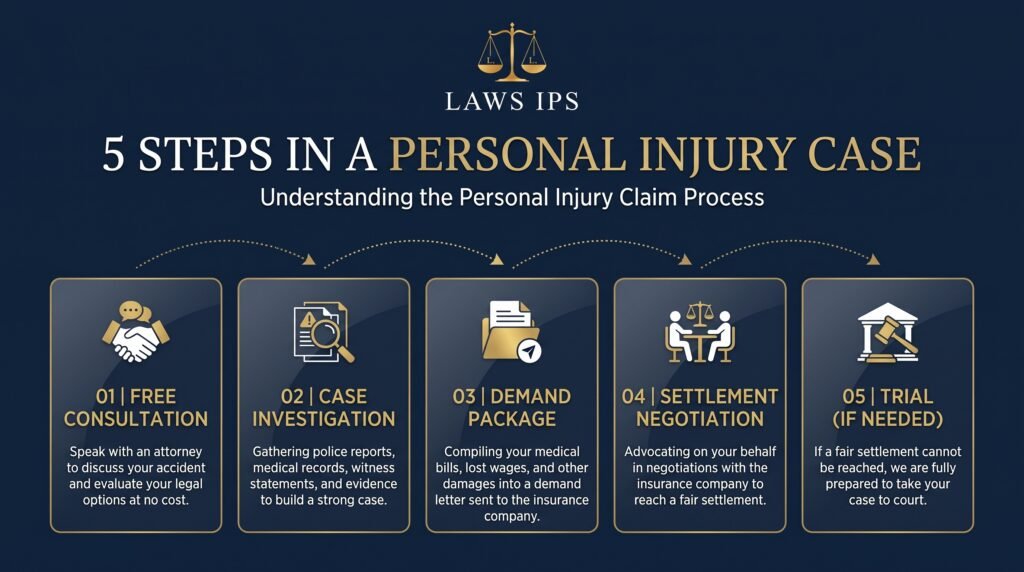
1. Consultation and Case Evaluation
The lawyer reviews facts, records, and insurance coverage, explains state law, and outlines options. This stage also covers fee agreement, costs, and deadlines. If a government defendant may be involved, notice deadlines should be checked immediately, not after treatment ends.
2. Investigation and Evidence Preservation
The lawyer collects reports, records, photos, witness statements, and expert opinions. Preservation letters can protect surveillance footage, vehicle data, and maintenance logs. Early investigation matters most for slip and fall, truck, and product cases, where evidence disappears fast.
3. Treatment, Documentation, and Damage Calculation
Treatment should follow medical advice, with consistent records and receipts. A lawyer tracks medical bills, lost wages, future care needs, and out-of-pocket costs. Damage calculation should wait until treatment stabilises or future needs are estimated, where possible.
4. Demand Package and Negotiation
A demand letter presents liability, medical evidence, damages, and a settlement demand. The insurer responds with an offer, denial, or records request. Negotiation may take several rounds, and a lawyer advises whether an offer reflects full losses, including future care and liens.
5. Lawsuit, Discovery, and Mediation
If negotiation fails, a lawyer files a lawsuit within the statute of limitations. Discovery exchanges evidence, depositions test testimony, and experts disclose opinions. Mediation may resolve the case before trial, with a neutral mediator helping both sides negotiate.
6. Trial, Verdict, and Settlement Statement
At trial, a judge or jury decides liability and damages. After settlement or verdict, the lawyer provides a written settlement statement showing fee, costs, liens, and net recovery. Review that statement carefully before signing a release, because settlement is usually final.
How Long Does a Personal Injury Case Take?
Some cases settle in months, others take a year or longer, especially with litigation, experts, or trial. Treatment duration, insurer cooperation, court calendars, and expert availability all affect timing. No lawyer can guarantee a timeline, and a realistic range with reasons is more trustworthy than a fixed date.
Settlement vs Trial: Pros, Cons, and Finality
Settlement and trial serve different goals. Settlement offers certainty, speed, and privacy, but requires compromise. Trial offers a judge or jury decision, but adds cost, delay, and risk. Many cases use both paths in sequence.
Settlement vs Trial Comparison
| Feature | Settlement | Trial |
| Control | Parties agree on amount and terms | Judge or jury decides |
| Timeline | Usually faster | Usually slower, with court delays |
| Cost | Usually lower, fewer experts and hearings | Usually higher, with trial preparation |
| Risk | Known amount, no appeal risk in most releases | Uncertain verdict, possible appeal |
| Privacy | More private than a public trial | More public, with court record |
| Finality | Release usually ends the claim | Verdict can be appealed, depending on grounds |
Settlement finality deserves emphasis. A signed release usually ends the right to seek more money for the same injury, even if treatment later worsens. That is why future medical costs, liens, and lost earning capacity must be estimated before signing.
Special Personal Injury Situations
Most definition pages stop at car accidents and slip and fall. Real cases involve government defendants, workers compensation overlap, wrongful death standing, and medical malpractice rules. Each situation needs state-specific advice.
Medical Malpractice: Standard of Care and Experts
Medical malpractice requires a medical expert to explain the accepted standard of care and how it was breached. Pre-suit notice, expert affidavits, and caps vary by state. Some states require a pre-suit expert review before filing, and missing that step can bar the claim.
Workers Compensation vs Third-Party Claims
Workers compensation is usually no-fault and limited to medical care and partial wage benefits. A third-party claim against a non-employer, such as a contractor, driver, or product maker, can add pain and suffering and full damages. A lawyer should check both paths, because workers comp alone may not cover full losses.
Government Injury Claims
Government claims need early notice, specific forms, and sometimes shorter deadlines than ordinary claims. Public property defects, public vehicle crashes, and public hospital injuries can all trigger these rules. Seek legal help immediately if a government entity may be responsible.
Wrongful Death: Who Can File
Wrongful death standing depends on state law. Spouses, children, parents, or estate representatives may file, depending on the statute. Damages, filing deadlines, and distribution rules also vary. A family should not assume every relative can file, or that funeral costs alone define the claim.
Uninsured and Underinsured Motorist Claims
If the at-fault driver has no insurance, or too little insurance, your own uninsured motorist or underinsured motorist coverage may apply. Coverage limits, notice rules, and stacking rules are policy- and state-specific. Check your policy early, and notify your insurer promptly, even when the other driver appears at fault.
Expert Tips for Working With a Personal Injury Lawyer
- Get medical care first, then legal advice. Treatment records prove injury better than any later explanation.
- Preserve evidence on day one. Photos, witness names, and incident reports fade fast.
- Do not give a recorded statement without advice. Insurers can use early statements to dispute fault or injury.
- Keep treatment consistent. Gaps in care invite arguments that injury healed or was unrelated.
- Track every cost and missed workday. Small receipts add up to a credible damage total.
- Do not post about the accident online. Social media can be used to dispute pain, limitations, or fault.
- Ask for fee math in writing. Gross versus net, stage changes, and costs on loss should be clear before signing.
- Estimate future care before settling. Settlement is usually final, even if treatment later worsens.
- Check government deadlines immediately. Notice periods can be months, not years.
- Choose trial readiness, not just promises. A lawyer ready for court often negotiates from a stronger position.
FAQs About What Is a Personal Injury Lawyer?
What is a personal injury lawyer?
A personal injury lawyer is a civil litigator who represents people injured by another person’s negligence or wrongful act. The lawyer helps seek compensation for medical costs, lost wages, pain and suffering, and other losses.
What does a personal injury lawyer do?
A personal injury lawyer evaluates claims, investigates and preserves evidence, calculates damages, negotiates with insurers, files lawsuits when needed, and represents clients in mediation or trial. Most work happens in records and negotiation, not in court.
What is the difference between a personal injury lawyer and an attorney?
In US usage, the terms are generally interchangeable. Both refer to a licensed legal professional. Experience with injury claims, insurance negotiation, deadlines, and litigation matters more than the title.
How much does a personal injury lawyer cost?
Most personal injury lawyers work on contingency, commonly 25% to 40% of recovery in competitor sources. About one-third pre-suit and 35% to 40% in litigation is a common structure, but the exact percentage must be in a written agreement.
What is a contingency fee?
A contingency fee is paid only if you recover compensation, as a percentage of settlement or verdict. If you recover nothing, you usually owe no attorney fee, but case costs on loss depend on the written agreement.
Do I pay upfront for a personal injury lawyer?
Usually no upfront attorney fee under contingency. Case costs, such as filing fees and experts, may be advanced by the firm and deducted from recovery, depending on the agreement. Ask who advances costs before signing.
What happens to case costs if I lose?
It depends on the written agreement. Some firms absorb costs on loss, others require reimbursement even without recovery. Ask, “If we lose, do I owe anything for expenses?” Get the answer in writing.
Do I need a personal injury lawyer?
Consider one for serious injury, disputed liability, multiple parties, denied or low offers, significant medical bills, lost wages, or permanent limitations. Minor, clear-liability claims can sometimes resolve directly, with risk.
How long do I have to file a personal injury claim?
State law controls, and deadlines vary sharply. Many negligence claims have two to three year statutes in competitor summaries, but government claims can be much shorter. Check your state statute immediately after an injury.
Will my case go to trial?
Most cases settle through negotiation or mediation. Trial is used when liability, damages, or settlement value cannot be resolved, and trial readiness can affect insurer offers.
How long does a personal injury case take?
Some cases settle in months, others take a year or longer, especially with litigation, experts, or trial. Treatment duration, insurer cooperation, and court calendars all affect timing. No lawyer can guarantee a timeline.
What if I was partially at fault?
You may still recover under comparative negligence in most states, with recovery reduced by your fault percentage. A few contributory negligence states bar recovery if you are even slightly at fault. State law controls.
What damages can I recover?
Economic damages include medical bills, lost wages, future care, and property damage. Non-economic damages include pain and suffering and emotional distress. Punitive damages are rare and state-limited.
Should I give a recorded statement to insurance?
Be cautious. Recorded statements can be used to dispute liability or injury severity. Speak with a lawyer before giving one, especially if fault or injury is disputed.
Should I accept the first settlement offer?
Not without evaluating full medical costs, future care, lost earning capacity, and liens. Early offers often come before the full injury picture is known, and settlement is usually final.
What should I bring to a personal injury consultation?
Bring police or incident reports, medical records and bills, photos, witness names, insurance information, pay records, and a timeline of treatment and symptoms. Organised documents make a consultation more useful.
What is a demand letter?
A demand letter is a written settlement demand to the insurer or defendant, with liability facts, medical evidence, damages, and a settlement amount. It starts formal negotiation and frames the claim value.
What is discovery in a personal injury lawsuit?
Discovery is the pre-trial exchange of evidence, including documents, written questions, depositions, and expert disclosures. Discovery tests both sides’ proof before trial or mediation.
What is medical malpractice vs personal injury?
Medical malpractice is a specialist subset requiring proof that a provider violated the accepted standard of care, usually with expert testimony and pre-suit requirements. General injury cases do not always need that expert structure.
Can a personal injury lawyer guarantee a result?
No. No lawyer can guarantee a settlement amount, verdict, or timeline. Guarantees are a red flag, and a trustworthy lawyer explains risks, evidence, and realistic ranges instead.
Conclusion on What Is a Personal Injury Lawyer?
A personal injury lawyer does more than file paperwork. The role combines investigation, medical evidence, insurance negotiation, damage calculation, and trial readiness, all tested against duty, breach, causation, and damages. That combination matters most when liability is disputed, injuries are serious, or an insurer offers less than full losses.
Cost should not stop an injured person from getting advice. Most cases use contingency, but the written agreement, gross versus net calculation, costs, and liens decide net recovery. Deadlines should not be left to chance either, especially for government claims and medical malpractice.
If you were hurt by someone else’s carelessness, get medical care, preserve evidence, and book a consultation with a personal injury lawyer in your state. Bring organised records, ask about fee, timeline, and trial experience, and do not sign a release until future costs are understood. With clear evidence and honest advice, a personal injury lawyer can help turn a difficult accident into a fair, documented claim.
