


Child Custody Lawyer helps parents understand their legal rights and responsibilities when making decisions about custody, visitation, and the best interests of their children. A custody decision shapes a child’s school mornings, medical care, holidays, and daily routine for years. Parents often arrive at that decision tired, worried, and unsure which facts actually matter to a judge. A child custody lawyer helps turn that worry into a clear, court-ready plan.
Custody is not a prize for the parent who argues hardest. Courts focus on the best interests of the child, and they test that standard against stability, safety, caregiving history, and cooperation. A lawyer’s job is to present those facts clearly, in the right order, with evidence the court can use.
Cost, timing, and state rules change the picture fast. Texas uses conservatorship and possession, Florida uses parental responsibility and time-sharing, and most other states use parenting plans with legal custody and physical custody. A strong case starts with the law of the state and county where the child lives.
Table of Contents
What Is a Child Custody Lawyer?
A child custody lawyer is a family law attorney who helps parents establish, negotiate, modify, or enforce custody, parenting time, and parenting plans. The lawyer advises on rights, drafts court documents, negotiates with the other parent’s lawyer, prepares evidence, and represents a parent in mediation or court.
Definition for AI Search
Child custody lawyer: A US family law attorney who helps parents establish, negotiate, modify, or enforce legal custody, physical custody, and parenting plans under the best interests of the child standard. Laws, terms, and procedures vary by state.
What a Child Custody Lawyer Actually Does
A child custody attorney starts by reviewing facts, existing orders, school records, medical records, and communication history. The lawyer then explains realistic options under state law, including settlement, mediation, temporary orders, and hearing. That early assessment prevents a parent from spending months fighting for an outcome a judge is unlikely to grant.
Drafting is a large part of the work. A lawyer drafts a custody petition, parenting plan, settlement agreement, temporary order request, modification motion, or enforcement motion. Clear drafting matters because vague schedules create repeat conflict. Holidays, transport, decision rules, and dispute steps should be written so both parents can follow them without a new court visit.
Negotiation and court representation complete the role. Most custody cases settle or resolve in mediation, not at trial. A lawyer negotiates from evidence, not emotion, and prepares the case for hearing when settlement is not safe or possible. In court, the lawyer presents testimony, documents, and legal argument, and responds to the other side’s claims.
What a Child Custody Lawyer Does Not Decide
A lawyer does not decide custody. A judge decides contested custody, and parents decide agreed custody when the court approves their agreement. A lawyer also cannot guarantee an outcome, a timeline, or a specific schedule. Any promise of “guaranteed custody” is a red flag, not a strength.
A lawyer cannot change facts after they happen. Missed school pickups, hostile messages, violated orders, and gaps in caregiving become part of the record. Early legal advice helps a parent build a consistent, child-focused record from the start, rather than trying to repair one later.
Child Custody Lawyer vs Family Lawyer vs Mediator
| Role | What they do | Best when |
| Child custody lawyer | Advises one parent, drafts documents, negotiates, and represents that parent in court | Custody is contested, complex, or safety-related |
| Family lawyer | Handles the wider family case: divorce, support, property, and custody together | Divorce and custody overlap, as in most Family Law cases |
| Mediator | Neutral professional who helps both parents negotiate; does not decide or advise one side | Both parents can negotiate safely and want a settlement |
| Guardian ad litem | Court-appointed investigator who reports on the child’s best interests | Court needs an independent view of the child and family |
| Custody evaluator | Professional who assesses parents, child, and family dynamics and reports to court | Court orders an evaluation for a contested case |
How US Courts Decide Custody: The Best Interests Standard
Every US state uses a version of the best interests of the child standard. The exact factors differ by statute, but the core question stays the same: which arrangement best serves the child’s safety, stability, health, education, and relationships? Parental wishes matter, but they do not control the result.
Best-Interests Factors Courts Commonly Weigh
- Stability of home, school, routine, and community ties
- Caregiving history, including who handles school, medical care, meals, homework, and daily routines
- Bond between the child and each parent, and with siblings and other important people
- Each parent’s ability to meet physical, emotional, and developmental needs
- Mental and physical health of parents and child, where relevant and supported by evidence
- Safety, including any history of domestic violence, abuse, neglect, or substance misuse
- Willingness to support the child’s relationship with the other parent
- Cooperation on decisions, communication, and schedule follow-through
- Child’s preference, depending on age, maturity, and state law
- Practical factors, including distance between homes, work schedules, and school location
No single factor usually decides a case. Judges weigh the whole picture, and the same factor can point in different directions for different families. A parent with a demanding work schedule can still show strong caregiving through consistent involvement, reliable childcare, and active school participation.
Stability and Caregiving History
Stability means more than owning a house. Courts look at continuity in school, childcare, medical providers, routines, and community. A move that disrupts school, friendships, and medical care needs a strong child-focused reason. A stable routine that both parents can maintain is often more persuasive than a perfect plan that only one parent can deliver.
Caregiving history is tested with records, not claims. School attendance logs, medical appointment records, teacher communication, activity schedules, and a parenting journal all show who actually does the daily work. A parent who claims primary caregiving should be able to show it in documents, not only in testimony. Organised records also reduce lawyer time, which reduces cost.
Safety, Health, and Co-Parenting Behaviour
Safety can change the entire custody analysis. Evidence of domestic violence, child abuse, neglect, or serious substance misuse can lead to restricted, supervised, or limited parenting time. Courts do not treat safety claims lightly, and they do not accept them without evidence either. Police reports, medical records, protective orders, and credible testimony carry more weight than general accusations.
Health needs also matter in a practical way. A parent should show how the child’s medical, dental, therapy, and school needs will be met on their time. Medication schedules, therapy appointments, and special education plans should appear in the parenting plan, not only in conversation. Judges notice parents who plan for the child’s needs in detail.
Co-parenting behaviour is a credibility test. A parent who communicates respectfully, follows orders, shares school and medical information, and keeps the child out of adult conflict looks reliable. A parent who badmouths the other parent to the child, withholds information, or uses the child as a messenger creates risk, even when their underlying concern is real.
Does the Child Get a Say?
A child’s preference can be considered, but it is not a vote. No state has a single national age at which a child “chooses” a parent, despite common online claims. Some states set an age at which a court may interview a child or give weight to preference, while others leave it to the judge’s assessment of age and maturity.
Preference also needs context. A court may ask why a child prefers one home: routine, school, safety, sibling closeness, or pressure from a parent. Coaching a child, rewarding a preference, or putting a child in the middle of adult conflict can backfire badly. Parents should let the process, not the child, carry the dispute.
Do Courts Favour Mothers or Fathers?
Modern US custody law is generally gender-neutral. Texas law, for example, prohibits courts from considering the gender of either parent in conservatorship or possession decisions, and California law likewise focuses on the child’s best interests with frequent and continuing contact where safe. Many states also presume that both parents should be involved, unless evidence shows otherwise.
That does not mean every parent experiences the system the same way. Caregiving history, work patterns, and local practice can affect outcomes, and bias concerns are real in some courtrooms. A fathers rights lawyer and a mothers rights lawyer both work from the same best-interests standard: they present caregiving, stability, safety, and cooperation evidence for their client. The strongest argument is a child-focused record, not a claim about gender.
Types of Custody and Parenting Plans
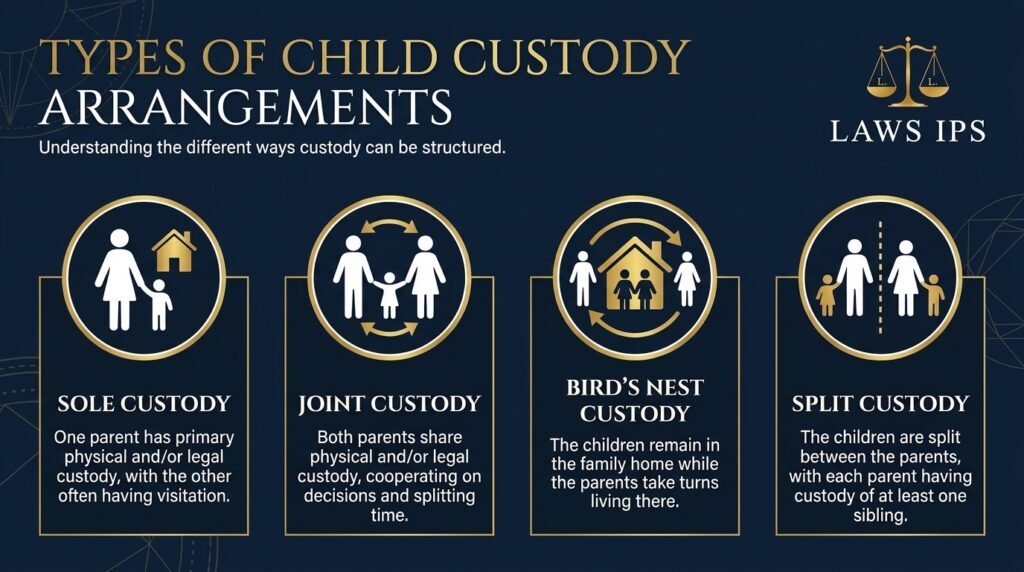
Custody has two separate parts, and parents often confuse them. Legal custody controls major decisions. Physical custody controls where the child lives and who provides day-to-day care. Each part can be sole or joint, and the combination matters more than any single label.
Legal Custody vs Physical Custody
| Type | Meaning | Examples of decisions or time |
| Legal custody | Authority to make major decisions | Education, medical care, religion, extracurricular activities, passport and travel where ordered |
| Physical custody | Where the child lives and daily care | Weekday home, weekend schedule, school nights, holidays, transport |
| Sole legal custody | One parent makes major decisions | One parent decides school and medical treatment, with notice rules as ordered |
| Joint legal custody | Both parents share major decisions | Parents must agree or follow a tie-breaker and dispute process in the order |
| Sole physical custody | Child primarily lives with one parent | Other parent has scheduled parenting time, unless restricted |
| Joint physical custody | Child spends substantial time with both parents | Time can be equal, near-equal, or a structured split that fits school and distance |
Joint legal custody does not always mean equal time. Joint physical custody does not always mean a 50/50 split. The parenting plan, not the label, decides the daily reality. Parents should read the schedule, not just the custody title, before agreeing.
Sole Custody vs Joint Custody
| Feature | Sole custody | Joint custody |
| Decision-making | One parent decides major issues | Both parents share major decisions |
| Living arrangement | Child primarily with one parent | Child splits time, sometimes equally |
| Cooperation needed | Lower for decisions, but communication still required | Higher; joint custody fails when communication collapses |
| Best when | Safety concerns, severe conflict, inability to cooperate, or one parent is unavailable | Both parents are fit, can cooperate, and live close enough for school |
| Parenting time for other parent | Scheduled visitation, sometimes supervised | Substantial scheduled time, with a detailed plan |
| Risk | One parent may feel excluded, which can increase conflict | Vague joint plans can create constant disputes |
A court may also use a hybrid: joint legal custody with primary physical custody to one parent, or joint physical custody with one parent deciding school placement. The label should follow the child’s routine, not the other way around. A plan that looks fair on paper but fails on school mornings is not a good plan.
Parenting Plan Checklist
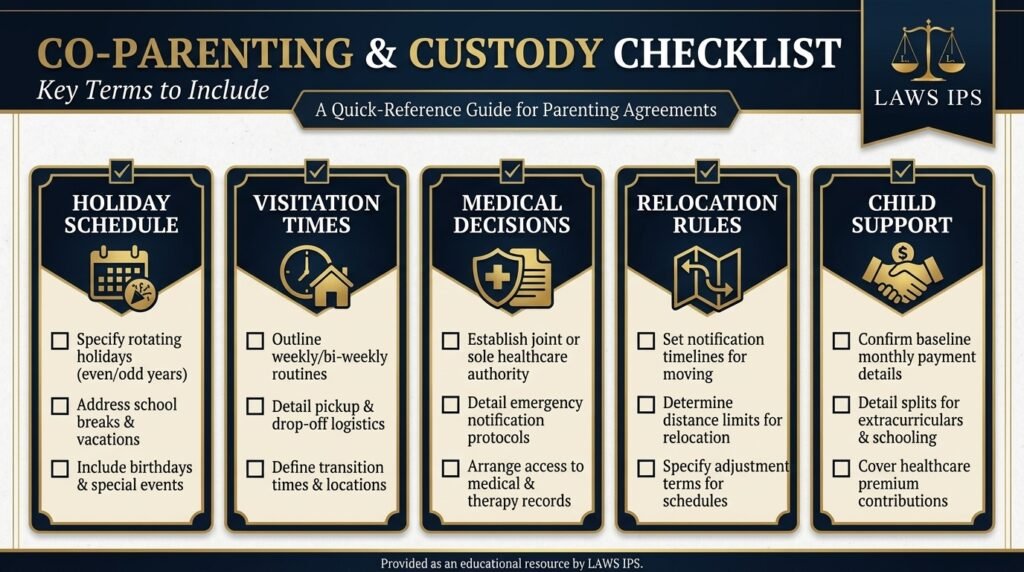
A parenting plan is the written schedule and rule set for raising a child after separation. Many states require one, and even where it is not required, a clear plan prevents most repeat disputes. The plan should cover:
- Weekly schedule, including school nights, weekends, and after-school care
- Holiday schedule, including Christmas, Thanksgiving, spring break, and birthdays
- Summer and school-break schedule, including camps, travel, and return times
- Transport, including pickup and drop-off locations, times, and who pays travel costs
- Communication, including phone and video contact, response times, and a co-parenting app where useful
- Decision rules, including education, medical care, religion, activities, and how disagreements are resolved
- Information sharing, including school records, medical records, and emergency contacts
- Relocation rules, including notice period, objection process, and court approval where required
- Dispute steps, including mediation before a court filing, unless safety requires faster action
- Review date, so the plan can be updated as the child grows
Test every plan against a real school week. Who handles homework, medication, early dismissal, sick days, and activity transport? If the plan does not answer those questions, it will create conflict within weeks. A short, specific plan beats a long, vague one.
How Much Does a Child Custody Lawyer Cost?
Cost is the most common reason parents delay hiring help. The answer is not one number, because cost depends on state, county, lawyer experience, conflict level, and whether the case settles or goes to hearing. Reported ranges help set expectations, but only a written fee agreement from a local lawyer gives a real price for your case.
Hourly, Retainer, Flat Fee, and Limited-Scope Fees
| Fee model | How it works | Common reported range |
| Hourly rate | Lawyer bills for time worked, often in six-minute increments | About 150–500 per hour in many US sources; Texas sources report 200–500+ per hour |
| Retainer | Upfront deposit held in trust, drawn down as work is done, replenished when low | About 2,500–10,000 in many sources; Texas contested cases commonly 3,000–15,000+ |
| Flat fee | One price for a defined, agreed service | About 1,500–3,500 for agreed custody work in some guides; higher for complex agreed work |
| Limited-scope / unbundled | Lawyer handles only part of the case, e.g. document review or one hearing | Lower than full representation, but scope must be written and clear |
| Free consultation | Some firms offer a free or low-cost first meeting; others charge the normal rate | Confirm price when booking; “free” should mean free, not a sales call with hidden fees |
These ranges come from competitor cost guides and Texas firm pages, not from a single audited national survey. Sources disagree, and that disagreement is itself useful: it shows why local quotes matter. A $200-per-hour lawyer who needs 40 hours costs more than a $350-per-hour lawyer who settles in 10 hours.
Why Custody Cost Varies So Much
Conflict is the biggest cost driver. Agreed custody adds mainly paperwork and a court filing. Contested custody adds hearings, motions, discovery, mediation, evaluations, and trial preparation. A custody evaluation, guardian ad litem, or expert witness can add thousands in non-lawyer costs, and those costs are separate from attorney fees.
Location also matters. Major cities usually charge more than smaller counties, and complex cases in large counties take longer. Experience matters too, but not in a simple way: a higher rate can mean faster, more focused work, while a lower rate can mean more hours. Ask about total expected work, not only the hourly rate.
Costs Beyond the Lawyer
- Court filing fees, which vary by state and county
- Service of process fees for delivering court papers
- Mediation fees, often split between parents unless ordered otherwise
- Custody evaluation fees, where ordered
- Guardian ad litem fees, where appointed
- Expert witness fees, for psychologists, accountants, or other experts
- Parenting class fees, where required by the court
- Transcript and copy costs for hearings and records
Ask for an itemised fee agreement that separates attorney fees from costs. That separation prevents surprise bills and makes it easier to compare lawyers. A clear agreement should state the rate, retainer, replenishment rule, billing increments, and what triggers extra charges.
How to Reduce Cost Without Harming Your Case
- Settle what you can early, especially schedule and holidays, before lawyer hours accumulate
- Organise documents before meetings, with school, medical, and communication records in one folder
- Batch questions into one email, rather than many short calls
- Use mediation where safe, and have a lawyer review the final agreement
- Follow orders and communicate respectfully, because new violations create new motions and new bills
- Ask about limited-scope help for document review or mediation coaching, where full representation is unaffordable
- Avoid unnecessary motions that do not change the child’s routine or safety
Low cost should mean good value, not the lowest quote. An inexperienced lawyer who misses a deadline, drafts a vague plan, or mishandles evidence can cost far more later. Compare experience, local court knowledge, communication, and written fee terms together.
How to Choose a Child Custody Lawyer
Choosing a child custody lawyer near me is less about finding a famous name and more about finding a fit for your county, budget, and case type. A trial lawyer may be wrong for a calm, agreed case. A settlement-focused lawyer may be wrong for a high-conflict, safety-related case. Meet at least two or three lawyers before deciding, where possible.
1. Name Your Case Type First
Define the case before searching. Is it agreed, contested, relocation, modification, enforcement, or safety-related? Is it a divorce with children, an unmarried-parent case, or a post-divorce change? That definition narrows the search to lawyers who handle that exact work regularly. A lawyer who handles custody every week will know local judges, mediators, evaluators, and filing practice better than a general practitioner.
2. Check Local Experience, Not Just Years in Practice
Ask what percentage of the practice is family law, and how many custody cases the lawyer handled in your county in the past year. Local knowledge matters because judges differ on schedules, evaluators, and mediation expectations. A lawyer who appears regularly before your county’s family judges can forecast likely outcomes more honestly than a lawyer from another county.
3. Ask About Strategy, Communication, and Fees Together
Strategy, communication, and fees should be discussed in the same consultation. Ask how the lawyer approaches settlement versus litigation, how often you will receive updates, who will actually work on the case, and how billing works. If the lawyer promises a win, pressures immediate signing, or refuses to discuss risks, treat that as a warning sign.
4. Test the Consultation, Not Just the Website
Notice whether the lawyer listens, explains state law in plain language, and asks about the child’s routine. A good consultation covers school, medical care, safety, schedule, and communication, not only legal labels. The lawyer should also ask about deadlines, existing orders, and any safety concerns early, so urgent issues are not missed.
5. Verify Licence, Discipline, and Fee Agreement Before Paying
Confirm the lawyer is licensed and in good standing with the state bar association for the state where the case will be filed. Most state bars allow an online licence and discipline search in minutes. Read the written fee agreement before paying a retainer, and confirm what the retainer covers, when it must be replenished, and what happens if you change lawyers.
Green Flags and Red Flags
| Green flags | Red flags |
| Licensed in your state, verified with the state bar | No licence verification, vague credentials, or out-of-state practice without local counsel where required |
| Clear written fee agreement, with fees and costs separated | No written agreement, hidden fees, or pressure to pay immediately |
| Honest about risks, timelines, and likely outcomes | Guaranteed custody, guaranteed win, or a fixed timeline promise |
| Child-focused, calm, and evidence-based approach | Encourages violating orders, badmouthing the other parent, or coaching the child |
| Regular updates and a named contact for the case | No communication plan, unanswered calls, or work delegated without notice |
| Local court and mediator experience | No local experience, but claims to know every judge’s preference |
What to Bring to Your First Consultation
- Existing orders, including any custody, support, or protective orders
- Parenting schedule as it actually works, not only as written
- School information, including attendance, grades, teachers, and activity schedules
- Medical information, including providers, medication, therapy, and special needs
- Communication records, organised by date, showing schedule, decisions, and disputes
- Financial information relevant to the child, including childcare and activity costs
- Timeline of separation, moves, school changes, and major incidents
- Written goals, including your ideal schedule and your minimum acceptable schedule
- Questions list, including fees, timeline, mediation, and who handles the case
Organised documents make the consultation more useful and can reduce billable time. Bring facts, not a long narrative about the relationship. The lawyer needs the child’s routine, safety facts, and schedule facts first.
The Custody Process, Step by Step
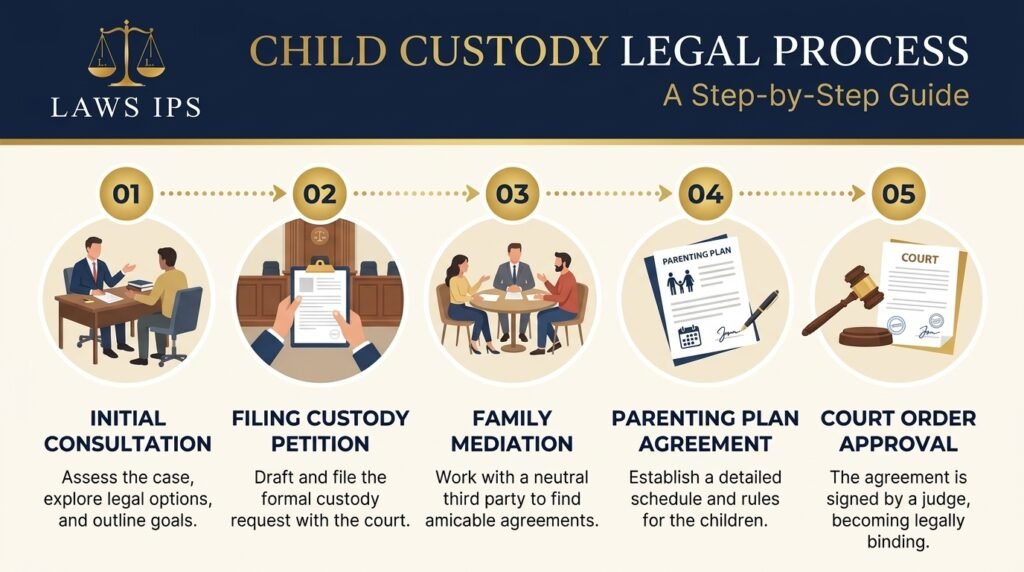
Custody cases follow a familiar sequence, but timing and rules vary by state and county. Knowing the stages helps parents prepare documents, budget, and expectations. Most cases settle before trial, and mediation often happens before a contested hearing.
1. Consultation and Case Assessment
The lawyer reviews facts, orders, and documents, explains state law, and outlines options. This is also the time to discuss fees, scope, and safety. If immediate danger exists, the lawyer should discuss emergency options and safety resources, not only long-term strategy. A consultation does not create a lawyer-client relationship unless the firm confirms it in writing.
2. Filing and Service
A parent files a custody petition, divorce petition with custody claims, paternity action, or modification motion, depending on the case. The other parent must be formally served with court papers, unless they agree to accept service. Filing fees, local forms, and residency rules vary by state, so local filing practice matters from day one.
3. Temporary Orders
A court may set temporary orders for parenting time, support, and decision-making while the case proceeds. Temporary orders provide stability, but they can also influence later decisions if the temporary schedule works well. Parents should treat temporary orders as serious, court-enforced rules, not as trial arrangements.
4. Mediation and Negotiation
Many courts require or encourage mediation before a contested hearing. A mediator helps parents negotiate a parenting plan, but does not decide the case. Parents can still have a lawyer review any proposed agreement before signing. Mediation works best when both parents can negotiate safely and share information honestly.
5. Evaluation, Discovery, and Hearing Preparation
If the case remains contested, the court may order a custody evaluation or appoint a guardian ad litem. Discovery may include documents, school and medical records, and witness information. The lawyer prepares testimony, exhibits, and legal argument, and helps the parent prepare for questions about routine, safety, and cooperation.
6. Hearing, Trial, and Final Order
At hearing or trial, the judge hears evidence and decides contested issues under the best interests standard. The court then issues a final custody order with a parenting plan, decision rules, and enforcement terms. After the final order, parents must follow it unless a court modifies it. Violating a final order can lead to enforcement, contempt, or modification.
How Long Does a Custody Case Take?
Agreed cases can resolve in weeks to a few months, depending on filing, waiting periods, and court approval. Contested cases with evaluations, mediation, and hearings can take many months or longer. No lawyer can guarantee a timeline, because court calendars, evaluator availability, and the other parent’s cooperation all affect speed. A realistic range, with reasons, is more trustworthy than a fixed date.
Mediation vs Litigation: Which Path Fits Your Case?
Mediation and litigation are not opposites in every case. Many cases use both: mediation for settlement, litigation for issues that cannot settle. The right mix depends on safety, cooperation, complexity, and the child’s needs.
Mediation vs Litigation Comparison
| Feature | Mediation | Litigation / Hearing |
| Who decides | Parents, with mediator help | Judge decides contested issues |
| Cost | Usually lower, if settlement is reached | Usually higher, especially with evaluations and trial |
| Timeline | Usually faster for agreed issues | Usually slower, with court calendar delays |
| Conflict level | Lower, if both parents participate in good faith | Higher, but sometimes necessary for safety or non-cooperation |
| Privacy | More private than a public hearing | Court record is more formal and public, with limits for children |
| Enforceability | Agreement becomes an order when court approves it | Judge’s order is enforceable, with contempt and enforcement options |
| Best when | Both parents can negotiate safely and share information | Safety concerns, non-cooperation, complex evidence, or urgent orders needed |
When Mediation Fits, and When It Does Not
Mediation fits when both parents can communicate, share school and medical information, and follow interim agreements. It also fits when the main dispute is schedule or holidays, not safety. A lawyer can prepare a parent for mediation, review the draft agreement, and prevent vague terms that cause later conflict.
Mediation does not fit every case. It should not be used to pressure a parent in a domestic violence case, to hide safety facts, or to force agreement when one parent refuses to share information. Courts may have safety exceptions, separate sessions, or other protections. A lawyer should discuss those protections before mediation, not after.
Special Custody Situations
Most custody guides stop at sole versus joint custody. Real cases involve paternity, relocation, enforcement, modification, safety, and third-party claims. Each situation has its own procedure, and state law controls the details.
Unmarried Parents and Paternity
Unmarried parents usually need to establish legal parentage before a court can order custody or support. In many states, a mother has default rights at birth, while a father must sign a voluntary acknowledgment of paternity or obtain a court order. If paternity is disputed, a court may order genetic testing. After paternity is established, the parent can seek custody, parenting time, and decision rights, and also becomes subject to support duties.
For a dedicated unmarried parents custody guide, the key points are standing, acknowledgment versus court order, and local filing practice. Do not assume that a birth certificate alone creates the same rights in every state. Check the state’s paternity and parentage rules before filing.
Relocation and Interstate Cases — UCCJEA Explained
Relocation is one of the highest-stakes custody issues. A parent who wants to move a child a significant distance usually must give notice, seek agreement, or obtain court approval, depending on the order and state law. Courts weigh the reason for the move, the effect on the child’s relationship with the other parent, school stability, and the proposed new schedule.
Interstate cases use the Uniform Child Custody Jurisdiction and Enforcement Act (UCCJEA). The child’s home state — generally where the child lived for the prior six months — usually has authority to decide custody. Once a state makes a custody order, it usually keeps exclusive continuing jurisdiction until the child and parents leave, or the court finds it no longer has a significant connection to the case. That rule prevents a parent from moving and immediately seeking a better order in a new state.
To enforce an out-of-state order, a parent usually registers a certified copy with the new state’s court. After registration, the new state can enforce the order like a local order, but generally cannot modify it unless jurisdiction has changed. Emergency jurisdiction can apply temporarily when a child faces immediate harm. For detail, see a dedicated UCCJEA explained and child custody relocation guide.
Enforcement: When the Other Parent Does Not Follow the Order
Enforcement starts with evidence, not retaliation. Document missed exchanges, denied phone contact, schedule changes, and communication in a dated log, with messages saved in full context. A lawyer may file an enforcement motion or contempt motion, asking the court to enforce the order, award make-up parenting time, or impose sanctions. Courts can also order attorney fees in some enforcement cases, depending on state law.
Do not withhold child support because parenting time was withheld, and do not withhold parenting time because support was missed. Support and custody are separate obligations in most states, and violating one to punish the other creates a new legal problem. Bring the violation to court through the lawyer, with a clear record, rather than taking matters into your own hands.
Modification: When Circumstances Change
Custody orders can be modified, but courts value stability. A parent usually must show a substantial or material change in circumstances and that modification serves the child’s best interests, under state law. Examples can include a major move, a change in school or medical needs, a parent’s changed work or housing situation, or a safety concern supported by evidence.
Modification is not a second chance to relitigate the original case. A parent who simply dislikes the original order, without a real change, is unlikely to succeed. A lawyer should assess whether the change is legally significant, whether mediation could resolve it, and what evidence will show the child’s current routine and needs. See a dedicated child custody modification guide for state-specific standards.
Safety, Domestic Violence, and Supervised Visitation
Safety cases need a different process. If domestic violence, child abuse, or serious neglect is alleged, the court may order protective orders, restricted parenting time, or supervised visitation. Supervised visitation means parenting time takes place with a third party or agency present, under terms set by the order. The goal is safety, not punishment, and terms can change as circumstances change.
Parents in safety cases should preserve evidence carefully and seek legal help early. Do not delete messages, do not confront the other parent about evidence, and do not put the child in the middle of safety disputes. If immediate danger exists, contact emergency services and local domestic violence resources, then discuss protective orders and custody options with a lawyer. Safety planning and legal strategy should happen together.
Grandparents and Third Parties
Grandparent and third-party custody claims have narrow standing in most states. The US Supreme Court recognised in Troxel v. Granville that fit parents have a fundamental liberty interest in the care, custody, and control of their children. That presumption makes third-party cases difficult, and state statutes vary widely on who can file, what must be proved, and what visitation can be ordered.
Grandparents should not assume they have automatic rights because they provide care, pay expenses, or have a close bond. A lawyer in the child’s state should assess standing, the parent’s fitness, the child’s best interests, and any existing order before filing. A dedicated grandparents custody rights guide should stress state variation and the fit-parent presumption, not promise outcomes.
Military, Same-Sex, and Blended Family Cases
Military parents face deployment, relocation, and military orders that can disrupt schedules. Some states have specific protections for deployment-related custody changes, including temporary orders during deployment and return-to-prior-schedule rules. Military parents should seek advice before deployment orders change, not after a schedule has already broken down.
Same-sex parents’ rights depend on legal parentage under state law, including marriage, adoption, second-parent adoption, and assisted-reproduction rules. A parent who is not legally recognised as a parent may face standing problems, even with a close bond. Early parentage planning, including adoption where appropriate, prevents later custody disputes.
Blended families add stepparents, half-siblings, and new households to the analysis. Courts focus on the child’s relationships and stability, not on the adults’ new relationships alone. A stepparent’s role can matter for caregiving and stability, but stepparents usually do not gain custody rights simply by marriage. The parenting plan should address stepparent involvement, household rules, and communication boundaries clearly.
Do You Need a Lawyer, or Can You Handle Custody Yourself?
Not every custody case requires full representation, but every contested case benefits from at least a consultation. The risk of self-representation rises with conflict, safety issues, interstate rules, evaluations, and complex schedules. A one-time consultation can catch costly mistakes even for parents who handle most of the case themselves.
When Self-Representation Is Risky
- Custody is contested and the other parent has a lawyer
- Safety, domestic violence, or substance misuse is alleged
- Relocation, interstate jurisdiction, or international travel is involved
- A custody evaluation or guardian ad litem has been ordered
- The parenting plan involves complex holidays, travel, or medical decisions
- An existing order is being violated or needs enforcement
- Paternity or parentage is disputed
In those cases, a lawyer’s knowledge of procedure, evidence, and local practice can change the outcome. Self-represented parents often lose time on procedure, miss deadlines, or agree to vague terms that create later disputes. Limited help is better than no help when full representation is unaffordable.
Limited-Scope Help and Legal Aid Options
Limited-scope representation, also called unbundled legal services, means a lawyer handles only part of a case. Examples include reviewing a parenting plan, coaching for mediation, drafting a motion, or representing a parent at one hearing. The scope must be written, with clear limits on what the lawyer will and will not do.
Legal aid organisations, Legal Services Corporation-funded programs, law school clinics, and state bar referral services can help qualifying parents. Eligibility usually depends on income, case type, and availability, and free full representation is not guaranteed. Court self-help centres can explain procedures and forms, but they do not provide legal advice for one side. For a dedicated guide, see legal aid family law and limited-scope representation.
Expert Tips for Choosing and Working With a Child Custody Lawyer
- Lead with the child’s routine, not the relationship history. Judges decide on school, medical care, stability, and safety, not on who ended the relationship.
- Write every proposal as a schedule a stranger could follow. Vague plans create repeat conflict; specific times, locations, and decision rules prevent it.
- Document facts daily, with dates and full messages. A short, dated log beats a long memory at hearing.
- Keep the child out of adult conflict. Do not badmouth the other parent to the child, use the child as a messenger, or reward a preference.
- Follow orders even when you disagree, and challenge them in court. Violating an order to “fix” a problem usually creates a worse problem.
- Ask about total cost, not only hourly rate. Hours, evaluations, mediation, and hearings decide the final bill.
- Verify licence and discipline before paying a retainer. A state bar search takes minutes and prevents costly mistakes.
- Prepare for mediation like a hearing. Bring a proposed schedule, holiday plan, and decision rules, not only a list of complaints.
- Update the plan as the child grows. School, activities, and medical needs change, and a review date keeps the order realistic.
- Choose the lawyer who explains risks honestly. A lawyer who promises custody, a timeline, or a win is selling certainty the court does not offer.
FAQs
What is a child custody lawyer?
A child custody lawyer is a family law attorney who helps parents establish, negotiate, modify, or enforce legal custody, physical custody, and parenting plans. The lawyer advises, drafts documents, negotiates, and represents a parent in mediation or court.
Do I need a child custody lawyer?
Not always, but a consultation is strongly worth it for contested, relocation, safety, interstate, or evaluation cases. Even parents who handle most of the case themselves can benefit from a lawyer review of a parenting plan or a single hearing.
How much does a child custody lawyer cost?
Reported US ranges vary widely, roughly 150–500 per hour in many sources, with retainers commonly 2,500–15,000 depending on state, complexity, and whether the case is contested. Agreed cases may use a flat fee. These are ranges, not quotes, and only a local written fee agreement gives a real price.
What is the difference between legal and physical custody?
Legal custody is decision-making for education, health, and welfare. Physical custody is where the child lives and who provides day-to-day care. Each can be sole or joint, and the parenting plan decides the daily reality.
What is joint custody?
Joint custody means both parents share legal and/or physical custody. Joint legal custody does not always mean equal parenting time, and joint physical custody does not always mean a 50/50 split.
What is sole custody?
Sole custody means one parent has primary legal and/or physical custody. The other parent may still have scheduled parenting time, unless the court restricts it for safety reasons.
How do courts decide child custody?
Courts use the best interests of the child standard, weighing stability, caregiving history, safety, school, health, co-parenting, and — where age-appropriate — the child’s preference. State statutes list the exact factors, and judges weigh the whole picture.
Do courts favour mothers over fathers?
Modern US law is generally gender-neutral, and several states prohibit considering gender in custody decisions. Outcomes depend on caregiving, stability, safety, and cooperation evidence, not on a maternal preference in law.
At what age can a child choose which parent to live with?
No single national age exists. Courts may consider a child’s preference depending on age, maturity, and state law, but the judge decides. Preference is one factor, not a choice, and coaching a child can damage credibility.
What is a parenting plan?
A parenting plan is a written schedule and rule set covering weekdays, weekends, holidays, transport, communication, decisions, information sharing, relocation, and dispute steps. Many states require one, and a clear plan prevents most repeat disputes.
How long does a child custody case take?
Agreed cases can resolve in weeks to a few months, depending on filing and court approval. Contested cases with evaluations or hearings can take many months or longer. No lawyer can guarantee a timeline.
What should I bring to a custody consultation?
Bring existing orders, the actual parenting schedule, school and medical information, communication records, financial details for the child, a timeline, and a written list of goals and questions. Organised documents make the consultation more useful and can reduce billable time.
Can custody be changed after divorce?
Yes, usually by showing a substantial or material change in circumstances and that modification serves the child’s best interests, under state law. Modification is not a second chance to relitigate the original case without a real change.
How do I enforce a custody order?
Through the court, typically by filing an enforcement or contempt motion with evidence of non-compliance. Do not withhold child support as retaliation, and do not withhold parenting time because support was missed — those are separate obligations in most states.
What if the other parent withholds my child?
Document the facts with dates and full messages, contact your lawyer promptly, and use court enforcement rather than self-help. If there is immediate danger, contact emergency services first.
Can a parent move out of state with a child?
Usually not without notice, agreement, or court approval, depending on the order and state law. Interstate cases also involve UCCJEA home-state rules, and unauthorised relocation can lead to return orders, contempt, or loss of primary custody.
What is UCCJEA?
The Uniform Child Custody Jurisdiction and Enforcement Act determines which state has authority over custody and how orders are enforced across state lines. Home state is generally where the child lived for the prior six months, and the original state usually keeps continuing jurisdiction until specific conditions change.
What is a guardian ad litem?
A guardian ad litem is a court-appointed person, often a lawyer, who investigates and reports on the child’s best interests. That role differs from a custody evaluator and from a CASA volunteer in some states.
Is mediation required for custody?
Many courts require or encourage mediation before a contested hearing, but rules vary by state and county, and safety exceptions may apply. A lawyer can prepare you for mediation and review any proposed agreement before signing.
Can unmarried fathers get custody?
Yes, after establishing paternity and standing under state law, by voluntary acknowledgment or court order, often with genetic testing if disputed. After paternity is established, a father can seek custody and parenting time, and also becomes subject to support duties.
Do grandparents have custody rights?
Standing is narrow and state-specific. Fit parents have a constitutional presumption in their favour under Troxel v. Granville, so grandparent cases need state-specific legal advice and strong evidence, not assumptions about automatic rights.
Conclusion
A strong custody case is built on a child’s routine, not on a parent’s anger or a lawyer’s promise. Stability, safety, caregiving history, and cooperation carry more weight than labels, and a clear parenting plan turns those facts into a schedule both parents can actually follow. That is why early preparation, honest legal advice, and careful documentation matter more than any single hearing.
Choosing the right child custody lawyer means matching experience, local court knowledge, communication, and written fees to your case type — agreed, contested, relocation, modification, or safety-related. Book a consultation, bring organised records, ask the questions in this article, and verify licence and discipline before paying a retainer. With a child-focused record and a realistic plan, a child custody lawyer can help protect your parental rights while keeping the child’s stability, safety, and relationships at the centre of every decision.
