


Settlement payout per person depends on the system behind the payment, not on the headline fund size alone. A $725 million case can pay about $29 per person, while a $395,000 case can pay about $1,588 per person, because class size and claim count change everything.
Most searchers want one number, but no honest number exists without a case name, a fund, a fee request, and a claim count. A page that promises one average for every settlement is hiding the variables that actually decide the check.
Four systems answer this question differently, and mixing them creates false expectations. Class actions divide a fund, personal injury cases price individual damages, mass torts use harm tiers, and FTC redress follows agency rules.
Start with the system that fits your case, then use its formula. That order prevents the most common error, which is comparing a class action check with an injury settlement as if both came from the same math.
Four Systems, Four Different Answers
Class action payment divides a net settlement fund among valid claimants, using a flat amount, a pro rata share, usage points, or a tier system. Claim count is the biggest unknown, so pro rata amounts cannot be known until after the claim deadline.

Personal injury payment prices one person damages, including medical costs, lost wages, pain and suffering, and future care, subject to liability, policy limits, liens, and a contingency fee. No fund is divided among strangers, so another claimant cannot shrink your payment.
Mass tort payment uses a matrix or points system for many individual cases grouped for pretrial work, with harm tiers based on diagnosis, treatment, and exposure. Two people in the same mass tort can receive very different amounts for different injuries.
FTC redress payment comes from agency enforcement, not from a private class settlement, with eligibility, amounts, and timing set by the agency program. FTC refunds follow agency rules, and they do not create class member rights in the same way.
| System | How payment is set | What shrinks it | Known before filing |
|---|---|---|---|
| Class action | Net fund divided by claims, flat amount, points, or tiers | More valid claims, higher fees, larger class | Flat amount only, pro rata only as a range |
| Personal injury | Individual damages, liability, policy limits, liens, fees | Weak liability, low policy limit, high liens, disputed damages | Only as a negotiation range, never as a promise |
| Mass tort matrix | Harm tier points times point value | Lower tier, weaker proof, many claims in the same tier | Tier range only, point value often unknown early |
| FTC redress | Agency formula and available funds | Program limits, claim volume, agency priorities | Agency notice amount where published |
The Formula: Gross Fund to Net Fund to Your Check
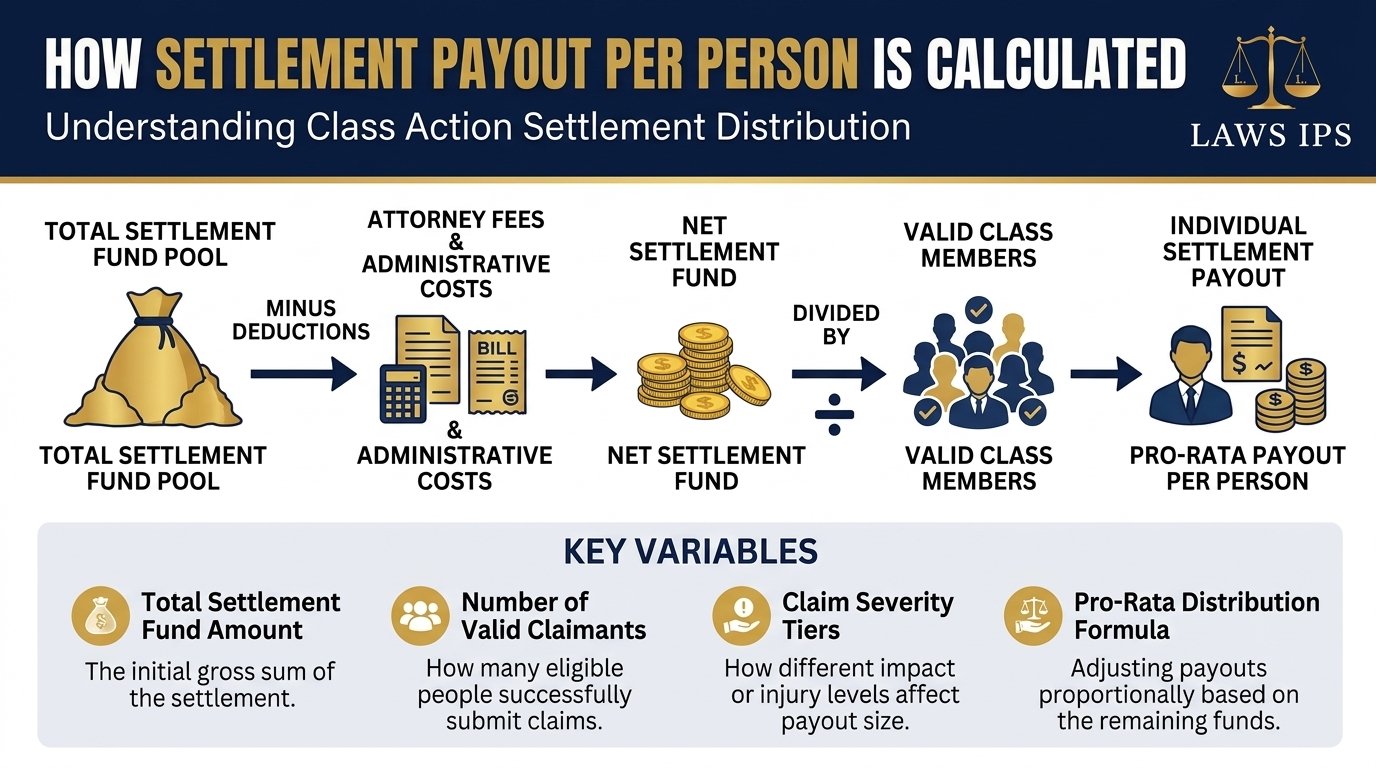
Gross settlement fund is the headline amount announced in news stories, and it is almost never the amount available to claimants. Headlines love gross funds because they look large, while claimants receive only what remains after court-approved deductions.
Attorney fees usually take 25 to 33 percent of a common fund in class cases, subject to court approval under Rule 23(h). A fee motion posted before the fairness hearing gives the exact request, and that motion outranks any news estimate.
Litigation costs and administration come next, covering expert work, notice mailing and emailing, claim processing, and payment distribution. ClaimOwed estimates litigation costs plus administration at roughly 3 to 4 percent in its TikTok illustration, but real cases vary widely.
Service awards pay lead plaintiffs for time, risk, and effort, usually $1,000 to $25,000 each per ClaimOwed. Service awards are small relative to a large fund, but they still reduce the net fund available to ordinary claimants.
Net settlement fund is the remainder after fees, costs, administration, and service awards, and it is the only fund that matters for per-person math. Always ask for the net fund, not the gross fund, when estimating a payment.
Flat payment formula is simple: a fixed dollar amount per valid claim, written into the settlement, subject to pro rata reduction if claims exceed the fund or topping up if claims fall short. Flat amounts are the only per-person figures known before filing.
Pro rata formula is also simple in form: net settlement fund divided by the number of valid claims, sometimes weighted by subclass, usage points, or recognized loss. That formula cannot produce a final number until the claim deadline passes and valid claims are counted.
Points formula adds weights, because each claim earns points for years of use, accounts, orders, searches, or other factors in the plan of allocation. Total points replace total claims in the denominator, and each point receives the same dollar value.
| Line | $10 million fund example | $92 million fund example | $725 million fund example |
|---|---|---|---|
| Gross fund | $10,000,000 | $92,000,000 | $725,000,000 |
| Fees at 30 percent | $3,000,000 | $27,600,000 | $217,500,000 |
| Costs and admin at 4 percent | $400,000 | $3,680,000 | $29,000,000 |
| Service awards, illustrative | $50,000 | $100,000 | $200,000 |
| Net fund, illustrative | $6,550,000 | $60,620,000 | $478,300,000 |
These waterfall figures are illustrative, not case-specific, because real fee motions and admin bills differ by case. Use the official fee motion for any named case, and treat every other waterfall as a teaching example only.
Flat, Pro Rata, Points, and Matrix Payments
Flat payment suits small, uniform harms, such as a $10 Starbucks mobile order fee payment, a $15 DoorDash payment, or an $8 Knott’s processing fee payment in the research examples. Flat payments are easy to understand, but they can still fall if claims exceed the fund.
Pro rata payment suits large classes with a shared fund and no easy way to price each claim individually, such as privacy and data breach cases. Pro rata payments are fair in form, because every valid claim in the same tier receives the same share, but they shrink as claim volume rises.
Points payment suits cases where usage matters, such as years on a platform, number of accounts, number of orders, or number of devices. Points reward heavier use, but they also complicate estimation, because a claimant needs to know both total points and point value.
Matrix payment suits mass tort and injury cases, where diagnosis, treatment, surgery, and permanence place each claimant in a harm tier. Matrix payments are individual, not equal, and a higher tier can pay many times more than a lower tier in the same program.
Subclass weighting changes pro rata math further, because a subclass with stronger claims can receive double or more per claim. Flo privacy estimates in research show California claimants receiving double the recovery of out-of-state claimants, because California claims survived summary judgment in that case.
Hybrid payments are common, because many settlements combine a flat no-proof payment with a documented tier for larger losses. Bank of America research example pays $50 flat plus documented losses up to $600, which shows why documented proof can multiply a base payment.
| Payment type | Formula | Known before filing | What moves the number |
|---|---|---|---|
| Flat | Fixed amount per valid claim | Yes, subject to reduction or top-up | Claim volume above or below the fund limit |
| Pro rata | Net fund divided by valid claims | Range only, based on expected claims | Claim volume, subclass weights, points |
| Points | Net fund divided by total points, times your points | Range only | Your points, total points, subclass weights |
| Matrix | Tier value times point value, subject to proof | Tier range only | Diagnosis, treatment, proof, total claims in tier |
Why Your Check Shrinks: Claims Rate and Class Size
Claims rate means the share of eligible class members who actually file valid claims, and it is the hidden variable behind every pro rata surprise. A low claims rate leaves a larger share for each filer, while a high claims rate divides the same fund among more people.
FTC median claims rate of 9 percent across 149 settlements, as cited by ClaimOwed, gives a useful planning anchor, but it is a median, not a promise for any single case. Famous cases with heavy news coverage often exceed that median, while obscure cases often fall below it.
Class size effect is easy to see with one fund and three class sizes, because the same net fund pays very different amounts when divided among 100,000, 1 million, and 10 million claimants. News headlines hide class size, so readers overestimate their share.
Famous case trap explains many small checks, because a famous case attracts millions of claims while a small case attracts thousands. Google+ paid $2.15 per claimant in the ClaimOwed example, not because the fund was tiny, but because claim volume diluted it.
Low claims rate advantage is real but uncontrollable, because an individual claimant cannot control how many other people file. Smaller, less publicized settlements often pay more per person than famous ones for exactly that reason.
| Net fund | 100,000 valid claims | 1 million valid claims | 5 million valid claims |
|---|---|---|---|
| $6.55 million | $65.50 each | $6.55 each | $1.31 each |
| $60.62 million | $606.20 each | $60.62 each | $12.12 each |
| $478.3 million | $4,783 each | $478.30 each | $95.66 each |
These sensitivity figures use the illustrative net funds from the waterfall table above, not any single case. They show why fund size alone cannot predict a check, and why claim count must be estimated before any range is quoted.
Real Cases: What People Actually Got
Facebook first round averaged $29.43 per person, with a range of about $4 to $38, from a $725 million fund, according to LegalAnalysis. About 19 million claims were validated out of about 250 million eligible users, which shows how a huge fund still pays modest checks when claim volume is high.
Facebook second round redistributed about $100 million in unclaimed funds to 15.7 million people who cashed their first check, starting June 9, 2026, in batches over about four weeks. Only people who cashed the first check qualified, which rewards prompt payment handling and punishes expired checks.
TikTok illustration from ClaimOwed uses a $92 million fund with about $61 million net after 30 percent fees and other deductions, then shows about $122 at 500,000 claims, $61 at 1 million, $30 at 2 million, and $12 at 5 million. That illustration is a teaching model, not a final TikTok payment, and the administrator range of $27 to $167 in related pages reflects the same claim volume uncertainty.
Equifax warning remains the best cautionary tale, because the notice offered up to $125 as an alternative cash payment, so many people chose it that the $31 million set aside for that option was swamped. The FTC publicly warned claimants they would receive far less, and many ended with single-digit payments, according to ClaimOwed.
Assa Abloy equal share shows a different model, because the fund grows by $1,588.45 per additional claimant, up to $395,000, with an estimated payout of about $1,588 each and a $5,000 per-person cap. Only 158 class members were identified from company records, which explains why a small fund still pays a large per-person amount.
Knott’s flat payment shows the opposite end, because about 1,405,235 class members share an $8 credit automatically or an $8 cash payment by claim, not per ticket. A flat $8 payment is honest and predictable, but it also shows why small per-order harms produce small checks.
| Case | Fund or payment type | Per-person figure | Status and source label |
|---|---|---|---|
| $725 million, pro rata | Avg $29.43, range $4 to $38, first round | LegalAnalysis, Sep 2025 first round, verify official site | |
| TikTok | $92 million, illustrative net $61 million | $12 to $122 by claim volume | ClaimOwed illustration, not a final payment |
| Equifax | Up to $125 alternative cash | Single digits for many, after swamping | FTC warning via ClaimOwed, cautionary example |
| Google+ | $7.5 million, pro rata | $2.15 per claimant | ClaimOwed, dilution example |
| Assa Abloy | Up to $395,000, equal share | Est $1,588, capped $5,000 | OpenClassActions, claim Dec 4, 2026 |
| Knott’s | $8 flat, credit or cash | $8 per person, not per ticket | OpenClassActions, claim Dec 22, 2026 |
| Fairmont FCU | $1.78 million, tiers | Up to $150 alternative cash, pro rata | ClaimDepot, claim Dec 18, 2026 |
| Peterson Oil | $14 million, two pools | Up to $180 per incident, no-doc | ClaimDepot, claim Feb 11, 2026, passed |
| Sidwell Air Freight | $1 million, weeks shares | Min $300 plus shares | ClaimDepot, weeks formula example |
| NYC strip search | $28 million distribution | No estimate possible until claims known | OpenClassActions, searches-based pro rata |
Payout Ranges by Case Type, With Sources
Consumer product cases typically pay $5 to $50 per person in LawFold biggest page, and $5 to $100 for no-proof claims in ClaimOwed. Those ranges overlap but do not match, so label the source and case type every time a range is quoted.
Data breach cases typically pay $25 to $500 per person in LawFold biggest page, with flat payments of $25 to $100 plus documented losses up to a cap in ClaimOwed category table. Fairmont example fits that pattern, with up to $150 alternative cash plus documented losses up to $7,500.
Privacy and biometric cases typically pay $10 to $150 nationwide in ClaimOwed, and $100 to $400 plus for Illinois biometric cases, driven by statutory damages of $1,000 to $5,000 per violation. Illinois residency and subclass status matter more than fund size in those cases.
Bank fee and overdraft cases typically pay $25 to $400 in ClaimOwed, often as a refund of fees charged with a minimum per account. Wells Fargo minimum $25 per account in the same table shows why minimums matter for small fee claims.
Antitrust cases typically pay $10 to $200 per person in LawFold biggest page, and $10 to $500 for consumers in ClaimOwed antitrust guide. Indirect purchaser rules vary by state, so the same product can produce different eligibility in different states.
Securities cases typically pay $500 to $10,000 plus per person in LawFold biggest page, but that average hides a wide spread, because institutional investors with large recognized losses receive far more than small retail investors. Securities payments follow recognized loss, not equal shares.
Employment cases pay by weeks, hours, and pay rate, so no single per-person average is meaningful without a work history. Sidwell minimum $300 plus shares shows the template, but actual amounts depend on weeks worked and state multipliers.
Environmental and injury cases typically pay $1,000 to $100,000 plus per person in LawFold biggest page, with mass tort matrices driving the spread. Those figures should never be quoted as consumer class averages, because injury tiers are individual.
Securities: Recognized Loss Worked Example
Recognized loss is the court-approved measure of investor harm in a securities settlement, based on purchase dates, sale dates, share counts, and price inflation during the class period. A flat per-person amount does not apply, because two investors with different trades have different recognized losses.
Buy and sell timing drives recognized loss, because shares bought during the inflation period and sold after a corrective disclosure usually carry more recognized loss than shares bought and sold before disclosure. Shares held through the period are treated differently from shares sold early, under the plan of allocation.
Illustrative example helps: an investor buys 100 shares during the class period, sells 50 shares after disclosure at a lower price, and holds 50 shares through the period end. Recognized loss for each lot follows the plan formula, then total recognized loss divided by total recognized loss for all claimants gives the pro rata share of the net fund.
Minimum payment often applies in securities plans, with $10 as a common threshold in the OpenClassActions securities guide. Claims below that threshold may receive no check, because distribution costs exceed the payment value.
Broker records are always required for securities claims, including trade confirmations or monthly statements showing dates, share quantities, and prices. No-proof filing does not exist for securities cases in the same way it does for consumer cases.
Employment: Weeks and Hours Worked Example
Weeks worked formula is the template in Sidwell, where each participating member receives a minimum of $300 plus a pro rata portion based on individual settlement shares. Shares come from weeks worked, with state multipliers where applicable, and the per-share dollar figure comes from net fund divided by total shares.
Illustrative example from Sidwell shows the math clearly: 10 weeks in Washington at a 1.5 multiplier gives 15 shares, and at $10 per share the pro rata portion is $150, for a total of $450 with the minimum. That example is a template, not a promise for any other wage case.
Hours and pay rate matter in other wage cases, because overtime, missed breaks, and wage deductions can be priced by hours worked and hourly rate rather than by weeks alone. Pay stubs, timesheets, and schedules become the proof that drives shares.
State law variation matters, because Washington, California, and other states use different wage rules, penalties, and limitation periods. A weeks formula from one state cannot be copied to another state without checking that state plan of allocation.
Personal Injury: A Different System Entirely
Economic damages form the base of a personal injury settlement, including medical bills, future medical care, lost wages, and lost earning capacity. Those damages are documented with bills, records, and expert opinions, not divided from a shared fund.
Non-economic damages cover pain and suffering, emotional distress, and loss of enjoyment, which are harder to price and often estimated with a multiplier or per diem method. Multiplier method multiplies economic damages by a factor, often 1.5 to 5 in Gain Servicing summary, based on injury severity.
Per diem method assigns a daily value to pain and suffering for each day of recovery, which suits injuries with a clearly defined recovery period. Per diem works poorly for permanent injuries, where future suffering has no clear end date.
Liability and comparative fault can reduce or defeat a claim, because a claimant who shares fault may receive a reduced payment under state comparative fault rules. Clear liability supports higher settlements, while disputed liability pushes settlements down.
Policy limits cap many injury settlements, because an at-fault party insurance policy may offer only $25,000, $50,000, or $100,000 in coverage regardless of damages. Underinsured motorist coverage, umbrella policies, and defendant assets can change that cap, but only where they exist.
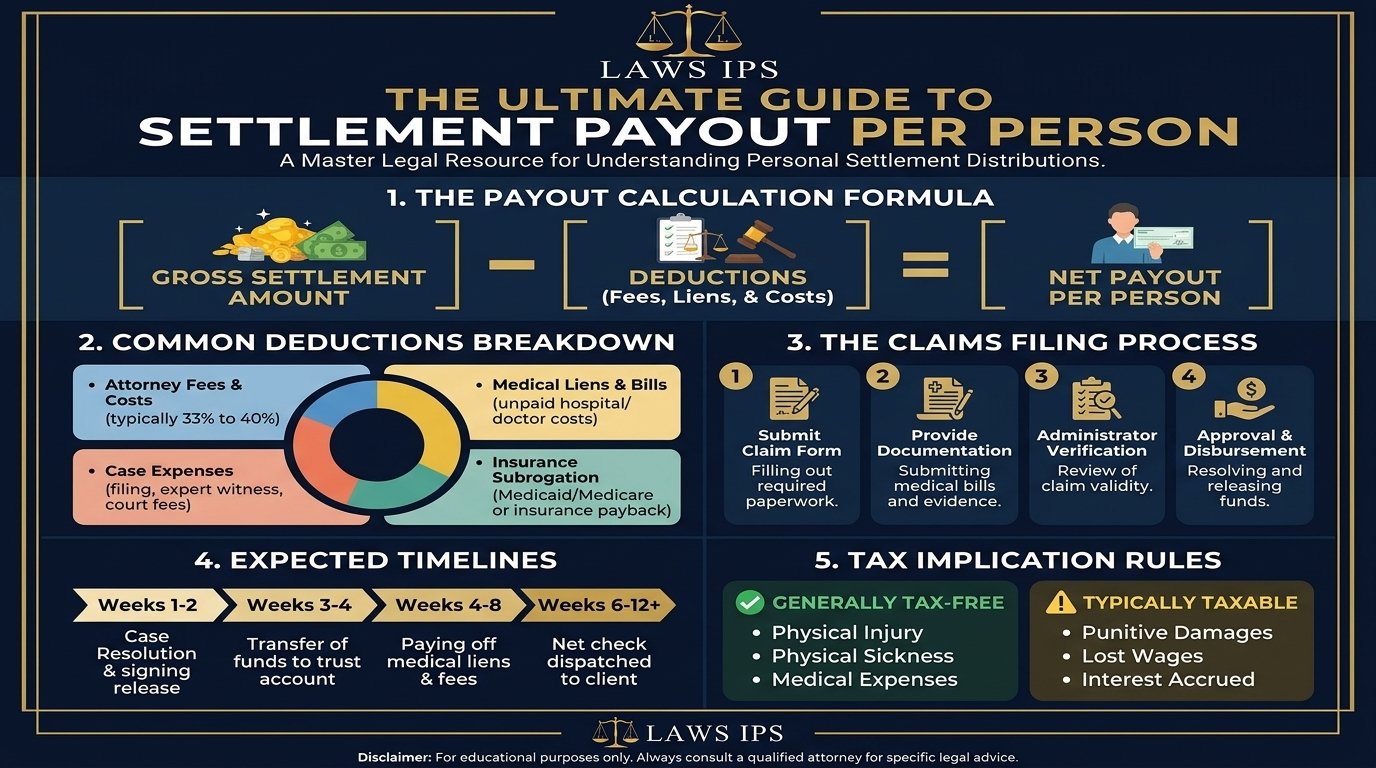
Liens and subrogation reduce net recovery, because health insurers, Medicare, Medicaid, and medical providers may claim reimbursement from a settlement for care they paid. Lien negotiation can increase net recovery, but liens must be resolved before final distribution in many cases.
Contingency fees in injury cases typically run about one-third of the gross recovery, plus costs, subject to state rules and the fee agreement. Net to client equals gross settlement minus fees, costs, liens, and medical balances, which is why gross and net figures differ sharply.
Average versus median matters for injury figures, because a few very large settlements raise the average above the typical case. Morris Bart median of about $52,900 and Nicoletlaw average of $113,391 describe different measures from different sources, so neither should be quoted as a typical injury payment without that label.
Mass Tort Matrix: Harm Tiers, Not Equal Shares
Matrix tiers sort claimants by diagnosis, treatment, surgery, permanence, and exposure duration, with each tier assigned points or a dollar range. A claimant with surgery and permanent harm sits in a higher tier than a claimant with brief treatment and full recovery.
Point value is often unknown early, because total points across all claimants must be counted before a point dollar value can be set. That uncertainty mirrors pro rata class math, but with harm weighting instead of equal shares.
Proof burden is higher in mass torts, because medical records, product use records, and exposure records must link the product to the injury for each claimant. Weak proof can drop a claim to a lower tier or to denial, even when the product is widely used.
Individual lawsuits remain possible in mass torts, because each plaintiff keeps an individual case even when pretrial work is coordinated in multidistrict litigation. That control differs from a class action, where one case outcome binds the class for covered claims.
FTC Redress: Agency Payments, Not Class Payments
FTC redress returns money to consumers after agency enforcement, using agency rules and available funds, not a court-approved class plan of allocation. Eligibility, amounts, and timing come from the agency notice, not from a claim form in a private settlement.
Amazon and Cleo examples in earlier research show agency timing differences, because FTC refunds can arrive automatically where the agency has payment details, while class claims usually require a form. Automatic FTC payment should not be confused with automatic class payment, because the legal basis differs.
No class release follows from FTC redress in the same way as a class settlement, because agency action does not bind private claims in the same manner. A consumer who receives FTC redress may still have private rights, subject to other legal limits and advice.
What Moves Your Number Up, Legitimately
Subclass membership moves payment most reliably, because Illinois biometric residency, California privacy status, creator status, or paid tier status can double or multiply a share. Answer subclass questions accurately, because false subclass claims can lead to denial.

Usage points move payment where the plan weights claims, because years of use, accounts, devices, orders, or searches earn points. Check account history before estimating, because memory alone often understates usage.
Documented tier moves payment most often for ordinary claimants, because documented losses commonly pay 2 to 10 times the no-proof amount in ClaimOwed summary, up to a cap. Bank of America $50 flat versus up to $600 documented shows that gap in one case.
Low claims rate moves payment indirectly, because fewer valid claims leave a larger share for each filer, but no individual can control that rate. Filing in a small, less publicized case often pays more per person than filing in a famous case for that reason.
Second distribution moves total recovery for cashed claimants, because uncashed funds are often redistributed to people who cashed the first check. Keeping address and payment details current, and choosing digital payment where offered, protects second round eligibility.
Taxes: General Rules, Not Personal Advice
Economic loss payments are generally taxable income in ClaimOwed summary, because they compensate for money lost rather than for physical injury. Small consumer payments often do not generate a 1099, but taxability and reporting are separate questions.
Physical injury payments are treated differently under general tax rules, because compensation for personal physical injuries is often excluded from income, while punitive damages and interest are generally taxable. That distinction needs a tax professional for any large or mixed payment.
IRS Publication 4345 is the general reference for settlement taxation, covering personal injury, employment, and other settlement types. Use it as a starting point, not as a personal tax ruling, because individual facts change treatment.
1099 thresholds vary by payment type and payer, so a missing 1099 does not prove a payment is tax-free, and a 1099 does not prove the full amount is taxable. Keep settlement notices, payment records, and tax forms together until tax filing is complete.
Benefits interaction needs separate advice, because settlement payments can affect means-tested benefits, depending on program rules and payment structure. Structured settlements and special needs trusts exist for some recipients, but they require professional advice before election.
| Payment type | General tax note | Action |
|---|---|---|
| Economic loss, consumer | Generally taxable income | Keep notice and payment record, ask a tax professional |
| Physical injury compensation | Often excluded, punitive and interest usually taxable | Separate injury, punitive, and interest amounts in records |
| Employment back pay | Generally taxable as wages, with withholding where applicable | Check W-2 or 1099 treatment with a tax professional |
| Punitive damages | Generally taxable | Do not assume exclusion because the case involved injury |
| Interest on settlement | Generally taxable | Track interest separately from principal where stated |
Timing, Check Problems, and Second Distributions
Typical timing from claims deadline to payment runs 3 to 18 months in ClaimOwed summary, after final approval, appeals, claim review, and distribution preparation. That range is typical, not a promise, because large cases, securities calculations, and appeals take longer.
Final approval must happen before distribution in most class settlements, and appeals can extend that wait further. Filing early helps review, but it does not shorten court or appeal timelines.
Claim review checks eligibility, identifiers, proof tier, and duplicates, with automated matching for simple claims and manual review for complex claims. Deficiency notices need prompt, complete responses through the stated method, or a fixable claim can become a denial.
Check void date matters for paper checks, because many settlement checks expire after the printed void date. Cash or deposit checks promptly, and contact the administrator quickly when a check expires, is lost, or is sent to an old address.
Reissue requests may be possible where the settlement allows them, but reissue is not guaranteed for every expired or uncashed check. Unclaimed funds may go to cy pres recipients, such as charities, under settlement terms, or to a second distribution where the plan provides one.
Second distribution workflow rewards cashed claimants, because Facebook second round went only to people who cashed the first check. Update address and payment details with the administrator, choose digital payment where offered, and keep claim records until the second round window closes.
Calculator: Estimate Your Payout in 2 Minutes
- Find the gross fund on the official settlement FAQ or notice, not on a news headline or tracker summary.
- Subtract roughly 30 to 35 percent for fees, costs, and administration to estimate the net fund, then replace that estimate with the fee motion figure once posted.
- Check flat versus pro rata in the plan of allocation, because flat amounts are known while pro rata amounts are ranges only.
- Estimate class size from the notice plan or press coverage, then apply a claims rate, using 9 percent as a planning anchor from FTC median data, not as a promise.
- Divide net fund by estimated valid claims, then apply your tier, subclass, usage points, or documented option where the form shows one.
- Label the result as an estimate, because final payment depends on actual valid claims, court approval, appeals, and administrator review.
Scam Check: Fake Calculators and Fake Payout Promises
Fee rule is the first scam test, because legitimate class filing is usually free and fees come from the fund where approved. Any calculator or claim helper that charges a fee, gift card, or subscription to estimate or file a claim deserves a scam check.
Guaranteed amount rule is the second test, because no legitimate calculator can promise a pro rata amount before the claim deadline passes. A specific dollar figure without a case name, fund, fee motion, and claims estimate is a marketing number, not a calculation.
Data rule is the third test, because legitimate calculators need only fund, fees, class size, and claims rate, not a full Social Security number, bank login, card number, password, or passcode. Any request for those credentials is a scam signal.
Domain rule is the fourth test, because a real settlement site ties to the case, court, and administrator, while a fake calculator uses a lookalike domain, free hosting, or a social media link. Compare the domain against the official notice before entering any detail.
Mistakes to Avoid
Quoting the gross fund as your payment is the most common mistake, because gross funds ignore fees, costs, admin, and service awards. Always convert gross to net before dividing by claims.
Treating up to as a promise is the second mistake, because up to usually means a documented tier cap, a statutory maximum, or a subclass ceiling. No-proof payment is the floor in most hybrid cases, not the ceiling.
Copying another case average is the third mistake, because Facebook, TikTok, Assa Abloy, and Knott’s payments come from different funds, classes, and formulas. Averages from one case cannot predict another case.
Merging class and injury averages is the fourth mistake, because a $29 class check and a $52,900 injury median describe different systems. Injury settlements price individual damages, while class checks divide a shared fund.
Letting a check expire is the fifth mistake, because void dates and digital payment expiry can remove second distribution eligibility. Cash promptly, update address, and choose digital payment where offered.
Ignoring a deficiency notice is the sixth mistake, because unanswered deficiencies turn fixable claims into denials. Respond promptly, completely, and through the stated method, with copies saved.
Paying a filing helper is the seventh mistake, because legitimate filing is free and helpers who charge a percentage or fee often add no value. File through the official administrator portal, not through a paid intermediary.
Payout Checklist
- Identify the system: class action, personal injury, mass tort, or FTC redress, before estimating anything.
- Find the official notice: fund, fees, tiers, deadlines, and plan of allocation from the official site only.
- Convert gross to net: subtract court-approved fees, costs, admin, and service awards.
- Check flat versus pro rata: flat is known, pro rata is a range until the deadline passes.
- Apply your tier: subclass, usage points, documented proof, or harm tier where the form shows one.
- Estimate claims rate: use 9 percent as a planning anchor only, then test low and high claim volumes.
- File once, correctly: one claim per eligible case, with accurate identifiers and proof for the tier chosen.
- Track status: respond to deficiencies promptly, update address and payment details, cash before void date.
- Keep tax records: notice, payment record, 1099 or W-2 where issued, and a tax professional contact for large payments.
FAQs
What is a settlement payout per person?
A settlement payout per person is the amount one valid claimant receives, either as a flat amount, a pro rata share of a net fund, a points share, or a harm tier payment, depending on the settlement plan.
How is a settlement payout per person calculated?
Net settlement fund divided by valid claims, points, or recognized loss is the core formula, after fees, costs, administration, and service awards are deducted from the gross fund and the plan of allocation is applied.
What is the average settlement payout per person?
No single average fits every case, because consumer class cases often pay $5 to $100 per person while securities, employment, and injury cases use different formulas and ranges, so always split the average by case type.
How much do no-proof settlements pay per person?
Most no-proof class settlements pay $5 to $100 per person in ClaimOwed summary, with privacy, biometric, and bank fee cases often reaching $100 to $400, and documented tiers paying more up to a cap.
What is the difference between gross fund and net fund?
Gross fund is the headline total, while net fund is what remains for claimants after court-approved fees, costs, administration, and service awards, and only net fund should be divided by claims.
What is a pro rata settlement payment?
A pro rata payment divides the net fund equally or by formula among valid claims, so each share shrinks as more valid claims are filed and cannot be known until after the claim deadline.
What is a flat settlement payment?
A flat payment is a fixed amount per valid claim written into the settlement, such as $8, $10, $15, or $50 in research examples, subject to reduction if claims exceed the fund or top-up if claims fall short.
Why is my settlement check so small?
Pro rata dilution, fees, and large class size usually explain small checks, because a large fund divided among millions of claimants, after 25 to 33 percent fees, leaves a small share for each person.
Why does a settlement say up to $100 but I got less?
Up to is a ceiling, not a promise, usually meaning a documented tier cap, a statutory maximum, or a subclass ceiling, while the no-proof or base payment sits far below that ceiling.
Can I know my exact payout before I file?
Exact pro rata payment cannot be known before the deadline, because valid claim count, total points, and recognized loss totals are not final until claims are reviewed, although flat amounts are known in advance.
Do I get more money if I have proof?
Documented tiers commonly pay 2 to 10 times the no-proof amount in ClaimOwed summary, up to a cap, because receipts, statements, and records prove larger losses than attestation alone.
How are securities settlement payouts calculated?
Securities payments follow recognized loss under a court-approved plan, based on buy dates, sell dates, share counts, and price inflation, with a minimum payment often $10, rather than a flat per-person amount.
How are employment settlement payouts calculated?
Employment payments often follow weeks worked, hours, and pay rate, with a minimum plus shares formula in cases like Sidwell, where weeks times a state multiplier gives shares and shares times a per-share value gives the pro rata portion.
How are personal injury settlements different from class actions?
Personal injury settlements price individual damages, including medical costs, lost wages, and pain and suffering, subject to liability, policy limits, liens, and contingency fees, rather than dividing a shared fund among strangers.
What is an FTC redress payment?
FTC redress returns money through agency enforcement, using agency rules and available funds, rather than a private class plan of allocation, and it does not create class member rights in the same way.
Is a voucher settlement worth less than cash?
Voucher value is usually worth less than cash in practice, because vouchers expire, carry redemption limits, and cannot be used like money, while cash can be deposited and spent without those limits.
What happens if my settlement check expires?
Expired checks may lose value and may lose second distribution eligibility, depending on settlement terms, so cash promptly, contact the administrator quickly for reissue options, and keep payment details current.
Can I get a second settlement check?
Second distributions happen in some settlements, when uncashed funds are redistributed to claimants who cashed the first payment, as in Facebook second round, but only where the plan provides for redistribution.
How long does it take to get a settlement check?
Payment typically arrives 3 to 18 months after the claim deadline in ClaimOwed summary, after final approval, appeals, claim review, and distribution preparation, with large or complex cases taking longer.
Is settlement money taxable?
Tax treatment depends on payment type, because economic loss payments are generally taxable, physical injury compensation is often excluded, and punitive damages and interest are generally taxable, so consult a tax professional for personal cases.
Conclusion
Settlement payout per person becomes clear once the system, the net fund, and the claim count are separated. Class actions divide a net fund, personal injury cases price individual damages, mass torts use harm tiers, and FTC redress follows agency rules, so no single average can answer every search.
Start with the official notice for the specific case, convert gross fund to net fund, check flat versus pro rata, and apply the tier, subclass, usage points, or documented option that fits your facts. Test low and high claim volumes before trusting any range, because pro rata math moves sharply with claim count.
Real cases show that discipline in action, from Facebook $29.43 average to Assa Abloy $1,588 equal share, from Knott’s $8 flat payment to Fairmont documented tiers. Those figures differ because funds, classes, formulas, and claim counts differ, not because one case is normal and another is an error.
File once through the official administrator, respond to deficiencies promptly, cash before the void date, update address and payment details, and keep tax records for large payments. That careful sequence gives an ordinary claimant the best chance of receiving the full amount a settlement actually offers, without falling for a fake calculator, a guaranteed amount promise, or a gross fund headline.

Dilawar Mughal is an SEO expert with 8 years of hands-on experience helping websites grow their organic traffic, rankings, and revenue. He specializes in content-driven SEO, local SEO, and Pinterest SEO, and builds practical, results-focused strategies for businesses and publishers.