
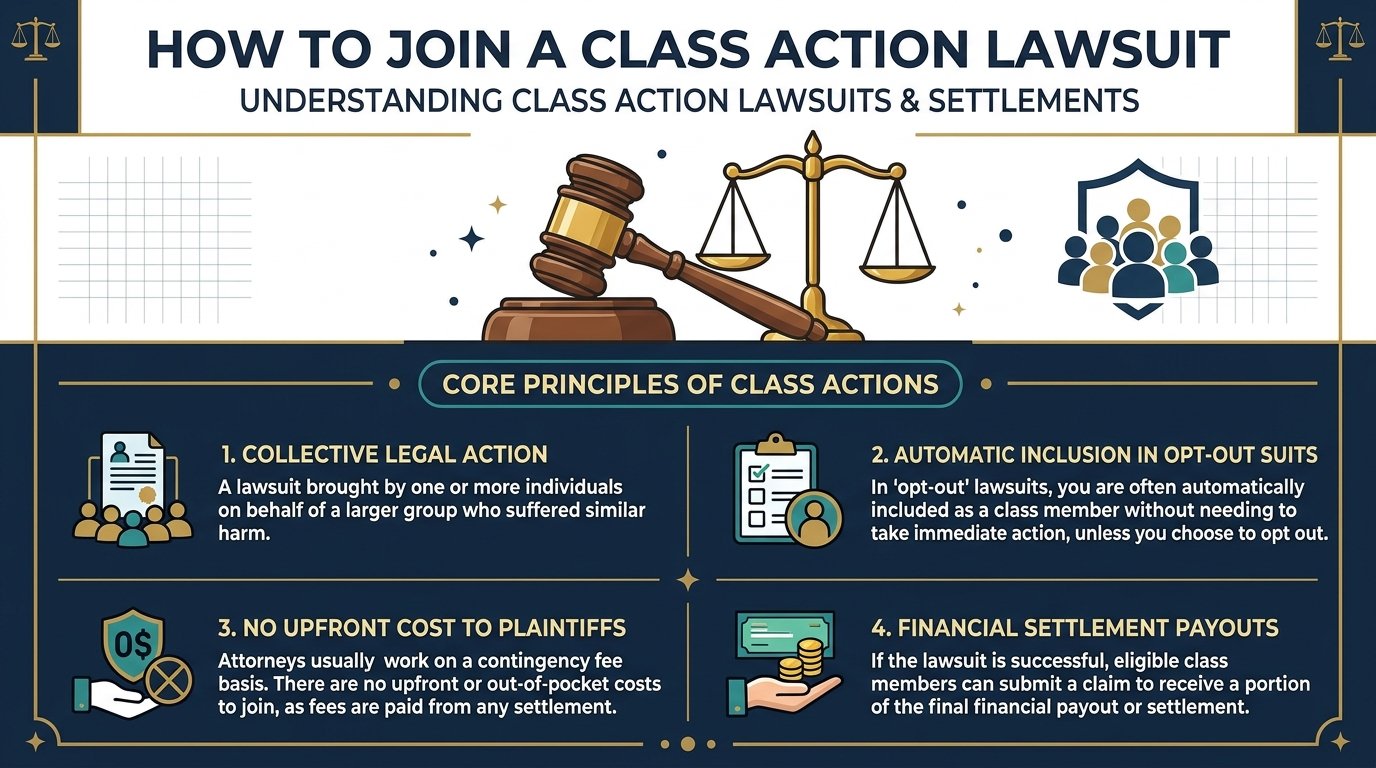

How to join a class action lawsuit starts with one decision: are you filing a claim, staying in a class, opting out, or starting a case. Those four paths look similar from the outside, but they lead to very different rights, deadlines, and outcomes.
Most people mean the first path when they search this question. They received a notice, saw a settlement in the news, or suspect they bought a product or used a service covered by a case. Filing a claim form before the deadline is usually the step that seeks payment.
A settlement is not a finding of wrongdoing. A company may settle to end a dispute without admitting liability, and a court must still approve the settlement as fair, reasonable, and adequate before it takes effect.
Filing is usually free for class members. Class counsel typically works on a contingency basis in class cases, and the settlement administrator is paid from the settlement fund, not by individual claimants.
The hardest part is rarely the form itself. Eligibility, proof, identifiers, and deadlines cause most delays and denials, so careful reading at the start saves months of follow-up later.
Quick Answer: Which Path Are You On?
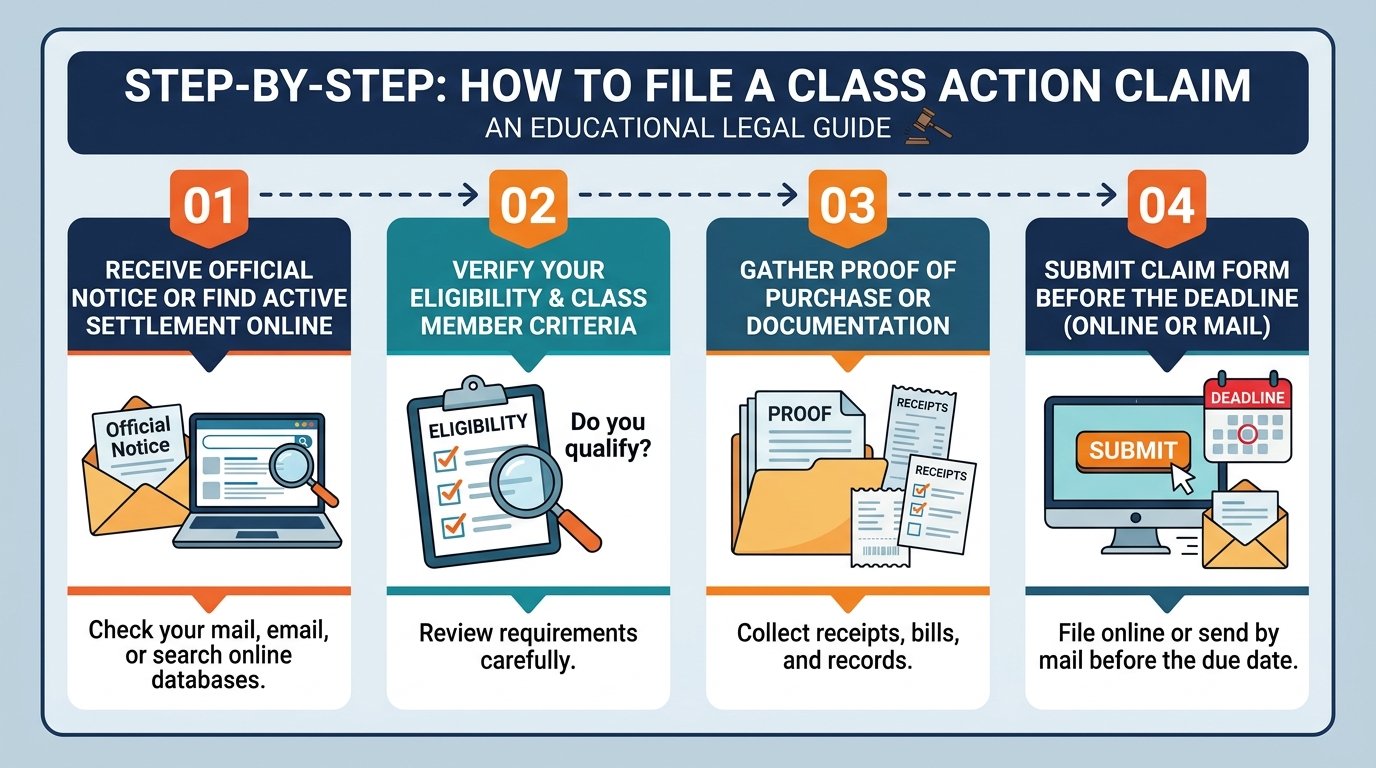
File a claim when a settlement exists, you fit the class definition, and payment requires a form. Read the notice, gather proof if required, file before the claim deadline, and save confirmation.

Stay in the class when you agree with the settlement and want any payment it offers. In most damages classes, staying in means you accept the release of covered claims, even if you never file a form.
Opt out when you want to preserve the right to sue on your own about the same claims. Opting out means no settlement payment, and the opt-out deadline often arrives before the claim deadline.
Start a case when no settlement exists, many people share the same harm, and a lawyer can assess whether a class action fits. Starting a case is litigation, not a claim form, and it takes far longer.
Become a lead plaintiff only when you are willing to work with class counsel, share documents, and possibly give testimony. Lead plaintiffs represent the class, so their claims must stay typical of the group.
| Path | Main action | Payment from settlement | Right to sue alone preserved |
|---|---|---|---|
| File a claim | Submit claim form before deadline | Yes, if claim is valid and approved | No, covered claims are released |
| Stay in class, no claim | Do nothing, unless payment is automatic | Only if payment is automatic | No, covered claims are released |
| Opt out | Submit exclusion request before deadline | No | Yes, for claims covered by the settlement |
| Object | Submit written objection before deadline | Yes, if settlement is approved | No, you remain in the class |
| Start a case | Consult class action counsel, file complaint | Only if case later settles or wins | Depends on case outcome and court orders |
Step 1: Check If You Are in the Class
Read the Class Definition, Not the Headline
Class definition controls eligibility, because headlines simplify cases into one product or one company. The definition in the notice or settlement agreement states the product, service, conduct, place, and time period that count.
Example pattern helps: a data breach class may cover people whose personal information was involved in a specific incident during a stated period. A privacy class may cover people who used a platform in the United States during stated dates, whether or not they paid.
Eligibility questions should follow the definition line by line. Did you buy, use, hold, work, or receive the item or service during the class period, in the covered place, under the stated conditions.
Borderline cases need care, because guessing wrong wastes time and can lead to denial. When the definition is unclear, the official notice FAQ and the administrator contact on the official site are better sources than social media summaries.
Class Period, Product, Service, and Place
Class period matters more than most people expect, because purchases or use outside the dates usually fall outside the class. Keep order dates, account opening dates, and employment dates ready before filing.
Product or service scope also matters, because a settlement may cover one model, one plan, one feature, or one version only. Similar products from the same company do not automatically qualify.
Place scope matters for national, state, and regional classes. Some settlements cover only United States residents, while others cover only one state or one group of states.
Conduct scope matters too, because a case may cover one practice, such as a specific fee, disclosure, or data practice. Other problems with the same company may fall outside that settlement entirely.
No Notice Does Not Mean No Eligibility
Notice lists come from company records, so missing or outdated contact details cause many eligible people to miss direct notice. Spam filters, old email addresses, and moved homes also hide legitimate notices.
Finding a case starts with the company name plus the word settlement, plus the official administrator site when one appears. Court dockets, reputable legal news, and administrator directories help confirm whether a case exists.
No-notice filing works in many settlements, because the claim form allows people without a Notice ID to file with identifying details instead. The notice for that case states whether a Notice ID is required or optional.
Automatic payment cases need special care, because some class members are paid from company records with no form at all. The notice states whether payment is automatic, claim-required, or split by tier, so read that section first.
Step 2: Find the Official Settlement Site
What an Official Site Looks Like
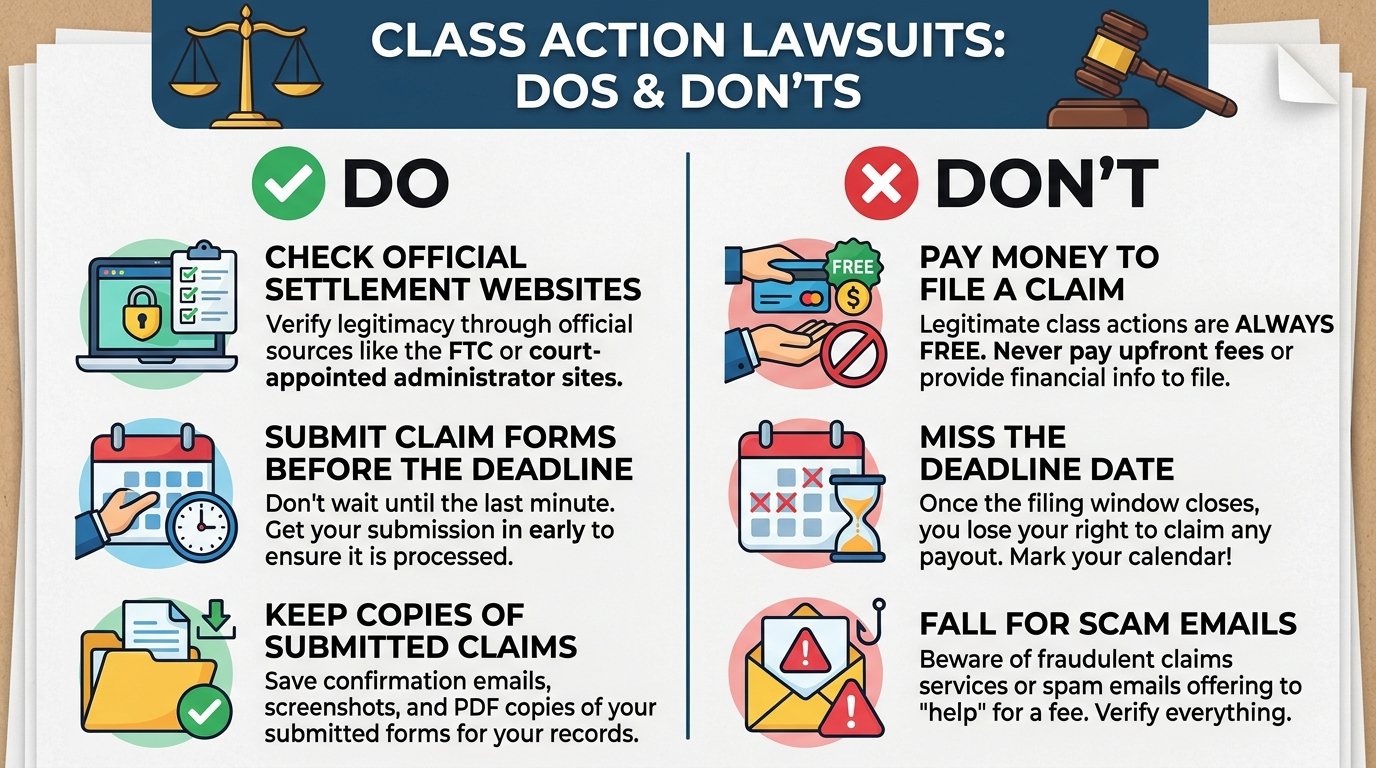
Official settlement sites are run by a court-appointed administrator, not by the defendant alone and not by a random tracker. The site names the case, lists the court and case number, and posts key documents.
Key documents on a real site include the long-form notice, the settlement agreement, the claim form, the opt-out form where applicable, and the preliminary approval order where posted. Missing documents deserve extra verification before any personal details are entered.
Contact details on a real site include a mailing address, a toll-free number, and a case-specific contact form or email address. A site with only a web form and no case caption, court, or administrator name deserves suspicion.
Filing cost on a real site is free for class members. Any fee, processing charge, subscription, or payment request to file a claim is a strong scam signal.
Real Site Versus Copycat Site
| Check | Real official site | Likely copycat or scam |
|---|---|---|
| Domain | Case-specific domain or administrator domain tied to the case | Lookalike spelling, extra hyphens, new domain, free hosting |
| Cost to file | Free | Any fee, gift card, or subscription |
| Documents | Long-form notice, settlement agreement, court order | No documents, blurry screenshots, vague promises |
| Payout promise | Range or ceiling only, with pro rata warning | Guaranteed amount, instant payment promise |
| Identifiers requested | Name, address, account email, Notice ID where applicable | Full Social Security number, bank login, card number, password, passcode |
| Urgency | Deadline stated once, usually months ahead | Countdown timer, 10-minute pressure, threat language |
| Contact | Administrator address, phone, case number | Web form only, no court or case caption |
Administrator names that appear often in legitimate US settlements include Epiq, Kroll, Angeion, JND Legal Administration, Verita Global, Rust Consulting, and Simpluris. An administrator name alone does not prove a site is real, because scammers impersonate real firms.
Verification steps protect every filing. Search the case name plus the administrator name, compare the domain on the official site with the domain in the court docket where available, and never click a link in an unexpected message without that check.
Email warning matters, because legitimate notices can land in spam and scam messages can look polished. A real notice names the case, links to a case-specific site, and never asks for a fee, password, bank login, or one-time passcode.
Step 3: Understand Your Four Deadlines
Claim Deadline
Claim deadline is the last day to submit a claim form for payment in a claim-required settlement. Missing it usually means no payment from that settlement, even when eligibility is clear.
Online versus mail deadlines can differ in wording, because online forms often close at a stated time on the deadline date while mailed forms must be postmarked by that date. Read the exact wording for the filing method you use.
Supplementing a claim may be allowed in some settlements, but filing late is rarely allowed. When a deadline is close, file the basic eligible claim first where the notice allows it, then supplement only if the notice permits supplementation.
Proof deadlines can differ from claim deadlines in complex cases, especially securities cases with holding and transaction data. Check whether supporting documents share the claim deadline or have a separate submission rule.
Opt-Out Deadline
Opt-out deadline is the last day to request exclusion from the settlement class. Opting out preserves the right to pursue the same covered claims on your own, subject to other legal limits and deadlines.
Opt-out timing often arrives before the claim deadline, so waiting to decide can remove the choice entirely. Calendar the opt-out date separately, even when you expect to stay in the class.
Opt-out method usually requires a signed written request with identifying details, sent to the administrator by the stated method. The notice states the exact address, required information, and whether online exclusion is offered.
Opt-out effect is final for that settlement in most cases. Once excluded, you cannot later claim a payment from that settlement or object to its terms as a class member.
Objection Deadline
Objection deadline is the last day to tell the court in writing why a settlement should not be approved. Objecting keeps you in the class, so an approved settlement still binds you and may still pay you.
Objection contents usually include your name, address, contact details, a statement that you are a class member, the grounds for objection, and whether you or counsel intend to appear at the hearing. The notice lists the exact requirements.
Objection versus opt-out is a common confusion, because both express dissatisfaction but only one preserves independent suit rights. Objecting challenges the deal from inside, while opting out leaves the deal entirely.
Hearing attendance is usually optional for ordinary class members, and class counsel answers court questions at the hearing. Objectors who want to speak should follow the notice rules for appearing, because late appearance requests may be denied.
Final Approval Hearing
Final approval hearing, also called a fairness hearing, is when the court decides whether the settlement is fair, reasonable, and adequate. The court also considers fees, costs, and service awards at or around that hearing.
Preliminary approval is not final approval. Preliminary approval allows notice to go out and claims to be filed, while final approval decides whether the settlement takes effect and payments can be distributed.
Hearing dates can move, so the official site controls over secondary summaries. A moved hearing does not usually move claim or opt-out deadlines unless the court order says so.
Appeals after final approval can delay payment further, because distribution often waits until appeal periods end or appeals resolve. Filing early does not shorten the appeal period.
| Deadline | What it does | If you miss it |
|---|---|---|
| Claim deadline | Last day to seek payment by form | Usually no payment from that settlement |
| Opt-out deadline | Last day to leave the settlement class | You remain bound by the release |
| Objection deadline | Last day to challenge the settlement in writing | You lose standing to object as a class member |
| Final approval hearing | Court decides approval, fees, and allocation | Informational for most members, unless you object or appear |
Deadline Triage Rule
Check opt-out and objection dates first, because they often arrive earlier than the claim deadline. A reader who focuses only on the claim date can lose the right to leave or challenge the settlement.
File the claim second, even when final approval feels far away. Early filing leaves time to fix a deficiency, correct an identifier, or supplement proof where the notice allows it.
Track the hearing last, unless you object or plan to appear. Hearing dates explain payment timing, but they rarely change the filing decision for ordinary claimants.
Set reminders at least two weeks before each deadline, plus a second reminder two days before. Administrators and courts treat deadlines strictly, and courtesy extensions are uncommon.
Step 4: Choose Your Proof Tier
No-Proof, Light-Proof, and Heavy-Proof Claims
No-proof claim usually means no receipt is required, not that nothing is required. A sworn statement, attestation, account details, and eligibility answers still apply, and false statements can lead to denial.
Light-proof claim usually means one or two documents, such as an order screenshot, account confirmation, or statement showing the product, service, or transaction. Light proof often supports a higher tier than a no-proof claim in the same case.
Heavy-proof claim usually means detailed records, such as receipts for documented losses, medical or repair records, pay records, or broker statements. Heavy proof takes longer to review and can support larger documented-loss payments where the settlement allows them.
Tier choice should match the records you actually hold. Filing a documented tier with weak or missing proof can delay review, while filing a no-proof tier when strong proof exists can leave money unclaimed where tiers differ.
| Proof tier | What you submit | Typical effect | Main risk |
|---|---|---|---|
| No-proof | Attestation plus identifiers | Lower or flat payment, faster review in simple cases | Denial if identifiers do not match records |
| Light-proof | One or two supporting documents | Mid-tier payment where tiers exist | Delay if documents are unclear or incomplete |
| Heavy-proof | Detailed loss records | Higher documented payment where allowed | Long review, denial if losses are undocumented |
Proof by Case Type
Consumer cases often use receipts, order confirmations, bank or card statements, packaging photos where requested, and account records. Keep the purchase date, product name, and seller name consistent across documents.
Data breach cases often use notice letters, account records, and receipts for out-of-pocket losses such as identity theft costs, credit monitoring, or fraud resolution expenses. Documented losses usually need receipts, while flat cash tiers may need only attestation.
Privacy cases often use account or usage records, such as platform use during the class period, subscription records, or viewing history where the notice defines use broadly. Some privacy classes cover browsing or visiting, not only purchase or account creation, so read the definition closely.
Employment cases often use pay stubs, timesheets, schedules, employment contracts, and employer records. Wage and hour claims need dates, hours, pay rates, and job classification details, because individual hours affect allocation in some cases.
Securities cases often use broker confirmation slips, account statements, and transaction lists with purchase dates, sale dates, share counts, and prices. Recognized loss formulas in the plan of allocation decide payment, and claims cannot exceed actual market loss in many securities settlements.
Antitrust and overcharge cases often use purchase records, invoices, and price evidence for the covered product during the class period. Indirect purchaser rules can differ by state, so the notice and plan of allocation control.
Step 5: File the Claim Form, Field by Field
Before You Start
Gather identifiers first, because identifier mismatch is a leading cause of manual review. Use the legal name, address, email address, phone number, and account details that match company records where possible.
Gather proof before opening the form, because switching between documents and form fields increases errors. Scan or photograph documents clearly, check file size limits, and keep originals until payment arrives.
Read the sworn statement before signing, because claim forms usually require attestation under penalty of perjury or a similar declaration. Only attest to facts you believe are true, and only for the class period and product that apply to you.
Choose a payment method where offered, because options vary by case: paper check, direct deposit, digital wallet, virtual prepaid card, or credit monitoring. Direct deposit and digital options can arrive faster, but they require accurate account details.
Field-by-Field Checklist
Legal name: Use your full legal name, not a nickname, shortened name, or household name. A nickname mismatch can send a claim into manual review.
Mailing address: Use a current address where mail will reach you for months after filing. Update the administrator promptly after any move, because returned checks may not always be reissued.
Email address: Use the email tied to the original account or purchase where the notice asks for it. A different email can delay matching, even when the rest of the form looks correct.
Phone number: Use a number you still control, because administrators may contact you about deficiencies. A disconnected number can stall a fixable claim.
Notice ID or class member ID: Enter it exactly as printed when you have one, including letters, numbers, and hyphens. When you have no Notice ID, follow the no-ID path in the notice instead of inventing an ID.
Class period facts: Enter purchase dates, account dates, employment dates, or holding dates that fall inside the class period. Dates outside the period usually fail eligibility even when the product matches.
Product, service, or holding details: Enter the exact product, plan, device, account, or security that the definition covers. Vague answers slow review, while precise answers match company records faster.
Payment choice: Select one payment method where offered, and double-check account details for direct deposit or digital wallets. A wrong account detail can delay or misdirect payment.
Sworn statement and signature: Sign only after reviewing every field, because an unsigned or incomplete form can be denied. Keep a copy of the signed form and any uploaded documents.
Online Versus Mail Filing
Online filing suits most claimants, because confirmation appears immediately and fields can be checked before submission. Save or screenshot the confirmation page, confirmation number, and submitted answers.
Mail filing suits claimants without reliable internet access or with paper proof that must be enclosed. Use the administrator address from the official notice, keep copies of everything sent, and consider certified mail for proof of mailing.
Postmark rule matters for mail claims, because many notices accept forms postmarked by the deadline even when delivery arrives later. Online forms usually require submission by a stated time on the deadline date, so do not assume the postmark rule applies online.
Duplicate filing warning matters, because filing twice for the same claim can trigger duplicate review or denial. File once per eligible claim, then correct through the administrator process stated in the notice if a correction is needed.
Step 6: After You File: Review, Deficiency, and Status Checks
Claim Review
Claim review checks eligibility, identifiers, class period facts, proof tier, and duplicates against company records and the settlement rules. Automated matching handles many simple claims, while complex claims move to manual review.
Review time varies widely by case size, proof complexity, and court schedule. Simple no-proof claims may move faster, while securities, employment, and documented-loss claims often take longer.
Approval does not mean immediate payment, because distribution usually waits for final approval and the end of any appeal period. Filing early helps review, but it does not shorten court or appeal timelines.
Rejection notice should state the reason where the settlement provides one, such as ineligibility, missing proof, duplicate claim, or identifier mismatch. Read the reason carefully before deciding whether a cure or dispute is available.
Deficiency Notices
Deficiency notice means the administrator needs more information or a correction before a claim can be approved. Common triggers include mismatched email, missing documents, unclear proof, missing signature, or incomplete holding data.
Response deadline in a deficiency notice matters as much as the original claim deadline, because an unanswered deficiency can lead to denial. Respond promptly, completely, and through the method stated in the notice.
Correction method usually follows the original filing method, with online correction or mailed supplements where offered. Keep copies of every correction, and save new confirmation numbers.
Dispute or appeal rights vary by settlement, because some notices allow a claim dispute process while others do not. The notice and plan of allocation state whether a dispute path exists and what deadline applies.
Status Checks and Address Maintenance
Status checks should use the official site portal or administrator contact from the official notice, not a tracker link from an unsolicited message. A Notice ID, confirmation number, or claim number usually speeds the lookup.
Address maintenance matters for at least two years after filing in many cases, because payment can arrive long after submission. Update the administrator after any move, email change, or name change, and keep the update confirmation.
Payment maintenance matters for direct deposit and digital wallets, because closed accounts or changed wallet details can block payment. Update payment details through the administrator process stated in the notice, never through an unsolicited link.
Communication records help when payment stalls, because dates, reference numbers, and administrator responses prove follow-up. Keep every message, confirmation, and correction in one folder until payment clears.
Step 7: Payment: Timing, Methods, Amounts, and Problems
Why Payments Take Time
Final approval must happen before distribution in most settlements, and appeals can extend that wait further. Claim review, audit, allocation calculation, and payment preparation also take time after approval.
Typical timelines vary from a few months to over a year after the claim deadline, depending on case size and complexity. Large cases with many claims, securities calculations, or appeals take longer than small flat-payment cases.
Payment waves occur in some cases, because administrators distribute in batches by tier, payment method, or review status. A neighbor receiving payment first does not prove your claim was denied.
No payment yet does not always mean denial, especially before final approval or before the distribution date stated on the official site. Check status through the administrator before assuming a problem.
Pro Rata Payments and the Net Fund
Gross settlement fund is the headline amount, not the amount available to claimants. Administration costs, notice costs, taxes where applicable, attorneys fees, expenses, and service awards are usually deducted first where the court approves them.
Net settlement fund is the remainder available for class member payments under the plan of allocation. The notice or plan states how that remainder is divided among tiers, claim types, and documented losses.
Pro rata payment means each valid claim receives a proportional share of the available fund or tier. More valid claims usually shrink each share, which explains why advertised maximums often fall in practice.
Up to language signals a ceiling, not a promise. A payment described as up to a stated amount can pay less, sometimes far less, depending on claim count, tier, proof, and allocation rules.
Payment Methods
| Payment method | Speed pattern | Main risk |
|---|---|---|
| Paper check | Slower, mail dependent | Returned mail, lost check, void date expiry |
| Direct deposit | Faster when details are correct | Wrong account details, closed account |
| Digital wallet | Faster when details are correct | Wrong wallet details, account access problems |
| Virtual prepaid card | Fast delivery, expiry rules vary | Card expiry, lost card details |
| Credit monitoring | Service start, not cash | Activation deadline, service scope limits |
| Voucher or coupon | Product dependent | Expiry, redemption limits, transfer limits |
Check void dates matter, because paper checks expire after the printed void date in many settlements. Cash or deposit checks promptly, and contact the administrator quickly when a check expires or is lost.
Reissue requests may be possible where the settlement allows them, but reissue is not guaranteed for every expired or uncashed check. Unclaimed or uncashed funds may go to cy-pres recipients, such as charities, under the settlement terms.
Payment tax note needs care, because tax treatment depends on payment type, claim type, and individual circumstances. This is general information only, not tax advice, so consult a qualified tax professional for personal tax questions.
Worked Payment Examples From Research
Telmate data breach example from October 2026 research shows a two-tier pattern: documented out-of-pocket losses up to $5,000 with proof, plus a pro rata cash payment with no proof required. Final amounts depended on valid claim count and other allocation factors.
Simplilearn video privacy example from October 2026 research shows a pro rata cash payment from a $3 million fund, with no fixed per-person promise in the excerpt. Broad use during the class period, including browsing, could qualify under that definition.
Teleflora text message example from October 2026 research shows a payment of up to $251 per claim from a $6 million fund, subject to the class definition and claim count. Up to language again signals a ceiling, not a guaranteed amount.
Apple Siri example from October 2026 research, as reported by Nolo, shows an estimated $25 per device with payments capped at $95, subject to final approval and claim count. No payment was due before final approval in that example.
All four examples are research snapshots, not current payment promises. Check the official site for each case before relying on any figure.
Opt Out Versus Object: The Decision Table
| Choice | Stay in class | Get settlement payment | Preserve independent suit | Challenge settlement |
|---|---|---|---|---|
| Do nothing | Yes, in most damages classes | Only if automatic or if you later file where required | No | No |
| File a claim | Yes | Yes, if valid and approved | No | No |
| Object | Yes | Yes, if approved | No | Yes, in writing by deadline |
| Opt out | No | No | Yes, subject to other limits | No, as a non-member |
Do nothing suits people who accept the settlement but do not need payment, or who expect automatic payment from company records. It does not suit people who want payment in a claim-required case, because no form usually means no payment.
File a claim suits most eligible people who want payment and accept the release. It is the lowest-effort path, with no upfront cost and no lawyer needed for ordinary filing.
Object suits people who stay in the class but believe the settlement, fees, or allocation are unfair. Objection requires a written submission by the deadline, with the grounds and member statement the notice requires.
Opt out suits people whose individual damages clearly exceed the settlement value and who can pursue independent litigation. Opting out needs legal advice in most serious cases, because independent suit costs, deadlines, and proof burdens differ sharply.
Cannot do both applies to opt-out and objection in most settlements. A person who opts out cannot object as a class member, because the settlement no longer affects them as a member.
Class Action Versus Individual Lawsuit Versus Mass Tort Versus MDL
| Option | Who controls the case | Cost pattern | Payment pattern | Best fit |
|---|---|---|---|---|
| Class action | Class counsel and lead plaintiff, court supervises | Usually no upfront cost to members, contingency fees from fund where approved | Shared, pro rata in many cases | Many people, similar small to moderate claims |
| Individual lawsuit | You and your lawyer | Hourly, contingency, or mixed, depending on case | Individual damages where proven | Large individual damages, unique facts |
| Small claims court | You, with court limits | Low filing cost, no lawyer usually needed | Limited by court dollar cap | Small, simple, local disputes |
| Mass tort | Each plaintiff keeps an individual case, often coordinated | Lawyer contingency common, individual proof still needed | Individual, based on personal harm | Similar product harm, very different injuries |
| MDL | Cases coordinated for pretrial work, then individual paths may resume | Lawyer contingency common | Individual or settlement by case facts | Many federal cases, shared pretrial issues |
| FTC redress | FTC or agency, not a private class | Free to eligible consumers where offered | Agency-directed refunds where available | Agency enforcement cases, not private class claims |
Class action advantage is collective power for claims too small to litigate alone. A $50 overcharge rarely justifies individual suit costs, but thousands of similar overcharges can support one efficient case.
Individual lawsuit advantage is control and potentially higher recovery for large, unique damages. That advantage comes with higher cost, longer effort, and proof burdens that class members avoid.
Mass tort difference matters, because mass tort plaintiffs keep individual cases even when pretrial work is coordinated. Class members, by contrast, share one case outcome and one release for covered claims.
MDL difference matters, because multidistrict litigation coordinates federal cases for pretrial proceedings, then cases may return to their home courts. An MDL is a coordination tool, not a class action by itself.
FTC redress difference matters, because agency refunds come from enforcement, not from a private class settlement. FTC programs have their own eligibility, deadlines, and payment rules, and they do not create class member rights in the same way.
How Class Actions Work: Certification, Notice, and Approval
Rule 23 in Plain Language
Federal Rule of Civil Procedure 23 governs federal class actions in the United States. State courts use their own class action rules, which often mirror Rule 23 but can differ in important details.
Rule 23(a) prerequisites require numerosity, commonality, typicality, and adequacy of representation. Numerosity means the class is so large that joining everyone individually is impracticable, with courts often noting classes over 40 members, though no strict cutoff exists.
Commonality means questions of law or fact are common to the class, not that every detail is identical. Typicality means representative claims align with class claims, and adequacy means representatives and counsel fairly protect class interests without conflicts.
Rule 23(b) categories add a second test, such as a damages class under Rule 23(b)(3) where common questions predominate and a class action is superior to individual suits. Other categories cover injunctive relief and limited fund or incompatible standard cases.
Rule 23(e) requires court approval for class settlements, with notice to class members and a fairness hearing. That approval step protects absent members who did not choose class counsel or negotiate the deal.
Certification, Discovery, and Resolution
Complaint filing starts a case, with a representative plaintiff alleging facts, legal claims, and relief for the proposed class. Filing alone does not make a case a certified class action.
Certification motion asks the court to recognize the case as a class action under Rule 23 or the applicable state rule. Certification can fail when individual issues predominate, representative claims are atypical, or conflicts divide the class.
Discovery follows certification in many cases, with documents, depositions, and expert work exchanged by both sides. Discovery often takes the longest time in litigation, and it can reveal strengths or weaknesses that shape settlement talks.
Settlement or trial resolves most class actions before trial, while some cases proceed to a judge or jury decision. Settlement requires court approval, while trial judgment follows court or jury findings and any appeal process.
Distribution happens only after approval, claim review, allocation calculation, and appeal periods where applicable. That sequence explains why a settlement announced in the news may pay many months later.
Preliminary Approval Versus Final Approval
Preliminary approval allows notice to class members, claim filing to open, and opt-out and objection periods to run. It signals that the settlement looks fair enough to present to the class, not that payment is guaranteed.
Final approval decides whether the settlement takes effect, whether fees and service awards are reasonable, and whether the plan of allocation is fair. Objections are considered at the fairness hearing before final approval.
Appeal risk after final approval can delay distribution, because objectors or other parties may appeal approval, fees, or allocation. Distribution often waits until appeals resolve or appeal periods expire.
Failed approval means the settlement does not take effect as proposed, and the case may continue toward trial, renegotiation, or dismissal depending on court orders. Claimants in a failed settlement should follow the official site for next steps, not secondary summaries.
Starting a Case or Becoming a Lead Plaintiff
When Starting Makes Sense
Starting a case makes sense when many people share the same harm, no settlement exists, and the harm pattern is clear enough for counsel to assess. A single complaint about one unique problem rarely fits a class action.
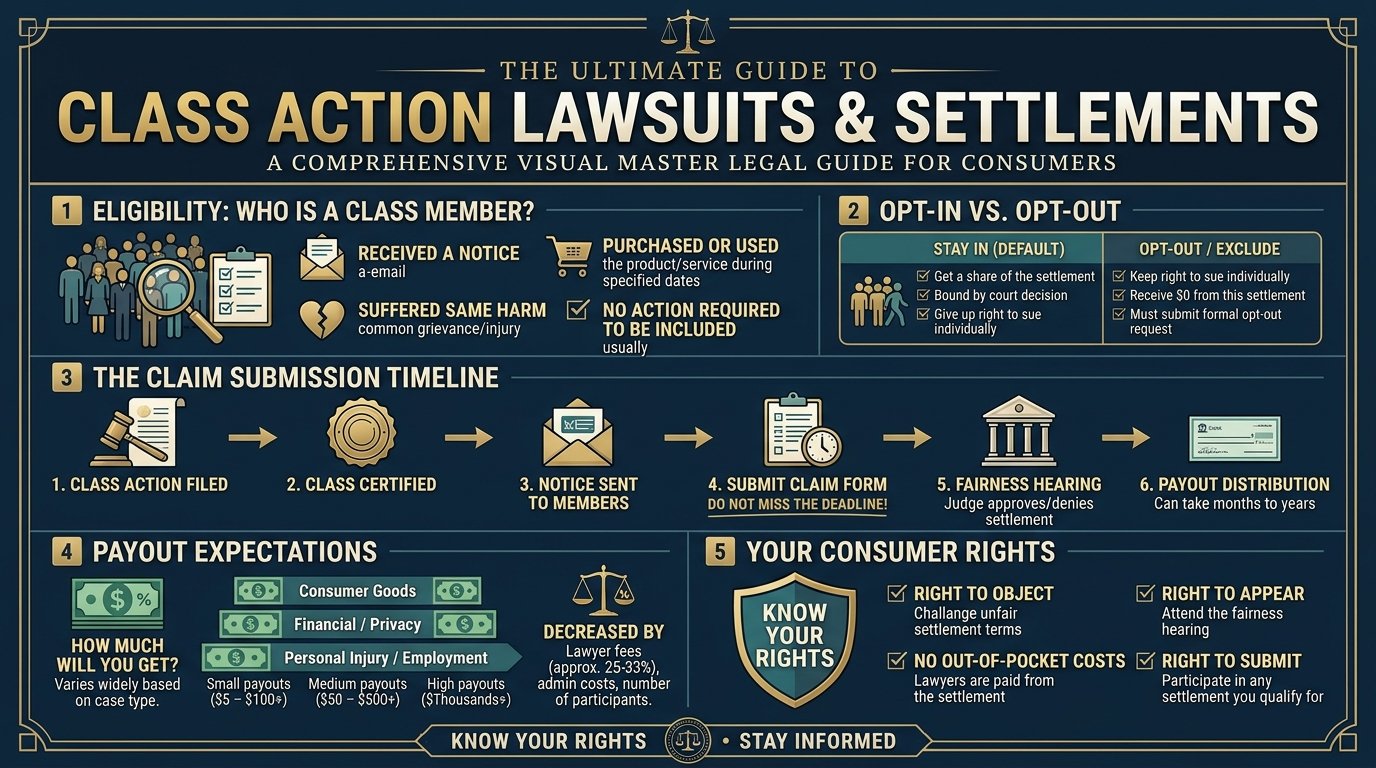
Evidence at the start includes purchase records, contracts, account records, communications, photos where relevant, and a timeline of events. Strong early records help counsel assess commonality, typicality, and damages.
Lawyer consultation usually comes first, because class counsel assesses certification risk, jurisdiction, limitation periods, and fee structure. Many class action firms offer free initial consultations, though consultation does not guarantee representation.
Fee structure in class cases is often contingency based, meaning counsel is paid from a settlement or judgment where the court approves fees. Fee percentages and costs vary by case and require court approval in class settlements.
Lead Plaintiff Role
Lead plaintiff, also called class representative or named plaintiff, represents the class in court filings and negotiations. Lead plaintiffs work with counsel, provide documents, and may give deposition or trial testimony.
Typicality requirement means lead plaintiff claims must align with class claims, so a lead plaintiff with unusual facts may not suit the role. Conflicts with other class members can also disqualify a representative.
Service award may be paid to a lead plaintiff where the court approves it, in recognition of time and effort. Service awards come from the settlement fund where approved, and they do not guarantee any larger personal payment than the allocation allows.
Time commitment matters, because class litigation can last years through certification, discovery, settlement talks, trial, and appeals. Lead plaintiffs should expect document requests, updates, and possible testimony over that period.
Alternatives to Starting a Case
Individual negotiation suits some disputes, especially when a company offers refunds, credits, or repairs through customer service. Keep written records of every offer, deadline, and response before accepting any resolution.
Small claims court suits small, simple disputes within the court dollar limit, without class certification. Small claims rules vary by state and county, so check local limits and procedures before filing.
Regulator complaint suits some consumer, employment, and privacy problems, through the FTC, CFPB, state attorney general, or relevant regulator. Regulator action does not guarantee personal payment, and it differs from a private class claim.
Arbitration clause check matters, because some contracts require individual arbitration and limit class participation. The contract, notice, and applicable law control, so legal advice helps when an arbitration clause appears.
Mistakes That Delay or Deny Claims
Using a nickname instead of a legal name creates identifier mismatch and manual review. Use the exact legal name on company records wherever possible.
Using a new email instead of the account email breaks matching in many systems. Use the account email for filing, then update contact details through the administrator process if that email is no longer accessible.
Filing with wrong dates outside the class period leads to ineligibility, even when the product matches. Check order, account, employment, or holding dates against the class period before submitting.
Submitting incomplete proof for a documented tier delays review or reduces the tier. Submit clear, complete documents for the tier chosen, and keep originals until payment clears.
Filing duplicates for the same claim triggers duplicate review. File once per eligible claim, then correct through the administrator process when a correction is needed.
Missing a deficiency response turns a fixable claim into a denial. Respond to deficiency notices promptly, completely, and through the stated method, with copies saved.
Ignoring address changes leads to returned checks and missed deficiency notices. Update the administrator after every move, email change, or name change, and keep update confirmations.
Trusting a fake site risks identity theft and lost claims, because fake sites harvest personal details while offering no court payment. Verify every site through the court docket, case number, and administrator name before entering details.
Assuming payment is automatic leads to missed claim deadlines in claim-required cases. Read the notice payment section first, because automatic payment applies only where the notice says so.
Waiting until the last day leaves no time to fix identifier errors, proof problems, or portal issues. File at least two weeks before the deadline where possible, with a second check two days before.
Filing Checklist
- Confirm class definition: product, service, place, conduct, and class period all match your facts.
- Verify official site: case name, court, case number, administrator, and key documents all line up.
- Record four dates: claim, opt-out, objection, and fairness hearing, with reminders set.
- Gather identifiers: legal name, current address, account email, phone, Notice ID where available.
- Gather proof: documents for the tier chosen, scanned clearly, originals kept safe.
- Choose payment method: check, direct deposit, digital wallet, prepaid card, or service benefit where offered.
- Review sworn statement: attest only to true facts for the covered period and product.
- File once: online with confirmation saved, or by mail with copies and certified mail proof.
- Track status: check through the official portal, respond to deficiencies promptly, update address and payment details.
- Cash promptly: deposit checks before void dates, activate service benefits before activation deadlines, keep records until payment clears.
FAQs
How do I join a class action lawsuit?
File a claim on the official settlement site when a settlement exists and you fit the class definition. In most damages classes you are already in the class unless you opt out, but filing a form is usually still required to seek payment.
Can anyone join a class action lawsuit?
Only people who fit the class definition can join, because product, service, place, conduct, and class period limits decide eligibility. A general dislike of a company, without matching class facts, does not create eligibility.
Do I need a lawyer to join a class action lawsuit?
No lawyer is usually needed to file an ordinary settlement claim, because the form, notice, and administrator process are designed for class members. Legal advice helps when opting out, objecting, or pursuing a large individual claim.
Does it cost money to join a class action lawsuit?
Filing a settlement claim is usually free for class members, with class counsel fees and administrator costs paid from the settlement fund where the court approves them. Any site charging a filing fee deserves a scam check before payment.
How do I know if I qualify for a class action settlement?
Compare your facts to the class definition in the long-form notice, including product, service, dates, and place. Company records, order confirmations, account records, and employment records help prove the match where proof is required.
How do I check if I am part of a class action lawsuit?
Search the company name plus settlement, then verify the case on the official administrator site or court docket. A Notice ID helps, but many settlements allow filing without one when identifying details match company records.
What if I never received a class action notice?
Missing notice does not always mean ineligibility, because notice lists depend on company records and current contact details. Search for the case, read the class definition, and follow the no-ID filing path in the notice when one exists.
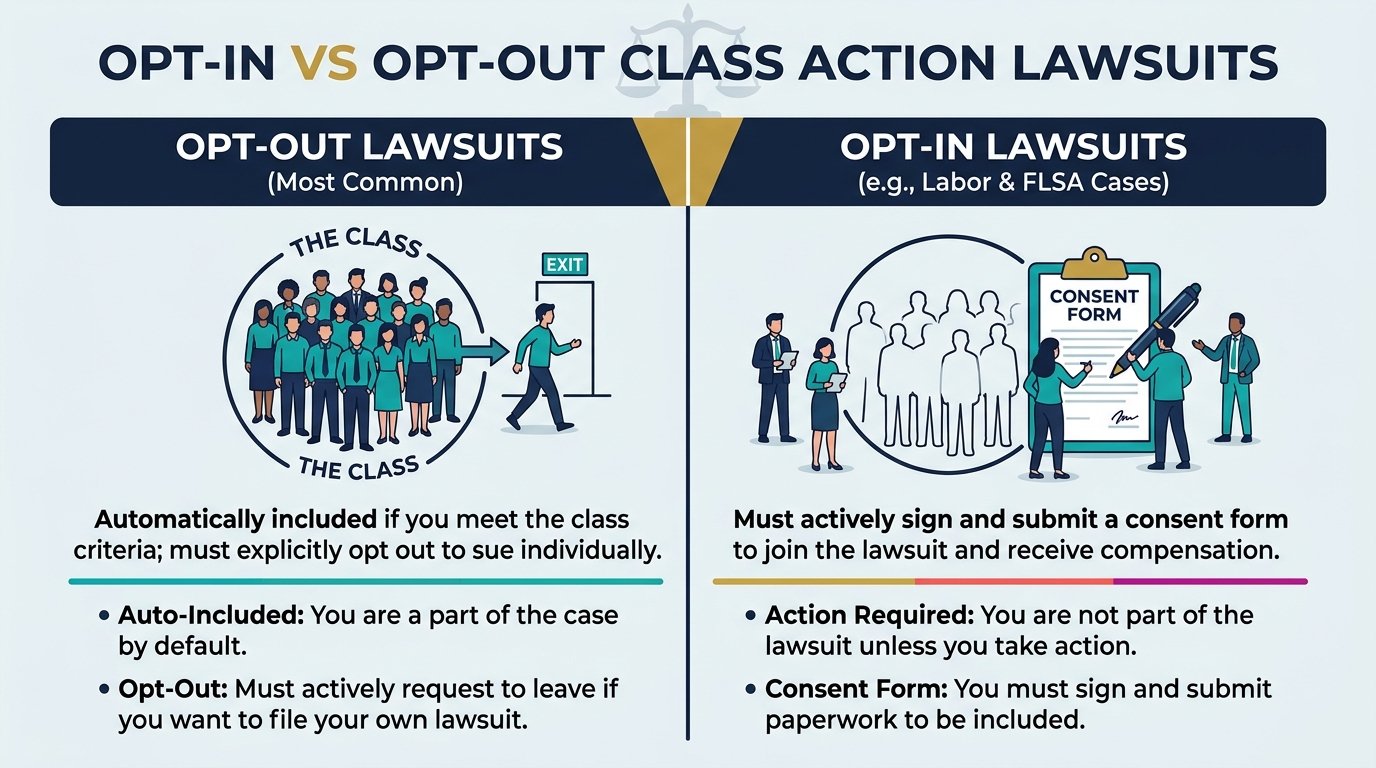
Do I have to opt in to join a class action lawsuit?
Most US damages classes are opt-out, meaning you are already in unless you opt out by the deadline. FLSA collective actions are a major exception, because they generally require affirmative opt-in consent to join.
What is the difference between opt in and opt out?
Opt in means you must affirmatively join to participate, as in many FLSA collective actions. Opt out means you are already included unless you affirmatively leave, as in most Rule 23 damages classes.
What happens if I do nothing after getting a settlement notice?
Doing nothing usually still binds you to the release in a damages class, even when you file no claim and receive no money. Automatic payment cases are the main exception, because payment may arrive from company records without a form.
Can I join a class action lawsuit after the claim deadline?
Late claims are usually denied, because courts and administrators enforce claim deadlines strictly. Some settlements allow late filing only where a court order or notice provision expressly permits it, so check the official notice rather than assuming flexibility.
Can I join a class action lawsuit after it settles?
Filing after settlement depends on the claim deadline, not only on the settlement announcement. Many settlements open claims after preliminary approval, so a settled case may still accept claims until its stated deadline passes.
How do I file a class action claim online?
Use the official settlement site claim portal, enter legal name, contact details, account email, Notice ID where available, class facts, proof where required, payment choice, and sworn statement. Save the confirmation page and confirmation number before closing the portal.
How do I file a class action claim by mail?
Download or request the paper claim form from the official site, complete every field, enclose required proof copies, sign the sworn statement, and mail to the administrator address in the notice. Keep copies and consider certified mail for proof of mailing.
What information do I need to file a class action claim?
Legal name, current address, contact details, account email, class period facts, product or service details, proof where required, payment choice, and signature cover most forms. Securities and employment claims also need transaction or work records specific to those case types.
What is a Notice ID or class member ID?
A Notice ID or class member ID links your claim to company records and notice mailing lists for a specific case. Enter it exactly as printed when you have one, and follow the no-ID path in the notice when you do not.
What if I lost my Notice ID?
Many settlements allow filing without a Notice ID, using name, address, email, and account details to match records instead. Contact the administrator through the official site when the portal requires an ID that you cannot recover.
Do I need proof of purchase to join a class action?
Proof depends on the settlement tier, because some claims need no receipt while others need light or heavy proof. No-proof usually still requires attestation and identifiers, while documented tiers need receipts or records for the claimed loss.
Can I file a no-proof class action claim?
Yes, where the settlement offers a no-proof tier, because that tier waives receipt requirements while keeping attestation and eligibility rules. Filing a no-proof claim does not guarantee the same payment as a documented claim in the same case.
What proof do securities class actions require?
Broker statements and confirmation slips usually prove holdings, purchases, sales, dates, share counts, and prices. The plan of allocation then calculates recognized loss, and claims cannot exceed actual market loss in many securities settlements.
What proof do employment class actions require?
Pay stubs, timesheets, schedules, contracts, and employer records usually prove hours, pay rates, job classification, and work dates. Individual work records matter, because allocation in some employment cases depends on hours or pay differences.
Can I file a claim for a deceased relative?
Estate or authorized representative filing may be possible where the settlement allows it, with death records and authority documents usually required. Check the notice for deceased claimant rules, because procedures and deadlines vary by case.
Can a business join a class action lawsuit?
Businesses can qualify where the class definition includes them, such as purchaser, subscriber, or account holder classes that do not limit membership to individuals. Business claims often need invoices, account records, and authorized signer details.
What is the difference between opting out and objecting?
Opting out removes you from the settlement class and preserves independent suit rights, while objecting keeps you in the class and asks the court to reject or change the settlement. You generally cannot do both in the same settlement.
What happens if I opt out of a class action settlement?
Opting out means no settlement payment and no release of covered claims for you, so independent litigation remains possible subject to other deadlines and proof burdens. Opt-out requests must arrive by the stated deadline and method in the notice.
What happens if I object to a class action settlement?
Objecting asks the court to consider your grounds at the fairness hearing, while you remain in the class. If the court approves the settlement despite objections, you remain bound and may still receive payment where eligible.
Do I have to attend the fairness hearing?
Attendance is usually optional for ordinary class members, because class counsel answers court questions at the hearing. Objectors who want to speak should follow the notice appearance rules, because late appearance requests may be denied.
How long does a class action lawsuit take?
Class actions often take years from filing through certification, discovery, settlement talks or trial, approval, and distribution. Settlement claim timelines feel shorter for filers, because filing usually opens only after preliminary approval.
How long after filing a claim do I get paid?
Payment often arrives months to over a year after the claim deadline, depending on final approval, appeals, claim review, and distribution preparation. Check the official site distribution timeline rather than relying on secondary estimates.
Why is my class action payment smaller than advertised?
Pro rata sharing, net fund deductions, tier limits, and claim count usually explain smaller payments. Headline funds are gross amounts, advertised figures are often ceilings, and more valid claims shrink each proportional share.
How do I check my class action claim status?
Use the official site portal or administrator contact from the official notice, with your Notice ID, confirmation number, or claim number ready. Avoid tracker links from unsolicited messages, because they may harvest details without court authority.
Conclusion
How to join a class action lawsuit becomes manageable when the path is clear before the form is opened. File a claim when a settlement exists and payment requires a form, stay in the class when the deal suits you, opt out only when independent suit makes sense, and start a case only when no settlement exists and shared harm is clear.
Eligibility always comes first, because the class definition, class period, product, and place decide who can claim. Official site verification comes second, because fake claim sites exploit every large settlement with fees, guaranteed amounts, and urgent pressure.
Deadlines decide everything after that, with opt-out and objection dates often arriving before the claim date. Proof tier, identifier accuracy, sworn statement honesty, and address maintenance decide whether a valid claim actually pays.
File early where possible, save confirmation, respond to deficiencies promptly, and track payment through the administrator on the official site. That careful sequence gives an ordinary claimant the best chance of receiving what a settlement offers, without giving up rights by accident or falling for a copycat claim site.

Dilawar Mughal is an SEO expert with 8 years of hands-on experience helping websites grow their organic traffic, rankings, and revenue. He specializes in content-driven SEO, local SEO, and Pinterest SEO, and builds practical, results-focused strategies for businesses and publishers.
1 thought on “How to Join a Class Action Lawsuit: Eligibility, Claims, Deadlines, and Payment”