
Product Liability Lawsuit: The Three Defects, the Three Theories and How a Claim Works
Product liability lawsuit is the claim you bring when a defective product injures you, and it asks a different question from an ordinary injury case: not what someone did wrong, but what was wrong with the product itself.
The product is the defendant in everything that follows: a product case is won or lost on the product’s condition when it left the seller’s hands. This page teaches the doctrine in order: three defect types, three legal theories, the five elements, the chain, the defences, and the two deadlines.
This page is general legal information about how product liability claims work in the United States. It is not legal advice, it does not create an attorney client relationship, and it cannot tell you whether you have a claim. Product liability rules and deadlines are set by state law and vary by state. If a product injured you, talk to a licensed attorney in your state about your own facts and deadlines.
Product Liability Lawsuit in 60 Seconds
Short answer: a product liability lawsuit claims a product was defective in its making, its design, or its warnings, and that the defect caused the injury alleged.
- Defect first: every claim starts by naming which of the three defect types the product carries.
- Theory second: strict liability, negligence, and breach of warranty are three separate routes, each with its own proof.
- Chain third: anyone who sold the product commercially, from component maker to retailer, can be a defendant.
- Proof fourth: the defect must have existed when the product left the defendant’s hands, and caused the injury.
- Two clocks last: a limitations deadline from the injury, and a repose deadline from the sale; either can end a claim.
What Product Liability Means
Short answer: product liability holds commercial sellers responsible when a defective product causes physical harm to a person or property.
A Doctrine About Products, Not Carelessness
Most injury law examines conduct: who failed to take care. Product liability examines a thing: the condition of a product at the moment it was sold. That is why a seller can be liable after taking every possible care: if the product itself was defective, care is not the question.
The doctrine covers more than factory goods. The Cornell Legal Information Institute’s products liability entry records that the idea of a product has stretched to gas, pets, and houses.
State Law, Not Federal Law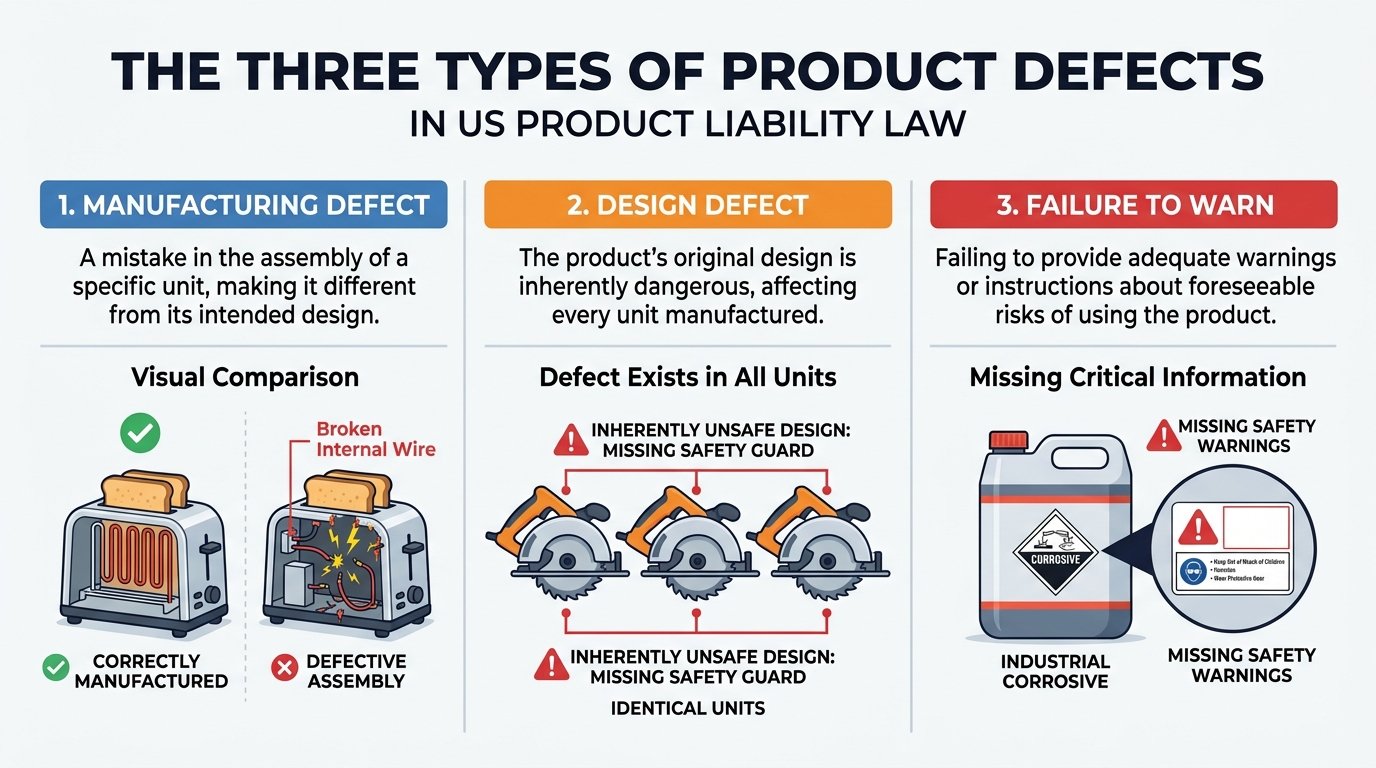
Short answer: there is no federal product liability law. The field is state law, built by state courts and the American Law Institute’s Restatements, and it varies by state.
The modern doctrine descends from two anchors. Greenman v. Yuba Power Products (California, 1963) first adopted strict liability openly, and the Restatement (Second) of Torts, section 402A spread the rule nationwide.
An older case cleared the path: MacPherson v. Buick Motor Co. (New York, 1916) abolished the privity bar, which had stopped injured users suing a manufacturer they had not bought from directly.
The Restatement (Third) of Torts: Products Liability, completed in 1997, reorganised the field. Its sections 1 and 2 supply the defect definitions taught here.
The Three Types of Product Defects
Short answer: a product is defective in one of three ways: it was made wrong, it was designed wrong, or it reached you without the warnings its risks required.
|
Defect type |
The test |
Plain meaning |
|---|---|---|
|
Manufacturing defect |
The product departs from its intended design, even though all possible care was exercised |
This one unit came out wrong |
|
Design defect |
Foreseeable risks could have been reduced by a reasonable alternative design, and leaving it out makes the product not reasonably safe |
Every unit carries the danger |
|
Failure to warn |
Foreseeable risks could have been reduced by reasonable instructions or warnings, and leaving them out makes the product not reasonably safe |
The warnings the risk required never arrived |
The definitions above follow the [Restatement (Third) text reproduced in the LibreTexts tort law text](https://biz.libretexts.org/Bookshelves/Civil_Law/Tort_Law%3A_A_21st-Century_Approach_(Said)/05%3A_Products_Liability_Law/5.05%3A_Product_Liability_Based_on_Dangerous_or_Defective_Condition), sections 1 and 2. Sorting your facts into the right row is the first real step in any claim.
Manufacturing Defect: This Unit Came Out Wrong
A manufacturing defect means this unit departed from the design every other unit follows. A cracked weld, a contaminated batch, a missing bolt: the design was sound, the making was not.
The proof compares the injured unit against the maker’s own specifications. If the product that hurt you differs from the product the maker meant to sell, the defect is proved by the difference.
No carelessness needs showing: the test applies even though all possible care was exercised, so a careful factory still answers for the unit that came out wrong.
Design Defect: Every Unit Carries the Risk
A design defect means the whole product line is not reasonably safe as designed. Every unit performs exactly as intended, and the intention itself creates an unreasonable risk.
The proof tool is the reasonable alternative design. You show a practical, safer design existed, that the maker left it out, and that leaving it out is what makes the product unsafe.
Without an alternative design, a design claim usually fails: courts ask what the maker could have built instead, not whether the product looks dangerous in hindsight.
Failure to Warn: The Marketing Defect
A failure to warn defect means the product was built as designed, but foreseeable risks could have been reduced by reasonable warnings that never came with it.
Cornell also calls this category the marketing defect. A drug without a side effect warning, a tool without a guard warning, a chemical without handling instructions: the missing words are the defect.
The warning must match the risk: a buried line in a manual may not answer a serious hidden danger, and a later warning does not repair the sale that hurt you.
The Two Tests Courts Use: Consumer Expectation and Risk Utility
Short answer: courts judge defectiveness under two different standards, and which one applies depends on the jurisdiction and the kind of defect alleged.
Under the consumer expectation test, a product is defective if its danger is unknowable and unacceptable to an ordinary consumer: what would a normal buyer expect it to do safely?
Under the risk utility test, a product is defective if its risk of harm outweighs the benefits of its design. The alternative design analysis lives here, weighing cost, usefulness, and safety together.
The Cornell product liability entry records that jurisdictions use one test, the other, or a mix of both. Never assume your state’s test; it is one of the first things a local lawyer checks.
The Three Legal Theories
Short answer: one injury can be pleaded under three separate theories, and each theory attacks something different: the product, the conduct, or the promise.
|
Theory |
What you attack |
Must you prove fault? |
|---|---|---|
|
Strict liability |
The product’s condition when it left the defendant’s hands |
No |
|
Negligence |
The defendant’s conduct in designing, making, inspecting, or warning |
Yes |
|
Breach of warranty |
The product’s failure to match a promise or an implied legal standard |
No negligence proof, but privity and notice rules vary |
Keeping these rows separate is the discipline of this page. Many explainers blur them, importing duty and breach into strict liability or calling every product claim strict liability. Both moves are wrong.
Strict Liability: The Product Is the Defendant
Strict liability asks only about the product’s condition. If the product was defective when it left the defendant’s hands and the defect caused the injury, liability follows, however careful the seller was.
Section 402A states the rule in its hardest form: the seller is liable even though the seller has exercised all possible care in preparing and selling it.
The Cornell strict liability entry puts the core the same way: the plaintiff proves the product was defective, and the defendant’s intent or care is beside the point.
Adoption is near-universal, not universal. A dated strand in the reference record lists Delaware, Massachusetts, Michigan, North Carolina, and Virginia as states that had rejected the 402A form; several states channel claims through their own statutes instead.
Negligence: The Conduct Is the Defendant
Negligence asks about behaviour. A product claim can absolutely be a negligence claim: careless design choices, sloppy manufacturing, skipped inspections, and warnings the maker knew were needed and withheld.
Its elements are the classic five: duty of care, breach, actual cause, proximate cause, and actual harm. Duty and breach belong to this theory alone, which is why they never appear inside the strict liability frame.
Negligence still matters where strict liability is unavailable or a defect is hard to prove, and it reaches defendants whose conduct, not their product, went wrong.
Breach of Warranty: The Promise Is the Defendant
Warranty claims attack the gap between promise and product. An express warranty is a promise the seller made; the implied warranty of merchantability promises the product is fit for ordinary purposes.
The implied warranty of fitness for a particular purpose applies when the seller knows the buyer’s specific use and the buyer relies on the seller’s judgment.
These claims run through UCC Article 2 and the federal Magnuson-Moss Warranty Act. They need no proof of negligence, but privity and notice requirements vary by state and by claim type.
What You Must Prove: The Five Elements
Short answer: Cornell’s frame lists five elements for a claim against the commercial seller of a defective product, and a claim missing any one of them fails.
- The defendant sells a product that the plaintiff uses. The claim begins with a product that reached the plaintiff through commerce.
- The defendant is the commercial seller of such a product. Strict liability targets businesses that sell the product, not a neighbour’s one-off garage sale.
- The plaintiff suffers an injury. Physical harm to the person, and in most strands harm to property, is the trigger for the tort claim.
- When the defendant sold the item, the item was defective. The defect must already exist at sale, not develop later through wear, damage, or alteration.
- The defect was an actual and proximate cause of the injury. The defect must actually cause the harm, and the harm must be the kind the defect made foreseeable.
Inside that frame sits the strict liability core in three beats: the product was defective when it left the defendant’s hand, and the defect caused the injury. Element four is where most product cases are actually decided.
Element five carries the standard of proof. Civil product claims are proved by a preponderance of the evidence: more likely than not, not beyond a reasonable doubt.
Who Can Be Sued: The Chain of Distribution
Short answer: liability can attach to any or all parties along the chain of manufacture and sale, from the maker of a single component part to the shop that sold you the finished product.
The chain runs in order: the component parts manufacturer, the assembling manufacturer, the wholesaler or distributor, and the retail store owner at the bottom. Each link sold the product commercially.
Importers stand in the chain for foreign-made products, and a business selling a product under its own label can answer for it as if it made it.
Suing the whole chain is common because the defect’s location is often unclear at the start. Discovery sorts out which link introduced the defect, and claims against the others fall away.
The Innocent Seller Limit
Chain membership is the starting point, not an automatic verdict against every link. Several states limit claims against sellers who merely passed a sealed product along untouched.
These innocent seller or sealed container rules push a claim up the chain toward the manufacturer. Whether your state has one is checked early in any real case.
Users, Gift Recipients and Bystanders
The plaintiff need not be the buyer. Section 402A’s protection extends to the user or consumer, to people the product was loaned or given to, and to bystanders.
A child using a parent’s purchase, a passenger in someone else’s car, a pedestrian struck by debris: each can hold a claim if defect and causation are proved.
Second-hand purchases are harder but not hopeless. The claim turns on the product’s condition when first sold, and later wear and repairs become evidence questions.
Defences: How Product Cases Are Answered
Short answer: defences attack the defect, the causation, or the plaintiff’s own conduct. A strong defect case can still shrink or fail against the right defence, and each one is state-shaped.
|
Defence |
What it answers |
|---|---|
|
Product misuse |
The injury came from a use that was not reasonably foreseeable |
|
Substantial alteration |
The product was changed after sale, so the condition at sale did not cause the harm |
|
Assumption of risk |
The plaintiff knew of the defect and voluntarily encountered it anyway |
|
Comparative fault |
The plaintiff’s own share of fault reduces the recovery, by the state’s formula |
|
State of the art |
The design matched the scientific and technical knowledge available at the time of sale |
|
Federal preemption |
Federal law displaces the state claim, mainly in regulated drug and device cases |
Misuse works only where the use was genuinely unforeseeable. A common, predictable use the maker should have anticipated hands the defence nothing.
Comparative fault divides rather than destroys in most states that use it: recovery falls by the plaintiff’s percentage of fault, and some states bar recovery past a threshold share.
State of the art is a factor in some states and a full defence in others: it asks what was knowable and feasible at the time of sale, not today.
For prescription drugs and devices, two further doctrines apply. Warnings are judged by the learned intermediary rule: the maker’s duty is to warn the prescribing professional, who then advises the patient.
That rule decides real warning cases. The LawSips guide to the Depo-Provera lawsuit examines a prescription drug claim where who had to be warned, and with what, sits at the centre of the dispute.
Federal preemption is the companion defence here: for some regulated devices, federal approval law can displace state claims imposing different requirements.
Damages: What a Product Claim Can Recover
Short answer: a successful claim recovers the losses the defect caused, in four families. It cannot quote you a typical figure in advance, because no honest one exists.
|
Family |
What it covers |
|---|---|
|
Economic damages |
Medical expenses past and future, lost wages, lost earning capacity, property damage |
|
Non-economic damages |
Pain and suffering, emotional distress, loss of consortium |
|
Wrongful death damages |
The family’s losses where the product killed, under the state’s wrongful death statute |
|
Punitive damages |
Reserved for the gravest conduct strands, such as knowingly selling a dangerous product, and governed by state standards |
One fence matters more than any row above: the economic loss rule says a product that merely fails, or damages only itself, is generally a warranty matter, not a tort lawsuit.
That rule is the boundary readers most often miss. A refund claim and a product liability lawsuit are different instruments, and the second generally needs injury or damage beyond the product itself. Case value turns on the injury’s severity, the medical record, earnings lost, and the strength of the defect proof.
The Two Clocks: Limitations and Repose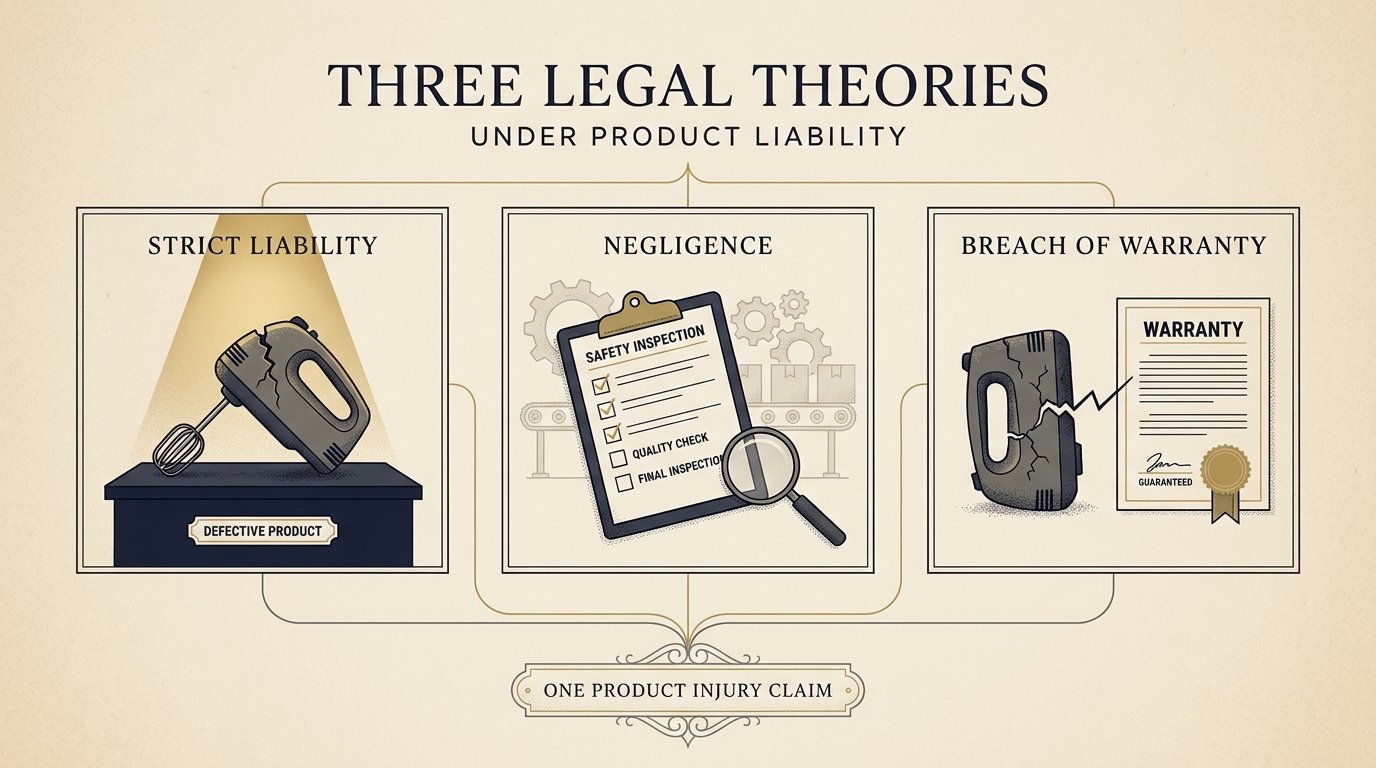
Short answer: product claims run on two separate deadlines. The limitations clock runs from the injury; the repose clock runs from the sale, and it can expire before you are ever hurt.
|
Clock |
Runs from |
What the record supports |
|---|---|---|
|
Statute of limitations |
The injury, or its discovery in discovery-rule states |
A usual range of one to four years, often two, varying by state |
|
Statute of repose |
The sale or delivery of the product |
An outer limit that can bar a claim before a latent injury even appears |
Anyone who tells you product cases simply have a two year deadline is flattening the map. The fetched state table runs from one year in Kentucky and Tennessee to six years in Maine and North Dakota.
New York and Washington sit at three years; Minnesota, Nebraska, Nevada, and Wyoming at four; Missouri at five. Your state’s number is a lookup, not a guess, and may differ from its ordinary injury deadline.
The discovery rule softens the first clock in many states: time runs from when you discovered, or should have discovered, the injury and its likely cause.
Repose has no such mercy. It counts from the sale whether or not anyone has been injured, which is why latent drug and device injuries are the deadline trap unique to this doctrine. One federal strand bars suits over aircraft parts more than eighteen years old; every state sets its own repose period, and some set none.
Recalls, Complaints and Lawsuits Are Different Things
Short answer: a recall is a safety remedy, a complaint is a report, and a lawsuit is a legal claim. None of the three, alone, proves or settles the others.
A recall proves a hazard was identified and a remedy offered: refund, repair, or replacement. It does not by itself prove your product was legally defective or caused your injury.
The CPSC recalls index is the live checking place for consumer products, showing hazards, remedies, and unit counts. The US Food and Drug Administration plays the same role for drugs and devices.
Checking both databases is the most useful first practical step here. A recall notice also preserves evidence, documenting the hazard in the regulator’s own words, and complaint reports are how regulators spot the next recall.
Product Liability, Mass Tort, Class Action and Personal Injury
Short answer: these four labels describe different legal shapes: product liability names the doctrine; mass tort and class action name ways many claims travel; personal injury names the wider field.
|
Shape |
What it is |
The product connection |
|---|---|---|
|
Product liability |
A doctrine: strict liability, negligence, and warranty claims over defective products |
The claim itself, whether one person sues or thousands do |
|
Mass tort |
Many individual lawsuits over the same product, coordinated for pretrial work |
Each plaintiff keeps their own case, proof, and damages |
|
Class action |
One lawsuit representing a whole class, with one common outcome |
The exception for personal injury product claims; commoner for economic loss |
|
Personal injury |
The general field of injury claims, usually negligence based |
A product case is one species inside it, with its own defect rules |
The common claim that product injury suits are often class actions is wrong. Most are individual actions; when thousands share one product, they are usually coordinated as a mass tort instead.
The mass tort versus class action comparison works through how those vehicles differ in control, proof, and payout. The class action lawsuit hub covers class mechanics and joining.
What separates a product case from an ordinary injury case is the defect requirement: a personal injury claim asks who was careless; a product claim asks what was wrong with the product.
How a Product Liability Claim Proceeds, Step by Step
Short answer: the sequence is preserve, check the clocks, build the proof, file, exchange evidence, and resolve, by settlement discussion or by trial, in this order.
Step 1: Preserve the product. Keep it unrepaired, uncleaned, and undiscarded, exactly as it was after the accident. The product is the case; without it, defect proof is an uphill argument about a missing object.
Step 2: Document everything. Photograph the product, its labels, lot numbers, and serial numbers. Keep receipts, manuals, and every medical record.
Step 3: Check both clocks. Calculate your state’s limitations and repose deadlines before anything else. A claim filed past either clock is usually finished, however strong the proof.
Step 4: Identify the defect and the theory. Sort the facts into manufacturing, design, or warning defect, then match the theory. This sorting decides what evidence the case needs.
Step 5: Line up the experts. Product cases are expert cases: engineers for design and failure analysis, medical experts for causation. Their opinions carry elements lay testimony cannot.
Step 6: File the complaint. The claim is filed in the proper court, naming the chain defendants the evidence supports. Forum choice has real limits in mass product cases, as the US Supreme Court’s Bristol-Myers Squibb decision showed.
Step 7: Work through discovery and resolution. Both sides exchange documents, design records, and testimony. Cases resolve by settlement discussion, or continue to trial.
Where many federal cases share one product, the Judicial Panel on Multidistrict Litigation can centralise them before one judge for pretrial work under the federal MDL statute, inside the federal courts the US courts system administers. Coordination is not a verdict: each case keeps its own plaintiff, own proof, and own damages.
Worked Examples Without Headline Figures
Short answer: examples teach the sorting, not the payouts. This page prints no verdict figures, because a number from someone else’s case says nothing reliable about your own.
Example one: one bad unit. A pressure cooker lid releases mid-cycle because its locking ring was cast from a weaker alloy than the maker’s specification. One unit departs from the design: a manufacturing defect, proved against the spec.
Example two: every unit. Every cooker in the line uses an alloy that predictably weakens under ordinary pressure, and a stronger, practical alloy existed. Now the claim is a design defect, proved through the alternative design.
Example three: the famous coffee case. The Liebeck hot coffee case is usually told as a punchline. The fuller record includes a jury award the court cut sharply before a confidential settlement ended the case, which is why this page tells it without the headline number.
The mass tort pointers. Talc and Roundup claims show product doctrine at scale: defect theories pleaded across thousands of individual suits. The mass tort lawsuit guide owns those live cases.
The LawSips Tort Cluster: Where This Page Sits
Short answer: this page is the doctrine layer of the LawSips tort cluster: the pages above it own live cases and routes; this one owns the rules those cases run on.
The LawSips guides divide the work: the mass tort parent tracks active cases, the comparison page settles routes, this page settles the claim itself.
For a second explainer treatment from a legal directory, the FindLaw product liability hub organises the topic as a reference tree.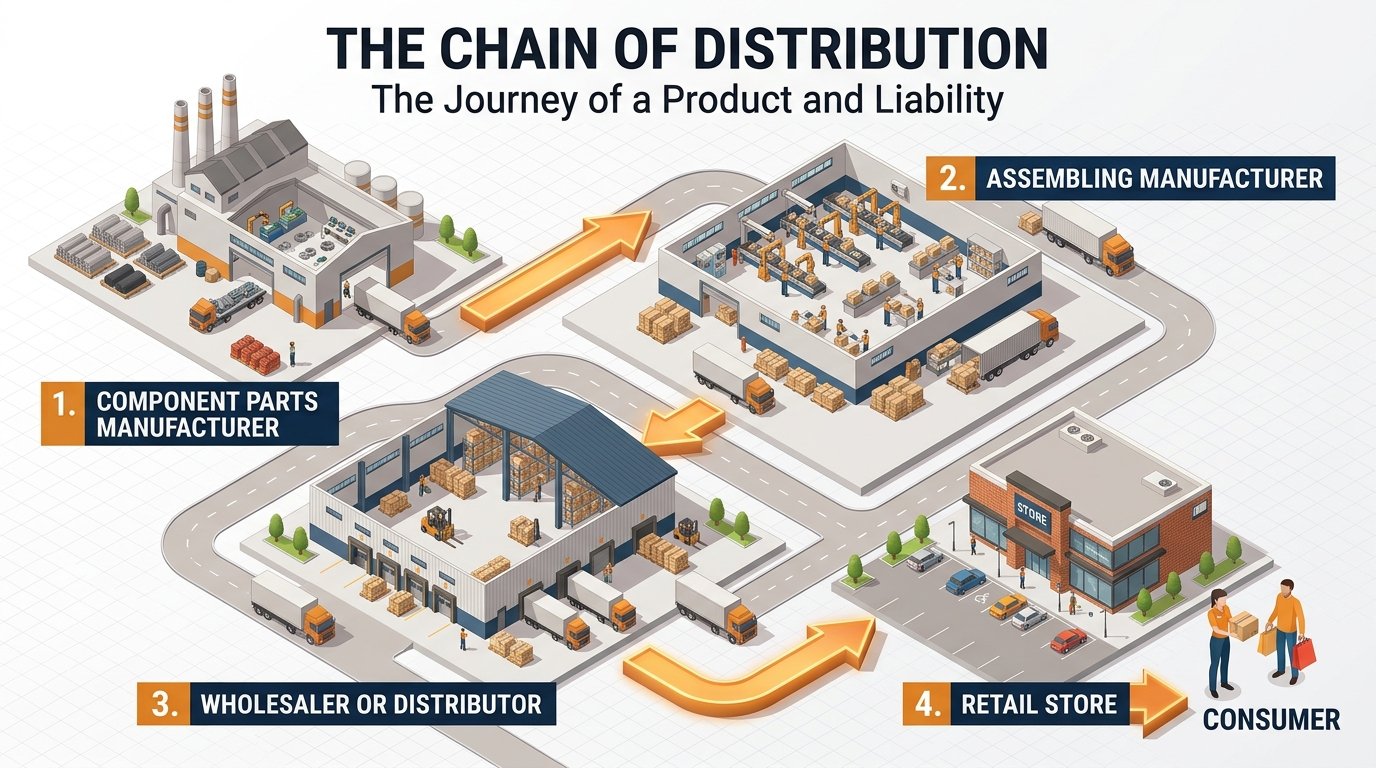
Frequently Asked Questions
What is a product liability lawsuit?
A lawsuit claiming a defective product caused physical harm. It rests on the product’s condition when sold, pleaded through strict liability, negligence, or breach of warranty, under the state law where it is filed.
What are the three types of product defects?
Manufacturing defect, where one unit departs from its design; design defect, where the design itself is not reasonably safe; and failure to warn, where foreseeable risks lacked the reasonable instructions or warnings that could have reduced them.
What is the difference between a manufacturing defect and a design defect?
A manufacturing defect is one unit gone wrong, proved against the maker’s own specifications. A design defect is every unit carrying the same risk, proved by showing a reasonable alternative design the maker left out.
What is a failure to warn claim?
A claim that foreseeable risks could have been reduced by reasonable instructions or warnings that never came with the product. The product may be built exactly as designed; the missing or inadequate warning is itself the defect.
What does strict liability mean in a product liability case?
The seller answers for a defective product’s harm without any proof of carelessness. Under section 402A, liability holds even though the seller exercised all possible care in preparing and selling the product.
Do I have to prove the manufacturer was negligent?
Not under strict liability, where the product’s condition is the issue. But negligence is its own full theory inside product law, and some claims are pleaded that way, with duty, breach, causation, and harm to prove.
What is the difference between strict liability and negligence?
Strict liability attacks the product; negligence attacks the conduct. Strict liability asks whether the product was defective when sold. Negligence asks whether the defendant behaved carelessly in designing, making, inspecting, or warning about it.
What is breach of warranty in a product case?
A claim that the product failed to match a promise or an implied legal standard: an express warranty, the implied warranty of merchantability, or fitness for a particular purpose, under UCC Article 2 and the Magnuson-Moss Act.
What do I have to prove to win a product liability case?
Cornell’s five elements: the defendant sells the product you used, is its commercial seller, you suffered an injury, the product was defective when sold, and the defect actually and proximately caused the injury.
Who can be sued in a product liability lawsuit?
Anyone in the chain of distribution: the component parts manufacturer, the assembling manufacturer, the wholesaler, and the retailer. Importers and businesses selling under their own label can also answer for the product.
Can a retailer or store be liable for a defective product?
Yes, retailers sit in the chain and can be sued. But several states have innocent seller rules limiting claims against a shop that merely passed a sealed product along, pushing the claim toward the manufacturer.
Can I sue if I was injured by a product I did not buy?
Yes. The doctrine protects the user or consumer, not only the buyer. People the product was loaned or given to, and household users who never signed anything, can hold claims if defect and causation are proved.
Can a bystander injured by a product file a claim?
Yes. The section 402A strands extend protection to bystanders: a pedestrian struck by debris from a failing product, for example. The bystander must still prove the product was defective and that the defect caused the injury.
Can I sue over a product I bought second hand or received as a gift?
Often, yes. The claim turns on the product’s condition when it was first sold commercially. Gifts are straightforward; second-hand purchases add evidence questions about wear, repairs, and changes made between the first sale and the injury.
What is the consumer expectation test?
One of the two defect standards: a product is defective if its danger is unknowable and unacceptable to an ordinary consumer. It asks what a normal buyer would expect the product to do safely, and some jurisdictions use it.
What is the risk utility test?
The other defect standard: a product is defective if its risk of harm outweighs the benefits of its design. It weighs cost, usefulness, and safety together, and it is the home of the reasonable alternative design analysis.
What is a reasonable alternative design and why does it matter?
A practical, safer design that existed when the product was sold. Under the Restatement (Third), a design claim generally needs one: showing the maker could have reduced the risk, and left the safer design out, proves the defect.
What damages can you recover in a product liability case?
Four families: economic losses like medical bills and lost wages; non-economic losses like pain and suffering; wrongful death damages where the product killed; and punitive damages in the gravest conduct cases, under state standards.
Can you recover punitive damages in a product liability case?
Sometimes. Punitive damages punish and deter rather than compensate, and the fetched strands tie them to the gravest conduct, such as knowingly selling a dangerous product. Availability and limits are set by state law and vary widely.
Can I sue if the product only damaged my property or only failed?
Usually that is a warranty claim, not a tort lawsuit. The economic loss rule treats a product that merely fails, or damages only itself, as a contract matter in most states. Damage to other property can cross the line.
How long do I have to file a product liability lawsuit?
Your state sets two deadlines, not one. The limitations period usually runs one to four years, often two, from the injury or its discovery. A separate repose period runs from the product’s sale. There is no single national deadline.
What is a statute of repose and how is it different from a statute of limitations?
Limitations runs from the injury; repose runs from the sale. Repose is an outer wall: it can bar a claim before a slow-appearing injury is even discovered, which makes it the deadline trap unique to product cases.
What is the discovery rule for product injuries?
In discovery-rule states, the limitations clock starts when you discover, or reasonably should have discovered, both the injury and its likely cause. It exists for harms that hide: a drug side effect or device failure surfacing years later.
Does a product recall prove my case?
No. A recall proves a hazard was identified and a remedy offered. It is useful evidence and worth checking, but your case still needs proof that your product was defective and that the defect caused your injury.
Where do I check whether my product was recalled?
For consumer products, the CPSC recalls database. For drugs and medical devices, the FDA. Check both before you discard anything: a recall notice documents the hazard in the manufacturer’s and the regulator’s own words.
What should I do with the defective product after an accident?
Keep it, untouched. Do not repair it, clean it, or throw it away. Photograph it with its labels, lot numbers, and serial numbers, and store it safely. The product is the central evidence in the case.
What if I threw the product away or had it repaired?
The claim gets harder, not always impossible. Photographs, purchase records, medical records, and the same model can partly rebuild the proof, but the defence will argue the missing product prevents defect testing. Tell any lawyer this fact first.
What happens if I misused the product?
Misuse is a defence only where the use was not reasonably foreseeable. A common, predictable use the maker should have anticipated does not end the claim. In comparative fault states, your share of fault may reduce the recovery instead.
What is the learned intermediary doctrine?
For prescription products, the maker’s warning duty runs to the prescribing professional, the learned intermediary, who then advises the patient. A warning claim for a drug or device is judged by what the prescriber was told, not the patient.
Are prescription drugs and medical devices treated differently?
Yes, in three ways: the learned intermediary rule redirects the warning duty, federal preemption can displace some state claims for regulated devices, and latent injuries make the repose clock a special danger. The core defect framework is the same.
Is a product liability case a class action or a mass tort?
Neither, by itself. Product liability is the doctrine; the case shape is a separate choice. Most product injury suits are individual actions, and large groups are usually coordinated as mass torts rather than certified as class actions.
What is an MDL and how is it different from a class action?
An MDL centralises individual federal lawsuits before one judge for pretrial work; each case keeps its own proof and damages. A class action is one lawsuit with one common outcome for the whole class. Coordination is not a verdict.
How long does a product liability lawsuit take?
There is no standard duration. Timelines turn on the injury’s clarity, the expert work required, the court’s calendar, and whether the case sits inside an MDL. Any page promising your case a fixed timeline is guessing about your facts.
How much is a product liability case worth?
It turns on the injury’s severity, the medical record, lost earnings, and the strength of the defect proof. No honest average exists in the verified record: anyone quoting a typical figure for cases like yours is guessing, not informing.
How much does a product liability lawyer cost?
Product cases are commonly handled on contingency, where the fee is a percentage of the recovery and nothing is owed if the case fails. The percentage and the handling of case costs are set in your written agreement.
Do I need an expert witness for a product liability claim?
Almost always. Defect and causation are technical questions: engineers analyse design and failure, medical experts connect the defect to the injury. Courts routinely require qualified expert testimony before a product case can reach a jury at all.
What evidence do I need for a defective product claim?
The product itself, preserved; photographs and serial numbers; receipts and manuals; your medical records; and a clear incident account written while it is fresh. Expert analysis then turns that record into defect and causation proof.
Can I still sue if I signed nothing and have no receipt?
Yes. Strict liability needs no contract and no privity with the seller; that bar was abolished a century ago. A missing receipt makes proving the purchase and the product’s identity harder, but records, photographs, and witnesses can fill the gap.
What defences do manufacturers use in product liability cases?
The main set: misuse, substantial alteration, assumption of risk, comparative fault, state of the art, and, for drugs and devices, federal preemption. Each attacks a different element: the defect, the causation, or the plaintiff’s own conduct.
What is the state of the art defence?
The argument that the product’s design matched the scientific and technical knowledge available when it was sold. In some states it is a complete defence; in others one factor among many. Hindsight knowledge does not count against the maker.
Does it matter that the product met government safety standards?
It is evidence, not a verdict. Meeting a safety standard can support the defence, and violating one can support the claim, but compliance alone does not settle defectiveness, and for some devices federal law raises the separate preemption question.
When should I talk to a lawyer about a defective product injury?
Early, and before the clocks run. The limitations and repose deadlines are calculated from your facts and your state, evidence is easiest to preserve at the start, and an early review costs nothing in most contingency practices.
Conclusion
A product liability lawsuit is decided by the product, not by outrage and not by carelessness alone. Name the defect, pick the theory that matches it, and prove the defect existed at sale and caused the injury.
The two habits that protect a claim are unglamorous: preserve the product, and check both clocks before anything else. Limitations runs from the injury, repose runs from the sale, and the second clock does not wait for symptoms.
Remember the limit of this page: it is general legal information, not legal advice, and it cannot tell you whether you have a claim. A licensed attorney in your state can apply this doctrine to your own facts and deadlines.

Dilawar is a dedicated writer and contributor at Lawsips.com, focusing on legal information, business law, consumer rights, legal awareness, and everyday legal matters. He is passionate about simplifying complex legal topics and providing readers with clear, practical, and easy-to-understand information. His goal is to help readers stay informed about legal developments, understand their rights, and make better decisions through informative and well-researched articles.