
Mass Tort Lawsuit: How Individual Claims Move Together
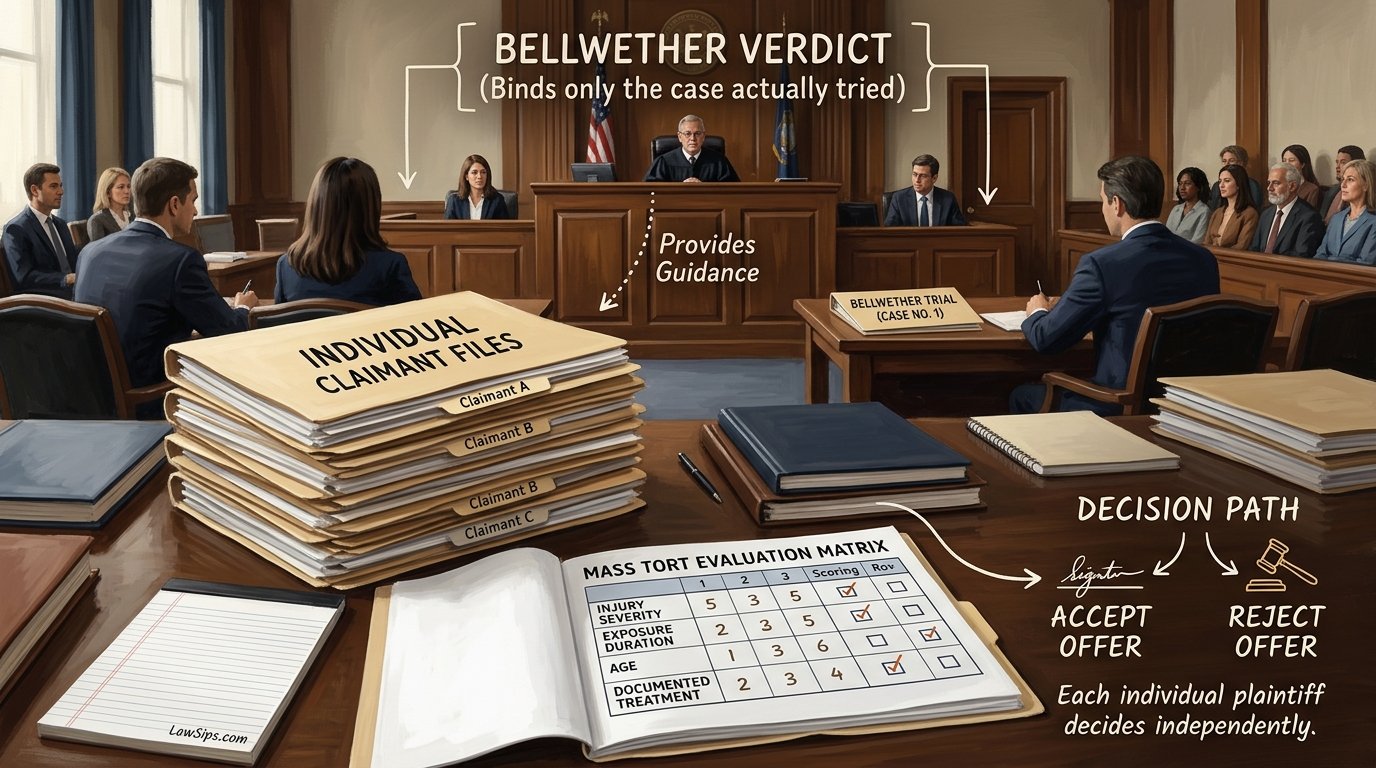
Mass tort lawsuit is the name for what happens when one product, drug, device or event harms many people, and each of them files an individual lawsuit. The ases move together for shared work, but no one gives up their own claim.
That one distinction runs this whole page. A mass tort is not a class action, an MDL is not a claim type, and the difference decides who controls a case, how damages are proven, and whether a settlement can bind you.
Everything here is general legal information, not legal advice. Case figures are the Judicial Panel on Multidistrict Litigation’s own counts, dated November 2, 2026. Anyone weighing a specific claim should talk to a lawyer licensed in their state.
Quick Answer: What a Mass Tort Lawsuit Is
Quick answer: a mass tort lawsuit is a set of individual lawsuits by many people harmed by the same product or event, coordinated for pretrial work while each person keeps their own claim and their own damages. That sentence is the definition every section below unpacks.
Most large mass torts sit inside a federal MDL. One judge runs discovery, experts and test trials for hundreds or thousands of cases at once. At the November 2, 2026 count, 164 MDL dockets held 204,987 actions pending.
The page is built in the order readers ask. First the four way difference, then the six step mechanism, then the dated landscape of active cases, then eligibility, timelines, costs, and the closed windows many pages still get wrong.
Mass Tort vs Class Action vs MDL vs Mass Joinder: The Four Way Difference
Four devices get confused because all four gather many claims. A class action, a mass tort, an MDL and a mass joinder gather them in completely different ways, with different control, different proof and different settlement effects.
The mass tort is the claim structure in the middle. Many individual lawsuits, each with its own plaintiff, lawyer and damages. The MDL below it is only the federal roof those lawsuits often sit under for pretrial work.
|
Device |
What it is |
Your claim |
Settlement effect |
|---|---|---|---|
|
Class action |
One lawsuit for a certified class under Rule 23 |
You are a class member, usually without your own suit |
A certified settlement binds members who do not opt out |
|
Mass tort |
Many individual lawsuits over one product or event |
Your own lawsuit, your own lawyer, your own damages |
Binds only plaintiffs who accept their own offer |
|
MDL |
A federal pretrial procedure under section 1407 |
Your case is transferred to one judge for pretrial work |
No settlement effect of its own; a procedure, not a claim |
|
Mass joinder |
Many plaintiffs joined in one complaint in one court |
You share one complaint with other plaintiffs |
Courts often sever joined plaintiffs; rarely used for big inventories |
Class mechanics live on the sibling page. How to join a class, what class members get and how class settlements bind are covered in our class action lawsuit guide. This page teaches the mass tort side and hands the class side over at every comparison point.
One contrast surprises readers: there is no mass tort claim form. Class members file claims into a settlement fund, a process our class action claim form guide walks through. A mass tort plaintiff instead files an actual lawsuit, usually into an MDL.
How a Mass Tort Works, Step by Step
The mechanism has six steps, and the same six repeat in nearly every large MDL. Filing, centralization, common discovery, bellwether trials, settlement allocation, and remand for the cases that do not settle.
Step 1: Individual Lawsuits Are Filed
Individual lawsuits are filed first, one per plaintiff. Each complaint names the defendant, the product, the exposure and the injury, and each is filed under the deadline of the state law that governs that claim.
Nothing about step one is collective. There is no class to join and no sign up that substitutes for a filed case. The collectivity arrives at step two, and it is procedural, not a merger of claims.
Step 2: The JPML Centralizes the Cases
The JPML then decides whether the cases centralize. Under the text of 28 U.S.C. section 1407 at Cornell’s Legal Information Institute, the panel transfers civil actions involving common questions of fact, pending in different districts, to one district for coordinated or consolidated pretrial proceedings.
The panel is seven federal judges designated by the Chief Justice. It picks the transferee district and judge at scheduled sessions. Its own site, the Judicial Panel on Multidistrict Litigation website, publishes the docket statistics this page uses.
The system is older than most readers expect. Congress created the panel in 1968, a history the Federal Judicial Center’s history of the MDL Panel records. The device was built for exactly this problem: the same factual fight repeated in courtrooms across the country.
Step 3: One Judge, Common Discovery and Plaintiff Fact Sheets
One judge then runs the common work once, for everyone. Common discovery covers the product, the warnings and the science. Expert challenges under the Daubert standard decide which causation testimony a jury may hear.
Each plaintiff also completes a plaintiff fact sheet. It is a court ordered questionnaire covering exposure, injury, treatment and background, and it functions like sworn discovery. Missing its deadline can put the individual case at risk of dismissal.
Leadership is appointed, not elected by plaintiffs. The court names a plaintiffs’ steering committee to run the common work, paid for through common benefit arrangements. Your own lawyer still owns your individual case throughout.
Step 4: Bellwether Trials Test the Value of the Cases
A few representative cases are tried first as bellwether trials. Both sides and the court use the verdicts to value the wider inventory and shape settlement talks. A bellwether verdict binds only the case that was tried.
Selection is fought over because the signal matters. A defense verdict lowers the value the parties assign to similar claims; a plaintiff verdict raises it. The NEC baby formula MDL shows the pattern: its first federal bellwether ended in a defense verdict on August 31, 2026.
Step 5: Settlement Talks, Matrices and Point Systems
Most mass torts end in settlement talks informed by the bellwethers. A global or inventory settlement is then allocated through a settlement matrix or point system, not one flat amount for everyone.
Points convert into payment tiers. Claims earn points for verified factors such as injury severity, age, exposure duration and documented treatment. A claims administrator or special master applies the grid claim by claim, under court supervision.
Your offer is yours to accept or reject. A mass tort settlement binds only plaintiffs who accept it. That is the sharpest practical difference from a certified class settlement, and it is why individual advice matters at this step.
Step 6: Remand: Cases That Do Not Settle Go Home
Cases that do not settle go home. Section 1407 transfer is for pretrial only. Under Lexecon Inc. v. Milberg Weiss (1998), the transferee judge cannot keep a case for trial without the parties’ consent, so unsettled cases are remanded to their home districts.
That is why bellwethers are consent trials or remanded trials. The remand step is the part of the machine almost no competitor explains, and it is the reason a mass tort never stops being your own lawsuit.
The Active Mass Tort Landscape, Checked November 2026
The landscape below is the mechanism at work, counted by the court system itself. Every count is an action pending in the JPML MDL Statistics Report for November 2, 2026. Actions are not plaintiffs, and a caseload count is not a count of claims that will be paid.
Product liability dominates the system. The talc docket alone holds 69,376 actions, roughly one in three of all pending MDL actions. Product liability MDLs together hold about 94 percent of pending actions, an analyst’s calculation from the same JPML figures.
MDL landscape, JPML actions pending at November 2, 2026:
|
Litigation |
MDL |
Actions pending |
Status at November 2026 |
|---|---|---|---|
|
Talcum powder (Johnson and Johnson) |
2738 |
69,376 |
Active. A $5.5 billion ovarian cancer proposal (July 27, 2026) is conditioned on 95 percent participation; a proposal, not a final settlement |
|
Bard hernia mesh |
2846 |
23,299 |
Active litigation; no global settlement in the verified record |
|
AFFF firefighting foam |
2873 |
15,270 |
Active. A 3M personal injury agreement reported at $7.35 billion is a company filing strand (November 3, 2026); other defendants are not covered by it |
|
Hair relaxer |
3060 |
12,743 |
Active litigation |
|
Proton pump inhibitors |
2789 |
11,404 |
Active, mature docket |
|
Bair Hugger warming devices |
2666 |
8,414 |
Active; no settlement disclosed in the verified record |
|
Paraquat |
3004 |
6,635 |
A settlement was entered August 4, 2025; opt outs continue litigating |
|
Depo-Provera |
3140 |
6,413 |
Master Settlement Agreement signed July 21, 2026; registration closes November 30, 2026 |
|
Uber passenger sexual assault |
3084 |
4,548 |
Active litigation |
|
Bard implanted port catheters |
3081 |
4,345 |
Active litigation |
|
Social media adolescent addiction |
3047 |
4,309 |
Active; the fastest growing large MDL in the November report |
|
Ozempic and GLP-1 stomach injuries |
3094 |
4,082 |
Active; discovery and expert phase, no trial date or settlement announced |
|
Suboxone tooth decay |
3092 |
2,016 |
Active; bellwether protocol set |
|
Roundup |
2741 |
916 |
The federal MDL is nearly wound down; a proposed Missouri state court class settlement is the live vehicle |
|
NEC baby formula |
3026 |
847 |
Bellwether trials under way; the first federal bellwether ended in a defense verdict on August 31, 2026 |
|
Ozempic vision loss (NAION) |
3163 |
278 |
Early stage; MDL created December 2025, split from the stomach injury MDL |
|
Roblox child sexual exploitation |
3166 |
196 |
Early stage, active discovery, no bellwether or settlement announced |
|
New 2026 MDLs: AirTag, spinal cord stimulators |
3199, 3194, 3195 |
Small counts at creation |
Emergence examples only; the device category is still generating new MDLs |
Roundup is the teaching example in the table. Its federal MDL is nearly wound down at 916 actions, while a proposed class settlement in Missouri state court runs beside it. One product, two different legal devices, at the same time.
One 2026 ruling reaches across two rows of the table. Monsanto Co. v. Durnell (June 25, 2026) is a Roundup case: the Supreme Court held that FIFRA can preempt state failure to warn claims. Its reasoning may affect paraquat theory, but it is not a paraquat ruling.
Camp Lejeune is not in the table because it is not an MDL. Its claims ran through a Navy administrative process and then suit in one North Carolina court, with bench trials instead of juries. Its window is covered in the next section.
Safety signals sit behind many of these dockets. Label changes and safety communications accumulate in the FDA drug safety and availability hub before litigation peaks. A recall, a warning and a lawsuit are three different events, and this page never merges them.
Closed and Closing Windows Readers Get Wrong
Three windows in this field are closed or closing, and pages that miss that mislead readers. This box is dated November 2026 and states each window as the court record stands.
Depo-Provera: Registration Closes November 30, 2026
Depo-Provera registration closes November 30, 2026, days from this page’s check date. A Master Settlement Agreement was signed on July 21, 2026 in MDL 3140. Claimants who do not register by the deadline become non settling plaintiffs under the court’s order.
Camp Lejeune: Closed to New Claims
Camp Lejeune is closed to new claims, whatever advertisements still say. The administrative claim deadline passed on August 10, 2024, and the Navy accepts no new claims. Filed cases are in bench trials in the Eastern District of North Carolina.
The gap is worth stating once, plainly. Firms still advertise Camp Lejeune sign ups more than two years after the window closed. A deadline quoted in an advertisement is not a court deadline; the court’s own record decides.
3M Earplugs: A Completed Giant
The 3M earplug claims process is also closed. MDL 2885 produced a settlement of about $6 billion announced in 2023, the largest in the verified record here. It stands as a completed example and a scale marker, not an open case.
Who May Qualify for a Mass Tort, at a General Level
Eligibility in a mass tort is a triad, stated generally: exposure, injury, timing. Exposure to the product at issue, the injury the litigation concerns, and a filing inside the deadline of the state law governing the claim.
Documentation is the fourth leg. Medical records for the injury, and exposure records from pharmacy, employment or military service files. Inside an MDL, that evidence is organized through the plaintiff fact sheet described at step three.
No general page can evaluate a case, and this one does not try. Whether someone qualifies turns on records only a lawyer reviewing them can weigh. On the class side, our guide to how to check if you qualify for a class action explains the parallel check.
Deadlines deserve their own warning. The governing limit varies by state and claim type, and doctrines such as the discovery rule can affect when it starts. Missing the governing deadline usually ends the claim, however strong the injury.
How Long a Mass Tort Takes and Why Nobody Can Promise a Date
MDLs commonly run for years, and no honest source can promise a date. The machine coordinates hundreds or thousands of cases through common discovery, expert challenges and bellwether sequencing before most claims resolve.
Flat averages printed elsewhere are marketing figures. A page stating that mass torts take a set number of years is not quoting a court. Stages, not averages, are the honest unit: each stage below has its own clock.
|
Stage |
What happens |
Who acts |
|---|---|---|
|
Filing and centralization |
Individual suits filed; the JPML decides transfer |
Plaintiffs’ lawyers; the panel |
|
Common discovery |
Product, warnings and science evidence exchanged |
Both sides; the transferee judge |
|
Fact sheets and experts |
Plaintiffs document claims; causation experts challenged |
Each plaintiff; both sides’ experts |
|
Bellwether trials |
Representative cases tried for valuation signals |
The court; trial teams |
|
Settlement or remand |
Matrix allocation, or cases return home for trial |
Administrators; home courts |
Class action deadlines work differently. Class settlement claim windows are calendar dates published per settlement, tracked on our class action settlement deadlines page. Mass tort timing runs on court orders inside each MDL instead.
What a Mass Tort Costs: Contingency Fees, Case Costs and Liens
Most mass tort plaintiffs pay nothing upfront, because representation is usually on contingency. A contingency fee is a percentage of any recovery, set in a written agreement, paid only if the case produces money.
Contingent is not the same as free. Case costs, a common benefit assessment and liens can all reduce a recovery before it reaches the plaintiff, a point our free settlement money guide makes for class settlement money as well.
|
Cost layer |
What it is |
When it bites |
|---|---|---|
|
Contingency fee |
A percentage of any recovery, set in the written agreement |
Only if the case produces money |
|
Case costs |
Filing, service, records and expert expenses of the individual case |
Usually deducted from any recovery |
|
Common benefit assessment |
A share funding the common work that helped all plaintiffs |
Deducted under the court’s orders |
|
Liens |
Medicare or Medicaid repayment claims for injury treatment |
Resolved before distribution |
Percentages vary by firm and case, and no court publishes a standard rate. The written agreement controls, so the percentage, the cost handling and the lien process are questions to settle before signing anything.
Mass Tort or Your Own Lawsuit: Choosing a Path at a General Level
Nothing requires a person to file into an MDL. An individual suit can proceed alone, usually in state or federal court. The trade off is cost and leverage: the MDL shares common proof work, while a solo case carries its own.
State courts run a parallel system. California’s JCCP and New Jersey’s MCL coordinate state cases the way an MDL coordinates federal ones. An MDL itself gathers only federal cases; section 1407 cannot pull a state case into federal court.
Bankruptcy can reroute everything. A defendant filing can pause a mass tort through the automatic stay and move claims into a bankruptcy trust. The repeated Johnson and Johnson talc bankruptcy attempts show how central that fight can become.
How to Verify a Mass Tort Is Real and Avoid Sign Up Scams
Verify three things before signing anything. The litigation exists on the JPML docket with a real MDL number, the deadline quoted matches a court order rather than an advertisement, and the firm asking for your details is a real, licensed practice.
Cornell’s reference entry is a useful cross check. Cornell Wex’s mass tort entry defines the term the way courts use it. If a sign up pitch describes something the definition does not match, that mismatch is the warning.
Fake claim forms are a documented problem in this field. Scams targeting mass tort claimants, including around Camp Lejeune, harvest personal details through lookalike forms. Court and panel sites, not advertisements, are the record to trust.
Where this page sits in the wider site: the LawSips home page gathers the site’s legal guides. The mass tort layer lives here; class mechanics, claim forms and class deadlines live with the siblings linked above.
Frequently Asked Questions
1. What is a mass tort lawsuit?
A mass tort lawsuit is a set of individual lawsuits by many people harmed by the same product, drug, device or event. Cases are coordinated, usually in one federal MDL, for shared pretrial work, but each person keeps their own claim, lawyer and damages assessment.
2. Is a mass tort the same as a class action?
No. In a class action, one certified class is represented by named representatives, and a class settlement generally binds members who do not opt out. In a mass tort, every plaintiff has an individual lawsuit and decides individually whether to accept a settlement offer.
3. What is the difference between a mass tort and a class action?
Four differences decide it. Structure: one class claim versus many individual claims. Control: a class representative versus each plaintiff with their own lawyer. Proof: class wide versus individual injury and damages. Settlement effect: a class settlement binds absent members; a mass tort settlement binds only plaintiffs who accept.
4. What is an MDL and how is it different from a mass tort?
An MDL is the federal procedure that gathers individual cases, not the claim type itself. Under 28 U.S.C. section 1407, the JPML transfers federal cases sharing common questions of fact to one judge for pretrial proceedings. The mass tort is the claims; the MDL is the roof.
5. What is mass joinder and how is it different?
Mass joinder puts many plaintiffs into one complaint in one court. It differs from both a class action and an MDL of individual suits. Courts frequently sever joined plaintiffs, because filing fees, venue and personal jurisdiction limits, after Bristol-Myers Squibb (2017), work against it.
6. How does a mass tort lawsuit work?
Individual lawsuits are filed, the JPML centralizes them in one district, and one judge runs common discovery with plaintiff fact sheets. A few representative cases are then tried as bellwethers, and the verdicts inform settlement talks. Cases that do not settle are remanded home for trial.
7. Who can join a mass tort lawsuit?
At a general level, people who used or were exposed to the product at issue, developed the injury the litigation concerns, and file within their state deadline. Eligibility is case specific. No general page can say whether any individual qualifies, and this page does not evaluate cases.
8. How do you join a mass tort lawsuit?
Joining is informal language for filing your own individual lawsuit. It is usually filed through a lawyer into the MDL or a coordinated state proceeding. There is no class to join, and no claim form substitutes for a filed case in an active MDL.
9. Do you need a lawyer for a mass tort?
As a practical matter, yes. Mass tort cases are filed as individual lawsuits with deadlines, fact sheets and court orders, and plaintiffs are almost always represented. This is general information, not advice about any individual case.
10. How much does it cost to join a mass tort lawsuit?
Most mass tort plaintiffs pay nothing upfront, because firms usually work on contingency. Costs still exist inside the case: filing and service costs, case expenses, and a common fund assessment on any recovery. The written fee agreement controls, so read it before signing.
11. What is a contingency fee in a mass tort?
A contingency fee is a percentage of any recovery, set in a written agreement, paid only if the case produces money. The percentage and the handling of case costs vary by firm and case. No court publishes a standard rate, so this page states none.
12. Are there upfront costs in a mass tort case?
Typically no upfront payment from the plaintiff, because representation is usually contingent. That is not the same as free. Case costs and a common benefit assessment are usually deducted from any recovery, and a settlement can also be reduced by liens.
13. How long does a mass tort lawsuit take?
No honest source can give a date. MDLs commonly run for years, because they coordinate hundreds or thousands of cases through discovery, expert challenges and bellwether trials. Any page printing a flat average timeline is stating a marketing figure, not a court fact.
14. How are mass tort settlements divided?
Through a settlement matrix or point system. Each claim is scored on factors such as injury severity, age, exposure duration and documented treatment. The points convert into a payment tier, and a claims administrator or special master applies the matrix. Individual figures are set by each program.
15. What is a settlement matrix or point system?
It is the allocation grid a mass tort settlement uses instead of one flat amount. Claims earn points for verified factors, and points map to payment tiers, so more serious documented injuries sit in higher tiers. The matrix is applied claim by claim.
16. Can you reject a mass tort settlement offer?
Yes. A mass tort settlement offer is made to each plaintiff individually. A plaintiff who rejects it keeps their individual lawsuit, usually heading toward remand and trial. That accept or reject choice is a core difference from a certified class settlement.
17. What is a bellwether trial?
A bellwether trial is an early trial of a representative case from the MDL inventory. Both sides and the court use the verdict to value the wider group of cases and to shape settlement talks. The verdict binds only the case that was tried.
18. What happens if a bellwether trial is lost?
The loss binds only the bellwether case itself. Practically, a defense verdict lowers the settlement value the parties assign to similar claims and can slow talks, while a plaintiff verdict raises them. In the NEC MDL, the first federal bellwether ended in a defense verdict August 31, 2026.
19. What is a plaintiff fact sheet?
A plaintiff fact sheet is a court ordered questionnaire each plaintiff completes early in an MDL. It covers exposure, injury, treatment and background, and functions like sworn discovery. Missing its deadline can put the individual case at risk of dismissal.
20. What is the JPML and what does it decide?
The Judicial Panel on Multidistrict Litigation is a panel of seven federal judges designated by the Chief Justice. It decides whether cases sharing common questions of fact are centralized, picks the transferee district and judge, and hears transfer motions at scheduled sessions.
21. What does 28 U.S.C. section 1407 do?
It is the federal statute that authorizes MDL centralization. It lets the JPML transfer civil actions involving common questions of fact, pending in different federal districts, to one district for coordinated or consolidated pretrial proceedings, with remand at or before the end of pretrial proceedings.
22. Can your case be sent back to your home court?
Yes. Section 1407 transfer is for pretrial only, and under Lexecon Inc. v. Milberg Weiss (1998) the transferee judge cannot keep a case for trial without consent. Cases that do not settle are remanded home, which is why bellwether trials are consent trials or remanded trials.
23. What kinds of cases become mass torts?
Cases where one product or event allegedly injures many people in individual ways. Defective drugs, failed medical devices, toxic exposures such as firefighting foam and contaminated water, herbicides, and platform based claims such as the social media and Uber MDLs.
24. How many mass tort cases are pending in 2026?
Per the JPML MDL Statistics Report dated November 2, 2026: 164 active MDL dockets holding 204,987 actions pending. A further 719,296 actions were filed since those dockets began, across 50 districts and 142 judges. These are action counts, a caseload measure, not claims that will be paid.
25. Is the Camp Lejeune lawsuit still open for new claims?
No. Camp Lejeune claims under the Camp Lejeune Justice Act required an administrative claim by August 10, 2024, and that deadline has passed; the Navy accepts no new claims. Filed cases are in litigation in the Eastern District of North Carolina, in bench trials.
26. Is the 3M earplug lawsuit still open?
No. The 3M Combat Arms earplug MDL (MDL 2885) produced a settlement of about $6 billion announced in 2023, and its claims process is closed to new entrants. It stands as a completed example, not an open case.
27. What happened with the Depo-Provera settlement?
It settled in principle, and the window is closing. A Master Settlement Agreement was signed on July 21, 2026 in MDL 3140, and registration to participate closes November 30, 2026 under Case Management Order No. 14. Claimants who do not register become non settling plaintiffs.
28. Is Roundup a mass tort or a class action?
Both, side by side, which is why it teaches the distinction. The federal Roundup MDL 2741 is nearly wound down, with 916 actions pending at November 2, 2026. Separately, a proposed $7.25 billion class settlement in Missouri state court awaits final approval.
29. What injuries qualify for a mass tort, in general?
In general terms, the injury the litigation is about, documented by medical records. For example, a diagnosed condition the cases link to the product, with exposure shown in pharmacy, employment or service records. Each litigation defines its own criteria; only a lawyer reviewing records can assess a case.
30. What evidence do you need for a mass tort claim?
Medical records and pathology reports for the injury, exposure records, and treatment records. Exposure records include pharmacy, employment or military service records, and product packaging or receipts where they exist. Inside an MDL, this evidence is organized through the plaintiff fact sheet.
31. What is the statute of limitations for a mass tort?
There is no single mass tort deadline. The limit is set by the state law governing the individual claim, varies by state and claim type, and doctrines such as the discovery rule can affect when it starts. Missing it usually ends the claim.
32. Do mass tort settlements get taxed?
At a general level, tax treatment depends on the type of damages and current tax law. Personal physical injury recoveries are treated differently from other components. This page gives no individual tax guidance; settlement recipients commonly need their own tax advice.
33. What are Medicare liens in a mass tort settlement?
When Medicare or Medicaid paid for treatment of the injury, the program may claim repayment, called a lien, out of a settlement. Lien resolution happens before money is distributed and reduces the net amount. The gross figure is therefore not what a plaintiff receives.
34. How is a mass tort different from a personal injury lawsuit?
A personal injury lawsuit is one plaintiff case standing alone. A mass tort keeps the individual lawsuit but shares the expensive common work, discovery, experts and bellwether trials, with hundreds or thousands of similar cases. Each plaintiff still proves their own injury and damages.
35. Can you file your own lawsuit instead of joining a mass tort?
Yes. Nothing requires a person to file into an MDL; an individual suit can proceed on its own, usually in state or federal court. The trade off is cost and leverage: the MDL shares common proof work, while a solo case carries its own.
36. What is a common fund in mass tort settlements?
In a mass tort settlement, a court supervised common fund is the pool from which payments and approved common benefit costs are handled. It is often run with a special master or claims administrator. Common benefit fees compensate the leadership work behind results for all plaintiffs.
37. How do you check the status of a mass tort case?
Track the MDL number on the JPML website and the transferee court docket, and read the case management orders. They set fact sheet, registration and bellwether schedules. Plaintiffs also receive status information through their own lawyer; no public per claim lookup exists for an active MDL.
38. How do you know if a mass tort sign up is a scam?
Check three things. The litigation exists on the JPML docket with a real MDL number, the deadline quoted matches a court order rather than an advertisement, and the firm asking for your details is a real, licensed practice. Fake claim forms targeting mass tort claimants are documented.
39. Can a mass tort be filed in state court?
Yes. States run their own coordinated proceedings, such as California JCCP and New Jersey MCL, alongside the federal MDL system. An MDL itself only gathers federal cases; section 1407 cannot pull a state court case into federal court.
40. What happens when a defendant files for bankruptcy in a mass tort?
A defendant bankruptcy filing can pause the mass tort through the automatic stay and move the fight into bankruptcy court. Claims may be channeled into a trust there. The repeated Johnson and Johnson talc bankruptcy attempts are the current example of how central this fight can become.
41. Can family members file a wrongful death claim in a mass tort?
Generally yes, where state law allows it. Wrongful death and survival claims are among the claim types filed inside mass torts, brought by the estate or eligible family members under the governing state rules. The individual proof and deadline rules still apply.
42. Will joining a mass tort guarantee a payment?
No. Filing or joining a mass tort claim guarantees nothing. Cases can fail on causation, be dismissed, settle for less than expected, or pay nothing at all, and no lawyer or page can promise a payment. Anyone told otherwise is hearing marketing, not law.
Conclusion
Mass tort lawsuit, in the end, means many individual lawsuits sharing one pretrial roof. Each plaintiff keeps their own claim, their own lawyer and their own damages, from the first filing to the final accept or reject decision.
The mechanism is the message. Six steps, one statute, one panel, and a remand rule that sends unsettled cases home. Readers who hold that picture can read any headline in this field, including the dated landscape above, without being misled.
The counts will move. JPML statistics refresh monthly, and the Depo-Provera registration window closes on November 30, 2026. This page was checked in November 2026, and its landscape table carries that date for exactly that reason.
For the other half of the comparison, our class action lawsuit guide covers how class actions work, who can join and what members receive. The two devices solve different problems, and choosing between them starts with the difference this page teaches.
This article is general legal information, not legal advice. Anyone weighing a specific claim, a deadline or a settlement offer should talk to a lawyer licensed in their own state.

Dilawar is a dedicated writer and contributor at Lawsips.com, focusing on legal information, business law, consumer rights, legal awareness, and everyday legal matters. He is passionate about simplifying complex legal topics and providing readers with clear, practical, and easy-to-understand information. His goal is to help readers stay informed about legal developments, understand their rights, and make better decisions through informative and well-researched articles.