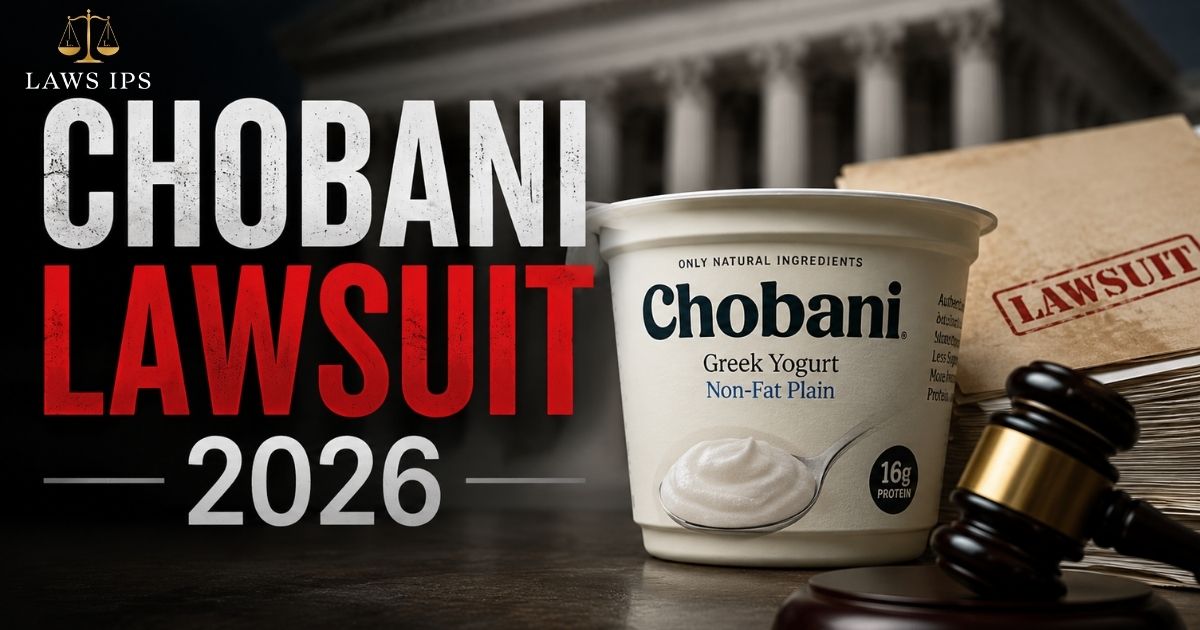

If you have ever reached for a Chobani yogurt because the label said “Only Natural Ingredients,” you may be part of a growing group of consumers with legal rights worth knowing about. Multiple lawsuits filed against Chobani LLC have put the company under serious scrutiny, and 2026 is shaping up to be a pivotal year for how those cases resolve.
This guide covers every active lawsuit, what each case actually claims, who qualifies, how much money you could receive, and exactly what steps to take before any deadline passes. Whether you bought Chobani Greek yogurt, Zero Sugar products, or plant-based items, this article gives you the complete picture.
Chobani Lawsuit
The Chobani lawsuit is not a single case. It is a series of consumer protection actions filed in federal courts targeting the company’s labeling and marketing practices across multiple product lines.
At the center of each complaint is a straightforward allegation: Chobani used terms like “Only Natural Ingredients,” “natural,” and “Zero Sugar” on product packaging in ways that misled reasonable consumers into paying premium prices for products that allegedly did not match those claims.
Read This: McDonald’s 100% Beef Lawsuit: 2026 Updates, Payouts
What the Core Lawsuit Argues
Plaintiffs argue that Chobani built its brand identity around health-forward messaging. That messaging, they say, directly influenced purchasing decisions. When consumers paid more for a Chobani product over a generic alternative, they did so because they trusted the label. The lawsuits claim that trust was misplaced.
Key allegations across the cases include:
- Products labeled “Only Natural Ingredients” allegedly contained synthetic plastic chemicals (phthalates) leaching from packaging.
- Zero Sugar products allegedly contained allulose, a naturally occurring sugar compound, without disclosing this to consumers in a clear way.
- “Only Natural Ingredients” claims on Zero Sugar yogurts were allegedly false because stevia and monk fruit extracts used in those products undergo extensive industrial processing.
The legal theory is consumer deception, not product safety. No regulatory agency has issued a product recall. This is a civil matter under consumer protection law.
Chobani Class Action Lawsuit
A class action lawsuit allows large numbers of consumers with similar claims to pursue legal action together as one group rather than filing individually. This structure benefits everyday buyers because legal costs are shared and the negotiating power of thousands of plaintiffs is far greater than any single consumer could exercise alone.
How Class Actions Work in Food Labeling Cases
In food labeling class actions, you do not need to hire your own attorney. Plaintiffs’ counsel represents the entire class. If a settlement is reached, class members receive notice and an opportunity to file a claim for their share of the settlement fund.
You are automatically considered part of the class if you purchased covered products during the defined class period, unless you formally opt out. Opting out means you preserve your right to sue Chobani individually, which is rarely worth the expense for most consumers.
The Chobani cases follow this exact structure. Millions of yogurt buyers across the country potentially qualify based on their purchase history alone.
Read This: Chime Lawsuit 2026: Payouts, Eligibility, and How to File
Chobani Lawsuit 2026
As of mid-2026, three major legal actions define the Chobani lawsuit landscape. Each targets a different product line and a different aspect of the company’s marketing. Here is where each case stands.
Case 1: Wysocki v. Chobani LLC (Phthalates Case)
Case Number: 3:25-cv-00907-JES-VET Court: U.S. District Court for the Southern District of California Filed: April 16, 2025
This case was triggered by December 2024 testing conducted by PlasticList, an independent research organization. Their report identified four types of phthalates in Chobani yogurt products: di-2-ethylhexyl phthalate (DEHP), diethyl phthalate (DEP), dibutyl phthalate (DBP), and di-2-ethylhexyl terephthalate (DEHT).
Plaintiff Amy Wysocki argues that phthalates, which are synthetic plastic-derived chemicals, leached into the yogurt from the polypropylene containers. She says the presence of these chemicals directly contradicts the “Only Natural Ingredients” claim on the label.
Chobani filed a motion to dismiss in June 2025. At an August 2025 hearing, the court indicated it would dismiss the case in a formal order. However, as of early 2026, that formal dismissal order had not been publicly filed. The case remains technically active pending that ruling.
Case 2: Albrigo v. Chobani LLC (Zero Sugar Natural Ingredients Case)
Court: Federal court Filed: August 2024
This lawsuit targets Chobani’s Zero Sugar yogurt line. The complaint alleges that calling these products “Only Natural Ingredients” is deceptive because stevia leaf extract and monk fruit extract, while derived from natural sources, undergo an 11-step industrial manufacturing process. The lawsuit also notes that most Zero Sugar flavors contain artificial coloring agents, which FDA guidelines classify as inherently unnatural additives.
In a significant ruling on July 11, 2025, Judge Benjamin J. Cheeks denied Chobani’s motion to dismiss. The court found that plaintiffs had sufficiently described the extensive processing involved in creating these sweeteners, making the claims more than speculative. This case is now advancing to the discovery phase and potential class certification.
Case 3: Franco v. Chobani LLC (Zero Sugar Allulose Case)
This case challenged Chobani’s use of allulose in Zero Sugar yogurts, arguing consumers were misled about sugar content. Judge John J. Tharp Jr. dismissed this case with prejudice on May 29, 2025. The court ruled that FDA guidance allowing companies to exclude allulose from “Total Sugars” on nutrition labels preempts state law false advertising claims. This case cannot be refiled.
Lawsuit Against Chobani
The lawsuits against Chobani reflect a broader national trend. Consumers and their attorneys are scrutinizing “natural” food labels with far greater intensity than they did even five years ago. Companies that built premium brand positioning on wellness and clean-ingredient messaging are facing legal accountability when product formulations tell a different story.
Why Chobani Became a Target
Chobani is one of the most recognized yogurt brands in the United States. Its products are stocked in virtually every major grocery retailer nationwide. That massive distribution footprint, combined with heavy investment in natural and health-forward marketing, makes any gap between label claims and product reality an attractive target for class action attorneys.
The lawsuits do not suggest Chobani yogurt is dangerous to eat under normal circumstances. The FDA currently permits the use of nine phthalates in food contact materials. The legal question is whether labeling products as “only natural” while using synthetic-adjacent ingredients or chemically processed sweeteners constitutes consumer fraud under state and federal law.
Class Action Lawsuit Chobani
The class action structure of the Chobani litigation means a wide range of consumers may ultimately be eligible for compensation. Understanding who the class includes is the first step in determining whether you qualify.
Who Is Included in the Class
Based on case filings and standard class action practices for food labeling disputes, the proposed class generally includes:
- Residents of the United States (some cases limited to California residents) who purchased covered Chobani products during the class period.
- Consumers who bought products for personal or household use, not for resale.
- Purchasers who relied on the “natural,” “Only Natural Ingredients,” or “Zero Sugar” claims when making their buying decisions.
The Albrigo case (Zero Sugar natural ingredients) specifically targets California consumers, as it was filed under California’s Consumers Legal Remedies Act (CLRA), Unfair Competition Law (UCL), and False Advertising Law (FAL). The phthalates case similarly focuses on California-based purchasers.
Chobani Settlement Payout
There is no finalized, court-approved Chobani settlement with an open claims process as of mid-2026. The active cases are still working through preliminary legal stages. However, consumers and legal observers are watching closely for when that changes.
What Payouts Could Look Like
Based on comparable food labeling and false advertising class action settlements, here is what consumers can realistically expect:
| Documentation Level | Estimated Payout Range |
| No receipt (self-certification) | $15 to $50 per household |
| Credit card statement or loyalty data | $50 to $100 per household |
| Original receipts on file | Up to full purchase price refund |
These ranges reflect industry norms for similar cases. The actual Chobani payout will depend on the total size of the settlement fund, the number of eligible claims filed, and court approval of the distribution plan.
Payment Timing
Class action settlements do not pay out immediately after a case settles. The typical timeline works as follows:
- Parties reach a preliminary settlement agreement.
- Court grants preliminary approval and authorizes notice to class members.
- A claims period opens, usually 60 to 120 days.
- Objection and opt-out period runs concurrently.
- Final approval hearing takes place.
- Settlement administrator distributes checks or electronic payments.
From the time a settlement is announced to when checks arrive in mailboxes, the process typically takes six to eighteen months.
Chobani Lawsuit Eligibility
Not every Chobani buyer automatically qualifies for every case. Eligibility depends on which case ultimately settles, which products were purchased, and when those purchases occurred.
General Eligibility Criteria
To be eligible in the Albrigo case (the most active case heading into mid-2026), you would generally need to meet these criteria:
- You purchased Chobani Zero Sugar yogurt products within the past four years.
- Your purchase was made in California, or in a state whose consumer protection laws are covered by the case.
- You bought the product for personal or household use.
- You relied, at least in part, on the “Only Natural Ingredients” labeling when making your purchase.
For the phthalates case, eligibility would be tied to purchases of Chobani Nonfat Plain Greek Yogurt or Whole Milk Plain Greek Yogurt during the defined class period, primarily targeting California consumers.
Products Covered
Products named across the various Chobani lawsuits include:
- Chobani Nonfat Plain Greek Yogurt
- Chobani Whole Milk Plain Greek Yogurt
- Chobani Zero Sugar yogurts across multiple flavors (Lemon Meringue Pie, Strawberry, Peach, Vanilla, Toasted Coconut Vanilla, and others)
- Products bearing the “Only Natural Ingredients” label claim
How to Join Chobani Lawsuit
Joining a class action lawsuit against Chobani does not require you to hire an attorney or take complex legal steps. The process is designed to be accessible to ordinary consumers.
Step-by-Step: How to File When a Settlement Opens
- Monitor official sources. Watch for notices from the official settlement administrator. These are mailed to consumers whose purchase history can be identified through retailer loyalty programs or financial records.
- Visit the official settlement website. When a settlement opens, a dedicated claims website will be established. Look for it through court records on PACER (pacer.gov) or reputable class action tracking sites.
- Confirm the covered product list. Verify your specific Chobani product appears on the list of qualifying purchases.
- Complete the online claim form. The form typically takes five to ten minutes. You will provide contact information, an estimate of your purchases, and any available documentation.
- Self-certify if you lack receipts. Most food labeling settlements allow self-certification under penalty of perjury for a base-tier payout. You state honestly how many qualifying products you purchased.
- Submit before the deadline. Class action deadlines are strict. Missing the filing window forfeits your right to compensation from the settlement.
- Keep a copy of your submission. Screenshot or save your confirmation number.
What to Avoid
Be cautious of any third-party website claiming to already accept Chobani settlement claims in 2026. As of the time of publication, no official Chobani settlement claims portal is open. Scam sites mimicking legitimate claim processes do appear during high-profile litigation. Always verify through official court records.
Chobani Sugar Lawsuit
The sugar-related litigation against Chobani centers on two distinct issues that are worth separating clearly.
The Allulose Dispute
Allulose is a rare sugar that occurs naturally in small quantities in figs, raisins, wheat, maple syrup, and molasses. Food companies have begun using manufactured allulose as a low-calorie sweetener because the FDA allows it to be excluded from the “Total Sugars” count on nutrition labels.
The Franco v. Chobani lawsuit argued this was deceptive because consumers reading “Zero Sugar” on the front label had no way to know allulose was present. However, this case was dismissed with prejudice in May 2025. The court ruled that FDA guidance on allulose labeling preempts state consumer protection claims. Chobani’s Zero Sugar designation was found to be legally compliant under federal rules.
The Stevia and Monk Fruit Dispute
The surviving Albrigo case addresses a related but different question. Even if allulose itself is legally permissible, are stevia and monk fruit extracts truly “natural” given the industrial processes required to create them? This question survived Chobani’s motion to dismiss and is heading toward discovery.
Chobani Labeling Lawsuit
Product labeling is the thread connecting every Chobani legal challenge. The company’s marketing strategy has long relied on positioning its yogurt as a wholesome, clean-label alternative to conventional dairy products.
The Legal Standard for “Natural” on Food Labels
Federal law does not have a strict, legally binding definition of “natural” for food products. The FDA has issued informal guidance stating it considers the term to mean that nothing artificial or synthetic has been included in a product. However, this guidance is not a formal regulation with enforcement teeth.
This ambiguity created the legal opening plaintiffs exploit. When a company uses “natural” broadly, and independent testing or regulatory analysis reveals the presence of processed or synthetic materials, state consumer protection laws can fill the gap that federal regulations leave open.
California’s CLRA, UCL, and FAL are particularly powerful tools in this context. They prohibit any business practice that deceives or misleads a reasonable consumer. You do not need to prove Chobani intended to deceive anyone. You need only show that a reasonable shopper would have been misled by the label.
Chobani False Advertising Lawsuit
False advertising in consumer product cases operates differently from what most people imagine. You do not need to prove a company deliberately lied. The legal standard asks whether the representation was objectively false or misleading to a reasonable consumer.
Legal Basis for the Claims
The Chobani false advertising lawsuits invoke several legal frameworks:
- California CLRA (Civil Code § 1750): Protects consumers against deceptive practices in the sale of goods.
- California UCL (Business and Professions Code § 17200): Broadly prohibits any unlawful, unfair, or fraudulent business practice.
- California FAL (Business and Professions Code § 17500): Specifically targets false or misleading advertising.
- Lanham Act (15 U.S.C. § 1125): Provides a federal basis for false advertising claims in product labeling.
The Albrigo case survived Chobani’s motion to dismiss precisely because the court found the processing description of stevia and monk fruit extracts plausible enough to proceed. That is a meaningful threshold. It signals that the “natural” claim for these sweeteners faces genuine legal scrutiny going forward.
Chobani Lawsuit Deadline
As of mid-2026, there is no open claims deadline for any Chobani lawsuit settlement because no settlement has been formally approved by a court. However, here is what you should know about deadlines in the context of this litigation.
Statute of Limitations
If you believe you were harmed by Chobani’s labeling practices, you have a limited window to preserve your rights. The statute of limitations for consumer fraud and false advertising claims varies by state:
- California: Three to four years under the UCL and CLRA.
- New York: Three years under General Business Law § 349.
- Most other states: Two to three years.
This means purchases made beyond the applicable lookback period may not qualify for any future settlement or lawsuit.
When a Claims Deadline Will Appear
Once a settlement receives preliminary court approval, a specific claims deadline will be publicly announced. That deadline is typically 90 to 120 days after the court sends notice to class members. Watch for updates through PACER, ClassAction.org, and reputable legal news outlets.
Chobani Lawsuit How Much Money
The amount you could receive from a Chobani lawsuit settlement depends on several variables. Here is a realistic breakdown.
Factors That Determine Your Payout
1. Your documentation level Self-certified claims without receipts receive the lowest payout tier. Adding loyalty card data, credit card records, or store receipts moves you into higher compensation brackets.
2. Total claims filed Class action settlement funds are divided among all eligible claimants. If participation rates are high, individual payouts shrink. Historically, food labeling class actions see claim rates of only five to fifteen percent of eligible consumers. Lower participation actually increases the payout for those who do file.
3. The settlement fund size Plaintiffs’ attorneys negotiate the total dollar amount Chobani pays into the settlement fund. Attorney fees, typically up to 33 percent of the fund, are deducted before distribution.
4. Product volume purchased If the settlement structure rewards higher purchase volumes, consumers who bought Chobani products regularly over several years may receive more than occasional buyers.
Think of the payout as recovering the premium you overpaid rather than a windfall. In food labeling cases, you are compensating for the price difference between what the product actually was and what you believed you were buying.
Is There a Lawsuit Against Chobani
Yes. As of 2026, there are active lawsuits against Chobani LLC. Here is a clear summary:
- Wysocki v. Chobani LLC (phthalates case): Filed April 2025. Active but expected to be dismissed based on August 2025 court hearing. No formal dismissal order issued as of early 2026.
- Albrigo v. Chobani LLC (Zero Sugar natural ingredients case): Filed August 2024. Survived motion to dismiss July 2025. Advancing toward discovery and class certification. This is the most active case.
- Franco v. Chobani LLC (allulose Zero Sugar case): Dismissed with prejudice May 2025. Cannot be refiled.
The litigation has been ongoing in various forms since at least 2013, with new legal challenges periodically added as consumer testing and regulatory guidance evolve.
Chobani Yogurt Lawsuit Claims
The core claims across the Chobani litigation can be summarized clearly.
The Phthalates Claim
Independent testing found phthalates in Chobani yogurt products. Phthalates are chemical compounds associated with plastic manufacturing. The lawsuit claims their presence contradicts the “Only Natural Ingredients” packaging claim. Phthalates are classified by the EPA as probable human carcinogens and endocrine disruptors based on exposure research.
The Stevia and Monk Fruit “Natural” Claim
Stevia and monk fruit are plant-derived sweeteners. However, the stevia leaf extract and monk fruit extract used in commercial food products go through multi-step industrial chemical processing before reaching the consumer product. The Albrigo lawsuit argues that the end product is no longer “natural” by any reasonable consumer definition, even if the original source material was.
The Artificial Coloring Claim
Most Chobani Zero Sugar flavors, with limited exceptions, contain ingredients used for artificial coloring. FDA guidelines state that any ingredient added for the purpose of coloring a food is categorically unnatural to the product. The Albrigo lawsuit argues this directly contradicts the “Only Natural Ingredients” claim on those products.
Chobani Lawsuit Proof of Purchase
One of the most common questions about food labeling class actions is what proof you need. The good news for most consumers is that you do not need original receipts to file a claim.
Documentation Tiers in Food Labeling Settlements
Tier 1: Self-Certification (No Receipt Required) You attest under penalty of perjury that you purchased qualifying Chobani products during the class period. This is the most common approach. It results in the lowest compensation tier but requires no documentation. Most claimants use this option.
Tier 2: Financial Records Credit card statements, bank records, or grocery store loyalty account purchase history showing Chobani product purchases during the class period qualify for a higher compensation tier. You typically submit these as scanned documents or upload them through the claims portal.
Tier 3: Receipts Original or photographed paper receipts showing the specific Chobani product, purchase price, and date are the strongest documentation and generally qualify for the highest payout tier.
Practical Advice for Gathering Documentation
If you shop with a loyalty card at stores like Kroger, Safeway, Target, Walmart, or other major retailers, log into your account and download your purchase history now. Many retailers keep digital records for two to three years. If a Chobani settlement opens and your purchase falls within the class period, that record could move you into a higher payout tier with minimal effort.
Chobani Settlement Check
A Chobani settlement check will arrive by mail or through electronic payment once a settlement is finalized and the distribution process is complete. Here is what to expect when that process happens.
How Settlement Payments Are Delivered
Settlement administrators typically offer two payment options:
- Paper check mailed to your address
- Electronic payment via PayPal, Venmo, or direct deposit
Electronic payment is faster and avoids the risk of an uncashed check. Most settlement administrators now offer digital payment options given the widespread adoption of these platforms.
Important: Check Expiration
Settlement checks typically expire 90 days after issuance. If you receive a check and fail to cash it within that window, you forfeit that payment. Electronic payments avoid this risk entirely.
Timeline After Filing Your Claim
After submitting your claim form, do not expect quick results. The typical sequence:
- Claims deadline closes.
- Administrator reviews and validates submitted claims (one to three months).
- Final approval hearing is held.
- Distribution takes place (two to four months after final approval).
- You receive payment.
Total time from filing your claim to receiving money: six to eighteen months in most food labeling class actions.
Chobani Lawsuit Update 2026
Here is where each case stands as of mid-2026 and what to watch for in the months ahead.
Latest Developments
Albrigo v. Chobani (Most Active Case) This is the case to follow. Having survived a motion to dismiss in July 2025, the lawsuit is advancing through the discovery process. The next critical milestone is class certification. If the court certifies the class, Chobani faces significantly stronger pressure to settle. Class certification decisions in federal consumer cases typically take twelve to twenty-four months after filing, putting potential settlement discussions into late 2026 or 2027.
Wysocki v. Chobani (Phthalates Case) The court indicated a likely dismissal at the August 2025 hearing. The formal order had not been issued as of early 2026. If formally dismissed, this case ends. If the court denies dismissal, it advances to discovery.
Franco v. Chobani (Allulose Case) Dismissed with prejudice in May 2025. Closed.
What Consumers Should Do Right Now
- Document your Chobani purchases using loyalty account records.
- Monitor PACER, ClassAction.org, and legal news outlets for case developments.
- Do not engage with any website or service claiming to process Chobani settlement claims today. No such process is currently open.
- Note your purchase history as far back as four years to cover applicable statutes of limitations.
Frequently Asked Questions
Is there an active Chobani lawsuit right now?
Yes. The Albrigo case challenging “Only Natural Ingredients” claims on Zero Sugar products survived a motion to dismiss and is advancing in federal court as of 2026.
Can I file a Chobani claim right now?
No official Chobani settlement claims process is currently open as of mid-2026. Any site claiming otherwise should be treated with caution.
Do I need a receipt to be eligible?
Most food labeling settlements allow self-certification without a receipt, though having purchase documentation qualifies you for higher compensation tiers.
How much money could I get from a Chobani settlement?
Typical food labeling settlements pay between $15 and $75 without receipts. Amounts vary based on documentation and the number of claims filed.
Which Chobani products are covered by the lawsuits?
Primarily Chobani Zero Sugar yogurts and Nonfat or Whole Milk Plain Greek Yogurts labeled “Only Natural Ingredients” are named across the active cases.
Is Chobani yogurt safe to eat?
No regulatory agency has issued a recall or declared Chobani products unsafe. The lawsuits are civil consumer protection matters about labeling accuracy, not product safety.
What is phthalates and why does it matter in this lawsuit?
Phthalates are chemicals used in plastic manufacturing. Independent testing found traces in Chobani yogurt. The lawsuit argues their presence contradicts “natural ingredient” label claims.
How long until a Chobani settlement is reached?
Based on the current pace of the Albrigo case, a settlement could realistically emerge in late 2026 or more likely in 2027, following class certification proceedings.
What happens if I miss the claims deadline?
Missing a class action claims deadline forfeits your right to compensation from that settlement. You retain the theoretical right to sue individually, though this is rarely practical.
Where do I find the official Chobani settlement website?
When a settlement opens, verify the official site through PACER at pacer.gov using the case number, or through ClassAction.org. Do not rely on third-party sites not linked directly from court documents.
Final Thoughts
The Chobani lawsuit landscape in 2026 is active but still evolving. No settlement check is in the mail today. What exists right now is a real and significant legal case, the Albrigo lawsuit, working its way through the federal court system with a meaningful chance of reaching a settlement that pays eligible consumers real money.
The single most important thing you can do right now is document your purchase history. Pull your grocery loyalty account records, check your credit card statements, and note which Chobani products you bought and when. That preparation costs you nothing today and could increase your payout substantially when a settlement does open.
Stay skeptical of any website or service claiming to already be processing Chobani claims. Verify every update through official court records or established legal news sources. When the time comes to file, the process will be straightforward and the official settlement website will be the only place you need to go.
For consumers who bought Chobani products trusting that “Only Natural Ingredients” meant exactly what it said, these lawsuits represent the legal system doing what it is supposed to do: holding companies accountable to the promises they make on their labels.

Daniel Christopher is the founder and administrator of LawsIps.com. He is passionate about making legal information easier to understand through clear, well-researched, and reader-friendly content. His goal is to help readers stay informed about legal topics, court updates, consumer rights, and educational legal resources in simple language.