
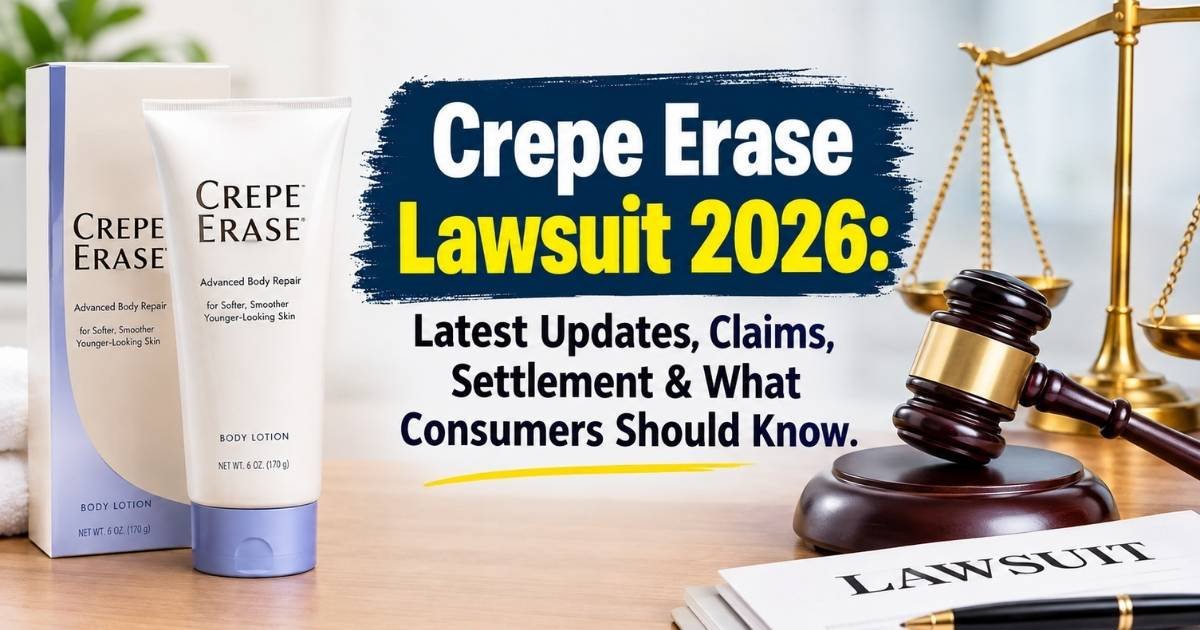

If you’ve searched “Crepe Erase lawsuit” recently, you’ve probably landed on a handful of sites promising a confirmed settlement, a payout amount, and a deadline to file a claim. Here’s the problem: as of September 2026, no public court record shows an active, certified nationwide class action lawsuit against Crepe Erase itself. What does exist is a real and well-documented pattern of consumer complaints about billing, autoship enrollment, and advertising claims, plus a genuine legal history tied to the brand’s parent company, Guthy-Renker.
This guide separates the two. You’ll get a clear, source-checked breakdown of what has actually happened, what consumers are complaining about, what the FTC is doing in this space, and what to do if you believe you were misled or overcharged, without the inflated claims that dominate this search topic right now.
What Is the Crepe Erase Lawsuit?
The phrase “Crepe Erase lawsuit” is mostly a search term, not a single legal case. It’s used online to describe three separate things that often get blended together:
- Individual consumer complaints filed with the Better Business Bureau (BBB), Federal Trade Commission (FTC), or state attorneys general about billing and cancellation issues.
- Historical class action settlements involving Guthy-Renker, the direct-response marketing company that sells Crepe Erase, over unrelated product lines like Proactiv and WEN.
- Speculative or aggregator content that reuses the “lawsuit” label to attract search traffic, sometimes implying an active case exists when it doesn’t.
There is no evidence of a currently certified class action lawsuit with Crepe Erase named as the defendant. That distinction matters because it changes everything else in this article: there is no settlement fund, no claim form, and no payout tied to a Crepe Erase-specific case right now.
What Is the Crepe Erase Class Action Lawsuit About?
Since no certified class action currently names Crepe Erase, there’s nothing to describe in terms of active claims, court filings, or a judge’s rulings. What can be described accurately is the type of claims a consumer class action against a direct-response skincare brand typically involves, because this pattern has played out repeatedly in the industry:
- Misrepresentation of product results in advertising, especially before-and-after imagery.
- Failure to clearly disclose automatic renewal (autoship) terms before charging a customer’s card.
- Difficulty canceling subscriptions once enrolled.
- Use of vague or unsupported “clinically proven” language.
Guthy-Renker has faced litigation on exactly these grounds before, just not for Crepe Erase specifically. In 2017, the company reached a settlement of up to $15.2 million over Proactiv’s auto-renewal billing practices, and in 2019 it agreed to an $8.5 million judgment with a coalition of California prosecutors covering both Proactiv and WEN autorenewal charges. Those cases are real, documented, and worth knowing about because they show the kind of legal exposure this business model has carried before.
What Are the False Advertising Allegations Against Crepe Erase?
There’s no filed lawsuit laying out formal false advertising allegations against Crepe Erase specifically. But there is a consistent set of public complaints and consumer watchdog criticisms about how the brand markets its products. These generally include:
- Before-and-after photos in infomercials that consumers say don’t reflect typical results.
- Language suggesting dramatic firming or “erasing” of crepey skin, when dermatologists note that no topical cream permanently removes crepey skin texture.
- Testimonials from paid brand ambassadors presented in a way some viewers find blurs the line between endorsement and independent review.
- Limited long-term, peer-reviewed clinical data made publicly available to back specific numeric claims (for example, percentage improvement figures shown briefly on screen).
None of this has been tested in a court judgment against Crepe Erase. It’s public complaint material, not adjudicated fact. That distinction is important if you’re trying to figure out whether you have a legitimate legal claim of your own.
What Complaints Did Consumers File About Crepe Erase?
The bulk of documented consumer complaints about Crepe Erase, found through the BBB and public review platforms, cluster around a few recurring themes:
- Unexpected recurring charges. Customers report being enrolled in an autoship program during a promotional purchase and not realizing it until a second charge appeared.
- Difficulty canceling. Some reviewers describe long hold times or multiple calls needed to stop shipments.
- Refund disputes. A subset of complaints involve disagreements over “risk-free trial” terms and whether a refund was owed after the trial window closed.
- Disappointment with results. A separate category of complaints is about product performance rather than billing. Some users feel the improvement in skin texture didn’t match what the infomercial implied.
It’s worth noting that billing complaints and performance complaints are legally very different. Billing and autorenewal disputes fall under consumer protection law (like ROSCA, discussed below). Disappointment in cosmetic results is much harder to turn into a legal claim unless there’s a specific, provably false factual claim behind it.
Is Crepe Erase a Scam? What the Evidence Shows
No, the evidence does not support calling Crepe Erase a scam. It’s a real, long-running cosmetic brand sold by an established direct-response marketing company, with actual manufacturing, actual ingredients, and actual retail distribution through its own site and retailers like Ulta.
That said, “not a scam” doesn’t mean “no legitimate criticism.” Two things can be true at once:
- Crepe Erase is a legal, functioning consumer product, not a fraudulent shell operation designed to take money and disappear.
- The subscription and billing model it uses has drawn real regulatory scrutiny across the direct-response marketing industry, including for its parent company.
The more accurate framing is this: Crepe Erase sits in a gray zone that’s common for infomercial-driven skincare brands, aggressive marketing claims paired with a legitimate underlying product, and a subscription structure that occasionally generates billing disputes. That’s a consumer caution flag, not proof of fraud.
Has the FTC Taken Action Against Crepe Erase?
There is no confirmed, publicly documented FTC enforcement action naming Crepe Erase specifically as of 2026. However, the regulatory backdrop is very relevant to understand:
- The FTC enforces the Restore Online Shoppers’ Confidence Act (ROSCA), which requires clear disclosure of subscription terms, informed consent before charging a card, and a simple way to cancel.
- In 2024, the FTC finalized an updated “Click-to-Cancel” rule targeting negative-option and autoship businesses broadly.
- In July 2025, the Eighth Circuit Court of Appeals vacated that rule on procedural grounds.
- In response, the FTC opened a new Advance Notice of Proposed Rulemaking (ANPRM) in early 2026 to rebuild a version of the rule, with the public comment period closing in April 2026.
- Separately, the FTC has continued bringing individual ROSCA enforcement cases against other subscription-based companies (including a $7.5 million settlement with Chegg in 2025) using its existing authority even while the broader rule was in limbo.
So while the FTC hasn’t named Crepe Erase in a public action, the regulatory framework it operates under is under active, high-profile revision. Any direct-response skincare brand using autoship, Crepe Erase included, is operating inside a regulatory environment that is tightening, not loosening.
What Does the Crepe Erase Ingredients Lawsuit Actually Claim?
There is no confirmed lawsuit specifically challenging Crepe Erase’s ingredient list or formulation claims in court. Some content sites use the phrase “ingredients lawsuit” loosely to describe consumer skepticism about proprietary blends, which is a different thing than a legal filing.
The actual consumer concern here usually comes down to three points:
- Proprietary blend labeling. Like many cosmetic brands, Crepe Erase lists some ingredients under branded names (like TruFirm Complex) rather than a full breakdown of exact percentages, which is legal under FDA cosmetic labeling rules but frustrates consumers who want more transparency.
- “Clinically shown” language. When a product claims results are “clinically shown,” consumers reasonably want to see the underlying study. Cosmetic companies aren’t always required to publish full study data the way drug companies are.
- Marketing versus formulation gap. Some ingredients (retinol, peptides, hyaluronic acid) do have real dermatological research behind them in general, but that doesn’t automatically validate every specific outcome claim made about a finished product containing them.
None of this currently amounts to a filed lawsuit. It amounts to legitimate, common cosmetic industry transparency questions.
What Is the TruFirm Complex and Why Is It Under Fire?
TruFirm Complex is Crepe Erase’s proprietary ingredient blend, most commonly described as a mix of plant-derived extracts, including apple, dill, and sage extract, formulated to target skin elasticity. A newer version marketed as TruFirm+ pairs this botanical blend with retinol and peptides in some product lines.
It’s “under fire” mainly in the sense that any proprietary cosmetic blend draws scrutiny once it’s tied to bold marketing language. The criticism generally isn’t about safety. It’s about two things:
- Lack of public dosage or concentration data. Consumers can’t independently verify how much of each active ingredient is present, since proprietary blends are typically listed as a single named complex rather than itemized percentages.
- Gap between “supports elasticity” and “erases crepey skin.” Dermatologists distinguish between ingredients that can improve skin hydration and surface texture (which TruFirm’s components plausibly can do) and ingredients that structurally reverse crepey skin caused by long-term collagen and elastin loss (which no topical product can fully do).
There is no recall, safety warning, or FDA enforcement action tied to TruFirm Complex as of 2026.
Does Crepe Erase Actually Work? What Science Says
This is the most useful question to actually answer directly, because it cuts through both the marketing hype and the lawsuit speculation.
Dermatological research generally supports the following, independent of any specific brand:
- Alpha hydroxy acids (AHAs) like glycolic and lactic acid, both present in various Crepe Erase products, do have evidence supporting mild exfoliation and short-term smoothing of skin texture.
- Hyaluronic acid and glycerin-based moisturizers can visibly plump skin temporarily by increasing surface hydration, which can make crepey skin look less noticeable while the product is in use.
- Retinol, found in some newer Crepe Erase formulations, has solid research behind it for stimulating collagen production over consistent, long-term use.
- No topical over-the-counter cosmetic, from any brand, has clinical evidence showing it can permanently reverse crepey skin caused by chronic sun damage and age-related collagen and elastin breakdown.
In plain terms: the ingredient categories in Crepe Erase are not fictional or fraudulent, they’re common, reasonably well-studied cosmetic actives. But “reduces the appearance of” and “erases” are very different promises, and dermatologists consistently note that visible, lasting structural change in crepey skin typically requires procedures (like laser resurfacing or prescription-strength retinoids) rather than an over-the-counter body cream alone.
How Did Crepe Erase TV Infomercial Claims Factor Into the Lawsuit Confusion?
Crepe Erase built its brand recognition primarily through direct-response television infomercials, fronted for years by actress Jane Seymour and later joined by Kate Walsh. This marketing format itself is part of why “lawsuit” searches around the brand are so persistent.
Direct-response infomercials have a well-documented history of FTC scrutiny across the industry, not unique to Crepe Erase, because they typically combine:
- Dramatic before-and-after visuals shown in short segments.
- Time-limited “as seen on TV” offers designed to prompt immediate purchase.
- Small-print disclaimers (“results not typical”) that flash briefly on screen.
- Introductory trial offers that convert into recurring shipments if not canceled.
That combination has triggered real regulatory action against other companies in this exact marketing category, which is likely why search interest in a “Crepe Erase lawsuit” keeps climbing even without a confirmed case, people are pattern-matching to a format that has produced lawsuits elsewhere in the industry.
Who Qualifies for the Crepe Erase Lawsuit?
Because there is currently no certified class action or confirmed settlement, no one currently “qualifies” for a Crepe Erase lawsuit payout. Be cautious of any site or form asking you to submit personal information to “check your eligibility” for a Crepe Erase settlement, since no such settlement exists yet.
What you can realistically pursue right now, individually, if you believe you were overcharged or misled:
- A direct refund or billing dispute request with Crepe Erase’s customer service.
- A chargeback through your credit card issuer if the company won’t resolve a disputed autoship charge.
- A complaint filed with the FTC, your state attorney general, or the BBB, which can contribute to future enforcement patterns even if it doesn’t resolve your individual case immediately.
- A small claims court filing, in cases involving a specific, documentable dollar amount and a clear billing violation.
If a certified class action is ever filed and approved, the qualifying group (“class”) would typically be defined by the court, for example, anyone who purchased a specific product during a specific date range under specific billing terms.
What Is the Crepe Erase Class Action Deadline?
There is no deadline to speak of, because there is no confirmed active class action or settlement claims period open right now. Any website listing a specific “file by” date for a Crepe Erase settlement claim should be treated with skepticism unless it links directly to an official, court-administered settlement website (which typically ends in a domain tied to a settlement administrator, not a generic “lawsuit blog”).
What does have real deadlines are the general legal timeframes that would apply if you wanted to pursue your own individual claim:
- Statutes of limitations for consumer protection or fraud claims vary by state, commonly ranging from two to four years from the date of the disputed charge or purchase.
- Chargeback windows with credit card issuers are typically much shorter, often 60 to 120 days from the statement date.
If you believe you have a claim, the safest approach is to act based on your own state’s statute of limitations and your card issuer’s dispute window, not a deadline claimed on a third-party lawsuit content site.
What Is the Crepe Erase Settlement Status in 2026?
As of September 2026, there is no confirmed, court-approved settlement specific to Crepe Erase. If that changes, official information would appear through:
- A court docket entry in the jurisdiction where a class action was filed.
- A dedicated settlement administrator website (commonly ending in domains like “.com/settlement” tied to firms such as Epiq, JND, or Angeion).
- Direct notice mailed or emailed to affected class members, based on purchase records the company or retailer maintains.
Several content sites currently describe settlement negotiations as “ongoing” or “active litigation” without linking to a verifiable court record. Readers should treat those claims as unconfirmed until an official source, not another blog post, substantiates them.
How Much Is the Crepe Erase Settlement Amount?
There is no confirmed Crepe Erase settlement amount because there is no confirmed Crepe Erase settlement. For context only, and not as a prediction, here’s what comparable Guthy-Renker cases have actually resolved for:
| Case | Year | Amount | Product Involved |
| Proactiv auto-renewal class action | 2017 | Up to $15.2 million | Proactiv |
| California Automatic Renewal Task Force settlement | 2019 | 8.5million(1.2M penalties, up to $7.3M restitution) | Proactiv and WEN |
These figures reflect real, documented settlements, but they involve different products and different plaintiffs than any current Crepe Erase claim. They’re useful only as a benchmark for the scale these cases can reach when a certified class action does move forward against this type of business model.
What Payout Can You Expect From the Crepe Erase Lawsuit?
Right now, the honest answer is zero, because there’s no active settlement to draw a payout from. If you’ve seen a claimed “average payout” figure for Crepe Erase specifically, that number is not sourced from any confirmed settlement and shouldn’t be relied on.
If a class action against Crepe Erase were eventually certified and settled, following the pattern of comparable Guthy-Renker cases, payouts would likely be structured around:
- A cash option with a fixed dollar range per claimant (the Proactiv case, for comparison, offered $20 to $75 per person).
- An alternative option of free or discounted product in place of cash.
- Payout amounts scaled down if the number of valid claims filed exceeds the settlement fund, which is standard in most consumer class actions.
Until an actual settlement is filed and approved, any specific payout number attached to “Crepe Erase lawsuit” content is speculative.
How to File a Crepe Erase Claim in 2026
Since there’s no active class action claim form to fill out, “filing a claim” today means protecting your own individual rights rather than joining a group settlement. Here’s a practical, step-by-step approach:
- Gather your documentation. Save order confirmations, credit card statements showing the charges, any cancellation confirmation emails, and screenshots of the original advertising or offer terms if you still have them.
- Contact Crepe Erase customer service directly. Request a refund or a stop to recurring charges in writing (email, not just a phone call) so you have a paper trail.
- Dispute the charge with your bank or card issuer if the company doesn’t resolve it, especially if you were charged without clear consent to an autoship program.
- File a complaint with the FTC at ReportFraud.ftc.gov. This doesn’t get you a refund directly, but it feeds into the FTC’s pattern-of-complaints data, which is often what triggers a future enforcement action.
- File a complaint with your state attorney general’s consumer protection division, particularly if you’re in a state with a strong autorenewal law (California, New York, and Illinois all have notably active enforcement histories in this space).
- Consider small claims court for a specific, documented dollar amount if the company won’t resolve a legitimate billing dispute.
- Watch official channels for future developments. If a real class action is ever filed, monitor PACER (federal court records) or reputable legal news trackers, not unverified “lawsuit update” blogs, for confirmation.
Frequently Asked Questions
Is there currently an active Crepe Erase class action lawsuit?
No public court record confirms an active, certified class action lawsuit against Crepe Erase specifically as of September 2026.
Has Crepe Erase been sued before?
Crepe Erase itself has no confirmed public lawsuit, but parent company Guthy-Renker has settled prior class actions over Proactiv and WEN billing practices.
Is Crepe Erase FDA approved?
Cosmetic products like Crepe Erase are not FDA “approved” in the way drugs are, they’re regulated as cosmetics, which have different labeling and safety requirements.
Can I get a refund if I was charged without consent?
Yes, contact Crepe Erase directly first, then dispute the charge with your card issuer if the company doesn’t resolve it.
Is Crepe Erase safe to use?
There are no confirmed FDA recalls or safety warnings tied to Crepe Erase products as of 2026.
Where can I check for an official Crepe Erase settlement?
Check court dockets or an official settlement administrator website directly, not third-party lawsuit content sites, for verified settlement information.
Should I give my personal information to a site claiming I qualify for a payout?
No, be cautious of any site asking for personal or financial information to “check eligibility” for a settlement that isn’t publicly confirmed to exist.
What’s the difference between a billing complaint and a false advertising lawsuit?
A billing complaint involves unauthorized or undisclosed charges, while a false advertising claim involves provably false statements about what a product does.
Conclusion
The truth about the “Crepe Erase lawsuit” is less dramatic than a lot of search results suggest, but it’s more useful. There’s no confirmed, active class action, no court-approved settlement, and no payout to claim right now, despite what several content sites imply. What is real is a pattern of consumer billing complaints, a documented legal history for parent company Guthy-Renker involving other product lines, and an FTC regulatory environment around subscription billing that’s actively being rebuilt in 2026.
If you’re a Crepe Erase customer with a billing dispute, your best path is a direct, documented approach: request a refund in writing, dispute the charge with your bank if needed, and file a complaint with the FTC or your state attorney general. If you’re simply deciding whether to try the product, treat the marketing claims with the same healthy skepticism you’d apply to any infomercial skincare brand, real ingredients, reasonable but limited expectations, and a subscription model worth reading the fine print on before you check out.

Daniel Christopher is the founder and administrator of LawsIps.com. He is passionate about making legal information easier to understand through clear, well-researched, and reader-friendly content. His goal is to help readers stay informed about legal topics, court updates, consumer rights, and educational legal resources in simple language.