
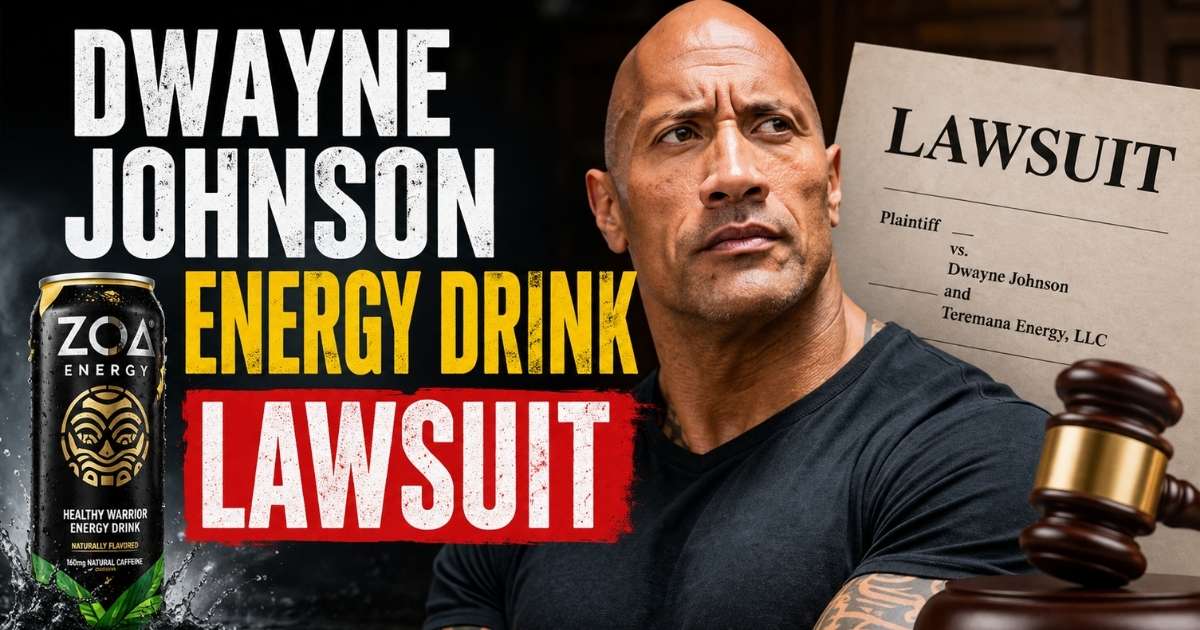

Dwayne “The Rock” Johnson has built a reputation as one of Hollywood’s most trusted names, so when his energy drink brand landed in a class action lawsuit, it made headlines fast. ZOA Energy, the beverage company Johnson co-founded, recently agreed to a $3 million settlement after facing accusations of misleading “0 preservatives” labeling.
If you have ever bought a can of ZOA, or you are simply curious how a celebrity-backed brand ended up in court, this guide breaks down everything that happened. You will find the full case history, who qualifies for compensation, how much money is on the table, and what comes next in 2026.
Dwayne Johnson Energy Drink Lawsuit
The lawsuit at the center of this story is officially known as Gershzon v. ZOA Energy, LLC, filed in the United States District Court for the Northern District of California in October 2023. The case does not name Dwayne Johnson personally. Instead, it targets ZOA Energy, LLC, the company he co-founded alongside business partners including Dany Garcia.
Johnson is one of several owners of the brand, and his image has been central to ZOA’s marketing since launch. That connection is exactly why the case attracted so much attention. Consumers trust celebrity-backed products differently than anonymous corporate brands, and lawsuits like this test whether that trust was well placed.
The core issue was not about Johnson’s involvement or endorsement. It was about a specific label claim: “0 preservatives.” According to the lawsuit, that claim was inaccurate because ZOA drinks contain citric acid and ascorbic acid, two ingredients the plaintiff argued function as chemical preservatives even though they are also common in many food and beverage products.
ZOA Energy Drink Lawsuit
ZOA Energy launched in 2021 and quickly grew into one of the more recognizable names in the crowded energy drink market, competing with brands like Celsius, Alani Nu, and Bang. Part of that growth came from Johnson’s massive personal following and his hands-on marketing approach.
The lawsuit alleges that between March 1, 2021, and November 21, 2025, ZOA marketed its drinks with a “0 Preservatives” claim printed directly on the can. Plaintiff Mikhail Gershzon argued that this statement misled health-conscious buyers who specifically avoid preservatives for dietary or wellness reasons.
ZOA denied any wrongdoing throughout the case. In court filings, the company maintained that its labeling and marketing were truthful, accurate, and fully compliant with applicable law. Even so, rather than risk a lengthy trial, ZOA agreed to resolve the matter through a negotiated settlement, a common outcome in food and beverage litigation where the cost of fighting a class action often outweighs the cost of settling.
ZOA Energy Class Action Lawsuit
This case moved through the legal system as a class action, meaning one named plaintiff represented a much larger group of consumers who shared the same complaint. Class actions are designed to make it practical for large numbers of people with relatively small individual claims to pursue justice together, rather than filing thousands of separate lawsuits.
Here is a simple timeline of how the case unfolded:
- October 2023: The lawsuit is filed in the Northern District of California.
- November 21, 2025: The court grants preliminary approval of the proposed settlement.
- February 13, 2026: Deadline passes for class members to opt out or object.
- February 20, 2026: Deadline passes for eligible consumers to submit claim forms.
- March 26, 2026: The court holds a final approval hearing in San Francisco.
The settlement class includes anyone in the United States who bought a ZOA Energy drink labeled “0 Preservatives” for personal use during that roughly four and a half year window. It does not cover business purchases or drinks bought for resale.
ZOA Energy Drink Misleading Claims
At the heart of this case is a debate that comes up often in food labeling litigation: what does an average shopper actually understand a claim like “0 preservatives” to mean?
Plaintiffs argued that most consumers interpret “no preservatives” as a promise that a product contains no ingredients added to extend shelf life or prevent spoilage, period. ZOA’s position was that its labeling followed standard industry practices and complied with FDA labeling rules.
The dispute did not center on whether the ingredients were disclosed. They were listed plainly on the can, as required by law. The disagreement was about whether the front-of-package marketing claim created a different impression than the ingredient panel supported. This is a pattern seen in many recent consumer protection cases, where technically accurate ingredient lists still get challenged because of how bold marketing language frames the product.
ZOA Energy Drink False Advertising
The false advertising claims in this case were brought under several California consumer protection statutes, including:
- California’s Unfair Competition Law
- California’s False Advertising Law
- California’s Consumers Legal Remedies Act
- Common law claims for breach of express warranty and misrepresentation
These laws exist to protect consumers from marketing that could reasonably mislead a typical shopper, even if no one intended to deceive anyone. That is an important distinction. A false advertising claim does not require proof that a company knowingly lied. It only requires proof that a reasonable consumer could be misled by the way a product was presented.
Because California has some of the strongest consumer protection laws in the country, it is a common venue for cases like this one, which is part of why the lawsuit was filed there even though ZOA sells its products nationwide.
ZOA Energy Drink Ingredients Lawsuit
So what exactly is in question here? The lawsuit points specifically to two ingredients:
- Citric acid: Commonly used to add tartness and balance flavor, but also known to have mild preservative properties by lowering pH levels.
- Ascorbic acid: Better known as vitamin C, frequently added for nutritional value and as an antioxidant that can also help slow oxidation.
Both ingredients appear in a huge range of everyday beverages and packaged foods, from fruit juice to sparkling water. The legal question was never whether these ingredients are safe or unusual. It was whether their presence contradicts a “0 preservatives” claim, given that they can technically serve a preservative-like function even when added primarily for flavor or nutrition.
This distinction matters for anyone trying to understand similar labeling disputes across the beverage industry, since citric acid and ascorbic acid show up in dozens of other “clean label” products currently on store shelves.
ZOA Energy Drink Side Effects Lawsuit
It is worth being clear about what this lawsuit is not. This is not a personal injury case, and it does not allege that ZOA Energy drinks caused physical harm, adverse health effects, or safety hazards to consumers.
The case is strictly a labeling and marketing dispute. No plaintiffs in this settlement claimed injury from caffeine content, ingredient reactions, or any other health consequence tied to drinking ZOA products. If you are researching general energy drink safety concerns such as caffeine sensitivity or heart palpitations, that is a separate topic entirely from this particular lawsuit.
Is ZOA Energy Drink Safe?
Since safety questions often come up alongside lawsuit news, it helps to separate fact from assumption here.
ZOA Energy drinks are formulated with common energy drink ingredients, including caffeine, B vitamins, and electrolytes. The products are sold legally across the United States and remain on shelves nationwide as of 2026. Nothing in the ZOA lawsuit alleges that the drinks are unsafe to consume.
That said, general energy drink guidance still applies:
- Most ZOA varieties contain moderate to high caffeine levels, so people sensitive to caffeine should check the label.
- Energy drinks are generally not recommended for children, pregnant individuals, or people with certain heart conditions.
- Moderation matters, regardless of the brand, since excessive caffeine intake from any source can cause jitteriness, elevated heart rate, or sleep disruption.
In short, the lawsuit is about label accuracy, not product danger.
Who Qualifies for ZOA Energy Lawsuit
Eligibility for the settlement is fairly specific. You may be a class member if you meet all of the following:
- You live in the United States.
- You purchased one or more ZOA Energy drinks bearing the “0 Preservatives” label statement.
- The purchase happened between March 1, 2021, and November 21, 2025.
- You bought the product for personal or household use, not for resale or distribution.
You do not need to have kept your receipt to be part of the settlement class, though proof of purchase does affect how much money you can claim.
ZOA Energy Lawsuit Eligibility Requirements
Beyond the basic qualifications above, a few practical details shape how the eligibility rules apply in real situations.
- Multiple purchases count. If you bought several ZOA drinks over the years, each can purchased within the class period could contribute toward your claim total.
- Household caps apply. Payments are calculated per household, not per individual purchaser, so multiple family members buying separately does not multiply the maximum payout.
- No physical harm required. You do not need to show any negative health effect. Simply purchasing the labeled product during the class period is enough.
- Automatic inclusion. Anyone who did not formally opt out by the February 13, 2026 deadline is automatically part of the settlement class, whether or not they file a claim.
How to File ZOA Energy Drink Claim
For consumers who purchased ZOA Energy drinks within the eligible window, here was the claims process:
- Visit the official, court-authorized settlement website.
- Locate your unique Class Member ID from your settlement notice, if you received one by mail or email.
- Complete the online claim form with your name, address, and contact details.
- Upload proof of purchase if available, such as a receipt, UPC code, or purchase record.
- Choose a payment method, such as a mailed check or electronic payment.
- Submit the form before the deadline and keep a confirmation for your records.
Consumers who could not find their Class Member ID were able to request one through the settlement website before submitting a claim.
Please note that the official claim filing deadline was February 20, 2026, and that window has already closed. If you missed it, you generally cannot submit a new claim for this particular settlement, though you may still be bound by its terms if you did not opt out.
ZOA Energy Drink Refund Claim
Many people search for this topic using the word “refund,” but it is worth understanding that this settlement functions more like compensation than a traditional product refund.
Instead of returning unused products for a repayment, eligible consumers filed a claim form asserting how many qualifying drinks they purchased. The payment is a settlement award tied to a legal resolution, not a refund issued by the retailer or manufacturer for a defective product.
- With proof of purchase, class members could claim $1 per unit, up to $150 per household.
- Without proof of purchase, class members could claim $1 per unit, up to $10 per household.
If total approved claims exceed the available settlement fund after fees and costs, individual payments may be reduced on a pro rata basis, meaning everyone’s payout shrinks proportionally to stay within the $3 million cap.
ZOA Energy Drink Lawsuit Settlement
ZOA Energy agreed to establish a $3 million settlement fund to resolve the case. That fund is intended to cover several things, not just consumer payments:
- Cash payments to approved class members
- Attorneys’ fees and litigation costs
- Notice and claims administration expenses
- A service award for the class representative, Mikhail Gershzon
Reports indicate that roughly one third of the total fund may go toward attorneys’ fees and administrative costs, a fairly standard proportion in consumer class action settlements of this size. The remaining balance is distributed among verified claimants.
Importantly, the settlement includes no admission of wrongdoing by ZOA Energy. The company has consistently stated that its labeling complied with the law, and the settlement language reflects that position. Settling a case is often a business decision made to avoid the unpredictability, cost, and time of a trial, rather than an admission that the claims were true.
ZOA Energy Lawsuit Payout Amount
Based on official settlement documents, here is a clear breakdown of expected compensation:
| Situation | Maximum Payout |
| With proof of purchase | $150 per household |
| Without proof of purchase | $10 per household |
| Rate per unit purchased | $1 per can |
Keep in mind that these are maximum figures. Your actual payment depends on how many units you documented, how many total valid claims were submitted across the entire class, and whether the fund needs to be reduced proportionally to stay within the $3 million cap. Settlement administrators typically finalize these calculations after the claims deadline closes and the court grants final approval.
ZOA Energy Drink Lawsuit Deadline
Here are the key dates that defined this case:
- Opt out or object deadline: February 13, 2026
- Claim form submission deadline: February 20, 2026
- Final approval hearing: March 26, 2026, in San Francisco
As of this guide’s publication, the claims window has closed, and the case moved into its final approval phase in the spring of 2026. Consumers who submitted timely claims generally do not need to take further action beyond waiting for the court’s final ruling and the distribution of payments, which typically follows within a set number of days once the settlement becomes legally final and any appeal period has passed.
Dwayne Johnson ZOA Lawsuit Update 2026
So where does the case stand now? After preliminary approval in November 2025, the settlement proceeded through its structured legal process on schedule. The final approval hearing took place on March 26, 2026, where the presiding judge in the Northern District of California reviewed the fairness of the settlement terms, considered any objections filed by class members, and decided whether to grant final judgment.
If the court grants final approval and no one appeals, settlement payments are typically distributed within roughly 30 to 90 days afterward. If an appeal is filed, payment timelines can extend by several months or longer while the appeal is resolved. Consumers who filed claims should watch for official communication from the Kroll Settlement Administration, the third party appointed to manage payments, rather than relying on unofficial sources for updates.
It is worth noting that Dwayne Johnson himself has not been named as an individual defendant at any point in this litigation, and the case has had no reported impact on his other business ventures or public appearances.
Celebrity Energy Drink Lawsuits
ZOA is far from the only celebrity-backed beverage brand to face legal scrutiny. As celebrity involvement in food, beverage, and supplement companies has grown over the past decade, so has consumer litigation targeting label claims, health statements, and marketing language across the industry.
This pattern extends well beyond beverages too. High-profile consumer and mass tort cases, ranging from health and supplement disputes like The Wellness Company Lawsuit to large-scale institutional cases such as the BSA Lawsuit, show how varied modern class action litigation has become, spanning everything from labeling disagreements to far more serious claims of harm.
For celebrity-backed brands specifically, a few lessons stand out:
- Trust is part of the product. When a public figure lends their name to a brand, courts recognize that endorsements can influence purchasing decisions, which increases scrutiny on how claims are worded.
- Absolute language invites absolute scrutiny. Phrases like “0 preservatives” or “all natural” leave little room for nuance and are judged by how an ordinary consumer understands them, not by internal technical definitions.
- Settling is common, not rare. Most food and beverage class actions resolve through settlement rather than trial, since litigation costs and uncertainty typically outweigh the benefit of fighting a labeling dispute in court.
For consumers, the takeaway is simple. Reading beyond the front label and checking the actual ingredient list remains the most reliable way to understand what you are buying, regardless of whose name is on the can.
Frequently Asked Questions
Is Dwayne Johnson personally being sued?
No. The lawsuit named ZOA Energy, LLC as the defendant, not Dwayne Johnson individually.
What was ZOA Energy accused of?
ZOA was accused of falsely advertising its drinks as having “0 preservatives” despite containing citric acid and ascorbic acid.
How much is the ZOA Energy settlement worth?
The total settlement fund is $3 million, covering consumer payments, legal fees, and administrative costs.
Can I still file a claim for the ZOA settlement?
The claim filing deadline was February 20, 2026, and that window has now closed for new claims.
Did ZOA admit any wrongdoing?
No. ZOA denied all allegations and maintained that its labeling was truthful and legally compliant throughout the case.
How much money can I get from the settlement?
Eligible claimants could receive up to $150 per household with proof of purchase, or up to $10 without proof.
Is ZOA Energy drink dangerous to drink?
No. The lawsuit involved labeling accuracy only and made no claims that the product is unsafe to consume.
When will settlement payments be sent out?
Payments typically begin within 30 to 90 days after final court approval, assuming no appeals are filed.
Where can I check the official settlement status?
Class members should refer to the court-authorized settlement administrator’s website rather than third-party news sources for the latest updates.
Final Thoughts
The ZOA Energy lawsuit is a reminder that even the most trusted celebrity brands are not immune to consumer protection laws. Dwayne Johnson’s name may have helped build ZOA into a household brand, but the case ultimately came down to a straightforward legal question: did the “0 preservatives” claim accurately reflect what was inside the can.
With a $3 million settlement fund, a defined eligibility window, and a final approval hearing now behind it, the case is moving toward resolution in 2026. Whether you filed a claim, are simply curious about how these lawsuits work, or want to keep an eye on similar cases involving other public figures and wellness brands, this case offers a useful blueprint for how modern false advertising litigation typically unfolds, from filing to final payout.
As always, if you believe you were affected by misleading labeling on any product, keeping your receipts and staying alert to official settlement notices is the best way to protect your right to compensation in future cases like this one.