
12 Universal Laws Explained: Meaning & Examples
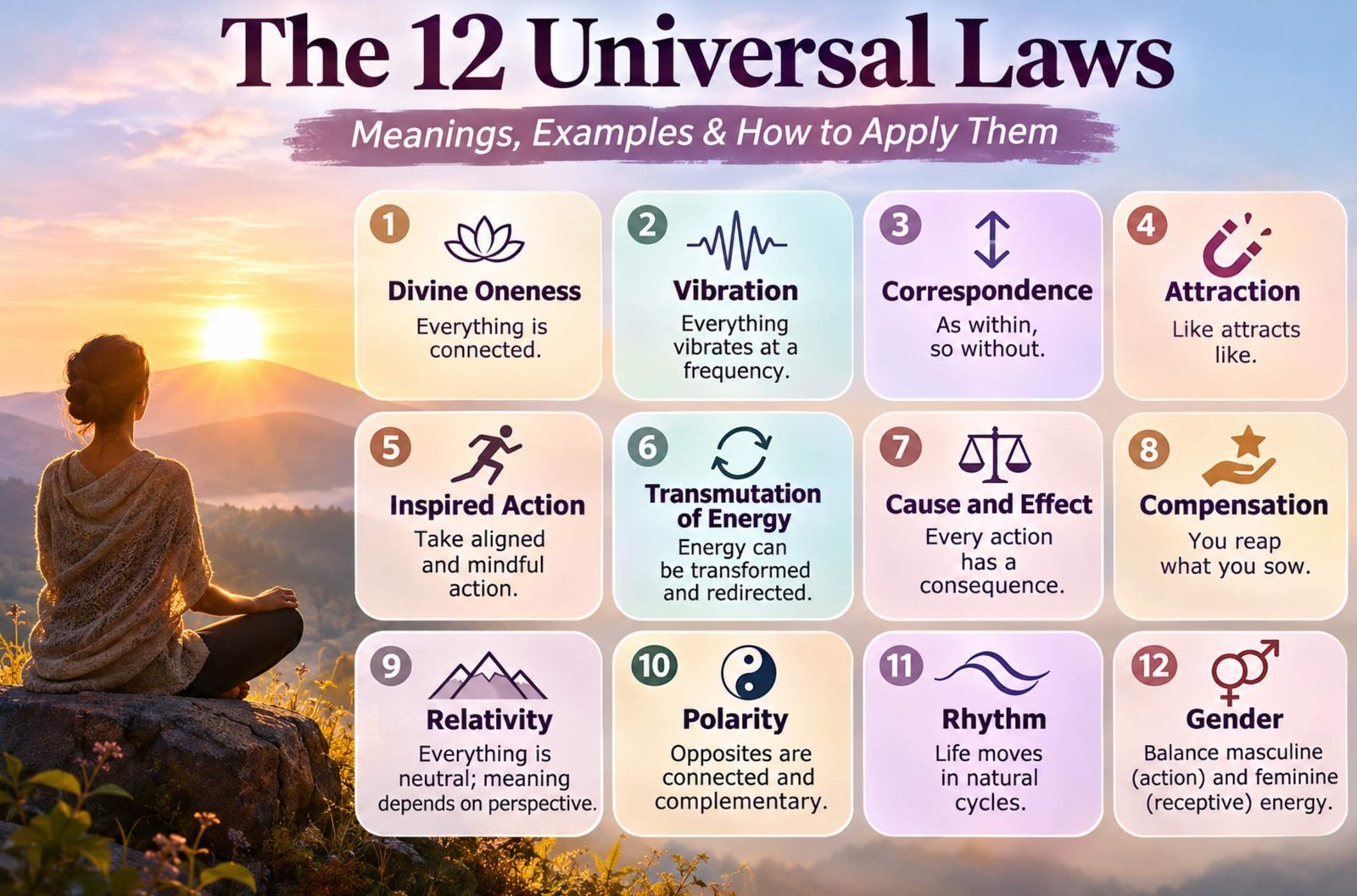
The 12 Universal Laws Explained: Meanings, Examples, and Practical Applications
Have you ever noticed how your thoughts, decisions, and daily habits influence your experiences? Many spiritual traditions explore this relationship through principles that encourage self-awareness, personal responsibility, and balance.
One popular framework is known as the 12 Universal Laws. While the Law of Attraction receives much of the attention, the other eleven principles explore interconnectedness, change, consequences, perspective, and personal development.
These laws are spiritual and philosophical teachings rather than scientifically established laws of nature. Nevertheless, their ideas can provide useful opportunities for reflection.
In this article, we will explore all 12 universal laws, explain their meanings, and discuss practical ways to apply their lessons in everyday life.
What Are the 12 Universal Laws?
The 12 Universal Laws are a collection of metaphysical principles that attempt to explain the relationship between human consciousness, behavior, energy, and life experiences.
The modern framework incorporates ideas associated with various spiritual traditions, including Hermetic philosophy. However, the precise historical origin of the complete list of twelve laws is not firmly documented.
Some of its concepts resemble themes found in the seven Hermetic principles, including correspondence, polarity, and rhythm.
It is also important to distinguish spiritual principles from enforceable legal rules. Spiritual laws offer philosophical interpretations, whereas legal systems establish rights, duties, and procedures that may be enforced by courts.
Understanding this distinction allows readers to appreciate spiritual teachings without confusing them with scientific discoveries or legal obligations.
1. The Law of Divine Oneness
The Law of Divine Oneness suggests that everything in existence is interconnected.
According to this spiritual principle, our thoughts and actions do not exist in isolation. What we do can influence the people around us and, indirectly, the wider community.
For example, showing kindness to someone experiencing a difficult day may encourage that person to treat others more positively.
The central message is that individual behavior can contribute to collective well-being.
How to Apply It
- Treat people with compassion and respect.
- Consider how your decisions affect others.
- Practice empathy during disagreements.
- Support your community whenever possible.
Real-life example: Healthy family relationships depend on communication, cooperation, and mutual respect. While spiritual teachings emphasize compassion, practical responsibilities within families may also involve legally recognized rights and duties under family law.
Key takeaway: Recognizing your connection with others can encourage more thoughtful and compassionate behavior.
2. The Law of Vibration
The Law of Vibration is based on the spiritual belief that everything possesses an energetic frequency.
Although physical matter exhibits measurable motion and vibration, extending this scientific concept to emotions and spiritual experiences is a metaphysical interpretation rather than an established scientific conclusion.
In everyday life, however, our emotional states can influence how we communicate, make decisions, and respond to challenges.
For instance, someone who feels calm and confident may approach a difficult conversation differently from someone experiencing intense anxiety.
How to Apply It
- Practice mindfulness or meditation.
- Exercise regularly.
- Maintain healthy sleeping habits.
- Spend time in supportive environments.
- Develop strategies for managing stress.
Research has examined the potential benefits and limitations of meditation. The National Institutes of Health’s overview of meditation and mindfulness provides useful scientific context.
Real-life example: Taking a short walk before an important meeting may help you relax and approach the conversation with greater clarity.
Key takeaway: Your emotional well-being can influence your behavior and the quality of your daily experiences.
3. The Law of Correspondence
The Law of Correspondence proposes that patterns observed in one area of life may reflect patterns found elsewhere.
In personal development, it is commonly interpreted as a connection between internal beliefs and external behavior.
Someone who consistently believes they cannot succeed may hesitate to pursue valuable opportunities. By developing confidence and improving their skills, they may begin making different choices.
However, this principle should not be interpreted to mean that every negative experience is caused by a person’s mindset.
How to Apply It
- Examine recurring habits and behavioral patterns.
- Identify beliefs that may be limiting your progress.
- Reflect on your reactions to difficult situations.
- Improve your self-talk.
- Focus on areas where you can make meaningful changes.
Real-life example: A person who struggles with professional confidence may benefit from additional training, constructive feedback, and gradual exposure to new responsibilities.
Key takeaway: Understanding your inner beliefs can help you recognize opportunities for personal improvement.
4. The Law of Attraction
The Law of Attraction suggests that focusing on particular thoughts, intentions, and goals can influence the experiences people attract into their lives.
Supporters often emphasize positive thinking, visualization, and belief.
Although there is no reliable scientific evidence that thoughts directly attract external events through supernatural forces, goal-focused thinking can influence motivation and behavior.
A clear objective may help someone recognize relevant opportunities and remain committed to practical action.
How to Apply It
- Set realistic personal and professional goals.
- Visualize the process of achieving them.
- Develop a constructive mindset.
- Track your progress.
- Combine optimism with consistent effort.
Real-life example: Someone hoping to start a business can focus on their vision while researching customers, creating a budget, and developing a marketing strategy.
Key takeaway: Positive thinking may support motivation, but meaningful results generally require action.
5. The Law of Inspired Action
The Law of Inspired Action emphasizes turning intentions into meaningful steps.
Having an idea or imagining a successful future is only the beginning. Progress requires decisions, effort, and a willingness to respond to opportunities.
Inspiration can arrive unexpectedly, but acting on an idea often requires planning and persistence.
This principle has a practical parallel in legal matters, where taking timely action can be essential to protecting one’s interests.
How to Apply It
- Identify one action that supports your goals.
- Break complicated projects into manageable steps.
- Avoid waiting for perfect circumstances.
- Seek reliable information before making major decisions.
- Review your progress regularly.
Real-life example: Individuals who believe they have experienced similar harm may explore how to file a class action lawsuit to understand the legal procedures involved. Unlike spiritual manifestation, legal action requires evidence, applicable rules, and formal processes.
Key takeaway: Goals become more achievable when they are supported by informed, consistent action.
6. The Law of Perpetual Transmutation of Energy
This spiritual principle suggests that energy is constantly changing and that people can transform negative experiences into more positive outcomes.
The physical transformation of energy is a scientific concept, but claims about thoughts directly changing spiritual energy have not been scientifically established.
As a personal development idea, however, this law encourages adaptability and constructive responses to adversity.
A difficult experience may become an opportunity to develop new skills or reconsider previous decisions.
How to Apply It
- Focus on solutions when problems arise.
- Turn frustration into motivation for improvement.
- Learn from previous mistakes.
- Develop emotional resilience.
- Accept that circumstances can change over time.
Real-life example: Someone who loses a job may use the transition to develop new professional skills or explore alternative career opportunities.
Key takeaway: You may not control every event, but you can often influence how you respond to it.
7. The Law of Cause and Effect
The Law of Cause and Effect emphasizes that actions produce consequences.
Our decisions can influence relationships, finances, careers, and personal well-being.
Sometimes the consequences appear immediately. In other situations, their effects become noticeable only after weeks, months, or years.
The principle also has a practical connection to legal accountability, although legal responsibility depends on specific legal standards rather than spiritual beliefs.
How to Apply It
- Consider possible outcomes before making decisions.
- Develop responsible habits.
- Learn from past experiences.
- Accept accountability for your behavior.
- Think about long-term consequences.
Real-life example: When a company’s alleged misconduct affects numerous consumers, those individuals may pursue collective legal remedies. Understanding what a class action lawsuit is illustrates how legal systems can address certain disputes involving groups of people.
Key takeaway: Thoughtful decisions and responsible behavior can improve your chances of achieving positive outcomes.
8. The Law of Compensation
The Law of Compensation suggests that our contributions, efforts, and actions may influence the rewards we receive.
In spiritual interpretations, this idea is often summarized as receiving benefits in response to what we contribute.
Rewards may involve money, professional opportunities, meaningful relationships, or personal satisfaction.
However, effort does not always guarantee equal compensation. Economic conditions, resources, discrimination, and other external factors can also affect outcomes.
How to Apply It
- Provide genuine value through your work.
- Help others when possible.
- Improve your professional skills.
- Build relationships based on trust.
- Recognize achievements beyond financial success.
Real-life example: Legal compensation operates under specific rules rather than spiritual expectations. People seeking information about potential financial remedies can learn about class action settlements they may be eligible to claim. Eligibility and payment amounts depend on the terms of each settlement.
Key takeaway: Providing value and acting responsibly can create opportunities, although rewards are never guaranteed.
9. The Law of Relativity
The spiritual Law of Relativity encourages people to recognize the influence of perspective.
Individuals often evaluate their circumstances by comparing themselves with others.
A financial achievement that seems significant to one person may appear modest to someone with different resources or expectations.
This principle encourages gratitude, perspective, and an awareness that personal experiences vary.
It is unrelated to Einstein’s scientific theories of relativity.
How to Apply It
- Avoid unnecessary comparisons.
- Appreciate your personal achievements.
- Consider different viewpoints.
- Focus on your own development.
- Recognize that circumstances differ from person to person.
Real-life example: Rather than feeling discouraged by another person’s career success, you might focus on the progress you have made and identify your next professional goal.
Key takeaway: Perspective influences how we interpret our experiences.
10. The Law of Polarity
The Law of Polarity suggests that many experiences can be understood through contrasting qualities.
Examples include light and darkness, happiness and sadness, confidence and uncertainty, or activity and rest.
In spiritual philosophy, these opposites are often presented as interconnected aspects of experience.
Recognizing contrast can help people understand their preferences and priorities.
For example, a difficult relationship may clarify the importance of honesty, respect, and communication.
How to Apply It
- Look for constructive lessons in difficult situations.
- Accept that positive and negative emotions are normal.
- Avoid extreme judgments when circumstances are complicated.
- Identify opportunities for improvement.
- Maintain perspective during setbacks.
Real-life example: A failed business project may reveal weaknesses in planning and encourage more effective decisions in the future.
Key takeaway: Contrasting experiences can offer valuable lessons about your needs and priorities.
11. The Law of Rhythm
The Law of Rhythm emphasizes cycles and recurring patterns.
Nature provides many examples, including the seasons, the movement between day and night, and biological sleep cycles.
Human experiences also involve periods of activity, rest, growth, and adjustment.
This principle encourages people to recognize that maintaining the same level of productivity every day may not be realistic.
How to Apply It
- Establish a sustainable work-life balance.
- Schedule regular rest.
- Recognize changes in motivation and energy.
- Adapt your routines when necessary.
- Be patient during periods of transition.
Real-life example: A business owner may experience months of rapid growth followed by slower periods dedicated to planning and operational improvements.
Key takeaway: Recognizing natural cycles can support a healthier and more balanced lifestyle.
12. The Law of Gender
The Law of Gender is a spiritual teaching that describes qualities traditionally associated with masculine and feminine energy.
Within this framework, masculine energy is often linked with action and structure, while feminine energy is associated with creativity and receptivity.
These categories are symbolic rather than biological facts. People of every gender can demonstrate determination, empathy, intuition, creativity, and logical thinking.
The practical lesson is to develop a balanced range of personal qualities.
How to Apply It
- Combine logical thinking with creativity.
- Balance confidence with empathy.
- Make time for reflection and action.
- Develop communication and leadership skills.
- Avoid rigid assumptions about gender roles.
Real-life example: An effective leader may combine decisive planning with patience, emotional awareness, and a willingness to consider other perspectives.
Key takeaway: Personal development benefits from flexibility and a balanced approach to different situations.
How the 12 Universal Laws Relate to Real-World Responsibilities
Spiritual principles can encourage reflection, but they should not replace professional advice, scientific evidence, or legal procedures.
For example, the Law of Cause and Effect may encourage accountability, while actual legal liability depends on applicable laws, evidence, and judicial processes.
Similarly, the Law of Compensation may promote the idea of receiving rewards for meaningful contributions, but legal compensation follows formal eligibility requirements.
When someone becomes eligible for a legal settlement, they must follow the established process rather than relying on positive thinking or spiritual expectations.
Readers interested in the practical steps involved can explore our guide on how to claim a class action settlement, including how to review eligibility requirements, prepare documentation, and submit a claim.
Understanding these differences helps separate philosophical inspiration from practical responsibilities.
Benefits of Understanding the 12 Universal Laws
Although the universal laws are not scientifically established as a unified system, reflecting on their ideas may encourage several useful habits.
Greater Self-Awareness
Examining your beliefs and behavior can help you recognize patterns that influence your decisions.
Improved Personal Responsibility
The principles of cause and effect and inspired action encourage thoughtful decisions and consistent effort.
Healthier Relationships
Interconnectedness and balance can remind people to practice empathy, respect, and cooperation.
Emotional Resilience
Ideas associated with polarity and rhythm may encourage a more flexible response to change and uncertainty.
Better Goal-Setting
The practical interpretation of attraction and inspired action can help people combine clear intentions with achievable steps.
How to Practice the 12 Universal Laws in Everyday Life
You do not need a complicated routine to reflect on these principles.
Start by identifying a few habits that support your values and goals.
Set a daily intention. Decide what you want to accomplish and identify one practical step toward that goal.
Practice gratitude. Recognize positive aspects of your life without ignoring genuine challenges.
Take responsibility. Consider the consequences of your decisions and correct mistakes when possible.
Support others. Practice kindness and cooperation in your relationships.
Accept change. Understand that setbacks and transitions are part of life.
Maintain balance. Make time for work, rest, relationships, and personal interests.
Reflect regularly. Review your experiences and identify lessons that may help you make better decisions.
These habits provide a practical way to engage with the teachings without assuming that spiritual principles guarantee particular outcomes.
Frequently Asked Questions
What are the 12 Universal Laws?
They are twelve spiritual principles commonly described as Divine Oneness, Vibration, Correspondence, Attraction, Inspired Action, Perpetual Transmutation of Energy, Cause and Effect, Compensation, Relativity, Polarity, Rhythm, and Gender.
Are the 12 Universal Laws scientifically proven?
No. The complete framework is a collection of metaphysical and philosophical teachings rather than scientifically verified laws.
Which universal law is considered the foundation?
The Law of Divine Oneness is commonly presented as the foundational principle because it emphasizes interconnectedness.
Is the Law of Attraction part of the 12 Universal Laws?
Yes. It is one of the twelve principles and focuses on the spiritual belief that thoughts and intentions influence personal experiences.
Can the universal laws improve everyday life?
Reflecting on ideas such as responsibility, gratitude, compassion, and balance may support personal development. However, these principles do not guarantee specific results.
Are spiritual universal laws the same as legal laws?
No. Spiritual laws are philosophical concepts, while legal laws are rules established or recognized by legal systems and enforced through formal institutions.
Do I need to follow all twelve principles?
No. You can explore the ideas individually and consider which practical lessons are relevant to your circumstances.
Conclusion
The 12 Universal Laws offer a spiritual framework for exploring thoughts, behavior, relationships, and personal growth.
Each principle highlights a different theme, from interconnectedness and responsibility to balance, perspective, and change.
Although their metaphysical claims are not scientifically established, many of their practical lessons can encourage reflection and more intentional behavior.
The most useful approach is to combine thoughtful self-reflection with realistic goals, informed decisions, and consistent action.
Ultimately, personal growth does not require controlling every outcome. It involves learning from experience, understanding your responsibilities, and making meaningful improvements wherever possible.

Washim is a content contributor at Lawsips.com with an interest in legal education, international regulations, business law, and emerging legal developments. He focuses on creating informative, research-based articles that make legal information easier to understand. His goal is to help readers explore important legal topics, understand regulatory changes, and stay informed about issues affecting individuals and businesses.
