
Johnson Johnson Talc Lawsuit: A Proposed Deal, Two Tracks, No Final Numbers

Johnson johnson talc lawsuit headlines announced a $5.5 billion settlement in July 2026. The announcement is real, and almost everything readers assume about it is wrong.
The deal is proposed, not final. It covers ovarian cancer claims only, it dies below a 95 percent participation threshold, and reporting in October 2026 put sign-on near 87.5 percent.
Mesothelioma is not in it. Those cases live on a separate track, in state courts, and nothing in the July announcement changes their path.
No per claimant amounts exist. No official figure for what any individual will receive has been published, because the deal has not taken effect.
Read this page as a status instrument. Every count carries its date, every company claim carries its speaker, and the two cancer tracks never share facts.
The structure that keeps it honest is simple. Four checks run through everything below: the deal’s status, the track split, the two floors of the science fight, and the verdict record.
Status First: Proposed, Not Final
The headline number is $5.5 billion. Johnson & Johnson announced the proposed resolution on July 27, 2026, aimed at the ovarian cancer side of the talc litigation.
The condition matters more than the number. The deal takes effect only if at least 95 percent of claimants participate. Below that line, there is no deal to pay anyone.
The coverage figure is about 76,000 claims. That span covers the federal cases in New Jersey and related state court ovarian claims together.
The latest participation reading is from October 2026. Plaintiffs’ lead lawyers told a federal magistrate judge that 313 law firms representing about 66,500 claimants had signed on.
That works out to roughly 87.5 percent. The gap to 95 percent is thousands of claimants, which is why the deal’s status is still an open question.
Payments cannot start this year. Company framing reported with the announcement puts up to $3 billion payable in 2027 if the deal takes effect, with the rest after 2028.
Nothing about that timeline is a promise. It is the company’s own description of a deal that has not yet met its own condition.
Coverage stays current on the LawSips home page, where this litigation is tracked alongside the wider settlements reporting, and this page is updated as the status changes.
Hold the status sentence exactly. As of the latest reporting checked for this page, the correct sentence is proposed, conditional, and not final.
The Deal’s Mechanics: What the Money Would and Would Not Do
The deal covers ovarian and gynecologic claims. Ovarian cancer is the center, with fallopian tube and primary peritoneal cancers inside the same claim family.
It resolves claims, not verdicts already won. Cases already decided at trial sit outside this kind of forward looking resolution.
Participation is counted through law firms. Claimants act through their own counsel, and firm sign-on announcements are the early measure of the count.
Firm sign-on is not the same as final consent. A firm announcing support and every one of its claimants formally opting in are two different events.
That distinction explains the slow count. 313 firms can announce in a month, while the claimant by claimant work behind the percentage takes far longer.
The threshold is unusually high. Many mass settlements proceed at lower participation; 95 percent gives the company a near complete peace or nothing.
What happens below the line is simple. The deal does not take effect, claims return to ordinary litigation, and trials continue on both tracks.
There is no partial version. A deal at 90 percent is not 90 percent of the money. The condition is a gate, not a dial.
Nobody official has published a claims matrix. No tiers, no point values, and no per diagnosis schedules exist for this proposal in any public source checked.
That absence is the honest answer to the most searched question on this topic, and the next sections keep returning to it on purpose.
Beware the range tables. Some pages publish per claimant ranges for this deal, built from verdicts and from the dead bankruptcy plan’s tiers.
Those ranges describe other money. A verdict is one jury’s answer on one record, and the bankruptcy tiers died with the plan in March 2025.
A real range needs a real matrix. Until the deal is final and a claims matrix is published, every per person figure in this field is arithmetic dressed as news.
Your claim’s value drivers are knowable. Diagnosis, treatment history, age at diagnosis, strength of the use record, and your state’s law move real cases, in that rough order.
Two Tracks, Two Endings
Track one is the ovarian track. Its home is the federal multidistrict litigation in New Jersey, and the proposed deal is addressed to it.
Track two is the mesothelioma track. Its home is state courts across the country, case by case, and the proposed deal does not touch it.
The two tracks allege different mechanisms. The ovarian claims center on genital use of talc based powders over years.
The mesothelioma claims center on asbestos. They allege the talc was contaminated with asbestos fibers and that inhaled dust caused the disease.
Different mechanisms mean different evidence. Exposure proof, expert fights, and trial calendars differ completely between the tracks.
The TortAdvisor mesothelioma update separates the tracks with the discipline this topic needs, sourcing its updates to press releases, court reports, and company filings.
On the mesothelioma side, trials continue. A new mesothelioma trial opened in Massachusetts on October 19, 2026, while the ovarian deal was still gathering signatures.
The company says most mesothelioma suits are settled. Johnson & Johnson states it has already settled about 95 percent of filed mesothelioma lawsuits, a company claim, printed here as one.
Do not let any page merge the tracks. An ovarian deadline, count, or deal term never describes a mesothelioma case, whatever a headline implies.
Families straddle the tracks most painfully. A mother lost to mesothelioma and a daughter facing ovarian cancer hold claims in different courts, under different rules, on different clocks.
Ask the track question at every intake. The first screening question is never how much, it is which cancer, which court, which deadline.
The UK runs a third front. A separate group action in Britain’s High Court extends the litigation abroad, reported in the explainer coverage, under different law entirely.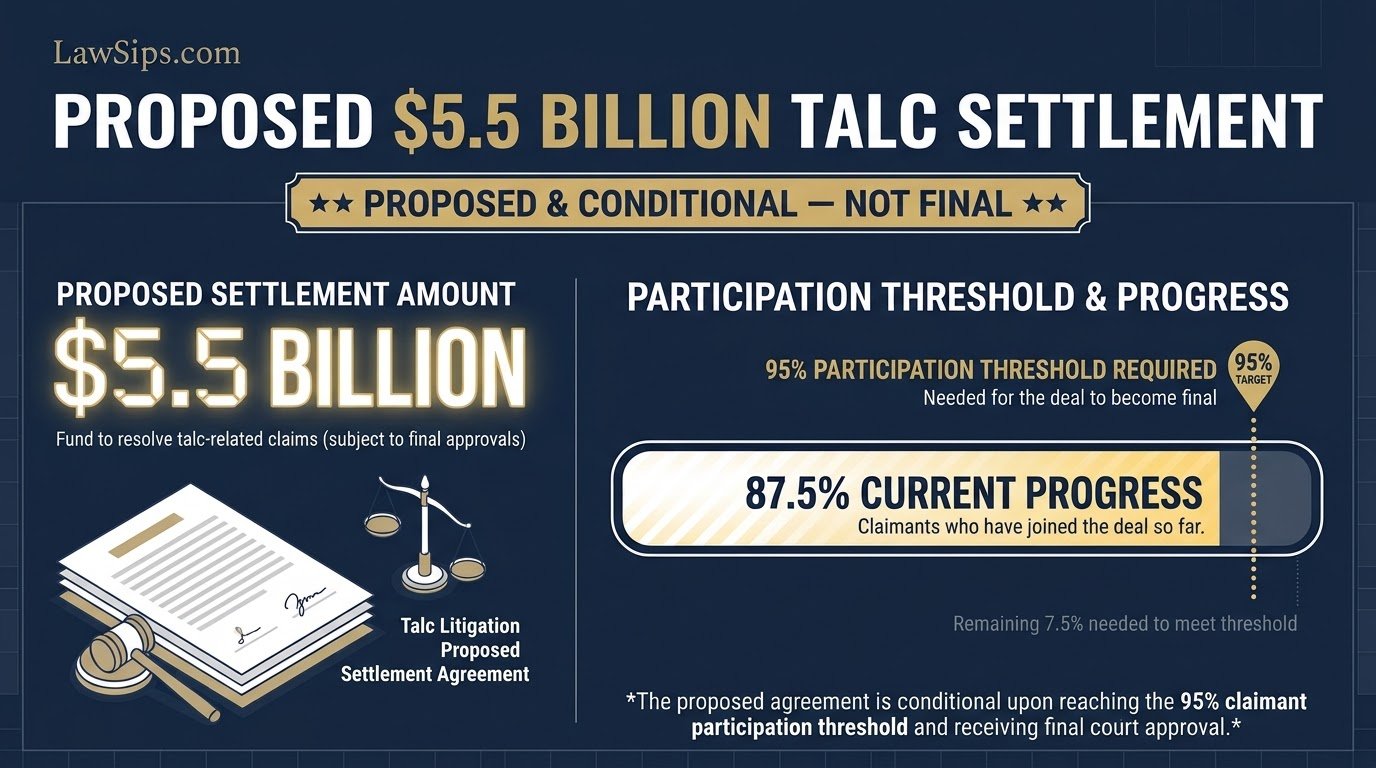
|
Track |
Cancer types |
Court home |
In the proposed deal |
How cases proceed |
|---|---|---|---|---|
|
Ovarian track |
Ovarian, fallopian tube, primary peritoneal |
Federal MDL 2738, New Jersey |
Yes, this is the deal’s subject |
Through the MDL and the participation count |
|
Mesothelioma track |
Mesothelioma, including peritoneal |
State courts, case by case |
No, expressly excluded |
Individual trials and individual settlements |
Read every talc headline by its track. The habit sounds small, and it prevents most of the confusion this litigation produces.
The MDL: Where the Ovarian Cases Live
The federal home is MDL No. 2738. Its full name covers the talcum powder products marketing, sales practices, and products liability litigation.
It sits in the District of New Jersey. Judge Michael A. Shipp presides over the consolidated cases in Trenton.
An MDL is a consolidation, not a verdict. Thousands of similar federal lawsuits share pretrial work before one judge while keeping their individual identities.
The pending count is a dated snapshot. The JPML report put 69,340 cases pending on October 1, 2026, the freshest primary count in the record checked.
Earlier snapshots differ, correctly. Readings near 67,623 in May 2026 and 68,435 in July 2026 appear in the coverage, each right for its own date.
A November firm reading says 69,376. The small differences are filing and dismissal movement, not errors to average away.
One firm counts over 90,000 filings. That figure covers all manufacturers and suppliers, not Johnson & Johnson alone, and it must never be read as the MDL count.
Mediation runs beside the docket. A mediator was appointed in 2025, with sessions reported underway through 2026.
One source names the mediator. LegalClarity reports Judge Shipp appointed Fouad Kurdi in March 2026 and required representatives with actual settlement authority.
The federal posture is clearest in one explainer. The LegalClarity talc settlement explainer covers it best, including the expert testimony ruling and the mediation appointment.
The MDL count will move again. Treat any talc number without a date as unusable, including numbers on pages that mean well.
State court ovarian cases run in parallel. Not every ovarian claim sits in New Jersey; some proceed in state courts, and the proposed deal counts those claims toward its 76,000.
That is why totals never match. One page counts the MDL, another counts the MDL plus state filings, and a third counts every talc suit ever filed against anyone.
Ask three questions of any count. Which court set, which date, and which defendants? A count that cannot answer all three is decoration.
The JPML publishes the MDL figure. Its pending actions reports are the primary source this page uses, quoted with their snapshot dates attached.
The Science Fight Has Two Floors
General causation asks a population question. Can genital talc use cause ovarian cancer, as a matter of science, in people generally?
Specific causation asks a personal question. Did talc use cause this claimant’s cancer, on her records, her exposure, and her differential diagnosis?
Confusing the floors is the field’s core error. A win on the general floor does not decide any individual case, and trouble on the specific floor does not erase the general record.
General Causation: The 658 Page Recommendation
A special master reviewed the experts. Retired Judge Freda Wolfson served as special master for the expert testimony fight in the MDL.
Her report runs 658 pages. Issued in January 2026, it recommends that plaintiffs’ experts be allowed to testify before juries.
Her finding was about methods. She found the experts used reliable methodologies and that the studies, taken as a whole, show a positive, statistically significant association.
A recommendation is not a ruling. Judge Shipp decides whether to adopt it, and Johnson & Johnson has said it will challenge the recommendation.
The company’s challenge names Rule 702. The December 2023 amendments tightened federal expert gatekeeping, requiring reliability shown by a preponderance of the evidence.
Both sides get experts either way. Wolfson’s report also leaves room for the company to present its own experts in rebuttal at trial.
Specific Causation: The Show Cause Order
The harder news came in July 2026. On July 22, the MDL court ordered plaintiffs to show cause on specific causation.
The order followed an expert withdrawal. Plaintiffs had withdrawn two lead causation experts rather than defend their method under the tightened standard, per legal analysis of the record.
The order’s question is narrow and serious. Why should claims not be dismissed for inability to prove specific causation?
Scope discipline matters here. The order concerns the ovarian MDL. It does not govern mesothelioma cases in state courts.
The two floors now point in different directions. General causation was recommended in while specific causation faces its hardest test, and honest coverage holds both facts at once.
For an individual claimant, the specific floor rules. Her case will be decided on her evidence, whatever happens to the general science debate.
The bellwether sits downstream of both floors. A federal test trial needs experts admitted on the general question and evidence assembled on the specific one.
Coverage expected it in late 2026. One firm page names the first case as Carter Judkins against the company; no firm trial date had been announced in the sources checked.
A bellwether verdict would move everything. It would test the expert rulings in front of a jury and reprice both the deal talks and the remaining docket.
Watch the adoption decision first. Judge Shipp’s ruling on the Wolfson recommendation is the nearest dated event on the science calendar.
The Science Record Beyond the Courtroom
The regulatory strand is dated 2024. The International Agency for Research on Cancer reclassified talc as Group 2A, a probable human carcinogen, in July 2024.
Case control studies point one way. Analyses report a 30 to 35 percent increased ovarian cancer risk among frequent users, a figure carried in legal analysis of the literature.
The largest pooled cohort points the other way. That analysis found no statistically significant association, and it is the strongest single counterweight in the record.
A 2024 oncology study found an association. Published in the Journal of Clinical Oncology, it drew on data from over 50,000 women, strongest among frequent and long term users.
A large JAMA analysis did not. Its pool of about 250,000 women found no statistically significant relationship, per the same coverage that reports the oncology study.
Print both, always. Any page that shows only the study favoring its own side is selling, not informing.
Why the studies disagree is itself instructive. Case control designs ask diagnosed women to recall past use, while cohort designs follow users forward, and each design carries its own bias profile.
Recall bias is the named weakness. Women with cancer may remember powder use differently from healthy controls, a methodological fight that runs through the expert reports.
Exposure measurement is the other weakness. Studies rarely know dose precisely, so frequency categories stand in for amounts nobody recorded decades ago.
The company position is categorical. Johnson & Johnson denies the products cause cancer, maintains its talc was asbestos free, and calls the claims meritless.
Plaintiffs allege knowledge. Firm pages allege internal documents show awareness of risk for over 40 years. That is an allegation in litigation, printed here as one.
The Bankruptcy Trilogy: Why a Direct Deal Exists
There was no direct deal for years. The company’s first strategy was to resolve the talc claims inside bankruptcy, through subsidiaries.
Attempt one was LTL Management. The subsidiary filed in 2021, and the case was dismissed after courts found it was not in genuine financial distress.
Attempt two was a refiling. LTL tried again in 2023, and that filing was dismissed as well, ending the Third Circuit chapter.
Attempt three changed the vehicle. Red River Talc filed a prepackaged plan in September 2024, in Houston, with claimant votes gathered in advance.
A bankruptcy judge refused it. Judge Christopher Lopez declined to confirm the plan on March 31, 2025, finding serious flaws including in how claimant votes were gathered.
The company chose not to appeal. That decision closed the bankruptcy road and pushed the litigation back into ordinary courts.
One plan carries three price tags. Sources value the Red River plan at about $9 billion, at $6.475 billion, and at about $8 billion in present value over 25 years.
All three are printed here as strands. They measure different things in different documents, and picking one silently is how wrong numbers are born.
The lesson is structural. Three courts said the bankruptcy machinery was not available for these claims, so the negotiation moved outside it, producing the July 2026 proposal.
Why the two step drew judicial skepticism is worth one paragraph. Courts asked whether a solvent parent could park claims in a subsidiary’s bankruptcy filed mainly to stop juries.
The answers came back no, repeatedly. The Third Circuit’s 2023 dismissal set the tone, and the Houston refusal applied it to a better funded plan.
Claimant votes were the last plan’s wound. The court found flaws in how support was gathered, which is why this deal’s participation count is watched so closely.
The direct deal inherits that sensitivity. Its 95 percent condition will be documented claimant by claimant, under a magistrate judge’s eye, precisely because the last count was disputed.
|
Attempt |
Vehicle |
Year |
Outcome |
|---|---|---|---|
|
First |
LTL Management |
2021 |
Dismissed; no genuine financial distress (Third Circuit, 2023) |
|
Second |
LTL Management refiling |
2023 |
Dismissed |
|
Third |
Red River Talc |
2024 |
Confirmation refused March 31, 2025; no appeal |
No bankruptcy stay is in effect. In 2026 the cases move in ordinary courts, which is why trials and a direct deal can advance at the same time.
Verdicts Are Not Prices
Juries have awarded enormous sums. The verdict record explains the settlement pressure on both sides better than any press release.
The durable verdict is Ingham. A Missouri jury’s award for 22 women ended as a $2.12 billion judgment, paid after appeals finished in 2021.
The cautionary verdict is Los Angeles 2025. A jury awarded $966 million in a mesothelioma case in October 2025, and one source reports it was later cut to about $16 million.
That cut is the lesson. A headline verdict is an opening position in a legal process, not a bank transfer.
Baltimore produced the largest single plaintiff award. In December 2025 a jury awarded roughly $1.5 billion to Cherie Craft, who developed peritoneal mesothelioma.
The detailed breakdown is more informative. One verdict table records $59.84 million compensatory, $1 billion punitive against Johnson & Johnson, and $500 million punitive against Pecos River Talc.
The company said it would appeal. The Baltimore figure is therefore a verdict under challenge, not money paid.
December 2025 was a heavy month. Minnesota returned $65.5 million in a mesothelioma case, and Los Angeles returned $40 million for two women with ovarian cancer.
Small verdicts exist too. A Philadelphia ovarian verdict of $250,000 in February 2026 appears in the same tables, flagged for verification by its own source.
|
Date |
Venue and type |
Headline figure |
Post verdict status |
|---|---|---|---|
|
2018, final 2021 |
Missouri, ovarian (Ingham, 22 women) |
$2.12 billion judgment |
Final; paid after appeals |
|
October 2025 |
Los Angeles, mesothelioma |
$966 million |
Later cut to about $16 million (one source) |
|
December 2025 |
Baltimore, mesothelioma (Craft) |
About $1.5 to 1.56 billion |
Appeal stated by the company |
|
December 2025 |
Minnesota, mesothelioma |
$65.5 million |
Appeal expected in coverage |
|
December 2025 |
Los Angeles, ovarian (two women) |
$40 million |
Firm reported strand |
|
February 2026 |
Philadelphia, ovarian |
$250,000 |
Flagged verify by its source |
Never price your claim from this table. Verdicts turn on individual evidence, venues, and appeals, and no two claims in this litigation are interchangeable.
Punitive damages explain the headline scale. Baltimore’s award was mostly punitive, money meant to punish conduct, and punitive components draw the hardest appellate scrutiny.
Compensatory damages are the quieter number. The $59.84 million compensatory part in Baltimore maps to one woman’s losses, which is why it survives differently on appeal.
Settlement pressure is the verdicts’ real product. Each large verdict raises the cost of refusing a global deal, for the company and for holdout strategies alike.
Per person figures have their own logic. Our class action lawsuit settlement amounts guide shows how they form in mass settlements, and why they cannot form before a deal exists.
Who May Qualify: General Information
This section is general information. It describes how the field screens claims; it is not legal advice and not a promise about any individual case.
The screening triangle has three sides. A covered diagnosis, a history of regular talc product use, and a claim filed inside the deadline.
Covered diagnoses are specific. Ovarian cancer, fallopian tube cancer, primary peritoneal cancer, and mesothelioma are the diagnoses firms screen for.
Product use means regular use. Firms describe Johnson’s Baby Powder and Shower to Shower used regularly, usually for several years, before the diagnosis.
Occupational exposure is also screened. Some firms review claims from people exposed to talc at work, a separate intake door from consumer use.
Estates can hold claims. Family members may pursue wrongful death or estate claims where a loved one died of a covered cancer after long term use.
The Sokolove Law talcum powder page publishes its screening openly, including the estate route and occupational exposure, which makes it useful field evidence.
Eligibility is finally a records question. Diagnosis documents and a credible use history decide more than any advertisement’s promise.
Intake criteria are published, unusually. At least one national firm prints its screening standards openly, including diagnosis lists and exposure types, which respects the reader.
Use those lists as a mirror, not a verdict. Meeting a firm’s published criteria means a case deserves review, not that any outcome is assured.
Prior claims and releases matter. Anyone who signed a release in an earlier individual settlement should expect that history to shape a new screening.
Two households, two postures. A claimant diagnosed this year and an estate holding a decade old diagnosis face different deadlines and different evidence problems.
Deadlines: The Trap That Ends Claims
Every state sets its own clock. Statutes of limitations for these claims often run two to three years, varying by state and claim type.
The clock usually starts at diagnosis or discovery. Many states count from when the illness was diagnosed or reasonably connected to talc, whichever the state’s rule uses.
A proposed settlement does not stop clocks. Until a deal is final and covers you, your own state’s deadline keeps running.
Deadlines end more claims than juries do. The field’s own guidance calls the limitations period the biggest trap in talc cases, and the record supports it.
Wrongful death clocks differ again. An estate claim may run on a different schedule from the claim the person held in life.
Check your date before anything else. Phase by phase, our how long does a settlement take guide walks through how settlement and claim timelines actually run.
Discovery rules can save a late claim. Where a state’s clock runs from reasonable connection rather than diagnosis alone, the date a claimant linked talc to her illness matters.
That doctrine cuts both ways. Publicity itself can start arguments that a claimant should have known earlier, which is another reason dated advice beats general reading.
Never calculate your own deadline from an article. State rules, tolling events, and prior filings interact, and a wrong self calculation is how viable claims quietly die.
And check what stage money is at. The difference between a verdict, a settlement in principle, and a payment in transit is exactly what settlement check status tracks.
The $700 Million That Is Not Claimant Money
One settlement in this story is final. In 2024 Johnson & Johnson agreed to pay $700 million to 42 states and the District of Columbia.
Its subject was marketing, not cancer compensation. The states alleged deceptive marketing about talc product safety, and the settlement resolved those government claims.
No individual claimant is paid from it. The money went to the states, and cancer claims were untouched by it.
Pages blur this constantly. A final $700 million government settlement gets quoted beside a proposed $5.5 billion claimant deal until readers think both are theirs.
Keep the two figures in separate boxes. One is closed and governmental; the other is open, conditional, and addressed to claimants.
The states’ case had a different theory. Attorneys general police consumer deception, so their settlement bought marketing changes and state funds, not individual recoveries.
A simple test separates them. Ask who receives the money. If the answer is a state treasury, the figure never belonged in a claimant’s planning.
What to Do Next, by Track
Start with your diagnosis. It decides your track, your court home, and whether the proposed deal concerns you at all.
Then gather the proof kit. The field’s standard list is short, and every item on it strengthens a screening conversation.
- #### Pathology and medical records first
Your **pathology report confirms the diagnosis. Medical records around it establish **dates, which the deadline analysis needs.
- #### Write the product use history
Products, frequency, and years. A plain written timeline of which powders, how often, and over what years is the second document firms ask for.
- #### Save physical evidence
Containers, receipts, and photos of products used are worth keeping. Old evidence is hard to recreate and easy to underestimate.
- #### Get the deadline checked
A firm handling talc cases can check your state’s clock against your dates. Consultations are free in this field, and cases are typically taken on contingency.
Ovarian track claimants watch the count. Your next milestones are the participation percentage and any dated statement that the condition has been met.
Mesothelioma track claimants ignore the count. Your case moves on its own state court schedule, untouched by the ovarian negotiation.
Compare sibling litigation carefully. The depo provera lawsuit shows how a different mass tort handles status, deadlines, and confidential terms, useful as a reading model only.
Whatever your track, distrust urgency. Real deadlines are state law dates, not countdown timers on intake pages.
Keep a personal status file. Diagnosis date, product timeline, firm correspondence, and every court notice in one folder makes each update actionable instead of alarming.
Expect this page’s facts to expire. Participation counts, bellwether dates, and rulings move monthly in an active negotiation, which is why each figure above carries its date.
Revisit after dated events. The adoption ruling, the next participation report, and the first bellwether are the three events that will rewrite the status box.
If your facts change, say so early. A new diagnosis detail or a missed earlier claim changes screening, and firms can only work with the record they are given.Johnson Johnson Talc Lawsuit: A Proposed Deal, Two Tracks, No Final Numbers
Frequently Asked Questions
1. What is the Johnson Johnson talc lawsuit about?
It is a mass litigation over talc based powders. Thousands of plaintiffs allege Johnson & Johnson talc products caused ovarian cancer or mesothelioma, and the company denies the products cause cancer.
2. Is the talc settlement final?
No, it is not final. The July 2026 proposal takes effect only if at least 95 percent of claimants participate, and October 2026 reporting put sign-on near 87.5 percent.
3. What is the proposed $5.5 billion talc settlement?
It is a proposed $5.5 billion resolution. Announced July 27, 2026, it would resolve ovarian cancer talc claims across the federal MDL and related state courts if its participation condition is met.
4. Why does the talc settlement need 95 percent participation?
Because the company wants near complete peace. Below 95 percent participation the deal does not take effect at all, so the threshold decides whether any claimant is paid under it.
5. What is the current participation level in the talc settlement?
About 87.5 percent, as of October 2026 reporting. Plaintiffs lawyers reported 313 firms representing roughly 66,500 claimants signed on, still thousands short of the 95 percent line.
6. What happens if the talc settlement does not reach 95 percent?
The deal does not take effect. Claims then continue in ordinary litigation, with trials proceeding in the MDL and in state courts, and no settlement payments under the proposal.
7. Does the talc settlement cover mesothelioma?
No, mesothelioma is expressly excluded. Mesothelioma cases are litigated individually, mainly in state courts, and Johnson & Johnson says it has already settled about 95 percent of filed mesothelioma suits.
8. When would talc settlement payments start?
In 2027 at the earliest, on the company’s framing. Up to $3 billion would be payable in 2027 if the deal takes effect, with the rest after 2028.
Nothing is payable while it stays proposed.
9. How much will each talc claimant receive?
Nobody knows, because no amounts are published. The proposal publishes no per claimant figures, tiers, or schedules, and any specific number offered today is an estimate, not a term of the deal.
10. Why have no per claimant talc amounts been published?
Because the deal has not taken effect. Per claimant values normally come from a claims matrix built after a settlement is final, and no public matrix exists for this proposal.
11. How many talc cases are pending in the MDL?
69,340 cases were pending on October 1, 2026. That is the JPML count for MDL 2738 in New Jersey.
Earlier 2026 readings were lower, and each count is only right for its own date.
12. What is MDL 2738?
MDL 2738 is the federal talc consolidation. It groups the ovarian and gynecologic talc cases in the District of New Jersey for shared pretrial work before Judge Michael A.
Shipp.
13. Who is Judge Michael Shipp in the talc litigation?
He presides over MDL 2738. Judge Michael A.
Shipp manages the consolidated federal talc cases, including the expert testimony fight, the mediation, and the proposed settlement’s progress reports.
14. What happened to Johnson and Johnson’s bankruptcy plans?
All three attempts failed. Subsidiaries LTL Management and Red River Talc sought bankruptcy resolutions, courts dismissed or refused them, and the last refusal came on March 31, 2025 with no appeal.
15. How many times did J&J try bankruptcy for talc claims?
Three times. LTL Management filed in 2021 and again in 2023, both dismissed, and Red River Talc’s prepackaged plan was refused confirmation in March 2025.
16. What was the Red River Talc plan?
It was the third bankruptcy vehicle. Red River Talc’s 2024 prepackaged plan would have resolved ovarian claims through bankruptcy, but Judge Christopher Lopez refused to confirm it in March 2025.
17. Why do sources give different values for the bankruptcy plan?
Because they measure different documents. Sources value the Red River plan at about $9 billion, at $6.475 billion, and at about $8 billion in present value.
This page prints all three as strands.
18. What did the special master’s 658 page report decide?
She recommended the experts be heard. Special Master Freda Wolfson’s 658 page January 2026 report found plaintiffs’ experts used reliable methods and recommended juries hear their general causation testimony.
Judge Shipp decides adoption.
19. Who is Freda Wolfson in the talc case?
She is the special master on expert testimony. Retired Judge Freda Wolfson was appointed to evaluate the talc experts and issued the 658 page recommendation in January 2026.
20. What is the difference between general and specific causation in the talc case?
They are different questions. General causation asks whether talc can cause ovarian cancer generally.
Specific causation asks whether it caused one claimant’s cancer on her own records and exposure.
21. What is the July 2026 show cause order on talc claims?
It puts individual proof in question. In July 2026 the MDL court ordered plaintiffs to show why claims should not be dismissed for inability to prove specific causation, after two lead experts were withdrawn.
22. What is a bellwether trial in the talc MDL?
A bellwether is a test trial. Early MDL cases are tried to real juries so both sides can value the wider docket.
The first federal talc bellwether was expected in late 2026.
23. When is the first federal talc bellwether trial?
No firm date has been announced. Coverage through 2026 expected the first federal bellwether in the second half of the year, with a firm page naming Carter Judkins as the lead case.
24. Is mediation happening in the talc litigation?
Yes, mediation is running. A mediator was appointed in 2025, one source names Fouad Kurdi from March 2026, and sessions with representatives holding settlement authority were reported underway.
25. Who may qualify to file a talc claim?
Generally, diagnosis plus use plus time. Firms screen for a covered cancer diagnosis, regular talc product use usually over several years before diagnosis, and a claim inside the state deadline.
26. Which cancers are covered by talc claims?
Four diagnoses are screened. Ovarian cancer, fallopian tube cancer, and primary peritoneal cancer sit in the MDL family, and mesothelioma is claimed on the separate state court track.
27. Can I file a talc claim for a loved one who died?
Yes, estates can hold these claims. Family members may pursue wrongful death or estate claims where a loved one died of a covered cancer after long term talc use, on their own deadlines.
28. Can I still file a talc claim in 2026?
Yes, firms are still accepting claims. New claims were being screened through 2026, but acceptance never overrides your state’s statute of limitations, so the deadline check comes first.
29. What is the statute of limitations for a talc claim?
It varies by state, often two to three years. Clocks usually run from diagnosis or from when the illness was reasonably connected to talc.
Your state’s exact rule decides your case.
30. What evidence do I need for a talc claim?
Start with the pathology report. Add your medical records, a written history of which products you used and when, and any containers, receipts, or photos you still have.
31. How do I prove I used talc products years ago?
A written history carries real weight. Firms ask for products, frequency, and years of use in your own words, supported by records, photos, or family recollection where documents are gone.
32. What was the $700 million talc settlement with the states?
It was a government marketing settlement. In 2024 the company agreed to pay $700 million to 42 states and DC over allegedly deceptive talc marketing claims.
33. Is the $700 million states settlement money for cancer claimants?
No, none of it is claimant money. The $700 million went to the states for their marketing claims.
It is separate from the proposed claimant deal and pays no individual cancer claim.
34. What are the biggest talc verdicts so far?
Ingham and Baltimore lead the list. Ingham ended at a $2.12 billion judgment paid in 2021, and Baltimore’s December 2025 mesothelioma award was roughly $1.5 billion, under a stated appeal.
35. Why do talc verdict amounts change after trial?
Because appeals and motions follow verdicts. Large awards are routinely challenged and can shrink drastically; one $966 million verdict was reported cut to about $16 million.
A verdict is not a payment.
36. What does Johnson and Johnson say about the talc claims?
The company denies causation. Johnson & Johnson says its talc was asbestos free, the products do not cause cancer, and the claims are meritless, while also reporting settlements on the mesothelioma track.
37. Has J&J settled mesothelioma cases?
Yes, by the company’s own account. Johnson & Johnson states it has already settled about 95 percent of filed mesothelioma lawsuits, which is why those cases are handled individually rather than in the MDL.
38. Where are talc mesothelioma cases heard?
In state courts, case by case. Talc mesothelioma suits are not part of MDL 2738.
They proceed in state courts where they were filed, including a Massachusetts trial opened in October 2026.
39. Is the talc lawsuit a class action?
No, it is a mass tort, not a class action. Each claimant holds an individual claim.
Federal ovarian cases are consolidated in an MDL for pretrial work, which is a different structure.
40. What is the difference between the talc MDL and a class action?
An MDL shares pretrial work only. Cases keep their own facts, evidence, and outcomes, unlike a class action where one result binds the class.
Settlements in an MDL still need individual participation.
41. Are talc claims being accepted by law firms now?
Yes, screening continues in 2026. Firms advertise free evaluations and contingency terms, but the honest first question is always whether your diagnosis, use history, and deadline fit.
42. What should I do first if I think I have a talc claim?
Check your deadline, then gather records. Confirm which track your diagnosis belongs to, get your state’s clock checked against your dates, and assemble the pathology report and use history.
Conclusion
The johnson johnson talc lawsuit now turns on a percentage, not a verdict. Watch the participation count, keep your own deadline alive, and let no headline spend money that has not been agreed.
Ovarian track claimants wait on the 95 percent line and on Judge Shipp’s adoption of the expert recommendation. Mesothelioma claimants follow their own state court cases, untouched by the count.
General information only. Nothing here values your claim or substitutes for advice on your dates and diagnosis. If the screening triangle fits, have a talc firm check your deadline before another month passes.

Dilawar is a dedicated writer and contributor at Lawsips.com, focusing on legal information, business law, consumer rights, legal awareness, and everyday legal matters. He is passionate about simplifying complex legal topics and providing readers with clear, practical, and easy-to-understand information. His goal is to help readers stay informed about legal developments, understand their rights, and make better decisions through informative and well-researched articles.