
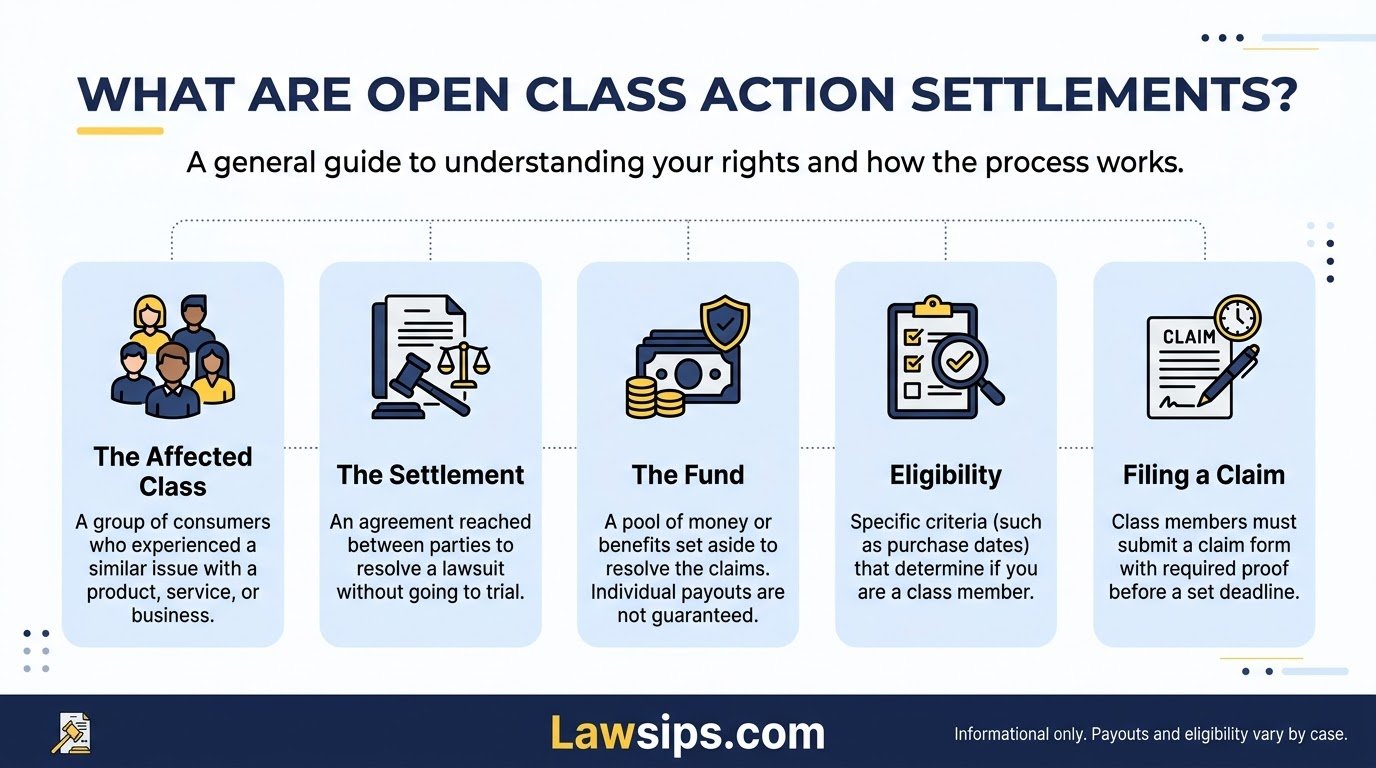

Open class action settlements are money already set aside for people like you. Companies have agreed to pay, courts have approved the process, and claim forms are open today.
Right now, settlements worth hundreds of millions are accepting claims. A pork price fixing settlement closes today, an Apple settlement pays up to $95 in December, and a renter settlement runs into January.
Most claims take about two minutes to file. Many need no receipt at all, just your honest statement that you fit the class definition.
Every settlement below is listed by deadline, with its payout, its proof rules, and who qualifies. Work down the list, file the ones that genuinely fit you, and keep your confirmations.
Quick Answer: The Open List at a Glance
Around fifteen notable settlements are open to US consumers right now. The nearest deadline is today, and the biggest per person payments sit in data breach and privacy cases.
| Question | Short answer |
|---|---|
| Nearest deadline | Pork price fixing, 29 October 2026 |
| Biggest fund open | Apple Intelligence settlement, $250 million per tracker listings |
| Highest per person ceiling | TransUnion estimate, $350 to $1,000 |
| Easiest claims | No proof settlements, statement only |
| Typical payment | $5 to $100 for most consumer cases |
| Cost to file | Always free on the official site |
One rule protects you throughout. Filing is always free, so any website charging you to file a claim is not legitimate.
Open Right Now: Settlements Sorted by Deadline
This is the master list for late October 2026. Amounts are the figures trackers published this week, and the official notice governs if any figure differs.
Read each row for three things. The deadline tells you your time left, the payout column shows the realistic shape, and proof tells you the effort involved.
| Settlement | Deadline | Payout (as listed) | Proof needed |
|---|---|---|---|
| Pork price fixing | 29 Oct 2026 | Pro rata share of $117 million | No receipts for most filers |
| Bestway above ground pools | 30 Oct 2026 | $40 flat | No receipt; proof unlocks more |
| TransUnion bankruptcy remarks | 30 Oct 2026 | Estimated $350 to $1,000 | Claim form required |
| Levoit air purifier | 3 Nov 2026 | Up to $10 | Per official notice |
| Forbes website tracking | 9 Nov 2026 | Varies | No proof per listings |
| CVS digital privacy | 16 Nov 2026 | $5 to $10 | No proof |
| Teleflora spam texts | 17 Nov 2026 | Varies | Per official notice |
| LSC laboratory data breach | 24 Nov 2026 | Up to several hundred | Tiered, some documented |
| Neutrogena Skin360 BIPA | 25 Nov 2026 | Pro rata share of $4.7 million | Sworn statement |
| Dr. Squatch natural labelling | 27 Nov 2026 | Up to about $12 | Statement for first products |
| Equifax hard inquiry | 29 Nov 2026 | Varies | Per official notice |
| Apple Intelligence | 21 Dec 2026 | $25 per phone, up to $95 | Serial number or Apple email |
| GoodRx privacy | 29 Dec 2026 | Up to $40 | No proof |
| RealPage rent pricing | 29 Jan 2027 | Pro rata share | Per official notice |
| Visa Mastercard ATM surcharges | 10 Feb 2027 | Estimated up to $60 | No proof |
Do not skim past the small funds. A $10 claim you file beats a $95 claim you miss, and several rows below take under two minutes.
Closing This Week: Do Not Miss These
Three settlements close within about 48 hours of the check date. If any of them fits you, file it before you read another word.
1. Pork price fixing: closes 29 October 2026
Grocery shoppers in 24 states can claim from a $117 million fund. The case covers raw pork and bacon bought between 2014 and 2018 at ordinary grocery stores.
Most filers need no receipts. You state your purchases honestly on the claim form, and the fund divides among valid claims.
2. Bestway above ground pools: closes 30 October 2026
Owners of Bestway pools 48 inches or taller, sold between 2008 and 2024, can claim $40 with no receipt and no claim ID.
Proof of purchase unlocks 10 percent of the price paid instead. If you still have the receipt or a retailer account record, the proof route pays more.
3. TransUnion bankruptcy remarks: closes 30 October 2026
This settlement covers people with a bankruptcy remark issue on a TransUnion credit report. Trackers estimate payments between $350 and $1,000 per valid claimant.
Higher estimates reflect stronger per person claims in credit reporting cases. File the claim form before the deadline and keep the confirmation email.
No Proof of Purchase: The Easiest Claims Open Now
No proof settlements accept a sworn statement instead of receipts. You declare, under penalty of perjury, that you bought the product or used the service during the class period.
Courts allow this for a practical reason. Nobody keeps a four year old grocery receipt, and judges avoid proof rules that make claiming impossible for ordinary people.
| No proof settlement | Deadline | What you state |
|---|---|---|
| Pork price fixing | 29 Oct 2026 | Pork or bacon purchases, 2014 to 2018 |
| Bestway pools | 30 Oct 2026 | Pool brand, size, and model details |
| CVS digital privacy | 16 Nov 2026 | You used the CVS site or app in the period |
| Dr. Squatch | 27 Nov 2026 | Products bought, first ones need statement only |
| Skin360 BIPA | 25 Nov 2026 | You completed a Skin360 assessment in Illinois |
| GoodRx privacy | 29 Dec 2026 | You used GoodRx in the class period |
| Apple Intelligence | 21 Dec 2026 | Serial number or Apple Account email instead |
No proof does not mean no checks. Administrators audit claims for duplicates and record mismatches, and knowingly false claims are perjury and fraud.
Only file where you genuinely fit the class. Honest mistakes get denied quietly, but invented claims can bring real legal trouble for a few dollars.
Early November: Three Quick Closers
November opens with three fast deadlines that reward a five minute check. None of them needs a lawyer, and each fits a different slice of ordinary life.
Levoit air purifier: closes 3 November 2026
Buyers of certain Levoit air purifiers can claim up to $10 from a $15 million false advertising settlement. The case challenged performance claims made for the units.
Check your model number against the official notice before filing. Appliance settlements define eligible models precisely, and one digit can decide the claim.
Forbes website tracking: closes 9 November 2026
This settlement covers website tracking claims involving Forbes visitors. Trackers list it among November’s no proof claims, with payout varying by claims filed.
Website cases rarely ask for documents. Your statement that you visited during the class period is normally the whole evidentiary ask.
Teleflora spam texts: closes 17 November 2026
A $6 million settlement covers unwanted marketing texts from Teleflora. If their messages reached your phone in the class period, the claim form takes minutes.
Text message cases sit under TCPA rules, which is why funds form quickly. Keep any message records your phone still holds.
Workplace and Investor Settlements Open Now

Consumer products dominate the headlines, but workers and investors hold some of this season’s strongest claims. Two November and December examples show the range.
WellNow Urgent Care wages: closes 25 November 2026
Hourly WellNow Urgent Care staff with direct patient care duties can claim from a $1.64 million wage settlement. Licensed practical nurses, X ray technicians, and medical assistants headline the class.
No pay records are needed to file. Employer payroll data does the identifying work in most wage settlements like this one.
NYC taxi licence suspensions: closes 28 December 2026
New York drivers affected by TLC licence suspensions can claim from a fund trackers list at $140 million. Per person payments are listed around $200.
City specific cases like this one reward local readers. National lists bury them, so state and city filtering matters when you scan.
Securities settlements: the quiet category
Investor cases, including a $10 million Hertz EV securities settlement opened this month, pay from trading losses rather than purchases. Claim forms ask for transaction records instead of receipts.
If you held the named stock in the class window, check the notice. Brokers’ statements usually supply everything the form requires.
The November Wave: Privacy, Products, and Data Breaches
November carries the densest deadline cluster of the season. Privacy and data breach cases dominate, which is why the per person ceilings rise this month.
CVS digital privacy: closes 16 November 2026
You may be included if you accessed the CVS website or app before 27 July 2026. The $20.5 million settlement pays a modest $5 to $10, with no proof required.
Small payments reflect huge class sizes. Millions of website visitors share the fund, so pro rata division shrinks each share.
LSC laboratory data breach: closes 24 November 2026
This healthcare breach settlement offers tiered payments. A flat option needs little documentation, while documented out of pocket losses can reach several hundred dollars.
Trackers disagreed on the exact ceiling for this one. Trust only the figure printed on the official settlement notice, and choose your tier from its text.
Neutrogena Skin360 BIPA: closes 25 November 2026
Illinois users who completed a Skin360 skin assessment through the app or website can claim from a $4.7 million fund. A sworn statement is enough, and the claim ID is optional.
Illinois biometric law, called BIPA, allows strong per person damages. That is why Illinois biometric settlements often pay several hundred dollars while national ones pay ten.
Dr. Squatch natural labelling: closes 27 November 2026
Buyers of certain Dr. Squatch products between November 2018 and August 2026 can claim from a $9 million fund. The case challenged “natural” labelling claims.
Payment runs about 50 cents per product, up to roughly $12 without receipts. Your signed statement covers the first products, and receipts unlock more units.
Equifax hard inquiry: closes 29 November 2026
This $30 million settlement covers hard inquiry issues on credit reports. Check the official notice for the class definition before filing, because credit cases define eligibility narrowly.
Keep any credit report copies you hold. Documented tiers in credit and breach cases reward people who can show real records.
December and 2027: The Big Fund Closers
The largest funds close latest, which tempts people to wait. File these early anyway, because forms, outages, and life all conspire near deadlines.
Apple Intelligence settlement: closes 21 December 2026
Buyers of seven eligible iPhone models in the US, between June 2024 and March 2025, can claim $25 per phone, up to $95. Trackers list the fund at $250 million.
The case challenged advertised Siri intelligence features that did not arrive as promoted. No receipt and no claim ID are needed, just the phone’s serial number or your Apple Account email.
GoodRx privacy settlement: closes 29 December 2026
GoodRx and Criteo agreed to a $32 million privacy settlement, paying up to $40 per claimant with no proof. File at the official GoodRx privacy settlement website before the deadline.
This case also shows the full machinery clearly. Claims, opt outs, and objections all close 29 December 2026, and the final approval hearing sits on 11 February 2027 in Oakland.
One detail matters for early filers. Claims submitted during a mid October testing window were rejected, so anyone who filed then must file again properly.
RealPage rent pricing: closes 29 January 2027
Renters are the class here. The case challenged algorithmic rent pricing software used by large landlords, and the settlement closes at the end of January 2027.
If you rented from a large property manager in recent years, read the class definition closely. Per person amounts depend on how many renters file valid claims.
Visa and Mastercard ATM surcharges: closes 10 February 2027
This $167.5 million settlement covers surcharges at non bank ATMs, the machines in convenience stores, bars, and gas stations. Trackers estimate up to about $60 per claimant, with no proof needed.
Keep expectations pro rata honest. A fund this size with a class this broad usually lands well below its ceiling per person.
When Proof Is Required: What Actually Counts
Some settlements ask for evidence, especially documented loss tiers in data breach cases. The good news is that proof is usually already sitting in your accounts.
| Proof type | Where you find it |
|---|---|
| Retailer order history | Your Amazon, Walmart, or store account orders page |
| Email receipts | Search your inbox for the brand name |
| Bank or card statements | Statements covering the purchase month |
| Product serial or model numbers | The label on the item itself |
| Employer or broker records | Pay portals and brokerage statements |
Screenshots count in most claim processes when originals are gone. Capture the order line, the date, and the amount in one image before uploading.
Never manufacture proof you do not have. If the evidence does not exist, take the statement tier honestly instead of inventing a record.
Data breach documented tiers ask for loss records: bank letters about fraud, credit monitoring bills, or time spent resolving identity issues. Gather them before opening the form, because sessions time out.
File Early: The Deadline Week Trap
Settlement websites strain near deadlines. The famous Red Bull claims site buckled under traffic in 2014, and administrators still warn about testing windows and rejected early filings today.
Filing early also protects against ordinary life. A deadline that falls on a busy workday, a holiday, or a family emergency quietly passes thousands of people every month.
Set your personal deadline seven days before the printed one. If the site fails or a form confuses you, a full week remains to fix it calmly.
How to Claim in Five Steps
Every legitimate claim follows the same five steps. Our full walkthrough on how to file a claim for settlement money expands each one with screenshots and examples.
Step 1: Check you fit the class definition
Every settlement defines its class with dates, places, and products. Read that definition first, because filing outside it wastes your time and risks a denied claim.
Step 2: Go to the official settlement website only
The court approved notice names one official website per settlement. Type its address yourself instead of clicking links in emails or social posts, exactly as the Federal Trade Commission’s consumer guidance advises for avoiding scams.
Step 3: Complete the claim form honestly
Enter the details the form asks for: name, address, and the purchase or use statement. If a claim ID arrived by mail or email, use it, because it can pre fill your record.
Step 4: Choose your payment method and tier
Pick check, PayPal, or Venmo where offered. Where a documented loss tier exists, compare it honestly with the flat option before choosing.
Step 5: Submit before the deadline and keep proof
Save the confirmation number or screenshot somewhere safe. If the form arrives incomplete, some settlements give you a cure window, often about 20 days, to fix it.
New to class actions entirely? Start with our plain English guide on how to join a class action lawsuit before your first filing.
What Happens After You File: The Road to Payment

Filing is the start, not the finish. Your claim then travels a fixed legal road, and knowing the stages explains every delay people complain about.
| Stage | What happens | Typical time |
|---|---|---|
| Claim validation | Administrator audits claims for duplicates and mismatches | 1 to 3 months |
| Final approval hearing | A judge decides the settlement is fair | 2 to 4 months after deadline |
| Appeal window | Objectors can appeal, about 30 days | 1 month, or years if appealed |
| Effective date | The settlement becomes final and binding | After appeals resolve |
| Distribution | Payments issued, often within 45 days of the effective date | Weeks |
In total, most people wait 6 to 18 months between deadline and payment. The GoodRx case models it: deadline 29 December 2026, hearing 11 February 2027, payment after the effective date.
An appeal can freeze everything for a year or more. That is frustrating, but it is also the court system protecting class members from a bad deal.
How Much Will You Actually Get? Honest Ranges
Listed maximums are ceilings, not averages. The fund is fixed, the class is large, and simple division decides your share.
| Case type | Typical per person range |
|---|---|
| Website privacy and tracking | $5 to $40 |
| Product and false advertising | $5 to $50, often per unit |
| Grocery and antitrust | Small pro rata shares |
| Data breach, flat tier | $25 to $100 |
| Data breach, documented losses | Up to several hundred or more |
| Illinois biometric (BIPA) | Often several hundred |
| Credit reporting | Sometimes $350 plus, per estimates |
Our breakdown of the settlement payout per person explains the maths behind these ranges, including why famous cases paid less than headlines promised.
The formula never changes. More valid claims mean smaller payments, because the same fund stretches across more people.
Treat settlements as found money, not income. Five honest claims a year returning $10 to $60 each is a realistic habit, and a pleasant one.
Claim, Opt Out, or Object: Your Three Legal Doors
Every class member faces the same three choices before the deadline. Picking the wrong door is the most expensive mistake in this system.
| Option | What you get | What you give up |
|---|---|---|
| File a claim | Your share of the settlement | The right to sue separately over the same conduct |
| Opt out | Nothing from this settlement | Nothing; you keep your own right to sue |
| Object | Your claim stays, and the court hears your concern | Time; objections need writing and deadlines |
Claiming suits almost everyone in consumer cases. Your individual loss is usually small, and the settlement is the only realistic recovery.
Opting out makes sense only with a large, documented individual claim you truly intend to pursue. Objecting suits people who support compensation but believe the deal itself is unfair.
Settlement Types You Will See Again and Again
Understanding the recurring categories helps you spot your own eligibility fast. The same fact patterns return with new company names every month.
| Type | The usual story | Typical proof |
|---|---|---|
| Data breach | A company exposed personal information | Notice letter, or statement; documented tier needs records |
| Privacy and tracking | Websites or apps shared data with trackers | Statement about use in the period |
| False advertising | Labels or ads overstated the product | Statement; receipts raise the cap |
| Antitrust | Competitors fixed prices together | Statement about purchases |
| Wage and hour | Workers missed overtime or breaks | Employer records often identify you |
| Biometric | Face or fingerprint data taken without proper consent | Statement; Illinois cases pay most |
Beauty and personal care buyers meet the false advertising type often. Our earlier explainer of the Red Bull wings lawsuit shows how a marketing claim becomes a $13 million lesson.
Stay Safe: Fake Settlement Sites and Claim Scams

Popular settlements attract impostor websites within days. Protect yourself with four habits that take seconds.
- Type the official address yourself. Never reach a claim form through an email, text, or social media link, however official it looks.
- Never pay to file. Legitimate settlements charge nothing: no filing fee, no processing fee, no claim help fee.
- Guard your data. Official forms never ask for full bank logins or card numbers; payment choices are limited and specific.
- Cross check the case. A real settlement appears in court records searchable through PACER, on major trackers, and in news coverage at the same time.
Suspicious consumer contacts can also be checked against USA.gov’s consumer resources before you act. When in doubt, close the tab and start again from the official address.
One more warning sign: urgency invented by the sender. Real deadlines are court ordered and published; scammers manufacture panic to stop you checking.
Just Closed: Settlements Whose Deadlines Just Passed
Arriving a few days late is the most common story in this niche. These major settlements closed within the last month, and their claim windows are over.
| Just closed settlement | Closed | What happens next |
|---|---|---|
| NAR homebuyer settlement | 27 Oct 2026 | Validation, then approval steps |
| Flo period tracker privacy | 15 Oct 2026 | Claims under review |
| NYC Central Booking | 19 Oct 2026 | Distribution planning |
Missed one of these? The money is gone for this round, and anyone promising to reopen a closed claim for a fee is running a scam.
The lesson is rhythm, not regret. Check the open list monthly, the way you check a mailbox, and the next window will not pass you by.
How to Find Settlements You Genuinely Qualify For
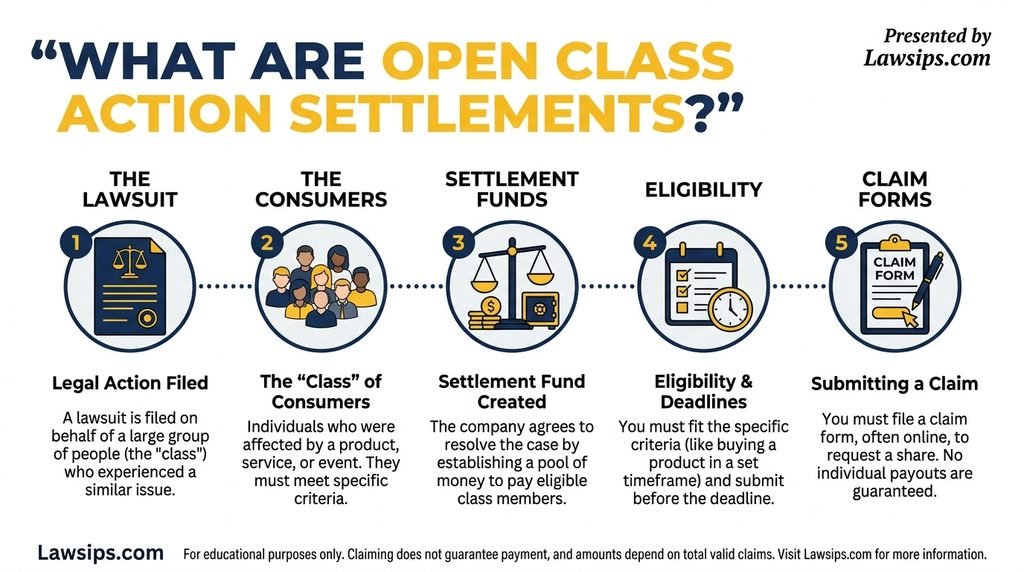
Work backwards from your own life instead of reading lists forwards. Four questions surface most of your real eligibility in minutes.
- Where have you lived? State specific cases, especially Illinois biometric and California privacy settlements, turn on your address during the class period.
- What do you buy monthly? Groceries, personal care, apps, and subscriptions generate the most consumer settlements.
- Which companies hold your data? Hospitals, labs, banks, and apps you used are your data breach exposure.
- Who employed you? Wage and hour settlements often identify workers from payroll records, and some pay automatically.
Our companion list of class action settlements you can claim applies the same method to individual cases as they open.
Automatic payments deserve a mention. Where company records already identify class members, some settlements pay without any form, so a surprise check is occasionally real.
Verify any surprise check before depositing. The administrator’s official site will confirm the case, the amount logic, and the payment schedule.
Famous Closed Settlements: A Reality Check on Payouts
History calibrates expectations better than any ceiling figure. Three famous cases show what headline funds became in real envelopes.
The Red Bull settlement paid $10 cash or $15 in products, and a second small round followed after the first distribution. Nobody’s life changed, and that was a $13 million fund.
Facebook’s $725 million privacy settlement divided across hundreds of millions of users. Per person payments landed in the tens of dollars, not the hundreds early posts promised.
The pattern holds everywhere. Fund size impresses; division decides. Read our wider guide to class action lawsuit settlements for more case histories and what they paid.
Mistakes That Cost Claimants Money
Most lost money in this system is self inflicted. Avoid the five errors administrators and trackers report most.
- Missing the deadline by trusting memory instead of a calendar reminder.
- Filing on a fake site reached through an email link, then wondering why nothing arrives.
- Ignoring a cure notice about an incomplete form, which quietly converts your claim into a rejection.
- Throwing away the confirmation, leaving no way to prove or query your filing.
- Choosing the documented tier without documents, when the flat payment was the honest fit.
One habit prevents most of these. File the week you learn about a settlement, not the week it closes, and save the confirmation in the same minute.
Why So Many Settlements Cluster in Autumn
Deadline waves are not random. Courts approve settlements in batches, notices run for fixed periods, and administrators schedule closings across the working calendar.
Autumn also follows the summer approval season. Cases approved in June and July carry ninety to one hundred twenty day claim windows, which land in October and November.
For readers, the lesson is seasonal awareness. The richest claiming months of the year are usually October through December, which is exactly when this list runs longest.
Our running page for the class action settlement 2026 season tracks how the year’s biggest funds have moved from filing to payment.
Settlements vs Other Unclaimed Money
Settlement money is only one stream of cash owed to ordinary people. Knowing the neighbours helps you search each stream in the right place.
| Money type | Where it lives | How you claim |
|---|---|---|
| Class action settlements | Administrator websites | Claim form before a deadline |
| State unclaimed property | State treasurer databases | Identity verification, no deadline pressure |
| Government refunds | Agency programmes, like FTC refunds | Agency process per programme |
| Forgotten accounts and pensions | Federal and state registries | Registry search and proof of identity |
The open class action lawsuits list on our companion page, open class action lawsuits, tracks cases still moving toward settlement, one stage earlier than this page.
Start with deadlines, not databases. Settlement windows close forever, while unclaimed property waits patiently for years.
How Settlement Notices Reach You (and Why You Miss Them)
Most class members first hear about a settlement through a postcard or email they almost throw away. Notices look like junk mail because courts require plain, cheap formats.
Companies also hold your old contact details. If you moved or changed email since the class period, the notice went to the wrong place, and the deadline still counts.
That is why checking lists like this one matters. The legal system notifies imperfectly, and the money does not wait for the notice to find you.
Reading a Settlement Notice Like a Pro
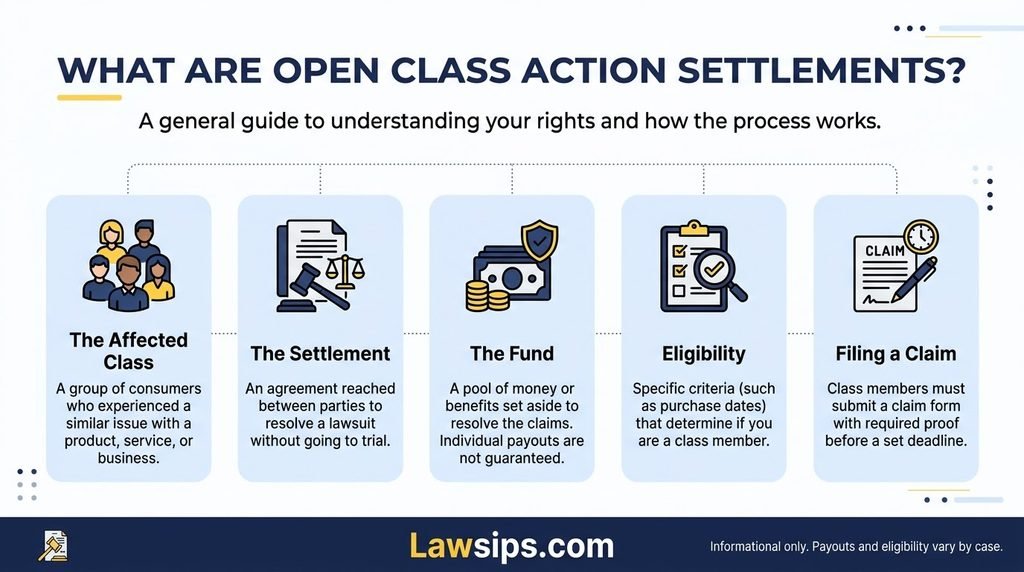
Five lines of any notice carry almost all the value. Find them before reading anything else, and you will understand the case in two minutes.
- The class definition: who is in, in one sentence.
- The claim deadline: the date everything turns on.
- The payment terms: flat, per unit, documented, or pro rata.
- The proof rules: statement only, or records required.
- The official website: the only address you should ever use.
Skilled readers also note the fairness hearing date. It tells you the earliest realistic payment season, months before any cheque exists.
A Two Minute Monthly Routine That Catches Your Money
Consistency beats intensity in this system. A tiny monthly habit outperforms one frantic annual search, because deadlines expire every single week.
- Minute one: scan the master list above for your states, your brands, and your apps.
- Minute two: file anything that fits, and save each confirmation in one folder.
Set the check for the same day each month, beside a bill or a payday. Twelve checks a year means no window closes on you unnoticed again.
Key Takeaways
- Fifteen notable settlements are open now, with deadlines from today through February 2027.
- The nearest deadlines are pork price fixing today, then Bestway pools and TransUnion tomorrow.
- No proof claims need only an honest sworn statement, and filing is always free.
- Realistic payments run $5 to $100 for most people; ceilings are not averages.
- Payment takes months: validation, a fairness hearing, an appeal window, then distribution.
- Fake sites are the main risk, so type official addresses yourself and never pay to file.
Frequently Asked Questions
What class action settlements are open right now?
About fifteen notable settlements were open at the 29 October 2026 check. Deadlines run from the pork settlement today through the ATM surcharge settlement in February 2027.
How do I claim a class action settlement?
Confirm you fit the class definition, visit the official settlement website, and complete the claim form before the deadline. Save your confirmation number afterwards.
Is it free to file a claim?
Yes, always. Legitimate settlements charge no fee at any stage, and any website asking for a filing or processing fee is a scam.
What does no proof of purchase mean?
The settlement accepts your sworn statement instead of receipts, usually up to a set number of units. Administrators still audit claims for duplicates and mismatches.
Are no proof settlements legit?
Yes, they are court approved settlements designed for purchases nobody receipts. What is never legit is a third party charging you to file one.
Do I need a claim ID to file?
Usually not. Most forms offer an I don’t have a claim ID route using the email, phone number, or account details the company holds.
How much money will I actually get?
Most consumer settlements pay $5 to $100. Privacy, credit, and Illinois biometric cases pay more, and documented loss tiers pay most of all.
What does pro rata mean for my payment?
The fixed fund divides among all valid claims. More claimants means a smaller share each, which is why ceilings rarely match cheques.
How long until I get paid after filing?
Typically 6 to 18 months after the deadline. Validation, the final approval hearing, and the appeal window must all finish first.
What is a final approval hearing?
A judge reviews the settlement’s fairness at a public hearing. In the GoodRx case it sits on 11 February 2027, weeks after its December deadline.
What happens if I miss the deadline?
You forfeit the payment and usually stay bound by the settlement’s release. Late claims are rejected automatically, whatever the reason.
Can I claim more than one settlement?
Yes, as many as you genuinely qualify for. Each settlement has its own form, class definition, and deadline.
What if I file a claim I do not qualify for?
Claims are signed under penalty of perjury. Honest mistakes are simply denied, while knowingly false claims count as fraud.
How do I know a settlement website is official?
It is named in the court approved notice and matches across trackers and news coverage. Type the address yourself rather than trusting email links.
Why do some settlements pay automatically?
Where company records identify class members, the settlement can pay without a form. The notice explains whether your case works this way.
Should I opt out instead of claiming?
Only with a large, documented individual claim you truly plan to pursue. For typical small consumer losses, claiming is the practical door.
What are documented loss claims?
Higher tiers that repay proven out of pocket losses, common in data breach cases. They need receipts or records, unlike flat payment options.
Why was my claim rejected?
Common reasons are duplicates, record mismatches, or an incomplete form whose cure notice went unanswered. Administrators publish contact routes for queries.
What happens to money nobody claims?
Terms decide: a second distribution to claimants, or court ordered cy pres awards to related charities. It does not return to the defendant by default in most structures.
Are settlement payments taxable?
It depends on what the payment compensates, and rules vary by case type. Keep your records and treat any general answer, including this one, as information only.
Can I claim if I moved to another state?
Usually yes. Eligibility turns on where you lived or bought during the class period, and the form collects your current address for payment.
Why did the Apple settlement ask for a serial number?
It verifies an eligible phone without receipts. The serial number or Apple Account email replaces the proof of purchase step.
What settlements just closed that I may have missed?
The NAR homebuyer settlement closed 27 October 2026, and the Flo tracker privacy settlement closed mid October. Their claim windows are over.
How often should I check for new settlements?
Monthly suits most people, and weekly during the autumn deadline season. New settlements open constantly, and each one you fit is money with an expiry date.
Conclusion
Open class action settlements reward a simple, honest habit: check the list monthly, file early on official websites, and expect modest money rather than miracles.
Start with today’s deadline if the pork settlement fits you, then work through the November privacy wave and the December Apple and GoodRx closings at your own pace.
Bookmark this page and return monthly, because open class action settlements refresh constantly. Every deadline you catch is money that would otherwise vanish.
For cases still moving toward settlement, follow the LawSips homepage. It carries the newest filings, deadline changes, and plain English guides.

Dilawar Mughal is an SEO expert with 8 years of hands-on experience helping websites grow their organic traffic, rankings, and revenue. He specializes in content-driven SEO, local SEO, and Pinterest SEO, and builds practical, results-focused strategies for businesses and publishers.