How to Write a Will: Validity First, Then Decisions, Then Drafting

How to write a will that a court will accept starts before drafting, not with a template. Wills fail quietly: never executed validly, or governing the wrong assets entirely.
So the order here is different. Validity gate first, then a control gate, then six decisions, then drafting, signing, and storage, each step carrying its state flags.
LawSips publishes plain English legal explainers. This page is general information only, not legal advice; LawSips is not a law firm, and nothing here guarantees any individual will is valid.
Rules that change by state are flagged STATE-DEPENDENT where they appear. Prices and survey figures print as dated, named strands, never averaged.
The Short Answer: What Makes a Will Count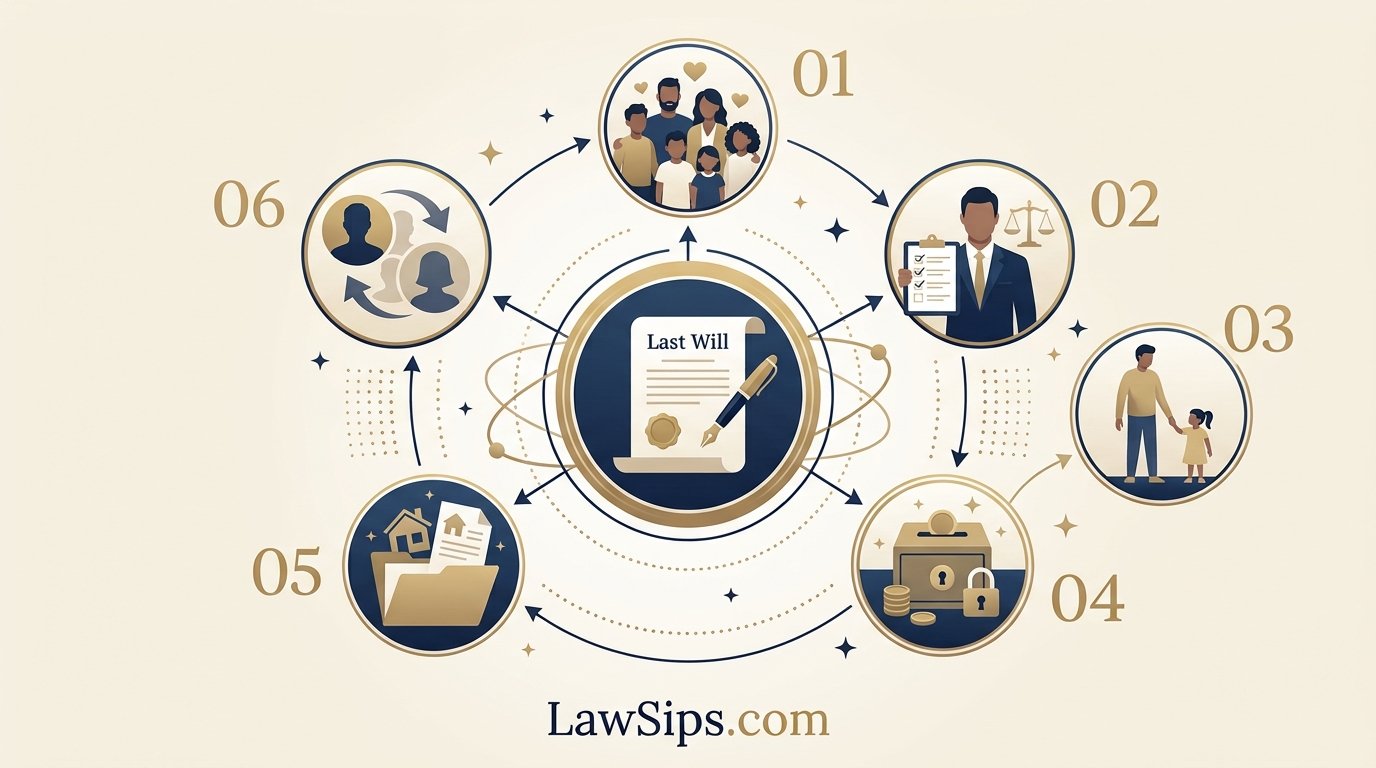
A will counts when four basics align: an adult maker with testamentary capacity, a document in writing stating it is a will, the maker’s signature, and witnesses as the state requires.
Everything beyond that core varies by state, from signature placement to electronic signing. The LegalClarity step by step guide to writing a will builds outward from the same small core.
Gate 1: Validity, Can Your Will Count in Your State?
Gate 1 asks one question before drafting: could a document you sign count at all where you live? Drafting errors are fixable. Execution errors usually are not.
Capacity: the three part test in plain English
Testamentary capacity means understanding three things: what property you own, who your natural heirs are, and that signing directs your property at death. The bar is lower than most expect.
You must be an adult, 18 in most states, with STATE-DEPENDENT edges. Where capacity might be questioned, the AARP guide to writing a will relays a useful habit: keep a doctor’s capacity note with the will.
In writing, signed, and signed at the end
A standard will must be in writing and signed by the maker. Signing at the end is the safe practice everywhere, though exact placement rules are STATE-DEPENDENT and some states are stricter.
If you cannot sign, most states allow another person to sign for you at your direction, in your conscious presence. Every other formality still applies, so treat directed signing as a documented exception.
Witnesses: the two witness standard and its state edges
The standard is two witnesses who watch you sign, then sign in your presence. Edges are STATE-DEPENDENT: some states allow or require three witnesses in specific situations, Vermont being the classic example.
Choose disinterested witnesses, adults inheriting nothing under the will. The Uniform Probate Code tolerates an interested witness, but many states void or scrutinize that witness’s gift, so the risk is never worth taking.
The National Council on Aging guide to making a will without a lawyer covers the same signing basics for the DIY route. Its message matches this gate: the ceremony is the validity.
Notarization: not required, with one Louisiana exception
For a standard attested will, notarization is not a validity requirement in most states. Signature plus witnesses do that work; a notary neither fixes a missing witness nor harms a proper document.
The exception is Louisiana. Its notarial testament, under Civil Code Article 1577, requires a notary plus witnesses, so mainstream templates and tools deserve real caution in that one state.
A notary appears in one optional place: the self-proving affidavit covered next. That notarized statement speeds probate later. It is not part of validity, and confusing the two is a common error.
The self-proving affidavit and the four exception jurisdictions
A self-proving affidavit is a sworn statement by you and your witnesses, signed at the same ceremony, confirming proper execution. At probate, the court may skip locating the witnesses, saving months.
It is optional where it exists, and it does not exist everywhere. Named exceptions: the District of Columbia, Maryland, Ohio, and Vermont, all STATE-DEPENDENT detail to check before relying on the shortcut.
The LegalClarity guide to writing a valid will on your own walks through these execution choices. Where your state allows the affidavit, sign it at the same sitting as the will.
Paper, electronic, or remote witnessed: the 2026 execution fork
Execution now has three routes, and which exist for you is entirely STATE-DEPENDENT. Paper with in-person witnesses works everywhere; the other routes exist only where a statute switched them on.
|
Route |
How it works |
Availability, as strands |
|---|---|---|
|
Paper will |
Print, sign, witnesses in the room |
Valid route in every state |
|
Electronic will |
Signed and stored as an electronic record under an e-will statute |
14 states (Aug 2026) vs 15 plus DC (Oct 2026) vs 16 jurisdictions (Oct 20, 2026 audit) |
|
Remote witnessing |
Witnesses attend by video under strict conditions |
About 20 jurisdictions, conditions vary |
The counts conflict because sources count different things on different dates, so they print as strands, never one number. Kentucky is newest, effective July 15, 2026; New York’s law takes effect only in 2027.
The LegalClarity explainer on electronic wills and the Uniform Estate Planning Documents Act explains the model law. The Pactlio table of will requirements by state is a solid statute level cross-check before relying on any electronic route.
Some e-will statutes require a qualified custodian for the electronic record, Arizona being the detailed example. Where that rule applies, storage and custodian duties are part of validity itself.
Handwritten wills: an emergency fallback, not a method
A holographic will is handwritten, usually unwitnessed, and recognized only in some states. Counts stay strands: 27 states in a current Pactlio table, 28 unwitnessed in an August 2026 strand, about half in general framing.
Standards split sharply: California requires signature and material provisions handwritten, Texas the entire will, Arkansas needs three disinterested witnesses to prove handwriting, and Florida rejects the form entirely. The RecordingLaw hub of wills and trusts laws by state, audited October 2026, tracks the differences.
Gate 2: Control, What Your Will Cannot Govern
Gate 2 is the check competitors print too late. A will governs only probate assets, and much of a typical estate never passes through the will, whatever it says.
|
Asset |
Controlled by the will? |
What actually controls it |
|---|---|---|
|
Life insurance |
No |
The beneficiary designation on the policy |
|
401(k) and IRA accounts |
No |
The beneficiary form held by the custodian |
|
Payable on death bank accounts |
No |
The POD designation at the bank |
|
Joint property with survivorship |
No |
The survivorship right in the title |
|
Assets inside a living trust |
No |
The trust document and its trustee |
|
Transfer on death deeds and registrations |
No, where allowed |
The TOD registration itself |
|
Solely owned property, no designation |
Yes |
The will, through probate |
Beneficiary forms beat the will on conflict. Drafting research carries the standing example of an IRA still naming an ex-spouse on an unchanged form: the form wins, the will’s instruction changes nothing.
Audit every designation the same week you sign: retirement accounts, life insurance, bank POD forms, transfer on death registrations. Our explainer on wills and trusts shows how trust assets sit outside the will the same way.
Two spousal overrides also limit control, both STATE-DEPENDENT: the elective share and community property rules, covered under drafting limits below.
The Decision Ledger: Six Decisions Before You Draft
Both gates passed, drafting becomes six decisions in order. Competitors list five or seven steps and merge the fourth decision away. Keep all six separate: each names a different person, clause, or failure mode.
|
Decision |
The question it answers |
Named in |
|---|---|---|
|
Who gets what, by full legal name? |
Specific gifts plus residuary clause |
|
Who runs the estate, and who backs them up? |
Executor and alternate executor |
|
Who raises minor children if both parents die? |
Guardian and alternate guardian |
|
Who manages what minor children inherit? |
Property manager, custodian, or trustee |
|
Who receives everything not specifically gifted? |
Residuary clause |
|
What if a first choice cannot serve or survive? |
Alternates and contingent beneficiaries |
Decision 1: who gets what, by full legal name
Inventory what you own first, then name recipients by full legal name, never nickname or relationship alone. Ambiguous names cause probate delays, and the inventory doubles as the Gate 2 checklist.
List specific bequests for items meant for specific people; let the residuary clause carry the rest. A tangible personal property memorandum referenced by the will can be binding in many states and updates easily.
Decision 2: who manages, executor and backup
Your executor, called a personal representative in some states, collects assets, pays debts and taxes, files returns, and distributes the rest. Choose an organized, trustworthy adult, and always name an alternate executor.
Decision 3: who raises minor children, guardian and alternate
Name a guardian and an alternate for minor children. Courts weigh the parents’ preference heavily but decide on the child’s best interests, so choose people who would realistically be approved, and ask them first.
Decision 4: who manages the children’s money, the separate step
The property manager handles money your children inherit, through a custodial account, a management arrangement, or a testamentary trust. It is a different job from raising the child, with its own person and alternate.
Decision 5: what is left over, the residuary clause
The residuary clause distributes everything not specifically gifted, after debts, taxes, and costs. It is the single most protective clause in a simple will, and the one template skimming writers most often omit.
Decision 6: what if your first choices cannot serve
People die, decline, move away, or become unable to serve. Name alternates for executor, guardian, and property manager, plus contingent beneficiaries, so one failure never sends a decision back to court.
Drafting the Will, Clause by Clause
Drafting turns the six decisions into clauses, in fixed order: opening declaration, revocation, specific gifts, residuary clause, appointments, digital authorization, and the attestation language your witnesses will sign.
Opening declaration and revocation of prior wills
Open with your full legal name and a declaration that this document is your will. Follow with a revocation clause cancelling all prior wills and codicils, so an older document cannot compete with this one.
Revocation also happens by physical act in the Uniform Probate Code pattern, destroying the old will with intent. Destruction invites proof fights, so a new will with an express revocation clause is the recommended route.
Specific gifts and the property memorandum
Give specific items in plain sentences: the item, the recipient’s full legal name, and a contingent recipient if the first dies before you. Vague descriptions of family items reliably produce post signing disputes.
Testamentary trusts for money minors should not hold outright
A testamentary trust is created inside the will and springs into existence at death, after probate. A trustee holds a child’s inheritance over time instead of handing a young adult a lump sum at eighteen.
The same mechanism protects a special needs beneficiary, with one hard warning. An outright gift can disqualify Medicaid or SSI benefits, and a special needs trust must be drafted correctly: a standing reason to hire an attorney.
Digital assets: authorization without passwords
Nearly every state has adopted a version of RUFADAA, the fiduciary access law for digital assets, in STATE-DEPENDENT versions. Authorize your executor’s access in the will or a memorandum, and use platform legacy tools.
Never print passwords inside the will itself. A filed will becomes part of a court record in probate, so credentials belong in a password manager or sealed instruction letter your executor reaches privately.
Spousal limits that override your drafting
Two limits sit above your clauses, both STATE-DEPENDENT: the elective share, typically one third to one half for a spouse, and community property rules limiting your will to your half of community assets.
Children sit differently: in most states an adult child can be disinherited if done clearly and deliberately. But pretermitted child rules protect children born or adopted after signing in many states, so silence is not a decision.
The Signing Ceremony, Step by Step
Execution is a ceremony, not a signature. Run it in one sitting, one room, with every required person present throughout; witnesses drifting in and out create exactly the defects contests are built on.
- Gather the room: you, two disinterested adult witnesses, and a notary if signing a self-proving affidavit or the Louisiana form.
- Declare the document: tell the witnesses this is your will, signed freely, so they can attest to capacity and voluntariness.
- Sign at the end before both witnesses, or direct another person to sign for you in your conscious presence.
- Witnesses sign next, in your presence and each other’s, with printed names and addresses as the attestation clause provides.
- Complete the self-proving affidavit at the same sitting where allowed, notary present, while signatures are still in the room.
- Date everything, keep pages together, and make no handwritten changes afterwards; later alterations can invalidate the gift they touch.
Common ceremony mistakes are small and fatal: witnesses who benefit under the will, a signature mid document, an affidavit signed weeks later, loose pages swapped afterwards. Clean execution is also the best contest defense.
Storage: A Will Nobody Can Find Is No Will
Store the original, not a copy, somewhere secure and findable: a fireproof home safe, your attorney’s office, or a safe deposit box. Caveat: some states require a court order to open a deceased person’s box.
Tell your executor where the original is, and give marked copies to the executor and one other trusted person. Some county courts will file a will for safekeeping for a fee, solving findability completely.
Updating: Cadence Strands and Life Event Triggers
Two cadence strands stay separate: review every three to five years in LegalClarity and AARP strands, versus at least every two years in the Investopedia strand. Both camps agree the real rule is event driven.
|
Trigger |
What changes |
Action |
|---|---|---|
|
Marriage |
Pretermitted spouse share may override the plan, STATE-DEPENDENT |
Review, usually rewrite |
|
Divorce |
Ex-spouse provisions revoke in nearly every state; separation does not |
Rewrite; check beneficiary forms |
|
Birth or adoption |
Pretermitted child rules may add a share, STATE-DEPENDENT |
Add the child deliberately |
|
Death of a beneficiary or executor |
Gifts lapse; roles fall to alternates or court |
Name replacements |
|
Move to another state |
Usually recognized, but witness and marital rules may fit badly |
Review against new state rules |
|
Major asset change |
Property may fall into residue or outside the will |
Re-run the Gate 2 audit |
A codicil is an amendment executed with the same formalities as a will, suiting small, single changes. Stacked codicils confuse executors and courts, so anything structural calls for a fresh will with a revocation clause.
Types of Wills, Sorted by Use
Beyond the simple will, the types sort by job. A pour-over will sends leftovers into an existing living trust at death, through probate. A testamentary trust will creates a trust at death for minors or protected beneficiaries.
Joint wills (one document for two people) and mutual wills (separate documents, mirrored by agreement) both create rigidity after the first death. Statutory wills are state fill-in forms, offered in California, Maine, Michigan, New Mexico, and Wisconsin strands.
One confusion to kill outright: a living will is a different document, an advance health care directive about treatment during incapacity. It directs no property. A complete plan usually needs both, plus a financial power of attorney.
Our wills and trusts comparison explains when a trust does the heavy lifting and when a will alone suffices. Our guide to what an estate planning lawyer does maps the professional route for situations outgrowing the simple types.
DIY, Online Maker, or Attorney: Routes and Honest Prices
Three routes can all produce a valid will, because validity turns on execution, not price. The honest comparison is fit and risk: how complex your family and assets are, and what a mistake would cost.
|
Route |
Price strands, dated and named |
Best fit |
|---|---|---|
|
Free tools and forms |
FreeWill free; statutory forms free where offered |
Simple estates, first wills, charitable bequests |
|
Online will makers |
LegalZoom own-site tiers $129, $149, $299 (Oct 2026) vs a $99 basic strand vs an $89 roundup start, a printed conflict; Trust and Will $199 individual, $299 couples |
Guided drafting, couples, stored updates |
|
Software |
Quicken WillMaker $109 to $219 in several strands; $99, $139, $209 tiers in one Oct 2026 strand |
Repeat users wanting more documents |
|
Attorney, flat fee |
Legal Templates 2026 study of 909 firms: $625 median; $450 to $1,000 middle range in one comparison strand |
Any complexity trigger below |
|
Attorney, other ranges |
LegalClarity pages carry $300 to $1,000 simple and $200 to $1,500 basic, kept separate |
Estates near a state tax threshold |
The LegalClarity comparison of online wills, pros and cons weighs platforms against attorney drafting. The National Council on Aging review of Nolo WillMaker warns that mainstream tools flag Louisiana as the state their documents may not suit.
Hire an attorney when any of these apply: blended family or stepchildren treated unequally, a business, real property in more than one state, an estate near a state tax threshold, a special needs beneficiary, disinheriting a spouse or child, or an expected contest. The hybrid also works: draft with a tool, then pay for an estate planning lawyer review.
How Many Americans Have a Will? Four Surveys, Four Answers
Surveys disagree because they ask different samples in different years. Printed with sponsor, year, and sample attached, they agree on the one point that matters: a majority of adults have no will.
|
Survey strand |
Finding |
Sample note |
|---|---|---|
|
Gallup, 2021 |
46% of US adults have a will |
National poll, May 2021; history strands 51% in 2005, 44% in 2016 |
|
Caring.com with YouGov, 2025 |
24% have a will, down from 32% in 2024 |
2,500 plus adults; top reasons: not gotten around to it, not enough assets |
|
Trust and Will, 2025 |
31% have a will; 55% have no estate plan |
10,000 adults, 2025 report strand |
|
Trust and Will, 2026 |
26% have a will; 56% have no core estate documents |
5,000 adults, Talker Research, Jan 28 to Feb 5, 2026, plus or minus 1.4 points |
|
AARP Research, 2024 |
51% of adults aged 50 plus have a will |
Older sample, hence the higher figure |
Each strand has a primary source: the Gallup poll on how many Americans have a will, the Caring.com wills and estate planning study, the Trust and Will estate planning statistics page, and the PR Newswire release of the Trust and Will 2026 report. Never average them; the spread is the information.
Federal Figures by Year: 2025, 2026 and 2027
Federal figures rarely change whether you need a will, but they are quoted constantly and often stale. The basic exclusion runs $13,990,000 for 2025, $15,000,000 for 2026, and $15,480,000 for 2027. The gift exclusion runs $19,000, $19,000, then $20,000.
The 2026 exclusion is per person, $30,000,000 per couple with portability, set by the One Big Beautiful Bill Act (P.L. 119-21) with no sunset and indexing after 2026. The IRS published the 2027 figures in Revenue Procedure 2026-35, released November 5, 2026; the 2025 and 2026 gift figures sit in Revenue Procedure 2025-32.
State taxes are separate: a strand of 17 to 18 jurisdictions levy estate or inheritance taxes at far lower thresholds, and the count stays a strand. Most estates owe no federal tax, and no threshold removes the need for a will.
Mistakes and Myths, With Authority Verdicts
- Myth: a will must be notarized. False in most states; signature plus witnesses create validity. Louisiana’s notarial testament is the exception.
- Mistake: drafting before checking beneficiary forms. The costliest error here; an unchanged IRA form naming an ex-spouse beats a new will.
- Myth: a handwritten will works anywhere. False; counts are strands, standards split by state, and Florida rejects the form entirely.
- Mistake: naming a guardian but no property manager. The merged step; a court then supervises or appoints the money role.
- Myth: free wills are not real wills. False; validity turns on execution, and free tools carry the same signing and storage rules.
- Mistake: storing the will where nobody can find it. Functionally no will; the court uses an older document or intestacy instead.
- Myth: dying without a will sends everything to the state. False usually; intestacy pays relatives in a state set order, and escheat happens only when no relative is found.
Dying without a will means the intestacy statute distributes probate property: spouse and children first in STATE-DEPENDENT shares, then parents and siblings. Friends, unmarried partners, unadopted stepchildren, and charities receive nothing under that formula.
Frequently Asked Questions
Does a will need to be notarized to be valid?
In most states, no. Signature and witnesses create validity, not a notary. The exception is Louisiana, whose notarial testament requires a notary plus witnesses. A notary appears only in the optional self-proving affidavit. STATE-DEPENDENT throughout.
How many witnesses does a will need?
The standard is two, STATE-DEPENDENT at the edges. Some states allow or require three in specific situations, Vermont being the classic example. Best practice: two adult, disinterested witnesses who watch you sign, then sign in your presence.
What makes a will legally valid in the USA?
An adult maker (18 in most states, STATE-DEPENDENT) with testamentary capacity, a document in writing stating it is your will, your signature, and witness attestation as your state requires. Capacity means understanding what you own, who your heirs are, and that signing directs property.
Can I write my own will without a lawyer?
Yes, for straightforward estates, if executed correctly. The risk is rarely the tool; it is execution errors, missing residuary coverage, and stale beneficiary forms. Blended families, a business, multi-state property, or a special needs beneficiary are attorney triggers.
Is a handwritten will legal?
Sometimes, and counts are strands, never one number: about half the states in general framing, 27 states in a current Pactlio table, 28 unwitnessed in an August 2026 strand. California requires signature plus material provisions handwritten, Texas the entire will. Florida does not recognize them.
Can I sign my will online or use an electronic will?
Only where your state allows it, and counts conflict: 14 states (August 2026), 15 plus DC (October 2026, Kentucky newest, effective July 15, 2026), 16 jurisdictions (October 20, 2026 audit). New York’s law takes effect only in 2027. Elsewhere, sign on paper.
What is a self-proving affidavit, and do I need one?
An optional, notarized statement by you and your witnesses confirming proper execution, so the court may not need to locate witnesses at probate. It speeds admission; it cannot validate an invalid will. Not available standardly in DC, Maryland, Ohio, and Vermont. STATE-DEPENDENT.
What happens if I die without a will?
Your state’s intestacy statute distributes probate property: typically spouse and children first in STATE-DEPENDENT shares, then parents, siblings, distant kin, with escheat if no relative is found. A court appoints an administrator. Friends, unmarried partners, unadopted stepchildren, and charities receive nothing.
What should be included in a will checklist?
Full legal names for you, beneficiaries, executor, and alternates; an asset inventory; specific gifts; a residuary clause; guardian and alternate for minor children; a separate property manager for children’s money; a revocation clause; digital asset authorization; execution and storage steps.
Who should I choose as executor, and do I need a backup?
An organized, trustworthy adult who can collect assets, pay debts and taxes, file returns, and distribute property, plus at least one alternate; authorities treat the alternate as standard. One trap: Florida strands require a family member or Florida resident. STATE-DEPENDENT.
What is a residuary clause and why does it matter?
It distributes everything not specifically gifted, after debts, taxes, and costs. Without it, leftovers can fall into partial intestacy and follow the state formula instead of your wishes. It is the most protective clause in a simple will, and the most often omitted.
What assets does a will not control?
Beneficiary designated accounts (life insurance, 401(k), IRA, POD bank accounts), joint property with survivorship rights, assets in a living trust, and transfer on death registrations where allowed. The beneficiary form beats the will on conflict, so audit forms the week you sign.
Is a will the same as a living will?
No. A last will directs property after death, taking effect only at death. A living will is an advance health care directive about treatment during incapacity. A complete plan usually needs both, plus a financial power of attorney.
What is the difference between a guardian and a property manager for children?
A guardian raises the child; a property manager, trustee, or custodian handles inherited money. They can be the same person, but they are different jobs. Naming only a guardian leaves a court to supervise or appoint the money role.
Can I disinherit my spouse or my child?
Children: an adult child can usually be disinherited if done clearly, though pretermitted child rules protect children born or adopted after signing. Spouses: generally not fully; the elective share, typically one third to one half, and community property rules override the document. STATE-DEPENDENT.
How much does it cost to make a will?
Print strands, never one price. Attorney: a 2026 Legal Templates study of 909 firms found a $625 median flat fee; LegalClarity ranges ($300 to $1,000; $200 to $1,500) stay separate. Online: FreeWill is free; LegalZoom tiers strand at $129, $149, $299; roundups show $89.
Are free online wills valid?
Validity turns on execution, not price. FreeWill is the standard example, with prior strands reporting 1.4 million plus wills created through it. The same signing, witness, and storage rules apply as to paid documents. Mainstream tools warn their documents may not suit Louisiana.
What is a codicil, and when should I use one instead of a new will?
A codicil is an amendment executed with the same formalities as a will, suiting small, single changes. Stacked codicils confuse executors and courts, so structural changes call for a fresh will with a revocation clause.
How does divorce, marriage or a new baby change my will?
Divorce revokes ex-spouse provisions in nearly every state; mere separation does not, and remarrying the same person can revive them. Marriage can trigger a pretermitted spouse share, birth or adoption a pretermitted child share. STATE-DEPENDENT; treat all three as automatic review triggers.
How often should I update my will?
Two strands stay separate: every three to five years (LegalClarity and AARP strands) versus at least every two years (Investopedia strand). Both agree the real rule is event driven: review after marriage, divorce, a birth, a death, an asset change, or a move.
Where should I store my will?
The original, secure and findable: a fireproof home safe, an attorney’s office, or a safe deposit box, noting some states require a court order to open a deceased person’s box. Tell your executor where it is; give marked copies to the executor and one other person.
Can someone else sign my will for me?
In most states, yes: another person may sign at your direction and in your conscious presence if you cannot sign, under the Uniform Probate Code pattern. Witnesses and all other formalities still apply. STATE-DEPENDENT in wording, standard in concept.
What if a beneficiary dies before me?
The gift can lapse, pass to an alternate you named, or follow state anti-lapse rules, often to the beneficiary’s descendants, depending on relationship and wording. Naming contingent beneficiaries and a pattern such as per stirpes keeps the question out of court.
Can my will be contested, and what is a no-contest clause?
Contests attack capacity, undue influence, fraud, and execution defects, so clean execution and, where capacity might be questioned, a doctor’s capacity note matter. A no-contest clause penalizes a beneficiary who challenges and loses, but enforceability varies by state. STATE-DEPENDENT.
Do I need a will if I have a living trust?
Usually yes, as a pour-over will: it catches assets never transferred into the trust and pours them in at death, through probate. It also names guardians for minor children, which a trust cannot do. An unfunded trust plus no will is the classic half finished plan.
How do digital assets and crypto fit into a will?
Nearly every state has adopted a version of RUFADAA, the fiduciary access law, in STATE-DEPENDENT versions. Inventory accounts, use platform legacy tools, and authorize executor access in the will or a memorandum, without printing passwords in the will, which becomes a court filed document.
What is a holographic will and which states accept one?
A will written entirely, or in some states in its material provisions, in the maker’s handwriting, usually unwitnessed. Counts are strands: 27, 28, and about half framings circulate. Arkansas requires three disinterested witnesses to prove handwriting; Florida rejects it entirely.
What is a statutory will?
A fill-in form will enacted by a state legislature for simple estates. States named in drafting research: California, Maine, Michigan, New Mexico, and Wisconsin. The trade is simplicity and presumed compliance against rigidity when family or assets do not fit the form. STATE-DEPENDENT.
Are oral wills ever valid?
Rarely. Most states do not recognize nuncupative (oral) wills at all. The few that do restrict them to imminent death or military circumstances and personal property only. Never plan around an oral will.
Does my will control my retirement accounts and life insurance?
No. Those pass by beneficiary designation, and the designation wins over the will on conflict. That is the most consequential misunderstanding in the topic: will, forms, and any trust must be read together, ideally in one review session.
What is probate and what does the executor actually do?
Probate is the court process validating the will and supervising transfer. The executor collects assets, pays valid debts and taxes, files returns, and distributes the remainder under court oversight. A self-proving affidavit can speed admission by removing the need to locate witnesses.
Can I leave money to my pets?
Not directly to an animal, but you can leave money to a person for the pet’s care or, where states allow, fund a pet trust. Name the caretaker and an alternate, with amount and instructions in writing; informal promises are the failure mode.
Are funeral wishes in a will legally binding?
In most states, no: they are treated as wishes, and the will is often read after the funeral anyway. Put final arrangement wishes in a separate, immediately accessible document or prepaid arrangement, and tell the family where it is.
I just moved to a new state. Is my will still valid?
Usually a will validly executed in one state is recognized in another, under the Uniform Probate Code choice of law pattern. But STATE-DEPENDENT witness, self-proving, and marital rules can make an old will work badly in a new state; community property moves are the trap.
What is an electronic will custodian and do I need one?
Some e-will statutes, Arizona being the detailed example, require a qualified custodian to maintain the electronic record; others impose none. If your state has an e-will statute, its storage and custodian rules are part of validity, not an afterthought. STATE-DEPENDENT.
How do I revoke an old will?
Two routes in the Uniform Probate Code pattern: sign a new will with an express revocation clause, the standard practice, or destroy the old will by a physical act done with intent to revoke. Destruction alone invites proof fights; authorities recommend the new will route.
What is the federal estate tax exemption for 2026, and does it affect my will?
For 2026 deaths, $15,000,000 per person, $30,000,000 per couple with portability, set by the One Big Beautiful Bill Act, Public Law 119-21, with no sunset. It was $13,990,000 in 2025; the IRS published $15,480,000 for 2027 in Revenue Procedure 2026-35.
What is the annual gift tax exclusion for 2026?
$19,000 per recipient, unchanged from 2025 under Revenue Procedure 2025-32. It rises to $20,000 per recipient for 2027 under Revenue Procedure 2026-35, released November 5, 2026. Gifts above the annual amount are reported on Form 709 and count against the lifetime exclusion.
Why do surveys disagree about how many Americans have a will?
They ask different samples in different years. Gallup (2021): 46 percent. Caring.com with YouGov: 32 percent in 2024, 24 percent in 2025. Trust and Will: 31 percent in 2025, 26 percent in 2026. AARP Research (2024): 51 percent of adults 50 plus. Never average them.
What is the difference between a joint will and mutual wills?
A joint will is one document for two people, usually spouses, often hard to change after the first death, and not recognized or favored in some states. Mutual wills are separate documents under an agreement to mirror terms. Both create rigidity drafters usually avoid. STATE-DEPENDENT.
Can I write a will for free, start to finish?
Yes: drafting can cost nothing, through FreeWill, a statutory form, or a careful self-drafted document; validity turns on execution, not price. A self-proving affidavit involves a notary fee in most states, and an attorney review of a free draft is the recommended hybrid.
When should I hire an attorney instead of using an online will maker?
The criteria recur across authorities and platform fine print: blended family or stepchildren treated unequally, a business, real property in more than one state, an estate near a state tax threshold, a special needs beneficiary, disinheriting a spouse or child, or any expected contest.
Conclusion
How to write a will that survives contact with a court comes down to order: validity first, control second, six decisions third, drafting last. Readers who start with a template start at step four of that sequence.
Pass both gates honestly. Confirm your state’s signature, witness, and execution route rules, then audit every beneficiary form the same week, because a form still naming an ex-spouse beats the newest will ever signed.
Then sign like it matters, store the original where your executor can find it, and review on life events, not anniversaries. LawSips explains the law in general terms; a licensed attorney in your state is the final check.

Dilawar is a dedicated writer and contributor at Lawsips.com, focusing on legal information, business law, consumer rights, legal awareness, and everyday legal matters. He is passionate about simplifying complex legal topics and providing readers with clear, practical, and easy-to-understand information. His goal is to help readers stay informed about legal developments, understand their rights, and make better decisions through informative and well-researched articles.