
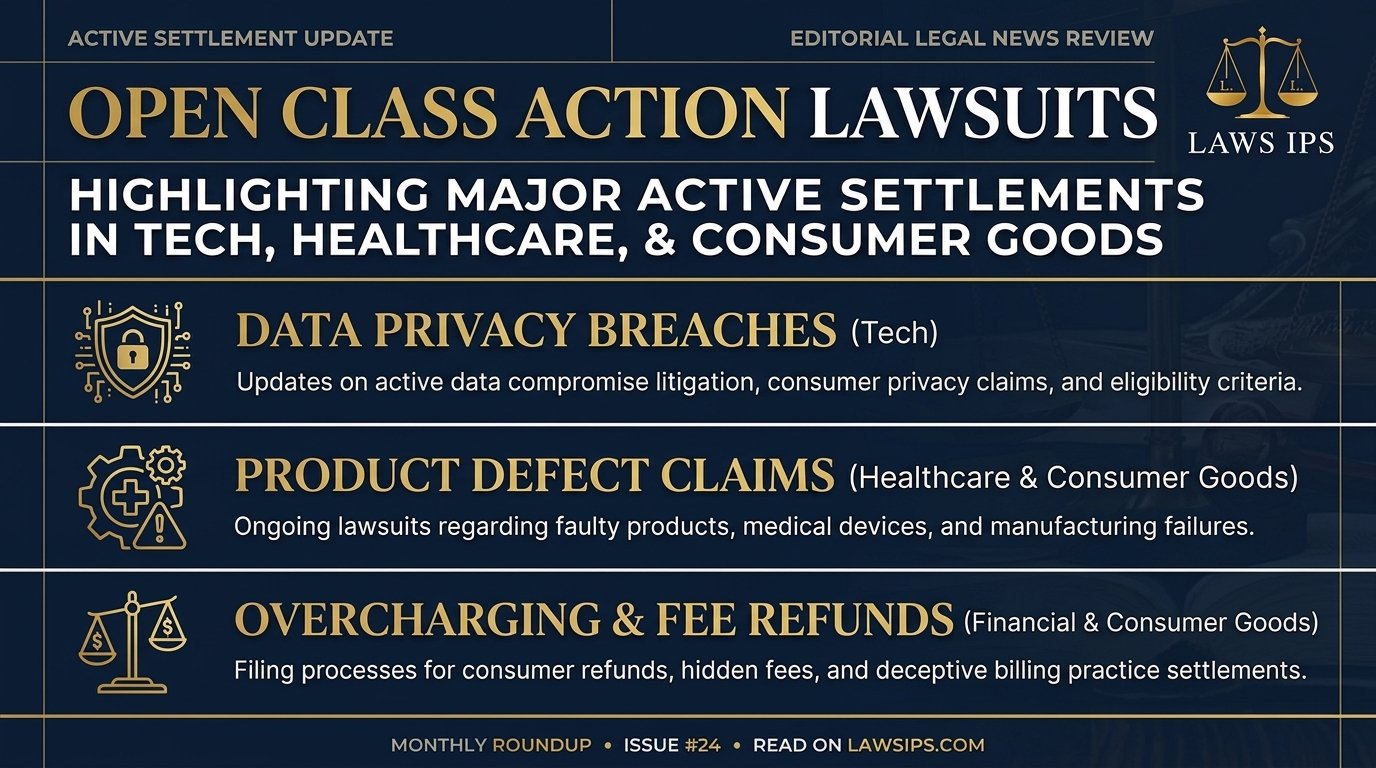

Open class action lawsuits are court-approved settlements currently accepting claims before a stated claim deadline. Filing means submitting a claim form to the appointed claims administrator, not hiring a lawyer or joining a new lawsuit. Most people can file alone, for free, when they genuinely meet the eligibility rules.
This information is general information only, not legal advice, and it does not create a lawyer-client relationship. Deadlines, funds, and eligibility rules below were reported in late October 2026 research and must be re-verified on each official settlement site before filing. Open lists change quickly, and a case listed as open in one directory may already be closed.
A settlement is not a finding of wrongdoing, and preliminary approval is not final approval. Companies often settle to avoid trial cost and risk, without admitting liability. Payment depends on final approval, valid claims, appeals, and the net fund left after fees and costs.
What Open Means in a Class Action
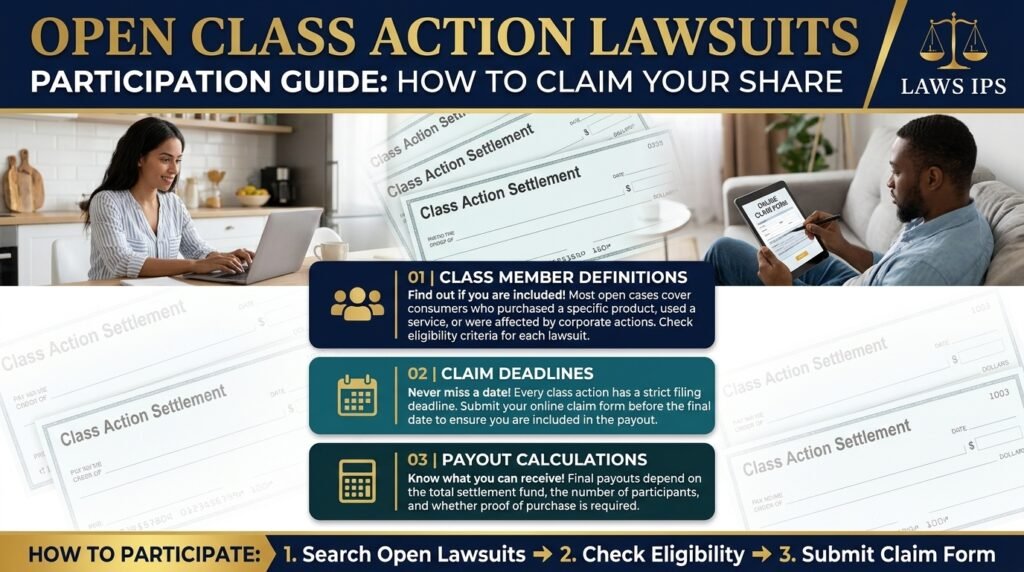
Open for Claims Versus Filed Only
Open for claims means a settlement has reached a stage where the claims administrator is accepting claim forms. A filed lawsuit, by contrast, may still be in early court stages with no settlement and no claim form. Confusing those two stages leads readers to search for forms that do not exist yet.
A case can also be certified as a class action without any settlement. Certification allows the case to proceed as a group case, but it does not promise payment. Only a settlement or a court judgment creates a payment process for class members.
Preliminary Approval Versus Final Approval
Preliminary approval means a judge has found a proposed settlement fair enough to notify class members and open claims. Final approval comes later, after a fairness hearing where objections are considered. Claims filed during the open period are usually held until final approval is granted.
Appeals can delay payment even after final approval. An appeal challenges the settlement approval, not necessarily your individual claim. Payment distribution usually waits until appeals are resolved or the appeal period expires.
Automatic Payment Versus Claim Required
Some settlements pay automatically to people already identified in company records, with no claim form needed. Others require a claim form even when the company knows who was affected. Never assume automatic payment, because missing a claim form can mean missing payment entirely.
Check the official notice for the words claim required or no claim required. If the notice says a claim is required, file before the deadline even when you received a notice by mail or email. Receipt of notice alone is rarely treated as a filed claim.
Open Claims Closing Soonest
Why Deadline Order Matters Most
Deadline order matters because open lists lose value the moment a deadline passes. A reader who finds a case after its deadline cannot file, even with perfect eligibility. Sorting by deadline, not by fund size, puts the most urgent cases first.
Treat every date below as a reported lead, not a verified deadline. Check the official settlement site and the court docket for the current claim deadline, opt-out deadline, and objection deadline. Those three dates are often different, and the earliest one may control your choices.
Reported November 2026 Closings
| Reported case type | Reported claim deadline | Proof note to verify |
|---|---|---|
| Digital asset trustee fund case | November 9, 2026 | Check official notice for claim and proof rules |
| Insurance robocall case | November 16, 2026 | Check call records and consent rules |
| Digital privacy case, retail pharmacy context | November 16, 2026 | Check data use period and notice rules |
| Text message marketing case | November 17, 2026 | Check message dates and phone number rules |
| Urgent care labour case | November 25, 2026 | Check employment period and role rules |
| Securities case, large reported fund | November 25, 2026 | Check purchase dates and loss documentation |
| Medical supplies data breach case | November 26, 2026 | Check breach notice and class list status |
| City strip search case | November 26, 2026 | Check detention dates and location rules |
| Personal care false advertising case | November 27, 2026 | Check purchase dates and proof tier |
| Technology data breach case | November 27, 2026 | Check breach notice and affected data types |
| Employee modification case | November 27, 2026 | Check employment dates and job category |
| Credit union loan case | November 29, 2026 | Check loan type and account period |
| Credit reporting inquiry case | November 29, 2026 | Check inquiry dates and report rules |
Each row above comes from secondary listings in late October 2026 research, not from a fresh official site check in this writing. Funds, eligibility periods, and proof tiers must be confirmed on the official notice before filing. Drop any row that the official site shows as closed.
Reported December 2026 Closing
A privacy case involving a health-related app was reported with a December 29, 2026 claim deadline in the same research period. That longer window gives more time to check eligibility, but it does not remove the need to verify. Earlier claims in the same case were reported as rejected during a testing phase, so refiling rules deserve special care.
When a case has a testing or refile history, read the official instructions twice. A claim filed in an early test portal may not count as a filed claim. Use only the current official portal named in the latest court-approved notice.
Open Claims by Category
Data Breach Open Claims
Data breach settlements usually cover people whose personal information was exposed in a specific incident. Eligibility often depends on receiving a breach notice or appearing on a company list. Documented losses, such as fraud costs or identity theft expenses, may pay in a higher tier.
No-proof tiers in breach cases often pay a smaller flat amount, while documented loss tiers require receipts or statements. Keep fraud alerts, police reports, and bank letters for documented tiers. File the tier that matches your real losses, not the highest tier available.
Privacy and Biometric Open Claims
Privacy settlements cover alleged misuse of personal data, location data, health data, or biometric identifiers. Biometric cases often involve face scans, fingerprints, or voiceprints collected without required consent. State law matters greatly, since biometric rules differ sharply by state.
Illinois biometric cases follow a distinct state statute with its own consent and retention rules. Other states may rely on general privacy or consumer protection law instead. Check the class definition for state limits before assuming nationwide eligibility.
False Advertising Open Claims
False advertising settlements allege that product claims, labels, or pricing misled buyers. Eligibility usually requires purchase within a stated class period and, sometimes, in a stated place. Product type, size, and purchase channel can all affect eligibility.
Payment often works per unit, with a cap per household, or as a pro rata share of a net fund. Keep purchase records where possible, even for no-proof tiers, since administrators may audit a sample of claims. Honest claims protect the whole fund from fraud-related delays.
Robocall and Text Message Open Claims
Robocall and text cases allege calls or messages sent without proper consent under federal telemarketing rules. Eligibility may depend on receiving a call or text from a specific number, during a specific period, to a specific phone number. Call logs and message screenshots help documented claims.
Consent history matters, since a prior business relationship or prior consent may affect eligibility. Do not guess about consent; check the official class definition and your own records. A wrong claim can be denied and can slow review for other claimants.
Employment Open Claims
Employment settlements cover alleged wage, hour, overtime, or workplace policy violations. Eligibility depends on job title, work location, and employment dates, not merely on working for the named employer. Pay records, schedules, and offer letters help confirm class membership.
Some employment settlements pay automatically through payroll records, while others require a claim form. Check whether former employees must file, since current employees are sometimes paid differently. Tax treatment for wage settlements also differs from consumer settlements in some cases.
Securities Open Claims
Securities settlements cover investors who bought shares during a stated class period and suffered losses. Proof usually requires transaction records showing purchases, sales, dates, and prices. Brokerage statements are the standard proof, and estimates alone rarely suffice.
Payment depends on a plan of allocation that weighs purchase timing, sale timing, and loss amount. Investors who sold early, held through disclosure, or bought after disclosure may receive different shares. Read the allocation plan before assuming a simple per-share payment.
Consumer Product Open Claims
Consumer product settlements cover defective products, misleading labels, or pricing practices across many product types. Eligibility may require ownership, purchase, repair, or a specific product model. Keep the product, packaging, and purchase proof where the notice asks for them.
Repair and replacement remedies sometimes exist alongside cash payments. A cash claim may require giving up a repair remedy, or vice versa. Read the remedy choice carefully, since choosing one option can waive another.
How to Check If You Qualify in 60 Seconds
Step 1: Match the Class Period
Check whether your purchase, exposure, call, or employment falls inside the stated class period. Dates outside that period usually mean no eligibility, even when the product or company matches. Class periods are strict, so compare exact start and end dates.
Note whether the period uses purchase date, exposure date, or account date, since those differ. A product bought before the period but used inside it may not qualify. Use receipts, statements, or account history to pin the correct date.
Step 2: Match the Product, Event, or Role
Check the specific product, service, event, or job role named in the class definition. A similar product from the same company does not automatically qualify. Model names, plan names, and service types must match the notice language.
Check location limits too, since some classes cover only certain states or stores. A nationwide brand does not always mean a nationwide class. State limits often reflect the law under which the case was filed.
Step 3: Match the Proof Tier You Can Honestly Meet
Choose the proof tier you can support with real records or a truthful sworn statement. No-proof tiers still require genuine eligibility and a signed declaration under penalty of perjury. Documented tiers require the documents named in the notice, not merely a claim that losses occurred.
If you cannot meet a documented tier, file the no-proof tier when available rather than inflating a claim. Inflated claims risk denial, audit, and delay for everyone. Honest tier selection protects your payment and your credibility.
Step 4: Confirm the Official Site and Deadline
Confirm the official settlement site by matching its domain character by character against the court notice or administrator case list. Do not trust a link in an unsolicited email, text, or social media ad alone. Type the official address yourself when possible.
Confirm the claim deadline on that official site, not on a directory summary. Directories can lag, misread time zones, or leave closed cases listed as open. A one-minute official check prevents a wasted filing after a deadline.
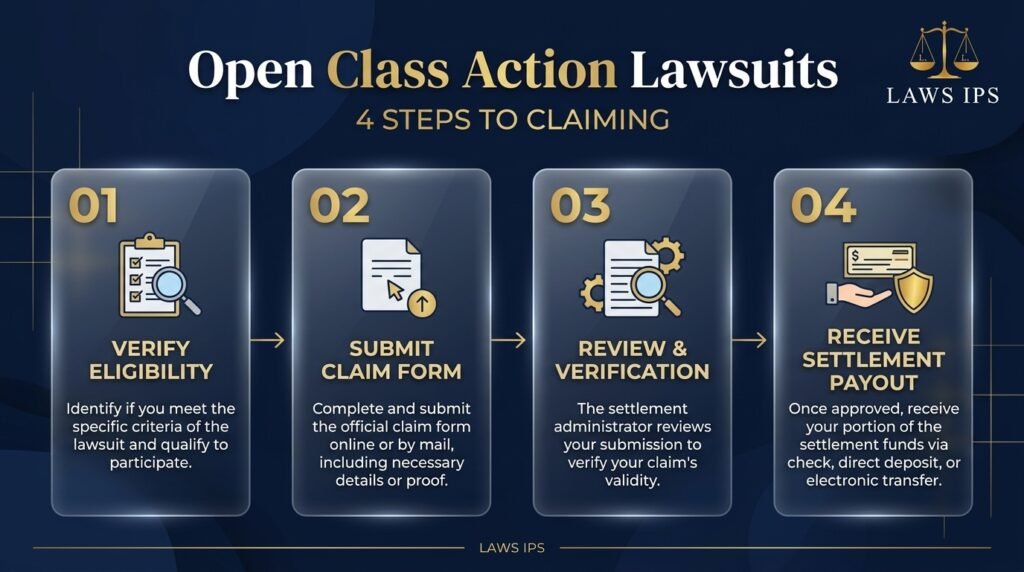
How to File a Claim Step by Step
Step 1: Read the Official Notice Fully
Read the full official notice, not merely a directory summary. The notice defines the class, deadlines, proof rules, payment tiers, and release of claims. Filing a claim usually releases related claims against the defendant, so understand that consequence before filing.
Note the claim deadline, opt-out deadline, and objection deadline separately. Filing a claim, opting out, and objecting are different choices with different effects. A claim form alone does not preserve an objection or an opt-out right.
Step 2: Gather Proof Before Starting the Form
Gather receipts, statements, call logs, photos, or employment records before opening the form. Starting without proof leads to rushed guesses and deficient claims. A short preparation step saves a later cure notice and possible denial.
Save copies of everything you submit, including screenshots of online submissions. Note the confirmation number, submission date, and contact details used. Those records become essential if the administrator later questions your claim.
Step 3: Complete the Form Accurately
Enter your legal name, current address, and contact details exactly as they appear in relevant records. Use the notice ID when you received one, since it links your claim to the administrator’s records. If you never received a notice, follow the official no-notice filing path instead of inventing an ID.
Answer eligibility questions truthfully, including purchase dates, quantities, and loss amounts. Do not round quantities upward or add purchases you did not make. Accuracy matters more than maximising a single claim amount.
Step 4: Choose a Payment Method Carefully
Choose a payment method offered by the settlement, such as check, direct deposit, or prepaid card. Check the method’s fees, expiry rules, and address requirements before selecting. A prepaid card with short expiry can lose value if overlooked.
Update your address promptly if you move after filing, since payment may arrive months later. Administrators often cannot redirect payment without a written address update. Keep the administrator contact details with your claim records.
Step 5: Submit Before the Deadline and Keep Proof
Submit before the stated deadline, accounting for time zone and online portal closing time. Mail-in claims usually require a postmark by the deadline, not merely mailing on that date. Online claims require successful submission, not merely starting the form.

Save the confirmation page, confirmation email, and any claim number issued. If no confirmation arrives, contact the administrator promptly through official channels. Do not resubmit blindly, since duplicate claims can trigger review or denial.
Step 6: Respond Promptly to Deficiency Notices
A deficiency notice means the administrator needs more information or a correction. Respond by the cure deadline stated in that notice, with the exact documents requested. Ignoring a cure notice often leads to denial, even for an otherwise valid claim.
If a document is unavailable, explain that fact in writing and offer the closest available alternative. Administrators sometimes accept substitute proof when the reason is clear. Silence, by contrast, is treated as failure to prove the claim.
No Proof Versus Proof Required
What No Proof Really Means
No proof means no receipt, invoice, or bank statement is required to file that tier. It does not mean no eligibility check, no sworn statement, and no honesty requirement. You still declare, under penalty of perjury, that you meet the class definition.
Administrators may audit a sample of no-proof claims, especially when quantities look unusual. A household cap often limits no-proof payments, such as a per-unit cap or a household maximum. Read the cap before estimating payment.
Documented Loss Tiers
Documented loss tiers pay more when losses are proved with receipts, statements, bills, or other records named in the notice. Losses must fall inside the class period and relate to the alleged harm. Unrelated expenses, even when real, usually do not qualify.
Documented claims take longer to review, since each document must be checked. Submit clear copies, highlight relevant lines where helpful, and avoid submitting unrelated personal information. Redact unrelated account numbers when the form allows it.
| Proof tier | What you submit | Typical payment pattern | Main risk |
|---|---|---|---|
| No proof | Claim form plus sworn statement | Smaller flat or per-unit amount, capped | Audit or denial if eligibility is false |
| Notice ID only | Claim form plus notice ID | Flat or pro rata amount, faster review | Lost ID delays filing |
| Documented loss | Claim form plus receipts or statements | Higher amount, tied to proved loss | Delay or denial if documents are incomplete |
Notice ID Recovery
A notice ID links your claim to the administrator’s mailing list, but losing it does not always end eligibility. Many official sites offer a notice ID lookup by name, address, or email. Others allow filing without an ID through a separate registration path.
Use only the official lookup tool, and never share a full Social Security number by email to recover an ID. Real administrators do not ask for bank logins, full Social Security numbers by email, or gift cards. Suspicious recovery requests should be reported through official channels.
Opt Out, Object, or File: Which Choice Fits
Filing a Claim
Filing a claim means accepting the settlement terms for your share and releasing related claims as described in the notice. Filing is the right choice when the settlement offers fair value and you do not plan a separate lawsuit. Most class members who want payment should file.
Filing does not require attending a hearing or hiring a lawyer. It does require meeting the claim deadline and any proof rules. A filed claim can still be denied if eligibility or proof fails review.
Opting Out
Opting out, also called exclusion, means leaving the class and giving up any settlement payment. Opting out preserves the right to pursue an individual claim, subject to separate deadlines and costs. Opting out must be done by the opt-out deadline, which is often earlier than the claim deadline.
Opting out makes sense mainly when individual damages are much larger than the class payment, or when a separate legal strategy exists. It rarely makes sense as a protest alone, since opting out without a separate plan usually means no recovery at all.
Objecting to the Settlement
Objecting means telling the court why the settlement should not be approved, while usually remaining in the class. An objection must follow the notice procedure and deadline, and it may require a written statement and hearing attendance rules. Objecting alone does not opt you out.
Objecting while filing a claim is sometimes allowed, but rules vary by settlement. Read the notice carefully, since some settlements treat objection and claim filing as compatible, while others require separate steps. Do not assume one form covers both actions.
| Choice | Payment | Right to sue separately | Deadline to watch |
|---|---|---|---|
| File a claim | Yes, if approved | Released for covered claims | Claim deadline |
| Opt out | No | Preserved, subject to separate law | Opt-out deadline |
| Object | Yes, if settlement approved and claim filed | Released if settlement approved | Objection deadline |
How Payments Are Calculated
The Net Fund First
Payment starts with the gross settlement fund, then subtracts court-approved attorney fees, administration costs, taxes where applicable, and service awards. The remainder is the net fund available to class members. Headline fund figures therefore overstate the amount available for claims.
Fee percentages and cost totals appear in the settlement agreement and preliminary approval papers. Those documents, not directory summaries, give the authoritative breakdown. A large headline fund with high fees and many claims can still produce small individual payments.
Pro Rata Math in Plain Terms
Pro rata means each valid claim receives a proportional share of the net fund, based on its recognised value. When more valid claims arrive, each share shrinks. When fewer claims arrive, each share grows, subject to any caps in the settlement.
Consider an illustrative example only, not a real case or a promise. Suppose a net fund is 850,000 dollars and total recognised claim value is 1,000,000 dollars. Each claim would receive 85 percent of its recognised value before caps, because 850,000 divided by 1,000,000 equals 0.85.
Caps change that math, since a per-claim cap can leave unspent funds for redistribution or for a second distribution. Some settlements include a second payment round when funds remain after the first distribution. Read the distribution plan for cap and redistribution rules.
Per Unit, Flat, and Tiered Payments
Per-unit payments multiply a fixed amount by the number of qualifying units, up to a household cap. Flat payments give the same amount to every approved claimant in that tier. Tiered payments give different amounts based on loss level, injury level, or documentation level.
Tier definitions matter more than tier labels, since similar-sounding tiers can use different proof rules. A higher tier with strict proof may pay less in practice than a lower tier filed correctly. Choose the tier your records actually support.
When You Will Get Paid
Final Approval and Appeals
Payment usually follows final approval, expiration of the appeal period, and resolution of any appeals. That sequence can take months after the claim deadline, even for straightforward settlements. Administrators cannot distribute funds while approval remains under appeal in most cases.
Some settlements pay in stages, with an initial distribution followed by a later redistribution of unclaimed funds. Stage timing appears in the settlement agreement and administrator updates. Check the official site for distribution updates, rather than relying on social media payment rumours.
Distribution and Payment Problems
Distribution may use checks, direct deposit, or prepaid cards, depending on the settlement and your selection. Checks can be delayed by address changes, while prepaid cards can expire if not used. Update contact details promptly and use payment promptly when received.
If payment never arrives, check claim status through the official administrator portal first. Have your claim number, name, and filing date ready. Contact the administrator through official channels, and keep a record of every inquiry and response.
| Stage | What happens | Typical timing note |
|---|---|---|
| Claim period closes | Administrator reviews claims for eligibility and proof | Weeks to months, by claim volume |
| Final approval | Court approves settlement after fairness hearing | Hearing date controls, not claim deadline |
| Appeal period | Appeals, if any, must be filed and resolved | Can add months, no payment during appeal in most cases |
| Distribution | Approved claims paid by chosen method | Weeks after distribution starts, varies by case |
| Second distribution | Unclaimed or residual funds redistributed, if allowed | Only when the plan permits it |
How to Spot a Fake Settlement

Real Administrator Signals
Real claims are free to file, and real administrators do not charge an upfront fee to process a claim. Real notices name the case, court, class definition, deadlines, and official site in plain language. Real sites match the domain named in the court-approved notice.
Real administrators may ask for limited identifying details to verify a claim, but they do not ask for bank logins, full passwords, or gift card codes. Payment method details, when requested, go through the official portal, not through an unsolicited email reply. Suspicious requests deserve a pause and an official check.
Fake Settlement Red Flags
- A fee, tax, or processing charge required before payment is released.
- A request for a bank login, password, or full Social Security number by email or text.
- A payment promise far above the stated settlement terms, with urgent pressure to act.
- A domain that closely mimics the official site but adds extra words, hyphens, or misspellings.
- A claim link sent only through social media comments, with no court notice behind it.
- A demand to keep the settlement secret from family, a bank, or authorities.
- A prepaid card, gift card, or cryptocurrency payment demanded to unlock a larger payment.
- A caller who refuses to give a case name, court name, or administrator contact details.
- A form that asks for unrelated medical, tax, or employment records for a simple product claim.
- A deadline that changes with every message, creating artificial urgency without a court document.
| Signal | Real settlement | Fake settlement |
|---|---|---|
| Cost to file | Free | Upfront fee or tax demanded |
| Contact method | Official site and notice channels | Unsolicited text or social message only |
| Personal data asked | Limited, through official portal | Bank login, password, or gift cards |
| Domain check | Matches court notice exactly | Close imitation with extra words |
| Payment promise | Capped, pro rata, or tiered as stated | Guaranteed large amount, no conditions |
Open Versus Closed Versus Filed-Only Cases
Open Cases
Open cases accept claims now, with a future claim deadline and an official claim form. Open status should be confirmed on the official site, since directories can lag behind closures. File open cases first when deadlines are near, since later cases can wait a few days.
Open does not mean guaranteed payment, since final approval, claim review, and appeals still apply. Open means the filing window is live, not that payment is immediate. Keep expectations tied to the settlement plan, not to headline fund figures.
Closed Cases
Closed cases no longer accept claims, even when payment distribution is still ongoing. A closed claim deadline cannot usually be reopened because a person missed notice. Late filing requests are rarely granted, and only under narrow court-approved circumstances.
Closed cases still matter for research, since they show how similar claims were valued and paid. They should never be listed as open, and they should never be filed through unofficial forms. Mark closed cases clearly to avoid wasted filings and false hope.
Filed-Only Cases
Filed-only cases are lawsuits or investigations with allegations, but no settlement and no claim form. News coverage of a filing does not create a payment process. Readers who file a form on an unofficial site for a filed-only case risk sharing personal data for no benefit.
Watch filed-only cases for future settlement news, but do not treat them as open claims. When a filed case later settles, the court-approved notice will create the official claim process. Until then, the correct action is usually to preserve records and wait for notice.
| Status | Claim form exists | Payment possible now | Correct action |
|---|---|---|---|
| Open | Yes, official form live | After approval and review | File before deadline |
| Closed | No, deadline passed | Only for timely filers | Check status, do not refile |
| Filed only | No settlement form yet | No, allegations only | Preserve records, watch for notice |
Mistakes to Avoid
- Filing a claim you do not genuinely qualify for, which risks denial and audit.
- Using a directory deadline without checking the official settlement site.
- Missing an earlier opt-out or objection deadline while waiting for the claim deadline.
- Signing a claim form without reading the release of claims language.
- Inflating quantities, losses, or purchase dates to reach a higher tier.
- Sharing bank logins or full Social Security numbers through unofficial links.
- Ignoring a deficiency notice until the cure deadline passes.
- Filing duplicate claims for the same purchase, person, or loss.
- Assuming notice receipt alone counts as a filed claim.
- Posting claim details, payment amounts, or personal data publicly while a case is pending.
Tips That Improve a Filing

- Create a simple claim folder for each settlement, with notice, form copy, and confirmation.
- File early in the claim period, when possible, to allow time for deficiency cures.
- Use the same name and address format across the claim, notice, and payment method.
- Photograph or screenshot the confirmation page immediately after submission.
- Keep purchase, call, employment, or medical records until payment arrives.
- Update your address with the administrator promptly after any move.
- Check claim status once a month through the official portal, not through rumours.
- Read payment method terms, including prepaid card expiry, before selecting.
- Keep tax records for any payment received, and seek tax advice when unsure.
- Share only the official site domain with family, never a forwarded claim link alone.
Frequently Asked Questions
What class action lawsuits are open right now?
Open class action lawsuits are settlements currently accepting claims before a stated claim deadline, with an official claim form live. The exact list changes weekly as deadlines pass and new settlements open. Check the official settlement site for each case, since directory lists can lag behind closures.
What does open for claims mean?
Open for claims means the claims administrator is accepting claim forms under a court-approved settlement notice. It does not mean the case has been won at trial or that payment is immediate. Final approval, claim review, and any appeals still control payment timing.
How do I file a claim for an open class action settlement?
Read the official notice, gather proof, complete the official claim form accurately, choose a payment method, and submit before the claim deadline. Save the confirmation page and claim number. Respond promptly if the administrator sends a deficiency notice requesting more information.
Do I need a lawyer to file a class action claim?
Usually no, since class members file claims directly with the claims administrator using the official form. Class counsel already represents the class in the settlement, subject to court approval. Seek independent legal advice only when considering opting out or pursuing an individual claim.
Is filing a class action claim free?
Yes, filing a genuine claim through the official portal is free, with no upfront fee charged by a real administrator. Any demand for a processing fee, tax payment, or gift card before release is a scam signal. Report such demands through official channels and do not pay.
What is a claim notice ID, and what if I lost it?
A notice ID links your claim to the administrator’s mailing list and speeds review. Many official sites offer a lookup by name or address, or a separate filing path without an ID. Never share a full Social Security number by email to recover an ID, since real administrators do not require that method.
Can I file without a notice ID?
Often yes, when the official notice provides a no-notice filing path for people who qualify but never received notice. Follow that path exactly, and provide the eligibility details the form requests. Do not invent a notice ID, since false IDs trigger review and possible denial.
What does no proof needed really mean?
No proof means no receipt or invoice is required for that tier, but genuine eligibility and a sworn statement are still required. You declare under penalty of perjury that you meet the class definition. Administrators may audit claims, so file only when the statement is true.
How do I know if I am in the class?
Compare your purchase, exposure, call, employment, or account history against the class definition and class period in the official notice. Product, location, date, and role must match, not merely the company name. When in doubt, read the definition line by line before filing.
What happens if I miss the claim deadline?
Missing the claim deadline usually means no payment from that settlement, even with perfect eligibility. Late filing is rarely excused, and unofficial forms filed late do not create a claim. Mark deadlines early, and file well before the final day when possible.
What is the difference between a claim deadline and an opt-out deadline?
A claim deadline controls payment through a claim form, while an opt-out deadline controls leaving the class. Opt-out deadlines are often earlier than claim deadlines. Missing the opt-out deadline usually means remaining in the class under the settlement terms.
If I object, do I still get paid?
Usually yes, when the settlement is approved and you file a timely claim, subject to the notice rules for objections. Objecting alone does not replace filing a claim. Read the notice, since objection and claim procedures vary by settlement.
If I opt out, can I sue on my own?
Opting out preserves the right to pursue an individual claim, subject to separate deadlines, costs, and legal rules. It does not guarantee a better result, and individual litigation can be expensive and slow. Seek legal advice before opting out for that purpose.
How is my payment calculated?
Payment depends on the net fund, your recognised claim value, payment tier, caps, and the number of valid claims. Pro rata sharing means more valid claims reduce individual shares. Headline fund figures do not equal individual payment amounts.
Why is my payment lower than the advertised up to amount?
Up to amounts are ceilings for the highest tier or the maximum possible share, not guaranteed payments. Fees, costs, caps, and pro rata reduction lower most payments below the ceiling. Documented tiers, caps, and claim volume explain most gaps between advertised and received amounts.
When will I get my class action settlement payment?
Payment usually follows final approval, appeal resolution, claim review, and distribution processing. That sequence can take months after the claim deadline. Check the official administrator site for distribution updates, rather than relying on payment rumours online.
Why was my class action claim denied?
Common reasons include missing the deadline, failing the class definition, insufficient proof for a documented tier, duplicate claims, or inconsistent information. The denial notice should state the reason and any cure option. Respond by the cure deadline when a cure path exists.
How do I check my class action claim status?
Use the official administrator portal or contact channel named in the notice, with your claim number ready. Status updates may show received, under review, deficient, approved, or denied. Check monthly, and keep records of every status change and inquiry.
Are class action settlement payments taxable?
Tax treatment depends on the payment type, such as wage replacement, physical injury compensation, or consumer refund, and on personal tax circumstances. Some payments are taxable, while others may not be, subject to tax law and reporting rules. Seek qualified tax advice for your specific payment, since general guidance cannot replace it.
Is this class action settlement email real or a scam?
Verify the case name, court, administrator, and official domain against the court-approved notice before clicking or replying. Real claims are free, and real administrators do not demand bank logins or gift cards. When unsure, type the official address yourself and contact the administrator through official channels.
What is the difference between a class action and an FTC refund program?
A class action is a court case with a class, settlement, and administrator, while a regulator refund program is run by a government agency under its own authority. Both can pay consumers, but their rules, deadlines, and claim processes differ. Do not treat a regulator program as a class action, or vice versa.
Can I join a class action that has not settled yet?
Class membership in a pending case depends on court certification and notice, not on a public signup form. Filed cases without settlement have no payment claim form. Preserve records, watch for official notice, and avoid unofficial signup sites that collect personal data early.
Can I file claims in more than one open settlement?
Yes, when you genuinely qualify for each settlement separately, with separate forms and proof. Each claim stands on its own eligibility and deadlines. Do not reuse the same purchase or loss to inflate multiple claims beyond what each settlement actually allows.
What should I do if I already filed but moved house?
Update your address with the claims administrator promptly through official channels, before distribution begins. Payment sent to an old address can be delayed, returned, or lost. Keep proof of the address update with your claim records until payment arrives.
Conclusion
Open class action lawsuits reward prompt, honest, and careful filing, not speed alone. Check eligibility against the official class definition, file before the claim deadline, choose the proof tier your records support, and keep confirmation records until payment arrives. Re-verify every deadline on the official settlement site, since open lists change fast and secondary summaries lag behind closures.
Avoid fake claim sites, upfront fees, and inflated claims, since those errors cost time and can end eligibility. When a case fits your history, file it properly and track it patiently through approval, review, and distribution. Open class action lawsuits work best for readers who verify first, file accurately, and treat every up to amount as a ceiling, never as a promise.
