

Red Bull wings lawsuit stories usually begin with a joke about a man who expected to fly. The real case was about coffee, not wings.
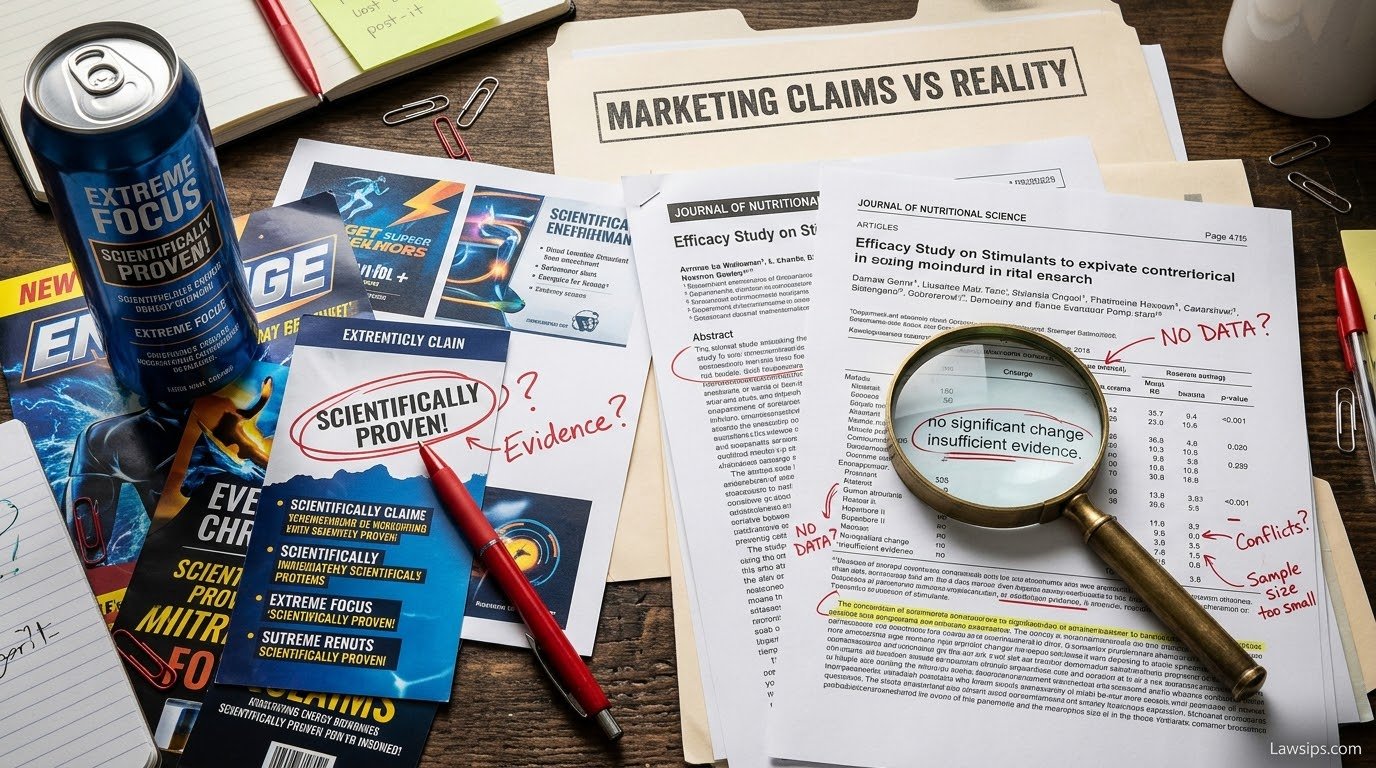
In 2013, New York consumer Benjamin Careathers sued Red Bull in federal court. He argued its marketing promised performance benefits that science did not support.
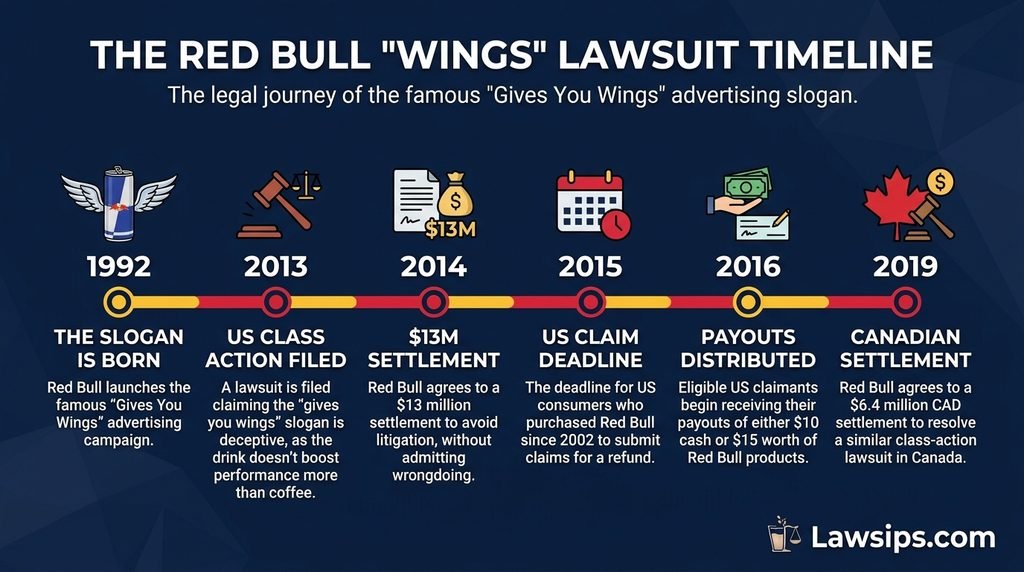
Red Bull settled in 2014 for $13 million. The company admitted no wrongdoing. No court ever ruled that its advertising was deceptive.
US buyers could claim $10 cash or $15 in products. The deadline passed on 2 March 2015. Everything since then is history, and some of it is wrong online.
Quick Answer: What Happened in the Red Bull Wings Lawsuit
| Question | Verified answer |
|---|---|
| Who sued? | Benjamin Careathers, a New York consumer, as lead plaintiff |
| When and where? | Filed in 2013, US District Court for the Southern District of New York |
| What was claimed? | The wings campaign and performance claims lacked scientific support and justified a premium price |
| How did it end? | Settled in 2014 for a $13 million fund, with no admission of wrongdoing |
| What could buyers claim? | $10 cash or $15 worth of Red Bull products, no proof of purchase needed |
| Claim deadline | 2 March 2015 (US); the case is closed |
| Was there a verdict? | No. There was no trial and no court finding of deception |
| Sequel | A Canadian class action settled in 2019 for CAD $850,000 |
The one sentence version: a consumer argued Red Bull charged coffee prices plus a premium for benefits it never proved, and Red Bull paid $13 million to end the argument.
The Complaint: What Careathers Actually Claimed
Careathers said he had drunk Red Bull since about 2002. He filed as lead plaintiff for millions of US buyers. The class period in the settlement reached back to 1 January 2002.
His complaint targeted the whole campaign, not one sentence. The slogan sat inside years of advertising about performance. Ads promised improved performance, concentration, and reaction speed.
The complaint’s most quoted line said there was a “lack of genuine scientific support” for superiority claims. It accused Red Bull of marketing the drink as a superior source of energy worthy of a premium over coffee.
That quotation survives in The Daily Meal’s October 2014 report, which covered the settlement as it broke. It remains the cleanest contemporary record of the complaint’s language.
It Was About Coffee, Not Wings
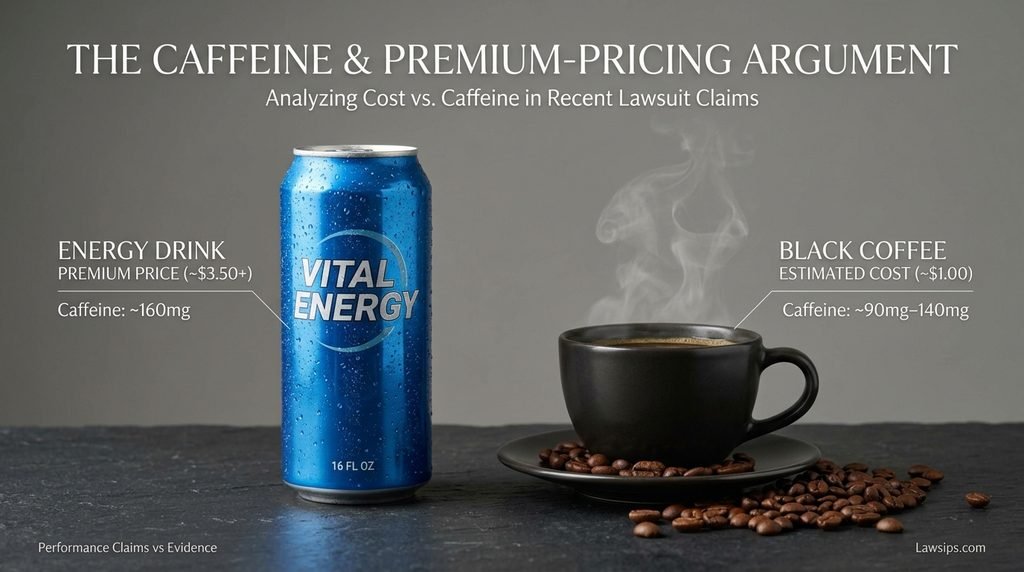
A standard Red Bull can holds about 80 milligrams of caffeine. That is comparable to a cup of coffee. The complaint built its whole theory on that comparison.
If the drink worked no better than cheaper caffeine, the premium price rested on marketing. Buyers had paid extra for benefits the company could not prove.
That is a measurable claim. Measurable claims can be tested in court. The whole case grew from that single distinction.
Nobody alleged an expectation of physical wings. The wings were the vehicle. The alleged deception was the performance story wrapped around them.
The Legal Claims in the Complaint
| Legal claim | Plain English meaning |
|---|---|
| California Unfair Competition Law | A state ban on unlawful, unfair, or fraudulent business practices |
| California False Advertising Law | A state ban on advertising that is untrue or misleading |
| California Consumers Legal Remedies Act | A state law against deceptive acts in consumer transactions |
| Lanham Act (federal) | A federal ban on misrepresenting the nature or qualities of goods in advertising |
| Breach of express warranty | The advertising itself made promises the product allegedly did not keep |
| Unjust enrichment | The company allegedly profited from premiums buyers paid under a misimpression |
The statute stack is set out in LegalClarity’s explainer of the case, which also tracks how the money was finally paid. Its account is the most complete secondary record of the case.
Puffery: The Defence Concept
Advertising law allows puffery. Puffery means vague exaggeration that no reasonable consumer takes literally. “The world’s best coffee” is puffery, because “best” cannot be measured.
Red Bull’s position fit that tradition. The company called its marketing “witty, truthful and accurate”. Wings, on that view, are an obvious metaphor for feeling energised.
The complaint tried to move the case out of puffery territory. Performance, concentration, and reaction speed are measurable. Claims like those need evidence, and evidence was exactly what Careathers said was missing.
Timeline: From 1992 Slogan to 2019 Canada Settlement
| Date | Event |
|---|---|
| 1992 | Red Bull begins using the “gives you wings” slogan in Austria |
| 1 January 2002 | Start of the US settlement class period |
| 2013 | Careathers files the class action in the Southern District of New York |
| Mid 2014 | Red Bull agrees to a proposed $13 million settlement |
| October 2014 | The settlement goes viral; the claims website crashes under traffic |
| 3 October 2014 | End of the US class purchase period |
| 2 March 2015 | US claim deadline passes |
| May 2015 | Final approval hearing held for the settlement |
| Early 2016 | Payouts reach claimants: four packs for product choosers, $10 checks for cash choosers |
| Later in 2016 | A second, smaller distribution of roughly $2 per cash claimant follows |
| August 2019 | The Canadian class action settles for CAD $850,000 |
| 14 October 2019 | Canadian registration deadline passes; both cases are closed |
Why the timeline matters: most retellings compress these dates into one blur. The blur is where errors breed. A claim filed in 2013, money paid in 2016, and a sequel in 2019 are three different stories.
The Settlement: $13 Million, $10 or $15 Each
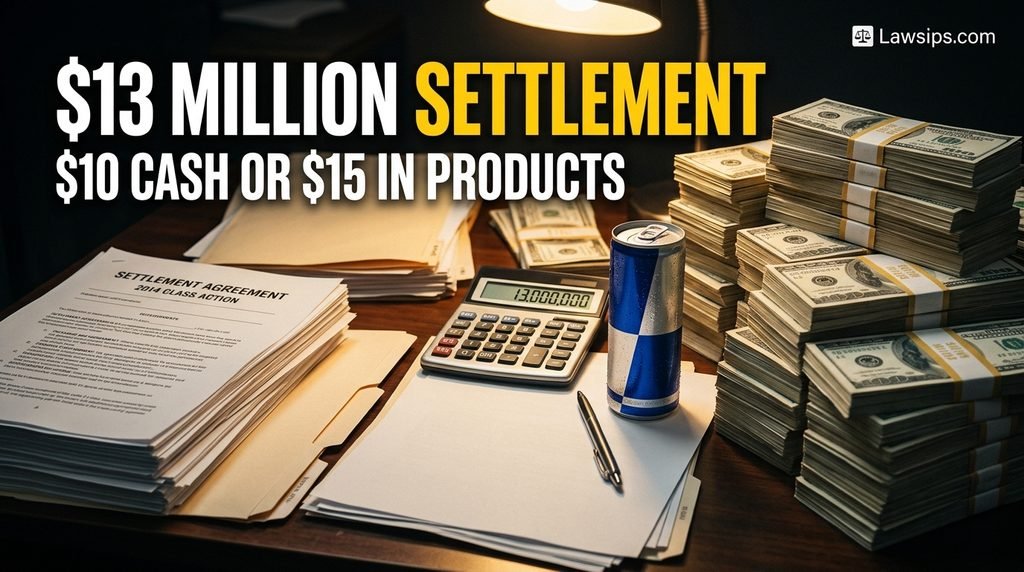
Red Bull agreed to a $13 million settlement fund in 2014. The fund was capped. Every valid claim drew from the same fixed pool of money.
Eligibility was simple on purpose. Anyone who bought a Red Bull product in the United States between 1 January 2002 and 3 October 2014 qualified. No receipt was required.
Each claimant chose one of two options. Option one was $10 in cash. Option two was $15 worth of Red Bull products, shipped to the claimant’s door.
Claims went to the administrator, GCG, through the settlement website. The Irish Times report from October 2014 recorded the website crashing under claim traffic within days of the announcement.
Class counsel fees were handled separately. LegalClarity reports fees of up to $4.75 million paid on top of the consumer fund. Lawyers did not take their pay out of the $13 million itself.
What Claimants Actually Received
Over a million claims arrived. A capped fund plus a viral claim window does predictable maths. The settlement’s later distributions tell the real story of what a claim was worth.
Product choosers received four packs of Red Bull in early 2016. That delivery fulfilled the $15 product option in physical form. Many claimants had forgotten claiming by the time it arrived.
Cash choosers received their $10 checks in the same period. Then a second distribution followed later in 2016. It was worth roughly $2 per claimant, paid from funds remaining after the first round.
The second round is the detail almost every retelling drops. It shows how class settlements really end. Not with a single dramatic payout, but with administrators sweeping the remainder out pro rata.
Did Red Bull Admit Anything?
No. The settlement contained no admission of wrongdoing. Red Bull stated that its marketing had always been witty, truthful and accurate.
The company said it settled to avoid the cost and unpredictability of litigating in the United States. That is the standard logic of large settlements: certainty today beats a jury tomorrow.
This distinction matters for every retelling. A settlement is a purchase of peace. It is not a verdict, not a confession, and not a court finding.
Any page claiming a court found Red Bull’s marketing deceptive is wrong. No judge or jury decided that question. The case ended before anyone had to.
The Canadian Sequel: The Attar Case
The story has a second act that US coverage mostly skips. Michael Attar, a Canadian consumer, first tried to claim under the US settlement. As a Canadian, he could not.
Attar then brought a class action in Quebec. His claim echoed the American one about functionality claims. It added a second complaint the US case never made.
The added claim was about disclosure. It alleged Red Bull failed to warn consumers about risks of its caffeinated energy drinks. The sharpest example was mixing energy drinks with alcohol.
The Canadian Settlement Terms
| Term | Detail |
|---|---|
| Plaintiff | Michael Attar |
| Law | Quebec Consumer Protection Act, sections 219 and 228 |
| Fund | CAD $850,000, with about CAD $600,000 for claimants |
| Individual amount | Up to $10 CAD per claimant |
| Class | Canadian residents who bought Red Bull in Canada, 1 January 2007 to 23 July 2019 (adults) |
| Registration deadline | 14 October 2019 |
| Extras | Marketing updates plus website Q and A linking to Health Canada’s alcohol mixing warning |
| Administrator | Velvet Payments |
The class definition and settlement mechanics are recorded in Top Class Actions’ Canada settlement coverage, which tracked the case for claimants at the time.
One honest uncertainty: reports disagree on Attar’s filing year. Newsweek based coverage says 2016. Other reports say February 2019. The settlement itself, in August 2019, is consistent everywhere.
The currencies must never merge. The US fund was $13 million US dollars. The Canadian fund was CAD $850,000. Retellings that blend them inflate the Canadian case fifteen fold.
Myths vs Facts: The Viral Version, Corrected
| Viral claim | The verified fact |
|---|---|
| A man sued because he did not grow wings | He sued over unproven performance claims and premium pricing; wings were the metaphor, not the claim |
| Red Bull lost the lawsuit | There was no trial. Red Bull settled and denied wrongdoing |
| A court found the ads deceptive | No court ruled on deception; the settlement avoided any ruling |
| The plaintiff got $13 million | The $13 million was a capped fund for over a million claimants |
| Everyone got $10 quickly | Payouts arrived in 2016, and cash claimants later got a second round of roughly $2 |
| Red Bull had to drop the slogan | The slogan stayed in use after the settlement |
| You can still claim your $10 | Claims closed on 2 March 2015 in the US and 14 October 2019 in Canada |
| It only happened in America | The Canadian class action settled in 2019 for CAD $850,000 |
Why the myth version wins online: it is funnier. “Man expects wings” fits a headline. “Consumer challenges claim substantiation for functional benefits” does not, even though it is the true story.
Why the Slogan Survived
The slogan dated to 1992, early in the brand’s expansion from Austria. By 2013 it anchored global marketing worth far more than $13 million. Protecting it was the real business decision inside the settlement.
Settlements let companies buy certainty without precedent. A trial loss on performance claims could have followed Red Bull into every market. A settlement ended the US case with the brand intact.
Red Bull’s adjustments were about claim clarity, not surrender. Marketing and labelling in North America were updated. The wings themselves never left the cans.
The slogan’s survival teaches the sharpest lesson here. The metaphor was never the legal problem. The measurable promises standing next to the metaphor were the exposure.
Beauty and wellness marketing runs on the same mechanics. A transformation promise, like the ones inside any glow up routine, is puffery until numbers and timelines make it measurable. Measurable is where regulators and plaintiffs start reading closely.
What the Case Changed
For advertisers, the case became a teaching example. Slogans are safe as atmosphere. Specific functional claims need substantiation files built before the campaign runs, not after a complaint arrives.
For class actions, it showed the viral settlement pattern. No proof of purchase plus a funny headline equals a million claims. Capped funds then shrink into four packs and small second checks.
For consumers, the useful legacy is verification skill. A real settlement has a court, an administrator, and dates. A viral post with a link and no docket is a story, not a payout.
For Red Bull, the brand absorbed the cost as marketing history. The case is now part of the slogan’s legend. Few advertising disputes end with the slogan more famous than before.
The same pattern repeats across lifestyle marketing. Bold claims in glow up tips style content live or die on what can be shown.
Red Bull’s lesson is simple. The showing part is a legal duty. It is not a creative choice.
The Case by the Numbers
| Number | What it means |
|---|---|
| 1992 | Year the wings slogan entered Red Bull’s marketing |
| 80 mg | Caffeine in a standard can, the coffee comparison at the case’s core |
| 2002 to 2014 | US purchase window covered by the settlement |
| $13 million | The capped US settlement fund |
| $10 or $15 | Each claimant’s choice: cash or products |
| 1 million plus | Claims filed, per payout reporting |
| $4.75 million | Maximum class counsel fees, paid separately |
| Roughly $2 | The second, smaller cash distribution in 2016 |
| CAD $850,000 | The separate Canadian settlement fund |
| 2 March 2015 | The US claim deadline that closed the case for buyers |
Numbers discipline is this story’s weak point online. Funds merge, currencies blend, and deadlines dissolve. The table above is the antidote, and every figure in it traces to the sources in this article.
Read the two funds side by side once more. Thirteen million US dollars ended the American case. Eight hundred fifty thousand Canadian dollars ended the Canadian one, six years later, under a different legal system.
That contrast is the honest scale of the sequel. Canada mattered for its disclosure precedent, not its money. Attar’s alcohol warning claim changed web content, which outlasts a $10 payment.
Keep this table beside any retelling you meet online. It settles most arguments about the case in under a minute.
Can You Still Claim? No, and Beware Payout Scams
There is nothing to claim. The US deadline passed on 2 March 2015. The Canadian registration closed on 14 October 2019. Both funds were distributed years ago.
The old settlement website no longer operates as a claims portal. It crashed under traffic in October 2014 and served its purpose through 2015. Any lookalike site collecting details today is not administering this case.
Fresh posts claiming a new Red Bull payout appear regularly. Lawfold’s updated case tracker states plainly that no new wings case has been filed and no active claims process exists. Treat such posts as scam bait.
How to Spot a Fake Settlement Offer
- It asks for bank details up front. Real administrators pay by check or product first round; they do not harvest accounts through social links.
- It has no dates. Legitimate settlements always name a filing deadline, a court, and an administrator.
- It promises large individual sums. Class settlements pay small amounts to many people, never windfalls to individuals.
- It lives only on social media. Real settlements generate court records and contemporaneous news coverage you can cross check.
- It urges secrecy or speed. Scarcity pressure is a fraud tool. Genuine claim windows run for months with public notice.
What to do instead: close the page. If you already shared details, contact your bank. Curiosity about the real case is satisfied by the record, not by a form.
The Case in the Classroom
Law and marketing teachers use this case for one clean reason. It separates two ideas students confuse. A slogan can be legally safe while the claims around it are legally exposed.
It also teaches settlement economics honestly. The headline number was $13 million. The lived experience was a four pack, a $10 check, and a $2 follow up that most people never expected.
Business students meet it as a brand protection decision. Red Bull valued the campaign’s future above the settlement’s price. A decade of continued slogan use proved the maths right.
Media students meet it as a virality case study. The funniest version of the story outran the true one within days. Corrections, including this one, are still catching up twelve years later.
Everyday routines carry smaller versions of the same claim making. The promises inside a beauty routine at home are harmless as encouragement.
They turn risky only as guarantees. The Red Bull file is the big budget proof of where that line sits.
The Slogan Before the Lawsuit
The slogan was born in 1992 in Austria. Red Bull had launched in 1987, adapting a Thai energy drink. The wings line arrived as the brand pushed into Western markets.
The animated ads built a recognisable world. Ordinary people drank, sprouted cartoon wings, and escaped boring moments. The joke format made the slogan feel like humour, not a promise.
That humour was the brand’s legal shelter for two decades. Nobody sued over the cartoons. The exposure grew quietly in the text around them: websites, cans, and campaigns describing functional benefits.
By 2013, Red Bull was a global marketing empire. It sponsored athletes, teams, and entire sports. The slogan’s value sat far beyond the drink aisle, which raised the cost of any legal threat to it.
Careathers had bought the drink since about 2002. His decade of purchases shaped the settlement’s reach. The class period opened in 2002 because long term buyers front these cases.
The October 2014 Viral Week
The settlement was agreed in mid 2014 but exploded in October. A BuzzFeed post framed it as money owed to every buyer. The headline travelled faster than the settlement notice itself.
The claims website crashed under the traffic. That detail, recorded by the Irish Times at the time, shows the scale. A legal notice became a consumer rush within days.
News coverage leaned on the joke. Headlines announced payment “because it doesn’t give you wings”. The caffeine argument, the actual case, appeared paragraphs later or not at all.
That week fixed the myth in public memory. The funny version arrived first and never left. Accuracy has been playing catch up since, which is why correction content still finds an audience.
The meme record treats the settlement as an internet event. Know Your Meme documents the refund as a 2014 online phenomenon. The story’s second life online is now longer than the case itself was.
How a Class Action Settlement Works, Using This Case
One buyer fronts the case. Careathers was the lead plaintiff. His name carried a claim that belonged, legally, to millions of buyers at once.
The class shares one outcome. Nobody negotiated individually. Every eligible buyer received the same two options, because a class settlement treats the group as a single unit.
The court supervises the deal. A judge reviews whether the settlement is fair to absent class members. The May 2015 final approval hearing was that checkpoint in this case.
An administrator runs the mechanics. GCG collected claims and managed distribution. Administrators are the invisible plumbing of every large settlement, and their notices are the documents that matter.
Caps divide, they do not multiply. The fund stayed $13 million however many claimed. Viral attention therefore reduced certainty, not the fund, and leftovers funded the smaller second distribution.
Fees are part of the record. The separate fee payment, up to $4.75 million per LegalClarity, is normal. Courts award fees for producing the fund, and the notice discloses them.
Cases Readers Confuse With This One
The McDonald’s hot coffee case is the closest cousin. It is remembered as a joke about spilled coffee. The record involved severe burns and a fight over serving temperatures and warnings.
The Subway footlong case chased a measurement. Customers said sandwiches fell short of twelve inches. It settled largely around measurement practices rather than a giant cash fund, and it is often oversimplified too.
The Pepsi Harrier jet case never paid out. A student tried to claim a fighter jet from a points catalogue joke. The court treated the advert as obvious humour, the opposite outcome from a negotiated settlement.
The differences teach the real rule. Courts test literal offers and measurable claims. Companies settle when fighting costs more than paying. Red Bull paid; Pepsi fought and won; both decisions were economic.
The People in the Story
Benjamin Careathers remains the name attached to the case. He was not a lawyer or an activist with a platform. He was a repeat customer whose decade of purchases gave him standing to sue.
That ordinariness is the point of class actions. One ordinary buyer can carry a claim too small for anyone to file alone. Ten dollars each becomes thirteen million together.
Careathers did not become rich from the case. Lead plaintiffs sometimes receive modest service awards from settlements. No report credits him with a personal windfall, and claims otherwise are invention.
Michael Attar entered the story through a doorway most consumers recognise. He saw the American settlement, tried to join it, and learned borders matter in class actions. His Quebec case exists because the US fund excluded him.
Attar’s addition changed the sequel’s character. The alcohol disclosure claim reflected Canadian regulatory debates about energy drinks. It pushed the settlement beyond money into website warnings and marketing updates.
Behind the brand stood Dietrich Mateschitz, Red Bull’s co founder and marketing architect. He built the company on event sponsorship and the wings identity. The settlement protected the asset he had spent two decades creating.
None of these people set out to write a teaching case. Together they produced one anyway. A buyer, a slogan, and a border generated the most retold advertising dispute of its decade.
Two Lawsuits, One Settlement
Contemporary reports describe the US settlement as resolving two related consumer class actions. Careathers fronted the famous one. A second filer raised overlapping claims about marketing and safety.
Consolidation is routine in consumer litigation. Courts prefer one settlement over competing ones for the same conduct. Buyers experienced it as a single fund with a single deadline, which is what mattered publicly.
The detail rarely survives retelling. It matters for accuracy, though: the $13 million closed a small docket of cases, not one man’s complaint alone.
Why $13 Million Was the Smart Price
From the outside, paying millions over a slogan looks like defeat. Inside a boardroom, the maths runs differently. Litigation against a flagship campaign carries risks no settlement does.
A trial puts advertising claims under oath. Executives and agencies testify about what evidence supported each promise. Even a win costs years of management attention and hostile coverage.
A loss would be worse than the money. A verdict brands the campaign deceptive in law. That single word follows a global brand into every negotiation, market, and future dispute.
The settlement capped everything. One fund, one administrator, one deadline. After May 2015 approval and 2016 distribution, the American chapter closed permanently and the slogan kept selling drinks.
Red Bull also bought control of the narrative’s ending. The company’s denial travelled with every story. “Witty, truthful and accurate” appears in coverage to this day because the settlement statement put it there.
Compare the counterfactual honestly. Fighting might have saved the fund. It would have spent the brand’s scarcest asset instead: a decade of unbroken confidence in its most famous line.
Reading a Settlement Notice: The Skill This Case Teaches
Most people meet class actions through viral posts, not notices. This case is the perfect training example, because the post and the notice said very different things.
- Find the deadline first. Every real settlement lives or dies by one date. Here it was 2 March 2015, and missing it ended a claim completely.
- Find the class definition. Dates and places define eligibility. The US window ran from 2002 to October 2014; guessing outside it wasted effort.
- Find the administrator’s name. GCG ran this settlement. A named, findable administrator separates a real fund from a content farm’s invention.
- Read the options exactly. Ten dollars cash or fifteen in products was the whole menu. Posts that promise more are editing reality.
- Check the court’s name. The Southern District of New York anchored this case. Court names are searchable, and fake offers never survive that search.
- Note what proof is required. No proof of purchase was unusual and newsworthy. When a post omits the proof rule, it is summarising from memory, not from the notice.
Keep those six checks for any settlement story. They take three minutes. They would have saved thousands of people from chasing a closed Red Bull claim in later years.
The Story’s Second Life Online
The case now lives mainly as content, not law. It appears in trivia, marketing lectures, and periodic viral threads. Each return trip trims more facts and sharpens the joke.
The trimming has a pattern. Dates vanish first, which is how a closed 2015 claim starts sounding current. Then the caffeine argument vanishes, leaving only the wings.
Platforms reward the trimmed version. Outrage and comedy outperform nuance in every feed. A correction must therefore be as readable as the myth, or it never catches up.
That is the standard this article set itself. Every colourful detail here, the crashing website, the four packs, the $2 second checks, is in the record. The truth had enough story; it never needed invention.
Expect another recirculation cycle. When it comes, the checks above apply unchanged. The case closed in two countries, in two currencies, on two deadlines. Nothing about it can reopen quietly.
Key Takeaways
- The claim: Red Bull’s performance marketing lacked scientific support and justified a premium over coffee, per the 2013 Careathers complaint.
- The outcome: a $13 million settlement in 2014, no admission of wrongdoing, and no court ruling on deception.
- The payout: $10 cash or $15 in products for US buyers (2002 to 2014), claimed by 2 March 2015 and paid out through 2016.
- The sequel: Canada settled in 2019 for CAD $850,000, adding an alcohol risk disclosure claim.
- The slogan survived. The metaphor was never the legal problem; the measurable claims beside it were.
- Nothing is open to claim. Current payout posts about this case are scams.
Frequently Asked Questions
What was the Red Bull wings lawsuit?
A 2013 US class action by Benjamin Careathers. It alleged the wings campaign claimed unproven performance benefits. Red Bull settled in 2014 for $13 million without admitting wrongdoing.
Did someone really sue Red Bull for not giving them wings?
A man really sued, but not for literal wings. The complaint attacked performance superiority claims and premium pricing. The wings were the slogan, not the substance.
Who sued Red Bull?
Benjamin Careathers, a New York consumer, as lead plaintiff. He said he had bought Red Bull for about a decade. The class covered millions of US buyers.
How much did Red Bull pay?
A $13 million settlement fund. Class counsel fees of up to $4.75 million were paid separately, per LegalClarity. Canada later added a separate CAD $850,000 fund.
Did Benjamin Careathers get $13 million himself?
No. The fund belonged to the claimant class. Lead plaintiffs front the case; they do not take the settlement fund as personal winnings.
Did Red Bull lose the case?
There was no verdict. Red Bull settled before trial and denied wrongdoing. Saying the company “lost” misdescribes a negotiated settlement.
Did a court rule the ads were deceptive?
No. No judge or jury made that finding. Pages claiming otherwise repeat an error. The settlement existed precisely to avoid such a ruling.
What could claimants get?
A choice of $10 cash or $15 in Red Bull products. No proof of purchase was required. The options were claimed through the administrator, GCG.
Who was eligible in the US?
Anyone who bought Red Bull products in the United States between 1 January 2002 and 3 October 2014. The claim deadline was 2 March 2015.
Did people actually receive money?
Yes, in 2016. Product claimants received four packs. Cash claimants received $10 checks, then a second distribution of roughly $2 as remaining funds were paid out.
Why did the payouts shrink?
The fund was capped and over a million claims arrived. Fixed money divided by viral demand produces small individual amounts. The second distribution swept out what remained.
Why did Red Bull settle if it denied wrongdoing?
Its stated reason was to avoid the cost and unpredictability of US litigation. The company maintained its marketing was witty, truthful and accurate.
How much caffeine is in a Red Bull can?
About 80 milligrams in the standard can. That is comparable to a cup of coffee. The comparison powered the complaint’s premium price theory.
What laws did the complaint use?
California’s Unfair Competition Law, False Advertising Law, and Consumers Legal Remedies Act, plus the federal Lanham Act. Unjust enrichment and warranty claims were also included.
What is puffery in advertising?
Vague exaggeration no reasonable consumer takes literally. Slogans usually qualify as puffery. Specific measurable claims, like faster reaction speed, fall outside that shelter.
Did Red Bull stop saying gives you wings?
No. The slogan continued after the settlement. Red Bull updated claim clarity in marketing and labelling instead. The wings remain on the brand today.
Was there a Canadian Red Bull lawsuit?
Yes. Michael Attar’s Quebec class action settled in August 2019 for CAD $850,000. Canadians could claim up to $10, with registration closing 14 October 2019.
What was different about the Canadian case?
It added a disclosure claim. Attar alleged Red Bull failed to warn about risks of its energy drinks, notably mixing them with alcohol. Quebec’s Consumer Protection Act carried both claims.
Can I still claim the Red Bull settlement?
No. US claims closed in March 2015 and Canadian registration in October 2019. Payouts finished years ago. No mechanism exists to join either settlement now.
Is there a new Red Bull wings lawsuit in 2026?
No filing supports one. Updated case trackers confirm the wings case remains closed. Posts promising a new payout from this story should be treated as scams.
I saw a post saying Red Bull owes me money. Is it real?
It is recirculating the closed 2014 settlement. The headline was true in 2014 with a deadline attached. Without that deadline, the same words become bait.
What did the lawyers earn?
Class counsel fees of up to $4.75 million, paid separately from the consumer fund, per LegalClarity. Separate fee payment is standard in large consumer settlements.
Why do websites give different dates for the Canadian filing?
Secondary reports conflict, citing 2016 and February 2019. The settlement in August 2019 is consistent across sources. Honest coverage labels the filing year as disputed.
How does this case compare to the McDonald’s hot coffee case?
Both are retold as jokes about the obvious. Both actually turned on narrower documented claims. There, injury severity and warnings; here, unproven performance superiority at a premium price.
Conclusion
The Red Bull wings lawsuit endures because the joke is better than the truth. The truth is more useful: measurable marketing claims need evidence, or they become a $13 million lesson.
Careathers never expected wings, and no court ever condemned the slogan. A settlement bought peace, claimants got their $10 and their four packs, and the wings kept flying.
For more stories where big claims meet real world checks, explore the explainers here on lawsips. Start from the Fashion Gleem homepage and keep the same habit this case teaches: read the claim, then read the evidence.

Dilawar Mughal is an SEO expert with 8 years of hands-on experience helping websites grow their organic traffic, rankings, and revenue. He specializes in content-driven SEO, local SEO, and Pinterest SEO, and builds practical, results-focused strategies for businesses and publishers.