


You filled out a claim form months ago and forgot about it. Then one morning an email arrives with a subject line that makes you pause: your class action settlement payment is on its way.
Or maybe the story runs the other way. You see a notice, assume it is junk and delete it, and only later learn that the deadline passed and the money went to people who bothered to file.
A class action settlement is the moment a long legal fight turns into real decisions for ordinary people. You may be offered money, asked to give up the right to sue, invited to object or told to wait while courts and administrators sort out the details.
Each of those choices has a deadline and a consequence.
Table of Contents
What Is a Class Action Settlement?

A class action settlement is an agreement that resolves a class action lawsuit without a trial. The defendant agrees to provide money or other benefits to the class, and in exchange the class members who stay in the case give up the right to sue over the same claims.
A judge must approve the settlement as fair, reasonable and adequate. After approval, eligible class members usually submit a claim form to receive payment, which is distributed by a settlement administrator.
Key Takeaways
- Settlements need court approval before they take effect.
- Most people must file a claim by the deadline to get paid.
- Staying in the class means you give up the right to sue over the settled claims.
- Opting out preserves your right to sue but means no settlement payment.
- Your share depends on the fund size, number of claims, fees and the settlement formula.
- Appeals can delay payments for months or longer.
- Never pay a fee to claim a settlement.
What Is a Class Action Settlement?
A class action settlement is a negotiated deal between the lead plaintiffs, their lawyers and the defendant. It ends the lawsuit and sets out what the class will receive.
Most class actions end this way rather than at trial. Settlement gives both sides certainty, which is valuable because trials are costly, slow and unpredictable.
Why Defendants Settle
Companies often settle to avoid the cost of continuing litigation, reduce the risk of a larger judgment and limit damage to their reputation. A settlement usually does not include an admission of wrongdoing.
Why Plaintiffs Settle
Plaintiffs and class counsel weigh the strength of the evidence against the risk of losing. A guaranteed recovery now can be better than an uncertain verdict years later.
Settlement vs Judgment
| Feature | Settlement | Trial Judgment |
|---|---|---|
| How it ends | Negotiated agreement | Decision by judge or jury |
| Admission of fault | Usually none | Court finding of liability |
| Certainty | Higher | Lower |
| Speed | Often faster | Slower |
| Appeals | Possible after approval | Common |
| Court approval | Required for class actions | Entered as a judgment |
Key Terms in a Class Action Settlement
Settlement notices are full of legal words. Learning the basics helps you read them with confidence.
| Term | Meaning |
|---|---|
| Settlement agreement | The written contract that sets the deal terms |
| Settlement class | The group covered by the settlement |
| Class period | The dates during which a person must have been affected |
| Settlement fund | The pool of money paid by the defendant |
| Claims administrator | The company hired to run notice, claims and payments |
| Claim form | The form used to request payment |
| Preliminary approval | The judge’s first review, which allows notice to go out |
| Final approval | The judge’s decision that the settlement is fair |
| Fairness hearing | The court hearing on final approval |
| Effective date | The date the settlement becomes final and binding |
| Release | Your agreement not to sue over the settled claims |
| Pro rata | Dividing the fund proportionally among valid claims |
| Cy pres | Distribution of leftover money to a charity or similar group |
| Service award | Payment to the lead plaintiffs for their work |
How a Class Action Settlement Works: Step by Step
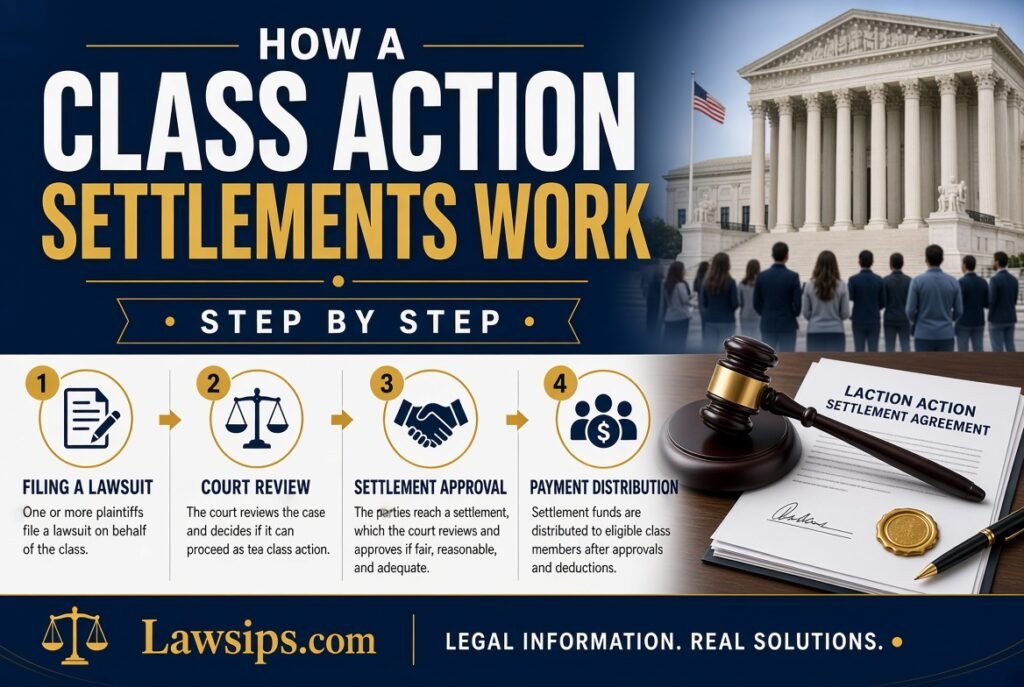
The path from agreement to payment has several stages. Delays can occur at almost any point.
1. Negotiation
Class counsel and the defendant negotiate terms, sometimes with a mediator. They agree on the amount, the benefits, the class definition, notice and claims procedures and attorney fees.
2. Settlement Agreement
The terms are written into a formal agreement. It includes the release that class members will give if the court approves the deal.
3. Preliminary Approval
The parties ask the judge to approve the settlement on a preliminary basis. The judge checks that the deal falls within the range of what could be fair and that the proposed notice is adequate.
4. Notice to the Class
Class members receive notice by mail, email, publication or a settlement website. The notice explains the case, the settlement terms and the available options.
5. Claims, Opt-Outs and Objections
Class members file claims, opt out or object by the deadlines set in the notice. The administrator collects and reviews these submissions.
6. Fairness Hearing and Final Approval
The judge holds a hearing, listens to the parties and objectors and decides whether to grant final approval. The court may also review the requested attorney fees.
7. Appeals Period
If an objector appeals, the settlement may not become effective until the appeal ends. Many settlements state that payments cannot be made until all appeals are resolved.
8. Effective Date
The settlement becomes effective after the judgment approving it is final and no longer subject to appeal. This date starts the clock for payment.
9. Claim Review and Distribution
The administrator reviews claims, resolves disputes and calculates payments. Funds are then sent by check, electronic payment or other agreed methods.
Settlement Timeline Overview
| Stage | What Happens | Typical Time Frame |
|---|---|---|
| Negotiation | Parties reach a deal | Months to years |
| Preliminary approval | Judge allows notice to go out | Weeks to a few months |
| Notice and claims period | Members decide and file | Often two to six months |
| Final approval hearing | Judge approves or rejects | Weeks to months after the claims period |
| Appeals | Objectors may appeal | Months to over a year |
| Distribution | Administrator pays claimants | Weeks to months after the effective date |
One settlement notice in a public filing warned that appeals could delay payment for more than a year, so patience is often required.
Who Is Eligible for a Class Action Settlement?
Eligibility depends on the class definition in the settlement. It usually involves a time period, a product or service and a type of harm.
Common Eligibility Criteria
- You bought or used a specific product or service
- You purchased during a defined time period
- You held an account or were affected by a data event
- You worked for the defendant under certain conditions
- You live in a certain state or country, if the class is limited
How to Check If You Qualify
Read the notice and visit the official settlement website. Compare the class definition to your records, such as receipts, emails or account statements.
If you did not get a notice but think you qualify, search for the case name and the claims administrator’s website. Notices are sent using available records, but not everyone is reached.
Who Is Usually Excluded
Defendants, their employees, judges and court staff are often excluded. People who timely opted out are also excluded from the settlement benefits.
Your Options When a Class Action Settlement Is Announced
Every class member has choices. Each one has consequences you cannot undo after the deadline.
| Option | What You Do | Result |
|---|---|---|
| File a claim | Submit a valid claim form on time | Eligible for payment and bound by the release |
| Do nothing | Take no action | Usually no payment, but still bound by the release |
| Opt out | Submit a written exclusion before the deadline | No payment, keep the right to sue individually |
| Object | File a written objection with the court | Remain in the class and can still claim, court considers your concerns |
Filing a Claim
Filing a claim is the most common choice. It tells the administrator you want a share of the settlement.
Claim forms may be short and simple or may require documentation. Many ask you to sign under penalty of perjury that your information is true.
Doing Nothing
If you stay in the class and do not claim when a claim is required, you generally receive no payment but still give up your right to sue over the released claims. In some settlements, payments are automatic and no action is needed.
Opting Out
Opting out may be wise when your personal losses are far greater than what the settlement offers. You must follow the notice instructions exactly, and some courts require a signed written request.
Objecting
Objections are your chance to tell the judge why a settlement should not be approved. You may object to the amount, the fees, the claims process or the way funds are distributed.
Objectors should follow the deadlines and format listed in the notice. Missing a requirement can cause the court to ignore the objection.
How to Decide
Compare the settlement amount with your estimated loss, the strength of any individual claim you might have and the time and cost of suing alone. For small losses, claiming is usually the practical choice.
For larger or unusual harms, talk to a lawyer before the deadline. Our guide on whether you need a personal injury lawyer explains when individual representation makes sense.
How Class Action Settlement Payments Are Calculated
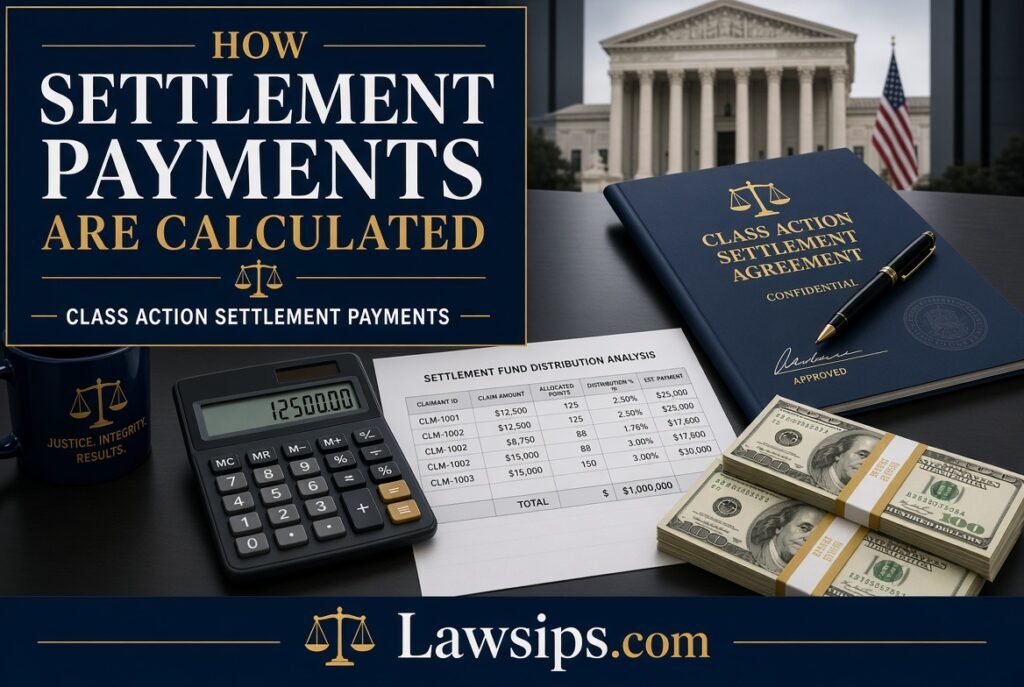
Your payment depends on the structure of the settlement. Understanding the formula helps you set realistic expectations.
Where the Money Goes
| Item | What It Covers |
|---|---|
| Attorney fees | Compensation for class counsel, subject to court approval |
| Litigation costs | Expenses such as experts, filing fees and depositions |
| Administration costs | Notice, claims processing and distribution |
| Service awards | Payments to lead plaintiffs for their time and effort |
| Net settlement fund | The amount left for class members |
Common Payment Methods
Settlements use different approaches to divide the net fund.
| Method | How It Works |
|---|---|
| Pro rata | The fund is divided proportionally, so payments rise or fall based on total claims |
| Fixed amount | Each valid claimant receives a set payment |
| Tiered payments | Payments depend on category, such as type of loss or product |
| Documented loss reimbursement | You are repaid for proven expenses up to a cap |
| Vouchers or credits | Benefits come as coupons or account credits |
| Automatic payments | Money is sent without a claim, based on records |
Why Your Payment May Change
In a pro rata settlement, the amount per person is unknown until all claims are counted. If many people file, each share shrinks. If few file, each share may grow, subject to caps in the agreement.
Some agreements limit payments per person. Others reduce payments if total claims exceed the fund.
Why Payments Are Often Small
When a fund covers millions of people, a share can be modest. A settlement of tens of millions of dollars may still produce only small individual checks.
Larger payments tend to go to people who can document significant losses.
Documentation Matters
Settlements often pay more to claimants who submit proof, such as receipts, statements or records. Without documents, you may be limited to a smaller flat amount.
Keep records of major purchases and accounts. They can make the difference in a future claim.
Two-Stage Payments
Some large settlements distribute money in more than one round. An initial payment may go out first, with a second payment after claims review is complete.
One published settlement update noted that claimants had to submit a W-9 tax form to receive the initial payment, which shows how paperwork can affect timing.
Attorney Fees in Class Action Settlements
Class members rarely pay lawyers directly. Fees are taken from the settlement fund or paid separately, as approved by the court.
How Fees Are Decided
Judges review requests for attorney fees and costs. They consider the result achieved for the class, the risk and complexity of the case and the work performed.
Published legal guidance commonly cites fee awards of roughly 25 to 33 percent of the settlement fund, though ranges vary by court and case.
Fee Structures
| Structure | How It Works |
|---|---|
| Common fund | Fees come from the settlement fund before class members are paid |
| Separate payment | The defendant pays fees on top of the fund |
| Clear sailing | The defendant agrees not to oppose a fee request up to a limit |
| Lodestar | Fees are calculated from hours and rates, sometimes with a multiplier |
Why Fees Draw Objections
Critics worry when fees are large compared to what members receive. Judges are expected to look carefully at whether a deal is mainly benefiting lawyers.
Read the notice to see how much counsel is requesting and how it compares with the fund.
Court Approval: Why Judges Review Class Action Settlements

Unlike private lawsuits, class settlements need judicial approval. The court protects absent class members who did not negotiate the deal.
What the Judge Considers
- The strength of the plaintiffs’ case and the risks of continuing
- The size of the relief compared with the potential recovery
- How claims will be processed and paid
- The proposed attorney fees
- Whether class members are treated equitably
- Whether the settlement was reached without collusion
- The class’s reaction, including opt-outs and objections
Red Flags Judges Watch For
- Very small member payments with large attorney fees
- Complicated claims processes that discourage participation
- Benefits that are mostly coupons with little value
- Releases that are much broader than the claims in the case
- Preferential treatment for certain class members
What Happens at the Fairness Hearing
The parties explain why the settlement is fair, and objectors may speak. The judge may approve, reject or ask for changes.
If the judge rejects the settlement, the parties can renegotiate or return to litigation.
Objections and Appeals
Objections give class members a voice. They can also lead to appeals that delay payments for everyone.
How to File an Objection
- Check the deadline. The notice states the date by which objections must be filed.
- Follow the format. Notices often require your name, address, a statement of your membership in the class and reasons for the objection.
- Send it as instructed. Submit to the court and sometimes to counsel by the listed method.
- Decide whether to attend the hearing. Some courts require notice if you plan to speak.
Strong Objections vs Weak Ones
Judges pay more attention to specific, reasoned objections. General complaints that the amount is too low rarely succeed on their own.
Appeals
After final approval, an objector may appeal. A settlement often says that no payments will be made until all appeals are resolved.
Appeals can delay payments for months or even more than a year. Some appeals are resolved by agreement with the objector, while others run through the appellate courts.
Why Class Action Settlement Payments Take So Long
Waiting is frustrating, but delays usually have identifiable causes.
| Cause | Why It Slows Things Down |
|---|---|
| Court schedule | Hearings and rulings take time |
| Objections and appeals | Payments wait until the settlement is final |
| Large claim volume | Administrators must review many claims |
| Fraud checks | Invalid or duplicate claims must be filtered |
| Eligibility disputes | Some claims require extra review |
| Tax and payment setup | Forms and payment systems take time |
| Multi-stage distribution | Money is paid in rounds |
Rule of Thumb
Even after the effective date, the administrator may need weeks or months to complete payments. Some settlement agreements set deadlines, such as a number of days after the effective date for the defendant to fund the payments.
How to Check Status
- Visit the official settlement website
- Read updates posted by the administrator
- Check the court docket for approval and appeal filings
- Contact the administrator using the information in the notice
What Not to Do
Do not pay anyone who claims they can speed up your payment. Legitimate administrators do not charge fees to class members.
How to Claim a Class Action Settlement: Step by Step
Filing is usually straightforward when you prepare in advance.
- Read the notice. Identify the case name, class definition and deadlines.
- Visit the official website. Use the address in the notice or a trusted source.
- Check eligibility. Compare your purchases, accounts or dates to the class definition.
- Gather documents. Collect receipts, statements, screenshots and account details.
- Complete the claim form. Answer accurately and completely.
- Choose your payment method. Options may include check, digital payment or direct deposit.
- Submit before the deadline. Online forms may close at a stated time, and mailed forms must usually be postmarked by the deadline.
- Save confirmation. Keep a copy of your claim and confirmation number.
- Update your contact details. If you move or change your email, notify the administrator.
- Watch for your payment. Check your mail and email, and verify any message before acting.
Common Claim Form Fields
| Field | Why It Is Needed |
|---|---|
| Name and address | To identify and pay you |
| Email address | For updates and electronic payment |
| Claim or notice ID | To match you to the class list |
| Purchase or account details | To verify eligibility |
| Proof of loss | To qualify for higher payments, if offered |
| Signature or attestation | To confirm accuracy |
Tips for a Successful Claim
- File early rather than waiting for the last day.
- Use the unique ID from your notice if you have one.
- Double-check spelling and addresses.
- Keep copies of everything you submit.
- Never provide Social Security numbers or bank details unless the official site requires them for payment.
Taxes on Class Action Settlement Payments

Settlement money can have tax consequences. The rules depend on what the payment compensates you for.
General Principles
Payments that replace income or provide a gain may be taxable. Payments that reimburse a loss may be treated differently.
Some settlements involve forms like a W-9 for tax reporting, and large payments may trigger tax forms from the payer.
Practical Steps
- Keep your settlement notice and payment records.
- Ask a tax professional if the payment is large or complicated.
- Report income as required by the tax rules that apply to you.
Tax treatment varies, so this section is general information only.
What Happens to Unclaimed Settlement Money
Not every class member files a claim. What happens to leftover money depends on the settlement terms and the court’s approval.
Possible Outcomes
| Outcome | What It Means |
|---|---|
| Redistribution | Remaining funds are shared among claimants |
| Reversion | Unclaimed funds return to the defendant |
| Cy pres | Funds go to a charity or organization related to the case |
| Escheat | Funds go to a state unclaimed property program |
Why Courts Care
Judges often prefer that money reach class members. Reversion to the defendant can draw criticism because it may reduce the incentive to encourage claims.
Uncashed Checks
Checks usually expire after a set period, such as 90 or 180 days. Cash them promptly and contact the administrator if you lose one.
Types of Class Action Settlements
Settlements vary by the kind of harm and the relief offered. Here are the most common patterns.
Consumer Settlements
These often cover deceptive marketing, hidden fees or defective products. Relief may include cash, refunds, vouchers or product replacements.
You can follow examples in our coverage of the Panera class action lawsuit and the Red Bull Wings lawsuit.
Data Breach and Privacy Settlements
These may offer cash payments, credit monitoring or reimbursement for documented losses. Some settlements provide different tiers for people who show actual harm.
Employment Settlements
Workers may receive back pay or damages for wage violations, misclassification or similar claims. Payments often depend on hours worked or time with the employer.
Our report on the DoorDash lawsuit is one example of how worker and platform disputes are covered.
Financial Services Settlements
Claims about lending practices, fees or debt collection may produce refunds or account credits. Our article on the Symple Lending lawsuit is an example of coverage in this area.
Securities Settlements
Investors who lost money from misleading statements may submit a proof of claim with trading records. Payments depend on when and how much stock they held.
Technology and Social Media Settlements
These often involve privacy, data use or platform policies. Large settlements can involve millions of claimants and long timelines. See our overview of the Facebook lawsuit settlement payments.
Product Liability and Injury Settlements
Some classes cover defective products or environmental harm. Members with serious injuries may have the option to opt out and sue individually.
Settlement Types Summary
| Type | Typical Relief | Proof Often Required |
|---|---|---|
| Consumer | Cash, refunds, vouchers | Receipts or a sworn statement |
| Data breach | Cash, credit monitoring, loss reimbursement | Records of losses for higher tiers |
| Employment | Back pay, damages | Employment records |
| Financial services | Refunds, credits | Account statements |
| Securities | Pro rata share | Trading records |
| Tech and privacy | Cash, practice changes | Account information |
| Product injury | Compensation, medical benefits | Medical and purchase records |
Types of Relief You Might Receive
Settlements are not always cash. Understanding the benefit type helps you judge value.
Cash Payments
The most straightforward relief. You receive a check or electronic payment.
Vouchers and Coupons
These give credit toward future purchases from the defendant. They may have expiration dates or restrictions, so their real value can be lower than the face amount.
Refunds and Credits
You may receive money back for an overcharge or account credits. These are usually tied to specific transactions.
Product Replacement or Repair
For defective products, relief may include repair, replacement or extended warranties.
Credit Monitoring and Identity Protection
Data breach settlements often include services to monitor for misuse. These can be useful, but they are not cash.
Injunctive Relief
Some settlements require the defendant to change a business practice. This helps future customers but may not pay you directly.
Which Is Best for You?
Cash is usually most flexible. Vouchers and services have value only if you will use them, so compare the options when they are offered.
Class Action Settlement vs Individual Settlement
Class members sometimes wonder how a class settlement compares with settling their own claim.
| Factor | Class Settlement | Individual Settlement |
|---|---|---|
| Who negotiates | Class counsel for the whole group | Your own lawyer or you |
| Payment | Formula-based or shared fund | Based on your specific damages |
| Court approval | Required | Usually not required |
| Control | Limited | High |
| Release | Applies to all class members who do not opt out | Applies only to you |
| Typical use | Widespread, similar harms | Unique or serious harms |
When to Consider Opting Out
If you suffered serious or unusual harm, talk to a lawyer about opting out and filing your own case. For most small, common claims, staying in the class is practical.
Releases and What You Give Up
By staying in the class, you release the claims covered by the settlement. Read the release language in the notice so you know what rights you are giving up.
How to Spot Class Action Settlement Scams
Scammers follow the news and mimic official notices. A few warning signs can protect you.
Common Red Flags
- A request to pay a fee to receive your settlement
- Messages that pressure you to act immediately
- Links that do not match the official settlement website
- Requests for your Social Security number, bank PIN or passwords
- Emails or texts from unknown senders claiming to be the court
- Promises of large payments for little proof
How to Verify
- Find the case name and court in the notice.
- Use the website address listed in the notice or confirmed by the court.
- Check that contact information matches official documents.
- Call the administrator using a number from the official site.
What to Do If You Are Scammed
Contact your bank or card issuer if you shared financial information. Report the scam to the Federal Trade Commission and consider a fraud alert with credit bureaus.
Common Mistakes with Class Action Settlements
Small errors can cost you money. These are the most common ones.
Ignoring the Notice
A notice may be the only way you learn about the settlement. Read it before discarding.
Missing Deadlines
Claim, opt-out and objection deadlines are strict. Late submissions are often rejected.
Not Reading the Release
Staying in the class releases your claims. Know what you are giving up.
Giving Inaccurate Information
Claims may be signed under penalty of perjury. Provide truthful details.
Throwing Away Records
Receipts and statements can support a stronger claim. Keep them until the case ends.
Failing to Update Contact Information
If you move, payments may be lost. Notify the administrator of changes.
Cashing Checks Late
Checks may expire. Deposit them promptly.
Falling for Scams
Never pay to claim, and verify every website and message.
Class Action Settlement Checklist
Use this list when a settlement is announced.
- Read the notice carefully.
- Identify the case name, court and administrator.
- Check the class definition and eligibility.
- Note the claim, opt-out and objection deadlines.
- Decide whether to claim, opt out or object.
- Gather documents and records.
- Submit the claim through the official website.
- Save your confirmation.
- Watch for updates and payment.
- Deposit your check or confirm your electronic payment promptly.
Also Read
- Panera Class Action Lawsuit: Full Guide for 2026
- DoorDash Lawsuit 2026: Claims, Settlements & Latest Updates
- Facebook Lawsuit Settlement Payments Latest Update 2026
- Hailey Welch Lawsuit 2026: Settlements, Payouts & Deadlines
- Blue World Pools Lawsuit 2026: Latest Updates & Claims
- Symple Lending Lawsuit 2026: Latest Updates & Claims
- Red Bull Wings Lawsuit 2026: Latest Updates & Claims
- Karl Jobst Lawsuit 2026: Latest Updates & Claims
- Chaturbate Lawsuit 2026: Latest Updates & Claims
- Caitlin Clark Lawsuit 2026: Latest Updates & Claims
- Do I Need a Personal Injury Lawyer? What to Know Before You Decide in 2026
Frequently Asked Questions (FAQs)
What is a class action settlement?
It is an agreement that resolves a class action lawsuit. The defendant provides money or other relief, and class members who stay in the class give up the right to sue over the settled claims.
How does a class action settlement work?
The parties negotiate a deal, the judge preliminarily approves it, notice goes to the class, members claim, opt out or object, the judge holds a fairness hearing and, after final approval and any appeals, payments are distributed.
Do I have to file a claim to get paid?
In most settlements, yes. Some pay automatically based on records, so read the notice to see which applies.
How much money will I get from a class action settlement?
It depends on the fund, the number of claims, fees and the formula. Many payments are modest, while larger payments usually require proof of significant loss.
What is a pro rata payment?
It means the net fund is divided proportionally among valid claims. Your payment can change depending on how many people file.
How long does it take to get paid from a class action settlement?
Often many months and sometimes more than a year. Court approval, claim review and appeals all affect timing.
Why is my class action settlement payment delayed?
Common reasons include appeals, large claim volumes, fraud checks, eligibility disputes and the administrator’s processing time.
What is the effective date of a settlement?
It is the date the settlement becomes final and no longer subject to appeal. Payments usually follow after that date.
What is a fairness hearing?
It is a court hearing where the judge decides whether to give final approval to the settlement, after hearing from the parties and any objectors.
What does it mean to opt out?
You leave the class, receive no settlement payment and keep the right to sue the defendant on your own.
What does it mean to object?
You tell the court why you think the settlement is unfair while remaining in the class. You can still file a claim.
What happens if I do nothing?
You usually receive no payment if a claim is required, and you are still bound by the release. Check the notice for your situation.
What does the release in a settlement mean?
It is your agreement not to sue the defendant over the claims covered by the settlement. It applies if you stay in the class.
Who pays the attorneys in a class action settlement?
Class counsel is paid from the settlement fund or separately by the defendant, as approved by the judge. Class members usually pay nothing out of pocket.
How much do class action lawyers get?
Published guidance often cites around 25 to 33 percent of the fund, though the amount varies by case and court approval.
What happens to unclaimed money?
It may be redistributed to claimants, returned to the defendant, given to a charity through cy pres or sent to a state program, depending on the settlement.
Are class action settlement payments taxable?
Some may be, depending on what the payment replaces and the amount. A tax professional can advise you on large payments.
How do I know if a settlement notice is real?
Verify the case name, court and website from a trusted source, and never pay a fee. Be cautious about unexpected emails or texts that pressure you.
Can I claim a settlement without a receipt?
Often yes, with a sworn statement, but payments may be smaller. Proof can qualify you for higher payments in some settlements.
What if I never received a notice?
Search for the case name and visit the official settlement website. If you meet the class definition, you may still be able to file a claim before the deadline.
Can I file a claim after the deadline?
Usually not. Some settlements allow late claims in limited cases, so check the notice or contact the administrator.
How do I check the status of my settlement payment?
Visit the official settlement website, read administrator updates and check the court docket for approval and appeal filings.
Can a settlement be rejected by the court?
Yes. If the judge finds the deal unfair, inadequate or the result of collusion, the settlement can be denied and the case may return to litigation.
Should I opt out of a class action settlement?
Consider it if your individual losses are large or unique, and talk to a lawyer first. For small claims, staying in the class is usually practical.
Can I get both a class settlement and sue separately?
Generally no. If you stay in the class, you release the settled claims. To sue separately, you must opt out by the deadline.
Conclusion
A class action settlement can put real money in your pocket or quietly end your right to sue, and which outcome you get depends on what you do after the notice arrives.
Read the notice, check the class definition, mark the deadlines and decide whether to claim, opt out or object. Keep your records, use only official websites and never pay to receive a settlement.
Expect delays, since approval and appeals take time, and keep your contact details current so payment can reach you. This article is general information, not legal advice, and a licensed attorney can help if your losses are large or your situation is unusual.

1 thought on “Class Action Settlement: How It Works, How Payments Are Calculated and What to Do Before the Deadline 2026”