
McDonalds 100 Beef Class Action Lawsuit: What’s Real, What’s Rumor, and What’s Unverified
General information only. This is not legal advice. Lawsuit statuses change, so verify every claim on a court docket or official settlement site before acting on it.
The Short Answer
There is no verified class action lawsuit challenging McDonald’s “100% beef” claim itself as of November 2026. Searches for this keyword mix three different things: real settled history (the 2001 to 2002 French fries case), viral myths (the Jamie Oliver lawsuit hoax), and unverified 2026 claims reported only by legal blogs with no docket to check.
McDonald’s official position is that its patties are 100% USDA-inspected beef with no fillers, extenders, or preservatives, seasoned only with salt and pepper after cooking. That statement is the company’s own claim, not a court finding, and no court has ruled the patties contain something else.
The only McDonald’s beef-adjacent case that ended in a real payout was the French fries settlement of 2001 to 2002, which involved undisclosed beef flavoring in fries, not patty contents. Everything else on this topic is either debunked or unconfirmed.
Introduction
The mcdonalds 100 beef lawsuit keyword pulls up a tangle of real history, viral myths, and unconfirmed claims. Some pages describe 2026 lawsuits with payouts and deadlines. Others repeat a story about a celebrity chef winning a courtroom battle. Most of it does not survive verification.
This guide separates the topic into three tiers: what court records and reputable sources confirm, what fact-checkers have debunked, and what remains unverified. You will learn the real cases, the real timeline from 2001 to 2026, what “100% beef” legally means under USDA rules, and how to check any lawsuit claim yourself.
If you came here looking for a claim form or payout, read the verification section first. No verified claim form exists for a “100% beef” case, and pages that suggest otherwise are reporting rumors, not dockets.
The Three Verdicts at a Glance
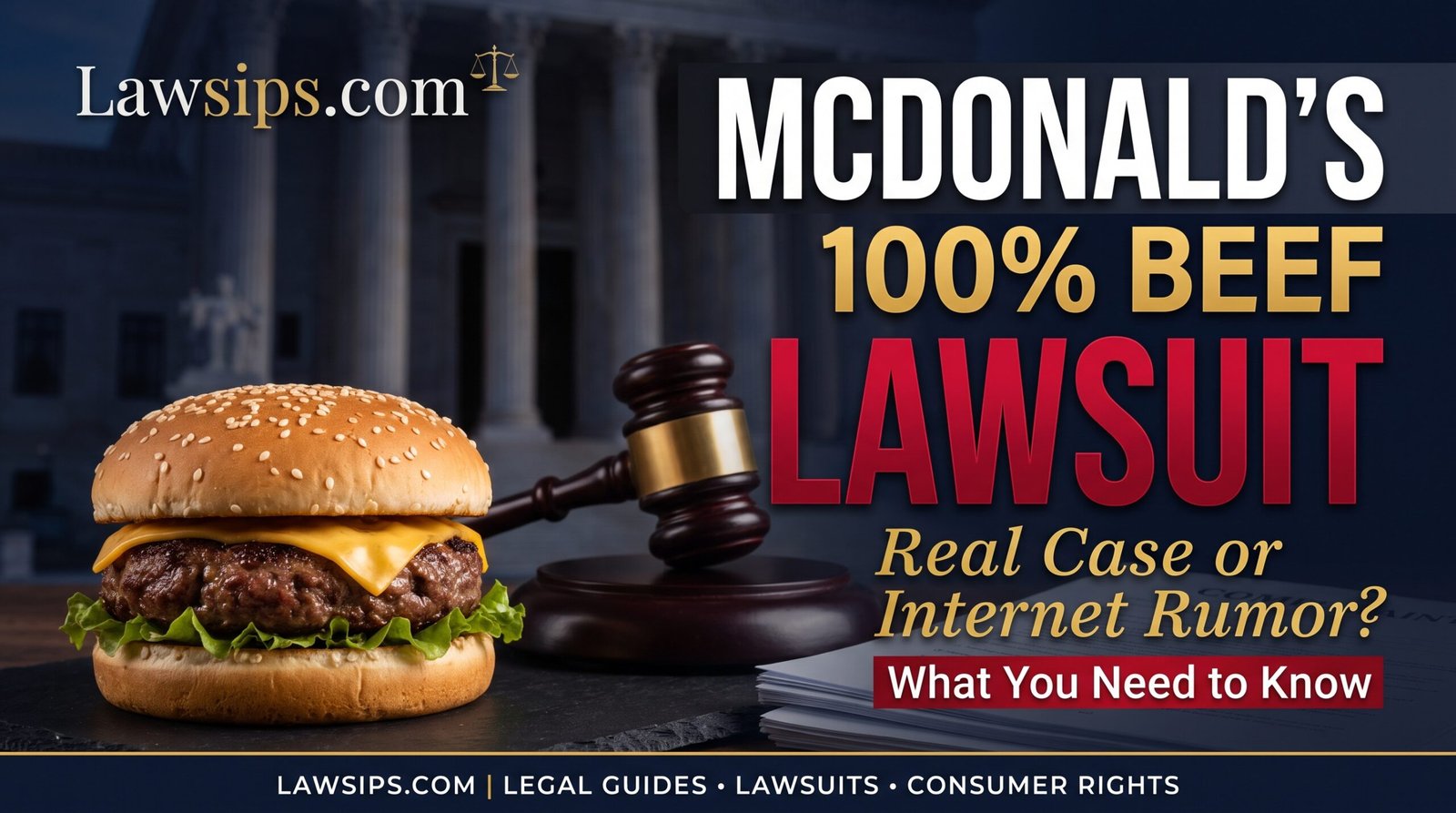
Every claim about McDonald’s beef lawsuits falls into one of three buckets. Verified means a court record, settlement administrator, or authoritative source confirms it. Debunked means fact-checkers traced it to a hoax. Unverified means only low-detail blog posts report it, with no case name or docket number you can check.
Keeping these buckets separate is the whole point of this article. Merging them is exactly how misinformation spreads, because one real settlement gets used to make unrelated rumors sound credible.
Claim Status Matrix
| Claim | Status | Evidence |
|---|---|---|
| 2001 to 2002 French fries settlement over beef flavoring | Verified | Multiple published sources report a $10 million settlement; one source reports $12.5 million under the name Block v. McDonald’s |
| McDonald’s discontinued LFTB (“pink slime”) in 2011 to 2012 | Verified | Widely reported policy change after a TV campaign; USDA and FDA considered the product safe |
| Beef Products Inc. v. ABC News defamation case | Verified | Settled in 2017 for an undisclosed sum |
| Jamie Oliver sued McDonald’s over beef | Debunked | Fact-checkers and Oliver’s own team confirm he never sued; it is a hoax |
| “100% Beef” is a supplier company name, not a claim | Debunked | No evidence supports this; it is an internet rumor |
| 2026 beef labeling class actions with payouts | Unverified | Reported only by legal blogs; no case names, docket numbers, or court documents found |
| A class action challenging patty contents exists now | Unverified | No verified docket found as of November 2026 |
What Is Actually Verified
This section covers only what published records confirm. Dates, dollar figures, and case names come from named sources, and where sources disagree, both versions appear with their sources attached.
The 2001 to 2002 French Fries Settlement
In 2001, McDonald’s faced lawsuits alleging it misled vegetarian and Hindu customers about its French fries. The fries were cooked in vegetable oil, but the oil contained beef flavoring that the company had not clearly disclosed.
Multiple published sources, including a business case study (ICMR reference BECG017) and educational summaries, report that McDonald’s agreed to pay $10 million to settle in 2002. The money was directed to vegetarian and Hindu organizations and related groups, not to individual consumers as cash payouts.
One legal blog reports a different figure: $12.5 million, under the case name Block v. McDonald’s. These two figures conflict and cannot be merged. Treat $10 million as the widely reported figure and $12.5 million as a single-source claim until a court document resolves it.
The key point for this keyword: the fries case was about flavoring disclosure in fries, not about whether burger patties contain 100% beef. Pages that cite this settlement as proof of a “beef lawsuit” against the patties are stretching the facts.
McDonald’s Discontinued LFTB in 2011 to 2012
Lean finely textured beef (LFTB), nicknamed “pink slime” by critics, is beef trimmings treated with ammonium hydroxide to kill pathogens. In 2011 to 2012, McDonald’s stopped using it in its patties, a move widely reported as following Jamie Oliver’s Food Revolution television campaign from 2011.
This was a business decision, not a lawsuit outcome. No court ordered McDonald’s to stop using LFTB, and no class action about LFTB against McDonald’s has been verified. The documented history of pink slime shows the product itself remained legal throughout.
Both the USDA and the FDA considered LFTB safe to eat at the time. Around 2018, the USDA even reclassified LFTB as “ground beef”, a regulatory detail that undercuts claims the product was secretly illegal.
Beef Products Inc. v. ABC News Settled in 2017
Beef Products Inc. (BPI), the main producer of LFTB, sued ABC News for defamation over its “pink slime” coverage. The case settled in 2017 for an undisclosed sum, after a lengthy trial in South Dakota.
This case matters because it is real, documented, and beef-related, which makes it useful camouflage for rumor pages. But BPI was the plaintiff, ABC News was the defendant, and McDonald’s was not a party. It says nothing about McDonald’s patty contents.
McDonald’s Official 100% Beef Position
McDonald’s states that its beef patties are made from 100% USDA-inspected beef, specifically cuts like chuck, round, and sirloin. The company says patties contain no fillers, extenders, or preservatives, and are seasoned only with salt and pepper after cooking.
This is the company’s own marketing and ingredient claim, repeated on its official channels. It is not a court finding, and it does not prove anything by itself. But it is also true that no court has found the claim false, and no verified lawsuit currently challenges it.
One legal blog names the company’s beef suppliers as Keystone Foods, Lopez Foods, and Cargill. That supplier list is competitor-reported, not officially confirmed in the sources reviewed, so treat it as background color rather than verified fact.
The USDA Ground Beef Standard
Under USDA rules, products labeled “ground beef” may contain up to 30% fat. They may not contain added water, phosphates, binders, or extenders. The ground beef standard is the legal backbone behind any “100% beef” claim.
“100% beef” on a label means the product is all beef and nothing else, within that standard. It does not promise a particular cut, grade, or leanness. A patty can be 100% beef and still contain up to 30% fat, because fat is part of beef.
What Has Been Debunked
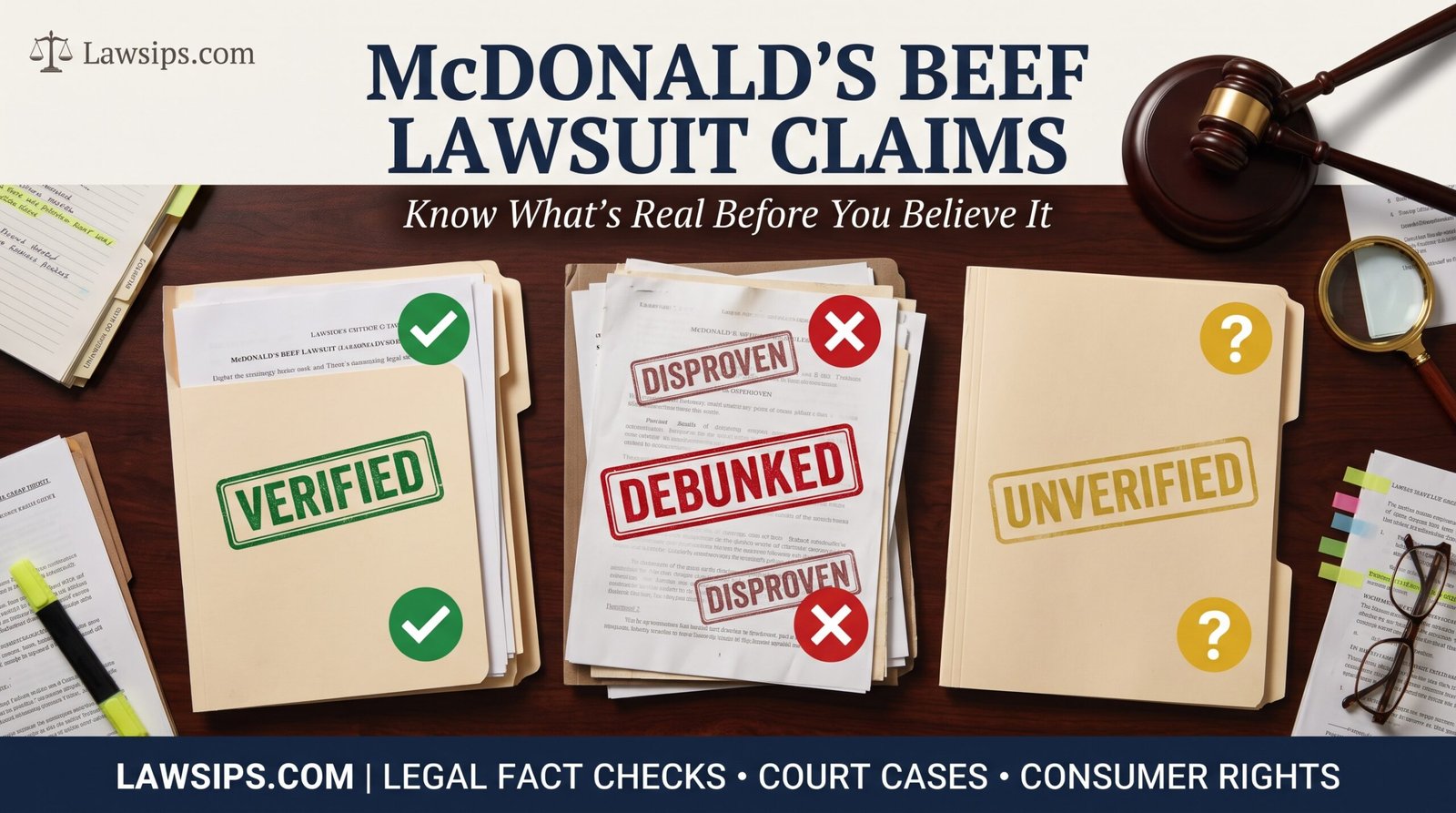
Debunked claims are not merely unproven. Fact-checkers investigated them and traced them to hoaxes, misunderstandings, or fabricated stories. Repeating them as open questions gives them credibility they have lost.
The Jamie Oliver Lawsuit Is a Hoax
The viral story says celebrity chef Jamie Oliver sued McDonald’s, proved its beef contained fillers or “pink slime,” and won a major judgment. Every part of the lawsuit framing is false.
Oliver did campaign against ammonium hydroxide-treated beef on his 2011 show Jamie Oliver’s Food Revolution. That campaign is real, and McDonald’s stopped using LFTB around the same period. But a TV campaign is not a lawsuit, and no court case followed from it.
The fact-check on the Jamie Oliver McDonald’s lawsuit claim confirms the story is fabricated. AFP, Africa Check, and BOOM Live reached the same conclusion, and Oliver’s own team confirmed in 2021 that he never sued McDonald’s.
The hoax survives because it mixes one real event (the TV campaign and the LFTB phaseout) with an invented one (a lawsuit and a courtroom win). That mixture is exactly what makes viral legal misinformation so durable.
“100% Beef” Is Not a Supplier Company Name
A persistent internet rumor claims McDonald’s can label patties “100% Beef” because that is the name of a supplier company, not a description of the meat. There is no evidence for this claim, and no such supplier has ever been identified in credible reporting.
Food labeling law does not work that way either. The USDA regulates meat label claims, and a company name trick would not survive inspection. This rumor belongs in the same category as other fast-food urban legends that collapse under basic scrutiny.
There Was No Ammonia Beef Lawsuit Against McDonald’s
Some pages imply McDonald’s was sued over ammonium hydroxide in its beef. No such case against McDonald’s has been verified. The chemical was used to treat LFTB as an antimicrobial step, regulators considered it safe, and the company voluntarily stopped using the product.
Disliking an ingredient is not the same as a lawsuit existing. Conflating criticism with litigation is one of the most common errors on this topic, and it appears on multiple competitor pages.
Myth vs. Fact
| Myth | Fact |
|---|---|
| Jamie Oliver sued McDonald’s and won | He campaigned on TV in 2011; he never filed any lawsuit, confirmed by his team in 2021 |
| “100% Beef” is a supplier’s company name | No evidence exists; USDA regulates meat label claims directly |
| McDonald’s was sued over ammonia in beef | No verified case; the company voluntarily stopped using LFTB |
| The fries settlement proves patties are not beef | The fries case was about undisclosed beef flavoring in fries, not patty contents |
| Pink slime was found illegal | USDA and FDA considered LFTB safe; USDA reclassified it as ground beef around 2018 |
| A 2026 court ordered payouts to beef buyers | No verified docket, case name, or settlement administrator has surfaced |
What Remains Unverified in 2026
This is the section that matters most for anyone considering action. Several pages describe 2026 beef labeling lawsuits against McDonald’s, complete with payout ranges and deadlines. None of the standard verification steps confirm them.
The Reported 2026 Beef Labeling Suits
According to a legal blog (LawFold, full page reviewed), lawsuits were filed in January 2026 in the Northern District of Illinois, followed by a California discovery ruling in February 2026, a consolidated motion to dismiss in March 2026, and a certification hearing projected for the third quarter of 2026. The blog describes a class period of 2020 to 2025, projected funds of $5 million to $20 million, and payouts of $5 to $100.
Those details appear only on that blog and on pages that repeat it. No case name, no docket number, and no court document is cited. Independent searches of federal court records did not surface a matching filing, and no settlement administrator lists a McDonald’s beef case.
This does not prove nothing was filed. It proves the claims are not docket-verified, which is the standard a serious legal page must meet before describing payouts and deadlines as fact.
The “Yvette Hinds” Reference
The same blog references a “Yvette Hinds McDonald’s lawsuit.” No docket, complaint, or reputable news report confirming such a case was found during research. A name in a blog post is not a case citation.
Until a court record appears, this reference should be treated as unverified background noise, not as evidence of a real proceeding. Serious pages do not build timelines on single unsourced names.
The Payout and Fund Figures
Figures like $5 to $100 per person and a $5 million to $20 million fund are presented on some pages as if they describe a real settlement. They are projections from a single blog, not administrator-published numbers, and no fund has been confirmed to exist.
In verified class actions, payout figures come from settlement agreements and court orders. When those documents are absent, any number is speculation. For context on how real payouts work, see the breakdown of settlement payout per person math.
Why No Docket Has Surfaced
Real federal class actions leave paper trails: a docket number, a complaint PDF, scheduling orders, and eventually a settlement website. High-profile food labeling cases also attract mainstream news coverage. None of that exists here.
There are innocent explanations, including sealed filings or very recent cases. But the longer detailed claims circulate without a single checkable citation, the more likely they are aggregator speculation rather than reporting.
How to Check Before You Believe
Search PACER (the federal court records system) for the Northern District of Illinois, the Central District of California, and the Southern District of New York using “McDonald’s” and “beef” as terms. Real cases appear there within days of filing.
Check whether a settlement administrator (companies like Epiq, Kroll, Angeion, or JND) lists the case. No administrator listing means no claims process exists, no matter what a blog’s deadline table says.
Be skeptical of pages that describe claim forms and deadlines without linking to an official settlement site. That pattern is a hallmark of content written for clicks, not for claimants. The step-by-step process for real cases is explained in the guide to how to claim a class action settlement.
Timeline: McDonald’s Beef Controversies, 2001 to 2026
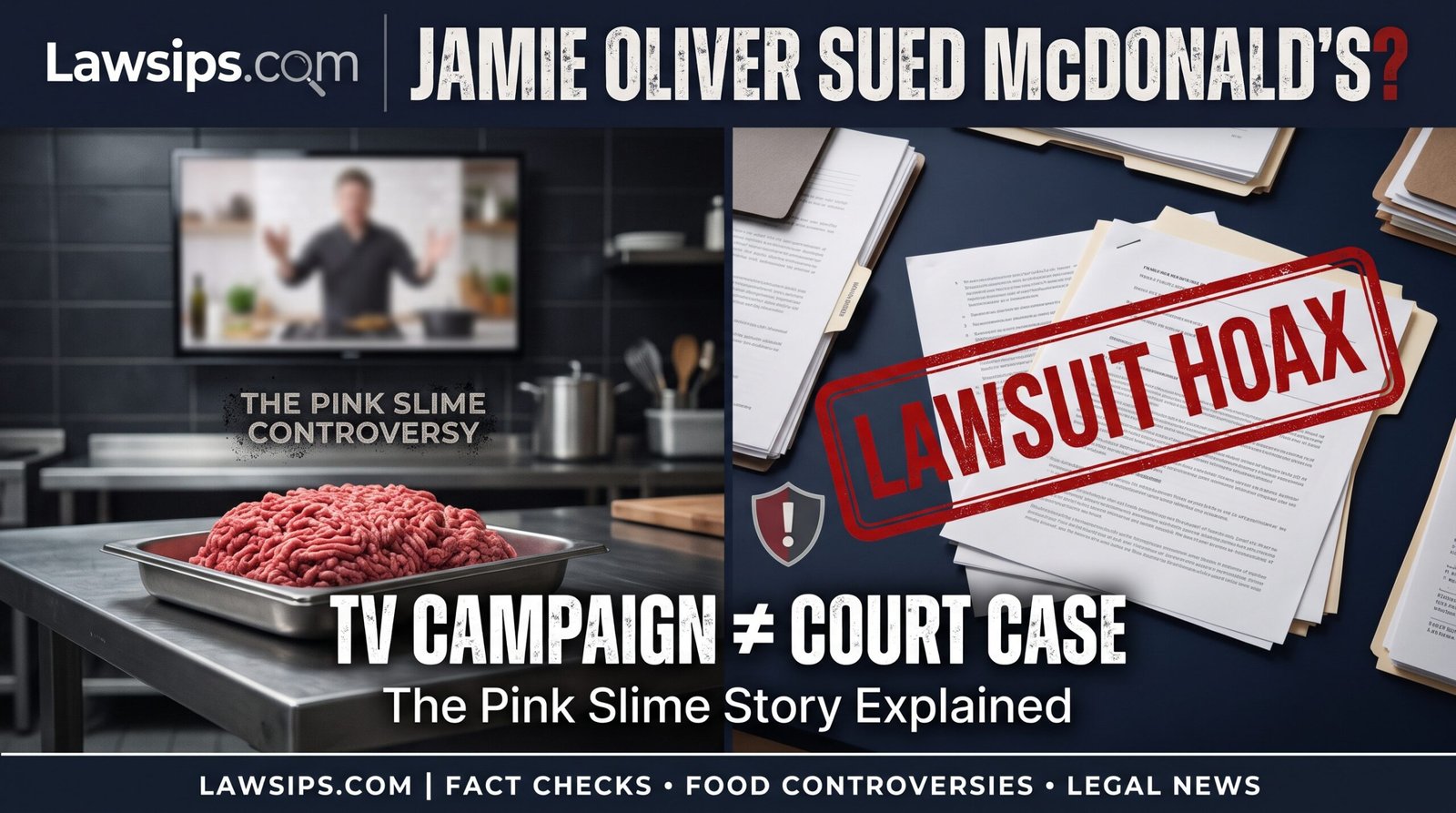
Putting events in order shows how separate stories merged into one confusing keyword. Each row below carries its verification status so the timeline itself does not mislead.
| Year | Event | Status |
|---|---|---|
| 2001 to 2002 | French fries settlement over undisclosed beef flavoring; reported around $10 million | Verified (figure conflicts: one source says $12.5 million) |
| 2011 | Jamie Oliver’s Food Revolution TV campaign against LFTB airs | Verified |
| 2011 to 2012 | McDonald’s stops using LFTB in patties as a business decision | Verified |
| 2012 onward | “Jamie Oliver sued McDonald’s” story begins circulating online | Debunked as a hoax |
| 2017 | Beef Products Inc. v. ABC News defamation case settles for an undisclosed sum | Verified |
| Around 2018 | USDA reclassifies LFTB as ground beef | Verified |
| 2021 | Oliver’s team confirms he never sued McDonald’s | Verified |
| 2026 | Blogs report new beef labeling class actions with payouts | Unverified; no docket found |
What “100% Beef” Legally Means
Most confusion about this keyword comes from not knowing the standard behind the words. Once the USDA definition is clear, many viral claims fall apart on their own.
The Ground Beef Rule
USDA regulations say ground beef may contain up to 30% fat and may not contain added water, phosphates, binders, or extenders. A product labeled “100% beef” must be entirely beef, with nothing else mixed in.
Crucially, fat counts as beef. A patty that is 80% lean and 20% fat is still 100% beef under the rule. Claims that finding fat in a patty disproves the label misunderstand the regulation.
What the Label Does Not Promise
“100% beef” does not promise a specific cut, grade, or leanness. It does not promise grass-fed, organic, or any particular sourcing. It promises composition only: the patty is beef, not beef plus soy, cereal, or other fillers.
Anyone evaluating a labeling lawsuit should ask what exactly was allegedly misrepresented. A case about leanness claims would look very different from a case about non-beef ingredients, and no verified case of either type exists here.
Why This Matters for Lawsuit Claims
Food labeling class actions succeed when plaintiffs show a specific false statement backed by testing or documents. Vague unease about fast food quality is not a legal claim, which is one reason the 2026 blog reports look thin: they describe conclusions without evidence.
The Pink Slime (LFTB) Story, Explained
Lean finely textured beef became the visual symbol of every McDonald’s beef rumor. Understanding what it actually is deflates most of the scare language around it.
What LFTB Is
LFTB is made from beef trimmings that are heated, spun in a centrifuge to separate fat, and treated with a small amount of ammonium hydroxide gas to reduce pathogens. The result is a lean beef product blended into ground beef.
The ammonium hydroxide step sounds alarming, but it was an antimicrobial treatment, and both the USDA and FDA considered the product safe. The full documented history shows regulators never banned it.
Why McDonald’s Stopped Using It
McDonald’s discontinued LFTB in 2011 to 2012 amid public pressure following the Jamie Oliver campaign and wider media coverage. The decision was about brand perception, not legal compulsion, and the company has not used it since.
Because the phaseout followed a TV campaign rather than a court order, it created a false memory of a legal defeat. That false memory is the seed of the lawsuit hoax.
The 2018 Reclassification
Around 2018, the USDA reclassified LFTB as “ground beef” rather than a separate product category. Whatever one thinks of the product, regulators moved it toward the mainstream definition, not away from it.
Where Class Actions Fit Into This Story
Readers searching this keyword often want to know whether they can join or file something. The honest answer starts with how class actions actually work, because the rumor pages skip that part.
The Basic Mechanics
A class action lets many people with the same legal complaint sue together. A court must certify the class under Federal Rule of Civil Procedure 23, which requires numerosity, commonality, typicality, and adequacy. Certification is a real hurdle, not a formality.
Most consumer class actions end in settlement, not trial, and a settlement is not a finding of wrongdoing. Anyone describing a McDonald’s beef payout should be able to name the case, the court, and the administrator. The current class action lawsuit list shows what verified open cases look like.
Joining vs. Filing vs. Claiming
These are three different tasks that rumor pages blend together. Joining means becoming part of an existing certified case, explained in the guide to how to join a class action lawsuit. Filing means starting a new case as a lead plaintiff, a much heavier lift. Claiming means submitting a form in an already-settled case, covered in how to claim a class action settlement.
For the McDonald’s beef topic, there is nothing verified to join and no settlement to claim from. Filing a new case would require evidence of a specific false statement, not just suspicion about fast food.
Finding Real Open Settlements
If your actual goal is finding payouts you qualify for, skip the rumor pages and check the settlements you can claim roundup, which tracks cases with verified administrators and deadlines. Real opportunities always link to an official settlement site.
Protecting Yourself From Fake Settlement Claims
Unverified lawsuit stories create real fraud risk. Scammers build fake claim forms around viral legal rumors, harvesting personal data from people who believe a payout is waiting.
Red Flags
Watch for pages that list deadlines and payout amounts but link to no official settlement website. Real cases always have one. Be suspicious of fees to file a claim, since legitimate class action claims are always free.
Short-link URLs in texts or social media posts promising McDonald’s settlement money are a classic phishing pattern. So are forms asking for bank logins or Social Security numbers upfront. A real administrator asks for claim details, not credentials.
What to Do Instead
Verify through PACER, court dockets, and administrator listings before entering personal information anywhere. The broader guide to how to file a claim for settlement explains the legitimate process across case types.
Mistakes Competitor Pages Make
Most ranking pages on this keyword share the same structural flaws. Naming them helps you see why this page is organized differently.
They Merge the Fries Case With Patty Claims
Competitors cite the 2001 to 2002 fries settlement as though it concerned burger patties. It did not. Using it as evidence of a “beef lawsuit” against patties is a category error, and it misleads readers about what was actually litigated.
They Report the Hoax as an Open Question
Several pages describe the Jamie Oliver story with hedging language (“some say he sued”) long after fact-checkers closed the question. Presenting a debunked hoax as unsettled is not balance; it is misinformation with caveats.
They Publish Payouts Without Dockets
The weakest pages list specific dollar amounts and deadlines for 2026 cases while citing no case name, docket number, or court document. That is not reporting. It is repeating another blog’s speculation with the uncertainty removed.
They Skip the USDA Standard Entirely
Almost no competitor explains what “100% beef” legally means. Without the USDA ground beef rule, readers cannot evaluate any labeling claim, which leaves them dependent on the page’s conclusions instead of equipped to judge.
How the 2026 Rumor Spread
Understanding how unverified claims travel is part of beating them. The 2026 McDonald’s beef story follows a pattern seen across many viral legal rumors, and each step stripped away uncertainty.
Step One: A Detailed but Uncited Post
It starts with a single blog publishing specific-sounding details: January 2026 petitions in the Northern District of Illinois, a February 2026 California discovery ruling, a March 2026 consolidated motion to dismiss, a third-quarter 2026 certification hearing, a 2020 to 2025 class period, and a $5 million to $20 million fund.
Specificity feels like verification. Exact months and dollar ranges sound like reporting, even when no case name, docket number, or court document appears anywhere in the post. That gap is the tell: real legal reporting cites its sources.
Step Two: Repetition Without Checking
Other pages then repeat the details, and each repetition drops the qualifiers. “A blog reports filings” becomes “lawsuits were filed,” which becomes “a settlement is coming.” By the third retelling, speculation reads as fact.
Search rankings accelerate this. When a page repeating the claims ranks number one, its position lends false authority, and more pages cite it. The rumor becomes self-reinforcing: visible because it is repeated, repeated because it is visible.
Step Three: The Responsible Fix
The fix is not deleting the page. It is reframing it around verification tiers, which is what this article does. Keep the reported claims, label them unverified, show readers how to check dockets, and update the moment a real case number appears.
That approach serves readers better than either silent deletion or blind repetition. It also protects the publisher, because presenting unverified claims as fact is how legal content loses trust.
Who Regulates the Label: USDA vs. FDA
Competitor pages almost never explain who actually polices a “100% beef” label. The answer matters, because it shows why some viral theories cannot work.
USDA FSIS Covers Meat Labels
The FDA regulates most packaged food labels, but meat, poultry, and egg products fall under the USDA’s Food Safety and Inspection Service (FSIS). McDonald’s beef patties sit on the USDA side of that line.
FSIS pre-approves meat labels before they reach the market. A scheme like the rumored “supplier company name” trick would have to pass federal label review, which is one more reason the rumor collapses under scrutiny.
Composition Claims vs. Nutrient Claims
“100% beef” is a composition claim: it describes what the product is made of. Nutrient claims like “lean” or “extra lean” follow separate definitions, with “lean” meaning less than 10 grams of fat per 100 grams, among other limits.
This distinction shapes what a real labeling case would need. Proving a composition claim false requires lab testing showing non-beef ingredients, not customer suspicion or a viral video. No such testing has surfaced in any verified proceeding against McDonald’s.
Frequently Asked Questions
Is there a McDonald’s 100% beef lawsuit?
No verified class action challenging the “100% beef” claim exists as of November 2026. Real history (the fries settlement), debunked myths (the Jamie Oliver hoax), and unverified 2026 blog claims are three separate things.
Did McDonald’s settle a beef lawsuit for $10 million?
Multiple sources report a $10 million settlement in 2001 to 2002, but it concerned undisclosed beef flavoring in French fries, not patty contents. One blog reports $12.5 million under the name Block v. McDonald’s, which conflicts with the wider reporting.
Did Jamie Oliver sue McDonald’s?
No. Oliver campaigned against LFTB on his 2011 TV show, but he never filed a lawsuit. Fact-checkers including Snopes, AFP, Africa Check, and BOOM Live debunked the claim, and his team confirmed it in 2021.
What is pink slime?
“Pink slime” is a nickname for lean finely textured beef (LFTB), beef trimmings treated with ammonium hydroxide to reduce pathogens. The USDA and FDA considered it safe, and the USDA reclassified it as ground beef around 2018.
Does McDonald’s still use pink slime?
No. McDonald’s stopped using LFTB in 2011 to 2012 as a business decision following public pressure. The company states its patties are 100% USDA-inspected beef with no fillers or extenders.
What does 100% beef legally mean?
Under USDA rules, ground beef may contain up to 30% fat and no added water, binders, or extenders. “100% beef” means the product is entirely beef, and fat counts as beef, so leanness is not promised.
Are there 2026 McDonald’s beef labeling lawsuits?
Some blogs describe 2026 filings with payouts of $5 to $100, but no case name, docket number, or court document has surfaced. These claims are unverified and should not be treated as fact.
Can I file a claim for a McDonald’s beef settlement?
No verified claim form exists for any “100% beef” case. Any page or message offering one without linking to an official settlement administrator should be treated as suspicious.
Who were the suppliers of McDonald’s beef?
One legal blog names Keystone Foods, Lopez Foods, and Cargill as suppliers. That list is competitor-reported, not officially confirmed, so treat it as background rather than verified fact.
What was the BPI v. ABC News case?
Beef Products Inc., the main LFTB producer, sued ABC News for defamation over “pink slime” coverage. It settled in 2017 for an undisclosed sum. McDonald’s was not a party.
Is “100% Beef” secretly a company name?
No. This is an internet rumor with no evidence behind it. The USDA regulates meat label claims, and a supplier-name trick would not survive inspection.
Was McDonald’s sued over ammonia in its beef?
No verified case exists. Ammonium hydroxide was used to treat LFTB as an antimicrobial step, regulators deemed it safe, and McDonald’s voluntarily stopped using the product.
How can I verify a lawsuit claim myself?
Search PACER for federal filings, look for the case on a settlement administrator’s site (Epiq, Kroll, Angeion, JND), and check for mainstream news coverage. Real cases leave all three trails.
What is the difference between joining and filing a class action?
Joining means entering an existing certified case. Filing means starting a new one as a lead plaintiff, which requires evidence and an attorney. Claiming means submitting a form in an already-settled case.
Do class action settlements admit wrongdoing?
Usually not. Most settlements include no admission of liability. A settlement is a business decision to resolve risk, not a court finding that the claims were true.
Why do blogs report lawsuits with no docket?
Some legal blogs publish speculation based on filings they describe but never cite. Others repeat those posts with the uncertainty removed. Always trace a claim back to a case name or docket number.
Could a real beef labeling case appear later?
Possibly. Food labeling litigation is active, and new cases are filed regularly. This page describes the state of verification as of November 2026; check dockets for anything newer.
What should I do if I get a text about McDonald’s settlement money?
Do not click or reply. Texts promising settlement payouts via short links are a classic phishing pattern. Verify through official administrator sites only, and never pay a fee to file a claim.
Does a settlement payout get taxed?
It depends on the type of payment. This is general information, not tax advice; check IRS guidance or a tax professional for your situation.
Where can I find real open class action settlements?
Use roundups that link to official settlement sites with named administrators and court-approved deadlines, and always confirm details on the settlement’s own website before filing.
Has any court ruled McDonald’s patties are not beef?
No. No court has found that McDonald’s patties contain non-beef ingredients. The company’s 100% beef claim stands unchallenged in any verified proceeding.
What is ammonium hydroxide and why was it used in beef?
Ammonium hydroxide is a compound used in tiny amounts as an antimicrobial step when producing LFTB. Regulators considered the treated product safe to eat, and its use was a processing aid, not a filler.
Can I sue McDonald’s myself over beef labeling?
Anyone can consult an attorney, but a real case needs evidence of a specific false statement, not just suspicion. Starting a class action as a lead plaintiff is a multi-year commitment explained in the guide to how to file a class action lawsuit. General information only, not legal advice.
How long do food labeling class actions usually take?
Most take two to five years from filing to resolution, with certification fights consuming much of that time. Cases that settle often do so after certification is decided, which is why early payout predictions are unreliable.
Did McDonald’s ever admit its beef was not 100% beef?
No. The company has consistently maintained that its patties are 100% USDA-inspected beef, and no court has found otherwise. The fries settlement involved flavoring disclosure, not patty composition.
What is a lead plaintiff?
A lead plaintiff is the named person representing the class, who participates in discovery and depositions. Courts can approve service awards for that work, separate from any class-wide recovery.
Why does this keyword confuse so many people?
Because one real settlement (fries, 2002), one real policy change (LFTB, 2012), and one viral hoax (the Oliver lawsuit) all involve McDonald’s and beef. Pages that merge them create the illusion of a single ongoing scandal.
Key Takeaways
One real settlement: McDonald’s paid a reported $10 million in 2001 to 2002 over undisclosed beef flavoring in French fries, not over patty contents. A single blog’s $12.5 million figure conflicts with wider reporting.
One real policy change: the company stopped using LFTB (“pink slime”) in 2011 to 2012 after a TV campaign, not a lawsuit. Regulators considered the product safe, and the USDA later reclassified it as ground beef.
One proven hoax: Jamie Oliver never sued McDonald’s. Fact-checkers and his own team confirmed this in 2021, yet the story still circulates as if it were an open question.
Zero verified 2026 cases: blog reports of new beef labeling class actions cite no case name, docket number, or court document. No claim form exists, and no settlement administrator lists a case.
One legal standard: USDA rules let ground beef contain up to 30% fat with no added water, binders, or extenders. “100% beef” is a composition claim, and fat counts as beef.
One verification habit: real cases always leave a case name, a docket number, and an official settlement site. Demand all three before believing, sharing, or acting on any lawsuit claim.
Conclusion
The mcdonalds 100 beef lawsuit story is really three stories wearing one headline. A verified fries settlement from 2002 that had nothing to do with patties. A debunked lawsuit hoax built on a real TV campaign. And a set of 2026 blog claims with no docket behind them.
What survives verification is narrow but clear. McDonald’s paid a real settlement over fries flavoring disclosure more than two decades ago. It voluntarily dropped LFTB in 2011 to 2012. The USDA ground beef standard defines what “100% beef” means, and no court has found McDonald’s patties violate it.
Before you share, cite, or act on any beef lawsuit claim, demand the three things real cases always have: a case name, a docket number, and an official settlement site. Anything missing all three is not ready to publish as fact, and pages that present it that way are doing their readers a disservice.
Next step: if you are hunting for real payouts, browse the verified class action lawsuit list and the settlements you can claim roundup, and confirm every deadline on the official settlement site. General information only; this is not legal advice.

Dilawar is a dedicated writer and contributor at Lawsips.com, focusing on legal information, business law, consumer rights, legal awareness, and everyday legal matters. He is passionate about simplifying complex legal topics and providing readers with clear, practical, and easy-to-understand information. His goal is to help readers stay informed about legal developments, understand their rights, and make better decisions through informative and well-researched articles.