

Every day, in courtrooms across America, a stranger’s life can change in minutes. A traffic stop becomes an arrest. A text message becomes evidence. A single signature on a plea form becomes a permanent record that follows someone for decades.
Most people never think about Criminal Law until it touches them or someone they love. By then, the rules feel confusing, the vocabulary feels foreign, and the stakes feel enormous.
Table of Contents
What Is Criminal Law?
Criminal law is the body of rules that defines which conduct is a crime and sets the punishments for it. It also governs how governments investigate, charge, try, and punish people accused of crimes.
The goal is to protect public safety, deter harmful behavior, and hold wrongdoers accountable. In a criminal case, the government, not the victim, brings the case against the accused.
Quick Answer
Criminal law is the part of the legal system that deals with offenses against society, such as theft, assault, fraud, and murder. A person found guilty may face punishment such as fines, probation, or imprisonment.
Why It Matters to Everyone
Criminal law affects far more than people in court. It shapes what is allowed in public, what employers can ask about, and how police are allowed to act.
It also protects individuals by limiting what the government can do, through rules about searches, arrests, and fair trials.
Two Parts of Criminal Law: Substantive and Procedural
Lawyers usually split criminal law into two broad parts. Understanding the difference clears up much of the confusion.
| Part | What It Covers | Example |
|---|---|---|
| Substantive criminal law | Defines crimes and punishments | The definition of burglary and its penalty |
| Criminal procedure | Rules for investigating and prosecuting | Search warrants, arrests, trials, appeals |
Substantive Criminal Law
Substantive law answers the question: what is a crime? It lists the elements of each offense and the possible punishments.
Each state has its own criminal code, and the federal government has its own as well.
Criminal Procedure
Procedure answers a different question: how must the government handle a case? It includes the constitutional rules that limit police and prosecutors.
Procedure is where rights such as remaining silent and having a lawyer come into play.
Where Does Criminal Law Come From?
Criminal law is not found in a single book. It comes from several sources that work together.
The Constitution
The U.S. Constitution sets the outer limits. Amendments such as the Fourth, Fifth, Sixth, Eighth, and Fourteenth protect people accused of crimes.
Statutes
Legislatures write criminal statutes. Congress writes federal crimes, and each state legislature writes state crimes.
Today, most crimes are defined by statute, even though many have roots in old English common law.
Court Decisions
Judges interpret statutes and the Constitution. Their rulings can change how laws are applied across an entire state or country.
Regulations and Local Ordinances
Some agencies and cities can create rules that carry criminal penalties. Examples include certain environmental rules and local ordinances such as noise or curfew violations.
The Model Penal Code
The American Law Institute published the Model Penal Code in 1962. It is not law itself, but many states used it as a guide when updating their criminal codes.
The Basic Elements of a Crime
To convict someone, the government must usually prove several elements beyond a reasonable doubt. Think of a crime as a recipe, where every ingredient must be present.
Actus Reus: The Guilty Act
Actus reus is the physical act, or sometimes a failure to act when the law requires action. Thoughts alone are generally not crimes.
Examples include taking property, striking someone, or failing to file a required report.
Mens Rea: The Guilty Mind
Mens rea refers to the mental state at the time of the act. It asks whether the person acted on purpose, knowingly, recklessly, or negligently.
The Model Penal Code uses four main levels: purposely, knowingly, recklessly, and negligently.
| Mental State | Meaning |
|---|---|
| Purposely | The person’s goal was to cause the result |
| Knowingly | The person was aware the result was practically certain |
| Recklessly | The person consciously ignored a substantial risk |
| Negligently | The person should have been aware of a substantial risk |
Concurrence
The guilty act and the guilty mind must happen together. A person who accidentally causes harm and only later feels glad has not committed the crime.
Causation
The defendant’s conduct must cause the harm. Courts ask whether the harm would have happened without the conduct and whether the result was reasonably foreseeable.
Harm
Many crimes require actual harm, such as injury or loss. Others punish risky behavior even if nobody was hurt, such as drunk driving.
Strict Liability Offenses
A few offenses do not require a guilty mind. Certain traffic, regulatory, and statutory offenses are examples.
These offenses are usually less serious, though exceptions exist.
How Crimes Are Classified
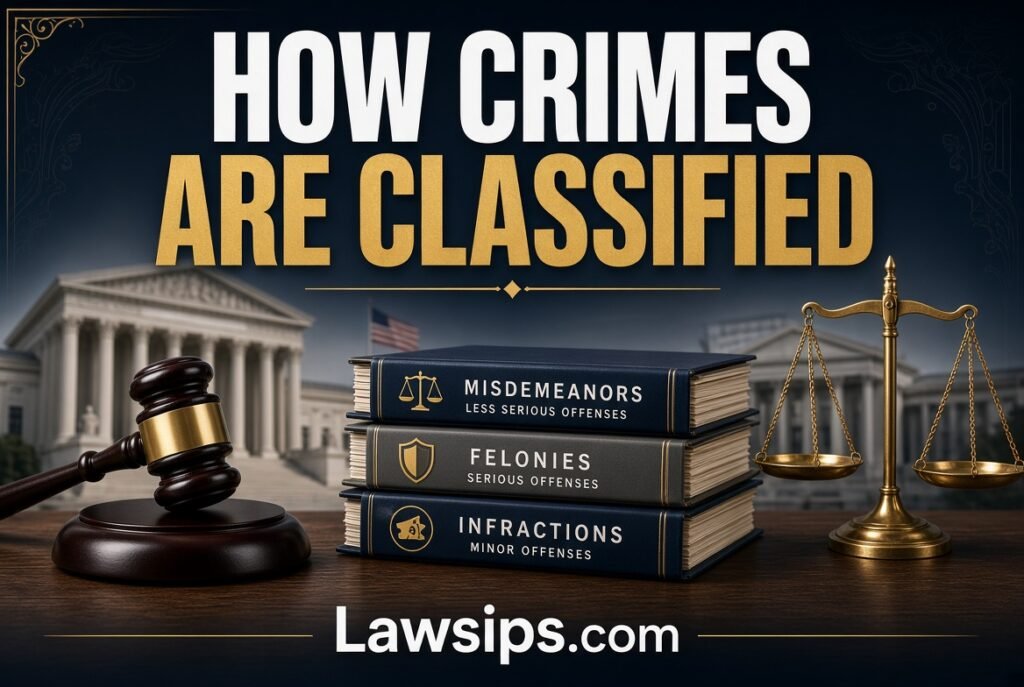
Not every crime is treated the same way. Classification affects penalties, court procedures, and long-term consequences.
| Category | General Meaning | Typical Penalty |
|---|---|---|
| Felony | Serious crime, often punishable by more than one year in prison | Prison, large fines, loss of some rights |
| Misdemeanor | Less serious crime | Up to one year in jail, fines, probation |
| Infraction or violation | Minor offense | Fines, usually no jail |
Felonies
Felonies include murder, robbery, aggravated assault, and large-scale fraud. A felony conviction can limit employment, housing, and firearm rights.
Misdemeanors
Misdemeanors include simple assault, petty theft, and many first-time offenses. They can still carry jail time and a lasting record.
Infractions
Infractions include most traffic tickets and minor local violations. They are usually handled with fines and do not involve a right to a jury trial in most places.
State Differences
Definitions and penalties differ across states. An act that is a felony in one state may be a misdemeanor in another.
Common Types of Crimes
Criminal codes cover a huge range of conduct. Grouping crimes into categories makes the system easier to understand.
Violent Crimes
Violent crimes involve force or threats against people. They include murder, manslaughter, assault, battery, robbery, kidnapping, and sexual offenses.
Property Crimes
Property crimes target belongings rather than people. They include theft, burglary, arson, vandalism, and motor vehicle theft.
White-Collar Crimes
White-collar crimes are usually non-violent and financial. Examples include fraud, embezzlement, insider trading, bribery, and money laundering.
Drug Crimes
Drug offenses cover possession, distribution, manufacturing, and trafficking of controlled substances. Laws, especially on cannabis, differ between states and federal law and have been changing, so current rules should always be checked.
Public Order Crimes
These crimes disturb community order. Examples include disorderly conduct, public intoxication, trespassing, and loitering in some places.
Cybercrimes
Cybercrimes involve computers or networks. They include hacking, online fraud, identity theft, and distribution of illegal content.
Crimes Against Children and Families
Child abuse, neglect, endangerment, and certain domestic violence offenses are treated seriously. Many states have special laws and procedures for them.
Traffic and DUI Offenses
Driving under the influence is a criminal offense in every state. Penalties can include fines, license suspension, and jail time.
Inchoate Crimes: Attempt, Conspiracy, and Solicitation

Some crimes punish steps taken toward a crime, even if the final harm never occurs. These are called inchoate offenses.
Attempt
Attempt occurs when someone intends to commit a crime and takes a substantial step toward it. The plan fails or is interrupted, but the person may still be guilty of attempt.
Conspiracy
Conspiracy is an agreement between two or more people to commit a crime. Many jurisdictions also require an act in furtherance of the plan.
Solicitation
Solicitation happens when someone asks, encourages, or hires another person to commit a crime. The crime does not need to occur.
Accomplice Liability
A person can be responsible for a crime even without being the main actor. The law treats people who help as accomplices in many situations.
Aiding and Abetting
Helping someone commit a crime with the intent to assist can create liability. Examples include acting as a lookout or providing tools.
Accessory After the Fact
Helping someone avoid arrest or prosecution after a crime can also be a crime. This includes hiding the person or destroying evidence.
Felony Murder
Under the felony murder rule in many states, a death caused during certain dangerous felonies can lead to murder charges for participants, even if they did not directly kill. The rule varies and has been limited in some states.
Understanding Homicide Laws
Homicide, meaning one person causing another’s death, is not always murder. The law distinguishes between types based on mental state and circumstances.
| Type | General Meaning |
|---|---|
| First-degree murder | Intentional, usually premeditated killing |
| Second-degree murder | Intentional killing without premeditation, or extreme recklessness |
| Voluntary manslaughter | Killing in the heat of passion after provocation |
| Involuntary manslaughter | Unintentional killing through recklessness or negligence |
| Justifiable homicide | Lawful killing, such as certain self-defense cases |
Why the Differences Matter
The category affects the potential sentence, which can range from probation to life in prison. States define these terms differently, so local law matters.
Criminal Law vs Civil Law
Many people confuse criminal and civil cases. They are separate systems with different goals and rules.
| Feature | Criminal Law | Civil Law |
|---|---|---|
| Who brings the case | Government (prosecutor) | Private person or company |
| Purpose | Punish wrongdoing and protect society | Resolve disputes and provide compensation |
| Burden of proof | Beyond a reasonable doubt | Usually preponderance of the evidence |
| Possible outcomes | Fines, probation, prison | Money damages, court orders |
| Right to appointed lawyer | Yes, for people who cannot afford one in many cases | Generally no |
Same Event, Two Cases
One incident can lead to both criminal and civil cases. For example, a drunk driving crash can trigger a criminal prosecution and a separate civil lawsuit for injuries.
Civil outcomes do not require proof beyond a reasonable doubt, which is why results can differ.
Civil Lawsuits in the News
Many high-profile disputes today are civil, such as consumer class actions. Examples include the Panera class action lawsuit, the DoorDash lawsuit, and the Netflix class action lawsuit.
These cases typically seek compensation, not punishment like prison.
When Injuries Are Involved
If you were hurt by someone’s actions, a civil claim may be possible even without criminal charges. This guide explains whether you need a personal injury lawyer and what to consider before deciding.
Burden of Proof in Criminal Cases
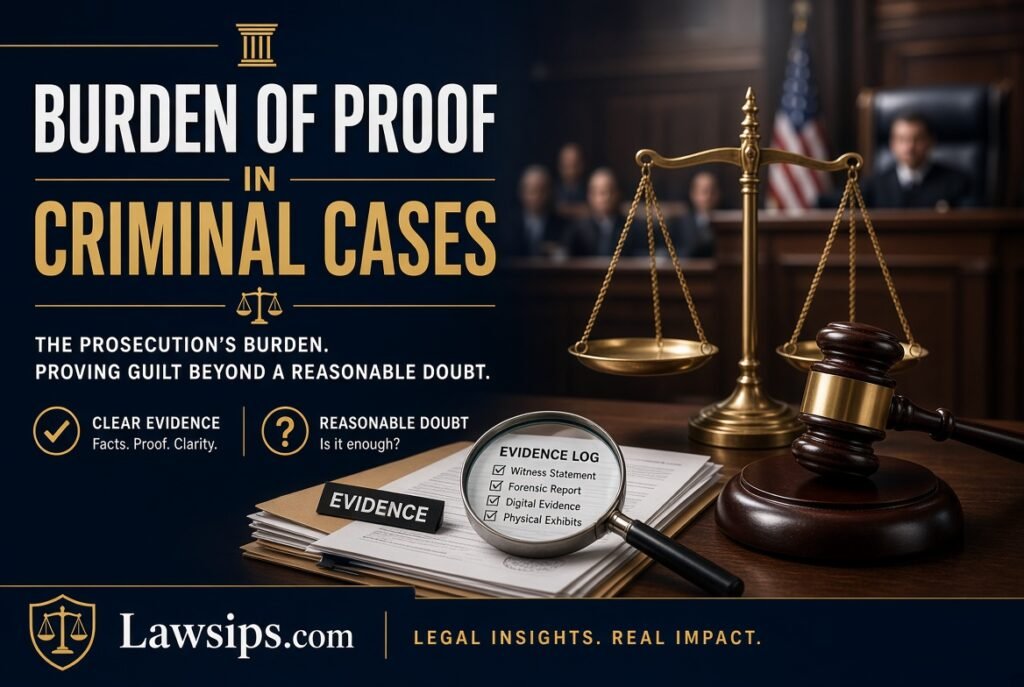
The prosecution must prove guilt, not the defendant’s innocence. This principle protects the presumption of innocence.
Beyond a Reasonable Doubt
The U.S. Supreme Court held in In re Winship (1970) that due process requires proof beyond a reasonable doubt. It is the highest standard in law.
It does not mean absolute certainty. It means the evidence must leave no reasonable doubt in the mind of a fair, careful juror.
Presumption of Innocence
A defendant is presumed innocent until proven guilty. The jury is told not to treat an arrest or charge as evidence of guilt.
The Defendant Does Not Have to Prove Anything
A defendant may choose not to testify, and the jury cannot hold that choice against them. In some cases, the defendant has to raise certain defenses, but the prosecution keeps the main burden.
Your Constitutional Rights in a Criminal Case
The Constitution gives powerful protections to people accused of crimes. Knowing them is essential.
| Amendment | Key Protections |
|---|---|
| Fourth | Protection against unreasonable searches and seizures; warrants require probable cause |
| Fifth | Right to remain silent, protection against double jeopardy, due process, grand jury for federal felonies |
| Sixth | Speedy and public trial, impartial jury, right to confront witnesses, right to a lawyer |
| Eighth | No excessive bail or fines, no cruel and unusual punishment |
| Fourteenth | Due process and equal protection applied to state governments |
The Right to Remain Silent
The Fifth Amendment protects against self-incrimination. In Miranda v. Arizona (1966), the Supreme Court required warnings before custodial police questioning.
You usually have to say clearly that you are invoking your right to remain silent and want a lawyer.
The Right to a Lawyer
In Gideon v. Wainwright (1963), the Court held that states must provide a lawyer to people charged with serious crimes who cannot afford one. Later decisions extended this to cases where jail time can result.
Protection From Unreasonable Searches
Police generally need a warrant, consent, or a recognized exception to search. In Mapp v. Ohio (1961), the Court applied the exclusionary rule to states, which can keep illegally obtained evidence out of trial.
Stops and Frisks
In Terry v. Ohio (1968), the Court allowed brief stops and limited pat-downs when officers have reasonable suspicion. This is a lower standard than probable cause.
The Right to a Jury Trial
The Sixth Amendment guarantees a jury trial for serious offenses. Defendants can waive it and choose a trial before a judge.
Protection From Double Jeopardy
The Fifth Amendment generally prevents the government from trying someone twice for the same offense after acquittal or conviction. Separate sovereigns, such as a state and the federal government, can sometimes prosecute separately, as the Court confirmed in Gamble v. United States (2019).
The Right to Evidence Disclosure
In Brady v. Maryland (1963), the Court held that prosecutors must disclose material evidence favorable to the defense. Failure to do so can lead to overturned convictions.
How a Criminal Case Works: Step by Step
A criminal case follows a series of stages. The details vary by state, but the overall path is similar.
| Stage | What Happens |
|---|---|
| Investigation | Police collect evidence and identify suspects |
| Arrest | Person is taken into custody with a warrant or probable cause |
| Booking | Fingerprints, photos, and basic information are recorded |
| Initial appearance | Judge informs the person of charges and addresses bail |
| Charging | Prosecutor files a complaint, information, or grand jury indictment |
| Preliminary hearing | Judge decides if there is probable cause to proceed |
| Arraignment | Defendant enters a plea of guilty, not guilty, or no contest |
| Discovery | Both sides exchange evidence |
| Pretrial motions | Lawyers ask the judge to exclude evidence or dismiss charges |
| Plea negotiations | Parties may agree to a plea deal |
| Trial | Evidence is presented to a judge or jury |
| Verdict | Guilty or not guilty decision |
| Sentencing | Judge decides the punishment after a conviction |
| Appeal | Higher court reviews legal errors |
Investigation and Arrest
Police can arrest someone with a warrant or with probable cause that a crime has occurred and the person committed it. After arrest, the person is booked and held.
Initial Appearance and Bail
Courts generally must find probable cause within about 48 hours of a warrantless arrest, under the Supreme Court’s ruling in County of Riverside v. McLaughlin. At the initial appearance, the judge informs the person of charges and considers release conditions.
The Eighth Amendment bars excessive bail. Judges can set conditions such as bail, supervision, or detention in some cases.
Charging Decisions
Prosecutors decide whether to charge and what to charge. Federal felonies generally require a grand jury indictment, while many states use a preliminary hearing instead.
Arraignment and Pleas
At arraignment, the defendant hears the charges and enters a plea. A no contest plea is treated like a guilty plea for the case, but may have different effects in later civil lawsuits.
Discovery
Discovery lets the defense see the evidence. It includes police reports, witness statements, lab results, and recordings.
Pretrial Motions
Lawyers can ask the judge to suppress illegally obtained evidence, dismiss charges, or change the trial location. These motions can decide a case before trial.
Trial
At trial, the prosecution presents evidence first. The defense can cross-examine witnesses and present its own evidence.
The jury or judge decides guilt. In felony jury trials, the verdict must be unanimous, following the Supreme Court’s decision in Ramos v. Louisiana (2020).
Sentencing
After a conviction, the judge determines the sentence. Judges consider the offense, the defendant’s history, and statutory guidelines.
Appeals
A defendant who is convicted can appeal for legal errors. Appeals do not retry the facts but review whether the law and procedures were applied correctly.
Plea Bargains: How Most Cases End
Most criminal convictions in the United States result from guilty pleas, not jury trials. A plea bargain is an agreement in which the defendant pleads guilty in exchange for some benefit.
Common Types of Plea Deals
- Charge bargaining: the defendant pleads to a lesser charge.
- Sentence bargaining: the prosecutor recommends a lighter sentence.
- Count bargaining: the defendant pleads to some charges while others are dropped.
Benefits of Plea Deals
Plea deals offer certainty, faster resolution, and often a lighter sentence. They also reduce the burden on busy courts.
Risks of Plea Deals
A guilty plea waives the right to trial and creates a criminal record. Some pleas also carry serious side effects, such as immigration consequences.
Why Legal Advice Matters Before Pleading
Anyone offered a plea should understand all consequences first. A lawyer can explain how the plea affects sentencing, record, immigration status, and professional licenses.
Common Criminal Defenses
A defense does not always mean the person denies the act. Some defenses challenge the evidence, and others offer a legal justification or excuse.
| Defense | Basic Idea |
|---|---|
| Self-defense | Reasonable force to protect against imminent harm |
| Defense of others | Force used to protect another person |
| Insanity | Mental illness prevented understanding the wrongfulness of the act |
| Duress | Acting under an unlawful threat of serious harm |
| Necessity | Breaking the law to avoid a greater harm |
| Entrapment | Government induced a person who was not otherwise inclined |
| Mistake of fact | Honest mistake negates the required mental state |
| Intoxication | Involuntary or, in some cases, voluntary intoxication affects intent |
| Alibi | Defendant was elsewhere when the crime occurred |
| Consent | Valid consent in limited situations |
| Constitutional violation | Evidence was obtained illegally |
Self-Defense
Self-defense allows reasonable force to stop an imminent threat. Some states require a duty to retreat when possible, while others follow stand-your-ground rules.
Many states also recognize the castle doctrine, which gives stronger protection when defending your home.
The Insanity Defense
The insanity defense applies when mental illness prevents a person from understanding the nature or wrongfulness of their conduct. It is rarely successful and is defined differently across states, with tests such as the M’Naghten rule and the Model Penal Code standard.
Entrapment
Entrapment applies when government agents induce a crime that the person was not predisposed to commit. Merely giving someone an opportunity to commit a crime is not enough.
Challenging the Evidence
Some of the strongest defenses attack the prosecution’s proof. Examples include weak identification, unreliable witnesses, flawed forensic methods, or illegal searches.
Affirmative Defenses
An affirmative defense admits the act but offers a justification or excuse. In many cases, the defendant has to raise it and provide some evidence.
Sentencing and Punishment
If a person is convicted, the court imposes a sentence. The goals include punishment, deterrence, rehabilitation, and public protection.
Types of Sentences
| Sentence | Description |
|---|---|
| Fines | Monetary penalty paid to the government |
| Restitution | Payment to the victim for losses |
| Probation | Supervised release in the community with conditions |
| Jail | Short-term custody, usually for misdemeanors |
| Prison | Long-term custody, usually for felonies |
| Community service | Unpaid work for the community |
| Treatment programs | Court-ordered drug, alcohol, or mental health programs |
| Death penalty | Capital punishment in jurisdictions that allow it |
Concurrent and Consecutive Sentences
When someone is convicted of multiple crimes, sentences may run at the same time, called concurrent, or one after the other, called consecutive. This choice can change total time served dramatically.
Sentencing Guidelines and Mandatory Minimums
Federal courts use sentencing guidelines that became advisory after United States v. Booker (2005). Some laws also set mandatory minimum sentences for certain offenses.
Factors Judges Consider
Judges look at the seriousness of the offense, the defendant’s record, remorse, role in the crime, and harm to victims. Letters and testimony can influence the outcome.
Probation, Parole, and Supervised Release
Probation is a sentence served in the community. Parole is early release from prison under supervision in many states, and federal courts now use supervised release after prison.
The Death Penalty
Capital punishment remains legal in the federal system and in some states. Many other states have abolished it or paused executions, and cases follow special rules and extra appeals.
Federal vs State Criminal Law
The United States has two parallel criminal systems. Most crimes are state crimes, but some fall under federal law.
| Feature | State Criminal Law | Federal Criminal Law |
|---|---|---|
| Who writes the laws | State legislatures | Congress |
| Typical cases | Assault, burglary, DUI, murder | Drug trafficking across states, immigration crimes, federal fraud |
| Where cases are tried | State courts | U.S. District Courts |
| Prosecutors | District attorneys | U.S. Attorneys |
When a Crime Is Federal
A crime may be federal if it crosses state lines, involves federal property, violates federal programs, or targets federal officers. Examples include mail fraud, wire fraud, and large drug conspiracies.
Overlap
Some conduct can violate both state and federal laws. Courts allow separate prosecutions in many cases under the dual sovereignty doctrine.
Why It Matters
Federal sentences and procedures can differ sharply from state ones. Charges in federal court often involve different rules and stricter sentencing guidelines.
Juvenile Criminal Law
Young people are generally treated differently from adults. Juvenile courts focus more on rehabilitation than punishment.
How It Works
Juvenile cases usually begin with an intake process. The court can offer diversion, probation, treatment, or placement in a juvenile facility.
When Juveniles Face Adult Court
Serious offenses can lead to transfer to adult court in some states. The rules depend on age and the offense.
Supreme Court Limits
The Supreme Court has held that executing people for crimes committed under 18 is unconstitutional in Roper v. Simmons (2005). It has also limited life without parole for juveniles, including in Graham v. Florida (2010) and Miller v. Alabama (2012).
Statutes of Limitations
A statute of limitations sets a deadline for the government to bring charges. After that time, prosecution may be barred.
How They Work
Deadlines vary by offense and state. Federal law generally sets a five-year limit for most non-capital offenses, with exceptions.
Crimes With No Time Limit
Many states have no limit for murder and some other serious crimes. Some also extend deadlines for sexual offenses, especially involving children.
Pausing the Clock
The clock can be paused, or tolled, in some situations, such as when the defendant flees. Rules differ, so legal advice matters.
What to Do If You Are Arrested
Few people know what to do in the moment. Calm, simple steps can protect your rights.
Stay Calm and Do Not Resist
Do not run, argue, or physically resist, even if you believe the arrest is wrong. Resisting can create new charges and risk injury.
Say the Key Words
Clearly say: “I am invoking my right to remain silent, and I want a lawyer.” Then stop talking about the case.
Do Not Consent to Searches
You can say, “I do not consent to a search.” Do this calmly, and do not physically interfere.
Do Not Discuss the Case
Do not talk about the case with anyone except your lawyer. Jail calls are often recorded.
Do Not Sign Anything Without Advice
Do not sign statements or waivers without a lawyer’s guidance. Ask for a copy of anything you are given.
Do Not Lie
Lying to police can lead to extra charges and harm your credibility. Staying silent is safer than lying.
Write Down Details
As soon as you can, write down what happened, who was present, and anything the officers said. Memory fades quickly.
Do You Need a Criminal Defense Lawyer?
If you are being investigated or charged, the answer is almost always yes. Criminal cases carry consequences that can last for life.
This guide offers general legal information, not legal advice, and laws differ by state and change over time. For your situation, talk to a licensed attorney in your jurisdiction.
What a Defense Lawyer Does
A criminal defense lawyer explains your rights, reviews evidence, negotiates with prosecutors, and represents you in court. They can spot constitutional violations and weak points that laypeople miss.
Public Defenders
If you cannot afford a lawyer, the court will generally appoint one in cases where jail is possible. Public defenders are licensed attorneys who often handle many cases and have deep experience in criminal courts.
Hiring a Private Lawyer
Private lawyers may offer more time and resources, but costs vary widely. Ask about fees, experience with your type of charge, and who will handle your case.
Questions to Ask a Lawyer
- Have you handled cases like mine in this court?
- What are the possible outcomes?
- What are the costs and fee structure?
- What should I do and avoid right now?
- How will a plea or conviction affect my record and future?
Criminal Records and Their Long-Term Effects
A conviction can follow someone long after the sentence ends. These effects are called collateral consequences.
Common Collateral Consequences
- Difficulty getting jobs or housing
- Loss of professional licenses
- Limits on owning firearms
- Immigration consequences, including deportation for non-citizens
- Impact on student aid eligibility
- Voting restrictions that vary by state
Expungement and Record Sealing
Many states allow some records to be sealed or expunged. Eligibility depends on the offense, time passed, and local law.
Clean Slate Laws
Some states have passed laws that automatically seal certain old records. These rules vary, so check current local law or speak with a lawyer.
Pardons and Clemency
A governor or the president can sometimes grant a pardon. A pardon does not always erase the record, but it can restore rights.
Criminal Law Around the World
Systems differ across countries, though many share basic principles such as fair trials and proportional punishment.
| Region | Basic Feature |
|---|---|
| United States | Federal and state systems; adversarial trials; constitutional rights |
| England and Wales | Common law system; prosecutions mainly through the Crown Prosecution Service |
| India | Bharatiya Nyaya Sanhita (BNS) replaced the Indian Penal Code in 2024 |
| Pakistan | Pakistan Penal Code 1860 and Code of Criminal Procedure 1898 remain core texts |
| Civil law countries | Detailed written codes, with judges playing a larger role in investigations |
Common Law vs Civil Law
Common law systems rely heavily on judicial decisions and adversarial trials. Civil law systems emphasize codes and a more active judge.
Why This Guide Focuses on the United States
The United States has a unique mix of federal and state systems. Readers elsewhere should consult their own country’s codes and a local lawyer.
Landmark Supreme Court Cases Every Reader Should Know
Some decisions shaped modern criminal law. These cases are often cited in courts and classrooms.
| Case | Year | Main Point |
|---|---|---|
| Mapp v. Ohio | 1961 | Illegally seized evidence can be excluded in state courts |
| Gideon v. Wainwright | 1963 | States must provide lawyers to poor defendants in serious cases |
| Brady v. Maryland | 1963 | Prosecutors must disclose material favorable evidence |
| Miranda v. Arizona | 1966 | Warnings required before custodial interrogation |
| Terry v. Ohio | 1968 | Brief stops and frisks allowed with reasonable suspicion |
| In re Winship | 1970 | Proof beyond a reasonable doubt is constitutionally required |
| Roper v. Simmons | 2005 | No death penalty for crimes committed under 18 |
| United States v. Booker | 2005 | Federal sentencing guidelines are advisory |
| Gamble v. United States | 2019 | Separate sovereigns can prosecute for the same conduct |
Key Criminal Law Terms in Plain English
Legal vocabulary can be intimidating. This quick glossary helps.
| Term | Plain Meaning |
|---|---|
| Arraignment | First court hearing where charges are read and a plea is entered |
| Acquittal | Verdict of not guilty |
| Bail | Money or conditions that allow release before trial |
| Indictment | Formal charge issued by a grand jury |
| Probable cause | Reasonable basis to believe a crime occurred |
| Plea | Defendant’s formal answer to the charges |
| Probation | Supervised sentence served in the community |
| Prosecutor | Government lawyer who brings the case |
| Warrant | Court order authorizing an arrest or search |
| Voir dire | Process of questioning potential jurors |
Common Myths About Criminal Law
Television and rumor spread many false ideas. Clearing them up prevents costly mistakes.
Myth: Innocent People Do Not Need a Lawyer
Innocent people can be misunderstood, and talking to police without a lawyer can create problems. Legal help matters regardless of guilt.
Myth: Police Must Read Miranda Rights at Every Arrest
Miranda warnings are required before custodial interrogation, not automatically at every arrest. If police do not question you, they may not need to read them.
Myth: You Can Always Get a Case Dismissed on a Technicality
Procedural errors can matter, but dismissals are not automatic. Courts weigh the seriousness of the error and its effect.
Myth: Minor Charges Do Not Matter
Even misdemeanors can create records that affect jobs, housing, and immigration status. Treat every charge seriously.
Myth: A Verbal Promise From Police Is Binding
Officers cannot usually promise outcomes. Only prosecutors and judges have that authority.
Mistakes to Avoid When Facing a Criminal Charge
Small errors can have big consequences. Avoiding them protects your options.
Talking Without a Lawyer
Statements can be used against you. Even friendly conversations can create evidence.
Posting on Social Media
Posts, messages, and photos can become evidence. Avoid discussing your case online.
Ignoring Court Dates
Missing a court date can lead to a warrant and added charges. Mark every date and arrive early.
Violating Release Conditions
Breaking bail or probation conditions can lead to detention. Read and follow every condition.
Accepting a Plea Without Understanding It
A plea can have long-term effects beyond the sentence. Take time to review it with a lawyer.
Where Criminal Law Is Heading
Criminal law keeps changing as society debates safety, fairness, and punishment. Several trends are worth watching.
Bail and Pretrial Reform
Many places are reviewing cash bail and pretrial detention. The goal is to protect safety without jailing people only because they cannot pay.
Sentencing Reform
Some states and the federal government have changed mandatory minimums and expanded alternatives to prison for certain offenses.
Technology and Evidence
Digital evidence, surveillance, facial recognition, and artificial intelligence raise new questions about privacy and fairness. Courts are still defining the limits.
Changing Drug Laws
Rules about cannabis and other substances differ across states and are changing. Always check current laws in your area.
Careers in Criminal Law
Criminal law offers many career paths. Each plays a role in keeping the system fair.
Prosecutors
Prosecutors represent the government. They decide what to charge and present cases in court.
Defense Attorneys
Defense attorneys represent accused people. They can be public defenders or private lawyers.
Judges
Judges oversee cases, rule on motions, and sometimes decide verdicts and sentences. They must remain impartial.
Other Roles
Paralegals, investigators, probation officers, forensic experts, and victim advocates also contribute. Each plays a key part in the process.
Trusted Sources for Further Reading
Reliable information helps you understand your rights and the system. These sources are widely used by students, lawyers, and journalists.
- United States Courts (uscourts.gov), for federal court processes
- U.S. Department of Justice, for federal criminal law and policy
- Cornell Legal Information Institute, for statutes and case law
- American Bar Association, for public legal education
- Bureau of Justice Statistics, for national crime and justice data
- State bar associations and court websites, for local rules and lawyer referrals
Also Read
- Do I Need a Personal Injury Lawyer? What to Know Before You Decide in 2026
- Panera Class Action Lawsuit: Full Guide for 2026
- DoorDash Lawsuit 2026: Claims, Settlements & Latest Updates
- Netflix Class Action Lawsuit 2026: Latest Updates & Claims
- Facebook Lawsuit Settlement Payments Latest Update 2026
- 3M Earplug Lawsuit 2026: Latest Updates, Settlement, Payouts & Who May Qualify
- Brita Lawsuit 2026: Settlement Payouts and How to File
- Temu Lawsuit 2026: Latest Updates, Claims, Settlement Status & What Consumers Should Know
- Affirm Lawsuit 2026: Class Action, Payouts & Your Rights
- Spectrum Lawsuit 2026: Eligibility, Payouts & How to File
- Popeyes Lawsuit 2026: Claims, Payouts and How to File
- Fortnite Lawsuit 2026: Claim Guide, Payouts and Deadlines
- Select Home Warranty Lawsuit 2026: Latest Updates & Claims
- Ozempic Lawsuit Morgan and Morgan Update 2026
- ASAP Tickets Lawsuit 2026: Are You Owed a Settlement?
- Biote Lawsuit 2026: Claims, Risks & How to File
- Symple Lending Lawsuit 2026: Latest Updates & Claims
- Red Bull Wings Lawsuit 2026: Latest Updates & Claims
- Blue World Pools Lawsuit 2026: Latest Updates & Claims
- Karl Jobst Lawsuit 2026: Latest Updates & Claims
- Chicken Class Action Lawsuit 2026: Payouts and Deadlines
- Made In Cookware Lawsuit 2026: Latest Updates, Claims, Settlement & What Consumers Should Know
- Olaplex Lawsuit 2026: Settlement, Payouts, How to File
- Always Pads Lawsuit 2026: Claims, Payout & Who Qualifies
Frequently Asked Questions (FAQs)
What is criminal law?
Criminal law defines crimes and sets punishments, and it governs how governments investigate, charge, and try people accused of offenses against society.
What are the main types of crimes?
The main types include violent crimes, property crimes, white-collar crimes, drug crimes, public order crimes, and cybercrimes. Inchoate crimes such as attempt and conspiracy are also common categories.
What is the difference between a felony and a misdemeanor?
A felony is a serious crime usually punishable by more than one year in prison. A misdemeanor is less serious and usually carries up to one year in jail, though definitions vary by state.
What is the difference between criminal law and civil law?
Criminal cases are brought by the government to punish wrongdoing, and the proof standard is beyond a reasonable doubt. Civil cases are brought by private parties for compensation and usually use a lower standard.
What does beyond a reasonable doubt mean?
It is the highest standard of proof in law. The evidence must leave no reasonable doubt in the mind of a fair, careful juror, though it does not require absolute certainty.
What are the elements of a crime?
Usually, the government must prove a guilty act, a guilty mind, a connection between them, and the required result or harm. Each crime has its own specific elements.
What is mens rea?
Mens rea is the mental state required for a crime, such as acting purposely, knowingly, recklessly, or negligently. It separates intentional wrongdoing from accidents.
What are Miranda rights?
They are warnings that police must give before questioning someone in custody, including the right to remain silent and the right to a lawyer. They come from Miranda v. Arizona (1966).
Do I have to talk to the police?
Generally, no. You can say clearly that you are invoking your right to remain silent and want a lawyer, and then stop answering questions about the case.
What happens after someone is arrested?
The person is booked, appears before a judge, and has bail or release conditions decided. The prosecutor then decides on charges, and the case moves through arraignment, pretrial, and possibly trial.
What is a plea bargain?
A plea bargain is an agreement where the defendant pleads guilty in exchange for a benefit such as lesser charges or a lighter sentence. Most convictions result from pleas rather than trials.
What is double jeopardy?
Double jeopardy generally prevents the government from prosecuting someone twice for the same offense. Separate governments, such as a state and the federal government, can sometimes bring separate cases.
What is the statute of limitations in criminal cases?
It is a deadline for bringing charges. It varies by offense and jurisdiction, and some serious crimes, such as murder, often have no time limit.
What is the difference between jail and prison?
Jails usually hold people awaiting trial or serving short sentences, often for misdemeanors. Prisons generally hold people convicted of felonies for longer sentences.
What is probation?
Probation is a sentence served in the community under supervision and conditions. Violating the conditions can lead to jail or prison.
Can a criminal record be expunged?
Some records can be sealed or expunged depending on the state, the offense, and the time that has passed. Eligibility rules vary, so check local law.
Do I need a lawyer for a misdemeanor?
A lawyer is often wise even for misdemeanors, because a conviction can affect jobs, housing, immigration status, and future charges. Many people qualify for a public defender.
What is the difference between federal and state crimes?
State crimes violate state laws and are tried in state courts. Federal crimes violate federal laws and are tried in U.S. District Courts, often involving interstate or federal issues.
What should I do if I am arrested?
Stay calm, do not resist, clearly invoke your right to remain silent, ask for a lawyer, do not consent to searches, and do not discuss the case with anyone except your lawyer.
Is this guide legal advice?
No. It offers general information, and laws vary by state and change over time. For help with a specific case, consult a licensed attorney in your jurisdiction.
Conclusion
Criminal law shapes how societies define wrongdoing, protect safety, and limit the power of the state. It is built on clear ideas: a crime needs a guilty act and usually a guilty mind, the government carries the burden of proof, and every accused person is entitled to fair treatment.
From the first police encounter to sentencing and beyond, rights such as remaining silent, having a lawyer, and being free from unreasonable searches protect people at every stage. Knowing how the process works, from charging and pleas to trials and appeals, makes a confusing system far easier to understand.
If you or someone you know faces a criminal investigation or charge, do not rely on guesses or internet advice alone. Speak with a licensed criminal defense attorney, learn your options early, and protect your rights from the very first step.
