What Is a Will? The Definition, the Four Tests and the Boundary
What is a will is a short question with a longer honest answer than most pages give it. A will is a written, signed and witnessed legal document that directs who receives your property after your death, names who manages the process, and names who raises your minor children if you die while they are young.
That sentence is where most definitions stop, and it is only the beginning. A real definition has to pass four tests: who can make one, what form it must take, what it actually controls, and when it takes effect. Each test has a failure mode, and the failure modes are where families get hurt.
The tests also explain the document’s odd reputation. People call wills simple and complicated in the same breath because the idea is simple and the boundaries are not: nearly everyone grasps leaving property to family, while almost nobody is warned that a retirement account ignores the document completely. This page teaches the idea and the boundaries together, in that order.
This page stays on the definition. The step by step process of making one lives on this site’s How to Write a Will page, and the wider comparison lives at Wills and Trusts. Everything here is general information, not legal advice, and validity is governed by state law throughout.
The Name Itself: Will, Testament, and One Impostor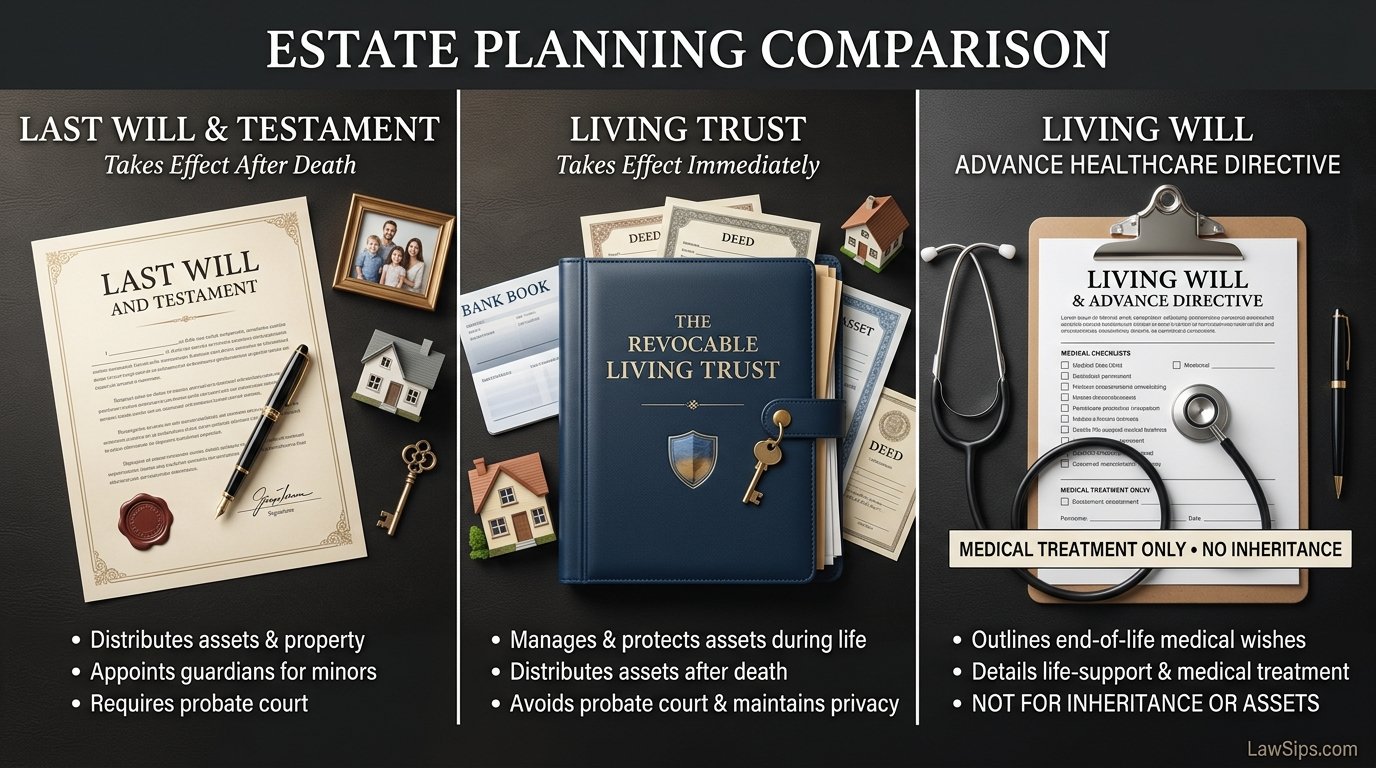
The document’s full formal title is the last will and testament. As the [Wikipedia entry on wills](https://en.wikipedia.org/wiki/Will_(law)) explains, will historically covered real property and testament covered personal property; the terms merged long ago, and today the combined phrase is simply tradition. A will and a last will and testament are the same document.
The person who makes one is the testator. The property they leave is their estate. The people who receive from it are beneficiaries, and the person appointed to run the process is the executor, called a personal representative in some states. Four words unlock nearly every sentence written about this document anywhere.
One impostor needs naming immediately. A living will is not a kind of will at all: it is a healthcare directive about medical treatment near the end of life, and it distributes no property to anyone. Standard lists of will types sometimes include it without flagging the difference, which is a category error this page will not repeat.
Test One: Capacity, or Who Can Make a Will
In nearly every state, the maker must be 18 or over and have what the law calls testamentary capacity. There is no income threshold and no property minimum: if you own anything you wish to direct, or have children who would need a guardian, the document is available to you today.
Capacity is more specific than the everyday phrase sound mind. Courts describe it as four understandings held at the moment of signing, and the Nolo wills FAQ tradition of summarizing the technical rules matches them closely.
|
The four understandings |
What it means in plain words |
|---|---|
|
You know you are making a will |
The document’s nature is understood, not mistaken for something else |
|
You know what property you own |
The broad shape of the estate, not an audited inventory |
|
You know your closest people |
The natural recipients: spouse, children, dependents |
|
You understand the distribution |
How this document actually divides what you own |
Capacity is judged at the moment of execution, which is why a will signed in a lucid period can stand even when the maker’s health later declines. It is also why late life changes to a will attract the closest scrutiny when a disappointed relative contests it.
One refinement matters for blended and modern families. The natural recipients understanding is about awareness, not obligation: a testator may leave everything to a charity and nothing to adult children and still have full capacity, provided they knew who those children were when they chose otherwise. Capacity measures the mind doing the choosing, never the choices themselves.
The second capacity condition is freedom: the will must be the maker’s own act, not the product of undue influence or pressure from anyone around them. Together, capacity and freedom are the grounds on which most will contests are fought in court.
Test Two: Form, or What the Document Must Look Like
The common core across states is three elements: the will is in writing, it is signed by the testator, and the signing is witnessed, usually by two witnesses who watch the maker sign and then sign themselves in the maker’s presence.
The witnesses carry a condition readers miss. In most states they should be disinterested, meaning they do not inherit under the will. A witness who is also a beneficiary can forfeit their own gift, a trap that has quietly emptied bequests made in front of well meaning family members.
Notarization is not on the list. In most states a will needs no notary to be valid. The notary appears in the optional self proving affidavit, a sworn statement attached at signing that lets the probate court accept the will later without hunting down the witnesses. Useful, often wise, and entirely separate from validity itself.
Two exceptions bend the form test, and both are state specific. Holographic wills, handwritten and signed by the maker with no witnesses, are recognized in roughly half the states and scrutinized heavily everywhere. Electronic wills exist only where a state statute allows them; a 2025 summary counted roughly 15 states plus the District of Columbia with e will laws, a figure that dates quickly and must be checked against current law.
A related mercy rule softens the edges: many states accept a will that was validly executed elsewhere, under the law of the place of signing or of the maker’s home, even if the local form differs slightly. The rule rescues movers; it does not rescue documents that were invalid everywhere they touched.
Oral wills, called nuncupative wills, survive only in narrow emergency corners of a few states’ law. For nearly everyone, a spoken wish, however clearly heard by the whole family, is not a will.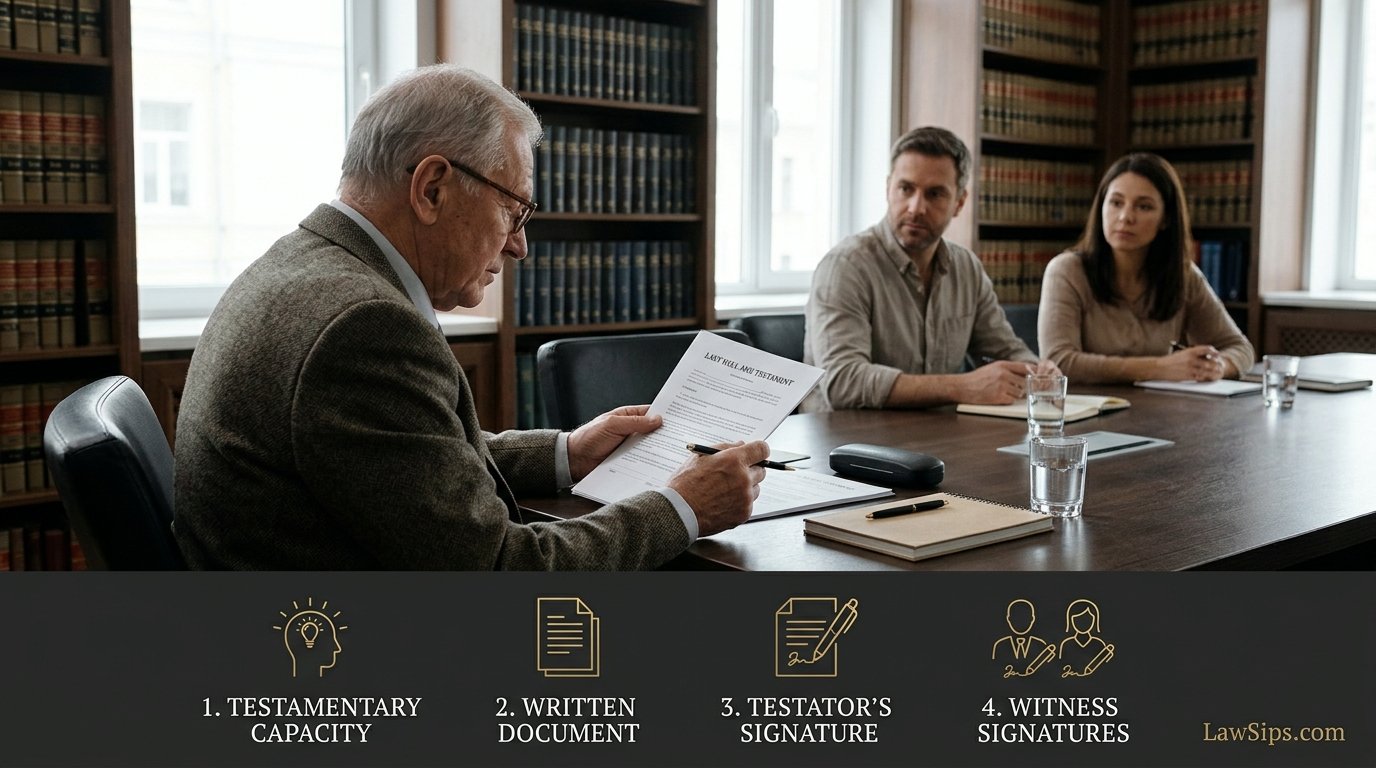
Test Three: Scope, or What a Will Actually Controls
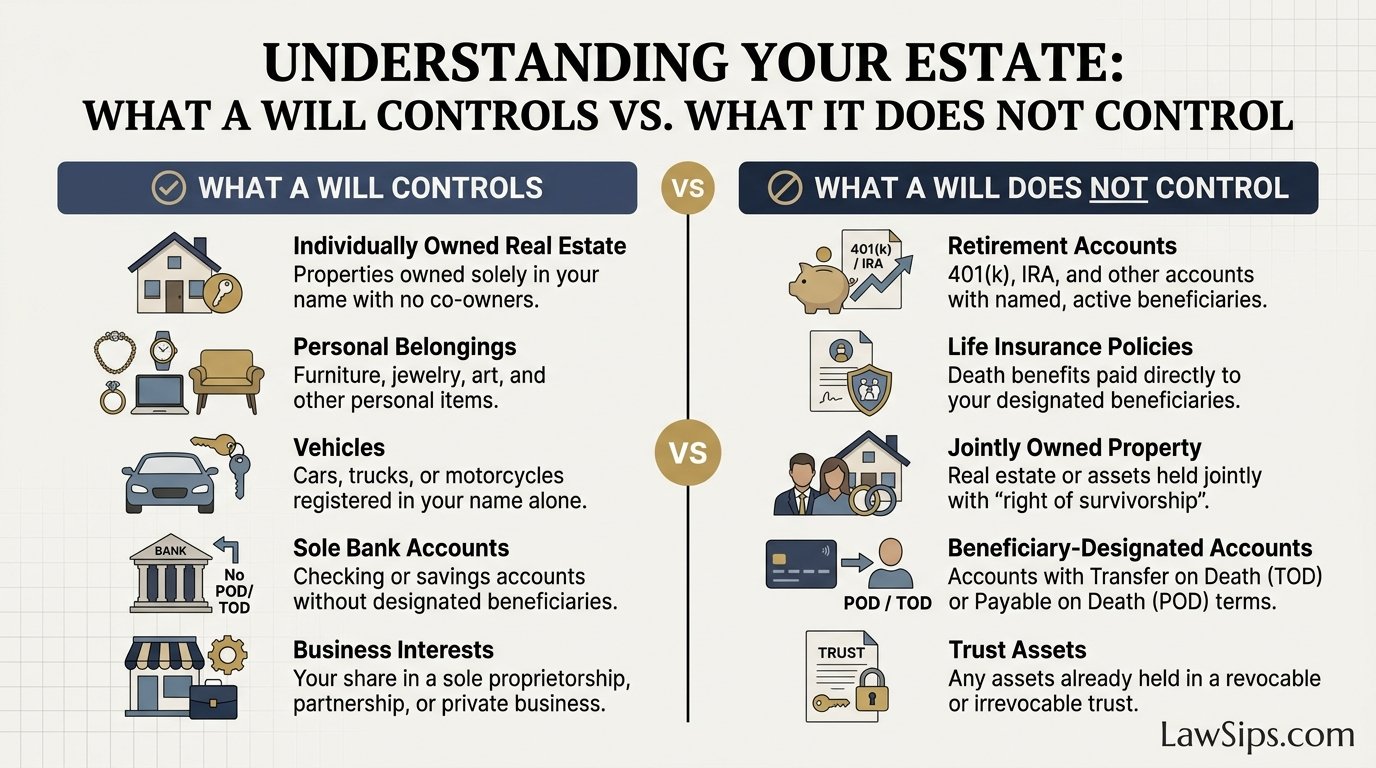
Here is the half of the definition the one sentence versions omit. A will controls probate assets only: property held in your name alone, with no other transfer mechanism attached to it. Everything else passes outside the will, and where the two conflict, the outside mechanism wins.
|
A will controls |
A will does NOT control |
|---|---|
|
Real estate titled in your name alone |
Retirement accounts with beneficiary designations |
|
Bank and investment accounts with no POD or TOD designation |
Life insurance with a named beneficiary |
|
Vehicles, furniture, jewellery and personal property |
Payable on death and transfer on death accounts |
|
Business interests held individually |
Joint tenancy property, which passes to the surviving owner |
|
The residuary estate, everything left over |
Property already held in a trust |
The override rule deserves its own sentence: beneficiary designations beat the will. A retirement account naming an ex spouse pays the ex spouse, whatever a newer will says, until the designation itself is changed. Coordinating the two is part of what makes a plan real rather than merely decorative.
Within its scope, a will does four jobs. It distributes the probate property, through specific bequests and the residuary clause. It appoints the executor. It nominates a guardian for minor children, for most parents the single most important line in the whole document. And it can create a testamentary trust, holding money for children or vulnerable beneficiaries under management instead of outright.
Test Four: Effect, or When a Will Works
A will takes effect only at death. Until that moment it controls nothing, the people named in it hold no rights in the property, and the maker can change or revoke it freely while capacity lasts. A new will revokes the old one, a codicil amends it, and informal notes on a copy change nothing.
And the point the National Council on Aging’s guide states more plainly than most: a will does not avoid probate. Probate is the court supervised process that validates the will, empowers the executor, settles debts and taxes, and transfers what remains. The will is best understood as instructions to that court, not as a way around it.
Probate also makes the will a public record once filed, which settles the common question of secrecy. The document you sign in private becomes, in time, a document anyone may read, and planning with that fact in mind beats being surprised by it later.
A will also never expires. An old will remains valid until revoked, which sounds reassuring and is actually the danger: staleness, not age, is what produces results the maker would never have chosen, after marriages, divorces, births and deaths have redrawn the family that the document was written to describe.
The Types of Wills, Read Carefully
The simple will is the standard instrument: distribution, executor, guardian, residue. The joint will is a single document for a couple, usually leaving everything to the survivor and then to shared beneficiaries, with the rigidity that it often cannot be changed after the first death occurs.
The testamentary trust will builds a trust inside the will that springs into existence at death, the classic tool for children who should not receive a lump sum at eighteen. The pour over will is the safety net partner of a living trust, sweeping any property never transferred into the trust during life into it at death instead.
Then the exceptions from the form test: the holographic will, valid only where its state says so, and the electronic will, valid only under an e will statute. And the impostor from the first section: the living will, a healthcare document that belongs in an estate plan but is not a will in any sense that distributes property at all.
What Happens Without One: Intestacy
Dying without a valid will is dying intestate, and the state supplies the document you did not write. Intestacy statutes distribute probate property by a fixed family formula: a surviving spouse first, then children, then parents, then siblings and wider kin, in proportions the statute sets.
The Uniform Probate Code’s model, in its sections on intestate succession, has been adopted in whole or part by about 18 states, and its shape is typical even where the details differ. What the formula never contains matters more: no unmarried partners, no stepchildren, no friends, no charities, however central they were to the life actually lived.
Intestacy also surrenders the two appointments. A court chooses the guardian for minor children and the administrator for the estate, from whoever petitions, rather than from the people the parent or the deceased would have picked. The formula is not cruel; it is simply blind, and blindness is the cost of leaving the definition unwritten.
How common is that cost? The National Council on Aging, reviewing estate planning data in 2025, reported that only 24 percent of American adults had a will, a share it describes as steadily declining since 2022. The figure is survey based and dated, and it is quoted here with both labels, because that is how statistics deserve to travel.
Reading a Will After a Death: The Definition From the Other Side
The definition also explains what happens in the weeks after a death, which is when many readers meet this document for the first time. The executor files the will with the probate court, and the court’s first question is the form test: was this document executed the way this state’s law requires?
If the answer is yes, the court issues the authority, often called letters testamentary, that lets the executor act: collecting assets, paying the estate’s debts and taxes, and finally distributing under the document’s instructions. If the will fails, the court falls back to an earlier valid will or to intestacy, which is the form test operating as a gate.
Beneficiaries receive what the scope test allows the will to give, after creditors and costs, and the designations on accounts pay their named people on a separate, faster track that never enters the courtroom. Families who understand the four tests find this sequence predictable; families who expected the will to do everything find it bewildering.
The Parts Inside a Will
A standard will runs to more parts than readers expect, around eighteen in the NCOA’s count, many of them a few words long. Beyond the distribution clauses sit the working parts: the revocation clause cancelling earlier wills, the residuary clause catching everything ungifted, and the appointments.
Three clauses deserve plain explanations. A survivorship clause requires a beneficiary to outlive the maker by a set period, commonly 120 hours in the Uniform Probate Code pattern, so property does not cascade through two estates in a week. A no contest clause strips the gift of a beneficiary who challenges the will and loses, where state law enforces it. And the self proving affidavit, already met in the form test, is the attachment that saves the witnesses a court appearance years later.
Digital property has joined the parts list. More than 40 states have adopted the Revised Uniform Fiduciary Access to Digital Assets Act, giving executors a legal framework for the deceased’s accounts, though platform settings often speak first. A modern will that ignores digital assets leaves its executor locked out of the estate’s own paperwork.
At LawSips, the wills cluster divides exactly here: this page defines, the process page instructs, and the hub compares. Readers sorting dates and deadlines for other legal matters will find the same dated discipline on the Class Action Lawsuit Deadlines page.
One Family, Two Outcomes: The Definition at Work
Consider a common household: a married parent of two young children, a house in one name, a retirement account from an old job, and a partner’s parent living nearby who helps daily. Nothing exotic, and every element tests the definition.
With a will, the house and accounts in the parent’s sole name follow the document: the spouse or the children as chosen, the guardian the parent picked rather than a court’s guess, an executor who knows where the paperwork lives, and a testamentary trust holding the children’s shares past eighteen.
Without one, the intestacy formula divides the probate property by statute, the retirement account follows its old beneficiary designation wherever that leads, a court selects the guardian from whoever applies, and the helpful grandparent, if not a legal relative in the formula’s line, is a stranger to it.
Notice what the will did not do in the good outcome: it did not avoid probate, it did not touch the retirement account, and it did nothing at all while the parent lived. The definition’s limits and its power are the same document, which is why learning both halves matters.
The Will Among Its Neighbour Documents
|
Document |
When it works |
What it governs |
|---|---|---|
|
Last will |
At death only |
Probate property, executor, guardianship |
|
Living trust |
During life and at death |
Property transferred into the trust |
|
Power of attorney |
During life only, ends at death |
Financial acts for a living person |
|
Living will (advance directive) |
During life, at incapacity |
Medical treatment wishes |
|
Beneficiary designation |
At death, outside probate |
The specific account or policy it names |
Read the table by its first column and the whole estate planning shelf sorts itself. The will is the death only, court supervised instrument; its neighbours cover the during life side and the outside probate side, and a complete plan usually assembles several of them rather than asking one document to do every job.
Confusion between the rows is the practical risk. A power of attorney cannot distribute an estate, a living will cannot leave a house to anyone, and a will cannot authorize anyone to act for you next Tuesday. Each document’s silence outside its row is as much a part of its definition as its powers inside it.
Common Misreadings of the Definition
A will is for the wealthy. The capacity test contains no property threshold, and the guardianship line alone justifies the document for a young parent whose estate is mostly future earnings and a rented flat’s contents.
The will controls everything I own. The scope test says otherwise, and the retirement account in the worked example is the standing proof. A will reviewed without its designations is a plan reviewed with its largest asset missing.
A verbal promise carries out my wishes. The form test disposes of this one: outside narrow emergency exceptions, unwritten wishes are not a will, and the family meeting where they were spoken has no standing in the probate court.
Once signed, it is settled forever. The effect test cuts both ways: revocable means changeable, and a will that predates a marriage, a divorce or a child is a document answering questions nobody is asking anymore. Review after life events is not maintenance; it is the definition still working.
The state takes everything without a will. Intestacy distributes to family by formula long before any escheat to the state, which happens only when no qualifying relatives exist at all. The real cost of intestacy is loss of choice, not confiscation, and stating it accurately makes the case for a will better than exaggeration does.
Frequently Asked Questions
What is a will, in simple terms?
A will is a written, signed and witnessed legal document that states who receives your property after your death, who manages the process, and who raises your minor children. It takes effect only at death, it can be changed at any time while you are alive and competent, and it works through the probate court.
What is a last will and testament?
The full formal name for the same document. Historically will covered real property and testament covered personal property; the terms merged centuries ago, and the combined phrase survives as the document’s traditional title. There is no legal difference between a will and a last will and testament.
What does a will do?
Four jobs: it distributes your probate property to the people and charities you name, it appoints an executor to carry the instructions out, it nominates a guardian for minor children, and it can create a testamentary trust to manage money for children or other beneficiaries over time.
What does a will NOT do?
It does not avoid probate, it does not control assets that carry their own beneficiary designations or co owners, and it does nothing while you are alive. Retirement accounts, life insurance, payable on death and transfer on death accounts, joint tenancy property and trust assets all pass outside the will, and their designations override it.
What makes a will valid?
State law decides, and the common core is four tests: the maker is an adult with testamentary capacity, the document is in writing, it is signed by the maker, and it is witnessed, usually by two disinterested witnesses. A will failing any test can be refused by the probate court, and the estate then falls back to intestacy or an earlier valid will.
What is testamentary capacity?
The legal version of sound mind for wills. Courts describe it as four understandings at the moment of signing: you know you are making a will, you know what property you own, you know who your closest relatives and dependents are, and you understand how the document distributes your assets.
Who can make a will?
In nearly every state, any person aged 18 or over with testamentary capacity. There is no income or property threshold: if you own anything you wish to direct, or have minor children to name a guardian for, you can make a will.
How many witnesses does a will need?
Usually two, who watch the maker sign and sign themselves. In most states they should be disinterested, meaning they do not inherit under the will; a beneficiary witness can forfeit their gift. A few states allow notarization routes or different numbers, so the maker’s state rule governs.
Does a will need to be notarized?
In most states, no. Notarization enters through the optional self proving affidavit, a sworn statement by the maker and witnesses attached at signing, which lets the court accept the will later without tracking the witnesses down. It speeds probate; it is not what makes the will valid.
Is a handwritten will valid?
Sometimes. Holographic wills, handwritten and signed by the maker with no witnesses, are recognized in roughly half the states, with conditions that vary, and courts scrutinize them heavily. In states that do not recognize them, a handwritten document may be worth nothing, however clear the intent.
What is an electronic will?
A will signed and witnessed through electronic processes where a state e will statute allows it. LegalClarity’s 2025 summary counts roughly 15 states plus the District of Columbia with enacted electronic will statutes and a few states expressly prohibiting them, so this strand moves fast and must be checked against current state law.
What happens if you die without a will?
You die intestate, and your state’s intestacy statute distributes your probate property by a fixed family formula: typically a spouse first, then children, then parents, then siblings and wider kin. Unmarried partners, stepchildren, friends and charities receive nothing under the formula, and a court chooses your children’s guardian and your estate’s administrator.
What is probate?
The court supervised process that validates the will, appoints the executor, sees debts and taxes paid, and transfers the remaining property to the beneficiaries. A will does not avoid probate; it instructs it. The common confusion on this point is the single most repeated error in competitor definitions.
Does a will avoid probate?
No. Only assets kept out of the probate estate avoid it, through beneficiary designations, joint ownership or a funded trust. A will’s whole job happens inside probate, which is why the executor files it with the court after the death.
What is an executor?
The person the will names to carry out its instructions: filing the will with the court, gathering and inventorying assets, paying debts and taxes, and distributing what remains. Some states call the role personal representative. If the will names nobody able to serve, the court appoints an administrator instead.
What is a beneficiary?
Anyone named in the will to receive property: a person, several people, or an organization such as a charity. Beneficiaries take specific bequests, general gifts, or the residuary estate, and only after debts, taxes and administration costs are settled.
What is the residuary clause and why does it matter?
The catch all clause that sends everything not specifically gifted, including property acquired after signing and gifts that fail, to the residuary beneficiary. Without one, leftovers fall into partial intestacy and pass by the state formula as if that property had no will at all.
What is a codicil?
A formal amendment to an existing will, executed with the same signing and witnessing formalities as the will itself. Small changes can ride on a codicil; large changes, or several accumulated ones, are usually cleaner as a new will that revokes the old.
Can you change or revoke a will?
Yes, at any time while you have capacity. A new will normally revokes earlier ones expressly, a codicil amends, and physical destruction with intent to revoke works in many states. What you cannot do is change a will informally: a handwritten note on a copy generally changes nothing.
When does a will take effect?
Only at death. Until then it controls nothing, can be replaced freely, and the people named in it have no rights in the property yet. This is the clean line between a will and a living trust, which can operate during life.
What is the difference between a will and a living will?
A trap in the terminology. A living will is a healthcare directive about medical treatment at the end of life; it distributes no property. A last will distributes property and does not direct medical care. The shared word will causes real confusion, and the documents are not interchangeable.
What is the difference between a will and a trust?
A will speaks at death and passes through probate. A living trust holds property during life, can manage it through incapacity, and passes it at death without probate for the assets actually transferred into it. Many plans use both: a pour over will catches whatever the trust missed.
What types of wills are there?
The standard lists name the simple will, the joint will for a couple, the testamentary trust will, and the living will, which is really a healthcare document. Beyond the lists sit the holographic will, the electronic will, the pour over will and the rare oral or nuncupative will, each valid only where its state’s law allows.
Can a will leave property to charity?
Yes. Charities are ordinary beneficiaries in a will, and charitable bequests are one of the things only a will or designation can do: the intestacy formula has no charity in it, so dying without a will gives nothing to causes, however long you supported them.
Can a will disinherit someone?
Generally yes for adult children and most relatives, with deliberate wording. A surviving spouse is the major exception: most states protect a spouse through an elective share or community property rights that a will cannot simply write away. This is general information, and disinheritance is a place for state specific advice.
What percentage of Americans have a will?
The National Council on Aging, reviewing estate planning data in 2025, reported that only 24 percent of American adults had a will, a share it describes as steadily declining since 2022. The figure is survey based and dated, and it is printed here with both labels attached.
Why do so few people have wills?
The research consensus is procrastination and misconception rather than cost alone: people overestimate the difficulty, underestimate what the intestacy default would do to their actual family, and assume a will is for the wealthy. The definition on this page is the counterweight: if you own anything or have children, the document applies to you.
What is a self proving affidavit?
A notarized sworn statement, signed by the maker and the witnesses at the execution, confirming the will was signed properly. At probate it substitutes for witness testimony, which matters when witnesses have moved, died or cannot be found years later.
What is a no contest clause?
A clause, also called an in terrorem clause, that strips the inheritance of a beneficiary who challenges the will in court and loses. Its enforceability varies by state, and it deters only beneficiaries with something to lose, which is a real limit worth knowing before relying on one.
What is a survivorship clause?
A clause requiring a beneficiary to outlive the maker by a stated period, commonly 120 hours under the Uniform Probate Code pattern, before inheriting. It prevents property from passing through two estates in quick succession when people die close together.
Do digital assets belong in a will?
They need planning, and the will is part of it. More than 40 states have adopted the Revised Uniform Fiduciary Access to Digital Assets Act, giving executors a legal framework for digital accounts, but platform settings and designations often speak first. Naming digital wishes and access routes in the plan beats leaving an executor locked out.
What are the grounds for contesting a will?
The classic four: lack of testamentary capacity, undue influence, fraud, and improper execution. A contest is a court proceeding with deadlines and costs, and disappointment with the contents is not itself a ground. Most wills are never contested; the risk concentrates in late life changes and unequal treatment without explanation.
Does a will expire?
No. A validly executed will remains valid until revoked or replaced, however old it gets. Age is not the danger; staleness is. Marriage, divorce, births, deaths and major asset changes can make an old will produce results its maker would never have chosen, which is why review after life events is the standing advice.
Is a will from another state valid?
Usually yes, if it was validly executed under the law of the state where it was made or where the maker lived; most states have savings provisions of that kind. Moving is still a standard trigger to have the document reviewed, because property law and family protections differ.
Where should a will be stored?
Somewhere the executor can actually reach after the death: a fireproof home safe they know about, or another accessible, known location. A safe deposit box can be sealed at exactly the wrong moment in some states. The best stored will is the one whose location the executor already knows.
Who should know about your will?
At minimum the executor, and practically the people who would need to act in the first days. Secrecy protects nothing: at probate the will becomes a court filing, and in most places a public record once filed.
Can a will name a guardian for pets or leave money for care?
A will can name who takes a pet and can leave money for its care, and many states also allow a formal pet trust for enforceability. The intestacy formula, by contrast, treats a pet as property with no instructions attached, which is why animal lovers are a classic audience for this document.
What is a pour over will?
A will designed to work with a living trust: whatever property was never transferred into the trust during life pours into it at death through probate. It is a safety net document, and its existence is an admission that even good trust plans leak assets.
How is a will different from a power of attorney?
They operate on opposite sides of death. A power of attorney authorizes someone to act for you while you are alive and ends at your death; a will does nothing during life and speaks only at death. A complete plan usually contains both, plus healthcare documents.
Is an online or template will a real will?
It can be: validity turns on the execution tests, not on who drafted the document. The risks of templates are fit and state specifics, not authenticity. Complex families, businesses, or disinheritance plans are where attorney drafting earns its cost. This page is general information, not legal advice.
What should I read next if I want to make one?
The process has its own page on this site: How to Write a Will, which owns the step by step, while Wills and Trusts owns the broader comparison of the two instruments. This page’s job ends at the definition: what the document is, what it controls, and what makes it count.
Does a will cover property in another state or country?
A will generally governs your probate property wherever it sits, but real estate is handled under the law of the state where it lies, which can mean an ancillary probate there. Foreign property adds another legal system entirely. This is one of the standard reasons lawyers ask where everything is before drafting.
Conclusion
What is a will, answered completely, is a document that passes four tests: a maker with capacity, a form the state accepts, a scope limited to probate property, and an effect that begins only at death inside a probate court.
Hold those four and the rest of the topic organizes itself: the types are variations on the form test, intestacy is what happens when the tests are never met, and every clause inside the document serves the scope it is allowed to govern.
If the definition now looks less like paperwork and more like a set of decisions only you can make, that is the correct reading. The making of one is a separate craft, with its own steps, templates and state checklists, and it is waiting on this site’s process page whenever you are ready to move from what a will is to writing yours.

Dilawar is a dedicated writer and contributor at Lawsips.com, focusing on legal information, business law, consumer rights, legal awareness, and everyday legal matters. He is passionate about simplifying complex legal topics and providing readers with clear, practical, and easy-to-understand information. His goal is to help readers stay informed about legal developments, understand their rights, and make better decisions through informative and well-researched articles.