
Data Breach Settlement Claim: The Notice ID Is the Claim, the Menu Is the Money

Data breach settlement claim forms confuse people for one specific reason: the form will not even open until you type in a code from a letter many people threw away. That code is not a formality. In a data breach case, the class is a fixed list of named victims, and the code is how the administrator knows you are on it.
This page is general information about how breach claims work, not legal advice. It is built from the claim systems of settlements that are open right now, with every figure tied to its source, so the procedure below is the real one, not a generic sketch.
Two ideas organize everything. First, the notice ID is the claim: no identifier, no filing, even for the payment tier that needs no receipts. Second, the menu is the money: every breach settlement pays from the same short menu of benefits, and choosing the right line on that menu is routinely worth ten to fifty times the default option.
The wider claiming landscape, privacy cases included, sits in the claim money from settlements guide. This page covers the breach side only, where the rules are stricter and the documentation decides the outcome.
Data Breach Settlement Claim: The Short Answer
A data breach settlement claim is filed on the official administrator’s website, opened with the ID from your breach notice, and paid from a menu: flat or pro rata cash, documented losses, lost time, and credit monitoring.
|
Element |
How it works |
|---|---|
|
The gate |
Notice ID, Claim ID, or Login ID and PIN from the breach notice |
|
Flat / pro rata cash |
Commonly about $25 to $150; no receipts, but the ID is still required |
|
Documented losses |
Reimbursement, commonly capped at $2,500 to $10,000; documents required |
|
Lost time |
Set hourly rate, capped hours, self attested under penalty of perjury |
|
Credit monitoring |
1 to 3 years, usually alongside either cash option |
|
Filing cost |
Always free |
|
Payment timing |
After final approval and any appeals; months after the deadline |
The ranges in that table come from OpenClassActions’ data breach class action guide, which also makes the point this page is built on: because the identifier is required to file, a data breach claim is generally proof-required even when no receipts are needed.
Why Breach Claims Are Gated: The Fixed List
A privacy settlement, the kind built on website tracking, defines its class by behavior: anyone who used a website in a period. Nobody has a list of those people, so the claim form is open and the claimant attests.
A breach is the opposite. The company knows exactly whose records were taken, because its own systems held them. The class is that list, the notices go to the people on it, and each notice carries the identifier the claim portal will demand.
That is why the breach claim experience starts with a code. The Cardiology Associates of Mobile claim form asks for the Class Member ID before a claim can be started. The Cardinal Services portal opens with a required Settlement Claim ID field. Grayback Forestry and Howard and Co. both open only with a Login ID and PIN from the notice.
The same gate explains a confusion readers bring from other pages on this site. Lists of class action lawsuit no proof needed settlements describe open form cases accurately, but a breach claim is almost never one of them: no receipts is not the same as no proof, and in breach cases the ID is the proof of membership.
Eligibility in the general sense, who counts as a class member and how classes are defined, is covered in the how to check if you qualify for a class action guide. What follows assumes you hold, or held, a breach notice.
The Benefit Menu, Tier by Tier
Flat or Pro Rata Cash: The No Receipt Tier
The default benefit is a cash payment with no receipts required. It comes in two shapes: a flat amount set in the agreement (Grayback pays $65; Howard and Co. pays $50), or a pro rata share: an equal slice of whatever money remains after the fund’s other obligations, which cannot be known until claims close.
OpenClassActions’ analysis of 305 data breach settlements puts the shape of this tier in one line: the median no-receipt payment was $50. Cardinal Services shows the mechanics live: its administrator estimates the pro rata payment at about $50, and states plainly that the figure rises or falls with the number of approved claims.
Documented Out-of-Pocket Losses: The Tier Almost Nobody Uses
The second tier reimburses money the breach actually cost you: fraud losses, bank and overdraft fees, credit monitoring you bought yourself, freeze and report fees, ID replacement, postage, notary and professional fees.
The caps are the story. The same 305 settlement analysis puts the median advertised maximum at $5,000, against that $50 median flat payment. The live examples in this article cap losses at $4,000 (Cardiology Associates) and $5,000 (Cardinal Services and Grayback). A claimant with real losses who takes the flat tier by default leaves the largest benefit in the settlement unclaimed.
Lost Time: The Self Attested Tier
Most breach settlements also pay for time spent dealing with the fallout: calling banks, disputing charges, placing freezes, replacing documents. The live rate in both December examples that publish one is $25 an hour for up to five hours, a $125 maximum (Grayback and Howard and Co. agree exactly).
Lost time needs no receipts. It needs an attestation: a description of what you did and a signature under penalty of perjury. Honesty is the whole requirement, and the hours must be real.
Credit Monitoring: The Benefit That Runs for Years
Nearly every breach settlement includes credit or identity monitoring for one to three years, with $1 million of identity theft insurance and access to fraud resolution agents as the standard pairing. The live range in this article runs from one year (Howard and Co.) through two years (Cardinal, and Cardiology Associates at all three bureaus) to three years (Grayback).
Monitoring is normally separate from the cash choice: you enroll in it whichever cash tier you pick. It is also the benefit claimants most often fail to activate, because enrollment takes a code and a second step after the claim itself.
How the Tiers Combine: Two Structures
Settlements combine the menu in one of two ways, and the notice says which.
Combine structure (Cardiology Associates, Cardinal Services): claim the cash, the losses and the monitoring together on one claim. Cardiology Associates states it directly: class members can claim any combination of its three benefits.
Choose one structure (Grayback, Howard and Co.): pick either the documented route or the flat alternate payment, with monitoring available either way. Howard and Co. splits its documented route further, into ordinary losses up to $1,000 (everyday costs, with lost time counted inside that cap) and extraordinary losses up to $2,500 (identity theft or fraud losses the claimant shows were caused by the incident, after trying the bank or insurer first).
|
Tier |
Typical shape |
Proof |
|---|---|---|
|
Flat / pro rata cash |
$25 to $150 typical; median $50 (OCA 305 settlement analysis) |
ID only |
|
Documented losses |
Caps commonly $2,500 to $10,000; median advertised max $5,000 |
ID plus documents |
|
Lost time |
Commonly $25 per hour, capped hours |
ID plus attestation |
|
Monitoring |
1 to 3 years, $1M insurance standard |
ID plus enrollment code |
The Documented Loss Standard
Documented loss claims are judged against a standard, and two of this article’s live notices state it in the same words: losses must be more likely than not caused by the incident. Four tests ride with that phrase, and a claim that fails any one of them fails.
- Caused by the breach. The loss connects to this incident, not to life in general. A fraudulent charge that appeared after your data was taken, on an account the breach exposed, is the model case.
- Unreimbursed. Money your bank or insurer already gave back is not claimable again. Cardinal’s form asks directly whether each loss was reimbursed by another source.
- Inside the window. Losses count only between the incident and the claim deadline: December 2024 to December 29, 2026 at Cardiology Associates; January 5 to December 28, 2026 at Grayback; September 29, 2024 to December 28, 2026 at Howard and Co.
- Documented by a third party. Bank statements, receipts, invoices and letters. Both Cardinal and Howard state the limit in the same terms: self prepared documents such as handwritten receipts are not enough on their own, though personal notes can explain real records.
PersProtect’s claim guide adds the practical ranking: a statement with dates is strong; a screenshot of an app is weak. And its most useful sentence in the whole topic: claims are rejected far more often for a missing attachment than for a small award, so the file gets assembled before the form is opened.
|
Document |
Strength |
|---|---|
|
Bank or card statement showing the charge, dated |
Strong |
|
Bank letter confirming fraud or fees |
Strong |
|
Receipt or invoice from a third party |
Strong |
|
Police report or FTC identity theft report |
Strong supporting |
|
Screenshot of an app or account |
Weak |
|
Handwritten receipt or personal note alone |
Not sufficient alone |
The Filing Procedure, Step by Step
- Find the notice. The breach notice letter, postcard or email holds the ID, the deadline and the official website. Search old email, including spam, for the administrator’s name as well as the company’s.
- Reach the official site from the notice, typed by hand, or from the company’s own breach page. Never from a search ad or a social media link.
- Read the menu before choosing. Decide the cash structure first: flat, or documented with the file assembled. The choice cannot usually be revisited after submission.
- Assemble the file. For documented losses: statements, receipts, the reimbursement answer for each item, and a one line description where a document does not explain itself.
- Log in with the ID and complete the form. Name, address, email, the benefits selected, and a payment method: the live forms offer PayPal, Venmo, Zelle or a paper check.
- Sign the attestation honestly and submit before the deadline, online by the stated cutoff time or postmarked by mail.
- Save the confirmation. Screenshot the confirmation page and keep the confirmation number with the notice. That pair is your proof of filing.
- Enroll the monitoring when the enrollment step opens, using the code from the notice or the post approval email.
Filing takes minutes once the file exists. PrivacyOn’s guide puts the form itself at five to ten minutes; the documentation, not the typing, is the work.
Four Live Examples, December 2026
These four settlements are open now, checked on November 25, 2026 against their published claim records. They are printed as dated examples of the system, and their deadlines are the reason to read quickly.
|
Settlement |
Fund / structure |
Claim deadline |
Cash |
Documented losses |
Monitoring |
Gate / administrator |
|---|---|---|---|---|---|---|
|
Cardiology Associates of Mobile |
$1.25M non-reversionary fund |
Dec 29, 2026 |
Pro rata share, no estimate published |
Up to $4,000 |
24 months, three bureaus |
Class Member ID; Kroll |
|
Cardinal Services |
$850K fund |
Dec 17, 2026 |
About $50 est. pro rata |
Up to $5,000 |
2 years, one bureau |
Settlement Claim ID; P and N |
|
Grayback Forestry |
$165K cash cap, fees paid separately |
Dec 28, 2026 |
$65 flat (choose one) |
Up to $5,000 incl. lost time |
3 years |
Login ID + PIN; Simpluris |
|
Howard & Co. CPAs |
No fund cap described; fees paid separately |
Dec 28, 2026 |
$50 flat (choose one) |
$1,000 ordinary + $2,500 extraordinary |
1 year |
Login ID + PIN; Simpluris |
Cardiology Associates of Mobile: The Combine Structure at Full Size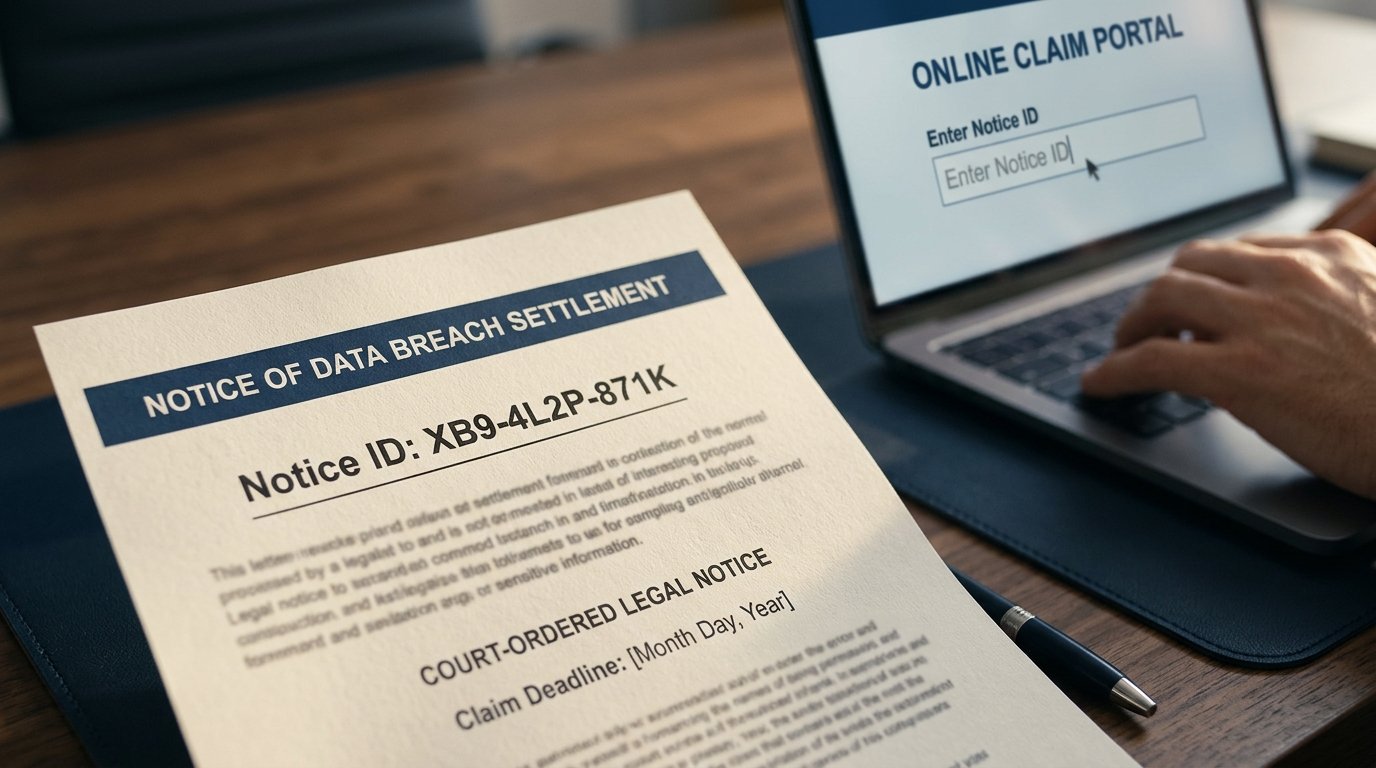
The Cardiology Associates of Mobile settlement record covers about 172,678 patients and providers whose names, birth dates, Social Security numbers, health insurance numbers and medical information were taken in an October 2024 incident. The $1,250,000 fund is non-reversionary: leftovers, including uncashed checks, go to the Alabama Civil Justice Foundation, not back to the defendants. All three benefits combine on one claim, payments follow 30 days after the settlement’s effective date, and checks are void after 90 days.
Cardinal Services: Where the ID Sits on the Postcard
The Cardinal Services settlement record covers about 142,000 people in a staffing company’s June and August 2025 incidents, with payroll, tax and banking records in the complaint’s account. Its practical gift to readers: on the mailed postcard, the Settlement Claim ID is printed just above the recipient’s name and address, and the portal links a help page showing exactly where it appears. Fund leftovers go to the Legal Foundation of Washington.
Grayback Forestry: The Choose One Structure, and a Safety Net
The Grayback Forestry settlement record covers about 5,029 people, names and Social Security numbers, in a January 2026 incident. Its cash benefits share a $165,000 cap with fees paid separately, and it carries the kindest term in this article: a documented claim that lacks sufficient third party proof gets 21 days to cure, and failing that, automatically receives the $65 instead of nothing.
Howard & Co. CPAs: Ordinary vs Extraordinary
The Howard and Co. settlement record covers a September 2024 attack on an accounting firm, and it is the live example of the two level loss structure: ordinary losses to $1,000 for the everyday costs, extraordinary losses to $2,500 for proven identity theft or fraud, with the $200,000 fee request paid separately by the firm and no pro rata reduction described in its notice.
Deadlines across the wider open landscape sit on the open class action settlements page; the four above are the breach examples this page teaches from, and each has a January 2027 final approval hearing behind its December deadline.
If the Notice Is Lost
A lost notice is a recoverable problem, and the recovery paths are printed in the settlements themselves.
Ask the administrator to resend the ID. Grayback and Howard both state the method identically: send your full name and mailing address through the official site’s contact page, and the administrator reissues the Login ID and PIN. Cardinal takes ID requests through its Contact page the same way.
Use the paper form. Cardiology Associates offers the fallback in its own terms: a class member without an ID can download the paper claim form and mail it in. Printed forms commonly carry an ID field marked if known, which is the system admitting the code is a key, not the lock itself.
Search properly first. Notices arrive from the administrator, not always from the company, and they land in spam. OpenClassActions’ guide adds two more routes: some portals have an ID lookup, and class counsel can help at no charge, since they represent the class.
Ask early. A resent code may travel by mail and take a week or more, and the claim deadline does not move because a notice went missing. The same guide’s warning deserves repeating: if the administrator cannot find you in the class list, you may not be in that settlement, however real the breach was.
Rejections and Deficiency Notices
A deficient claim is usually not a dead claim. Cardiology Associates gives claimants 21 days to fix an incomplete or inadequately supported claim, and Grayback’s agreement runs the same 21 day cure before its automatic $65 fallback.
The deficiency notice names what is missing: a document, a description, the reimbursement answer. The cure is to supply exactly that, inside the window, through the channel the notice specifies. What cannot be cured is the claim deadline itself: a claim never filed by the deadline has no deficiency process, because there is nothing on file to fix.
Keep the confirmation from step 7 of the procedure. In any dispute about whether a claim exists, the confirmation number is the conversation.
After You File: Confirmation, Hearing, Payment
The sequence after a deadline is fixed: the court holds the final approval hearing (all four live examples sit in January 2027), any appeals run, the settlement becomes effective, and only then does money move.
The live agreements put concrete clocks on the last step: Cardiology Associates and Grayback both call for payment 30 days after the effective date. PrivacyOn’s guide gives the reader level range, three to twelve months after the claim deadline, which matches a December deadline, a January hearing and a spring payment.
Two disciplines protect the money at this stage. Keep your address and payment method current with the administrator, and cash checks fast: Cardiology Associates voids them at 90 days. Digital payment choices avoid the mailbox risk entirely.
Payment timing differs by case family, and the contrast is instructive: the Flo period tracker settlement on this site ran on an app privacy theory with its own fund and clock. Breach cases run on theirs. The notice in your hand is always the controlling document.
Scam Checks
Claim filing scams spike around large settlements, and the rules are absolute. Filing is always free. A legitimate administrator never charges a fee, never asks for a gift card, and never needs your full Social Security number up front to open a claim you were noticed for.
Reach the claim site from the notice or the company’s own page, typed by hand. A site that cannot name the case, the court and the administrator is not the claim site. When in doubt, the administrator’s contact channels, reached through the official site, settle the question.
Mistakes That Cost Claimants Money
- Throwing away the breach notice. The ID is the claim; recovery exists but costs time against a fixed deadline.
- Taking the flat tier with real losses unclaimed. The median gap is $50 against a $5,000 advertised maximum.
- Claiming reimbursed losses. The forms ask; a wrong answer risks the whole claim.
- Filing losses outside the window. Dates on documents decide this before any person does.
- Submitting screenshots instead of statements. Weak documents are the top rejection cause.
- Skipping the monitoring enrollment. Qualifying is not enrolling; the code step is the benefit.
- Missing the cure window. A deficiency notice has its own 21 day deadline.
- Letting a check sit. Void windows run as short as 90 days.
Key Takeaways
- The gate: breach claims open with the notice ID, because the class is a fixed list. No receipts never means no proof here.
- The menu: flat or pro rata cash, documented losses, lost time, monitoring. Medians across 305 settlements: $50 flat, $5,000 loss cap.
- The standard: unreimbursed, more likely than not caused by the breach, inside the window, documented by third parties.
- The live clock: four December 2026 deadlines in this article, January 2027 hearings, payments after approval and appeals.
- The safety nets: ID reissue by name and address, paper forms, 21 day cures, and in one live case an automatic flat payment instead of a rejection.
FAQs
What is a data breach settlement claim?
A claim filed by a member of a fixed class of breach victims for the benefits a settlement offers: cash, reimbursement of documented losses, lost time, and credit monitoring. It is filed with the court appointed administrator, opened with the ID from the breach notice, and due by a court ordered deadline.
How do I file a data breach settlement claim?
Find the notice, reach the official settlement website from it, read the benefit menu, assemble any loss documents first, log in with the notice ID, complete and sign the form before the deadline, save the confirmation, and enroll the monitoring when its step opens.
What do I need before I start a breach claim form?
The notice with its ID, your current contact details, a payment method choice, and, for a documented loss claim, the documents themselves: statements, receipts and letters, each with dates, plus the answer to whether each loss was reimbursed elsewhere.
Why does the claim form ask for a Notice ID or Claim ID?
Because the class is a list, not a description. The company knows whose data was taken, notices went to those people, and the ID proves the filer is on the list. OpenClassActions’ guide puts it plainly: the identifier is why a breach claim is generally proof-required even when no receipts are needed.
Is a data breach claim proof required even for the flat payment?
The ID, yes; receipts, no. The flat or pro rata tier needs no documents about losses, but the portal still opens only with the Notice ID, Claim ID or Login PIN from the notice in nearly every breach settlement.
Can I file a breach claim if I lost my notice?
Usually yes. Administrators reissue IDs to class members who send a full name and mailing address through the official site, as Grayback and Howard and Co. both provide, and several settlements offer a paper claim form whose ID field reads if known, as Cardiology Associates does.
What is the difference between a flat cash payment and pro rata?
A flat payment is a fixed amount set in the agreement, like Grayback’s $65. A pro rata payment is an equal share of what remains in the fund after its other obligations, so the amount is only known after claims close and can shrink as more people file.
What are documented out-of-pocket losses?
Money the breach cost you that you can prove with third party records: fraud losses, bank fees, credit monitoring you bought, freeze and report fees, ID replacement, postage, notary and professional fees. They must be unreimbursed and connected to the incident.
What does more likely than not caused by the breach mean?
It is the causation standard printed in live notices such as Cardiology Associates and Grayback: the loss must be more probable than not a result of this incident. A fraud charge on an exposed account after the breach is the model case; an unrelated expense is not.
What documents prove a documented loss?
Dated bank or card statements, bank letters, third party receipts and invoices, police reports and FTC identity theft reports. Statements outrank screenshots, and self prepared documents like handwritten receipts are not sufficient on their own, though notes can explain real records.
What are extraordinary losses in a breach settlement?
A higher documented tier for identity theft or fraud losses the claimant shows were caused by the incident, usually after trying to recover through the bank or insurer first. Howard and Co. caps them at $2,500, separately from its $1,000 ordinary loss tier.
What is a lost time claim in a data breach settlement?
Payment for hours spent dealing with the breach: disputing charges, calling banks, placing freezes, replacing documents. The live rate in this article’s examples is $25 an hour for up to five hours, and it is claimed by attestation rather than receipts.
How is lost time proven if there are no receipts?
By a description of the tasks and a signature under penalty of perjury. The system trades documents for sworn honesty, which is why the hours claimed must be real and defensible.
Can I claim both cash and credit monitoring?
Yes. Monitoring is separate from the cash choice in the standard structure and in all four live examples in this article. You enroll in it whichever cash tier you take.
Do I have to choose one cash tier?
It depends on the settlement’s structure. Combine settlements (Cardiology Associates, Cardinal) let you claim cash, losses and monitoring together. Choose one settlements (Grayback, Howard and Co.) make the flat payment an alternative to the documented route. The notice states which.
How much is a typical data breach settlement payment?
Across OpenClassActions’ analysis of 305 settlements, the median no receipt payment was $50 and the median advertised documented loss maximum was $5,000. Individual settlements vary widely around those medians, and pro rata amounts depend on claim counts.
Why are flat breach payments so small?
The flat tier divides what is left of a fund among everyone who files, after fees, administration and the documented claims are paid. With classes in the tens or hundreds of thousands, the equal share lands small by arithmetic, not by anyone’s choice.
How do I enroll in the free credit monitoring?
With the enrollment code from the notice or the post approval email, on the monitoring provider’s enrollment page, inside its own enrollment window. Qualifying in the settlement does not activate it; the code step does.
What does the $1 million identity theft insurance cover?
It is the standard pairing with settlement monitoring: coverage for certain costs of recovering from identity theft while the monitoring runs, alongside fraud resolution help. The provider’s terms on the enrollment page define the coverage precisely.
How long does credit monitoring from a settlement last?
One to three years in the standard range. This article’s live examples run one year (Howard and Co.), two years (Cardinal, Cardiology Associates) and three years (Grayback).
What is the claim deadline in a data breach settlement?
A court ordered date, usually a few months after notices go out, with an online cutoff time or a mail postmark rule. It is the one date fully in the claimant’s control, and it is enforced strictly.
What happens if I miss the breach claim deadline?
There is no late filing route in the standard terms. A claim never filed cannot be cured, and the class member receives no benefits, while remaining bound by the settlement’s release if it is approved.
Is filing a data breach claim free?
Always. No legitimate administrator charges to file, to resend an ID, or to release a payment. Any fee, gift card or release payment demand is a scam riding the settlement’s publicity.
How do I know the claim website is the real one?
It is the site named in the court approved notice and linked from the company’s own breach page, run by the named administrator, and it never charges. Type the address by hand rather than following ads or social links.
Who is a settlement administrator?
The neutral company the court appoints to run notice, claims, questions and payments. The live examples use Kroll, P and N, and Simpluris. The administrator, not the defendant, is the claimant’s point of contact.
What happens after I submit my breach claim?
The administrator reviews it against the class list and its documents, may issue a deficiency notice with a cure window, and holds payment until the court grants final approval and any appeals resolve. Keep the confirmation number throughout.
What is a deficiency notice on a claim?
A notice that the claim is incomplete or inadequately supported, naming what is missing. Cardiology Associates gives claimants 21 days to fix such a claim. It is a repair instruction, not a rejection.
Can a rejected breach claim be fixed?
A deficient claim usually can, inside its cure window. Grayback goes further: an uncured documented claim automatically receives the $65 flat payment instead of nothing. A claim that was never filed by the deadline cannot be fixed at all.
When do data breach settlements pay?
After the final approval hearing and any appeals, on the agreement’s clock: two live examples in this article specify 30 days after the effective date. In reader terms, commonly three to twelve months after the claim deadline.
Why does payment wait for a final approval hearing?
Because until the court approves the settlement and appeals run out, the deal is not final and could change or fail. The hearing is where the judge decides the settlement is fair and approves the fees and costs that come before claimant payments.
Is a data breach settlement payment taxable?
As general information: reimbursement that restores money you lost is generally not treated as new income, while other payment types can differ. Tax treatment is individual; the administrator’s payment paperwork and a tax professional are the authorities for a specific case.
Can I file a claim for my child in a breach settlement?
Breach classes routinely include minors whose data was held, and claims for them are filed by a parent or guardian on the child’s behalf, using the child’s notice ID. The settlement’s FAQ and claim form state the exact signing rule.
Can I file a claim for a deceased relative’s breach notice?
Estates can generally claim for a deceased class member, with the executor or administrator filing and documenting their authority. The administrator’s contact channels give the exact requirements, which vary by settlement.
Can I file claims in two different breach settlements?
Yes. Each breach is its own case and its own claim. Being in two breaches means two notices, two IDs and two deadlines, and neither claim affects the other.
Should I file a claim or opt out of a breach settlement?
Filing takes the settlement’s benefits and gives up the right to sue over the breach. Opting out keeps an individual suit right, which matters only with significant, provable personal harm and a lawyer’s advice. For most class members with ordinary losses, the documented claim is the practical route. This is general information, not advice about your case.
Do I need a lawyer to file a data breach claim?
No. The claim process is built for unrepresented class members, and class counsel represents the class as a whole at no charge to you. A lawyer becomes relevant for an opt out decision or losses far beyond the settlement’s caps.
What if I had no losses from the breach?
Take the flat or pro rata tier and the monitoring. That is exactly the claimant those benefits exist for: exposed data, no out of pocket harm, and value in the monitoring years.
What if my losses were already reimbursed by my bank?
Then they are not claimable as documented losses; the forms ask the reimbursement question directly. Your time dealing with the breach may still be claimable as lost time, and the flat tier and monitoring remain open.
I moved after the breach. How do I get my notice or payment?
Notices go to the address the company had, so a move is the common reason one never arrives. Contact the administrator through the official site with the old and new addresses to recover the ID, and after filing, update the address so the payment follows you.
Why did I get a breach notice but there is no settlement?
Because not every breach becomes a case. OpenClassActions’ guide describes the standing fight: after TransUnion v. Ramirez, courts test whether exposure alone is a concrete injury, and some breaches never produce a viable lawsuit or a claimable settlement.
How is a data breach claim different from a privacy settlement claim?
The gate. A breach class is a fixed list, so the claim opens with an administrator issued ID and is proof-required even without receipts. A tracking or privacy class is defined by behavior, so its form is typically open with an attestation, as the CVS digital privacy settlement on this site showed.
What should I keep after filing a breach claim?
The notice, the confirmation number and a screenshot of the confirmation page, copies of every document you submitted, and a note of the hearing date. That small file answers every question the administrator might ask later.
Conclusion
A data breach settlement claim rewards the claimant who treats it as what it is: a gated form, a short menu, and a documentation standard. Find the notice, read the menu before choosing, assemble the file before opening the form, and enroll the monitoring after you file.
The four December deadlines in this article will pass, and the system will not change: the next breach notice in your mailbox runs on the same ID, the same menu and the same standard, and it will pay the people who file it properly.
This page is general information about public settlements and claim procedures, not legal advice. For advice about your own rights, consult a qualified attorney.

Dilawar is a dedicated writer and contributor at Lawsips.com, focusing on legal information, business law, consumer rights, legal awareness, and everyday legal matters. He is passionate about simplifying complex legal topics and providing readers with clear, practical, and easy-to-understand information. His goal is to help readers stay informed about legal developments, understand their rights, and make better decisions through informative and well-researched articles.