
5th Amendment: Five Rights in One Sentence, Explained

The 5th Amendment packs five separate rights into a single sentence of the Bill of Rights. It covers grand juries, double jeopardy, self-incrimination, due process, and payment when the government takes property.
Most readers arrive with one question, usually about pleading the Fifth. This page answers that question in full, then gives the other four clauses the same plain English treatment.
One boundary first: this page, published by LawSips, is general information, not legal advice. It explains how the amendment works; a specific situation needs a licensed attorney, not a website.
The Text of the 5th Amendment, Word for Word
The amendment is one sentence long, ratified on 15 December 1791 as part of the Bill of Rights. Below is the complete text, quoted exactly, with nothing modernized, shortened, or rearranged.
No person shall be held to answer for a capital, or otherwise infamous crime, unless on a presentment or indictment of a Grand Jury, except in cases arising in the land or naval forces, or in the Militia, when in actual service in time of War or public danger; nor shall any person be subject for the same offence to be twice put in jeopardy of life or limb; nor shall be compelled in any criminal case to be a witness against himself, nor be deprived of life, liberty, or property, without due process of law; nor shall private property be taken for public use, without just compensation.
Source: the National Archives transcription of the ratified Bill of Rights, which this page follows exactly. The Archives spelling offence is kept as written, not updated.
The same wording appears in the Cornell Legal Information Institute constitutional text. The National Constitution Center pairs the text with scholar essays written for classroom readers.
The Constitution Annotated, maintained for Congress, carries the deepest clause by clause commentary available. It is named here in text only; its site does not accept this page’s automated link check.
The 5th Amendment in Simple Terms
In simple terms, the 5th Amendment limits how the federal government can charge, prosecute, and punish people. It also limits what the government must pay when it takes private property for public use.
Read as a list, the sentence promises five things:
- Grand jury screening before serious federal charges.
- No double jeopardy: no second prosecution for the same offence.
- No compelled self-incrimination: the right behind pleading the Fifth.
- Due process before life, liberty, or property is taken.
- Just compensation when private property is taken for public use.
Each promise is a separate clause with its own cases and its own limits. The sections below take them one at a time, including what each clause does not cover.
The sentence was not invented from nothing in 1791. Its protections grew from English common law traditions, including the Magna Carta lineage for property and fair process, and from state ratifying conventions demanding written limits on federal power.
The Five Clauses at a Glance
|
Clause |
What it guarantees |
Who it binds |
Key case |
|---|---|---|---|
|
Grand Jury |
Indictment before serious federal charges |
Federal government only |
Never incorporated against the states |
|
Double Jeopardy |
No second prosecution for the same offence |
Federal and state governments |
Blockburger v. United States (1932) |
|
Self-Incrimination |
No compelled testimony against yourself |
Federal and state governments |
Miranda v. Arizona (1966) |
|
Due Process |
Fair procedure before life, liberty, or property is taken |
Federal government; the Fourteenth Amendment covers states |
Brown v. Mississippi (1936) |
|
Takings |
Public use plus just compensation |
Federal and state governments |
Kelo v. City of New London (2005) |
The middle column is where many summaries go wrong. Four clauses reach state governments through the Fourteenth Amendment; the grand jury clause does not, as the states section below explains.
Clause 1: Grand Jury Indictment
The first clause says no person shall be held to answer for a capital, or otherwise infamous crime, unless on a presentment or indictment of a Grand Jury. Serious federal charges therefore begin with a grand jury, not with a prosecutor alone.
A grand jury is a body of citizens that decides whether enough evidence exists to bring a charge. It does not decide guilt; that decision belongs to the trial jury at a later stage.
Readers who want the courts’ own process explainers can find them at United States Courts, the federal judiciary’s public site. The grand jury step is a screening step, designed to filter weak charges early.
What It Covers, and the Military Exception
The requirement applies to federal felony charges, the infamous crimes of the text. A valid indictment means the grand jury, not just the prosecution, found the charge worth answering.
The text itself carves out an exception: cases arising in the land or naval forces, or in the militia when in actual service in time of war or public danger. Those cases follow the military justice system instead.
What It Does NOT Cover: The States
This clause has never been incorporated against the states. The indictment requirement therefore governs federal charges only, however serious a state charge may be.
States remain free to start felony cases by an information, a prosecutor’s filing reviewed by a judge. Many states use grand juries by choice or state law, but the Fifth Amendment does not command it.
Clause 2: Double Jeopardy
The second clause bars any person being twice put in jeopardy for the same offence. Once a sovereign has prosecuted and finished, it cannot simply run the same case again hoping for a different result.
The protection covers both a second prosecution and a second punishment for the same offence. An acquittal by that sovereign is final, which is why acquitted defendants cannot be retried on identical facts.
The Blockburger Same-Elements Test
Courts decide whether two charges are the same offence using the test from Blockburger v. United States (1932). If each charge requires proof of an element the other does not, the two are different offences.
The test compares legal elements, not the underlying conduct. The same act can therefore support two distinct offences, provided each statute demands something the other does not.
Lawyers describe the moment the protection engages as jeopardy attaching. From that point, the same sovereign’s room to restart the case narrows sharply, and an acquittal closes the matter completely.
The Separate Sovereigns Exception
The double jeopardy limit runs per sovereign, not per act. A state prosecution and a federal prosecution are treated as offences against different governments, even when the conduct is identical.
In Gamble v. United States (2019), the Supreme Court declined to overturn this separate sovereigns doctrine. An offence is defined by a sovereign’s law, so two sovereigns produce two offences, and both may prosecute.
Clause 3: Self-Incrimination and Pleading the Fifth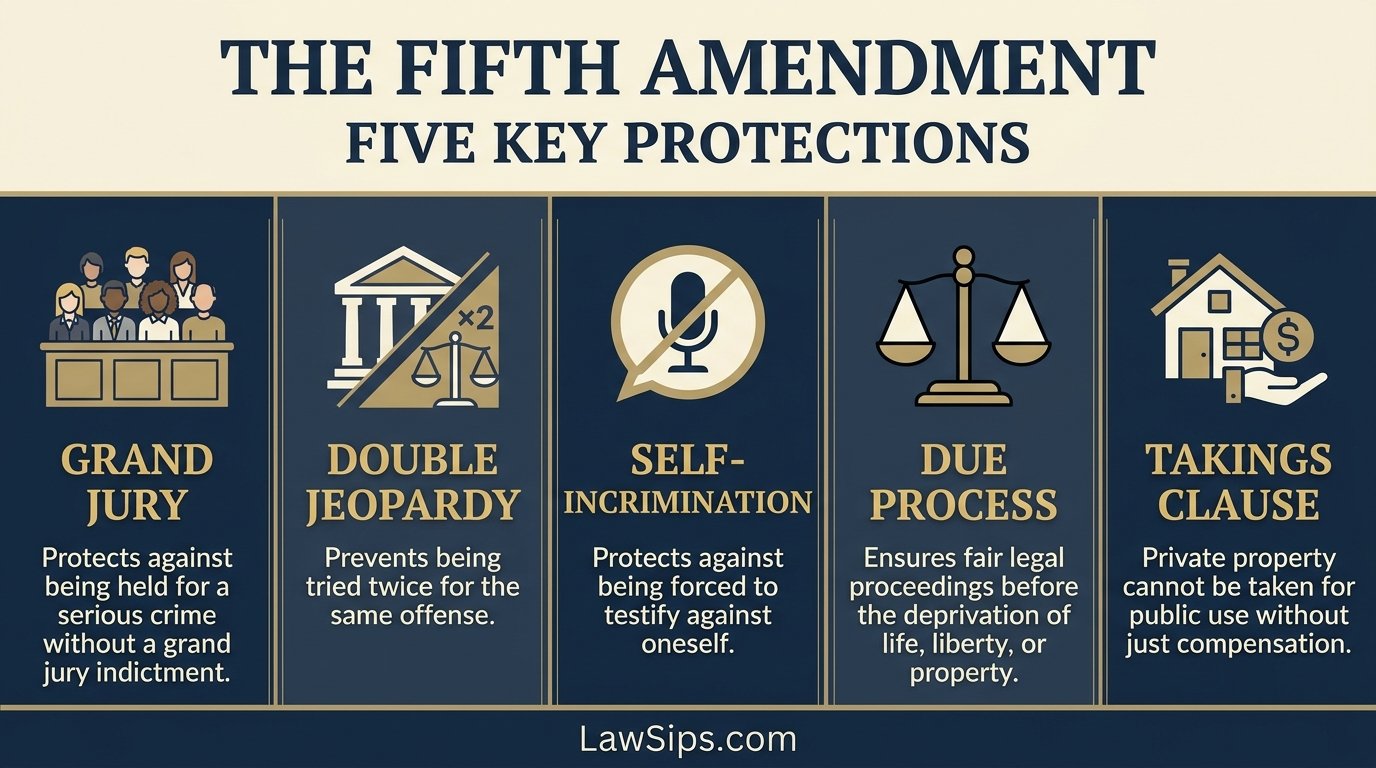
The third clause says no person shall be compelled in any criminal case to be a witness against himself. This privilege against self-incrimination is the right behind the everyday phrase pleading the Fifth.
The privilege protects testimonial evidence: statements and communications that could expose the speaker to prosecution. It is not a general right to withhold every kind of evidence, as the limits below show.
Under Hoffman v. United States (1951), protection reaches answers that would furnish a link in the chain of evidence needed to prosecute. The fear of prosecution must be reasonable, not fanciful, for the privilege to apply.
Where You Can Plead the Fifth
The privilege is not limited to criminal trials, despite what some classroom timelines claim. It can be invoked in any proceeding where a compelled answer might tend to incriminate the person answering.
In McCarthy v. Arndstein (1924), the Court held the privilege applies alike to civil and criminal proceedings, wherever the answer might tend to subject the speaker to criminal responsibility. That holding is nearly a century old.
That is why a witness may plead the Fifth in a civil case, a deposition, or a congressional hearing. The controlling question is always whether a truthful answer could expose the person to prosecution.
Criminal vs Civil vs Hearings: The Adverse Inference Table
Invoking the privilege is allowed in all three settings, but the consequences of silence differ sharply. This table is the distinction readers most often miss, and the one other pages most often blur.
|
Setting |
Can the privilege be invoked? |
Can silence count against the person? |
|---|---|---|
|
Criminal trial |
Yes, by defendant or witness |
No: Griffin bars prosecution comment and guilt instructions |
|
Civil case or deposition |
Yes, where answers could incriminate |
Yes: Baxter allows the factfinder to draw an adverse inference |
|
Congressional hearing |
Yes, where answers could incriminate |
No criminal inference, but contempt and immunity grants are the counters |
In a criminal case, Griffin v. California (1965) holds that the Fifth Amendment, through the Fourteenth, forbids comment by the prosecution on the accused’s silence. It also forbids court instructions that such silence is evidence of guilt.
Civil cases run the other way. Baxter v. Palmigiano (1976) states that the Fifth Amendment does not forbid adverse inferences against parties to civil actions when they refuse to testify, at 425 U.S. 308.
Miranda Warnings: What They Are and When They Apply
Miranda v. Arizona (1966) protects the privilege during custodial interrogation. Before questioning a person in custody, police must deliver the warnings the case requires, or the resulting statements may not be used by the prosecution.
The warnings cover the right to remain silent, that anything said may be used against the person, and the right to an attorney, retained or appointed. A waiver of these rights must be voluntary, knowing, and intelligent.
Miranda sits on two amendments, and honest pages say so. The warnings guard the Fifth Amendment privilege, while the attorney element also connects to the Sixth Amendment right to counsel.
Outside custody, the privilege is generally not self-executing, as Salinas v. Texas (2013) holds. A witness in a voluntary interview usually must claim the privilege expressly to rely on it later.
What the Privilege Does NOT Cover
The privilege bars compelled testimony, not compelled physical evidence. Schmerber v. California (1966) holds it does not bar making a person the source of real or physical evidence, such as a blood sample.
The privilege is also personal to individuals. A corporation, as an entity, cannot plead the Fifth, although a person asked about their own exposure may hold a privilege of their own.
If the government grants immunity broad enough to remove the risk of prosecution, it can then compel the testimony. The privilege protects against incrimination; once that risk is removed, the basis for refusing goes with it.
Public employees keep the privilege too. Garrity v. New Jersey (1967) holds that statements extracted by a threat of removal from office are coerced and involuntary, and cannot be used in a criminal prosecution.
Congressional committees meet the privilege regularly. A witness may refuse a specific question on Fifth Amendment grounds, and the committee’s lawful counters are an immunity grant or a contempt referral, not compulsion of the answer itself.
Clause 4: Due Process
The fourth clause bars the government from depriving any person of life, liberty, or property, without due process of law. It is the amendment’s fairness guarantee, and as written it restrains the federal government.
Procedural due process concerns fair process: notice of what the government proposes, a chance to be heard, and a neutral decision maker. It asks whether the government followed a fair procedure before acting.
Substantive due process concerns protected rights themselves. It asks whether the government’s action touches a liberty the Constitution protects, whatever procedure the government used along the way.
The clause has teeth in hard cases. Brown v. Mississippi (1936) is the cited example of convictions resting on coerced confessions being repeatedly overruled, because a proceeding built on torture is not due process at all.
The clause is triggered by a deprivation: the government must be acting against life, liberty, or property before due process is owed. That trigger is why the first due process question is always what interest the government action touches.
Fifth vs Fourteenth Due Process
Due process appears twice in the Constitution, and the two clauses are not interchangeable. Confusing them is the single most common error in student answers and AI summaries of this amendment.
|
Question |
Fifth Amendment |
Fourteenth Amendment |
|---|---|---|
|
Whose action is limited? |
The federal government |
State governments |
|
Where is due process written? |
The Fifth Amendment Due Process Clause |
The Fourteenth Amendment Due Process Clause |
|
Role in incorporation |
It is the source of the rights |
It is the vehicle applying most Fifth Amendment rights to the states |
The accurate sentence is this: the Fifth Amendment’s due process clause binds the federal government. State action is reached through the Fourteenth Amendment, adopted after the Civil War for exactly that purpose.
Clause 5: Takings and Eminent Domain
The fifth clause permits eminent domain but conditions it twice: private property shall not be taken for public use without just compensation. Both conditions are enforceable limits on government, not courtesies it may skip.
Just compensation is commonly measured at fair market value, as Cornell’s Wex entry explains. The owner is meant to be paid what the property was worth, not what the taking authority prefers to offer.
A common confusion is worth clearing up: eminent domain is the power, and the Takings Clause is the limit on it. The power predates the amendment; the amendment prices and conditions how the power may be used.
The clause reached the states early. Chicago, Burlington and Quincy Railroad v. Chicago (1897) applied just compensation against a state, making it the first Bill of Rights guarantee incorporated through the Fourteenth Amendment.
Public Use, Just Compensation, and Kelo
Kelo v. City of New London (2005) read public use broadly, as public purpose. A city’s taking of homes under a carefully considered economic development plan qualified as a public use, at 545 U.S. 469.
The Court deferred to legislative judgments about what serves a public purpose. Homeowners who were not behind on any obligation lost their homes to a development project that promised jobs and taxes.
Kelo remains the field’s most debated takings decision. Many states responded by tightening their own laws on economic development takings, a legislative reaction the ruling itself left entirely open to them.
Regulatory Takings, Permit Fees, and Tyler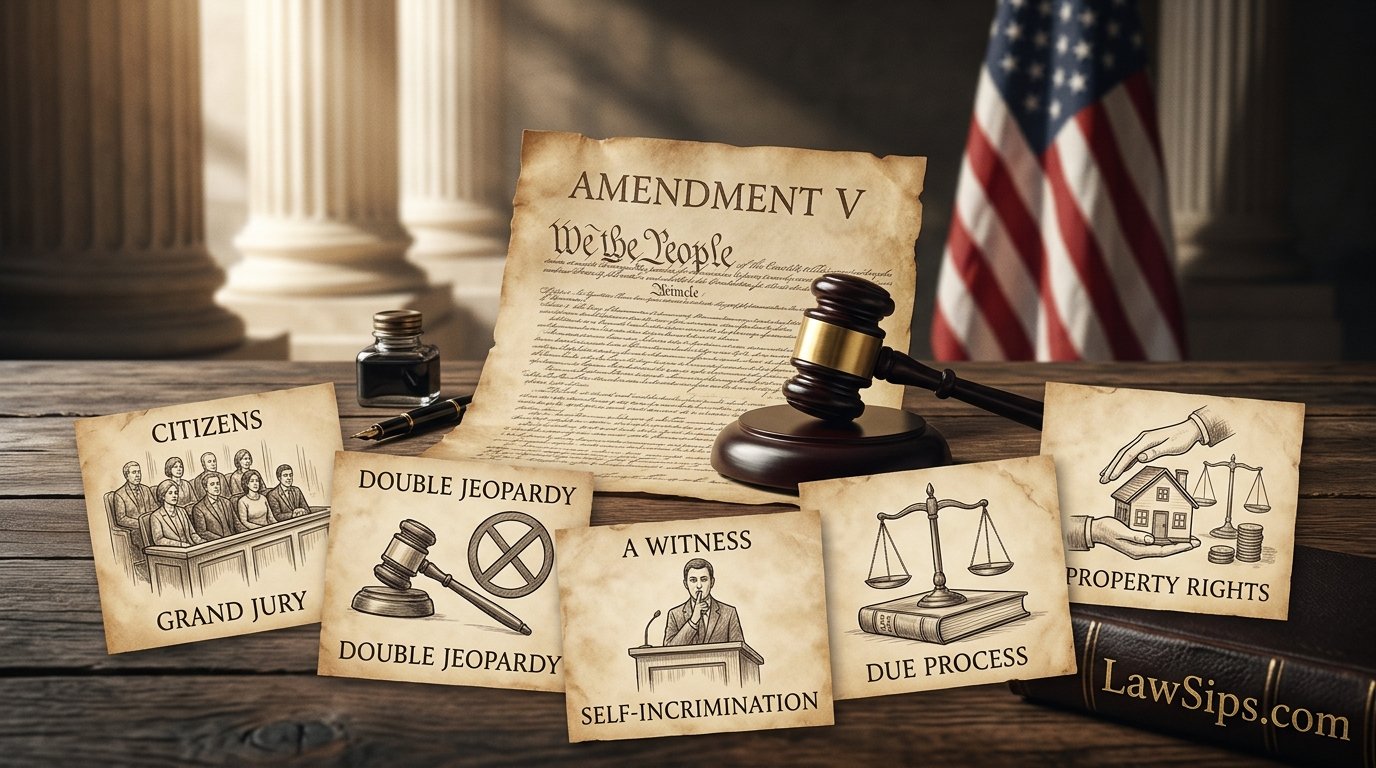
A taking can also occur without a formal seizure. Regulation, or conditions attached to a permit, can go so far that the law treats the result as a taking requiring compensation.
Sheetz v. County of El Dorado (2024) held unanimously that the Takings Clause applies equally to legislatures and agencies imposing conditions on land use permits. A fee set by a legislature receives no exemption from the clause.
Tyler v. Hennepin County (2023) shows the clause’s oldest logic. The county sold a home over roughly $15,000 in tax debt, kept the $25,000 surplus above that debt, and returned nothing to the owner.
Tyler sued, filing as a class action on behalf of similarly placed owners. The Supreme Court held she plausibly alleged a classic taking: the county could collect what was owed, not confiscate more than was due.
Fifth vs Sixth Amendment
Miranda warnings cause most of the confusion between these two amendments. The table below keeps each right on its own side of the line.
|
Right |
Fifth Amendment |
Sixth Amendment |
|---|---|---|
|
Silence and self-incrimination |
Yes |
No |
|
Counsel |
Miranda warnings protect the Fifth Amendment privilege |
Right to counsel in criminal prosecutions |
|
Speedy and public trial |
No |
Yes |
|
Confronting witnesses |
No |
Yes |
|
Grand jury, double jeopardy, due process, takings |
Yes |
No |
Gideon v. Wainwright, the famous case on appointed counsel for defendants who cannot afford a lawyer, is a Sixth Amendment case. It is routinely misfiled under the Fifth, and this page deliberately keeps it where it belongs.
Does the 5th Amendment Apply to the States?
Mostly yes, with one famous exception. The amendment as written binds the federal government; through the Fourteenth Amendment, the Supreme Court has applied most of its guarantees to the states, but the Grand Jury Clause is not incorporated.
Malloy v. Hogan (1964) is the incorporation landmark for the privilege. The Court held the self-incrimination protection is also protected by the Fourteenth against abridgment by the states, under the same standards governing federal proceedings.
Double jeopardy and takings are incorporated as well. A state defendant therefore holds the same privilege and double jeopardy protection as a federal defendant, judged by the same rules.
The practical exception is the first clause. A state felony charge needs no grand jury indictment, because that one clause never crossed over to the states through the Fourteenth Amendment.
Current Status: Checked November 2026
Doctrine on this page was checked in November 2026. The most recent verified changes are in takings law, not in the privilege or double jeopardy doctrine most readers ask about.
Sheetz (2024) extended the permit conditions framework to legislatively set fees. DeVillier v. Texas (2024) was vacated and remanded on state law grounds, without deciding whether the Takings Clause is self-executing.
No Supreme Court decision from 2024 to 2026 verified for this page materially changed self-incrimination, double jeopardy, or grand jury doctrine. Pages claiming a recent revolution in pleading the Fifth should be read with care.
This page also publishes no statistics about how often the privilege is invoked. None could be verified from an authoritative source, and a precise rate quoted without a checkable origin is not information.
How this page was checked: the text was verified word for word against the National Archives transcription, and every case holding was checked against Cornell, Justia, or the opinion itself. Where a holding could not be verified that way, it was left out.
Landmark 5th Amendment Cases
|
Case |
Year |
Clause |
What it held |
|---|---|---|---|
|
Chicago, Burlington and Quincy Railroad v. Chicago |
1897 |
Takings |
Just compensation applied to the states; first Bill of Rights guarantee incorporated |
|
McCarthy v. Arndstein |
1924 |
Self-incrimination |
The privilege applies alike to civil and criminal proceedings |
|
Blockburger v. United States |
1932 |
Double jeopardy |
Two offences differ if each requires proof of an element the other does not |
|
Brown v. Mississippi |
1936 |
Due process |
Convictions resting on coerced confessions were overruled |
|
Hoffman v. United States |
1951 |
Self-incrimination |
Protection covers answers furnishing a link in the chain of evidence |
|
Malloy v. Hogan |
1964 |
Self-incrimination |
The privilege is protected by the Fourteenth against the states |
|
Griffin v. California |
1965 |
Self-incrimination |
No prosecution comment on silence, and no guilt instruction from it |
|
Miranda v. Arizona |
1966 |
Self-incrimination |
Custodial interrogation requires warnings; waiver must be voluntary, knowing, intelligent |
|
Schmerber v. California |
1966 |
Self-incrimination |
The privilege covers testimony, not physical evidence such as blood |
|
Garrity v. New Jersey |
1967 |
Self-incrimination |
Statements coerced by threat of job loss are involuntary and inadmissible |
|
Baxter v. Palmigiano |
1976 |
Self-incrimination |
Adverse inferences are allowed against silent parties in civil actions |
|
Kelo v. City of New London |
2005 |
Takings |
Economic development under a considered plan qualifies as public use |
|
Salinas v. Texas |
2013 |
Self-incrimination |
Outside custody, the privilege generally must be claimed expressly |
|
Gamble v. United States |
2019 |
Double jeopardy |
Separate sovereigns may each prosecute the same act |
|
Tyler v. Hennepin County |
2023 |
Takings |
Keeping surplus equity above a tax debt plausibly states a taking |
|
Sheetz v. County of El Dorado |
2024 |
Takings |
The Takings Clause binds legislatures and agencies alike on permit conditions |
Every holding above is stated as its source states it, and the table is a map, not a substitute. Readers who need a case’s full reasoning should read the opinion itself through Cornell or a court source.
Myths and Mistakes Other Pages Make
- All five clauses bind the states. Wrong. The Grand Jury Clause has never been incorporated, so state felony charges need no federal style indictment.
- Miranda is purely a Fifth Amendment case. The warnings protect the Fifth Amendment privilege, but the attorney element also rests on the Sixth Amendment right to counsel.
- The privilege works only in criminal trials. McCarthy v. Arndstein held in 1924 that it applies alike to civil and criminal proceedings where answers could incriminate.
- Silence is always protected automatically. Salinas holds the privilege is generally not self-executing outside custody; a witness usually has to claim it expressly.
- The privilege covers all evidence. Schmerber limits it to testimony and communications; physical evidence such as blood or fingerprints sits outside it.
- Due process lives only in the Fifth Amendment. The Fourteenth Amendment carries its own due process clause, and that clause is what reaches state action.
Frequently Asked Questions
1. What is the 5th Amendment in simple terms?
It is one sentence carrying five protections: grand jury screening, no double jeopardy, no compelled self-incrimination, due process, and just compensation for taken property. Together they limit how government prosecutes people and takes property.
2. What are the five rights in the 5th Amendment?
The five are the grand jury right, the double jeopardy protection, the privilege against self-incrimination, due process, and just compensation under the Takings Clause. Each is a separate clause with separate case law.
3. What is the exact text of the 5th Amendment?
The exact text is the block quotation near the top of this page, reproduced from the National Archives transcription of the ratified Bill of Rights. It runs from “No person shall be held to answer” to “without just compensation.”
4. When was the 5th Amendment ratified?
It was ratified on 15 December 1791, together with the rest of the Bill of Rights. That date is now marked as Bill of Rights Day, and the amendment’s text has not changed since.
5. Who wrote the 5th Amendment?
James Madison introduced the proposed amendments in Congress in 1789, drawing on state ratifying convention demands and earlier English protections. Congress revised his drafts; the ratified sentence is the product of that process, not one author’s draft.
6. What does pleading the Fifth mean?
It means invoking the privilege against self-incrimination: refusing to answer a question because a truthful answer could expose you to criminal prosecution. The phrase comes from the amendment’s third clause, the self-incrimination clause.
7. What does taking the Fifth mean?
It means the same act as pleading the Fifth. “Taking the Fifth” is simply the more colloquial of the two everyday phrases for invoking the privilege, and the legal effect does not differ.
8. When can you plead the Fifth?
When you are being compelled to answer and a truthful answer could tend to incriminate you, including by furnishing a link in the chain of evidence, per Hoffman. The risk must be real and substantial, not fanciful.
9. Can you plead the Fifth in court?
Yes. A witness may invoke the privilege in court, and a defendant may decline to testify at all. The privilege applies question by question for witnesses, within the limits the case law sets.
10. Can a defendant refuse to testify at their own trial?
Yes. A criminal defendant may decline the witness stand entirely, and under Griffin the prosecution may not comment on that silence, nor may the court instruct the jury to treat it as evidence of guilt.
11. Can you plead the Fifth in a civil case?
Yes. McCarthy v. Arndstein (1924) holds the privilege applies alike to civil and criminal proceedings wherever an answer might incriminate. The difference lies in the consequences, covered by the adverse inference answer below.
12. Can you plead the Fifth in a deposition?
Yes, on the same civil position as in court testimony. A deponent may invoke the privilege for questions whose answers could incriminate, though the civil factfinder may later weigh that silence under Baxter.
13. What is an adverse inference?
It is the inference a civil factfinder may draw that the withheld answer would have been unfavourable to the silent party. Baxter v. Palmigiano (1976) confirms the Fifth Amendment does not forbid that inference in civil actions.
14. Can your silence be used against you in a criminal case?
No. Griffin v. California (1965) forbids both prosecution comment on the accused’s silence and court instructions that silence is evidence of guilt. That bar is a core part of the privilege in criminal trials.
15. Can you plead the Fifth at a congressional hearing?
Yes, where answers could incriminate you. Congress’s practical counters are a grant of immunity, which removes the incrimination risk, and contempt proceedings against witnesses who refuse without a valid privilege claim.
16. Can you plead the Fifth if you are innocent?
Yes. The privilege protects innocent people too, because an honest answer can still furnish a link in a chain of evidence built by others. Hoffman states the standard in exactly those protective terms.
17. Does pleading the Fifth make you look guilty?
Legally, no inference of guilt may be drawn from it in a criminal case; that is the Griffin rule. Public perception is a different matter, and it is not a legal rule this page can quantify.
18. How do you plead the Fifth?
You state the invocation expressly, making clear you are claiming the privilege rather than simply staying quiet. Salinas explains why: outside the Miranda setting, the privilege is generally not self-executing.
19. What happens if you stay silent without saying you are pleading the Fifth?
It depends on the setting. Under Salinas, pre-arrest silence during a voluntary interview, without an express claim of the privilege, may not preserve it. Inside the Miranda custody setting, the rules operate differently.
20. What are Miranda rights?
They are the warnings from Miranda v. Arizona (1966): the right to remain silent, that statements may be used against you, and the right to an attorney, retained or appointed. They apply when custody and interrogation combine.
21. Are Miranda rights in the 5th or 6th Amendment?
Both. The warnings protect the Fifth Amendment privilege against self-incrimination, and the attorney element also connects to the Sixth Amendment right to counsel. Attributing the whole warning to either amendment alone is inaccurate.
22. What happens if police do not read Miranda warnings?
Statements taken during custodial interrogation without the warnings may be excluded from the prosecution’s case. The case itself is not automatically dismissed; the precise consequence depends on the evidence and the proceedings.
23. Can police use your fingerprints or blood against you?
Yes. Schmerber v. California (1966) holds the privilege covers testimony and communications, not compulsion that makes a person the source of real or physical evidence such as a blood sample.
24. Can a corporation plead the Fifth?
No. The privilege is personal to individuals, and a corporation as an entity holds no privilege against self-incrimination. Individuals involved may still hold their own privilege for their own compelled testimony.
25. Can the government force you to testify after giving you immunity?
Yes. A grant of immunity removes the incrimination risk the privilege protects against. With that risk gone, the testimony can be compelled, and refusing may be treated as contempt.
26. What is double jeopardy in simple terms?
It means the same government cannot prosecute or punish you twice for the same offence. One sovereign gets one full attempt; an acquittal or completed punishment closes that sovereign’s case.
27. Can you be tried again after an acquittal?
Not by the same sovereign for the same offence. Acquittal finality is the heart of the clause, and it holds even if later observers believe the verdict was mistaken.
28. Can you be tried again after a mistrial?
Often yes. Whether a retrial is allowed depends on why the trial ended and how the first proceeding was terminated. This is one of the questions where the honest answer is genuinely case specific.
29. Can the state and federal government both charge you for the same act?
Yes. Under the separate sovereigns doctrine, reaffirmed in Gamble v. United States (2019), a state law and a federal law define different offences, so each government may prosecute its own.
30. What is the Blockburger test?
It is the same-elements test from Blockburger v. United States (1932): two offences are different if each requires proof of an element the other does not. Courts use it to decide whether charges count as the same offence.
31. What is a grand jury?
A grand jury is a body of citizens that decides whether enough evidence exists for federal felony charges to proceed by indictment. It screens charges; it does not decide guilt or innocence.
32. Do all states have to use grand juries?
No. The Grand Jury Clause is not incorporated against the states, so the federal indictment requirement does not bind them. Many states use grand juries voluntarily, or use a prosecutor’s information instead.
33. What is the difference between a grand jury and a trial jury?
A grand jury decides whether a charge may be brought; a trial jury decides whether the prosecution proved guilt at trial. They sit at opposite ends of a criminal case and answer different questions.
34. What does due process mean in the 5th Amendment?
It means the federal government may not deprive a person of life, liberty, or property without fair procedures and respect for protected rights. It covers both the process used and certain substantive limits.
35. What is the difference between 5th and 14th Amendment due process?
The Fifth binds the federal government; the Fourteenth binds state governments. The Fourteenth is also the vehicle through which most Fifth Amendment protections, except the grand jury clause, apply to the states.
36. Does the 5th Amendment apply to the states?
Mostly. Double jeopardy, self-incrimination, and takings apply to the states through the Fourteenth Amendment, and due process has its own Fourteenth Amendment clause. The grand jury requirement is the exception: it does not apply to states.
37. What is eminent domain?
Eminent domain is the government’s power to take private property for public use. The Takings Clause allows the power but conditions it on just compensation to the owner.
38. Can the government take your house for a shopping centre?
Under Kelo v. City of New London (2005), a taking for economic development under a carefully considered plan counted as public use. Many states afterwards restricted such takings under their own law, so the local answer varies.
39. What is just compensation?
It is the payment the Takings Clause requires when property is taken for public use. It is commonly measured at the property’s fair market value, as Cornell’s Wex entry explains.
40. Can the government regulate your property so much that it counts as a taking?
Sometimes. Regulatory takings exist, and Sheetz (2024) confirms permit conditions set by legislatures are tested under the clause like agency conditions. Whether a regulation crosses the line is fact specific; it depends on the case.
41. Is the right to a lawyer part of the 5th Amendment?
Not directly. The right to counsel at trial is a Sixth Amendment right, the Gideon line. Miranda’s attorney warning exists to protect the Fifth Amendment privilege during custodial questioning, which is why the two are confused.
42. Is the 5th Amendment legal advice for my case?
No. This page is general information about how the amendment works, not legal advice about any person’s situation. Anyone facing an actual charge, subpoena, or taking should consult a licensed attorney.
Conclusion
The 5th Amendment is five promises in one sentence, and it rewards being read clause by clause. The grand jury screens federal charges, double jeopardy closes finished cases, the privilege guards compelled testimony, due process disciplines federal power, and the Takings Clause prices government takings.
Three boundaries keep the amendment straight: the grand jury clause stops at the federal line, due process reaches states through the Fourteenth Amendment, and Miranda’s counsel warning belongs partly to the Sixth Amendment. Pages that blur those lines mislead their readers.
The natural next reads in this cluster are a Bill of Rights hub and a Sixth Amendment explainer, both in preparation. Until then, the verbatim text above and the case table are the reference points this page stands behind.

Dilawar is a dedicated writer and contributor at Lawsips.com, focusing on legal information, business law, consumer rights, legal awareness, and everyday legal matters. He is passionate about simplifying complex legal topics and providing readers with clear, practical, and easy-to-understand information. His goal is to help readers stay informed about legal developments, understand their rights, and make better decisions through informative and well-researched articles.