Flo Period Tracker Settlement: The $59.5 Million Fund, the Closed Deadline and the Meta Verdict
The flo period tracker settlement is really two separate legal matters sharing one name, and mixing them up produces wrong answers. One track is a 2021 FTC action that paid consumers nothing at all.
The other track is a class action that built a $59,500,000 settlement fund and ended in a jury verdict against Meta. This page keeps those two tracks apart from the first line to the last.
The class action claim window has closed. Claims were due by October 15, 2026, the final approval hearing was held on October 29, 2026, and no payments have been sent yet.
This LawSips page prints every date with its current state, names its source for every figure, and labels every payment figure as the estimate it honestly is.
Status, Checked 23 November 2026: Claims Are Closed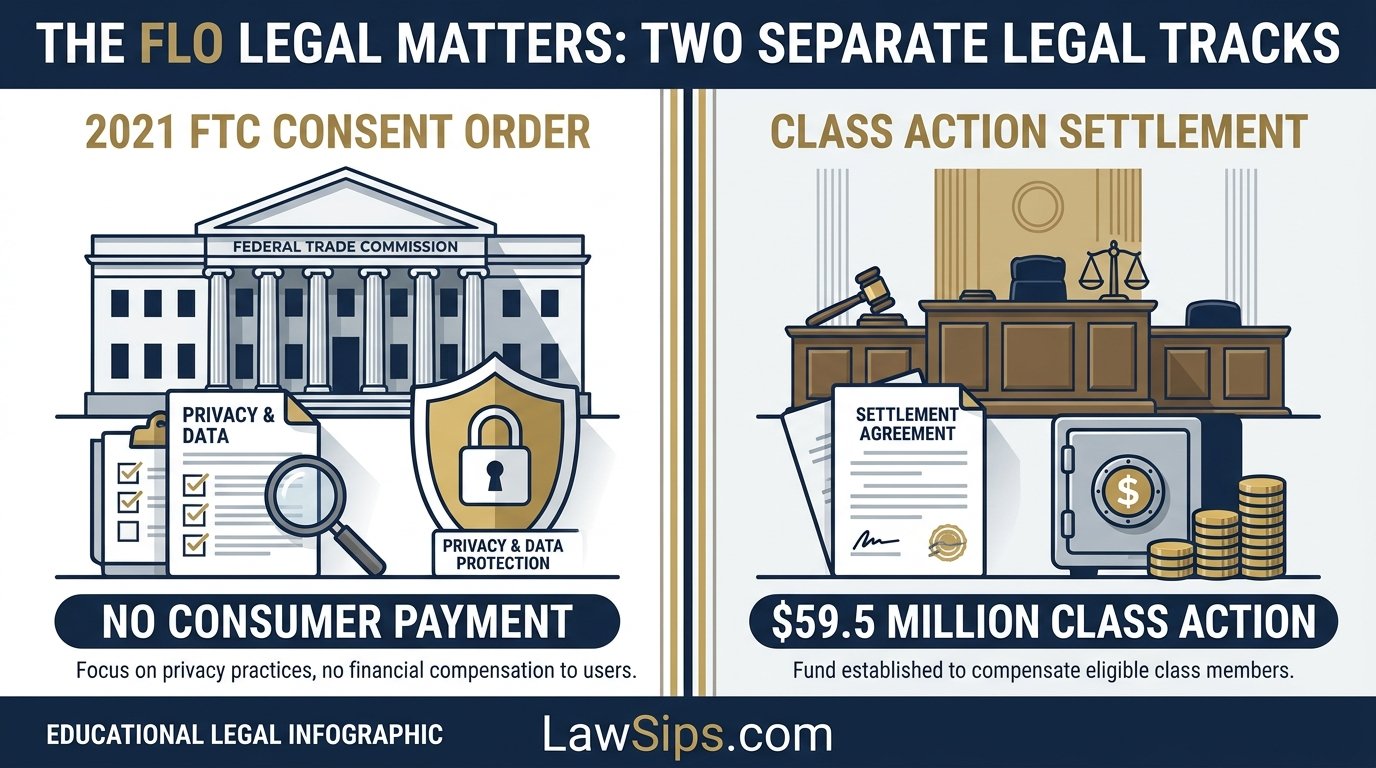
The claim deadline was October 15, 2026, at 11:59 p.m. Pacific Time online, or postmarked by mail that day. That deadline has passed, and the claim window is closed.
The objection deadline of October 8, 2026 and the opt out deadline of July 20, 2025 have also passed. No deadline in this settlement remains open today.
The Final Approval Hearing was held on October 29, 2026. Law360 reported the judge indicated he would approve the settlements with a 5 percent cut to the requested attorneys fees.
As a separate strand, settlement blogs reported on November 14, 2026 that no signed final approval order had been confirmed. Both strands are printed here; a signed order is not stated as fact.
Payments have not been sent. They follow final approval, claim validation and any appeals period, and several sources estimate distribution during 2027 rather than promise a date.
For claim status and official updates, use the official settlement website only. It is run by the court appointed administrator, A.B. Data, Ltd., reachable at 1-866-778-9626.
This page is general information about a public settlement record. It is not legal advice, and anyone facing an individual claim dispute should consult an attorney.
Two Matters, One Timeline
The FTC track is a regulator settlement from 2021 about privacy promises. The class action track is a private lawsuit, Frasco et al. v. Flo Health, Inc., that produced the fund and the verdict.
|
Date |
Track |
Event and its state |
|---|---|---|
|
January 13, 2021 |
FTC |
FTC announces its consent settlement with Flo Health, File No. 192 3133, with no consumer claim fund |
|
January 2021 |
Class action |
The first Flo privacy class action is filed in federal court in California |
|
July 20, 2025 |
Class action |
Opt out deadline passes |
|
July 21, 2025 |
Class action |
Trial begins against the remaining defendants |
|
July 31, 2025 |
Class action |
Flo Health settles during trial for $8,000,000 |
|
August 1, 2025 |
Class action |
A jury finds Meta liable under the California Invasion of Privacy Act |
|
September 15, 2025 |
Class action |
The court denies Meta post trial motions in Dkt. 775 |
|
April 22, 2026 |
Class action |
The court grants preliminary approval of the Google and Flo settlements |
|
October 8, 2026 |
Class action |
Objection deadline passes |
|
October 15, 2026 |
Class action |
Claim deadline passes; the claim window closes |
|
October 29, 2026 |
Class action |
Final Approval Hearing is held in San Francisco |
Matter A: The FTC Action, and Why It Pays No Claims
The Federal Trade Commission announced its Flo settlement on January 13, 2021, after a 5 to 0 Commission vote. It alleged Flo broke its promise that health data would stay private.
The FTC said Flo disclosed health information, including the fact of a pregnancy, in the form of app events. The recipients named were Facebook analytics, Google analytics, Google Fabric, AppsFlyer and Flurry.
The FTC framed the scale plainly: the Flo app was used by more than 100 million consumers. It also alleged violations of the EU-U.S. and Swiss-U.S. Privacy Shield frameworks.
The consent order banned Flo from misrepresenting how it handles personal information. It required Flo to notify affected users about the disclosures its users never agreed to.
Flo also had to instruct third parties that received health information to destroy that data. It had to obtain an independent review of its privacy practices on an ongoing basis.
Before sharing health information again, Flo must disclose the categories, recipients and purpose, then obtain each user affirmative express consent. Those are forward looking duties, not payments.
The money point is absolute: the FTC order carried no financial penalty and no consumer claim fund. There was never an FTC claim form, and no sentence on this page moves class action money into this track.
The FTC package followed the regulators normal course: a Federal Register notice invited public comments on the proposed consent agreement, due on or before March 1, 2021. It was a comment process about the order, not a claim process for users.
That distinction is the one readers most often miss. A regulator settlement can change a companys future behavior completely while paying its users nothing, and the Flo FTC matter is the textbook example.
Matter B: The Class Action and the $59.5 Million Fund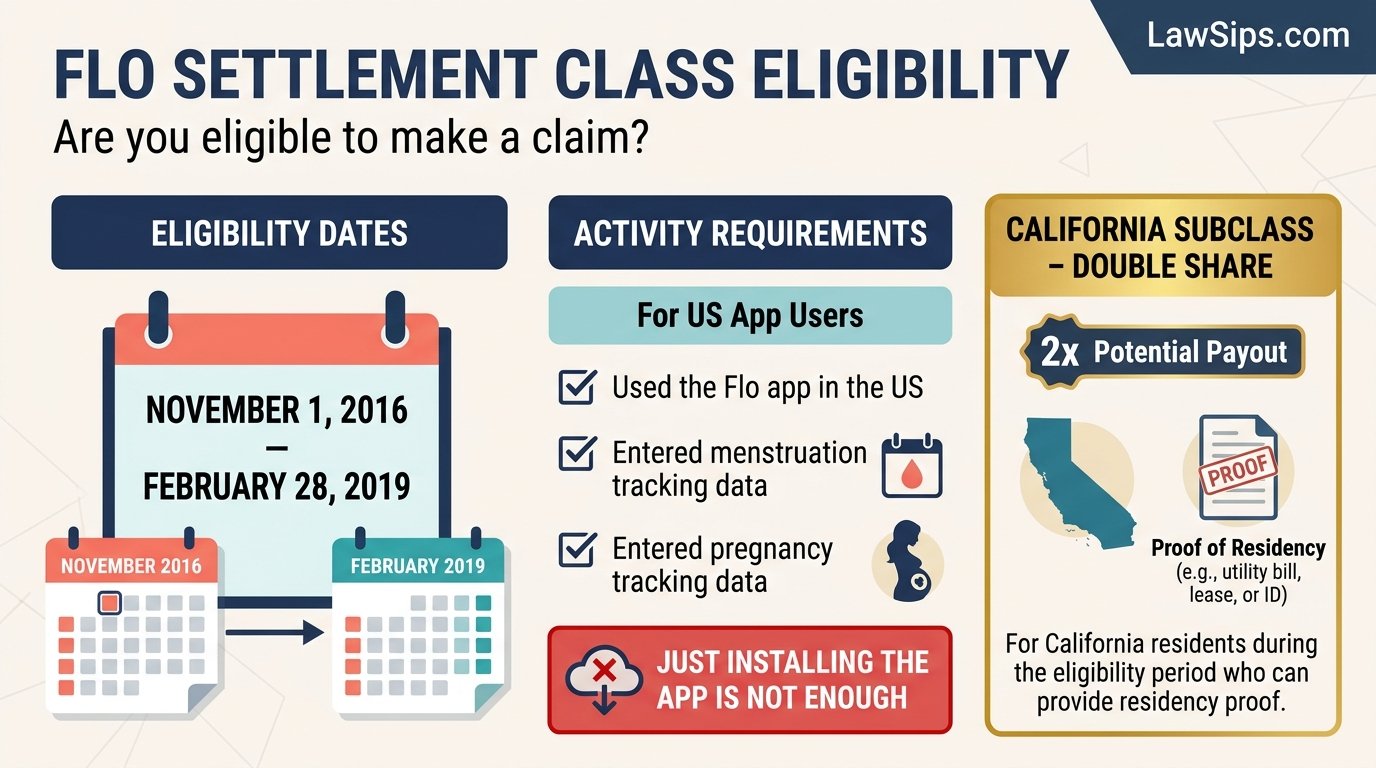
The class action is Frasco et al. v. Flo Health, Inc. et al., No. 3:21-cv-00757-JD. It sits in the U.S. District Court for the Northern District of California, before Judge James Donato.
The lawsuit alleged that Flo built software development kits, called SDKs, from Flurry, Meta and Google into the app. Through those SDKs, menstruation and pregnancy information was allegedly shared with those companies.
Three defendants settled. Google paid $48,000,000, Flo paid $8,000,000 after settling during trial, and Flurry paid $3,500,000, combining into the $59,500,000 fund before court approved deductions.
Class counsel is Labaton Keller Sucharow, acting as co-lead with Lowey Dannenberg and Spector Roseman and Kodroff. The Labaton Keller Sucharow case page carries counsel own summary of the case and verdict.
The court appointed A.B. Data, Ltd. as settlement administrator. A.B. Data ran the notice program, received the claims, and now handles validation and claim status questions.
Flo, Flurry and Google deny all allegations in the official notice. They deny that personal or health information was shared and deny they did anything wrong, and the court has not ruled otherwise for them.
The court granted preliminary approval of the Google and Flo settlements on April 22, 2026. Preliminary approval is the step that authorized the notice program and opened the claim window that later closed in October.
That sequence matters for readers checking status today. The settlements are proposed and preliminarily approved, heard at final approval, and still awaiting the signed final order on the sources checked.
Who Qualified: The Class Definition as the Eligibility Test
Eligibility was never a matter of opinion or memory. It was set by the class definition the court certified, and the definition below is the whole test.
The Nationwide Class
The certified nationwide class covers all Flo App users in the United States who entered menstruation and/or pregnancy information into the Flo Health App between November 1, 2016, and February 28, 2019, inclusive.
Read that test carefully. Merely having the app installed was not enough; a person had to enter menstruation or pregnancy information during that window to be a class member.
The class period is a closed historical window. Using the Flo app in 2020 or later, however regularly, does not meet the definition the court certified for this case.
The California Subclass and the Double Share
Inside the nationwide class sits a California subclass: users who entered that information while residing in California during the same class period dates.
California subclass members are allocated twice the pro rata share of other class members. The double share is not automatic; it requires reasonable documentation of California residency for the period.
That documentation condition is the detail most summaries drop. A California claimant without residency documentation should expect the standard share, not the double share, under the allocation plan.
Who Was Excluded, and the Passed Opt Out Date
Class members who wanted no part of the settlements had to exclude themselves by the opt out deadline. That deadline was July 20, 2025, and it has passed.
Anyone who opted out on time is not in the class and gets no payment from this fund. Anyone who stayed in is bound by the outcome, including the releases the settlements contain.
Notice reached class members by email, mail and publication, because Flo records identified millions of app users from the class period. Many notices carried a Unique ID and PIN for use on the claim form.
Not receiving a personal notice did not decide eligibility either way. The class definition decided eligibility; the notice program was the courts method of reaching as many qualifying users as it could.
The Money by Defendant
Every figure below carries its payer and its route, because the commonest reader error is adding the Meta verdict to this fund. Meta contributes nothing to the $59,500,000.
|
Defendant |
Route |
Amount into the fund |
|---|---|---|
|
Google LLC |
Settlement |
$48,000,000 |
|
Flo Health, Inc. |
Settlement reached during trial |
$8,000,000 |
|
Flurry, Inc. |
Settlement before trial |
$3,500,000 |
|
Meta Platforms, Inc. |
Jury verdict, a separate track |
$0 into this fund |
|
Total settlement fund |
Before court approved deductions |
$59,500,000 |
The fund is a gross figure. Court approved attorneys fees, litigation expenses, administration costs, taxes and service awards all come out of it before class members are paid.
How Much Per Person: The Two Estimate Strands, Honestly Labelled
Payments are pro rata shares of the net fund: what remains after deductions, divided by the number of valid claims. California subclass shares count double in that division.
The deduction requests show why the net fund shrinks. Attorneys fees requested were $19,366,666.67, litigation expenses $2,091,517.74, service awards $155,000, and administration costs $3,556,087.39 incurred plus an estimated $325,000 to finish.
|
Estimate strand |
Figure |
Basis |
Status |
|---|---|---|---|
|
Latest, October 2026 |
About $60 to $63 per valid claim; about $120 to $126 for California |
A.B. Data declaration figures in the October 22, 2026 court filing |
Current estimate, not guaranteed |
|
Earlier, August 2026 |
$31.94 at a 10 percent claim rate; $12.69 at a 25 percent claim rate |
Final approval motion estimates made before final claim counts |
Superseded math |
The October strand is the latest court filed estimate, built on the administrators declaration figures. It supersedes the August math, which assumed claim rates that the real filing numbers replaced.
Neither strand is a promise. The final amount depends on the courts fee ruling, including the reported 5 percent fee cut indication, and on the final count of valid claims.
The estimate moved upward between August and October for one main reason: the screening separated real claims from the flood. Fewer valid claims dividing the same net fund means a larger pro rata share for each valid claimant.
That is also why no honest page printed a single certain figure in August. The claim count was still a guess then, and any page that presented it as settled was guessing with it.
Every Deadline and Its State Today
Deadlines in this case are perishable facts, so each one below is printed with its state on the check date. None of these dates comes from any LawSips page; each comes from the official settlement record.
|
Date |
What it was |
State on 23 November 2026 |
|---|---|---|
|
July 20, 2025 |
Opt out deadline |
Passed |
|
October 8, 2026 |
Objection deadline |
Passed |
|
October 15, 2026 |
Claim deadline, 11:59 p.m. Pacific Time online or postmarked by mail |
Passed; claims are closed |
|
October 29, 2026 |
Final Approval Hearing, Courtroom 11, San Francisco |
Held; signed order not confirmed at check date |
|
After final approval |
Payment distribution |
Not scheduled; 2027 timing is an estimate |
Readers following other cases can learn how settlement claim deadlines work in general on LawSips. That explainer is a neutral hand off; this page dates stand on the official record alone.
If You Filed: Claim Status, Deficiency Cures and Payment Timing
If you filed on time, keep your claim confirmation and any Unique ID and PIN records. Status questions go to A.B. Data at 1-866-778-9626, not to the court and not to Flo.
LawSips explains how settlement check status checking works across cases. For this case, the administrator and the official website are the only status sources that count.
The standard Flo claim needed no receipts, screenshots or app logs. It rested on a signed attestation under penalty of perjury, which is why this case sits in the class action lawsuit no proof family of settlements.
How a class action lawsuit claim form is built explains the rest of that form: the attestation, the payment election, and the perjury warning printed above the signature line.
How Filing Worked, as the Record
Filing ran two ways while the window was open: online through the claim form on the official website by 11:59 p.m. Pacific Time, or by mail, with paper forms postmarked by the deadline date.
Each claim carried the signed attestation described above and a payment election. That closed process is the record the administrator now validates; it is described here in the past tense because it is over.
The Fraud Screening Figures, Stated Exactly
The claims numbers in this case are extraordinary, and they need their exact framing. A.B. Data and fraud vendor Covalynt flagged 21,697,461 of the 22,238,137 claims filed, about 97.6 percent, as fraudulent, per the Dkt. 860 filing.
That flagging is an administrator screening result, not a court finding. The same filing records that at least 461,766 claims were identified as valid, a figure that matters as much as the fraud headline.
The filing also recorded 78,654 curable claims, of which about 3 percent were estimated to cure. If you received a deficiency notice, the cure instructions and deadline in that notice are what govern your claim.
Counsel also asked the court to accept 72,843 late claims. Whether any late claim is accepted is a court decision, and no reader should treat that request as an acceptance.
When and How Payments Would Arrive
No payment date is set. Payments follow final approval, the end of any appeals period, and completed claim validation, which is why 2027 appears in coverage as an estimate.
Claimants chose their delivery route on the claim form: PayPal, Venmo, Apple Pay, Amazon or direct deposit, or a paper check. The election made at filing is the route the administrator will use.
If You Did Not File: What Is Closed and What Remains
The honest headline is that the claim window is closed. There is no open form, no late filing portal, and no service that can reopen an individual claim for a fee.
One narrow thread remains from the record: counsel asked the court to accept late claims that arrived after the deadline. That request is undecided on the sources checked, and it is not a filing route.
What genuinely remains open is the Meta verdict track. The official notice states that people eligible for money from the Meta verdict will be contacted at a later time.
That same notice confirms a settlement claim election does not affect Meta verdict rights. Missing the settlement deadline does not, by itself, erase whatever the verdict process later produces.
Until that contact comes, the only reliable watch point is the official settlement website, where the administrator posts case updates. Social media summaries of the verdict process are reporting strands, and this page treats them that way.
Readers who missed this window can check open class action settlements whose windows are still open. LawSips also explains how to claim a class action settlement before the next deadline arrives.
The Meta Verdict in Plain English
Meta did not settle. It was the last defendant standing when trial began on July 21, 2025, and it took its chances with a jury instead of joining the fund.
On August 1, 2025, the jury found Meta liable under the California Invasion of Privacy Act, at Cal. Penal Code section 632. The finding was that Meta obtained highly personal ovulation and menstrual period information from Flo app users.
Why a Wiretapping Statute Decided a Health App Case
The California Invasion of Privacy Act is a 1967 California wiretapping law. Section 632 bans eavesdropping on, or recording, confidential communications without the consent of the parties involved.
The plaintiffs theory, which the jury accepted, treated the SDK data flows as a form of electronic eavesdropping. Meta, on this reading, listened in on private in app communications it had no right to hear.
The courts reasoning lives in its post trial order. Readers can read the court order denying Meta post trial motions, Dkt. 775, filed September 15, 2025, on govinfo.
In that order, the court denied Meta motions to overturn the verdict, decertify the class and win a new trial. It declined to disturb the unanimous verdict, and that denial stands on the record checked.
What the Verdict Is Not
The verdict is not a payment into the settlement fund, and no judgment amount against Meta was verified as entered in the sources checked. Any total attached to Meta today is a reported strand, not a judgment.
News framing in 2025 described potential exposure in the billions of dollars, built from class size multiplied by statutory damages. Later reporting carried a plaintiffs request for a judgment of about $1.1 billion; both figures are strands only.
Until a judgment is entered and survives appeal, the accurate sentence is short: Meta was found liable, the amount is not decided, and eligible people will be contacted later, per the official notice.
Is the Flo Settlement Legit? Verifying the Official Website
Yes, the settlement is real, and verification is simple. The official website is PeriodTrackerDataPrivacyLitigation.com, confirmed from the official notice, class counsel materials and court documents hosted on that same domain.
That domain is the only claim and status route this page will ever print. The administrator named on it is A.B. Data, Ltd., at 1-866-778-9626, with documents and updates posted there.
The site hosts the long form notice, the claim form record and a library of filed court documents, including approval orders as they are entered. If a fact about this case cannot be found there or in a court document, treat it as unverified.
Type the domain directly into your browser rather than following links from social media posts or comment threads. App settlements attract lookalike sites, and a lookalike needs only a similar name to harvest details.
Filing and checking were always free. Any site or service asking for a fee, a card number or a password to file or check a Flo claim is not the official route, whatever it claims.
How this page was checked: every figure was verified against the official settlement website, the FTC release and the court post trial order on 23 November 2026. Where a point rests on a filing as reported, the text says so.
Privacy Note: What Never to Share
Checking a settlement claim never requires your health history. No administrator, court or counsel will ask for your period dates, pregnancy details or app screenshots to confirm a claim status.
What identifies a claim is the claim confirmation, Unique ID and PIN from the filing process. Guard those like account credentials, and share them only with A.B. Data through the official website or its phone line.
Never enter health details, passwords or payment information on a site reached from a social media link about this settlement. The general lookalike pattern is the warning; no specific victim story is needed to justify it.
The wider privacy frame, including the 5th Amendment and its limits on government power, is covered in a companion LawSips explainer now in preparation. This page stands on the settlement record alone.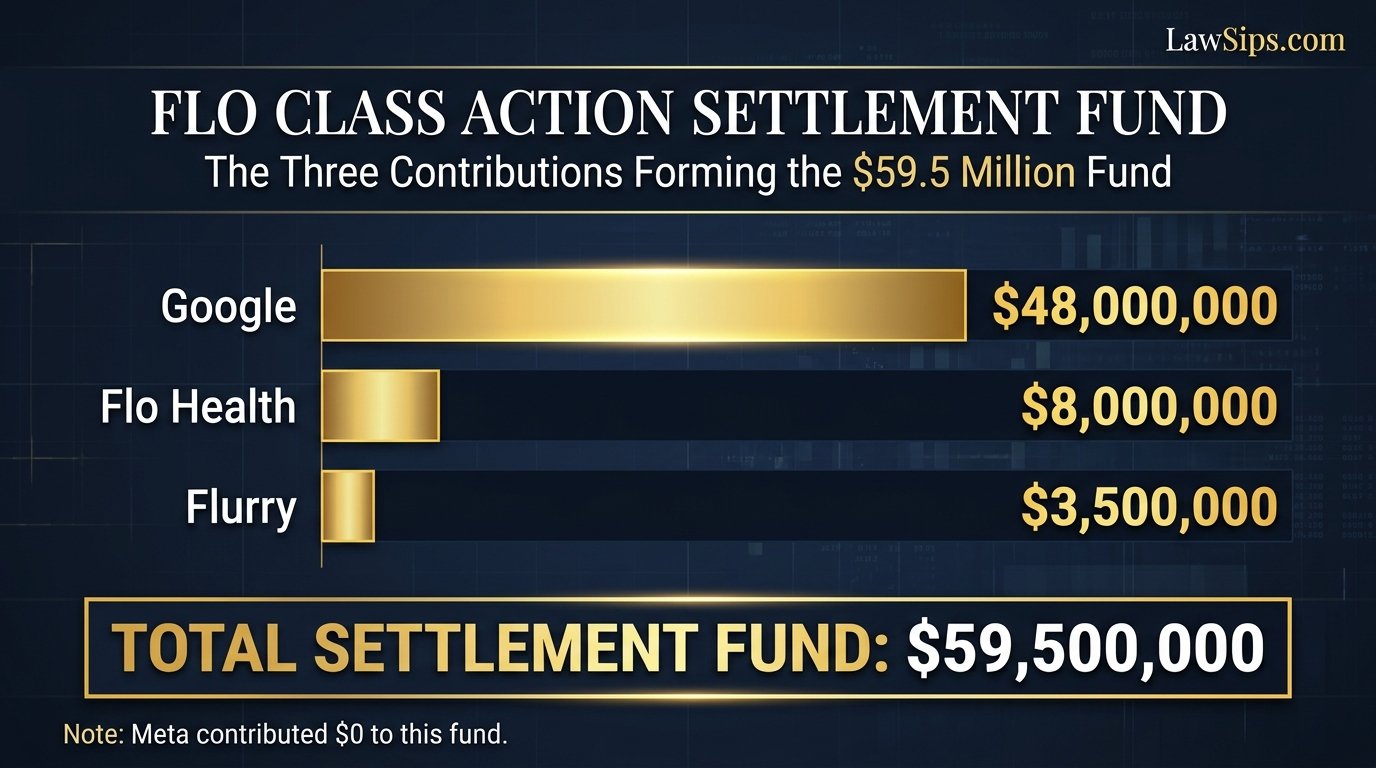
Frequently Asked Questions
1. Is the Flo period tracker settlement legit?
Yes. It is a real, court supervised class action, Frasco et al. v. Flo Health, Inc., No. 3:21-cv-00757-JD, in the Northern District of California. The official website is PeriodTrackerDataPrivacyLitigation.com, and the administrator is A.B. Data, Ltd.
2. What is the Flo period tracker settlement about?
It resolves claims that Flo embedded third party SDKs in its period and ovulation tracker app, through which menstruation and pregnancy information was allegedly shared with Google, Meta and Flurry. The settling defendants deny the allegations and any wrongdoing.
3. What is the difference between the FTC Flo settlement and the class action settlement?
The FTC settlement was a 2021 regulator consent order about privacy promises, with no money for consumers. The class action is the separate private lawsuit that produced the $59,500,000 fund and the Meta jury verdict. They never merge.
4. Can I get money from the FTC Flo settlement?
No. The FTC order carried no financial penalty and no consumer claim fund, and there was never an FTC claim form. All consumer money in this story comes from the class action track, whose claim window closed on October 15, 2026.
5. Who qualified for the Flo class action settlement?
United States Flo app users who entered menstruation and/or pregnancy information into the app between November 1, 2016, and February 28, 2019, inclusive. Simply having the app installed, without entering that information in the window, did not qualify.
6. What was the Flo settlement class period?
The class period ran from November 1, 2016 through February 28, 2019, inclusive. App use outside that window, earlier or later, falls outside the certified class definition for this case.
7. What information did I need to have entered in the Flo app to qualify?
Menstruation and/or pregnancy information entered into the Flo app during the class period. That entry, not downloads, account creation or general app use, is the qualifying act written into the class definition.
8. What is the California subclass in the Flo settlement?
It is the part of the class made up of users who entered the qualifying information while residing in California during the class period. California subclass members are allocated twice the pro rata share, with reasonable residency documentation.
9. Why do California class members get double?
The allocation plan gives the California subclass twice the pro rata share of other class members. The double weighting reflects the California claims in the case, including the California Invasion of Privacy Act claim that produced the Meta verdict.
10. What was the Flo settlement claim deadline?
October 15, 2026, at 11:59 p.m. Pacific Time for online filing, or postmarked by mail that day. The date comes from the official settlement website, checked on 23 November 2026, and it has passed.
11. Can I still file a Flo settlement claim now?
No. The claim window is closed, and there is no late filing portal. Counsel asked the court to accept a set of late claims, but that request is a court decision, not a filing route open to new claimants.
12. What happens if I filed my Flo claim on time?
Your claim goes through validation by A.B. Data, including fraud screening and any deficiency cure process. Payment follows final approval, the end of any appeals period, and the courts rulings on fees and the final valid claim count.
13. How do I check my Flo settlement claim status?
Use the official settlement website or call the administrator, A.B. Data, Ltd., at 1-866-778-9626, with your claim confirmation or Unique ID and PIN ready. No other site or service can give an authoritative status.
14. What was the total Flo settlement fund?
$59,500,000, before court approved fees, expenses, administration costs, taxes and service awards. It combines Google payment of $48,000,000, Flo payment of $8,000,000 and Flurry payment of $3,500,000. Meta contributed nothing to this fund.
15. How much did Google pay in the Flo settlement?
$48,000,000, the largest single contribution to the fund. Google settled before trial, received preliminary approval with the Flo settlement on April 22, 2026, and denies the allegations and any wrongdoing in the official notice.
16. How much did Flo Health pay in the class action?
$8,000,000. Flo settled during the trial, on July 31, 2025, shortly before the jury returned its verdict against Meta. Flo denies the allegations, and the FTC action from 2021 is a separate matter with no fund.
17. How much did Flurry pay?
$3,500,000. Flurry, whose analytics SDK was one of the tools named in the case, settled before trial. Together with Google and Flo, its payment completes the $59,500,000 fund stated in the official notice.
18. Did Meta pay into the $59.5 million fund?
No. Meta did not settle and paid $0 into the fund. Meta was found liable by a jury in a separate verdict track, and any Meta money would come through that process, not through this settlement fund.
19. How much will I get from the Flo settlement?
Only an estimate exists. The latest court filed estimate is about $60 to $63 per valid claim, and about $120 to $126 for California subclass members. The final figure depends on the valid claim count and the courts fee ruling, and it is not guaranteed.
20. Why is the per person amount only an estimate?
Because payments are pro rata shares of a net fund whose size is not final. Court rulings on fees, the number of claims that survive validation, and the California double share all move the per person figure until distribution is calculated.
21. What was the latest estimated payment per person, and what is it based on?
About $60 to $63, or $120 to $126 for California subclass members. It is based on the A.B. Data declaration figures in the October 22, 2026 court filing, after the real claim counts replaced the earlier claim rate assumptions.
22. When will Flo settlement payments be sent?
No date is set. Payments follow final approval, any appeals period and completed claim validation. Coverage and administrator process descriptions point to 2027 as an estimate, not a promise, and the official website will carry the date when one exists.
23. Did I need proof to file a Flo settlement claim?
No receipts, screenshots or app logs were required for the standard claim, which rested on a signed attestation under penalty of perjury. The exception was the California double share, which required reasonable documentation of California residency.
24. What if I deleted the Flo app years ago?
Deleting the app does not change the class definition, which turns on entering menstruation or pregnancy information during the class period, not on having the app today. What mattered was filing a valid claim by the October 15, 2026 deadline.
25. What if I never received a Unique ID or PIN?
Notice reached class members by email, mail and publication, and not everyone received an ID. Claim questions of that kind belonged to the administrator, A.B. Data at 1-866-778-9626, which handled claims filed with and without a Unique ID.
26. What if my Flo claim was flagged or I got a deficiency notice?
A flag came from the administrator fraud screening process, not from a court ruling on your claim. A deficiency notice set out what to fix and by when; following that notice, with the stated cure deadline, was the route to cure a claim.
27. Why were so many Flo claims flagged as fraudulent?
The administrator and its fraud vendor screened an extraordinary filing volume: 22,238,137 claims for a class estimated at about ten million people. Their screening flagged 21,697,461 claims, about 97.6 percent, while at least 461,766 claims were identified as valid.
28. What was the final approval hearing and when was it held?
It was the hearing where the court decided whether to finally approve the Google, Flo and Flurry settlements and the requested fees. It was held on October 29, 2026, at 11:00 a.m. Pacific Time in Courtroom 11, San Francisco.
29. Has the court signed the final approval order?
Not confirmed on the sources checked 23 November 2026. Law360 reported the judge indicated he would approve with a 5 percent fee cut, while settlement blogs reported on November 14 that no signed order had been confirmed. Both strands stand until the order appears.
30. What was the objection deadline and can I still object?
The objection deadline was October 8, 2026, and it has passed. Objections had to reach the court and counsel by that date to be heard at the final approval hearing, so the objection route is closed.
31. What was the opt out deadline and can I still exclude myself?
The opt out deadline was July 20, 2025, and it has passed. Class members who did not exclude themselves by that date remain in the class and are bound by the settlements and their releases.
32. What did the jury decide against Meta?
On August 1, 2025, the jury found Meta liable for obtaining highly personal ovulation and menstrual period information from Flo app users. Meta had not settled, and the court later denied its motions to overturn the verdict.
33. What law did Meta violate according to the verdict?
The California Invasion of Privacy Act, at Cal. Penal Code section 632, which bans eavesdropping on confidential communications without consent. The courts post trial order, Dkt. 775, works through that claim and the denial of Meta motions.
34. How much will Meta pay, and when?
No judgment amount against Meta was verified as entered in the sources checked. Reported exposure figures and a reported plaintiffs request of about $1.1 billion are strands, not a judgment, and any payment would follow judgment and appeals.
35. Will I be contacted about the Meta verdict money?
The official notice says people eligible for money from the Meta verdict will be contacted at a later time. It also confirms that a settlement claim election does not affect Meta verdict rights, so watch for administrator contact through official channels.
36. What is the official Flo settlement website?
PeriodTrackerDataPrivacyLitigation.com, confirmed from the official notice, class counsel materials and court documents hosted on that domain. It is the only website this page routes readers to for claim status, documents and updates.
37. Who is the Flo settlement administrator and how do I contact them?
A.B. Data, Ltd. is the court appointed administrator: Period Tracker Data Privacy Litigation, c/o A.B. Data, P.O. Box 173126, Milwaukee, WI 53217. Its phone number is 1-866-778-9626, and its contact email appears on the official website.
38. How were Flo settlement payments going to be delivered?
By the election made on the claim form: a digital payment such as PayPal, Venmo, Apple Pay or Amazon, a direct deposit, or a paper check. The route chosen at filing is the route the administrator uses at distribution.
39. What data did the lawsuit say Flo shared, and with whom?
The lawsuit and the FTC both described menstruation and pregnancy information, including the fact of a pregnancy, shared as app events. The recipients named across the two matters were Facebook, Google, AppsFlyer and Flurry analytics and marketing services.
40. Did Flo, Google and Flurry admit wrongdoing?
No. In the official notice, Flo, Flurry and Google deny all allegations, deny that personal or health information was shared, and deny they did anything wrong. Their settlements resolve the claims without any court finding that they broke the law.
41. Is it safe to use claim filing services or links from social media for this settlement?
No. Filing and status checks were free and official only, through the settlement website and A.B. Data. Services charging fees and links circulating on social media are the known lookalike pattern for app settlements, and none can reopen the closed claim window.
42. Where can I read the official Flo settlement documents?
On the official settlement websites documents library, which hosts the notices and filed court orders, and through class counsel Labaton Keller Sucharow. The court order on the Meta verdict, Dkt. 775, is posted on govinfo.
Conclusion
The flo period tracker settlement makes sense only when its two tracks stay separate: an FTC consent order that paid consumers nothing, and a class action that built a $59,500,000 fund and produced a jury verdict against Meta.
The claim window is closed, the hearing is held, and the honest open items are a signed final approval order, the courts fee ruling, and a payment date. Every payment figure on this page remains an estimate until the administrator calculates real shares.
For the signed order, claim status and the payment announcement, check the official settlement website and no other address. When any of those facts changes, this page status box is the first thing that gets updated.

Dilawar is a dedicated writer and contributor at Lawsips.com, focusing on legal information, business law, consumer rights, legal awareness, and everyday legal matters. He is passionate about simplifying complex legal topics and providing readers with clear, practical, and easy-to-understand information. His goal is to help readers stay informed about legal developments, understand their rights, and make better decisions through informative and well-researched articles.