How to Check If You Qualify for a Class Action

How to check if you qualify for a class action comes down to a single document match. The class definition is the test, and your own dates and records are the evidence you hold up against it.
Some ranking pages answer a different question. They explain whether a case qualifies as a class action. This page answers whether you, a person with dates and receipts, qualify for a settlement.
Most eligible people never run the check. An FTC staff study, as cited by the MoneyPilot guide to finding settlements you qualify for and corroborated by LegalClarity and CourtDocket, found a median claims rate of 9 percent across 149 settlements.
What follows is general information only, not legal advice. The settlement administrator decides every claim under the court approved terms. This page teaches you to run the check the way the administrator will.
Quick Answer: The Class Definition Is the Test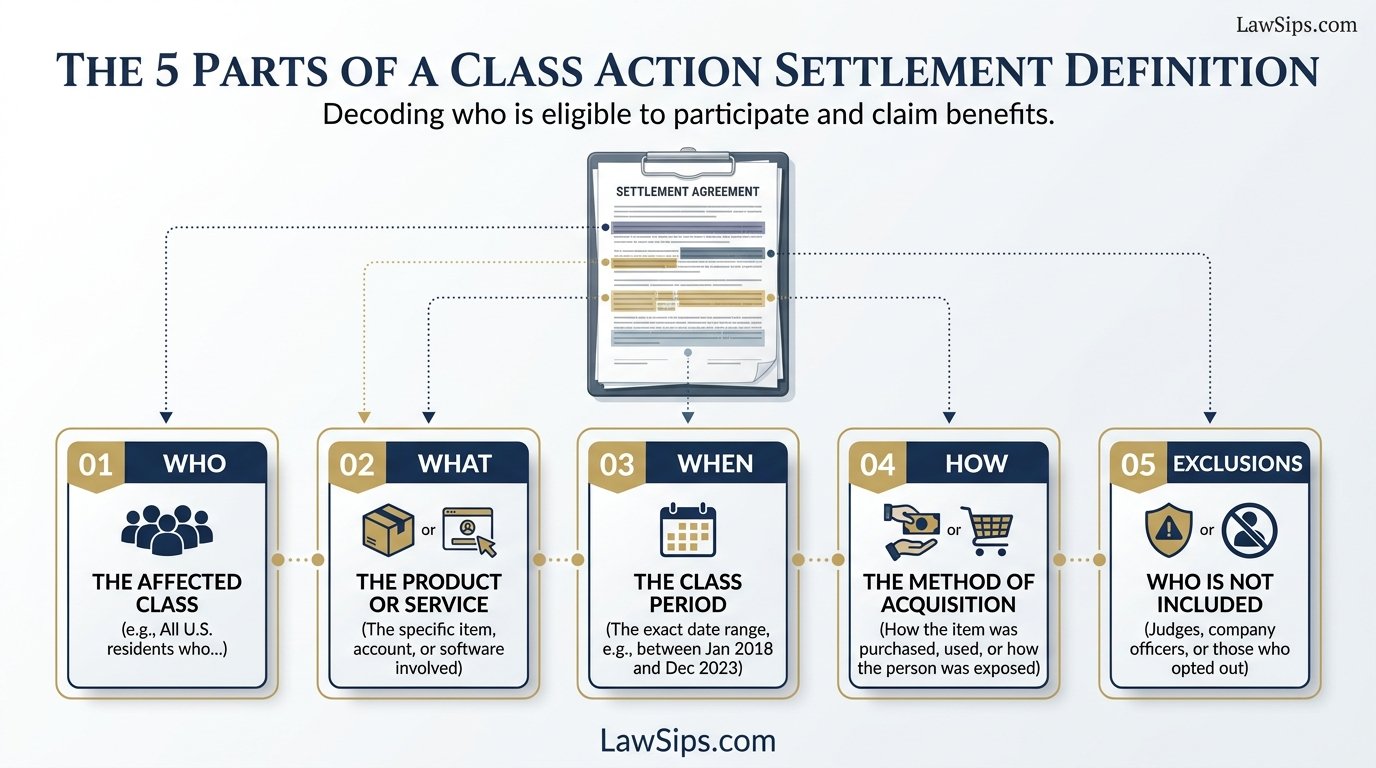
Find the class definition on the official settlement website. It sits under an eligibility heading, usually some form of Am I Included in the Settlement, and it is the whole test in one paragraph.
Take the definition apart into five parts. Who is covered, what product or conduct, when it happened, how the purchase or exposure happened, and who is excluded. Then match your dates and records to each part.
A match on every part means you appear to fit. It does not guarantee payment. The administrator reviews each claim against the court approved terms and makes the final decision.
The check costs nothing and commits you to nothing. Reading a definition and comparing your records changes no right you hold. Only two acts bind you: filing a claim, and missing an opt out deadline.
What This Page Owns, and Where the Sibling Pages Take Over
This page stops at the claim form’s door. It covers finding a settlement, reading its definition, matching your facts, checking exclusions and identifying the payment route. It does not teach the form itself.
The form has its own page: our class action lawsuit claim form guide reads it section by section. Once you match a definition, that is where you go next, not back to the start of this check.
The money route sits elsewhere too: our how to get settlement money guide owns how payment works end to end, and our class action lawsuits no proof guide owns claiming with no proof in depth. Proof appears here only as one eligibility variable.
Dates and tracking are sibling territory: our class action lawsuit deadlines calendar tracks claim windows as they open and close, and our settlement check status guide follows a claim after filing. This page teaches you to note dates, not to chase them.
Step 1: Start From the Signals You Already Hold
Begin with your own inbox and mailbox, not a search engine. A notice addressed to you means the defendant’s records already place you in the class, which makes it the highest signal you can hold.
Search your email for the field’s own terms. Class action, settlement notice, legal notice, claim ID and notice ID all surface real notices. So do administrator names such as Kroll, Epiq, Simpluris, Angeion and JND.
Keep every data breach letter you receive. A breach letter is not a settlement notice, but it names the company, the window and the records involved, which is exactly what a later definition check needs.
A notice is a pointer, not the prize. Receiving one does not guarantee payment, and never receiving one does not settle membership. The definition decides both questions, which is why the check runs the same either way.
Most guides skip this step and start from directories. That order wastes the strongest evidence first. Your own records answer the definition’s questions; a list can only suggest where to ask them.
Step 2: Find Candidate Settlements, Then Leave the List
Use lists to discover candidates, never to decide eligibility. Aggregator roundups, administrator portals and our open class action settlements page are discovery tools. They tell you a settlement exists, not that you are in it.
Every list entry is a paraphrase: the ClaimSensor guide to finding settlements you qualify for frames it correctly: the summary is a rewritten version of the definition, and the check itself happens on the official settlement website, word by word.
Official lists carry their own verification anchors. The FTC refunds list prints a company name and a phone number for each case. A candidate you can cross-check there starts the definition check already trusted.
The moment a candidate looks plausible, leave the list. Open the official site, find the definition, and run the match there. Staying on the list is how readers file for settlements they never fit.
Step 3: Verify the Settlement Is Real Before You Enter Anything
Verification comes before any personal information moves. A real settlement can always be verified independently. A lookalike site depends on you never checking, and it harvests whatever you type into it.
Every real notice carries three identifiers. The case caption, the settlement administrator and the court. Match all three against the mailed notice, court coverage or the FTC refunds list before trusting any page.
The FTC’s refund guidance sets the floor. In its refund programs FAQ, the FTC states it never requires upfront fees and never asks for a Social Security number or bank account information to send a refund.
Type the official address yourself. Never arrive through a link inside a message, because the message is the one thing a scammer fully controls. An independently reached site is the only safe starting point.
Step 4: Read the Class Definition Word by Word
The definition is not marketing copy. Under Rule 23(c)(1)(B), the court order certifying a class must define the class, which makes the definition part of a court order: the full text of Rule 23 of the Federal Rules of Civil Procedure carries the rule in full.
Read it the way the Claim guide to finding settlements you qualify for recommends. That guide calls the definition the single most important sentence in the settlement, because every later question, proof, payment and exclusion, is answered by it.
Slow down at capitalized words. Definitions nest: a capitalized term inside a definition usually has its own definition elsewhere in the notice, and that second definition can widen or narrow who you thought you were.
Who, What, When, How, Exclusions: The Five Parts of Every Definition
Every definition decomposes into the same five parts. Two of them, How and Exclusions, are the parts summary tables most often drop, and they are the two that disqualify people.
|
Part |
The question it answers |
What you hold against it |
|---|---|---|
|
Who |
Individuals, businesses, which states or nationwide |
Your residency and buyer type |
|
What |
The exact products, models, plans or accounts covered |
Your product, model or account records |
|
When |
The class period the settlement covers |
Your purchase, account or exposure dates |
|
How |
Only certain retailers, channels or notice recipients |
Where and how you bought or were exposed |
|
Exclusions |
The people the definition removes |
The exclusions list in the notice, checked name by name |
Work the parts in order and stop at the first failure. A miss on any one part ends the match, however well the other four fit. That discipline is what makes the check fast and honest.
Worked Example: Two Definitions Inside One Settlement (Historical)
Historical example only: every deadline in it passed on August 27, 2026. The Google Assistant Privacy Settlement, administered by A.B. Data, is used here because one settlement held two classes with two different tests.
The Purchaser Class was a purchase test. Its definition covered a user who purchased a Google-Made Device in the United States or its territories between May 18, 2016, and March 19, 2026.
The Privacy Class was an exposure test. It covered users and household members whose communications were recorded or obtained by Google Assistant through a False Accept, or disclosed to a third party review vendor.
Even the word User was defined. The notice defined Users as individuals residing in the United States or its territories whose Google accounts were associated with a Google Assistant Enabled Device during the class period.
The do nothing row shows the stakes in one line: the official Google Assistant Privacy Settlement website printed it plainly: do nothing, get no payment, and give up your rights to sue about the claims in the lawsuit.
One wrinkle surprises almost every reader. People who opted out of the earlier certified Purchaser Class by September 9, 2024 stayed out of the settlement unless they opted back in by filing a claim.
Proof split by class inside the same case. Purchaser claims required a device model, serial number and proof of purchase. Privacy claims required a good faith attestation. Proof is a property of the subclass, not the case.
Valsartan shows how sharp the What can get: the OpenClassActions page on the Valsartan settlements lists three related settlements with three windows, one limited to eight specific NDC numbers. A reader can fit one, two, all three or none.
Step 5: Check the Class Period Against Your Own Dates
The class period is where most self checks fail. A purchase one year before the window opens does not qualify, however identical everything else looks. The window is a hard edge, not an approximation.
Take dates from records, never from memory. Order histories, bank and card statements, pharmacy records and account open and close dates all carry exact dates. Memory rounds, and rounding is how near misses happen.
Check both edges of the window. A start date and an end date both bind. Purchases after the window closes fail the same way purchases before it opened do, and for the same reason.
Employment and exposure windows work the same way. Wage cases use employment dates; breach cases use the window when records were exposed. Whatever the When describes, your records, not your recollection, supply the dates.
Step 6: Match Your Facts and Records to the What
Match the exact identifier the definition names. Where it names a model, a serial range or a drug’s NDC numbers, your record must show that identifier. A sibling model that looks identical is the classic near miss.
Definitions in the wild split single brands: our Toyota airbag lawsuit guide turns on model and year ranges, our Whirlpool fridge settlement guide on model and serial ranges, and our Hyundai Kia airbag lawsuit guide gathers several cases into one settlement. Each is a definition before a headline.
Channel limits count as facts too. Some definitions cover only purchases from certain retailers or only account holders of a type. Where you bought is part of the What, not a detail to round off.
Step 7: Check the Exclusions Before You Assume You Are In
Exclusions are the step the whole top ten skips. Most guides give employees and opt outs one clause inside another section. Here the list is the section, because exclusions are where confident readers get removed.
|
Category |
Who it removes |
|---|---|
|
The defendant and its insiders |
The defendant, its parents and subsidiaries, and its officers, directors and employees |
|
The court |
The judge, court staff and their immediate families |
|
Valid opt outs |
People who requested exclusion by the exclusion deadline and never opted back in |
|
Prior releases |
People who already released the claims, settled individually or filed an arbitration demand and release |
|
Resale and commercial buyers |
Resale purchasers and commercial buyers where the class is retail consumers |
|
Intermediaries |
Pharmacy benefit managers and similar intermediaries named in the notice |
|
Government entities |
Federal and state government entities, with limited exceptions some notices print |
|
Geographic scope |
Anyone outside the covered states or outside a state statute class |
|
Outside the definition’s facts |
Anyone whose dates, model, NDC or serial range fall outside the covered list |
Read your settlement’s own list name by name. The table above is the common pattern assembled from real notices. Your settlement’s exclusions govern your check, and no summary of them, including this one, outranks the notice.
Step 8: Work Out Which Payment Route the Settlement Uses
Settlements pay by one of three routes, and the route changes everything. Until you know which route yours uses, you cannot know whether doing nothing pays you or costs you your share.
|
Route |
How payment happens |
What doing nothing pays |
|---|---|---|
|
Claims made |
You file a valid claim by the deadline |
Nothing; you stay bound and unpaid |
|
Automatic from records |
The defendant’s records identify you and your amount |
A payment can still arrive without any filing |
|
Hybrid |
Noticed members are paid from records; everyone else files |
Depends which group the records put you in |
The claims made route is not universal, whatever some guides imply: the Settlemate guide to checking class action eligibility overstates it as the rule. The FTC record corrects it: most FTC refund cases require no claim at all and mail refunds from customer records.
The official site’s rights table tells you the route. If it prints a claim form with a deadline, assume claims made until the site says otherwise. If it describes payment from records, no form is coming.
Step 9: Note the Three Dates, Not One
A settlement notice carries three deadlines, not one. The claim deadline decides payment. The opt out deadline decides whether you are bound. The objection deadline decides whether the court hears your objection while you stay in.
|
Date |
What it decides |
What missing it costs |
|---|---|---|
|
Claim deadline |
Whether a claims made payment can be made |
Your share, while you remain bound by the judgment |
|
Opt out deadline |
Whether you keep a separate right to sue |
Your separate claim; you are bound either way |
|
Objection deadline |
Whether the court hears your fairness objection |
Your say in the approval hearing |
|
Final approval hearing |
Whether the settlement becomes final |
Nothing directly; it sets when payments can begin |
Opt out and objection dates are eligibility dates. Miss the opt out date and you are bound whether or not you file. Miss the claim date in a claims made settlement and you are bound and unpaid.
The cluster’s trackers hold the live dates. This page teaches what each date decides, and our class action settlement deadlines today page holds the dates themselves for open cases.
Step 10: Decide, Then Act at the Boundary of This Page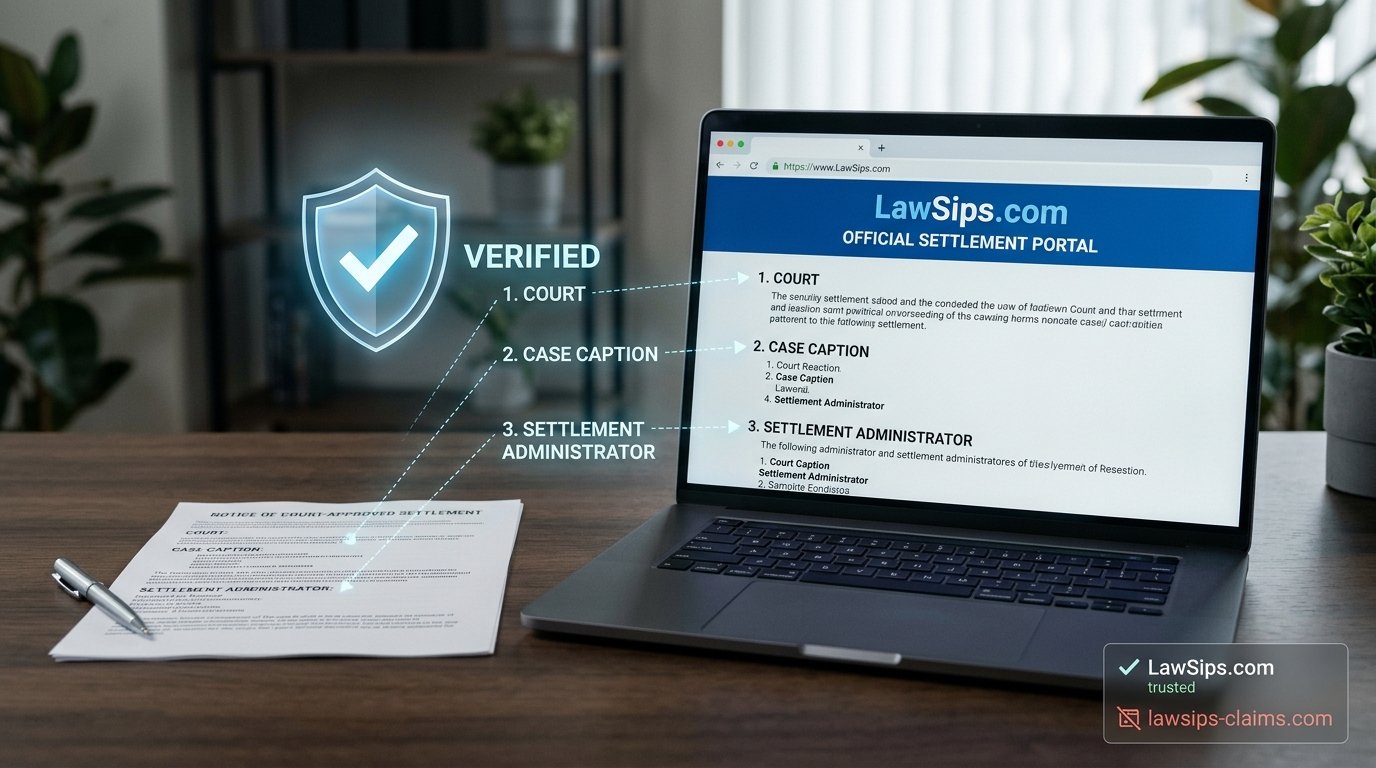
If every part matches, your next step is the form: our class action lawsuit claim form guide takes over from there, section by section. Bring your definition match with you: the form will ask you to attest to exactly what you just checked.
If any part fails, stop. A claim form is signed under penalty of perjury. Filing for a settlement your facts do not fit is not a harmless bet; it is a sworn statement that is not true.
Genuine uncertainty has a free route. The administrator’s hotline and the official site’s FAQ answer definition questions before you sign anything. Asking costs nothing and commits you to nothing, which is more than a wrong filing offers.
What Happens If You Do Nothing
Doing nothing does not remove you from the class. For a damages class, Rule 23(c)(2)(B) requires the notice to state the binding effect of a class judgment on members. Stay silent and the judgment still binds you.
You also give up suing separately on the same claims. Membership is decided by the definition and the opt out deadline, not by whether you filed, read the notice or ever heard of the case.
Payment is where the route decides your outcome. In a claims made settlement, silence pays nothing. In an automatic settlement or an FTC program, a check can still arrive from records. Step 8 tells you which world you are in.
Proof Tiers: What the Definition May Ask of You
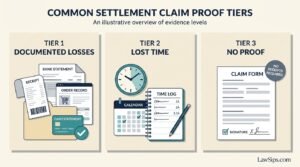
Proof is set by your subclass, not by the case as a whole. The same settlement can ask one group for documents and another for a signature alone, as the historical worked example above showed.
|
Tier |
What it asks |
Typical effect |
|---|---|---|
|
Tier 0, no proof |
A sworn attestation under penalty of perjury |
Usually capped at a product count or fixed amount |
|
Tier 1, proof of purchase |
A receipt, order confirmation or statement line |
Often unlocks a higher amount |
|
Tier 2, documented losses |
Out of pocket records, monitoring costs, pharmacy records |
Scales with the loss you can document |
|
Administrator records match |
The defendant’s records already identify you |
The record itself is the proof; an ID speeds the claim |
Reported terms show the spread, as strands only. Settlemate reports one Walmart settlement paying $10 to $25 without receipts and up to $500 with proof. Those are that settlement’s terms, not a general rule.
Data breach settlements split the same way. canireturn reports a base no proof amount against documented losses up to a far higher ceiling in the LastPass pattern. The tiers are the pattern; the figures belong to those cases.
The no proof route in depth lives with its owners: our class action lawsuit no proof needed guide covers claiming on attestation alone. Here, proof matters only because the tier your definition assigns changes what your match is worth.
Scam Signals: The Checks That Cost Nothing
A fee is the clearest scam signal in this field. Checking is free, filing is free, and releasing a payment is free. Any charge to join, check or unlock money marks the site or caller as fraudulent.
Guard the two requests no legitimate check makes. A real process never needs your bank login or password, and never needs a full Social Security number from a cold contact. Verify any number request on the independently reached official site.
Guaranteed money is a promise no administrator can make. Most funds are pro rata, so the amount depends on how many valid claims arrive. Anyone naming your amount before review is inventing it.
Pressure to act within hours is manufactured. Real deadlines are set by court order and printed on the notice, usually weeks or months out. Urgency exists to stop you verifying, which is why step 3 comes before data entry.
Lookalike sites harvest data quietly. They copy a real settlement’s name, drop the case caption, court and administrator, and collect emails and personal details: our free settlement money guide separates what is genuinely free from what only wears the word.
Frequently Asked Questions
1. How do I know if I am in the class for a settlement?
Run the match on the official settlement website, where the class definition sits under an eligibility heading. Split it into Who, What, When, How and Exclusions, and hold your dates and records against each part.
The administrator decides every claim.
2. What is a class definition and where do I find it?
The class definition is the written test that says who is in the class. Under Rule 23(c)(1)(B), the court order certifying the class must define it, and you find the definition on the official settlement website under its eligibility heading.
3. What is a class period and how do I check my dates against it?
The class period is the When inside the definition: the window of purchase, account, employment or exposure dates the settlement covers. Check it against dates from your own records, not memory, because a purchase before the window opens fails.
4. I never got a notice. Can I still qualify for a class action settlement?
Yes, possibly, because not receiving a notice settles nothing either way. Identifiable members get individual notice under Rule 23(c)(2)(B), but members who cannot be identified are reached by publication notice or not reached directly.
Run the same definition check as a noticed member.
5. I threw away a class action notice. What can I do now?
The notice is a pointer, not the eligibility itself, so the check can still be run. Search the settlement by company, product or case name, reach the website, and read the definition there, checking the deadlines because they apply.
6. I lost my Claim ID or Notice ID. Can I still file?
Usually yes, because an ID speeds a claim without being the claim itself. Most official sites offer a route for members without a Claim ID, and the administrator can often look your record up.
File only through the official site.
7. What counts as proof of purchase for a class action claim?
It depends on the proof tier your settlement assigns. Tier 1 proof is a receipt, order confirmation or statement line; some settlements accept a sworn attestation, and documented loss tiers use records like pharmacy records or explanations of benefits.
8. I have no receipt. Does that disqualify me?
No, a missing receipt does not by itself disqualify you. Many settlements run a no proof tier on a sworn attestation, usually capped, with documented claims paying more.
Settlemate reports one Walmart settlement paying $10 to $25 without receipts and up to $500 with proof.
9. What disqualifies you from a class action settlement?
The exclusions list in the notice disqualifies people. Common categories cover the defendant and its employees, the court and its families, opt outs, prior releases, resale purchasers, intermediaries, government entities, anyone outside the geographic scope, and facts outside the definition.
10. Are employees of the company excluded from its class action settlement?
In the standard pattern, yes. The defendant, its parents and subsidiaries, and its officers, directors and employees appear in the exclusions of the official notices in this research.
Read your own settlement’s exclusions to confirm, because that list governs.
11. What happens if I do nothing after getting a class action notice?
You remain a member, the judgment binds you, and in a claims made settlement you also get nothing. The official Google Assistant site printed its do nothing row in one line: get no payment, give up your rights to sue.
12. If I stay in the class, am I bound by the settlement even if I never file?
Yes, membership and payment are separate questions. Members who do not request exclusion are bound by the judgment whether or not they saw the notice or filed.
Filing decides payment in a claims made settlement; only a valid opt out decides membership.
13. What is the difference between opting out and objecting?
Opting out removes you from the class; objecting keeps you in while you complain. An opt out keeps any separate claim of your own but pays nothing.
An objection tells the court the settlement seems unfair, and objectors can still be paid if it is approved.
14. Is it free to check if I qualify for a class action?
Yes, checking costs nothing at every step. Reading a definition, comparing records and filing are all free, and the FTC states it never requires upfront fees or asks for a Social Security number or bank details to send a refund.
15. Can checking my eligibility hurt me or cost me anything?
Checking itself cannot hurt you, because reading and comparing changes no right you hold. The risks sit elsewhere: entering personal information on an unverified lookalike site, paying any fee, or signing an attestation for a settlement you do not fit.
16. Is there a risk in filing a claim I am not sure I qualify for?
Yes, because a claim form is signed under penalty of perjury. You attest that your claim fits the definition, and administrators review claims, issue deficiency notices and deny claims that do not fit.
Genuine uncertainty about a date or model belongs to the administrator’s hotline, before you sign.
17. I missed the claim deadline. Is there any way back in?
For that settlement, almost certainly not. A closed settlement is closed, with no individual extensions, and a member who never opted out remains bound by the judgment.
The remaining routes are different money: state unclaimed property for an issued check, and second distributions where provided.
18. Can I qualify for two class action settlements at the same time?
Yes, because settlements are separate cases with separate definitions. The Valsartan family holds three settlements under one headline with three windows, and a reader can fit one, two, all three or none.
Run each check separately, and watch for a prior release inside one settlement’s exclusions.
19. Can I be in two classes inside the same settlement?
Yes, when a settlement certifies two classes or subclasses. The historical Google Assistant settlement held a Purchaser Class with a purchase test and a Privacy Class with an exposure test, and a person could fit both, with proof for each.
20. Does receiving a notice mean I am definitely getting paid?
No, a notice means check now, not money guaranteed. A notice addressed to you means the defendant’s records place you in the class, the strongest starting signal there is.
Payment still depends on the route, a valid claim by the deadline, and pro rata claim volume.
21. Does not receiving a notice mean I am not a class member?
No, membership is decided by the definition, not by your mailbox. Individual notice goes to members identifiable through reasonable effort under Rule 23(c)(2)(B).
Everyone else is reached, if at all, by publication notice, and plenty of members are never individually identified.
22. Why did I get a class action notice in the mail?
Because a court ordered it. For a certified damages class, Rule 23(c)(2)(B) requires the best notice practicable, including individual notice to identifiable members, using names and addresses from the defendant’s records.
The notice must state the definition, the claims, the exclusion route and the binding effect.
23. What is the difference between direct notice and publication notice?
Direct notice reaches you personally; publication notice is the fallback for unidentified members. The FTC study, as cited, found claims rates differ by notice type: packet about 10 percent, postcard about 6 percent, email about 3 percent.
24. How can I tell if a class action notice or website is a scam?
Check the three identifiers every notice carries: the case caption, the settlement administrator and the court. Then verify independently by typing the official address yourself and matching the administrator against the mailed notice or court coverage.
Fees, guaranteed money and pressure to act within hours are red flags.
25. A site wants a fee to check my eligibility. Is that legitimate?
No, a fee to check is the clearest scam signal in this field. Filing is free at every stage, and the FTC never requires payment to send a refund.
Leave the site and run the check yourself on the official settlement website, which costs nothing.
26. Do I need a lawyer to check if I qualify for a class action?
No, the check is a document match any reader can run. The definition is published so members can test themselves, class counsel represents the class as a whole, and the administrator’s hotline answers definition questions.
A lawyer matters for different decisions, like weighing a large individual claim.
27. Who decides whether my claim is approved?
The settlement administrator decides, applying the court approved settlement terms. The administrator reviews claims against the definition, issues deficiency notices where a claim can be cured, and denies claims that do not fit.
A matching service saying you may qualify is making no decision at all.
28. What is a settlement administrator and what do they do?
A settlement administrator is the neutral firm that runs the settlement for the court approved process. It sends notices, operates the official website and hotline, reviews claims against the definition and exclusions, and distributes payments.
The FTC contracts with named administrators for its own refund programs.
29. Some settlements pay automatically. How do I know if mine does?
The official site and notice say so, in the rights table. Automatic payment happens where the defendant’s records identify members and amounts, common in FTC programs, where most cases require no claim.
If a claim form exists with a deadline, assume claims made until the site says otherwise.
30. What is the difference between a class action settlement and an FTC refund?
A settlement resolves a lawsuit; an FTC refund enforces one. A court certifies a class and approves the settlement under Rule 23(e).
The FTC instead distributes money from customer records, usually with no claim required, and lists each case with a company name and phone number.
31. I bought the product but outside the class period. Do I qualify?
No, the class period is part of the definition, and an outside purchase does not qualify. ClaimSensor’s warning is the field’s standard one: buying a year before the window opens does not qualify you.
Check the exact start and end dates against a record, not an estimate.
32. I live in a different state than the lawsuit. Can I still be in the class?
Often yes, because many classes are nationwide and the court’s location does not limit membership. Some classes are geographic by design, such as single state classes and Illinois biometric privacy cases.
Read the definition’s Who for a state name or a nationwide phrase before assuming either way.
33. The settlement covers one model but I bought another model from the same brand. Am I in?
Not on that purchase, because definitions split one brand into covered and uncovered lines. Match the identifier in the definition, a model, serial range or, in the Valsartan settlements, eight NDC numbers, against your product or pharmacy record.
A sibling model is the classic near miss.
34. I already settled my own claim with the company. Can I join the class action too?
Generally no, because prior settlements and releases sit in the standard exclusions. People who released the claims or settled individually are excluded, and the Google Assistant exclusions added people who filed an individual arbitration demand and release.
Double recovery on the same claims is what the exclusion prevents.
35. I opted out of a class action years ago. Can I get back in?
An opt out is final for the case. The Google Assistant terms created a wrinkle: people who opted out of the Purchaser Class by September 9, 2024 stayed out unless they opted back in by filing a claim.
Check the settlement FAQ for an opt back in provision.
36. What if I moved since I bought the product or got the notice?
Moving affects notice delivery, not the facts of membership. Your purchase inside the class period is unchanged.
Check the official site rather than waiting for mail, file with your current address, and search state unclaimed property under your old address if a payment may already have been issued.
37. Can a parent file for a minor who is in the class?
In the pattern of the official notices in this research, yes. The Google Assistant terms allow parents or legal guardians to claim for minors.
Treat that as that settlement’s rule, not a universal one, and follow the official site’s representative instructions for your case.
38. What happens to my eligibility if the person in the class has died?
The claim becomes a matter for the person’s estate or legal representative. Settlements set their own representative rules, so the administrator’s hotline is the correct first call, with a death certificate and representative documentation usually requested.
Never file in the deceased person’s name as if they were living.
39. Do I have to prove I was harmed to qualify for a consumer class action?
You have to match the definition, which is not always the same as proving harm. Many definitions require only a covered purchase or account inside the period, while payment tiers scale with documented loss.
Data breach settlements split it: a base attestation tier and a documented loss tier.
40. What is a subclass and why does it matter for my proof?
A subclass is a group inside the class with its own definition and often its own proof rules. In the historical Google Assistant settlement, Purchaser claims required a model, serial number and proof of purchase.
Privacy claims required only a good faith attestation, per the official terms.
41. Why do some people in the same settlement get more money than others?
Reasons explain it: proof tiers pay differently, subclasses carry different allocations, and most funds are pro rata. The amount depends on valid claim volume, which is why no administrator can promise one.
The FTC study, as cited, found half of settlements paid $69 or more per claimant.
42. Where do I find class action settlements I might qualify for?
Start with what you already hold: your mail, your email and any breach letters. Use lists as discovery only: aggregators, the FTC refunds list, administrator portals and this site’s open settlements page.
The real check runs on the official settlement website, where the definition governs.
Conclusion
How to check if you qualify for a class action is a matching exercise, not a search for your name on a list. The class definition is the test; your dates and records are the evidence.
Run the ten steps in order. Signals first, verification before data, the definition word by word, exclusions before assumptions, and the payment route and three dates before you decide anything.
No page can decide your claim, including this one. The administrator applies the court approved terms to your facts. What this check gives you is the same test, run honestly, before you sign anything.
From here, the cluster routes you. Readers who matched go to our class action lawsuit claim form guide, readers still hunting go to our open class action settlements page, and readers who already filed go to our settlement check status guide.
The rest of the cluster is gathered from the LawSips home page. Open settlements, deadlines, no proof claims and claim status each keep their own page there, and this page’s hand-offs point to them rather than repeating them.

Dilawar is a dedicated writer and contributor at Lawsips.com, focusing on legal information, business law, consumer rights, legal awareness, and everyday legal matters. He is passionate about simplifying complex legal topics and providing readers with clear, practical, and easy-to-understand information. His goal is to help readers stay informed about legal developments, understand their rights, and make better decisions through informative and well-researched articles.