
What Are Miranda Rights?
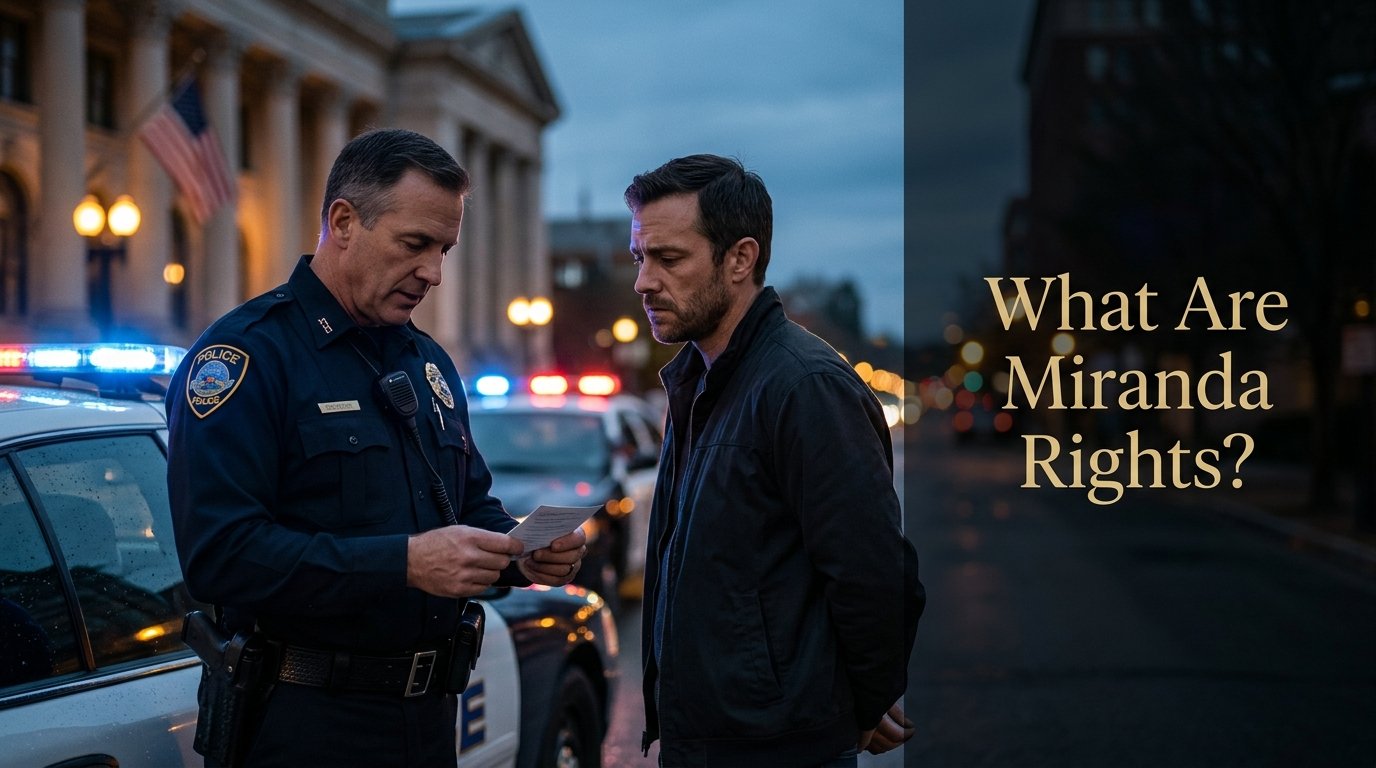
What are Miranda rights? They are the four warnings police must give a person in custody before questioning them, and the constitutional rights those warnings describe. The Supreme Court required them in Miranda v. Arizona in 1966.
The short version is four warnings. A person must be told they may stay silent, that anything said can be used against them, that they may have a lawyer present, and that one is appointed free if they cannot pay.
The duty itself switches on only when two conditions meet. The person is in custody, and police are about to interrogate them. No custody, or no interrogation, means no warning is owed at that moment.
This page answers the definition questions directly. What the warning says word for word, why searchers keep asking for five rights instead of four, how the rights differ from the warning, and when the words change by state.
The Definition in One Paragraph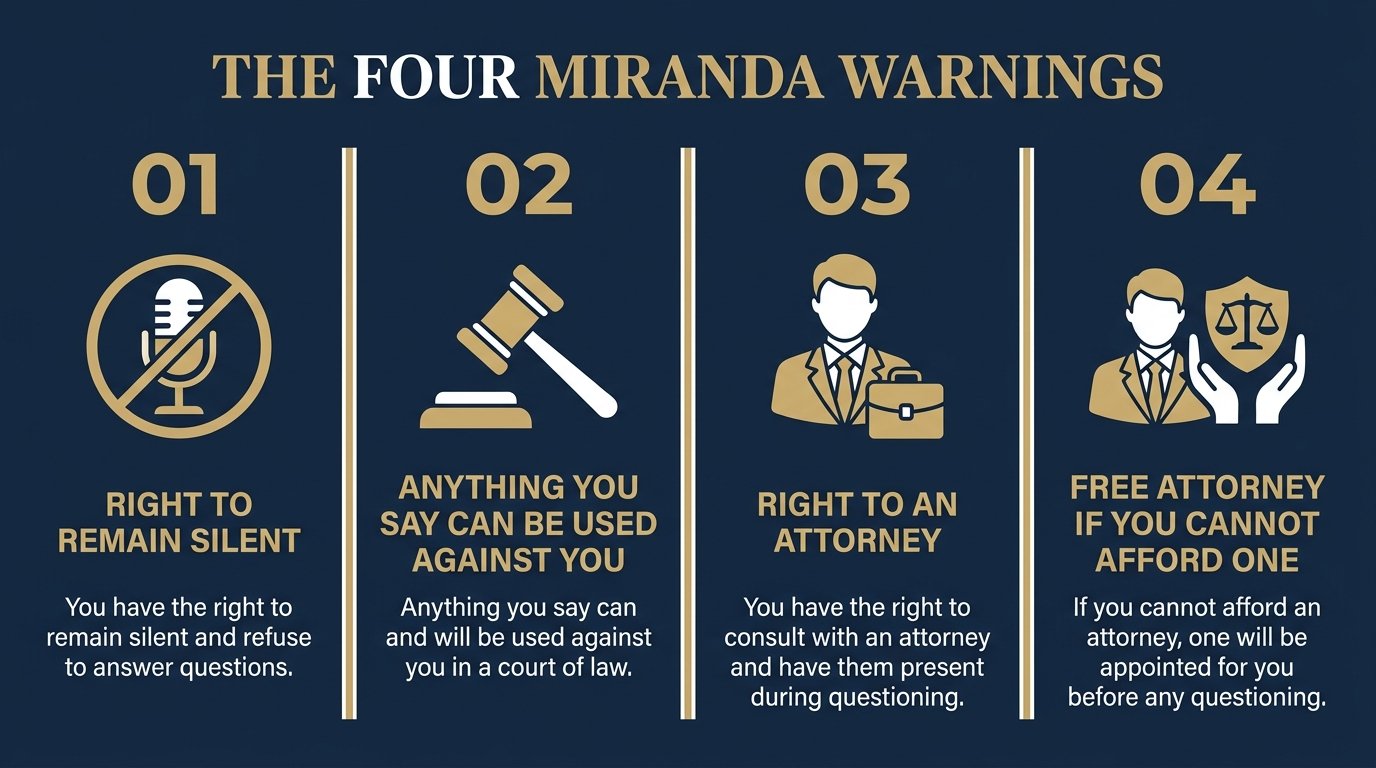
Miranda rights are constitutional protections that attach when police question a person in custody. The warning that announces them comes from Miranda v. Arizona, 384 U.S. 436, decided June 13, 1966, by a five to four vote.
The rule underneath is a bar on questioning, not a formality. A person in custody may not be interrogated until they have been made aware of these rights and given a genuine chance to exercise them.
The authorities define the terms the same way. Cornell Law’s Wex entry on the Miranda warning grounds the warnings in the privilege against self-incrimination, and its companion Miranda rule entry states the bar plainly: no custodial interrogation until the person knows the rights.
The privilege behind the warnings is the Fifth Amendment’s own rule. No person shall be compelled to be a witness against himself, the subject of what is the 5th Amendment on this site. The warnings exist to protect that privilege where pressure is highest.
The name comes from the defendant, not from the doctrine’s subject. Ernesto Miranda was arrested in Phoenix in 1963 and signed a confession after two hours of questioning. Retried without that confession, he was convicted again. The rule kept his name.
Miranda rights in simple terms
In simple terms: before police question you in custody, they must tell you four things. You can stay silent. What you say can be used against you. You can have a lawyer with you. If you cannot pay, the court appoints one free.
That simple version is complete at its level. Everything else on this page adds precision around the same four points: the exact wording, the state variations, and the two conditions that trigger the duty.
The federal judiciary teaches the case in the same plain register. Its Fifth Amendment activities present Miranda to students in plain language, which is the level this labeled version follows.
The Four Warnings
The warning is a list of four statements, and the list is the answer most searchers came for. Every department words it slightly differently, but the four elements below are the stable core that every version must convey.
- You have the right to remain silent.
- Anything you say can be used against you in a court of law.
- You have the right to an attorney, present during questioning.
- If you cannot afford an attorney, one will be appointed for you.
|
# |
Warning |
What it protects |
|---|---|---|
|
1 |
You have the right to remain silent. |
The choice not to answer questions at all |
|
2 |
Anything you say can be used against you in a court of law. |
Fair notice that statements become evidence |
|
3 |
You have the right to an attorney, present during questioning. |
Legal help while the questions are asked |
|
4 |
If you cannot afford an attorney, one will be appointed for you. |
The same help, free, for those who cannot pay |
Four warnings are the whole requirement; nothing else is owed as part of the warning itself. A version that drops one element has dropped part of the requirement, whatever extra lines it happens to add.
The order in the list follows the opinion’s own order. Silence first, the use of statements second, counsel third, and appointed counsel last, as the closing element of the counsel warning.
The warnings are usually read aloud, and often handed over in writing as well. Departments print them on pocket cards and advisement forms, because a clear record of the advisement matters as much as the words themselves.
Are There 5 Miranda Rights?
There are four warnings, not five. Search phrasing assumes five, and some law firm pages build five-item lists to match the question. The warning itself has never carried a fifth item at any point.
The claimed fifth is the right to stop answering. Five-item lists split the first warning in two: the right to remain silent, and the right to stop answering after questioning has already begun.
That second right is real, but it is not a separate warning. It flows from the first: whoever may remain silent may also stop partway through. Police recite four; the fifth item is the first one, working.
Miranda Rights vs the Miranda Warning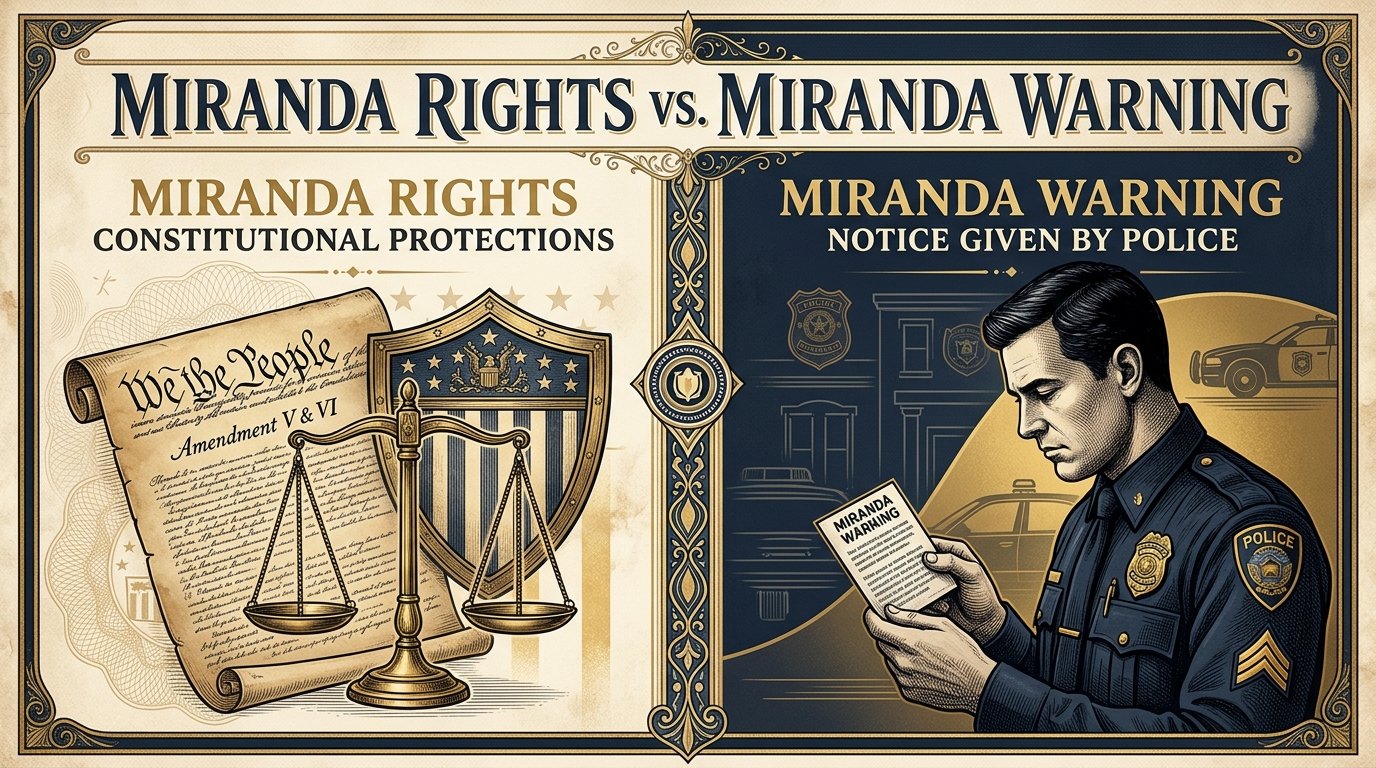
The rights and the warning are not the same thing. The rights are constitutional protections a person holds whether or not anyone recites them, rooted in the 5th Amendment privilege against self-incrimination.
The warning is the notice police give of those rights. It exists so a person in custody knows the protections before deciding whether to speak, stay silent, or ask for a lawyer first.
|
Question |
Miranda rights |
Miranda warning |
|---|---|---|
|
What is it? |
Constitutional protections the person holds |
The spoken or written notice of them |
|
Where does it come from? |
The Fifth Amendment privilege, applied in Miranda v. Arizona |
Police departments, wording their own advisements |
|
When does it exist? |
At all times, recited or not |
Given before custodial interrogation begins |
|
What if it is skipped? |
The rights remain fully intact |
Statements taken may be kept out of the case |
A skipped warning does not erase the rights; it leaves them intact and puts the statement at risk. The warning is the delivery. The rights are what is delivered.
Sources describe the roots in two strands, and they are best kept apart. Cornell’s Wex entry names the Fifth Amendment privilege and the Sixth Amendment right to counsel together, as the twin sources of the warnings.
A second strand, stated plainly by LegalClarity’s word for word analysis, ties the Miranda counsel right to the Fifth Amendment alone. This page follows the opinion itself: the warning system guards the privilege inside the interrogation room.
Word for Word: What the Warning Actually Says
The closest thing to an official text is the opinion itself. At 384 U.S. 444-45, the Court stated the warnings in its own words, as Justia’s Miranda rights explainer quotes them:
“He has a right to remain silent.”
“Any statement he does make may be used as evidence against him.”
“He has a right to the presence of an attorney, either retained or appointed.”
The appointed counsel point sits inside the third sentence. Retained or appointed is the opinion’s compressed phrasing for the fourth warning above: your own lawyer, or one the court provides free.
Police cards recast the same points in the second person. One phrase sharpens in the move: where the Court wrote “may be used as evidence,” the familiar card wording reads “can and will be used against you in a court of law.”
No official script exists. The Supreme Court never mandated exact words, and courts ask only whether the warning reasonably conveyed the four rights, the standard applied in the line of cases after California v. Prysock.
The opinion also states the waiver condition in the same passage. A person may waive these rights, the Court wrote, provided the waiver is made voluntarily, knowingly, and intelligently. That single sentence is the seed of every waiver form in use today.
Do the words change by state?
Yes, the wording varies by jurisdiction and agency. Departments write their own cards, some add a closing understanding question, and translations differ again. Hundreds of versions circulate across the country.
What does not change is the core. All four elements must be conveyed, whatever words the department chose. A state version is judged on its substance, not on matching a national script that does not exist.
The warning on TV, and in real life
Television compresses the warning into the arrest moment. The cuffs close, the words follow, and the scene moves on. That timing is the screen’s invention, not the rule’s actual requirement.
In real life, the warning is owed before custodial interrogation, which may come hours after an arrest, or never. A person can be arrested, booked, and released without the warning ever being required.
When the Warnings Are Owed: Custody Plus Interrogation
Two conditions switch the duty on, and only two. The person must be in custody, and police must be about to interrogate them. Both together trigger the warning; either one alone does not.
Custody means a reasonable person in the same position would not feel free to end the encounter and leave. Formal arrest is the clearest case, but the test is the situation, not the label.
Interrogation means express questioning, or words and actions reasonably likely to draw out an incriminating answer. Ordinary conversation, volunteered statements, and routine booking questions sit outside it.
Arrest alone does not trigger the warning, and neither does questioning alone. A person questioned at home, free to end the conversation, is owed no warning. A person held in a cell and asked nothing is owed none either.
Both conditions are everyday working concepts in criminal law practice. They are applied at stationhouses, roadside stops, and school offices alike, and small factual differences decide which side of the line a case falls on.
That is as far as the definition goes, and the doctrine goes much further. Scenario by scenario custody tests, invocation, waiver, and the exceptions are treated in full in the complete Miranda rights guide on this site.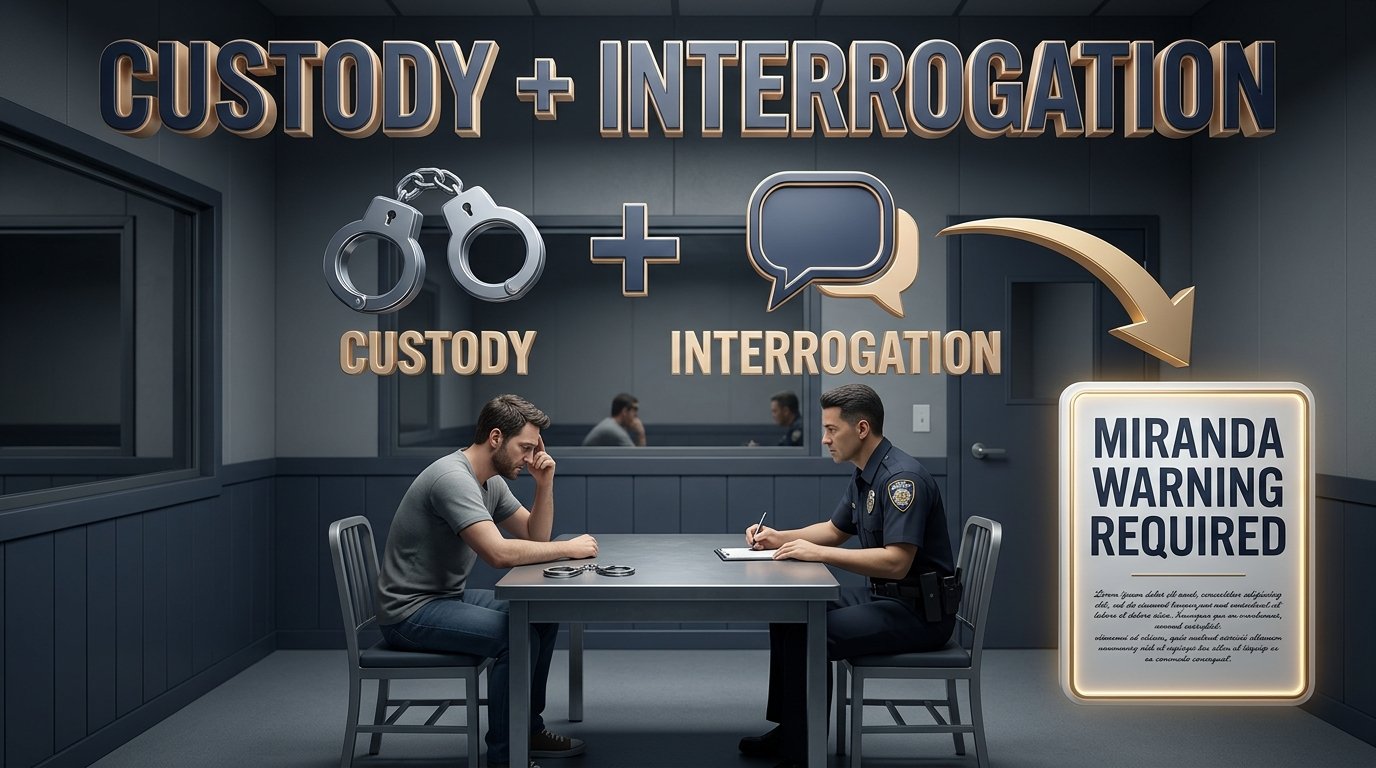
Frequently Asked Questions
The questions below are the ones this keyword actually asks: counts, wording, origins, and scope. Questions about doctrine, remedies, and procedure are answered in the full guide linked above.
What are the 5 Miranda rights?
There are four, not five. Silence, use of statements in court, an attorney present, and an appointed attorney if the person cannot afford one. The usual fifth, stopping partway through questioning, flows from the first warning.
What are Miranda rights in simple terms?
Before police question you in custody, they must tell you four things. You can stay silent, what you say can be used against you, you can have a lawyer, and one is appointed free if you cannot pay.
What is the difference between Miranda rights and the Miranda warning?
The rights are constitutional; the warning is the notice of them. The rights exist whether or not anyone recites them. The warning is what police say so a person in custody knows them before speaking.
Do Miranda rights apply in every state?
Yes. Miranda binds every state, and Dickerson confirmed it a constitutional rule no legislature can repeal. What varies by state is the warning’s wording and any added state protections, not the duty itself.
Can you invoke Miranda rights before you are arrested?
Not in advance, as a standing declaration. The rights are exercised when custodial questioning happens or looms. A person who is not in custody can still decline to answer questions and can ask for a lawyer.
Do Miranda rights apply to questioning by federal agents?
Yes. Miranda is federal constitutional law, and it governs custodial interrogation by federal agents the same way it governs state and local police. The four warnings and the two trigger conditions are identical.
Do police have to read Miranda rights in Spanish or another language?
The warning must reasonably convey the rights, so language matters. Departments use translated cards and interpreters. A warning given in a language the person cannot understand conveys nothing the rule is meant to protect.
How long does an invocation of Miranda rights last?
An invocation of counsel holds while custody continues. Police may not restart questioning on their own initiative. After a break in custody of fourteen days or more, they may reapproach with fresh warnings, under Maryland v. Shatzer.
Do Miranda rights apply to military members?
Service members get a parallel protection, not Miranda itself. The military’s Article 31 warnings under the Uniform Code of Military Justice predate Miranda and are broader in some respects. Miranda governs civilian police questioning.
What does it mean to be Mirandized?
It means police gave a person the Miranda warnings. The verb comes from the case name and marks the advisement moment, usually before custodial questioning. Being Mirandized does not itself mean an arrest happened.
What are your Miranda rights?
The same four warnings, stated to you directly. You may remain silent, anything you say can be used against you, you may have an attorney present, and one is appointed if you cannot afford one.
What are the four Miranda warnings?
Remain silent; anything said can be used in court; an attorney during questioning; an appointed attorney if the person cannot afford one. Those four statements are the whole warning, in the opinion’s own order.
What is a Miranda warning?
The notice police give of the rights before custodial interrogation. It is the spoken or written statement of the four warnings. The warning is the delivery; the rights are the protections behind it.
Why are they called Miranda rights?
They carry Ernesto Miranda’s name. His Phoenix case became Miranda v. Arizona in 1966, the decision that required the warnings nationwide. Landmark rules commonly take the name of the defendant whose case announced them.
Where do Miranda rights come from?
From the Fifth Amendment privilege against self-incrimination. In Miranda v. Arizona, the Court built the warning system as the safeguard for that privilege during custodial interrogation, where pressure to speak is at its highest.
Is the Miranda warning constitutionally required?
Yes. Dickerson v. United States held in 2000 that Miranda announced a constitutional rule Congress cannot overrule by statute. The warning duty is constitutional law, not a courtesy or a department policy choice.
What does the Miranda warning say word for word?
No single official wording exists. The opinion states the points in its own words, including “may be used as evidence.” Police cards adapt them, as “can and will be used,” varying by department.
Do Miranda warning words vary by state?
Yes. Each jurisdiction words its own warning, and courts test substance rather than identical phrasing. The four elements are the stable core; added lines, like an understanding question, are local practice.
What should you say, in exact words, to invoke your rights?
No magic words exist, but the statement must be unambiguous. “I want a lawyer” and “I do not want to answer questions” both work. A maybe, as in Davis, does not stop questioning.
Are the Miranda rights read on TV accurate?
The words are usually close; the timing is not. Television reads the warning at the moment of arrest. The real duty attaches before custodial interrogation, which may come hours later, or never.
What happens if you do not understand the warning?
A warning the person cannot understand does not do its job. Any waiver must be knowing and intelligent, so comprehension is part of the test. Courts examine language, translation, and the person’s condition.
Can police question you before reading your rights?
Yes, outside custodial interrogation. Police may ask questions of a person who is free to leave, take volunteered statements, and ask routine booking questions. The warning duty attaches only when custody and interrogation meet.
Do Miranda rights apply to students questioned at school?
Yes, juveniles hold Miranda rights too. A child’s age is part of the custody analysis, under J.D.B. v. North Carolina, so the school setting and the student’s age both shape whether warnings were owed.
When were Miranda rights created?
On June 13, 1966. That is the day the Supreme Court decided Miranda v. Arizona, five votes to four, and required the warnings before custodial interrogation across the United States.
Conclusion
What are Miranda rights, in the end, is a definition with four parts and two conditions. Four warnings, owed before custodial interrogation, in whatever wording reasonably conveys them, with no official script behind any version.
For everything past the definition, the doctrine is already mapped. Invocation, waiver, exceptions, and the modern cases are covered in the full Miranda rights guide, which this page is written to stand beside.

Dilawar is a dedicated writer and contributor at Lawsips.com, focusing on legal information, business law, consumer rights, legal awareness, and everyday legal matters. He is passionate about simplifying complex legal topics and providing readers with clear, practical, and easy-to-understand information. His goal is to help readers stay informed about legal developments, understand their rights, and make better decisions through informative and well-researched articles.