What Is the 5th Amendment? Your Rights at the Moment They Matter

What is the 5th amendment is a question with two answers. The first is a text: one long sentence in the Bill of Rights, ratified on December 15, 1791, carrying five distinct rights.
The second answer is a set of moments. The amendment matters when police ask questions, when a subpoena arrives, when a grand jury sits, when property is taken, or when the government tries again.
Each right below is explained at its moment: what it is, how it is claimed, what happens next, and what it does not do.
Everything here is general legal information, not legal advice. Constitutional rules turn on setting and facts. Anyone facing questioning, a subpoena or a taking should talk to a lawyer in their own state.
Quick Answer: Five Rights, Met at Seven Moments
Quick answer: the Fifth Amendment protects people against government overreach in criminal cases and property disputes. It requires a grand jury for federal felonies, bars double jeopardy, and protects silence, fair procedure and paid takings.
The five rights are these. Grand jury indictment, protection against being tried twice for the same offence, the privilege against self incrimination, due process of law, and just compensation when private property is taken for public use.
The right most people meet first is the privilege. Pleading the Fifth means claiming that privilege: refusing to answer because the answer could expose you to criminal liability. The claim has rules, and the rules change by setting.
The Amendment in One Sentence and Its Exact Words
The amendment is a single sentence of five clauses. James Madison proposed the Bill of Rights, and this sentence packs a charging rule, a retrial bar, a silence right, a fairness rule and a payment rule into one breath.
Its exact words come from one source only. The text below is the National Archives transcription of the Bill of Rights, quoted once and exactly. Other references modernize the spelling; this page never mixes versions inside the quote.
No person shall be held to answer for a capital, or otherwise infamous crime, unless on a presentment or indictment of a Grand Jury, except in cases arising in the land or naval forces, or in the Militia, when in actual service in time of War or public danger; nor shall any person be subject for the same offence to be twice put in jeopardy of life or limb; nor shall be compelled in any criminal case to be a witness against himself, nor be deprived of life, liberty, or property, without due process of law; nor shall private property be taken for public use, without just compensation.
The spelling inside the quote is the ratified spelling. The Archives text prints “offence”, the British style spelling of 1791. The modernized “offense” form appears in Cornell Legal Information Institute’s Wex entry on the Fifth Amendment, which is why sources are never mixed here.
The Constitution Annotated prints the same “offence” spelling. That annotation, prepared for Congress, is named here as text credit: its amendment page could not be verified by direct fetch at this build, so it is cited by name rather than linked.
|
Clause |
What it promises |
Where you meet it |
|---|---|---|
|
Grand Jury |
Federal felony charges start with an indictment |
Moment Three |
|
Double Jeopardy |
No second trial for the same offence by the same sovereign |
Moment Six |
|
Self Incrimination |
No compelled testimony against yourself |
Moments One, Two and Four |
|
Due Process |
Fair federal procedure before life, liberty or property is taken |
Moment Seven |
|
Takings |
Payment when private property is taken for public use |
Moment Five |
Moment One: Arrest and Questioning
The first meeting usually happens in an interview room. Police questioning is where the privilege stops being a text and becomes something a person must say out loud, correctly, and in time.
Custodial Questioning and the Miranda Warnings
Miranda warnings exist to protect the privilege in custody. In Miranda v. Arizona (1966), the Supreme Court required warnings before custodial interrogation: the rights to silence and to counsel, and a warning that statements can be used in court.
The warnings describe the right; they are not the right itself. The Fifth Amendment is the constitutional source. Miranda is the safeguard decision that makes the privilege usable in the station house, where pressure is at its highest.
Custody is the trigger. Warnings attach to custodial interrogation, not to every police conversation. A voluntary, noncustodial interview carries no warning requirement, and that difference decides the next rule here. The same custody line appears in the Khan Academy Fifth Amendment lesson with the National Constitution Center.
Before Arrest: Silence Alone Is Not a Claim
Standing mute is not invoking the privilege. In Salinas v. Texas (2013), a man answered questions in a voluntary interview, then fell silent at one question. His silence was used at trial because he had never expressly claimed the privilege.
The rule from Salinas is express invocation. Outside the trial setting, the privilege is generally not self executing. A person who wants its protection must claim it, in words, at the time. The full reasoning is in the Salinas v. Texas opinion at Justia’s Supreme Court Center.
No ritual formula is required. Salinas itself notes that no special words are needed. A plain statement that you are invoking your right to remain silent is the general information the case supports; silence by itself is not.
After Warnings: Invocation Must Be Unambiguous
After Miranda warnings, the claim must be unambiguous. In Berghuis v. Thompkins (2010), prolonged silence during interrogation did not invoke the right. A clear statement is required, and once the right is invoked unambiguously, questioning must stop.
The syllabus states the standard directly: the Berghuis v. Thompkins syllabus in the U.S. Reports at govinfo records that an unambiguous invocation is required, and that officers need not ask clarifying questions after an ambiguous statement.
Answering can undo the protection. Berghuis also treats a knowing, voluntary course of answering after warnings as evidence of waiver. A person who invokes, then keeps talking, may be held to have given the right up.
What the Privilege Does Not Do at This Moment
It does not make an interview disappear. Invoking controls your answers, not the investigation. Police may keep investigating, and a voluntary conversation is judged by the express claim rule, not by your intentions.
It does not cover the body as evidence. In Schmerber v. California (1966), a compelled blood sample was not protected testimony. The privilege covers testimonial communications, not physical evidence such as blood, fingerprints or lineups.
Public employees sit in a special corner here. Under Garrity v. New Jersey (1967), statements compelled from public employees under threat of dismissal cannot be used against them criminally. They cannot be forced to choose between job and privilege.
Moment Two: Subpoena and Testimony
The second meeting arrives on paper. A subpoena orders a person to appear and answer, at a trial, before a grand jury, in a deposition or in an agency proceeding. The privilege travels with the witness, question by question.
Appear First, Then Claim Question by Question
A subpoena normally requires appearance. The privilege is not a blanket refusal and not a reason to stay home. The witness appears, and claims the privilege as to specific questions whose answers could incriminate.
The standard is a link in the chain. Under Hoffman v. United States (1951), an answer need only furnish a link in the chain of evidence needed to prosecute. The court decides each claim. The settings are mapped in Cornell Wex’s guide to taking the Fifth.
Immunity: The Off Switch for the Privilege
Immunity replaces the privilege by removing the danger. If testimony cannot be used against the witness, there is nothing left for the privilege to protect. The government can then compel the testimony, and refusal becomes a contempt problem.
The federal form is use and derivative use immunity. In Kastigar v. United States (1972), that form was held coextensive with the privilege: neither the testimony nor evidence derived from it may be used against the witness.
Kastigar puts a burden on the government. If a previously immunized witness is later prosecuted, the government must show an independent source for the evidence it uses. The testimony cannot quietly feed the later case.
Federal immunity orders run through a statute. Sections 6002 and 6003 of Title 18 supply the mechanism in judicial, grand jury, agency and congressional settings. Some states use broader transactional immunity instead; no single national type exists.
Waiver Traps for Witnesses
Answering on a subject can waive the privilege for its details. A witness who testifies about a topic under oath may be unable to refuse the follow up questions that unpack it. Partial testimony is the classic trap of this moment.
A defendant who testifies takes the same risk. Choosing the stand generally waives the privilege as to cross examination within the testimony’s scope. Testifying is therefore a waiver decision too.
What the Privilege Does Not Do at This Moment
It does not excuse embarrassment or civil liability. The trigger is criminal exposure. Answers that are merely damaging, shameful or expensive in a civil sense do not qualify, however much a witness would prefer silence.
Moment Three: Inside the Grand Jury Room
The third meeting is the amendment’s first clause at work. In the federal system, a capital or otherwise infamous crime starts with a grand jury indictment, from a body that screens charges rather than deciding guilt.
A Federal Right Only
The grand jury right was never incorporated against the states. In Hurtado v. California (1884), the Supreme Court rejected incorporation of the Grand Jury Clause. It remains the one Fifth Amendment right that does not bind state governments.
States may charge by information instead. A state felony can begin with a prosecutor’s filing rather than a grand jury indictment. Any source saying all five rights bind the states in the same way is wrong on this clause.
The text carries its own exception. Cases arising in the land or naval forces, or in the militia in actual service in time of war or public danger, are excepted from the indictment requirement on the amendment’s face.
Witnesses in the Grand Jury Room
Targets and witnesses both meet the privilege here. A grand jury witness normally must appear, then invoke as to specific questions. The Hoffman link in the chain standard governs whether each claim holds, tested in court if the government moves to compel.
Documents: The Act of Production
Producing documents can itself be testimony. Under Fisher v. United States (1976), document contents are generally not privileged, but the compelled act of producing them can be: it admits the documents exist, are held, and are the ones demanded.
Hubbell shows the doctrine with teeth. In United States v. Hubbell (2000), a broad document demand failed because the government could not show prior knowledge of the documents with reasonable particularity. The production itself was the testimony. Compelled phone passcodes remain a divided, developing strand.
Moment Four: Congress, Depositions and Civil Cases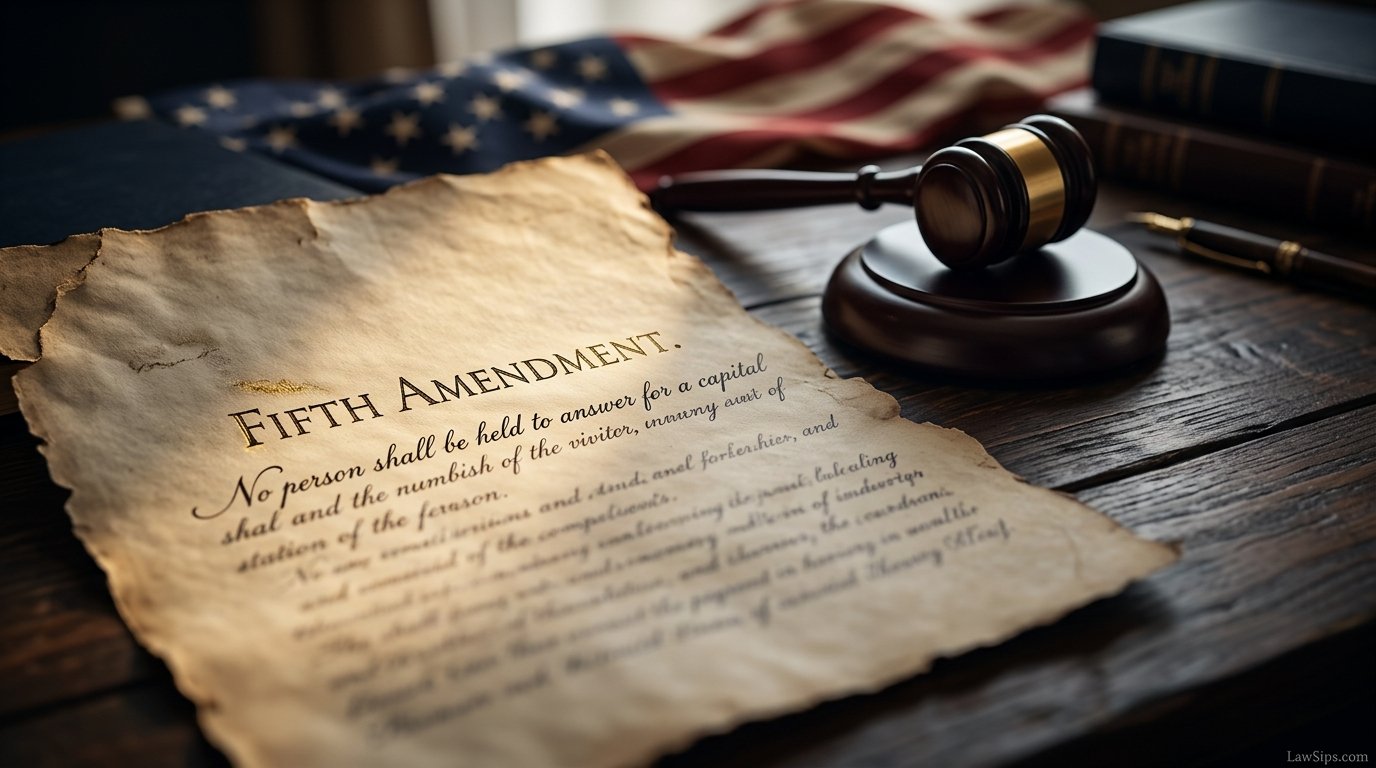
The fourth meeting changes the consequences, not the right. The privilege can be claimed in a congressional hearing, a deposition or a civil lawsuit wherever an answer could create criminal exposure. What follows differs.
The Criminal Trial Exception: No Comment, No Inference
A defendant need not take the stand to claim the privilege. At their own criminal trial, a defendant may simply not testify. No express claim on the record is required, because the right not to testify is absolute.
Silence at a criminal trial cannot be used. In Griffin v. California (1965), the Court barred prosecutorial or judicial comment on a defendant’s failure to testify, and barred adverse inference from it. Comment would make the privilege costly, and cost is what Griffin forbids.
Civil Cases: The Adverse Inference Rule
Civil cases run the opposite inference rule. In Baxter v. Palmigiano (1976), the Court held the Fifth Amendment does not forbid adverse inferences against parties in civil actions when they refuse to testify in response to probative evidence.
The same claim, two different prices. In a criminal case, invocation is protected from comment. In a civil case, a party who invokes may watch the fact finder hold the silence against them. Setting, not sincerity, decides which rule applies.
Depositions follow the civil pattern. A deponent claims the privilege question by question, on criminal exposure grounds. The claim is valid, but a party’s silence can carry the Baxter inference when the case is decided.
Congress: Invocation Under the Cameras
A committee witness may invoke as to specific questions. The standard is the same: criminal exposure, claimed question by question. A committee that insists must make its demand clear, since contempt requires a clear demand and deliberate refusal. Immunity orders are how Congress compels testimony over a claim.
Two Limits That Belong to This Moment
A company cannot plead the Fifth. The privilege is personal. Under the collective entity limit in the standard summaries, corporations and similar entities cannot claim it for entity records; a records custodian strand applies instead.
Moment Five: When Government Takes Property
The fifth meeting is about land, fees and tax sales. The Takings Clause does not forbid takings; it conditions them. Private property shall not be taken for public use without just compensation, and both halves are litigated.
Public Use and the Kelo Line
Public use has been read broadly. In Kelo v. City of New London (2005), economic development qualified as a public use, with broad judicial deference to the legislature’s stated purpose. The ruling remains the field’s reference point.
Kelo also produced a political correction. Many states tightened their own takings rules after 2005, so the practical answer also depends on state reforms.
Physical Takings: Access and Flooding
Government authorized access can be a per se taking. In Cedar Point Nursery v. Hassid (2021), a regulation appropriating the right to exclude, by granting access to organizers, was a per se physical taking.
Flooding claims need a route into court. In DeVillier v. Texas (2024), decided unanimously, owners whose land flooded after highway work could pursue their takings claim through the cause of action Texas law provides, rather than a direct federal claim.
Permit Fees: The Sheetz Rule
A permit fee can be tested as a taking. In Sheetz v. County of El Dorado (2024), a unanimous Court held the Takings Clause applies equally to legislatures and administrators. A legislatively imposed permit condition is not exempt from review.
The fee in Sheetz was $23,420. It was a traffic impact fee attached to a building permit. The framework it must survive is the nexus and rough proportionality test drawn from the Nollan and Dolan line of cases.
Tax Sales: Tyler, Then Pung
A government may sell for the debt, not keep the surplus. In Tyler v. Hennepin County (2023), the county sold a home over a $15,000 tax debt for $40,000 and kept the $25,000 surplus. The Court held it could not retain the surplus. See the Tyler opinion.
The Current Law: Pung and the Open Question
The newest rule in this field is a tax sale rule. In Pung v. Isabella County, decided June 23, 2026, the Court held that after a fairly conducted tax sale, just compensation is measured by the auction sale price, not hypothetical fair market value.
The Pung figures show why the measure matters. The record carried about $2,241.93 in claimed tax delinquency, a home assessed at $194,400, and an auction price of $76,008. Which number counts is the whole case; the syllabus is in the Pung v. Isabella County slip opinion at Justia.
Pung is not a general eminent domain change. It governs the measure after a fairly conducted tax sale. Ordinary condemnation still runs on its own compensation rules, and this page prints the limit in the same breath as the holding, every time.
One nearby question is open, not decided. In October 2026 the Court declined to hear petitions on compensation when police destroy property, two justices calling it an open question. A denial of review is not a holding.
Checked November 2026. Invocation, incorporation and adverse inference rules stand as stated. The live movement is in takings compensation and removal due process procedure.
Moment Six: When Government Tries Again
The sixth meeting is the second trial that usually cannot happen. The Double Jeopardy Clause bars the same sovereign from twice putting a person in jeopardy for the same offence.
One Sovereign, One Prosecution
The protection binds the states. In Benton v. Maryland (1969), double jeopardy protection was incorporated against the states through the Fourteenth Amendment. A state gets one prosecution for the same offence, just as the federal government does.
Dual Sovereignty: The Gamble Rule
Two sovereigns can mean two prosecutions. Under the dual sovereignty doctrine, retained in Gamble v. United States (2019), federal and state prosecutions for the same conduct are not the same offence. Each sovereign vindicates its own laws.
A city is not a second sovereign. In Waller v. Florida (1970), a municipal prosecution followed by a state prosecution for the same acts violated the clause. A city and its state are the same sovereign for this purpose.
Retrial After Mistrial or Appeal
Some second trials are allowed. Retrial after a mistrial, and retrial after a defendant’s successful appeal, are standard exceptions to a simple no second trial reading. The clause bars repeat prosecution, not every repeat proceeding.
The posture of the first case decides. Whether jeopardy attached, how the proceeding ended, and who sought its end all matter. This page states the general pattern only.
Moment Seven: When Fair Procedure Is the Fight
The seventh meeting is the due process clause itself. The federal government may not deprive any person of life, liberty or property without due process of law: fair procedure, notice, and an opportunity to be heard.
Federal Clause, Federal Government
The Fifth’s due process clause binds the federal government only. That is its text and its limit. Claims about state deprivations run through the Fourteenth Amendment’s twin clause, not through the Fifth.
Confusing the two clauses is the field’s common error. Reference pages sometimes present the Fifth as the clause that binds states. For due process it never has been; the Fourteenth does that work. The clause also reaches beyond criminal cases, to benefits, licenses and property interests.
The Removal Strand, Labelled Carefully
Removal proceedings carry a due process strand. Supreme Court orders in 2025 removal litigation restated that Fifth Amendment due process applies to noncitizens in removal proceedings, with notice and an opportunity to challenge. Those are orders, not a new merits test.
The Incorporation Map: Which Rights Bind the States
Incorporation is the map readers most often get flattened. Through the Fourteenth Amendment, most Fifth Amendment protections also bind state governments. One does not, and one was never a state clause at all.
|
Right |
Binds the states? |
The authority |
|---|---|---|
|
Grand jury indictment |
No |
Hurtado v. California (1884) rejected incorporation |
|
Double jeopardy |
Yes |
Benton v. Maryland (1969) |
|
Self incrimination |
Yes |
Malloy v. Hogan (1964) |
|
Just compensation |
Yes |
Chicago, Burlington and Quincy line (1897) |
|
Fifth Amendment due process |
Federal only |
State due process comes from the Fourteenth Amendment |
Malloy states the incorporation logic. In Malloy v. Hogan (1964), the Fourteenth Amendment secures the same privilege against state invasion that the Fifth guarantees against federal infringement. Takings were incorporated early, in the 1897 Chicago, Burlington and Quincy line.
A second map is available: the National Constitution Center’s Amendment V page presents the clause text with interpretive essays matching the Archives spelling used here.
Mistakes and Myths That Cost People the Right
Myth one: staying silent is the same as claiming the right. Salinas and Berghuis say otherwise. Outside the defendant’s trial choice, the privilege must be claimed in words, expressly before arrest and unambiguously after warnings.
Myth two: pleading the Fifth is an admission of guilt. In a criminal case, Griffin bars comment and adverse inference on a defendant’s silence. The civil rule differs under Baxter, but a criminal invocation is not evidence.
Myth three: all five rights bind the states equally. The grand jury clause was never incorporated, and the Fifth’s due process clause is federal only. Summaries that skip Hurtado misstate the map.
Myth four: the Fifth covers anything you would rather not hand over. It covers compelled testimonial communications. Physical evidence sits outside it under Schmerber, and document contents under Fisher; only the act of production can be protected.
Myth five: immunity is a trick that changes nothing. Kastigar immunity removes the criminal exposure the privilege guards against. After a valid grant, testimony can be compelled and refusal is contempt.
Myth six: the government can never prosecute twice. Dual sovereignty under Gamble allows federal and state prosecutions for the same conduct. The clause binds each sovereign separately.
Myth seven: a tax sale lets the government keep everything. Tyler bars keeping surplus equity, and Pung sets the compensation measure after a fair sale at the auction price. Both rules are recent and easy to miss.
Where this page sits in the wider site: the LawSips home page gathers the site’s legal guides, and our class action lawsuit guide shows the civil claim side of the same legal system.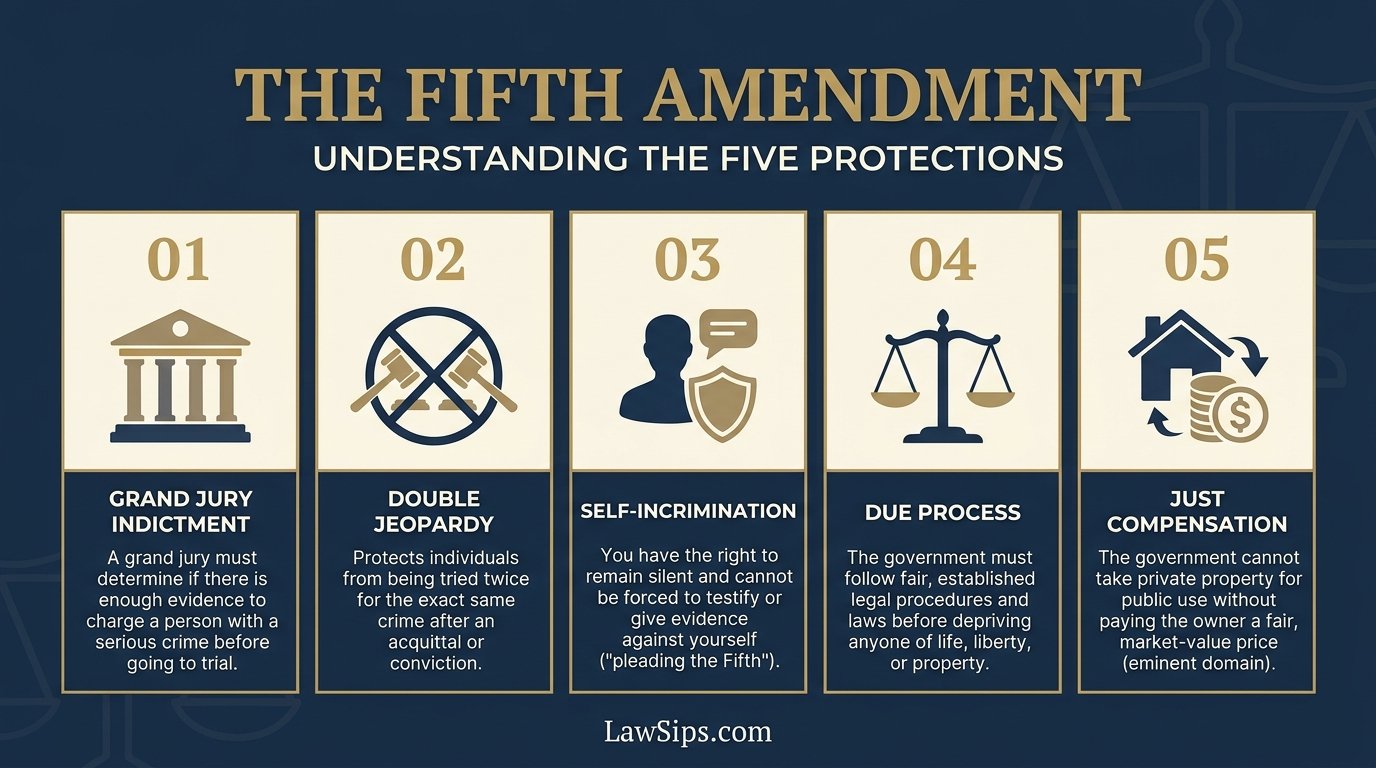
Frequently Asked Questions
1. What is the 5th Amendment in simple terms?
It is the Bill of Rights amendment that guards people in criminal cases and property disputes. It requires a grand jury for federal felonies and bars a second trial for the same offence and forbids compelled self incriminating testimony and requires due process and payment for takings.
2. What are the five rights in the 5th Amendment?
The five rights are grand jury indictment, double jeopardy protection, the privilege against self incrimination, federal due process, and just compensation for takings. One limit matters: the grand jury right binds the federal government only.
3. What does the 5th Amendment say word for word?
The National Archives transcription begins: No person shall be held to answer for a capital, or otherwise infamous crime. It uses the ratified spelling offence; the full text is quoted exactly once on this page.
4. What does it mean to plead the Fifth?
Pleading the Fifth means claiming the privilege against self incrimination. You refuse to answer because the answer could expose you to criminal liability.
The claim is made question by question, and the court decides whether it is valid.
5. How do you plead the Fifth, in actual words?
In words, clearly. Salinas and Berghuis require the privilege to be claimed expressly and unambiguously in most settings outside a defendant’s choice not to testify.
A plain statement invoking your right to remain silent is what the cases support; no formula is required.
6. Is pleading the Fifth an admission of guilt?
No. In a criminal case, Griffin bars comment on a defendant’s silence and adverse inference from it.
Civil cases differ: Baxter allows an adverse inference against a party who refuses to testify.
7. Can silence alone count as pleading the Fifth?
Usually not, outside the trial defendant setting. In Salinas, pre arrest silence could be used because the privilege was never expressly invoked.
After Miranda warnings, Berghuis requires an unambiguous claim; prolonged silence alone does not invoke.
8. Can you plead the Fifth to police before you are arrested?
Yes, but the claim must be made expressly. Salinas holds that standing mute in a noncustodial interview is not a claim.
Custodial interrogation is different: Miranda warnings apply, and an unambiguous invocation ends the questioning.
9. What is the difference between Miranda rights and the Fifth Amendment?
The Fifth Amendment is the source and Miranda is the safeguard. The amendment holds the privilege and Miranda (1966) requires warnings before custodial interrogation so the privilege can be protected in the station house and the warnings describe the right without being the right itself.
10. Can your silence be used against you in court?
It depends on the setting. A criminal defendant’s silence at trial cannot be commented on under Griffin and pre arrest silence never expressly claimed could be used under Salinas while civil silence can support an adverse inference against a party under Baxter.
11. Can a prosecutor comment if a defendant does not testify?
No. Griffin (1965) holds that prosecutorial or judicial comment on a defendant’s failure to testify, and instructions inviting adverse inference from it, violate the privilege in a criminal case.
12. Can you plead the Fifth in a civil case?
Yes, where an answer could create criminal exposure, but the consequence differs. Under Baxter, a court may allow an adverse inference against a party in a civil action who refuses to testify in response to probative evidence.
13. Can you plead the Fifth in a deposition?
Yes, on the same condition: the answer must risk criminal exposure, not merely embarrassment or civil liability. The claim is made question by question, and the civil adverse inference rule can apply to a party.
14. Can you plead the Fifth in front of Congress?
Yes. A committee witness may invoke the privilege as to specific questions.
If the committee insists after a valid claim, it must make its demand clear, and immunity orders under Title 18, sections 6002 and 6003, are the mechanism used to compel testimony.
15. Can you plead the Fifth before a grand jury?
Yes. Grand jury witnesses normally must appear and invoke the privilege as to specific questions rather than refuse outright.
Under Hoffman, an answer need only furnish a link in the chain of evidence for the claim to be considered.
16. Can a witness plead the Fifth, or only defendants?
Witnesses can. The privilege belongs to any person whose compelled answer could incriminate them, in trials, grand juries, depositions, agencies and legislative hearings.
A defendant at their own trial may simply not take the stand.
17. Can the government force you to testify after you plead the Fifth?
Yes, if immunity removes the criminal exposure. Under Kastigar, use and derivative use immunity is coextensive with the privilege and can compel testimony.
After a valid grant, refusal becomes a contempt problem rather than a privilege problem.
18. What is immunity, and how does it override the Fifth?
Immunity replaces the privilege by barring use of the compelled testimony, and evidence derived from it, against the witness. Under Kastigar, the government bears the burden of showing an independent source for later evidence it uses.
19. What is the difference between use immunity and transactional immunity?
Use immunity bars use of the testimony and its fruits; it is the federal Kastigar form. Transactional immunity is broader, barring prosecution for the transaction the testimony concerns, and some states use it.
There is no single national immunity type.
20. If you answer some questions, can you still plead the Fifth on others?
Sometimes, but answering carries waiver risk. Answering on a subject under oath can waive the privilege as to its details, and a testifying defendant generally waives as to cross examination within scope.
Partial strategies are fact specific; general information only.
21. Does pleading the Fifth protect documents and phones?
Documents only in part. Contents of voluntarily created documents are generally not privileged, but the compelled act of producing them can be testimonial, under Fisher and Hubbell.
Phones and passcodes are a developing area with divided authority, labelled a strand, not a national rule.
22. Does the Fifth Amendment protect blood tests, fingerprints or lineups?
No. Under Schmerber, the privilege covers compelled testimonial communications, not the body as physical evidence.
A compelled blood sample was not protected; fingerprints, lineups and voice exemplars sit on the same physical side of the line.
23. Does the 5th Amendment apply to the states?
Mostly, through the Fourteenth Amendment, but not in full. Double jeopardy (Benton, 1969), self incrimination (Malloy, 1964) and takings (1897) are incorporated.
The Grand Jury Clause is not (Hurtado, 1884), and Fifth Amendment due process binds the federal government only.
24. Why does the grand jury right not apply to state cases?
Because the Supreme Court declined to incorporate it. Hurtado (1884) rejected incorporation of the Grand Jury Clause, so the indictment right applies to federal felonies only and states may charge by information.
25. What is a grand jury, and how is it different from a trial jury?
A grand jury screens federal felony charges and decides whether an indictment issues; it does not decide guilt. A trial jury decides guilt or innocence.
The grand jury right concerns the screening step, in federal cases only.
26. What is double jeopardy?
Double jeopardy is the bar on being twice put in jeopardy for the same offence. The same sovereign generally cannot prosecute again for the same offence after acquittal or conviction.
Benton (1969) applied the protection against the states.
27. Can the federal government and a state both prosecute the same act?
Generally yes. Under the dual sovereignty doctrine, retained in Gamble (2019), federal and state prosecutions for the same conduct are not the same offence.
A city, however, is not a separate sovereign from its state, under Waller.
28. Can you be retried after a mistrial or a successful appeal?
Often yes, within limits stated generally here. Retrial after a mistrial and after a successful defence appeal are standard exceptions to a simple no second trial reading, while retrial after an acquittal is barred.
Outcomes depend on procedural posture.
29. What is due process under the 5th Amendment?
It is the federal bar on depriving a person of life, liberty or property without fair procedure. Notice and an opportunity to be heard are its core.
The Fifth’s clause binds the federal government; the Fourteenth’s twin binds the states.
30. What is the difference between 5th and 14th Amendment due process?
The difference is the government each clause binds. The Fifth Amendment Due Process Clause restrains the federal government while claims against a state arise under the Fourteenth Amendment and presenting the Fifth clause as the one that binds states is an error.
31. Does the 5th Amendment due process clause protect noncitizens?
A labelled strand says yes. Supreme Court orders in 2025 removal litigation restated that Fifth Amendment due process applies to noncitizens in removal proceedings, with notice and an opportunity to challenge.
Those are orders and summaries, not a new merits test.
32. What is eminent domain?
Eminent domain is the government power to take private property for public use. The Takings Clause conditions it: the use must be public and just compensation paid.
Kelo held economic development can qualify as public use.
33. Can the government take property for a private development? (Kelo)
Under Kelo (2005), yes: economic development can qualify as public use, with broad judicial deference. The decision drew a political backlash and many states tightened their own rules afterward, so the practical answer also depends on state law.
34. Can a building permit fee be a taking? (Sheetz)
It can be reviewed as one. Sheetz (2024), decided unanimously, held the Takings Clause applies equally to legislatures and administrators.
A legislatively imposed permit condition, a $23,420 traffic impact fee in that case, is not exempt from the nexus and rough proportionality framework.
35. What happens if the government floods your land or lets others onto it?
Two strands govern. Government authorized access appropriating the right to exclude is a per se physical taking, under Cedar Point Nursery (2021).
In DeVillier (2024), flooded owners could pursue their claim through the cause of action Texas law provides.
36. Can the government keep the extra money from a tax sale of your home? (Tyler)
No. Tyler (2023) held a government may sell property to satisfy a tax debt but may not keep surplus equity beyond what is owed.
On its facts: a $15,000 debt, a $40,000 sale and a $25,000 surplus the county could not retain.
37. How is just compensation measured after a tax sale after Pung?
After Pung (June 23, 2026), the baseline is the auction sale price, not hypothetical fair market value, after a fairly conducted tax sale. Its record: about $2,241.93 claimed delinquent, a home assessed at $194,400, sold for $76,008.
Pung is a tax sale rule only.
38. Can a company plead the Fifth?
Generally no. The privilege is personal, and the collective entity limit in the standard summaries means corporations and similar entities cannot claim it for entity records.
A records custodian strand applies instead, stated here briefly and at general information level.
39. Can public employees be forced to answer questions at work? (Garrity)
Statements compelled from public employees under threat of job loss cannot be used against them in a later criminal case. That is Garrity (1967): public employees cannot be forced to choose between their jobs and their privilege.
40. What is contempt, and when can refusing to answer lead to it?
Contempt is the enforcement response to a refusal the law does not excuse. After a court rejects a claim, or immunity removes the privilege, continued refusal can be contempt.
It requires a clear demand and a deliberate refusal.
41. What is the act of production doctrine?
It is the Fisher and Hubbell rule on compelled production. Document contents are generally not privileged but the act of producing them can be testimonial because production admits the documents exist and are in the person’s possession and are the ones demanded.
42. What should you do if you are subpoenaed and worried about self incrimination?
General information only: a subpoena normally requires appearance, the privilege is claimed question by question, and waiver mistakes are hard to undo. Anyone facing a real subpoena should talk to a lawyer in their own state first.
This page gives background, not advice.
Conclusion
What is the 5th amendment, in the end, is a question about moments. Its five rights are met in interview rooms, hearing rooms, grand jury rooms and tax sales, and each setting carries its own rule for claiming them.
The through line is invocation. Outside a defendant’s own trial, the privilege must be claimed in words, question by question, before the answer is given. Silence, embarrassment and good intentions are not claims, and waiver is hard to undo.
The map matters as much as the mechanics. Four protections bind the states; the grand jury right does not, and the Fifth’s due process clause is federal only. Older summaries that flatten that map misstate the law.
The takings line is the moving part. Tyler, Sheetz, DeVillier and Pung date from 2023 to 2026, and the police destruction question remains open. This page was checked in November 2026.
This article is general legal information, not legal advice. Anyone facing questioning, a subpoena, a charge or a taking should talk to a lawyer in their own state first.

Dilawar is a dedicated writer and contributor at Lawsips.com, focusing on legal information, business law, consumer rights, legal awareness, and everyday legal matters. He is passionate about simplifying complex legal topics and providing readers with clear, practical, and easy-to-understand information. His goal is to help readers stay informed about legal developments, understand their rights, and make better decisions through informative and well-researched articles.