Miranda Rights: A Rule About Questions, Not About Arrests
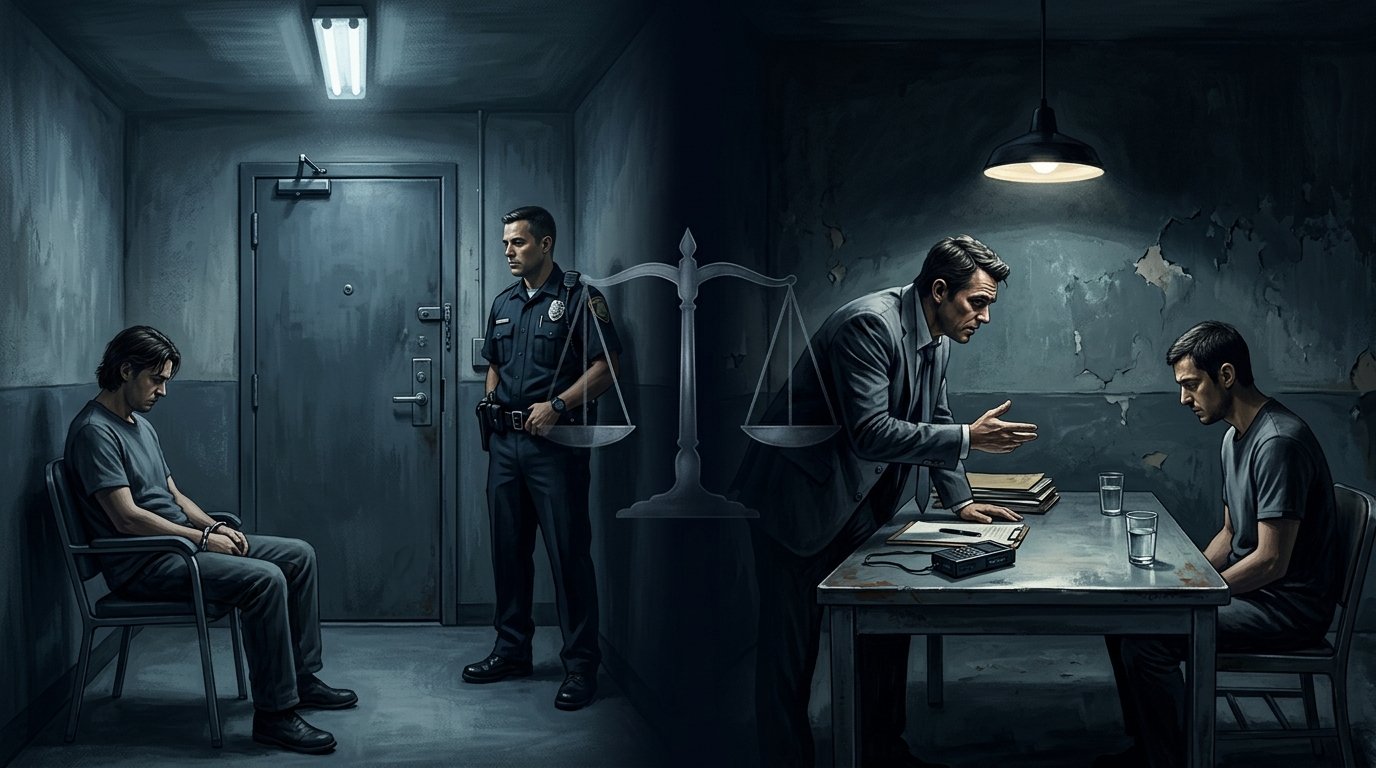
Miranda rights are the most famous words in American criminal law, and the most misunderstood. The television version says police must read them the moment handcuffs close, and that forgetting means the case collapses. The real rule is narrower, stranger, and more useful than that.
This page is general legal information, not legal advice. It states the doctrine as the Supreme Court has stated it, case by case, because in this topic the cases are the content: every rule below carries the name of the decision that made it.
The organizing fact is simple. Miranda governs custodial interrogation, not arrest. The warnings are the price police pay for questioning a person who is not free to leave. No custody, no warning needed. No questioning, no warning needed. Both together, and the warning must come first.
The rights themselves grow out of the 5th Amendment and its privilege against self-incrimination, which that page covers in full. This page covers the warning system the Court built on that foundation in 1966, and everything that has happened to it since.
Miranda Rights: The Short Answer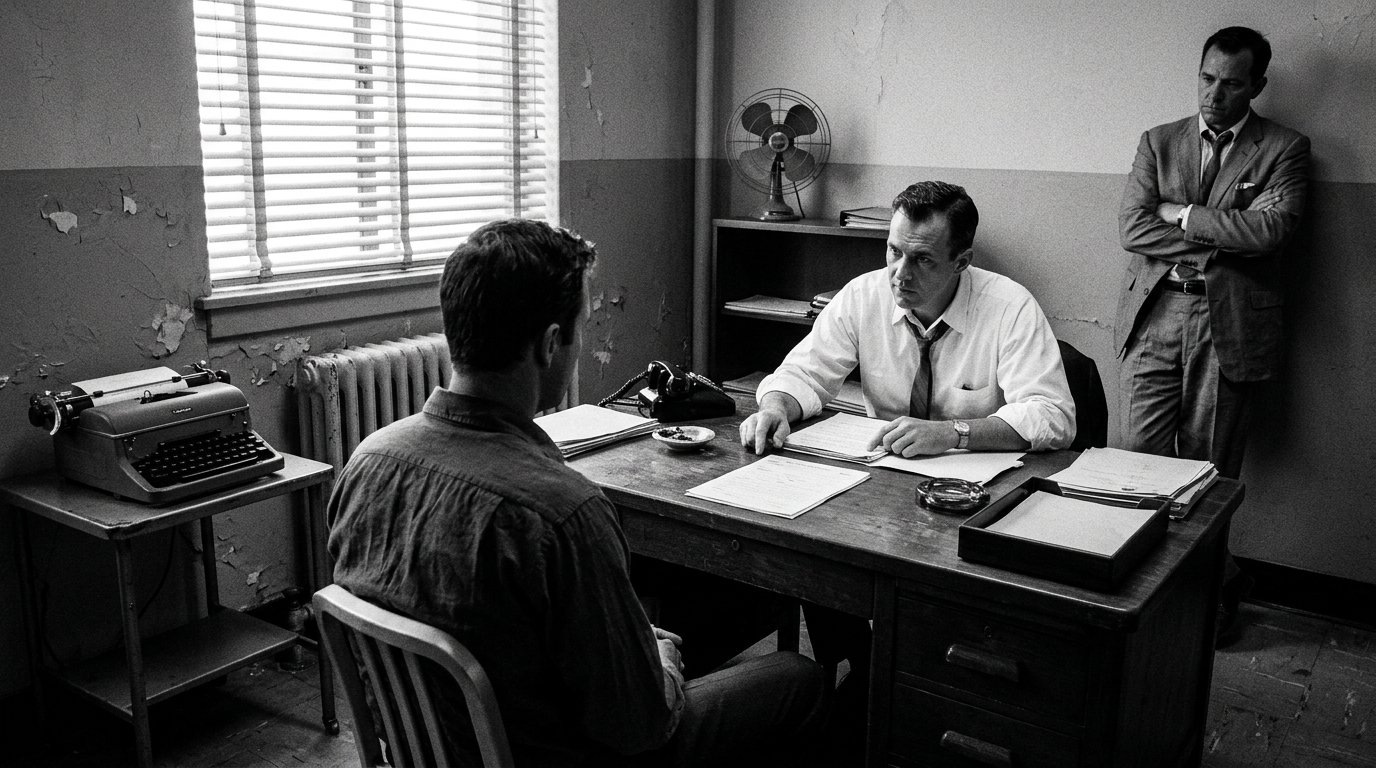
Miranda rights are four warnings police must give before questioning a person in custody. Statements taken in custodial interrogation without them, and without a valid waiver, cannot be used in the prosecution’s case in chief.
|
# |
The warning, in substance |
|---|---|
|
1 |
You have the right to remain silent |
|
2 |
Anything you say can be used against you in court |
|
3 |
You have the right to an attorney during questioning |
|
4 |
If you cannot afford an attorney, one will be appointed for you |
|
Question |
The short answer |
|---|---|
|
When are warnings required? |
Before custodial interrogation: custody and interrogation together |
|
Is there an official script? |
No. Courts test whether the substance of all four points was conveyed |
|
What if police skip them? |
The statement is suppressed from the case in chief. The case is not dismissed |
|
How do you use the rights? |
Out loud, unambiguously. Silence alone does not invoke silence |
|
Are they still the law? |
Yes. Constitutional since Dickerson (2000); Vega (2022) narrowed only the damages remedy |
The Warning Itself: Substance Over Script
There is no federally required wording. Departments write their own versions, cards differ from state to state, and the Supreme Court has never mandated a script. What courts test, in the line of cases running through Duckworth v. Eagan and Florida v. Powell, is whether the substance of all four points reached the suspect in a form a reasonable person would understand.
That test cuts in both directions. A warning in plain, imperfect words that covers all four points is valid. A polished recitation that omits appointed counsel, or buries the right to have counsel present during questioning, is deficient, and the statements after it are exposed at a suppression hearing.
Many departments add a fifth line, some version of “do you understand these rights?” That question is practice, not doctrine: the four warnings are the requirement, and the suspect’s understanding is judged at the waiver stage, on the totality of the circumstances, rather than by a yes at the warning stage.
Where Miranda Rights Come From: Phoenix, 1963 to June 13, 1966
In March 1963, Phoenix police arrested Ernesto Miranda after a witness identified him, and two detectives questioned him for about two hours. Nobody told him he could remain silent or have a lawyer. He signed a written confession anyway, on a form carrying a typed statement that he had confessed voluntarily and with full knowledge of his legal rights, rights that had never been explained to him.
The confession convicted him. The Arizona Supreme Court affirmed, reasoning in part that Miranda had never specifically asked for a lawyer. The United States Supreme Court took his case, consolidated it with three others raising the same question, and ruled on June 13, 1966: Miranda v. Arizona, 384 U.S. 436, decided 5 to 4, with Chief Justice Earl Warren writing for the majority.
The holding’s logic was about the room, not the man. Custodial interrogation, Warren wrote, carries inherently compelling pressures that work to undermine the privilege against self-incrimination. The four warnings were the safeguard the Court required against that pressure. Justice Harlan, joined by Justices Stewart and White, dissented, arguing the older voluntariness test already handled coerced confessions and the new rules went further than the Constitution required.
The Library of Congress guide to the Miranda case preserves the timeline, including what happened to Miranda himself, which is the doctrine’s best illustration. Arizona retried him without the confession. His common law wife testified that he had admitted the crimes to her during a jail visit, a private statement no warning rule reaches, and on March 1, 1967 a second jury convicted him again. He was paroled in 1972. On January 31, 1976 he was stabbed to death in a Phoenix bar fight, and the Library of Congress records the coda: the man who killed him received his Miranda rights, and, as the standard accounts add, exercised the right to silence.
Winning the most famous rights case in American history did not free Ernesto Miranda. That is the first lesson of the doctrine: Miranda excludes statements. It does not acquit anyone.
The Two Triggers: Custody and Interrogation
Custody: Would a Reasonable Person Feel Free to Leave?
Custody is an objective test: under the totality of the circumstances, would a reasonable person in the suspect’s position have felt free to terminate the encounter and leave? Formal arrest always qualifies, but handcuffs are not required. A lengthy stationhouse interview, a locked room, several officers and a blocked exit can add up to custody without an arrest ever being announced.
The negative cases define the edges. An ordinary traffic stop is not custody: in Berkemer v. McCarty (1984) the Court reasoned that a roadside stop is brief, public and usually involves one or two officers, lacking the isolation of stationhouse questioning. A voluntary station visit is not custody either, when the person came willingly and was told they could leave. And imprisonment alone is not automatically custody for questioning about another matter, per Howes v. Fields (2012); the circumstances still decide.
One refinement matters for families: age counts. In J.D.B. v. North Carolina (2011), the Court held that when officers know or should recognize a child’s age, that age is part of the custody analysis, because a reasonable child does not experience an interrogation room the way a reasonable adult does. The case involved a 13 year old questioned at school.
Interrogation: Questions, and Everything That Works Like Them
Interrogation is broader than questions. In Rhode Island v. Innis (1980), the Court defined it as express questioning or its functional equivalent: words or actions police should know are reasonably likely to draw out an incriminating response. An officer thinking out loud about how bad the evidence looks, in a suspect’s hearing, intending a reaction, is interrogating.
The negative space matters as much. Volunteered statements are not interrogation: words a suspect blurts out unprompted are admissible, warning or no warning. And routine booking questions, name, address, date of birth, are administrative, not interrogation, under the booking exception associated with Pennsylvania v. Muniz, unless officers use booking as a pretext to investigate.
The Scenario Table
|
Situation |
Custody? |
Interrogation? |
Warning required? |
|---|---|---|---|
|
Arrested, then questioned at the station |
Yes |
Yes |
Yes |
|
Arrested, driven to jail, officer says nothing |
Yes |
No |
No |
|
Voluntary station interview, told you may leave |
No |
Yes |
No |
|
Routine traffic stop, roadside questions |
No (Berkemer) |
Yes |
No |
|
Traffic stop that escalates into arrest like detention, then questions |
Yes |
Yes |
Yes |
|
Booking intake: name, address, birth date |
Yes |
No (Muniz) |
No |
|
Suspect blurts out a confession unprompted |
Either |
No |
No |
|
Officer stages a conversation to provoke a statement |
Yes |
Yes (Innis) |
Yes |
TV Miranda vs Real Miranda
|
The television version |
The real rule |
|---|---|
|
Rights are read at every arrest |
Rights are read before custodial interrogation, whenever that occurs |
|
No warning means the case is dismissed |
No warning means the statement is suppressed; the case continues on other evidence |
|
Staying silent protects you automatically |
Silence must be invoked out loud and unambiguously (Thompkins) |
|
There is one official script |
There is no script; the substance of four points must be conveyed |
|
A Miranda violation means a payout |
Since Vega (2022), a violation alone supports no damages lawsuit |
How to Invoke Your Rights: Say It Out Loud
The rights are not self executing. They must be claimed, in words a reasonable officer cannot misunderstand, and the two rights behave differently once claimed.
Invoking Silence
In Berghuis v. Thompkins (2010), the suspect sat largely silent through about three hours of questioning, then answered. The Court held that silence had not invoked the right to silence, and that answering after warnings he understood was an implied waiver. The lesson is mechanical: say the words. “I am invoking my right to remain silent” and “I do not want to answer questions” are the form the doctrine rewards.
An honored silence invocation still has a limit. Under Michigan v. Mosley, police must scrupulously honor an invocation of silence, but after a significant interval they may approach again, with fresh warnings, about a different matter. Silence pauses questioning; it does not end the relationship forever.
Invoking Counsel: The Stronger Stop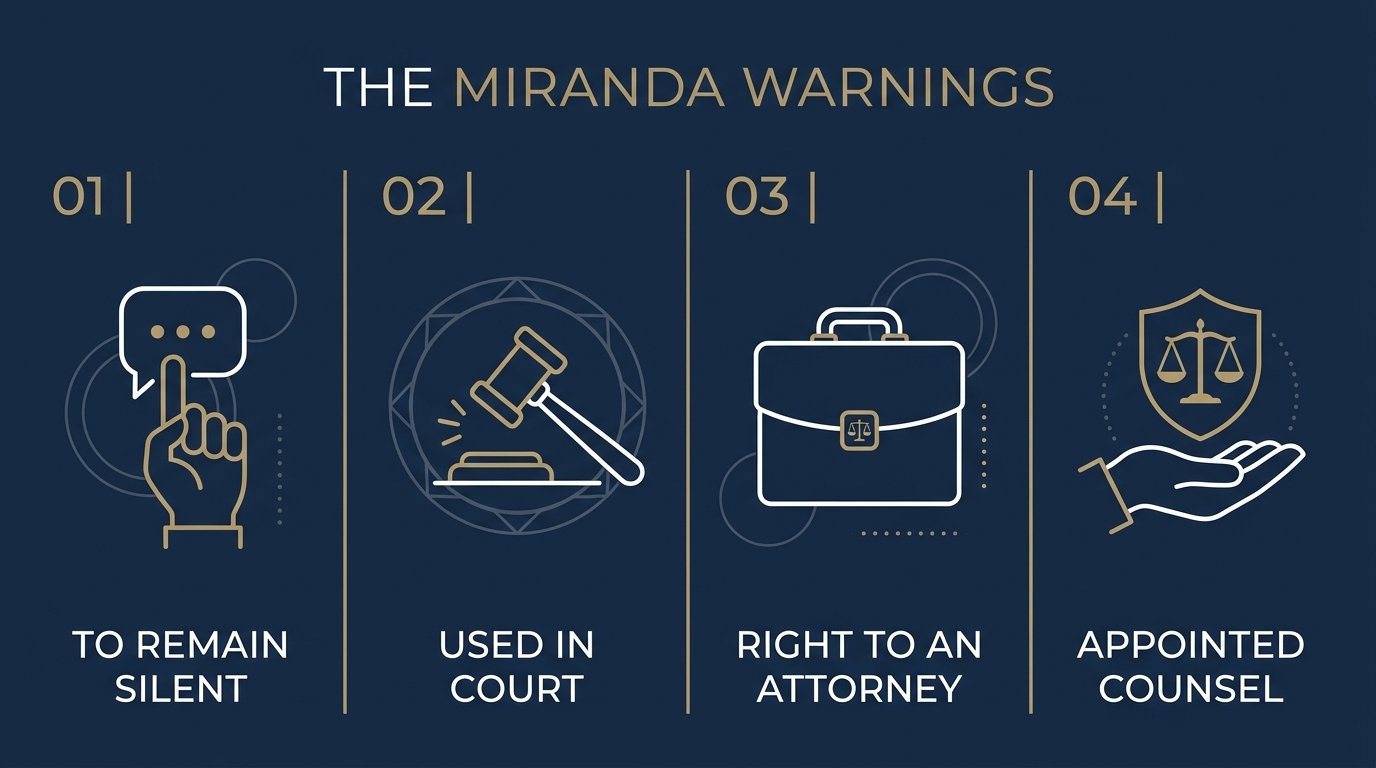
Asking for a lawyer triggers the doctrine’s hardest rule. The request must be unambiguous: in Davis v. United States (1994), a statement that the suspect might want a lawyer was held not to be a request at all, and questioning lawfully continued. “Maybe I should talk to a lawyer” is a thought. “I want a lawyer” is an invocation.
Once counsel is invoked, Edwards v. Arizona (1981) bars police from reinitiating interrogation until counsel is present, unless the suspect himself restarts the conversation. Fresh warnings alone do not undo an Edwards invocation. One later refinement: in Maryland v. Shatzer (2010), the Court held that a break in custody of 14 days ends the Edwards bar, because two weeks of normal life dissipates the pressure the rule guards against.
|
Silence |
Counsel |
|
|---|---|---|
|
Invocation must be |
Unambiguous statement (Thompkins) |
Unambiguous request (Davis) |
|
Effect |
Questioning must stop and the invocation be scrupulously honored (Mosley) |
Questioning must stop until counsel is present (Edwards) |
|
Police reapproach |
Possible after a significant interval, fresh warnings, generally a different matter |
Barred while custody continues; 14 day break in custody ends the bar (Shatzer) |
|
Who can restart |
Either side, within the limits above |
Only the suspect |
Waiver: How Rights Are Given Up
A suspect may waive the rights and speak. The prosecution must prove the waiver was knowing, intelligent and voluntary, judged on the totality of the circumstances, and it carries that burden by a preponderance of the evidence (Colorado v. Connelly, 1986).
Three facts about waiver surprise people. No signature is required: a waiver can be implied from conduct, as Thompkins itself shows, a suspect who understood the warnings and then answered questions has waived by answering. A signed form is not armor either: a signature obtained by coercion proves nothing. And deception about events outside the suspect’s awareness does not automatically void a waiver, a strand of the doctrine courts still apply from Moran v. Burbine.
The practical reading: the waiver question is never “was a form signed.” It is “did this person understand the rights and freely choose to give them up,” and the recording, the warnings given and the suspect’s condition are the evidence.
The Exceptions and the Non Triggers
The Public Safety Exception
In New York v. Quarles (1984), an officer chasing a suspect through a supermarket found an empty shoulder holster in the frisk and asked, before any warning, where the gun was. The suspect pointed: “the gun is over there.” The Court admitted both the answer and the gun, creating the public safety exception: questions aimed at neutralizing an immediate danger may precede warnings.
The exception is as narrow as its facts. It covers the missing weapon, the accomplice at large, the bomb timer. It does not cover case building, and once the danger is resolved, the warning duty returns in full.
The Undercover Exception
In Illinois v. Perkins (1990), an undercover officer posed as a fellow inmate and drew out incriminating statements without warnings. The Court allowed it: Miranda guards against a police dominated atmosphere, and a suspect who does not know he is speaking to police feels none of that pressure. The cellmate conversation, real or planted, sits outside the warning system.
The Non Triggers, Collected
Warnings are not required before a voluntary conversation, during routine booking, at an ordinary traffic stop, before physical evidence procedures such as field sobriety tests, breath or blood draws, fingerprints and lineups (Miranda covers statements, not the body), or when a suspect volunteers statements unprompted. Each non trigger is the absence of custody, of interrogation, or of a statement at all.
The Two Step Ban
One police technique crossed the line from gap to game. In Missouri v. Seibert (2004), the Court addressed the deliberate question first, warn later method: interrogate unwarned, win the confession, then give warnings and have the suspect repeat it. The Court held that midstream warnings in a deliberate two step cannot function as the safeguard requires, and the repeated statement falls with the first. An honest failure to warn, by contrast, does not automatically taint a later warned statement (the Elstad contrast the Seibert opinions work from).
What a Violation Actually Does: Suppression, Not Dismissal
When police interrogate in custody without warnings or a valid waiver, the remedy is suppression: the statement is excluded from the prosecution’s case in chief. The defense files a motion to suppress, and the court holds the statement out of the trial’s main event.
Three survivals define the remedy’s limits, and each has a case.
Other evidence survives untouched. Witnesses, forensics, video and independently gathered proof are unaffected. Miranda’s own retrial is the standing example: convicted again without his confession.
The statement itself survives for one narrow use. Under Harris v. New York (1971), a voluntary statement taken without proper warnings may be used to impeach a defendant who testifies inconsistently at trial. It cannot prove guilt; it can attack credibility. Miranda, the Court reasoned, is not a shield for perjury.
Physical fruits survive. Under United States v. Patane (2004), physical evidence discovered because of a voluntary but unwarned statement, the gun whose location the suspect revealed, is admissible. The words are excluded; the object is not, because Miranda protects against compelled testimony, and an object is not testimony.
One floor sits beneath all of this. A statement that was involuntary, coerced in the due process sense, is barred for every purpose including impeachment (Mincey v. Arizona), and warnings do not cure coercion. Miranda is a warning rule layered on top of an older voluntariness rule, and the older rule is the stronger one. The full case chain, with citations, is laid out in CourtDocket’s Miranda precedent survey.
Minors and Other Special Cases
Juveniles hold the same rights, with the J.D.B. adjustment: a child’s age, when known or objectively apparent, is part of the custody test. A 13 year old questioned at school by police and administrators is judged as a reasonable 13 year old would experience the room, not as an adult would. Some states add their own protections for minors by statute; those are state rules, printed as such wherever they appear.
Non citizens are covered. The Fifth Amendment speaks of persons, and the warning duty applies to custodial interrogation regardless of citizenship or immigration status.
Inmates are not automatically in Miranda custody for every conversation (Howes v. Fields), and the undercover and cellmate settings fall outside the system entirely (Perkins). The through line is always the same pair of questions: custody, in the reasonable person sense, and interrogation, in the Innis sense.
State law can add, never subtract. States may give more protection than the federal floor. Texas, for example, requires by statute (Article 38.22) that oral custodial statements be electronically recorded with the warnings on the recording, and adds a warning that the interview may be terminated at any time. That is a Texas rule, printed here as an example of the pattern, not as national law.
The Rule Today: Dickerson Locked It, Vega Narrowed the Remedy
Congress tried to repeal Miranda by statute almost immediately. A 1968 law, 18 U.S.C. Section 3501, purported to make voluntariness the only test for confessions in federal court. For three decades it sat mostly unused, until the question reached the Court in Dickerson v. United States (2000).
The answer was categorical: Miranda announced a constitutional rule, and Congress cannot override a constitutional rule by statute. Section 3501 fell. The opinion’s author made the point unforgettable: it was Chief Justice Rehnquist, long a Miranda critic, who wrote that the warnings have become part of the national culture and the rule would stand.
The 2022 case changed something narrower. In Vega v. Tekoh, a hospital worker sued a deputy under Section 1983 for damages over an unwarned statement (which had in fact not been used to convict him). The Court held 6 to 3 in the standard reporting that a Miranda violation does not itself support a Section 1983 damages claim, reasoning that the warnings are a prophylactic rule protecting the Fifth Amendment right rather than a right in themselves.
What Vega did not do is the part the headlines missed. It did not excuse the warnings, did not admit any unwarned statement, and did not touch the suppression remedy. Police must still warn, courts must still suppress, and no one may sue for money over the warning alone. The duty survived; one proposed remedy for breaking it did not.
Mistakes People Make After Arrest
- Waiting for the warning as a signal. The warning marks interrogation, not arrest. Its absence tells you nothing about how serious the situation is.
- Talking to fill the silence. Patrol car small talk after arrest is the classic self inflicted wound: volunteered words need no warning to be used.
- Hinting at a lawyer. “Maybe I should talk to a lawyer” has been held not to be a request. Say “I want a lawyer” or say nothing.
- Staying silent without invoking. Hours of silence followed by one answer can be an implied waiver. Invoke out loud, then be silent.
- Restarting the conversation after invoking counsel. Under Edwards, your own restart is the one door police cannot open themselves. Do not open it.
- Assuming the case dies with the statement. Suppression removes words. Evidence, witnesses and physical fruits usually remain.
- Signing the waiver to seem cooperative. Cooperation is a strategy decision for counsel, not a courtesy. The signature will be Exhibit A at the waiver hearing.
Key Takeaways
- The trigger: custody plus interrogation, at the same time. Arrest alone, questioning alone, neither one requires the warning.
- The warnings: four points of substance, no official script, from Miranda v. Arizona, 384 U.S. 436 (1966).
- The use: invoke out loud and unambiguously. Counsel is the stronger stop (Edwards); silence can be revisited within limits (Mosley).
- The remedy: suppression from the case in chief, with impeachment use (Harris) and physical fruits (Patane) surviving. Never dismissal by itself.
- The status: constitutional since Dickerson (2000). Vega (2022) removed a damages lawsuit, not the warning duty.
FAQs
What are Miranda rights?
The four warnings police must give before custodial interrogation, from Miranda v. Arizona (1966): the right to remain silent, that statements can be used in court, the right to an attorney during questioning, and the right to appointed counsel if you cannot afford one. They protect the Fifth Amendment privilege against self-incrimination.
What does the Miranda warning say?
In substance: you have the right to remain silent; anything you say can be used against you in court; you have the right to an attorney; if you cannot afford one, one will be appointed. Departments phrase it differently, and the law tests the substance.
Is there an official Miranda warning script?
No. The Supreme Court has never required exact words. Courts ask whether all four points were conveyed clearly enough for a reasonable person to understand them. A warning that drops a point, such as appointed counsel, is deficient however polished the rest sounds.
When must police read Miranda rights?
Before custodial interrogation: when a person is in custody and about to be interrogated, both at once. That moment may come at arrest, hours later at the station, or never, if police do not question the person.
Do police have to read Miranda rights at arrest?
No. Arrest alone triggers nothing. An arrested person who is never questioned needs no warning, and an unarrested person in Miranda custody does. The warning attaches to the questioning, not the handcuffs.
What is custodial interrogation?
The combination that triggers Miranda: custody, meaning a reasonable person would not feel free to end the encounter and leave, plus interrogation, meaning express questioning or its functional equivalent, at the same time.
What counts as custody for Miranda?
An objective, totality test: setting, duration, restraint, number of officers, whether the person was told they could leave. Formal arrest qualifies; so can a locked room interview. A voluntary visit and an ordinary traffic stop generally do not.
What counts as interrogation for Miranda?
Express questioning, and under Rhode Island v. Innis (1980), any words or actions police should know are reasonably likely to draw out an incriminating response. Staged conversations and pointed remarks count. Volunteered statements and routine booking questions do not.
Is a traffic stop custody under Miranda?
Generally no. Berkemer v. McCarty (1984) held an ordinary roadside stop is brief and public, not the coercive setting Miranda addresses. If a stop escalates into arrest like detention, custody can begin on the roadside and warnings follow.
Do Miranda rights apply during booking questions?
No. Routine booking questions, name, address, date of birth, are administrative and fall outside interrogation under the booking exception. If officers use booking as a pretext to investigate the crime, the exception falls away.
What happens if police do not read Miranda rights?
Statements taken in custodial interrogation without warnings or a valid waiver are suppressed from the prosecution’s case in chief, on a defense motion to suppress. Nothing else automatic happens: no dismissal, no damages, no effect on other evidence.
Does a Miranda violation dismiss your case?
No. This is the doctrine’s most important correction. Suppression removes the statement, not the charge. Ernesto Miranda himself was retried without his confession and convicted again in 1967 on other evidence.
What is a motion to suppress in a Miranda case?
The defense filing that asks the court to exclude the statement from trial because it was taken in violation of Miranda. The court examines the warnings, the waiver and the custody and interrogation facts, usually at a hearing before trial.
Can a statement taken without warnings be used at trial at all?
In one narrow way. Under Harris v. New York (1971), a voluntary unwarned statement may be used to impeach a defendant who testifies inconsistently. It cannot be used as proof of guilt in the case in chief.
How do you invoke your Miranda rights?
Out loud, in unambiguous words. “I am invoking my right to remain silent.” “I want a lawyer.” Then stop talking. The doctrine rewards clarity and ignores hints, and officers need not stop for statements a reasonable officer could read as indecision.
Does staying silent invoke the right to remain silent?
No. Berghuis v. Thompkins (2010) held that sitting silent through questioning does not invoke the right, and that answering afterward can be an implied waiver. Silence is the exercise of the right only after the right has been claimed in words.
What words invoke the right to an attorney?
An unambiguous request: “I want a lawyer.” Under Davis v. United States (1994), a reference a reasonable officer would hear only as a possible thought, such as “maybe I should talk to a lawyer,” does not require questioning to stop.
What happens after you ask for a lawyer?
Under Edwards v. Arizona (1981), interrogation must stop until counsel is present, and police may not reinitiate it. The only door back is the suspect’s own: if you restart the conversation yourself, the bar lifts.
Can police reapproach after you invoke silence?
Within limits. Michigan v. Mosley requires an honored silence invocation to be scrupulously respected, but permits a later approach after a significant interval, with fresh warnings, generally about a different matter. The counsel invocation is stricter and has no equivalent general reapproach.
What is a Miranda waiver?
A suspect’s decision to give up the warnings’ protection and speak. It must be knowing, intelligent and voluntary, and the prosecution must prove it by a preponderance of the evidence under the totality of the circumstances (Colorado v. Connelly).
Can you waive Miranda rights without signing a form?
Yes. Waiver can be implied from conduct: a suspect who received and understood the warnings and then answered questions has waived by answering, signature or no signature. Forms and recordings are evidence of waiver, not the waiver itself.
Can you take back a Miranda waiver?
A waiver lasts until you invoke. At any point during questioning you may claim the right to silence or counsel in unambiguous words, and from that moment the invocation rules, not the waiver, govern what police may do next.
What is the public safety exception to Miranda?
From New York v. Quarles (1984): officers facing an immediate danger, there a loaded gun discarded in a crowded supermarket, may ask the questions needed to neutralize it before giving warnings. The exception ends with the danger and never covers ordinary case building.
Do Miranda rights apply to volunteered statements?
No. Statements a suspect offers without interrogation are admissible whether or not warnings were given. The patrol car monologue is the standard example, and it is why experienced counsel give one instruction above all: do not fill silences.
Can an undercover officer question you without Miranda warnings?
Yes. Illinois v. Perkins (1990) held that Miranda addresses the pressure of a known police dominated setting. A suspect speaking to someone he believes is a fellow inmate feels none of it, so no warnings are required.
Do Miranda rights cover physical evidence like breath tests?
No. Miranda governs statements. Field sobriety tests, breath and blood samples, fingerprints and lineups are physical evidence procedures outside the warning system, though other constitutional rules govern some of them.
Do Miranda rights apply to non citizens?
Yes. The Fifth Amendment protects persons, and the warning duty applies to custodial interrogation regardless of the suspect’s citizenship or immigration status.
Do juveniles have Miranda rights?
Yes, the same rights, with one adjustment from J.D.B. v. North Carolina (2011): a child’s age is part of the custody test when officers know or should recognize it, because children experience authority and confinement differently from adults. Some states add statutory protections on top.
Does a child’s age matter in the Miranda custody test?
It does since J.D.B. The question is how a reasonable child of that age would perceive the encounter: free to leave, or not. The case itself involved a 13 year old questioned at school by police and school officials.
Who was Ernesto Miranda?
A Phoenix laborer arrested in March 1963, identified by a witness, and questioned for about two hours without being told of his rights. His signed confession, on a form claiming he knew those rights, convicted him, and his appeal produced the 1966 decision. Retried without the confession, he was convicted again in 1967, paroled in 1972, and killed in 1976.
What did Miranda v. Arizona decide?
That the prosecution may not use statements from custodial interrogation unless the suspect was first warned of the four rights and validly waived them, because custodial questioning carries pressures that threaten the Fifth Amendment privilege. Decided June 13, 1966, 5 to 4, reported at 384 U.S. 436.
Why was the Miranda decision 5 to 4 controversial?
The dissenters, led by Justice Harlan, argued the Court had written a code of police procedure beyond the Constitution’s text, displacing the case by case voluntariness test that had governed confessions. The closeness of the vote is why later cases about Miranda’s status mattered so much.
What did Dickerson v. United States decide?
Dickerson (2000) held that Miranda is a constitutional rule, not a mere procedure, so Congress cannot override it by statute. The Court struck down the 1968 law that tried, and Chief Justice Rehnquist, a longtime critic, wrote the opinion keeping Miranda.
Did Congress try to overrule Miranda?
Yes. 18 U.S.C. Section 3501 (1968) purported to restore voluntariness as the only test for federal confessions. It sat largely unused for three decades and was held unconstitutional in Dickerson, because a statute cannot repeal a constitutional interpretation.
What did Vega v. Tekoh decide in 2022?
That a Miranda violation, standing alone, does not support a damages lawsuit under Section 1983. The Court treated the warnings as a prophylactic safeguard of the Fifth Amendment right rather than a right themselves. The exclusion remedy was untouched.
Do police still have to give Miranda warnings after 2022?
Yes, fully. Vega changed a remedy, not the duty. Unwarned custodial statements are still suppressed, departments still train the warnings, and the 2022 headlines suggesting Miranda had been abolished were wrong.
Can you sue an officer for a Miranda violation?
Not for money under Section 1983 on the violation alone, after Vega v. Tekoh (2022). The remedy the system provides is suppression of the statement in the criminal case, which remains complete.
Are Miranda rights in the Constitution itself?
The words are not; the privilege is. The Fifth Amendment bars compelled self-incrimination, and Miranda is the Court’s safeguard for that privilege in custody. Dickerson settled that the safeguard itself has constitutional status against Congress.
Which amendment do Miranda rights come from?
The Fifth Amendment, for the privilege against self-incrimination that the warnings protect during custodial interrogation. The appointed counsel warning serves that Fifth Amendment protection in the interrogation room; the general trial right to counsel is the Sixth Amendment’s separate guarantee, covered on the 5th Amendment page’s cluster.
What is the difference between Miranda rights and the Fifth Amendment?
The Fifth Amendment is the right; Miranda is the warning system the Court built to protect it in one setting, custodial interrogation. The amendment also operates where Miranda does not: grand juries, trials, congressional hearings, and every other place the state would compel testimony.
Can a warned statement still be thrown out as involuntary?
Yes. Beneath Miranda sits the older due process voluntariness rule: a coerced statement is inadmissible for every purpose, including impeachment (Mincey v. Arizona), whether or not warnings were given. Warnings do not launder coercion.
Should you talk to police after being read your rights?
As general information: the doctrine exists because custodial answers are evidence, and the decision to waive is the most consequential one in the process. It is the decision counsel exists for. This page explains the rules; advice about your own situation belongs to a lawyer, and asking for one is itself the unambiguous invocation the law rewards.
Conclusion
Miranda rights are a rule about questions, not about arrests: four warnings, owed before custodial interrogation, claimed out loud, and enforced by suppression rather than dismissal. Sixty years of cases have narrowed the edges, public safety, undercover work, impeachment, physical fruits, and one, Dickerson, locked the core in constitutional concrete while another, Vega, trimmed a remedy almost nobody had used.
The doctrine rewards the person who understands its mechanics before needing them: the warning marks the interrogation, silence must be spoken to count, and a lawyer must be asked for in words that cannot be mistaken. Ernesto Miranda won the rule and served the sentence anyway, which is the whole system in one life.
This page is general legal information about a public doctrine, not legal advice. For advice about your own case, consult a qualified attorney.

Dilawar is a dedicated writer and contributor at Lawsips.com, focusing on legal information, business law, consumer rights, legal awareness, and everyday legal matters. He is passionate about simplifying complex legal topics and providing readers with clear, practical, and easy-to-understand information. His goal is to help readers stay informed about legal developments, understand their rights, and make better decisions through informative and well-researched articles.