
Class Action Lawsuit No Proof Needed: The Signature Is the Proof

A class action lawsuit no proof needed settlement lets you claim your share by signing a sworn statement instead of producing receipts, and that signature is not a shortcut around evidence. It is the evidence.
Federal law gives an unsworn declaration signed under penalty of perjury the same force as a notarized oath. Courts approve the swap because the alternative, demanding paperwork nobody kept, would pay almost nobody.
Two limits keep the system honest. You must still fit the class definition exactly, and administrators still check claims for duplicates, caps, and fraud. No proof has never meant no eligibility or no checking.
This page is general legal information from LawSips, which files nothing and charges nothing. It teaches the mechanism, the money, the dated open cases, and the scam filter that separates real settlements from bait.
The Short Answer: Your Signature Is the Evidence
Every claim form ends with an attestation: a statement, signed under penalty of perjury, that your answers are true. In a proof based settlement that signature backs up documents. Here, it replaces them.
The statute behind it is 28 U.S.C. § 1746, which gives unsworn declarations the force of oaths across federal practice. The signature is a legal instrument, not a checkbox, and the whole design stands on it.
Why receipts are excused is practical, not generous. Nobody keeps proof of a four dollar delivery fee, a 2019 app session, or a speaker recording them, and the Federal Judicial Center warns judges against requiring documents class members are unlikely to have retained.
Why companies agree is equally practical. A settlement only ends a lawsuit if class members actually claim and release their claims. A claims process nobody can complete buys the defendant no peace.
What the Attestation Actually Says
The wording varies by case, but the shape is constant. You declare under penalty of perjury that you bought the product, used the service, or held the account during the class period, and that your form is true.
One field guide quotes the standard form: a declaration that you purchased the named product during the stated period and that the information provided is true and correct to the best of your knowledge.
Signing takes ten seconds. The ten second honesty test used by careful filers is the right frame: if you cannot sign that sentence truthfully and immediately, from your own memory, do not file the claim.
That is not caution theater. A knowingly false attestation is perjury and fraud, and the claim form’s own language, plus federal false statement law cited across the field, makes the exposure real rather than rhetorical.
Four Kinds of Proof: The Taxonomy
No proof is only one cell in a four cell system. Sorting any settlement into its cell takes ten seconds on its official site and prevents most filing mistakes.
|
Proof type |
What you submit |
Typical examples |
|---|---|---|
|
Automatic payment |
Nothing; records already name you |
Breach notice classes paid from defendant records |
|
Records matched |
A claim with a notice ID |
Settlements mailed or emailed to known members |
|
Sworn statement (no proof) |
The signed attestation alone |
Product, fee, and privacy base tiers |
|
Documented tier |
Receipts, statements, invoices |
Loss reimbursement and higher product tiers |
Automatic cases need no form at all for the base payment. Records matched cases need the ID from your notice. Confusing either with the sworn tier wastes effort in both directions.
The documented tier is not a different settlement. It is the upper floor of the same one, and the next sections price the staircase between the floors.
No Proof Is Not No Eligibility
The class definition is the gate, and it does not move. Product or service, class period dates, geography, and sometimes a notice or an account: miss any element and the claim fails, signature or not.
Read the definition before the payout figure. The order matters, because the payout is the part designed to hold your attention, and the definition is the part that decides whether any of it applies to you.
Eligibility questions are factual, not hopeful. Did you actually buy it, use it, or hold it, inside the window the notice prints? Your memory, your account history, and your email archive answer that question better than any list does.
Where the facts are genuinely uncertain, the honest options are to check your records or skip the claim. A guess signed under penalty of perjury is the one filing this page exists to prevent.
No Proof Is Not No Checking
Administrators screen sworn claims with data, not trust. Duplicate names, addresses, and emails, bot like submission patterns, claims outside the class period, and households over the cap are the standard catches, per the Owed comparison of no proof and proof required claims.
Some settlements reserve the right to request documentation later, from all claimants or a sample. A request is not an accusation; it is the audit working as designed, and it deserves a prompt, truthful answer.
Claims also die for dull reasons: quantities no household plausibly bought, products outside the covered list, or forms whose own answers contradict the class definition they were filed under.
The system tolerates honest imprecision (an estimated count of ATM withdrawals, sworn as an estimate) and punishes invention. That distinction, estimate versus fabrication, is the line the attestation draws.
The Money: Base Tier Pricing
No proof payouts are modest by design. The Owed guide to no proof settlements puts most at 5 to 100 dollars, with some privacy and bank fee cases reaching 100 to 400 dollars, and comparison data widens the usual base band to about 5 to 150 dollars.
Two shapes deliver the money. Flat payments pay a fixed amount per valid claim; pro rata shares divide the fund by valid claims, so the amount is unknown until the deadline passes and the count is in.
Documented tiers pay multiples of the base, commonly two to five times in product cases.
Documented loss tiers in breach cases run to hundreds or thousands of dollars against receipts and records. The house’s own explainer of how much do class action lawsuits pay works the same math from the fund side.
Filing time prices the trade honestly. A sworn claim takes about five minutes; a documented claim takes fifteen to thirty and fails when paperwork mismatches. Spend the effort where your real documents actually exist.
The Strategy the Field Recommends, With Its Fence
Comparison editors advise filing the base tier broadly and spending real effort on documented claims where receipts exist, because that is where the larger money sits. The advice is sound, inside one fence.
The fence is the signature. Broadly means every settlement you genuinely qualify for, not every settlement on a list. Each attestation is a separate sworn statement about a separate set of facts.
Treat every list, including the snapshot below, as leads to verify, not as eligibility decisions. The official notice remains the only authority on who may sign, a point the Settlement Notices open list builds its whole method on.
File the claims you can sign truthfully, keep every confirmation, and let the documented upgrades happen only where your paperwork is real. That is the entire strategy, and it needs no embellishment.
Open Now: A Dated Snapshot (Checked November 9, 2026)
These cases were open with deadlines still ahead when checked on November 9, 2026, drawn from administrator notice based listings. Settlement lists rot quickly; re-verify every case on its official site before filing, and treat any date below as a snapshot, not a promise.
|
Settlement |
Base terms as listed |
Claim deadline |
|---|---|---|
|
CVS digital privacy |
Up to 5 dollars base, up to 10 with proof |
November 16, 2026 |
|
LSC data breach (Planned Parenthood lab tests) |
Cash tier per notice terms |
November 24, 2026 |
|
Dr. Squatch natural labeling |
Per product base, capped, pro rata |
November 27, 2026 |
|
Apple Siri privacy |
Up to 95 dollars per claimant as listed |
December 21, 2026 |
|
Equifax credit score |
Records based class, claim per notice |
December 28, 2026 |
|
Non-bank ATM surcharge |
Sworn estimate of surcharged withdrawals |
February 10, 2027 |
Deadlines run on the house rule from the settlement claim deadline page: online by the stated time, mail by postmark, exactly as each notice directs. A week of buffer is worth more than a day of optimism.
Two recent closures show why the date is printed at all. The Flo period tracker settlement closed October 15, 2026, and the pork price fixing settlement October 29; both still circulate in fall roundups, including the OpenClassActions fall roundup, as if open.
How to File a No Proof Claim, Step by Step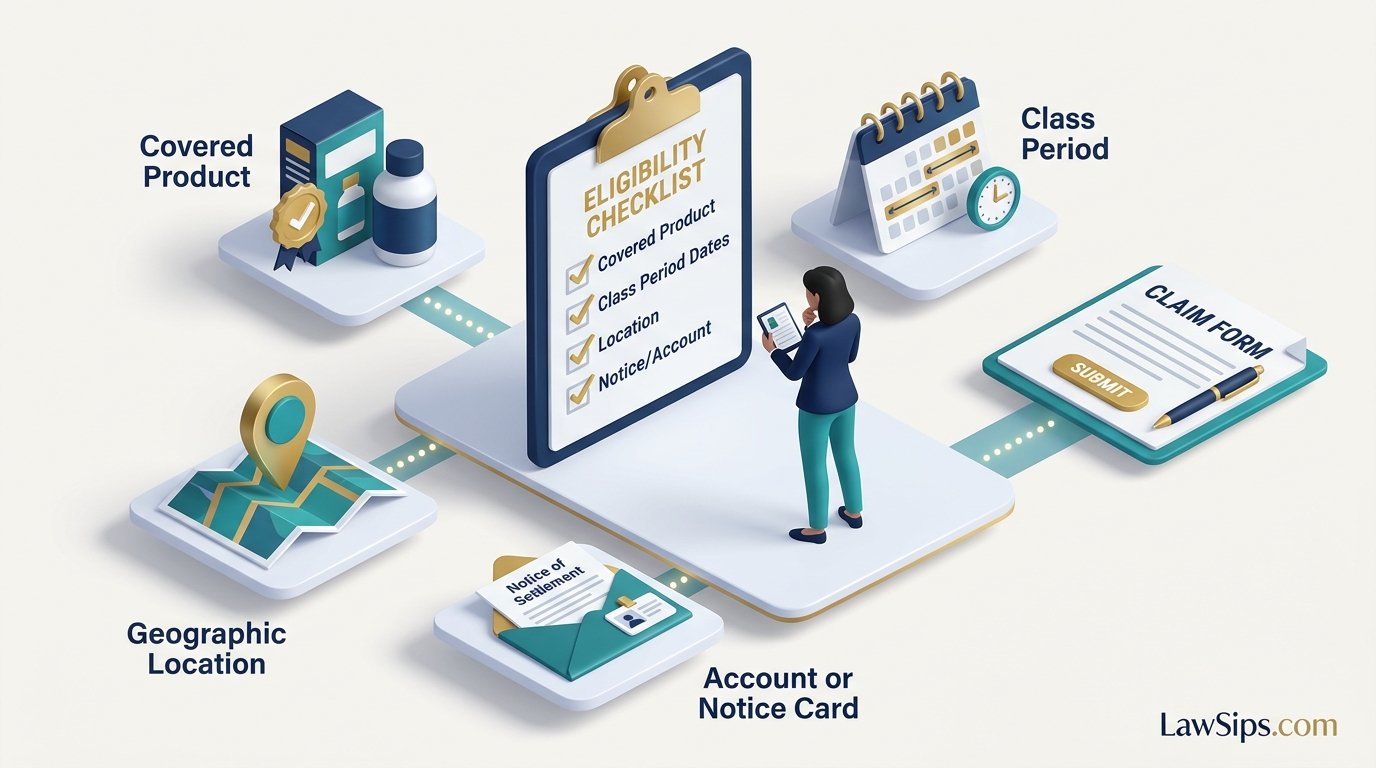
Step 1: Find the official site. It is named in the court approved notice and the administrator’s case list. Search results and roundups are signposts; the official site is the only filing desk.
Step 2: Read the class definition. Product, period, place, exclusions. Decide eligibility from the definition, not from the headline amount.
Step 3: Choose your tier honestly. Sworn base, or documented if your records are real and retrievable. The form presents both as separate options; pick once, accurately.
Step 4: Complete the form. Name, address, contact, the eligibility answers, and your payment election. A typical form takes two to five minutes when the answers are simply true.
Step 5: Sign the attestation like it matters. It is the one legally loaded line on the page. Then submit before the deadline and save the confirmation screen and claim number the moment they appear.
The full filing walkthrough, for claims of every proof type, lives in the house guide to how to file a claim for a settlement, and the claimable universe beyond the no proof corner is gathered at class action settlements you can claim.
After Filing: Audits, Deficiency Letters, and Waiting
Most claims simply wait. Validation, the appeal window, and the court’s final approval all sit between a deadline and a payment, and field accounts put the wait at roughly three to nine months after the claim deadline.
A deficiency notice means your claim needs something: a clearer document, a corrected detail, a response to an audit request. Administrators typically allow a cure window of about two to four weeks, and missing it ends the claim.
A rejection states its reason in the same plain categories the screening uses: duplicate, outside the period, over the cap, ineligible on the form’s own answers. Read it against your filing before assuming error, yours or theirs.
Track what happens next the way the house’s settlement check status guide teaches: claim number first, official site second, and patience calibrated to the distribution schedule rather than to rumor.
The Money After the Deadline
When claims close, the fund divides by the plan of allocation. Flat tiers pay their figure; pro rata tiers pay whatever the valid claim count does to the arithmetic, which is why honest filing protects strangers as well as yourself.
False claims dilute real ones in every pro rata case. The sworn system’s integrity is not abstract: each invented claim is a small transfer from people who actually bought the product.
Unclaimed money follows the settlement agreement: redistribution to claimants, cy pres donation, or reversion to the defendant. The agreement, as always, is the rulebook, and the open universe of cases is tracked at open class action settlements.
The Scam Filter
Real settlements share a fingerprint. Filing is free, always: any site, message, or caller charging a fee to file is fake, full stop, and no legitimate administrator will ever ask for one.
The official site is named in the court approved notice. Lookalike domains, text message links, and social posts promising large sums for tiny effort are the standard bait in this category.
Intake funnels are the gray zone: pages that collect your details to pass to law firms rather than filing anything. Their forms may be legal, but they are not the settlement, and your claim is not filed by submitting one.
Verify in this order: the case name, the administrator, the official domain printed in coverage of the court’s own documents, and the deadline. Four checks, two minutes, and the bait loses its power.
A Note on the Lists Themselves
Treat headline counts as marketing until proven otherwise. One major aggregator’s no proof page headlines 200+ open settlements and thousands in household value, while its own dated open table, updated the same week, listed 14.
Both numbers cannot describe the same inventory.
The table, tied to named cases and deadlines, is the credible one; the headline is the funnel talking. Apply that discount to every list in this category, including this page’s snapshot, which is why its check date is printed in its heading.
The corrective habit is cheap: named case, official site, live deadline, or it does not count. Lists that cannot survive those three words are entertainment, not inventory.
Two Filers, Two Correct Outcomes
The first filer used a period tracker app years ago and keeps no records of it. The settlement’s class is defined by that use, the attestation matches her honest memory, and she files the sworn claim in minutes, confirmation saved.
The second filer kept every receipt for a labeled product line across the class period. He skips the base tier entirely and files documented, at several times the base amount, because his paperwork is real.
Neither filer gamed anything. Each filed at the tier their facts and records supported, which is the entire discipline of this category in two portraits.
Where LawSips Fits
The settlements cluster here runs the full journey: finding cases, filing them, watching deadlines, checking status, and understanding payouts, with general information at every step and a lawyer’s consultation reserved for questions a website should not answer.
This page owns the proof question inside that cluster: what evidence a settlement wants, what your signature legally is, and how to sort any case into its tier before you spend a minute on forms.
LawSips files nothing for readers. Your claim is yours to file, on the official site, under your own name and your own signature. That signature deserves the truth, and now it has the context to give it.
The Honesty Test, One Last Time
Before any no proof filing, read the attestation sentence aloud. If it is true, sign it and file with confidence. The system was built for exactly your situation: a real purchase, a lost receipt, a small harm.
If it is almost true, it is not true. Close the tab. Another settlement, one you actually qualify for, is a better use of the same five minutes, and the list will still be there when it opens.
Worked Examples: Reading Three Real Shapes
The privacy case with no purchase at all. Some classes are defined by use, not buying: you visited the site, used the app, or appear in breached records.
The CVS digital privacy case in the snapshot is that shape, with a base up to 5 dollars and a documented option up to 10.
The breach case with two cash doors. Data breach settlements commonly offer an alternative cash payment beside documented loss reimbursement. The cash door needs no loss receipts; the reimbursement door pays real losses, up to thousands, against records. Same settlement, different evidence, different money.
The estimate case. The ATM surcharge settlement asks for a sworn estimate of surcharged withdrawals across a class period stretching back to 2007. Nobody has those receipts; the form knows it, and invites an honest estimate instead of pretending otherwise.
Each shape teaches the same reading skill: find which cell of the taxonomy you are in before you touch the form, and the rest of the process explains itself.
Records You Might Have Without Knowing It
The documented tier is not limited to paper receipts. Order histories sit inside retailer accounts for years, and email confirmations survive in inboxes long after envelopes are recycled.
Bank and card statements prove payment without proving the product, which some settlements accept and others do not. Read the form’s own list of accepted documents before assuming yours fails.
Account screenshots show subscriptions, app usage, and service periods. For use based classes, a settings page or an old download record can corroborate what your memory already knows.
Retrieval takes minutes in most accounts. Spend them only when the tier gap justifies it: doubling a 10 dollar base may not, while a documented loss claim in the hundreds almost always does.
The Claim Form, Field by Field
Identity fields come first: name, current address, email, phone. These are how the administrator matches, contacts, and pays you, and errors here cause more delays than any legal question on the form.
Eligibility fields restate the class definition as questions. Answer them as facts about the class period, not about today: where you lived then, what you bought then, which account you held then.
Quantity fields ask how many products, visits, or transactions. Honest counts and honest estimates are the standard; the form’s caps exist because volume claims are where invention concentrates.
Payment election chooses check, deposit, or digital payment where offered. Pick the channel you will actually monitor months from now, because uncashed and expired payments are a quiet way claims evaporate.
The attestation closes the form. Everything above it is information; that block is the sworn statement, and it deserves the slowest ten seconds of the whole process.
Mistakes That Cost Honest Claimants Money
Filing the wrong tier. Claiming documented without documents invites a deficiency fight; claiming base when your records are strong leaves multiples unpaid. The tier choice is a money decision, not a formality.
Missing the cure window. A deficiency letter with a two to four week deadline is easy to lose in an inbox. Claims die there quietly, weeks after a successful filing.
Letting the payment expire. Checks go stale and digital payments expire unclaimed. Calendar the expected window when you file, and watch the channel you elected.
Filing and forgetting the move. Administrators mail to the address on the form. A move without an update sends your payment to a stranger’s mailbox and your claim into the reissue queue.
Trusting a stale list. Every closed case in a roundup costs a filer real minutes and occasionally real hope. The three word test, named case, official site, live deadline, prevents all of it.
Questions Readers Ask Before the FAQs
Is my information safe on a claim form? File only on the official site named in the notice, and be suspicious of any form asking for data the settlement does not need. Administrators ask for payment details; they do not need your full financial life.
Can I file for my children or my late parent? Settlements define who may claim for minors and estates, usually a guardian or executor with authority documents. The notice carries the rule; the claim itself stays the same shape.
What if the deadline is today? File online now, not by mail, and screenshot the confirmation with its timestamp. Today is the one day the postmark rule cannot save you.
Why did my neighbor get more? Tier, claim counts, and pro rata arithmetic explain almost every gap. Different evidence, different cell of the taxonomy, different money, same settlement.
Why This Category Exists at All
Class actions were built for harms too small to sue over alone. A four dollar fee taken from forty million people is a fortune in aggregate and a shrug individually, and the sworn claim is the mechanism that lets the aggregate case pay the individuals.
Without it, the math collapses. Requiring receipts for undocumentable micro transactions would leave claim rates near zero, settlements would release claims nobody was paid for, and courts would be approving empty gestures.
That is why the doctrine comes from the courts’ own guidance rather than from marketers. The Federal Judicial Center’s warning about documents people do not retain is the sound of the judiciary protecting its own remedy.
The category will keep growing wherever commerce leaves no paper: apps, subscriptions, speakers, trackers, and fees. Every new invisible transaction is a future class whose members cannot prove membership with anything but their word, properly sworn.
Read generously, that is the system’s integrity working. Read cynically, it is small money for small harms. Both readings agree on the operating rules, which are the ones this page teaches.
A Five Minute Filing Session, Timed Honestly
Minute one: open the official site from the notice and find the class definition. Read it twice; it is shorter than the FAQ and decides everything.
Minute two: sort yourself into the taxonomy. Automatic, records matched, sworn, or documented, and if documented, whether your records are actually retrievable today.
Minutes three and four: complete the form in order, answering eligibility questions about the class period, choosing the payment channel you will still monitor next year.
Minute five: read the attestation aloud, sign, submit, and screenshot the confirmation. Save it beside the claim number in a folder you will find again, because the payment conversation, if any, starts from those two artifacts.
The Postcard Version
Keep this version for the group chat, because it is the one people actually repeat. No proof never means no rules. It means the rule about evidence changed, and only that rule.
Everything else, eligibility, deadlines, screening, caps, and the duty to be truthful, stayed exactly where it was. The settlements that work are the ones whose claimants understood that sentence before they signed anything.
For the Person Reading This for Someone Else
Parents, adult children, and caregivers file these claims for households, not just for themselves. The rules travel with the signature: you may help with the form, but the attestation speaks for the claimant’s facts, so the facts still have to be theirs and true.
Where a settlement allows a guardian or executor to claim, it says so and names the authority documents it wants. Bring those, and the process is the same five minutes, plus paperwork.
The One Paragraph to Remember
If the whole page had to shrink to a postcard, it would say this: your signature is a sworn statement with the force of an oath.
It is offered because your receipt no longer exists, accepted because courts know it, and checked because administrators screen it. Sign it only when it is simply true, and the system works exactly as designed, for you and for everyone sharing the fund.
Frequently Asked Questions
1. What does no proof needed mean in a class action settlement?
It means your signature replaces receipts. The settlement accepts a sworn statement, signed under penalty of perjury, that you qualify, instead of documents proving the purchase.
2. Is it legal to file a class action claim without a receipt?
Yes, courts approve it deliberately. Federal law (28 U.S.C.
§ 1746) gives that declaration the force of an oath, and judges allow it where receipts are unrealistic to keep.
3. What is an attestation on a claim form?
It is the form’s sworn statement. You declare under penalty of perjury that you bought, used, or held the covered item during the class period and that your answers are true.
4. Do I still have to be eligible if no proof is needed?
Yes, completely. No proof changes the evidence, not the eligibility.
You must still fit the class definition: the product, the period, the place, and any notice requirement.
5. How much do no proof settlements pay?
Usually about 5 to 150 dollars. Field roundups put most base payments at 5 to 100 dollars, with some privacy and bank fee cases reaching a few hundred.
6. What is the difference between no proof and proof required claims?
Money and effort. No proof pays a modest flat or pro rata base on your signature.
Documented claims pay multiples more, up to thousands for proven losses, and take longer.
7. Can I file a no proof claim and later add receipts?
Usually you choose at filing. Most forms make you pick a tier.
Some administrators accept documentation later or during a deficiency cure; the settlement’s terms decide.
8. Will my no proof claim be audited?
It can be screened or sampled. Administrators check duplicates, caps, and fraud patterns on every claim, and some settlements audit a sample or ask for documents later.
9. Why would a claim be rejected if no proof was needed?
For administrative reasons, not missing receipts. Duplicates, claims outside the class period, households over the cap, implausible quantities, and answers that contradict the class definition.
10. What happens if I file a claim for something I did not buy?
That is perjury and fraud. A knowingly false attestation is a sworn false statement, with legal exposure, and in pro rata cases it also dilutes honest claimants’ shares.
11. Is guessing about eligibility risky?
Yes, do not guess. If you cannot truthfully sign from your own knowledge, check your records or skip the claim.
An estimate is fine only where the form invites one.
12. Can the administrator ask for documents after I file without proof?
Yes, in settlements that reserve audits. Treat a request as routine, answer promptly and truthfully, and send only what is asked.
Ignoring it usually ends the claim.
13. How long does a no proof settlement take to pay?
Months, typically. Validation, appeals, and final approval follow the deadline; field accounts commonly describe about three to nine months from deadline to payment.
14. Do I need a notice ID to file a no proof claim?
Sometimes, and that is a different category. Notice ID cases are records matched, not pure no proof.
The notice tells you which kind of claim yours is.
15. What is an alternative cash payment in a data breach settlement?
It is the no loss cash tier in breach cases. Instead of documenting out of pocket losses, you take a set or pro rata cash amount, usually far smaller than documented claims.
16. What does pro rata mean for my no proof payout?
Your amount is calculated after the deadline. The fund divides by the number of valid claims, so the final figure is unknown until claims close and are validated.
17. What is a per household cap?
It is a limit on sworn claims per household. Capped settlements pay the base amount once per household regardless of products claimed, to keep small funds from draining on volume.
18. Can two people in one household file separate claims?
It depends on the settlement’s definition of household. Some allow individual claims by adults at one address; capped cases usually treat the address as one claim.
The notice controls.
19. Why do companies allow claims without proof?
Because settlements must actually settle. Companies agree to sworn claims so eligible people can participate, claims get released, and the lawsuit genuinely ends.
20. Why do courts approve no proof settlements?
Because documentation rules would exclude the class. Judicial guidance warns against requiring papers people are unlikely to have kept, which would deny most members any recovery.
21. What proof counts if I do have documents?
Receipts, order histories, and statements. Bank or card statements, account screenshots, invoices, and order confirmations, as long as names, dates, and products match the class terms.
22. What if I lost my receipt for a settlement that offers both tiers?
File the base tier instead. That is exactly the situation the sworn tier exists for.
If receipts surface later, some settlements allow supplementing during a cure window.
23. Are no proof settlement lists accurate?
Treat them as dated leads, not gospel. Counts conflict even within one site, and lists go stale as deadlines pass.
Verify each case on its official settlement website.
24. How can I tell a real no proof settlement from a scam?
Check the fingerprint. Real settlements are filed free on the official site named in the court approved notice.
Fees to file, lookalike domains, and pressure tactics mark fakes.
25. Do real settlements ever charge a fee to file?
Never. Filing a claim is always free.
Any person or site charging to submit your claim is running a scam, whatever their page claims.
26. Where do I file a no proof claim?
On the official settlement website only. It is named in the notice and the administrator’s case list.
Roundups and search results are signposts, not filing desks.
27. What information does a no proof claim form ask for?
Contact details and the eligibility answers. Name, address, how to pay you, the purchase or use facts the class definition requires, and your signed attestation.
28. What is a deficiency notice on a claim?
It is a fix it letter. The administrator found something missing or unclear and gives you a short window, often two to four weeks, to correct or document it.
29. What should I do if I get a deficiency notice?
Respond inside the window, truthfully. Send exactly what is asked, keep copies, and keep your claim number on everything.
Missing the cure deadline usually ends the claim.
30. Does no proof needed mean the settlement is automatic?
No, the opposite. No proof settlements still require a claim form by the deadline.
Automatic settlements, paid from records with no form, are a separate category.
31. What is the difference between automatic payment and no proof claims?
Automatic pays without any form. The defendant’s records identify you and payment follows.
No proof still needs your form and signature before the deadline.
32. Which settlements are open with no proof needed right now?
Check the dated snapshot in this article. It lists notice verified cases checked November 9, 2026, with deadlines from mid November 2026 into February 2027.
Re-verify before filing.
33. How often do new no proof settlements open?
Continuously, in small numbers. New settlements open as cases resolve year round, which is why dated lists expire and official directories beat roundups for freshness.
34. Can I claim if I bought the product but live in a different state now?
Usually yes, if the definition allows. Classes are typically defined by where the purchase, use, or account happened, not your current address.
Read the definition’s geography carefully.
35. What if I am not sure I bought the product during the class period?
Do not sign yet. Look for order histories, account records, or emails that settle the question.
If the facts stay unclear, the honest choice is not to file.
36. Does signing the attestation count as proof of purchase?
Yes, legally it is your proof. Under federal law the signed declaration carries the force of a sworn oath, which is why settlements can pay on it and why it must be true.
37. Can a no proof claim be filed by mail?
In most settlements, yes. Paper claim forms are usually offered with a postmark deadline.
Keep a copy and proof of mailing; online filing gives instant confirmation.
38. What happens to unclaimed money in no proof settlements?
The agreement decides. Leftover funds are redistributed to claimants, donated cy pres to related charities, or returned to the defendant, per the distribution plan.
39. Do no proof claims lower what everyone else gets?
In pro rata cases, yes, at the margin. Every valid claim shares the same fund.
That is also why false claims harm real ones, and why honest counts matter.
40. Is a no proof claim worth filing for a small amount?
For most people, yes. Five minutes for a truthful claim with a real, if modest, payment beats leaving a valid claim unfiled.
Just keep expectations at base tier scale.
41. Can I withdraw a claim I filed by mistake?
Contact the administrator promptly. Explain the mistake in writing with your claim number.
Administrators can usually correct or withdraw a claim filed in genuine error.
42. Does LawSips file claims for readers?
No. LawSips publishes legal information only.
Claims are filed by class members themselves, free, on each settlement’s official website, under their own signature.
Conclusion
A class action lawsuit no proof needed settlement trades your receipt for your signature, and the signature carries the law with it: same force as an oath, same duty to be true.
Sort every case by its proof tier, file only what you can honestly sign, keep your confirmations, and let the documented tiers reward the paperwork you actually have.

Dilawar is a dedicated writer and contributor at Lawsips.com, focusing on legal information, business law, consumer rights, legal awareness, and everyday legal matters. He is passionate about simplifying complex legal topics and providing readers with clear, practical, and easy-to-understand information. His goal is to help readers stay informed about legal developments, understand their rights, and make better decisions through informative and well-researched articles.