
Average Class Action Settlement Payout: What You Actually Get Per Person

General information only. This is not legal advice or tax advice. Settlement figures change as cases resolve; verify every deadline and amount on the official settlement site.
The Short Answer
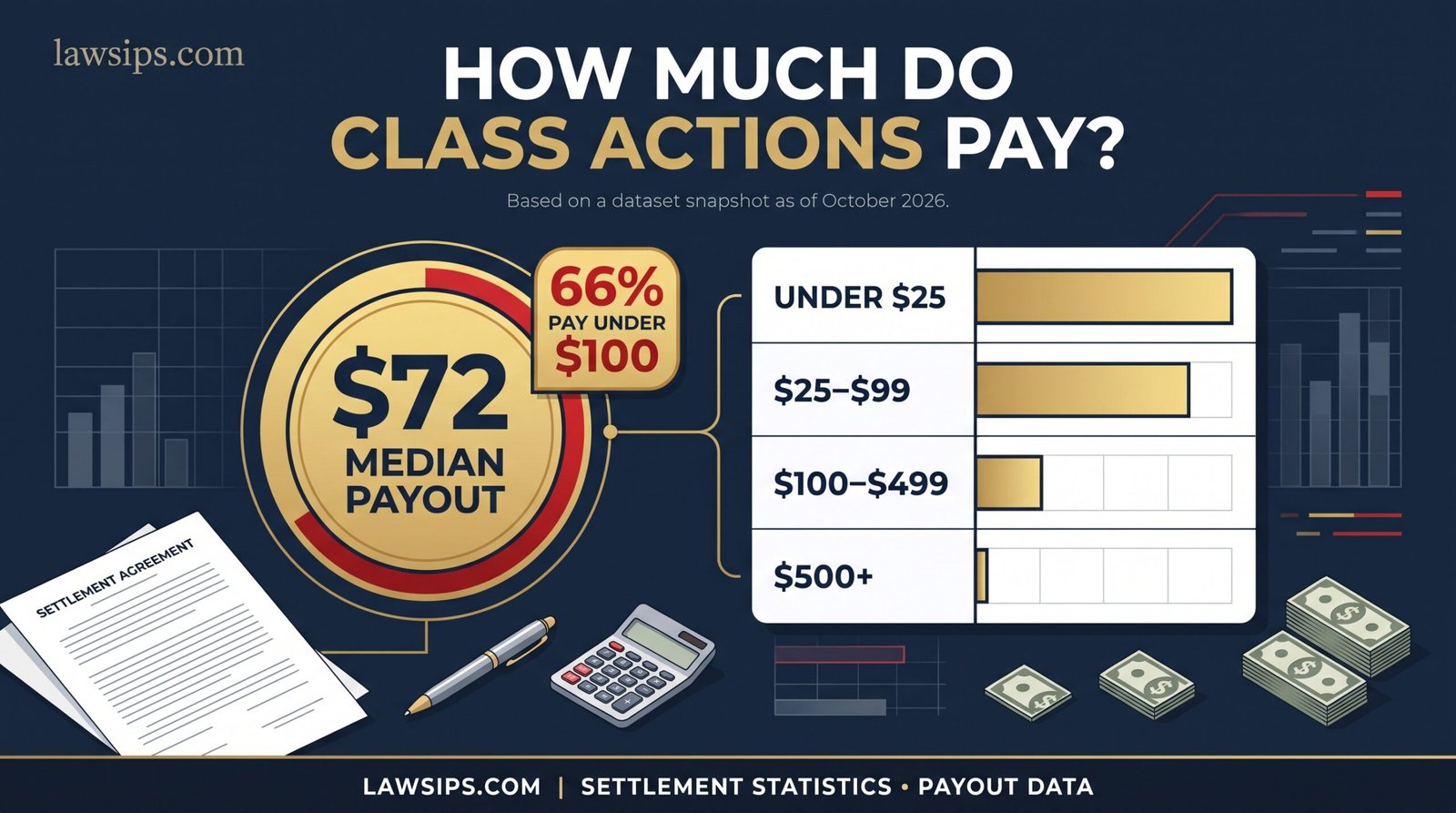
The median class action payout is $72 per person, based on an October 2026 analysis of 110 settlements with published figures. About 66% of settlements pay under $100 per person. Published “averages” range from under $50 to $500 depending on how the number was calculated, which is why this page exists.
Most individual checks land between $20 and $100 for no-proof claims. Documented-loss claims can pay ten times more or higher, and rare outliers like the Volkswagen diesel case paid $5,100 to $10,000 per person. The headline fund size tells you almost nothing about your check.
Introduction
The average class action settlement payout is one of the most misunderstood numbers in consumer law. Search results quote figures from under $50 to $500, and every site sounds confident. They cannot all be describing the same thing, because they are not.
This guide does what competitors skip: it shows how each average is built, which ones to trust, and why the median beats the mean for this question. You will see the real distribution of payouts, averages by case type, the math that shrinks every check, and the documented steps that raise yours.
If you want the formula for dividing any single settlement, that lives in the companion guide to settlement payout per person. This page answers a different question: what do the statistics say across hundreds of real cases.
How This Page Differs From the Per-Person Formula Guide
Two pages on similar keywords must earn their separate existence. The per-person guide teaches the division formula: net fund divided by valid claims, flat versus pro rata tiers. This page teaches the data: medians, distributions, per-type averages, and why published figures conflict.
Read the formula guide to calculate one case. Read this page to understand the landscape. Each links to the other, and neither repeats the other’s job.
Why the “Average” Misleads: Mean vs. Median
Ask ten sites for the average and you get ten different answers. Investopedia reports the average is often less than $50 per claim. Other pages say $20 to $100, $20 to $500, or $10 to $600 for no-proof claims. The conflict is methodological, not factual.
The $72 Median That Matters

ClassActionHero’s open-settlements dataset found a median payout of $72 across 110 settlements with published per-person figures (October 18, 2026 snapshot). The median is the middle value: half of settlements pay more, half pay less. The dataset visualization page publishes the finding with its method.
The median beats the mean here because payout distributions are heavily skewed. A handful of six-figure documented-loss payments pull the arithmetic mean upward, while the typical claimant’s experience sits much lower. For planning purposes, use the median.
The Equifax Example That Breaks the Mean
The $700 million Equifax data breach settlement shows the distortion clearly. Some claimants with documented identity-theft losses received over $125,000. Claimants without proof of specific harm received around $125 to $500, and even that was later reduced because so many people filed.
Fold those six-figure payments into a simple average and the “average claimant” looks far richer than anyone typical. The median ignores the distortion. This is why serious pages quote medians and ranges, not single averages.
The Real Distribution
About 66% of analyzed settlements pay under $100 per person, with payouts clustering hard in the $50 to $100 range. Only 14 settlements in the dataset pay $500 or more per person. Those are the outliers worth hunting, not the norm.
| Payout band | Share of settlements | What it feels like |
|---|---|---|
| Under $25 | Roughly 1 in 4 | Massive classes; the check barely covers postage |
| $25 to $99 | Roughly 2 in 5 | The typical consumer case; the $72 median lives here |
| $100 to $499 | Roughly 1 in 4 | Targeted cases or documented-loss tiers |
| $500 and up | Roughly 1 in 8 | Outliers: defect cases, securities, big documented losses |
Bands are approximate, derived from the ClassActionHero October 2026 finding that 73 of 110 settlements with published figures pay under $100. Re-verify against the live dataset before publishing.
Why Published Averages Conflict: A Methodology Guide
Four reputable pages give four different “averages,” and none of them is lying. They are measuring different things with different methods. Understanding the differences turns confusion into a toolkit.
| Source | Figure quoted | What it actually measures |
|---|---|---|
| Investopedia (attorney interviews) | Often less than $50 per claim | Practitioner experience across consumer cases |
| ClassActionHero (dataset) | $72 median | Middle value of 110 settlements with published figures |
| Settlemate | $20 to $100 | Typical range for individual payouts |
| Tribeca Lawsuit Loans | $20 to $500 | Broad range including larger fraud and antitrust cases |
| Owed | $10 to $600 no-proof | No-proof tier range across recent cases |
The pattern: practitioner quotes skew low (they see the modal consumer case), datasets give the honest middle, and broad ranges include outlier categories like securities. When a page does not say which method it used, treat its number as anecdote, not data.
This is also why the worth-it analysis from LegalClarity frames the question around $20 to a few hundred dollars rather than a single figure. Ranges with sources beat false precision every time.
Average Payout by Case Type
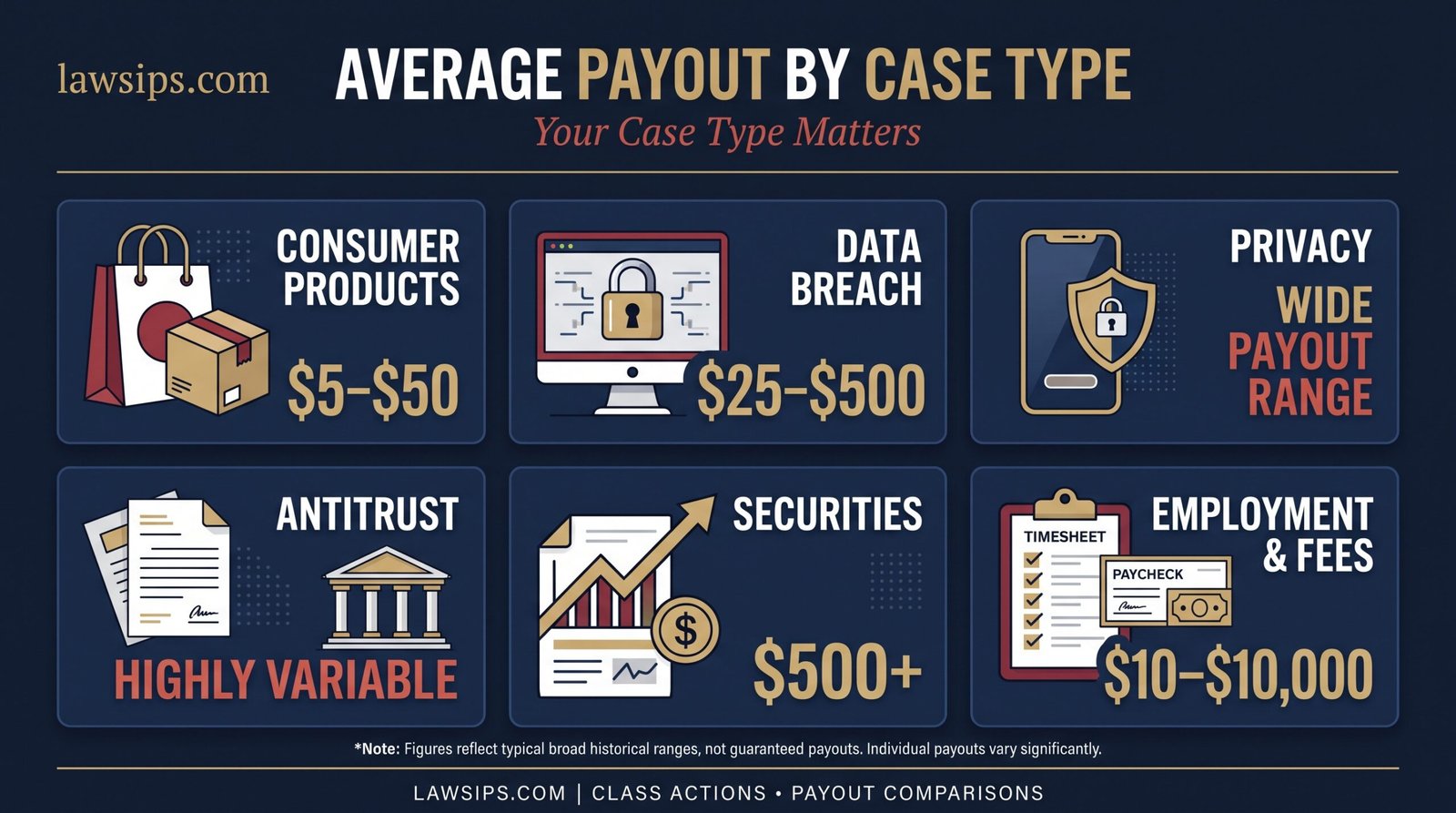
Case type predicts your check better than any single overall average. A data breach fund and an antitrust fund live in different financial universes, and the per-person math follows.
Consumer Product Cases: $5 to $50
False advertising and defective-product cases produce the smallest typical checks, often $5 to $50 per claimant. Classes are enormous, individual harm is small, and no-proof tiers dominate. A $4 million fund split across 400,000 buyers is $10 each before fees.
Data Breach Cases: $25 to $500
Data breach settlements typically pay $25 to $500 per person, with documented-loss tiers reaching much higher. The Bank of America breach case paid $50 flat, up to $600 with documentation. Data breach funds average about $1.37 million per case, far smaller than most people assume from headlines.
Privacy Cases: Wide Range
Privacy settlements swing wildly. The TikTok privacy case carried a $92 million fund with payouts from $1 to $100,000 depending on documentation. The Fitbit health-data case paid roughly $12 to $32+ per person. Documentation is the divider in this category.
Antitrust Cases: The Fund Giants
Antitrust settlements hold the largest funds by far, averaging about $186 million per case, roughly 136 times the data-breach average. But classes are huge and proceedings are slow, so per-person figures vary enormously. These are the cases where patience matters most.
Securities Cases: $500 and Up
Securities fraud settlements often pay $500 or more per claimant because losses are documented investment losses, not $12 overcharges. Fewer claimants, larger harms, bigger checks. This category drives much of the “average” upward.
Employment and Fee Cases: Tiered by Proof
Wage-and-hour and hidden-fee cases pay in documented tiers. The DoorDash hidden-fees case paid $15 flat and up to $10,000 with proof. The Starbucks mobile-order-fee case paid $10 flat. Your records decide your tier.
| Case type | Typical per-person range | Average fund size | Key driver |
|---|---|---|---|
| Consumer product | $5 to $50 | Small to mid | Huge classes, tiny per-unit harm |
| Data breach | $25 to $500 | ~$1.37M | Documented-loss tiers |
| Privacy | $12 to $100,000 | Mid to large | Documentation gap is extreme |
| Antitrust | Highly variable | ~$186M | Giant funds, giant classes |
| Securities | $500+ | Large | Documented investment losses |
| Fees/wage | $10 to $10,000 | Mid | Proof-of-loss tiers |
Ranges are competitor-reported (LawFold, Owed, Tribeca, Settlemate) and fund averages are from the ClassActionHero November 2026 dataset. Verify on official settlement sites before publishing.
The Open-Case Snapshot: November 2026
As of November 2026, the ClassActionHero dataset tracks 304 open settlements holding $6.08 billion in published funds. That headline number needs the same median treatment as everything else in this guide.
Data breach cases dominate the count at 85 open settlements, yet hold only 1.9% of published money ($116.7 million). Six antitrust settlements hold 18.4% of all published money ($1.12 billion). The typical open case is a small data-breach fund, not a headline giant.
This snapshot explains why your mailbox fills with $25 notices rather than $5,000 ones. The dataset’s per-person chart records maxima, not typical payouts, so treat every “up to” figure in it as a cap while awaiting typical-payout data.
The Math That Shrinks Your Check
Headline funds mislead because you are paid from what remains after several deductions, then split among everyone who files. A worked example makes the shrinkage concrete.
Worked Example: $92 Million Becomes ~$41
Take a $92 million fund, a realistic consumer-case size. Attorney fees of 30% remove $27.6 million. Notice and administration costs remove roughly $5 million. Service awards to named plaintiffs remove a small slice more. The net fund lands near $59 million.
Now divide by valid claims. If 1.4 million people file from a large class, each gets about $41. This is the worked example published by Owed, and it mirrors real distributions closely. The headline was $92 million; the check is $41.
Attorney Fees: 25% to 33% Off the Top
Courts award class counsel fees under Federal Rule of Civil Procedure 23(h), typically 25% to 33% of the fund in consumer cases. One attorney quoted by Investopedia puts the observed range at 20% to 46% before class members see anything.
Percentages tend to fall as funds grow. A $1 billion settlement rarely pays 33%, but in the $5 million to $100 million range where most consumer cases live, 25% to 30% is typical. The judge sets the number, not the lawyers alone.
Administration and Notice Costs
Someone must find class members, process claims, and mail checks. Administrators like Epiq, Kroll, Angeion, and JND do this work, and their fees plus notice campaigns come from the fund. Complex notice programs cost more, which is one reason simple cases pay relatively better.
Service Awards to Lead Plaintiffs
Named plaintiffs who sat for depositions and produced documents receive service awards, typically a few thousand dollars each. These come off the top and explain part of why lead plaintiffs get the most while absent class members get the median.
The Claims-Rate Paradox: 9% Helps You
A 2019 FTC staff study of 149 consumer settlements found a median claims rate of 9% and a weighted mean of just 4%. Mailed notice packets did best at 16%; email-only campaigns did worst. Most eligible people never file.
Here is the paradox competitors never state plainly: low claim rates raise your check. Pro rata division means the net fund splits among filers only. Every eligible person who ignores the notice leaves more for you. Filing is the entire edge.
| Deduction (in order) | Typical size | Who decides |
|---|---|---|
| Attorney fees | 25% to 33% of gross fund | Judge under Rule 23(h) |
| Litigation costs | Varies; experts and discovery | Judge-approved |
| Notice and administration | Single-digit millions in large cases | Settlement agreement |
| Service awards | A few thousand per named plaintiff | Judge-approved |
| Your share | Net fund divided by valid claims | Pro rata math |
No-Proof vs. Documented Loss: The 10x Lever
The single biggest controllable factor in your payout is which tier you file under. No-proof tiers pay fast and small. Documented-loss tiers pay slow and large, because far fewer people qualify and bother.
| Case | No-proof tier | Documented tier | Multiple |
|---|---|---|---|
| Bank of America data breach ($425M) | $50 flat | Up to $600 | 12x |
| DoorDash hidden fees ($25M) | $15 flat | Up to $10,000 | ~667x |
| TikTok privacy ($92M) | $1 and up | Up to $100,000 | Extreme |
| Equifax breach ($700M) | $125 to $500 | Over $125,000 | 250x+ |
Figures are competitor-reported 2026 snapshots (Owed, LawFold). Verify on each official settlement site; tiers and caps change.
Receipts, account statements, and proof of out-of-pocket loss are the difference between the median and the outlier. If you have documentation, never file the no-proof tier by default. The extra paperwork is the highest-paid hour in the process.
How Long Until the Money Arrives
From filing to payout typically takes 9 to 24 months. The fairness hearing, the appeals window, and claims processing each consume months. Filing early does not speed this up, but filing late can exclude you entirely.
Once distribution starts, processing a settlement check takes roughly one to six weeks. Digital options like PayPal or Venmo, where offered, arrive faster than mailed paper checks. Keep your address current with the administrator; stale addresses are a top reason checks go unclaimed.
Timeline Table
| Stage | Typical timing | What happens |
|---|---|---|
| Preliminary approval | Month 0 | Judge allows notice to go out |
| Claim filing window | Months 1 to 4 | Class members submit claims |
| Final fairness hearing | Months 5 to 8 | Judge reviews objections, approves deal |
| Appeals window | Months 8 to 14 | Objectors may appeal; clock runs |
| Distribution | Months 12 to 24 | Checks and digital payments go out |
Are Class Action Payouts Taxable?
General information only, not tax advice. Under IRC Section 61, settlement amounts are generally taxable as income unless an exclusion applies. The main exclusion covers damages for physical injury or sickness.
Most consumer overcharge and privacy payouts are taxable. Administrators may issue 1099 forms for larger payments. When in doubt, ask a tax professional; the claim-filing guide covers the mechanics while a professional covers your return.
Which Payments Are Usually Taxable
Compensation for lost money, overcharges, and privacy harm is generally taxable. Interest on the settlement is taxable. Physical injury damages are the main exclusion, and emotional distress counts only when tied to physical injury. Keep the administrator’s tax documents with your return files.
What Happens to Unclaimed Money
Unclaimed funds do not quietly vanish. Depending on the agreement, leftovers go to a second distribution among filers (raising your effective average), to a cy pres recipient (a charity related to the case’s subject), or back to the defendant under a reversion clause.
Second distributions are why filing in low-claim-rate cases sometimes pays twice. Cy pres awards explain why “unclaimed millions” headlines rarely mean bigger checks later. Read the settlement agreement, not the headlines, to know which applies.
Class Action vs. Mass Tort vs. Individual Suit: Payout Comparison
“Average payout” means something different in each vehicle, and competitors rarely separate them. A mass tort matrix payment and a class action pro rata check are computed differently and feel different to recipients.
| Feature | Class action | Mass tort / MDL | Individual lawsuit |
|---|---|---|---|
| How your share is set | Pro rata from common fund | Points matrix by injury severity | Your damages, negotiated or tried |
| Typical per-person range | $20 to $500 | $1,000 to $100,000+ | Unbounded; often larger |
| Proof burden | Low for flat tiers | Medical records usually required | Full evidence of your losses |
| Timeline | 9 to 24 months to distribution | 2 to 5+ years | 1 to 4 years |
| Cost to you | Free to file | Contingency fee 25% to 40% | Contingency or hourly |
The takeaway: class actions optimize for access and efficiency, not maximum individual recovery. If your documented losses are large, an individual consultation may beat any class average. General information only, not legal advice.
The Administrator’s View: Where the Money Actually Goes
Administrators like Epiq, Kroll, Angeion, and JND run the machinery competitors describe abstractly. Understanding their workflow explains two payout mysteries: why notice quality varies and why some checks arrive in waves.
Notice Campaigns Set the Claims Rate
The FTC study found mailed full-notice packets achieved a 16% median claims rate, while email-only campaigns did worst. Administrators design notice plans to satisfy the judge, balancing cost against reach. Cheap notice means fewer filers, which means bigger checks for those who file.
Validation Filters the Fund
Administrators validate every claim: duplicates, ineligible dates, and fraudulent filings are rejected before division. High rejection rates in documented tiers further concentrate payouts among legitimate filers. Honest, complete claims are not just ethical; they are mathematically advantaged.
Residual Distributions Reward Patience
When first-round checks go uncashed, administrators run residual distributions to filers with valid addresses. Some claimants receive a second, unexpected check months later. Keeping your contact details current is the entire strategy here.
Biggest Per-Person Payouts in History
Outliers teach the shape of the possible, not the likely. These are the cases competitors cite, presented here with the context they usually omit.
| Case | Fund | Per-person figure | Why it was high |
|---|---|---|---|
| Volkswagen diesel emissions (2016) | Multi-billion | $5,100 to $10,000 plus buyback | Nearly every owner got restitution; documented vehicle loss |
| Equifax data breach (2019) | $700M | Over $125,000 documented; $125 to $500 no-proof | Documented identity-theft losses; no-proof tier diluted by volume |
| TikTok privacy | $92M | $1 to $100,000 | Documented tiers vs. minimal-harm tiers |
| Bank of America data breach | $425M | $50 flat; up to $600 documented | Two-tier structure |
Figures are competitor-reported (LawFold, Owed). The lesson is structural: documented, concentrated harm pays; diffuse, tiny harm does not.
How to Raise Your Own Average
You cannot change the fund size, but you can change your position in it. These steps are ordered by impact.
1. File Under the Documented Tier Whenever You Qualify
Gather receipts, statements, and records before the deadline. The documented tier routinely pays 10x to 600x the no-proof tier. This is the highest-leverage action available.
2. File in Every Case You Qualify For
Most people receive only one or a handful of settlements per year. Filing costs nothing and takes about 10 to 15 minutes per claim. Volume across cases is how small medians compound.
3. Monitor Verified Settlement Lists
Use the settlements you can claim roundup and the class action lawsuit list, which link to official settlement sites. Aggregators are fine for discovery; the administrator’s site is the source of truth.
4. Keep Your Contact Details Current
Update your address with every administrator you have claimed through. Stale addresses are a leading cause of uncashed checks, and some second distributions require no new filing if your details are current.
5. Understand “Up to” Before You Count On It
A per-person maximum is a recorded cap, often the documented-loss tier, not the typical payout. Plan around the median and the flat tier; treat the cap as a ceiling you will probably not touch.
6. Never Pay to File
Legitimate claims are always free. Sites charging fees, or texts with short links promising settlement money, are scams. Verify through dockets and administrator listings, as explained in the guide to how to join a class action lawsuit.
Common Mistakes That Shrink Your Payout
Most payout losses are self-inflicted and avoidable. These five errors account for the majority of reduced or forfeited payments.
1. Filing the No-Proof Tier When You Have Documents
Claimants default to the easiest tier even when receipts sit in their email. The documented tier exists precisely for you. Spend the extra twenty minutes; the multiple covers it hundreds of times over.
2. Missing the Claim Deadline
Deadlines are court-ordered and final. Administrators reject late claims without discretion. Set a calendar reminder the day you first see the notice, not the week it expires.
3. Letting Your Address Go Stale
Moved since the class period? The administrator mails to the address on file. Update it directly with the administrator; forwarding orders expire, and second distributions skip bad addresses silently.
4. Ignoring Deficiency Notices
If the administrator flags your claim as deficient, you usually get one cure window. Treat that email like a court date. Most deficiencies are missing documents, fixable in minutes.
5. Filing Claims You Do Not Qualify For
Submitting ineligible claims is illegal and can taint your legitimate filings. Attorneys quoted by Investopedia stress filing quickly and honestly. Fraud filters improve with every case.
Key Takeaways
The median is $72: half of analyzed settlements pay more per person, half pay less, and 66% pay under $100. Use the median, not the mean, when setting expectations.
Case type beats overall averages: consumer cases pay $5 to $50, data breach $25 to $500, securities $500+, and antitrust funds average $186 million per case. The right benchmark is your category.
Fees and dilution do the shrinking: 25% to 33% goes to attorneys, administration takes its cut, and the rest splits pro rata. A $92 million fund can realistically mean $41 per person.
The 9% claims rate is your edge: most eligible people never file, which raises payouts for those who do. Documentation multiplies the effect further.
“Up to” is a ceiling, not a promise: plan on the flat tier and the median. Outliers like the $5,100 to $10,000 Volkswagen payments required documented, concentrated harm.
Is Filing Worth Your Time? A Decision Framework
The secondary intent behind this keyword is a cost-benefit question: is ten minutes of paperwork worth the expected check? The honest answer depends on three variables, and you can estimate all of them before filing.
| Variable | How to estimate it | When filing wins |
|---|---|---|
| Expected payment | Flat tier amount on the notice; use the median, not the cap | Above $20 for most people |
| Your time cost | 10 to 15 minutes for no-proof; up to an hour with documents | Almost always worth it at typical wages |
| Documentation you hold | Receipts, statements, account records from the class period | Documented tiers change the math completely |
A $25 no-proof claim taking ten minutes equals a $150 hourly rate. Even at the $72 median, the return on time is excellent. The cases to skip are the ones where you must reconstruct records you do not have for a $5 tier.
As one class action attorney told Investopedia, settlements work as occasional windfalls, not passive income. File everything legitimate, expect the median, and let the documented outliers surprise you.
Reading a Settlement Notice Like a Lawyer
Notices are written to satisfy judges, not readers. Three sections carry the numbers that matter; the rest is procedure you can skim.
Find the Payment Tiers First
Skip to the section describing what you can receive. Identify the flat tier, the documented tier, and any caps. The flat tier is your planning number; the documented cap is your ceiling if you have proof.
Check the Fund and the Fee Request
The notice states the gross fund and the fee percentage class counsel will request. Divide the remainder by the estimated class size if stated. If the math implies a tiny check, that is useful honesty, not a reason to skip filing.
Circle Three Dates
Exclusion deadline, objection deadline, and claim deadline are different dates with different consequences. Missing the claim deadline forfeits payment; missing the exclusion deadline forfeits your right to sue separately. Calendar all three.
Frequently Asked Questions
What is the average class action settlement payout per person?
There is no single true average, but the median is $72 per person (ClassActionHero, October 2026), and most no-proof claims pay $20 to $100. Published “averages” differ because sites use different methods.
Is the median or the mean more accurate for payouts?
The median. Payout data is heavily skewed by rare six-figure documented-loss payments, which drag the mean upward. The median describes the typical claimant’s experience.
Why do different sites report different average payouts?
They measure different things: medians vs. means, no-proof tiers vs. all tiers, consumer cases vs. all case types. Always check what the figure includes before comparing.
What is the typical no-proof claim payout?
Usually $10 to $100, with $20 to $50 most common in consumer cases. No-proof tiers trade convenience for size; documentation unlocks the larger tiers.
How much more do documented-loss claims pay?
Often 10x to 600x the no-proof tier. Examples: Bank of America $50 vs. up to $600; DoorDash $15 vs. up to $10,000. Receipts are the multiplier.
What percentage do class action lawyers take?
Typically 25% to 33% of the fund, set by the judge under Rule 23(h). Observed ranges run 20% to 46%, with percentages falling as funds grow very large.
Why are class action checks so small?
Three reasons: attorney and admin deductions shrink the fund, then the remainder splits pro rata among all filers. Big classes plus small per-unit harm equals small checks.
How long does it take to get a class action check?
Usually 9 to 24 months from filing to distribution, plus one to six weeks for processing once payments start. Fairness hearings and appeals set the pace.
Are class action payouts taxable?
Generally yes under IRC Section 61, except damages for physical injury or sickness. This is general information, not tax advice; consult a professional for your situation.
Do I need a lawyer to file a claim?
No. Class members file directly through the administrator’s site. Class counsel already represents the class; you only need your own lawyer if you opt out to sue individually.
Is it free to file a class action claim?
Always. Any site charging a fee to file, or any text promising money via a short link, is a scam. Real administrators never charge claimants.
Who gets the most money in a class action?
Lead plaintiffs via service awards, then claimants with documented losses in the highest tiers. Absent class members in no-proof tiers get the median.
What is pro rata distribution?
The net fund divided by the number of valid claims. More filers means smaller checks; fewer filers means larger ones. It is the core mechanic behind payout dilution.
What is cy pres?
A doctrine sending unclaimed settlement money to a charity related to the case’s subject matter, when distributing it to class members is impractical. An alternative to second distributions.
What happens to unclaimed settlement money?
It goes to a second distribution among filers, a cy pres recipient, or back to the defendant via a reversion clause, depending on the settlement agreement.
Why was the Equifax $125 payment reduced?
Far more people filed than expected, so the pro rata math shrank each share. It is the textbook example of why “up to” figures are ceilings, not promises.
What is the claims rate in class action settlements?
An FTC study of 149 settlements found a median of 9% and a weighted mean of 4%. Mailed notice reached 16%; email-only notice performed worst.
What was the biggest class action payout per person?
Among widely reported cases, Volkswagen diesel owners received $5,100 to $10,000 plus a buyback, and some Equifax documented-loss claimants exceeded $125,000. Both required documented, concentrated harm.
Do data breach settlements pay more than consumer cases?
Usually yes, especially in documented tiers ($25 to $500 typical vs. $5 to $50). But data breach funds average only about $1.37 million per case, so no-proof tiers stay modest.
What does “up to $X” really mean on a settlement notice?
It is the maximum possible, typically the documented-loss cap. Your actual payment depends on deductions, tiers, and how many people file. Plan on less.
Can I still get paid if I missed the claim deadline?
Generally no. Deadlines are court-ordered. Late claims are rejected, which is why monitoring verified settlement lists matters more than any single case.
How do I find open class action settlements I qualify for?
Check roundups that link to official administrator sites, such as the settlements you can claim list, and verify every detail on the settlement’s own website.
Will filing a claim affect my credit score?
No. Filing a class action claim is not a credit event. It creates no inquiry, no account, and no negative record.
Can I object to a settlement I think is unfair?
Yes. Class members may object before the fairness hearing, though objecting and claiming have different deadlines. The claim-filing guide explains the full process.
What is a coupon settlement?
A settlement paying vouchers or discounts instead of cash. Critics argue coupons overstate value since many go unused. Cash is worth more than face-value coupons in every realistic comparison.
What is a reversion clause?
A term sending unclaimed money back to the defendant instead of to class members or charity. Consumer advocates dislike reversions; check the settlement agreement to see if one applies.
Can I get a second distribution check?
Sometimes. If first-round funds go unclaimed, administrators may redistribute to filers. No new filing is usually needed, but your address must be current with the administrator.
What if the administrator rejects my valid claim?
Most settlements include a deficiency or dispute process with a cure deadline. Respond quickly with supporting documents; silence converts a fixable rejection into a final one.
Do children or estates claim differently?
Yes, procedurally. Minors’ claims typically require a parent or guardian signature, and deceased class members’ claims go through an estate representative. The payout math itself does not change.
How do I know a settlement notice is real?
Real notices name the case, court, and administrator, link to an official settlement website, and never charge fees. Cross-check on PACER or the administrator’s site before entering personal information.
Should I pay a service to file claims for me?
No. Filing takes minutes and is free. Third-party filing services charge for what you can do yourself, and sharing personal data with them adds risk without benefit.
What is the average employment class action payout?
Wage-and-hour cases pay in documented tiers tied to hours worked, so averages mislead more than usual. Individual recoveries range from tens to thousands of dollars depending on tenure and records.
Could a settlement affect my government benefits?
Possibly, for means-tested programs. Lump-sum payments can count as income or assets in the month received. This is general information, not legal advice; check with a benefits counselor before filing if this applies to you.
What happens if the defendant goes bankrupt?
Class members become unsecured creditors, and payouts may shrink dramatically or vanish. This is one reason settlement timing matters: approved funds in escrow are safer than promised future payments.
Can I sell my expected settlement payment?
Some companies buy structured or anticipated payments at a steep discount. Selling almost always destroys value; the discount exceeds any benefit of early cash in typical cases.
What is the average TCPA robocall settlement payout?
TCPA cases often pay $20 to $100 per call or text in no-proof tiers, with documented tiers higher. Statutory damages of $500 to $1,500 per violation set the ceiling, but pro rata division sets the reality.
Do I owe taxes on a coupon or voucher settlement?
Generally no tax is due on coupons you never redeem for cash, but converting vouchers to cash can create taxable income. This is general information, not tax advice.
Can a finalized settlement be reopened?
Almost never. Final approval with an expired appeals window ends the case. The rare exceptions involve fraud on the court, not disappointment with the amount.
What is the average false advertising settlement payout?
Typically $5 to $50 per person in no-proof tiers, since per-unit overcharges are tiny and classes are huge. Documented bulk purchasers can recover far more in the upper tiers.
How do I estimate my own payout before filing?
Start with the flat tier amount on the notice, then discount for the fee request and expected claim volume. The companion per-person formula guide walks through the exact calculation.
Do published averages include attorney fees?
Per-person figures never include attorney fees; those come off the gross fund first. When you see “$72 median,” that is the claimant’s share after deductions, which is the number that matters to you.
Conclusion
The average class action settlement payout is best understood as a distribution, not a number. The median sits at $72, two-thirds of settlements pay under $100, and a handful of outliers pull every naive average upward. Once you see the shape, the conflicting figures from different sites stop conflicting.
Your actual check comes from a short chain: the fund minus fees and costs, divided pro rata among filers, multiplied by your documentation tier. Nothing in that chain is mysterious, and every link is checkable on the official settlement site.
The practical lesson is simple. File every legitimate claim, file under the documented tier when you qualify, and ignore “up to” figures when planning. The 9% claims rate means most of the money goes to people who show up. Be one of them.
Next step: browse the verified class action lawsuit list for open cases, use the step-by-step claim guide to file correctly, and confirm every amount and deadline on the official settlement site. General information only; this is not legal or tax advice.

Dilawar is a dedicated writer and contributor at Lawsips.com, focusing on legal information, business law, consumer rights, legal awareness, and everyday legal matters. He is passionate about simplifying complex legal topics and providing readers with clear, practical, and easy-to-understand information. His goal is to help readers stay informed about legal developments, understand their rights, and make better decisions through informative and well-researched articles.