
Claim Money From Settlements: How to Find Money Owed to You and Actually Get Paid

Claim money from settlements starts with a simpler question: where is the money sitting? It waits in four places: open settlement funds, government refund programs, payments sent but never cashed, and state unclaimed property offices.
Claiming is always free, and the route depends on the settlement type. Follow one dollar through five stages: discovery, claiming, verification, payment, and residue.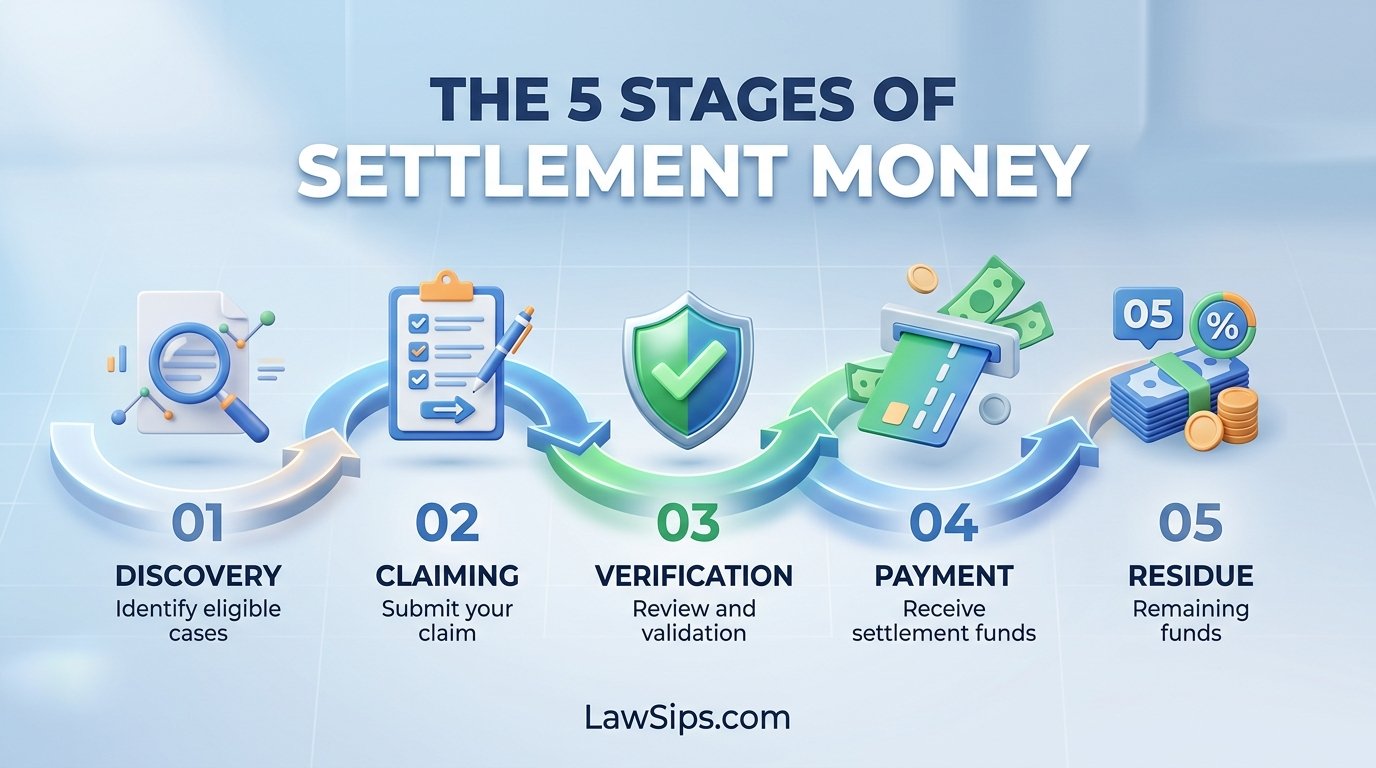
Settlement Money at a Glance: The Five Stages Between a Settlement and Your Bank
Every settlement payment moves through the same five stages.
|
Stage |
What happens |
What you do |
|---|---|---|
|
Notices go out, or an agency identifies who is owed |
Search for money in your name |
|
Members file claims, or the program pays automatically |
File free on the official site, if a form is required |
|
The administrator checks claims against records |
Answer any deficiency letter inside its cure window |
|
Approval and effective date pass; money goes out |
Cash or accept the payment inside its window |
|
Unclaimed money is redistributed, donated or transferred |
Claim from the state if your share escheated |
The claims administrator is the company a court appoints to run stages two through four: notices, claims and payments. The later stages are where money is most often lost quietly, so they get the most room here. LawSips is an information site, not a law firm; this is general legal information, not legal advice.
Step 1: Find Out Whether Money Is Owed to You
Run the four checks below in order.
The Four Places Settlement Money Sits
Settlement money sits in open settlement funds, in government refund programs, in mailed payments never cashed, and in state unclaimed property offices. People who moved since the settlement period are missed most often.
Check Your Mail, Email and Spam Folder for Notices
Courts require a notice program: direct notice by mail or email, plus publication. Treat every notice as unverified until you run the verification routine below.
Search the Open Settlement Lists
Settlement trackers list cases currently accepting claims. Start with the LawSips open class action settlements list, scanning for products you used in the class periods shown, and work deadline first using the class action lawsuit deadlines calendar.
Check the FTC Refunds List and Government Programs
The FTC returns money in cases it brings, and most of its programs need no claim form at all: the agency pays people from company records. The FTC refunds list shows every active program; on November 24, 2026 it listed Walmart money transfer refunds and Cleo AI refunds, both run by Rust Consulting, already distributing. See also USA.gov’s unclaimed money page.
Search State Unclaimed Property in Every State You Have Lived In
When settlement money goes unclaimed long enough, it can be transferred to a state unclaimed property office, generally with no fee to claim and, in many states, no deadline. Use the NAUPA state directory and search every state you have lived or worked in, under name variations.
The Settlement Types, Compared: Where the Money Is and Whether You Must File
Different settlement types work differently. This table is the route map for the whole page.
|
Settlement type |
Where the money sits |
Claim form needed? |
Where to check |
|---|---|---|---|
|
Class action settlement |
A court supervised fund run by an administrator |
Usually yes |
The official settlement website named in the notice |
|
Government or regulatory refund (FTC, CFPB, state AG) |
With the agency’s administrator |
Usually no; paid from company records |
The agency’s refunds list or case page |
|
Bank or mortgage settlement |
With the bank or an administrator |
Varies; often automatic for account holders |
The official settlement site or the regulator’s order |
|
Insurance settlement |
With the insurer, an administrator, or the state if escheated |
Varies by route |
Class lists, state insurance department, state property search |
|
Old uncashed settlement payment |
With the state unclaimed property office |
State claim form, not the settlement’s |
Your state’s unclaimed property program |
Class Action Settlements: A Claim Form Is Usually Required
A class action settlement pays class members, people who fit the class definition in the court approved agreement. Most consumer class actions require a claim form; if you do nothing, you get nothing. A minority pay members automatically from company records; your notice says which. The class action lawsuit hub explains the cases themselves.
Government and Regulatory Refunds: Often No Claim Form at All
When the FTC, the Consumer Financial Protection Bureau or a state attorney general settles a case, refunds usually flow without any form: the agency pays people from company records. Verify on the agency’s own page, never an uninvited message.
Bank and Mortgage Settlements
Bank and mortgage settlements follow the same patterns: account holders are often paid automatically from bank records; others file on an official settlement site. Regulator ordered refunds are paid under the order’s terms.
Insurance Settlements
Insurance money reaches people three ways: a class action claim, a regulator ordered refund, or an old uncashed payment that escheated to the state.
Step 2: Claim It the Right Way (Summary, With the Full Guides Linked)
This section is a summary on purpose: the step by step walkthrough already lives on LawSips.
Confirm You Match the Class Definition
Every settlement defines its class by product, dates and place: what you bought, when, and where. Claim only if you genuinely fit it. Forms are signed under penalty of perjury, so filing for a settlement you do not qualify for is improper.
Gather Proof Only If Your Tier Requires It
Many consumer settlements run two tiers: a no proof tier needing only your details and an attestation, and a documented tier asking for receipts or account records and usually paying more. Our class action lawsuit no proof page explains no proof claims.
File on the Official Settlement Website Only
File on the official settlement website named in the notice, typing its address yourself. The full walkthrough is our guide to how to claim a class action settlement; the settlement claim form online walkthrough and the class action lawsuit claim form field guide cover the form, and how to file a claim for a settlement ties the steps together.
Save Your Claim ID and Confirmation
When you submit, save the claim ID, the confirmation, and a copy of the form; if a deficiency letter arrives later, those records are what you cure it with.
Step 3: What Happens After You File
Filing is the middle of the journey, not the end. This section is the part of the money pipeline that almost no competitor explains, and it is where claims quietly succeed or fail.
Verification: How Administrators Check Claims
The administrator checks each claim against the class definition and any records the settlement uses: purchase data, account records or documents you submitted. Claims that match move forward without any notice to you.
Silence is normal. The settlement agreements reviewed for this page do not require an approval letter, and for many claimants the first confirmation is the payment itself. Problems, by contrast, always arrive in writing.
The Deficiency Letter: What It Means and How to Cure It
A deficiency letter is a written notice that your claim is incomplete or does not check out: a missing signature, missing documentation, or details that do not match. It is a fix it notice, not a denial.
The letter states the problem and a fixed cure period. In the settlement agreements reviewed for this research, cure windows ran 20 to 21 days; one closed case, the Limetree Bay settlements, allowed 21 days. The date in your own letter controls, so treat it as a hard deadline.
Cure it by sending exactly what the letter asks for, through the channel it names, before the window closes. Keep proof of sending. An uncured deficiency is the most common reason a filed claim ends up paying nothing.
Denied Claims and Disputes
A denial is a final determination that a claim does not qualify. The notice states the reason and starts whatever dispute process the settlement allows, with its own response window.
Follow the notice instructions exactly and respond inside the window. If the denial rests on a curable problem that was never fixed in time, options are limited, which is why deficiency letters deserve an immediate answer.
Final Approval, the Effective Date and Why Payment Waits
Payments wait for the court’s process to finish. Preliminary approval opens the claim period; final approval follows a fairness hearing; the effective date arrives once appeal windows close or appeals are resolved.
Only then does the administrator distribute the fund. A settlement can be accepting claims for months before a single dollar moves, and that delay is structural, not a sign of trouble.
Payment Timelines, Stage by Stage
|
Stage |
Typical timing |
What controls it |
|---|---|---|
|
Claim period |
Weeks to months |
The deadline in the notice |
|
Claim review |
During and after the claim period |
Administrator workload and deficiency cures |
|
Final approval |
At the fairness hearing, after the deadline |
The court’s calendar |
|
Effective date |
After appeals resolve or windows close |
Whether anyone appeals |
|
Distribution |
Weeks after the effective date |
The settlement’s payment schedule |
Across settlements, a commonly reported range is roughly 3 to 12 months after the deadline before money arrives. Each settlement sets its own schedule, and the administrator’s published updates control over any general range.
How Settlement Money Is Paid: Check, Direct Deposit, PayPal, Zelle and Cards
Payment follows the method the settlement offers and the election you make on the claim form.
|
Method |
How it arrives |
Window or limit to know |
|---|---|---|
|
Paper check |
Mailed to your claim address |
Printed validity; FTC checks state 90 days |
|
Direct deposit |
To your bank account |
Details must match your records |
|
PayPal |
To your PayPal account email |
FTC programs allow 30 days to accept |
|
Zelle or Venmo |
To your enrolled phone or email |
Must be enrolled before distribution |
|
Prepaid card |
Mailed, activated on receipt |
Fees and expiry follow the card terms |
Cashing Windows: 90 Days on Checks, 30 Days on PayPal
FTC refund checks state a 90 day cashing window on the check itself, and class action checks carry printed validity periods. Cash or deposit promptly; a check in a drawer is money on a timer. PayPal differs: FTC recipients get 30 days to accept.
Expired, Lost or Never-Arrived Checks: The Reissue Route
An expired or missing check is not always the end. Contact the administrator at the number on the official site and ask about reissue; administrators can often reissue while money remains in the fund. If the money has moved to a state unclaimed property office, claim it from the state. Track a payment on its way via our settlement check status page.
If You Never Filed: Missed Deadlines, Uncashed Checks and Money That Moved On
Plenty of settlement money is never claimed. The FTC’s study of class action settlements found that fewer than 1 in 10 class members typically file a claim.
The Honest Rule on Late Claims
Late claims are almost never accepted. The deadline in the notice is firm and administrators routinely reject late filings. The narrow exceptions are a court ordered reopened window (uncommon) and money that later escheated to a state, claimed from the state. Our settlement claim deadline page explains how deadlines are set.
The Five Destinations of Unclaimed Settlement Money
The settlement agreement and the court decide what happens to unclaimed money.
|
Destination |
What it means |
Can it still reach you? |
|---|---|---|
|
Second distribution |
Leftover divided among people who filed valid claims |
Yes, automatically, if you filed |
|
Cy pres award |
Leftover goes to nonprofits whose work relates to the case |
No, but it serves the class indirectly |
|
Escheat |
Money transfers to a state unclaimed property office |
Yes, by claiming from the state |
|
Reversion |
Leftover returns to the defendant |
No; courts generally disfavor it |
|
Reopened window |
The court reopens claims for a further period |
Yes, if you file in the new window |
Cy Pres, Escheat and Reversion in Plain English
Cy pres, from a French phrase meaning as near as possible, sends leftover money to nonprofits whose work indirectly benefits the class; the court chooses the recipients, a doctrine discussed in Frank v. Gaos (2019). Escheat transfers unclaimed money to a state, which holds it for the owner. Reversion sends it back to the defendant, an outcome courts generally disfavor.
When Money Can Still Reach You: Second Distributions and State Property Offices
Two routes can still pay you after a deadline passes. If you filed a valid claim and money remains after the first distribution, some settlements send a second distribution automatically; the FTC’s National Landmark program sent one in May 2026. If you never filed, escheated money sits with the state until claimed, so the broader settlement money picture ends with a state search under every name you have used.
Is Settlement Money Taxable? The Basics From the IRS
This section is general information from IRS sources, not tax advice. The authority is the IRS page on the tax implications of settlements and judgments, and IRS Publication 4345 covers the same rules for recipients.
The Origin of the Claim Rule
Under the origin of the claim rule, tax follows what the payment replaces: wages or profits are taxable like the original, and a capital loss follows capital rules.
The Physical Injury Exclusion and What Stays Taxable
Damages received on account of personal physical injuries are generally excluded from income under Section 104(a)(2), and emotional distress damages only when they flow from a physical injury. Two categories are always taxable: punitive damages and interest on any award. Some settlements issue a Form 1099 and some do not; the FTC generally does not issue 1099s.
Settlement Scams: How to Verify Any Notice Before You Act
Settlement money attracts impersonators, because real programs pay strangers with no purchase involved. The defense is a routine.
Real Notice vs Fake Notice
|
Signal |
Real notice |
Fake notice |
|---|---|---|
|
Case details |
Names the case, court and defendant |
Vague on the case, heavy on the amount |
|
Website |
An official address you type yourself |
A lookalike domain sent as a link |
|
Cost |
Filing is free, always |
Asks for a processing or release fee |
|
Information requested |
Claim details proportionate to the case |
Full Social Security number or bank login |
|
Urgency |
A deadline weeks or months away |
Pressure to act within hours |
|
Payment promise |
Estimates, or no figure yet |
A large exact amount promised to you |
The Fee Rule: Legitimate Claims Are Always Free to File
No real administrator charges a fee to file a claim or to release a payment; an upfront processing or claim filing fee is a scam pattern. The FTC likewise never asks you to pay for a refund. Keep 100 percent of your payment by filing yourself; see our free settlement money page.
Fee-Charging Claim Services and Unclaimed Money Finders
Services may offer to file claims for you, for a cut or a fee. They are never required: filing yourself is free, takes minutes, and no service can improve a valid claim. Unclaimed money finders are a regulated trade: many states cap finder fees and bar agreements signed too soon after money reaches the state, and claiming from the state yourself is free.
The Three-Step Verification Routine
Run these three steps on any settlement message before acting:
- Type the address yourself. Never click through from an email or text; enter the official address exactly as printed in trusted sources.
- Cross-check the case. Confirm the settlement on a trusted tracker, the FTC refunds list or the court’s public record, and check the deadline still stands.
- Confirm the administrator. Use only the phone number on the official site or regulator’s page, and report impersonators at ReportFraud.ftc.gov.
A text gets the same treatment as an email: scammers copy real settlement names into texts, and a legitimate process never needs you to act within hours.
Worked Examples Checked on November 24, 2026
Short, dated examples. Statuses change; confirm details on the official site before filing.
|
Example |
Type |
Status on Nov 24, 2026 |
What it shows |
|---|---|---|---|
|
Apple Siri settlement (Landsheft v. Apple, N.D. Cal.) |
Class action, claim required |
OPEN. Claims began September 21, 2026; deadline December 21, 2026 |
Live window, estimated payment |
|
GoodRx privacy settlement (Doe v. GoodRx, N.D. Cal.) |
Class action, claim required |
OPEN. Deadline December 29, 2026; $32 million fund |
Equal shares; no per person figure exists yet |
|
Amazon return policy settlement (W.D. Wash.) |
Class action, mixed |
OPEN. $309.5 million fund; Subclass B claims due December 1, 2026 |
Automatic for one group, a claim form for another |
|
FTC Walmart money transfer refunds |
Government refund |
DISTRIBUTING. No claim form; about $9.8 million to 65,022 customers |
Agency pays from company records |
|
FTC Cleo AI refunds |
Government refund |
DISTRIBUTING. PayPal payments began October 27, 2026 |
Electronic payment, 30 day acceptance window |
The Apple Siri settlement pays an estimated $25 per eligible device, possibly rising pro rata to a maximum of $95; an estimate, not a promise. File at Smartphone AI Settlement. GoodRx splits its fund into equal shares, so no honest per person figure exists yet. Amazon pays Subclass A automatically and requires Subclass B claims by December 1, 2026 at Amazon Return Policy Litigation.
Frequently Asked Questions
1. How do I claim money from a settlement?
Find the official settlement website named in your notice or on a trusted settlement list, confirm you match the class definition, and submit the claim form there before the deadline. Filing is free. Government refunds such as FTC programs are different: most need no claim form at all, because the agency pays people it identifies from company records.
2. How do I find out if I am owed settlement money?
Check four places: notices sent to you by mail or email, the open settlement lists, the FTC refunds list for government programs, and your state unclaimed property search for older money transferred to the state. Search every state you have lived in, not just your current one.
3. Do I always have to file a claim to get settlement money?
No. Most class action settlements require a claim form, and if you do nothing you get nothing. But many government refund programs, including most FTC refunds, pay automatically from company records with no form. Some class actions also pay identifiable members automatically. The settlement notice tells you which kind you are in.
4. Is it free to claim settlement money?
Yes. Filing a legitimate settlement claim is always free, and no real administrator charges a fee to file or to release a payment. Anyone asking for an upfront processing fee, administrative fee or claim filing fee is running a scam. This is general information, not legal advice.
5. How much money will I get from a settlement?
There is no fixed figure. Most consumer class action payments are a pro rata share of what remains after fees and costs, so the amount depends on the fund and on how many valid claims are filed. Per person figures published before a deadline are estimates only. Documented loss claims usually pay more than no proof claims.
6. How long does it take to get settlement money after filing?
Usually months, sometimes longer. Payments generally wait for the claim deadline, claim review, final court approval and the end of any appeal window. A common range reported across settlements is roughly 3 to 12 months after the deadline, but each settlement sets its own schedule and the administrator’s updates control.
7. What happens after I submit my claim form?
The administrator verifies your claim against the class definition and any records or documents required. Silence is normal: the agreements reviewed for this page do not require an approval letter, and for many claimants the first confirmation is the payment itself. Problems are communicated in writing, as a deficiency letter or a denial.
8. What is a deficiency letter from a settlement administrator?
A written notice that your claim is incomplete or does not check out, for example a missing signature, missing documentation or a claim ID that does not match. It states the reason and gives you a fixed period to fix it. In the settlement agreements reviewed, cure windows ran 20 to 21 days. Treat the date in your letter as controlling.
9. What if my settlement claim is denied?
A denial notice states the administrator’s determination and starts any dispute process the settlement allows. Follow the instructions in the notice, respond within its window, and keep copies of everything you filed. If the denial rests on a curable problem that was never fixed, options are limited, which is why deficiency letters should be answered immediately.
10. How are settlement payments sent?
By the method the settlement offers and you elect: paper check, direct deposit, PayPal, Zelle, Venmo or a prepaid card are all in use. FTC refunds are sent by check, prepaid card, PayPal and Zelle. The claim form’s payment election controls, so choose a method you can actually receive.
11. How long do I have to cash a settlement check?
Cash or deposit it promptly. FTC refund checks state a 90 day window on the check. Class action checks also carry printed validity periods. An expired check is not always the end: contact the administrator and ask about reissue while money remains in the fund.
12. What if my settlement check expired or never arrived?
Contact the settlement administrator using the phone number on the official settlement website. Administrators can often reissue a payment if funds remain. If the money has already been transferred to a state unclaimed property office, claim it there instead, where there is generally no fee and, in many states, no deadline.
13. Can I claim settlement money after the deadline?
Almost never for that settlement. Late claims are routinely rejected, and the deadline in the notice is firm. The realistic exceptions are narrow: a court ordered reopened window, which is uncommon, or money that later escheated to a state unclaimed property office, which you claim from the state rather than the settlement.
14. What happens to settlement money nobody claims?
The settlement agreement and the court decide. The five destinations are a second distribution to people who filed valid claims, a cy pres award to nonprofits whose work relates to the case, escheat to a state unclaimed property office, reversion to the defendant (generally disfavored by courts), or a reopened claims window. Filing a valid claim on time is the only step that keeps your share in your reach.
15. What does cy pres mean?
Cy pres, from a French phrase meaning as near as possible, sends leftover settlement money to nonprofit organizations whose work indirectly benefits the class, when paying class members directly is not practical. The Supreme Court described it in Frank v. Gaos (2019). The court, not the company or the lawyers, chooses the recipients.
16. I never received a settlement notice. Can I still claim?
Usually yes, if you are in the class. Notices fail because addresses go stale. Search the open settlement lists for products and services you used during the class period, open the official settlement website, and check the class definition. Many claim forms can be filed without the claim ID from a notice; the GoodRx form, for example, treats the Unique ID as optional.
17. Do I need a lawyer to claim settlement money?
No. Class members file their own claims, and the claim form is designed for consumers. Class counsel is paid from the settlement fund after court approval, not by you. A lawyer becomes relevant for opting out to sue individually or for a large, complex individual loss, which is a separate decision and general information only here.
18. Can someone charge me to file my settlement claim?
A service can offer to file for you, but no service is required, and filing yourself is free and usually takes minutes. Never pay an upfront fee to release a payment; that is a scam pattern. For state unclaimed property, many states cap finder fees and bar agreements signed too soon after the money reaches the state; check your state’s rules.
19. How can I tell if a settlement notice is real or a scam?
A real notice names the case, the court and the defendant, explains why you are eligible, and points to an official settlement website you can reach by typing the address yourself. Red flags: any fee, a request for your full Social Security number or bank login, extreme urgency measured in hours, and payout promises far above what the case supports. Cross-check the case on a trusted tracker or the FTC refunds list.
20. Is the FTC sending me money? How do FTC refunds work?
The FTC sends refunds in cases it brings, using money defendants paid. Most FTC programs need no claim form; the agency identifies people from company records and pays by check, prepaid card, PayPal or Zelle. The FTC never asks you to pay to receive a refund. Verify any program on the FTC’s own refunds list before acting on a message.
21. Where do I check for unclaimed money held by my state?
Use the NAUPA directory to reach your state’s official unclaimed property program, or search many states at MissingMoney.com, the site endorsed by state administrators. Both routes are free. Search every state where you have lived or worked, and under name variations.
22. Is settlement money taxable?
Often, yes. Under the IRS origin of the claim rule, tax follows what the payment replaces: amounts replacing wages or profits are taxable, punitive damages and interest are always taxable, and damages received on account of personal physical injuries are generally excluded under Section 104(a)(2). IRS Publication 4345 explains settlement taxability. This is general information; your situation may differ.
23. Will I get a 1099 for a settlement payment?
It depends on the settlement and the payment type. Some settlements issue tax forms and some do not; the FTC says it generally does not issue 1099 forms to refund recipients. Keep the payment records and the settlement notice with your tax documents, and report as the forms you receive require.
24. Why is my settlement payment smaller than the headline amount?
Headline figures describe the whole fund. Your payment is a pro rata share after court approved attorneys fees, administration costs and service awards, divided among all valid claims. More claims means smaller shares. Published per person numbers before distribution are estimates only.
25. What is a claims administrator and can I trust one?
A claims administrator is a company the court appoints to run the settlement: sending notices, processing claims and paying class members. Firms named on FTC and court pages include Rust Consulting, Epiq, JND Legal Administration, Simpluris, Analytics Consulting and A.B. Data. Trust is verified, not assumed: reach the administrator through the official settlement website or the regulator’s page, never through a number in an unsolicited message.
26. What proof do I need to file a claim?
Many consumer settlements have a no proof tier needing only your details and an attestation, signed under penalty of perjury. Higher tiers ask for receipts, order history or account numbers and pay more. Only claim what you are entitled to: filing for a settlement you do not qualify for is improper even when no proof is requested.
27. What is the difference between a settlement and unclaimed property?
A settlement is a live fund with a deadline, run by an administrator under a court’s supervision. Unclaimed property is money a state holds after it was lost or abandoned, including some old settlement checks that were never cashed. The routes differ: claim a settlement before its deadline; claim state property from the state office, generally with no deadline pressure.
28. Can I claim settlement money for a deceased relative?
Often, yes, as an heir or through the estate, with documentation such as a death certificate and proof of your authority to act. Administrators and state unclaimed property offices both have heir claim processes. Requirements vary by settlement and state, so start with the administrator or the state office holding the money.
29. Does filing a claim affect my right to sue?
Usually, yes. Filing a claim and accepting payment generally releases your claims against the defendant over the same issue. The alternative is to opt out by the exclusion deadline and pursue your own case. The notice explains both routes and their deadlines. This is general information about how settlements work, not advice about your rights.
30. What if I moved since the settlement period?
Update your address with the administrator as soon as you can, using the contact route on the official settlement website. Stale addresses are a leading cause of unclaimed money: notices never arrive and checks go to old homes. If a check already went to an old address, ask about reissue; if the funds escheated, search the state property office.
31. Are no proof of purchase settlements legitimate?
Yes, when they are real settlements. No proof means the claim form relies on your attestation rather than documents; it does not mean the money is open to everyone. Eligibility still follows the class definition, and forms are signed under penalty of perjury.
32. How do I check the status of my settlement claim?
Use the claim status route on the official settlement website or call the administrator at the number listed there, with your claim ID ready. Expect long quiet periods: review runs during and after the claim period, and many settlements provide no approval notice at all.
33. What is a second distribution?
If money remains after the first round of payments, some settlements divide the leftover among people who filed valid claims, which can mean a second check. FTC refund programs may also send a second round when funds remain, as the FTC’s National Landmark program did in May 2026. You do not apply for it; it follows from your valid first claim.
34. Why do so many people never claim their settlement money?
Notices look like junk mail or phishing, addresses go stale, amounts seem too small to bother with, and deadlines pass quietly. The FTC’s study of class action settlements found that fewer than 1 in 10 class members typically file. Every stage of this page exists to close one of those gaps.
35. Can I claim bank or mortgage settlement money the same way?
The pattern is similar but the route differs by program. Some bank and mortgage settlements pay automatically from account records; others use a claim form on an official settlement site. Regulator ordered refunds, including CFPB enforcement refunds, are paid by the company or an administrator under the order, and the agency’s case page is the verification point.
36. What about insurance settlements?
Insurance related money reaches people three ways: a class action claim, a regulator ordered refund, or an old uncashed insurance payment that escheated to the state. Check the class action lists, your state insurance department’s announcements, and the state unclaimed property search to cover all three.
37. The settlement website is down or will not load. What should I do?
Do not switch to a lookalike site. Administrator sites do go down temporarily; the GoodRx settlement site returned errors for several days in October 2026 while its December 29, 2026 deadline stood unchanged. Wait, retry the exact official address, and call the administrator’s published phone number if the problem persists near a deadline.
38. I got a text about settlement money. Should I click it?
No. Type the settlement website address yourself, or find the case through a trusted tracker or regulator page first. Scammers copy real settlement names into texts and emails. A legitimate process never needs you to act within hours and never asks for a fee, a full Social Security number or a bank login.
39. What should I keep after filing a claim?
Your claim ID, the confirmation page or email, a copy of the form and any documents you submitted, and the administrator’s contact details. If a deficiency letter arrives, those records are what you cure it with. Keep them until the payment arrives and the check has cleared.
40. Are there settlements open right now that I can check?
Yes, the open list changes constantly. Two verified examples from this research, checked November 24, 2026: the Apple Siri settlement (claims open, deadline December 21, 2026, estimated $25 per device capped at $95) and the GoodRx privacy settlement (deadline December 29, 2026, equal shares of the remaining fund). Always confirm details on the official settlement website before filing, and use the LawSips open class action settlements page for the current full list.
41. What is the difference between preliminary and final approval?
Preliminary approval is the court’s first review, after which notices go out and claims open. Final approval follows a fairness hearing and confirms the settlement. Payments normally wait until after final approval and the settlement’s effective date, once appeals are resolved. A settlement accepting claims has not necessarily been finally approved.
42. Does claiming settlement money affect my taxes if the amount is small?
The tax rules do not switch off for small amounts; taxability still follows what the payment replaces. In practice many small consumer payments arrive without any tax form, and the FTC says it generally does not issue 1099s to refund recipients. Keep the records, follow the forms you receive, and treat this page’s tax section as general information only.
Conclusion
To claim money from settlements, work the whole pipeline, not just the form. Find the money in all four places, file free on the official site when a form is required, and stay reachable afterward.
The stages after filing decide more outcomes than the form does. Answer deficiency letters inside their cure windows, cash payments inside theirs, and search the state property offices for anything that moved on without you. Every figure here was checked on November 24, 2026; confirm your case on its official site before you act.

Dilawar is a dedicated writer and contributor at Lawsips.com, focusing on legal information, business law, consumer rights, legal awareness, and everyday legal matters. He is passionate about simplifying complex legal topics and providing readers with clear, practical, and easy-to-understand information. His goal is to help readers stay informed about legal developments, understand their rights, and make better decisions through informative and well-researched articles.