
Class Action Lawsuit vs Individual Lawsuit: The Five Questions That Decide Your Lane

Class action lawsuit vs individual lawsuit is not a question with one right answer. It is a decision with a deadline inside it, and most people meet it holding a notice they did not ask for.
The structural difference fits one sentence. A class action resolves many similar claims in one case whose result binds everyone who stays in; an individual lawsuit resolves only yours, under your control.
Everything else follows from that sentence. Cost, payout, timing, proof, and risk all change shape depending on which side of it you stand on.
One boundary before the comparison. Everything here is general information, not legal advice, and no page can pick a lane for your specific claim, contract, and deadlines.
More explainers in this series live in the LawSips legal guides library, where each legal topic gets the same treatment. Both lanes graded honestly, neither one sold.
The Short Answer
Choose the class lane when your harm is small, similar to thousands of others, and impossible to fund alone. That is the problem class actions were built to solve.
Choose the individual lane when your harm is large, unique, or worth far more than the class average. A formula built on averages serves outliers worst.
And check first whether you have a choice at all. Some classes allow no opt out, some wage cases require opting in, and some contracts waive class proceedings entirely.
The Five Questions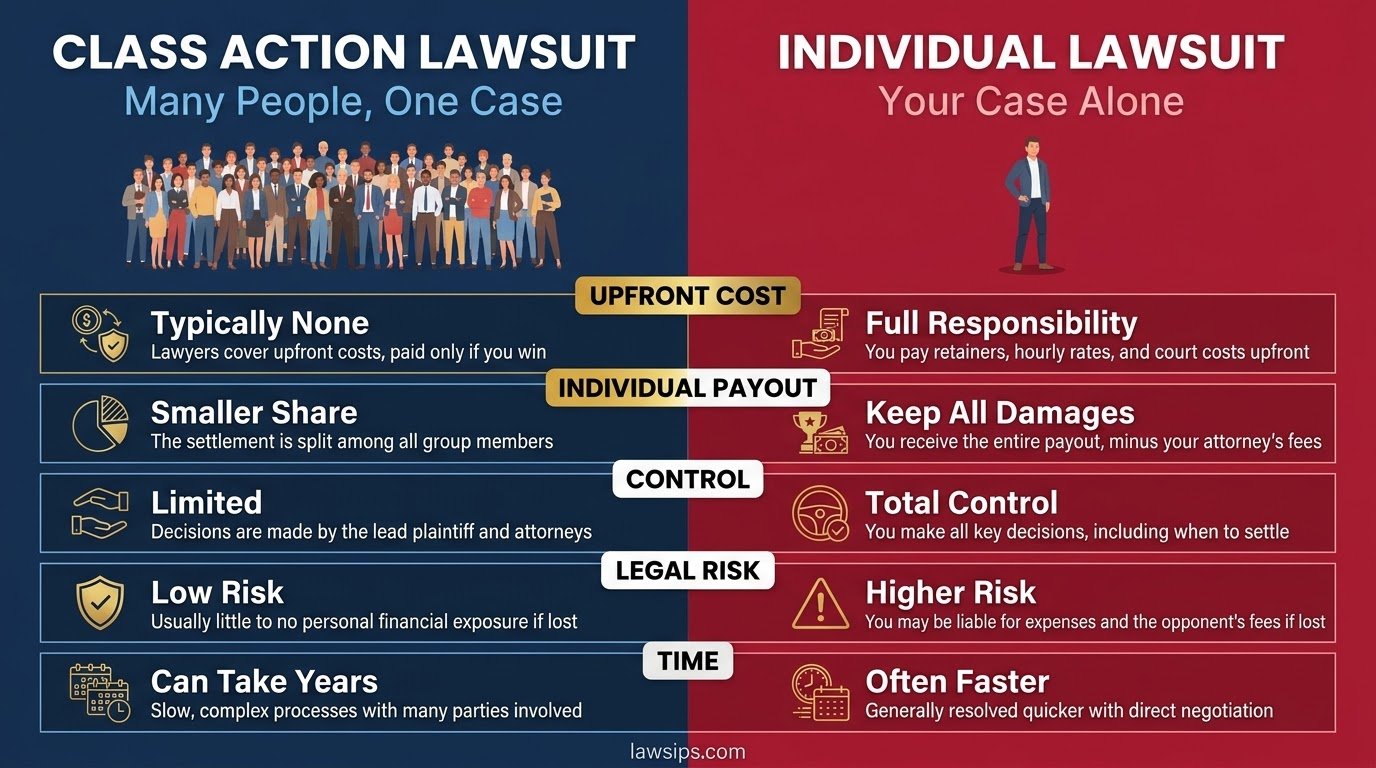
Run these in order, because the later questions only matter while the earlier ones leave both lanes open. Each one maps to a section below.
- How big is your harm next to the class average? A harm near the average is priced fairly by a formula. A harm far above it is subsidizing everyone else.
- How unique is your proof? Identical overcharges need no individual evidence. A drained account or a unique injury needs a file that a class formula cannot see.
- Can you carry the individual lane? Its costs, time, and risk are real: filing, experts, depositions, and the possibility of recovering nothing.
- How much do you value control? In the individual lane you choose the lawyer and accept or reject every offer. In the class lane you hold three deadline bound levers, not the wheel.
- Do you actually have a choice? Opt out rights, three separate deadlines, and your contract’s arbitration terms decide this before your preferences get a vote.
The Master Comparison
|
Factor |
Class action |
Individual lawsuit |
|---|---|---|
|
Who is covered |
Everyone in the class definition who does not opt out |
You alone |
|
Who runs the case |
Class counsel and lead plaintiffs |
You and your own lawyer |
|
Upfront cost to you |
None |
Filing fees and case costs, often advanced by counsel |
|
Lawyer pay |
Court approved percentage of the fund |
Your contingency or hourly agreement |
|
Payout basis |
Formula, tier, or pro rata share |
Your own documented damages |
|
Control over settlement |
None directly; object or opt out by deadline |
You accept, reject, or counter |
|
Your time burden |
Minimal; a claim form at most |
Depositions, records, hearings, possibly trial |
|
Timeline |
Commonly years, with certification and approval stages |
Months to years, court and case dependent |
|
If the case loses |
You are bound; no second suit on the claim |
You bear the loss and the costs |
|
Appeal rights |
Limited; objectors may appeal in some cases |
Full rights on your own judgment |
|
Best fit |
Small, similar, widely shared harms |
Large, unique, well documented harms |
|
Worst fit |
Outliers with severe individual losses |
Harms too small to fund a case |
No row in that table is the decision by itself. Read it through the five questions, with your own numbers in place of the general words.
How the Class Lane Works
A class action begins when named plaintiffs file on behalf of a proposed class. It becomes a real class action only when a court certifies it.
OpenClassActions’ glossary entry on class actions states the test plainly. Under Rule 23(a), plaintiffs must show numerosity, commonality, typicality, and adequacy of representation.
Damages classes must also satisfy Rule 23(b)(3). Common questions must predominate over individual ones, and a class action must be the superior way to resolve the dispute.
Written from the defense side, the Legal500 analysis of class action certification treats certification as two hurdles for the same reason. It is the pivotal battle: many cases settle soon after a class is certified.
The Notice and Its Three Deadlines
Once a class is certified or a settlement is proposed, members receive a court approved notice. It defines the class, describes the case, and carries three different dates.
|
Date in the notice |
What it controls |
What happens if you miss it |
|---|---|---|
|
Claim deadline |
Filing for your share of a settlement |
You receive nothing from the fund |
|
Opt out deadline |
Leaving the class to sue on your own |
You stay in and are bound |
|
Objection deadline |
Asking the court to reject or improve a deal |
The deal is judged without your objection |
The same mechanics are walked through in the Compens.ai guide to participating in a class action, which puts typical opt out windows at roughly 60 to 120 days from notice. Treat that as a reported range; the date printed in your notice controls.
Our own explainer on how to join a class action lawsuit covers the joining side of the same machinery. In a damages class you are usually already in unless you act, which surprises most first time readers.
The Binding Effect
Staying in a class means accepting its result either way. Win, and you share the recovery by formula; lose, and the judgment bars your own suit on the same claim.
Lawyers call that bar res judicata, and the Simple Lawyer’s plain English explanation of class actions explains it in plain terms. If the case loses, you cannot sue the same defendant again for the same claim.
That binding downside is the real price of the class lane’s convenience. It is also why the opt out decision deserves care while the window is open, not after it closes.
How the Individual Lane Works
An individual lawsuit is your case: your lawyer, your evidence, your decisions. You file a complaint, the case moves through discovery, and it settles or goes to trial on your facts alone.
The control argument is the lane’s core. Gordon, Wolf and Carney’s case for suing independently, a firm that represents individual plaintiffs, puts it directly: you are in the driver’s seat on whether to settle or go to court.
Read that source as advocacy, because it is. The underlying fact is still structural: in an individual case, no settlement binds you unless you sign it.
What the Individual Lane Costs
Costs are the lane’s gate. Filing fees, service, expert witnesses, and deposition transcripts are your case’s expenses, whether advanced by your lawyer or billed as they arise.
Most individual injury and consumer cases run on contingency, commonly around a third of the recovery and sometimes more if the case reaches trial, as retainer agreements in this field generally describe.
That percentage buys alignment, not certainty. Lose, and the usual result is no recovery after months or years of effort, which is the risk the class lane exists to spread.
The Proof Burden Is Personal
In a class case, common proof carries everyone: the same policy, the same defect, the same overcharge. Your individual file matters mainly at the claiming stage.
In an individual case, your file is the case. Documents, records, receipts, communications, and expert support must tie the defendant’s conduct to your specific losses.
That burden is why question two matters so much. A strong, unique record is wasted inside an average based formula, and a thin record starves in a lane with no one to carry it.
When You Have No Choice
Question five exists because three structures can erase the choice entirely. Check them before any strategy discussion, because each one rewrites the rest of this page.
Mandatory Classes
Classes certified under Rule 23(b)(1) or (b)(2) generally carry no opt out right. The (b)(2) category covers injunctive and declaratory relief, common in civil rights cases, where the remedy is indivisible.
If your notice offers no exclusion option, that is usually why. Your levers in such a case are objection and participation, not exit.
Wage Cases Run Backwards
Federal wage claims under the Fair Labor Standards Act proceed as collective actions, and nobody is in until they file a written consent. It is an opt in system wearing similar clothes.
Miss the consent and you are simply not part of the case. Your own claim still exists, on its own limitations clock, for you to pursue individually if you choose.
Arbitration Clauses and Class Waivers
Many consumer and employment contracts require individual arbitration and waive class proceedings, and US courts generally enforce those waivers. A waiver can close both court lanes at once.
No class action, and no court lawsuit either: your claim routes into private arbitration instead. Checking your contract’s dispute terms is step zero, before deadlines or damages.
The Third Lanes
The binary in the keyword hides two further lanes. For many readers, one of them fits better than either headline option.
Small Claims Court
Small claims courts hear individual cases below a state set dollar limit, with simplified procedure, low filing fees, and usually no lawyer required.
For a provable small harm with an identifiable defendant, that lane can beat waiting years inside a class for a similar amount. Its limits are the cap, limited discovery, and your own time.
MDL and Mass Torts
A mass tort, usually consolidated as a multidistrict litigation, keeps every claim individual. Cases share pretrial work, bellwether trials test values, and each outcome turns on its own injury and proof.
Serious injury litigation runs this way for a reason. Harms that differ person to person break the commonality a class action needs, so the system gives them a lane built for differences.
Asbestos.com’s comparison of mesothelioma class actions and individual suits makes the point concretely for mesothelioma. Individual suits are the norm there, because one plaintiff’s exposure and disease are rarely typical of anyone else’s.
Three Scenarios
Scenario one: the 60 dollar overcharge. A subscription service overcharged two million customers by small amounts. No individual case can fund itself, and small claims would return the fee at best.
The class lane is the only economics that work. Stay in, file the claim, and let the aggregate do what your 60 dollars cannot, which is exactly the design.
Scenario two: the drained account. A data breach victim lost thousands to identity theft, with records of every dollar and hour spent repairing the damage.
Inside the class, that file earns a base tier payment unless documented tiers exist. Individually, the same records are the case, and the comparison deserves a lawyer’s evaluation before the opt out date.
Scenario three: the unique injury. A patient suffered a rare complication from a widely used product, with medical proof unlike the typical claim.
Class formulas price the average injury, and injury classes often fail certification on individual causation anyway. The realistic lanes are an individual suit or an MDL, not a class average.
Running Your Own Numbers
Abstract pros and cons persuade nobody for long. The decision sharpens when you run one claim, your claim, through both lanes with honest placeholders.
Take a documented loss of 4,000 dollars from a data breach: fraudulent charges reversed late, hours of remediation, and a paid monitoring year. The figures below are illustrative, labeled as such, and built to be replaced with your own.
Inside the class, that file earns whatever the settlement’s tiers allow. If a documented tier exists, the records matter; if the settlement pays a flat base amount, the same records earn nothing extra.
Individually, the claim is the whole case. A contingency fee near a third, plus costs, comes out of any recovery, and the defendant’s willingness to settle a single documented claim decides most of the outcome.
|
The same 4,000 dollar loss |
Class lane |
Individual lane |
|---|---|---|
|
What your records earn |
Base payment, or a documented tier if one exists |
The full measure of the claim |
|
What comes off the top |
Fund level fees and costs, shared by all |
Your fee percentage and your case costs |
|
Your realistic range |
Set by the settlement formula |
Zero if you lose, up to your proven loss if you win |
|
Your effort |
One claim form |
Months of process, possibly a deposition |
|
Your deadline pressure |
Claim and opt out dates in the notice |
Your own limitations clock |
Now run the mirror image: a 40 dollar overcharge with no records beyond a statement line. The individual column collapses, because no fee structure makes that case rational to file.
The class column barely changes. That asymmetry, tested at both ends of the harm scale, is the whole decision in miniature, and it is why averages mislead outliers in both directions.
Mistakes That Close Doors
Mistake one: the drawer notice. The single most common failure in this topic is a notice ignored until every date inside it has passed. Calendar the earliest deadline the day the notice arrives.
Mistake two: deciding by the estimated check alone. A small class payment is the right answer for a small harm. Compare it against your documented damages, not against the fund headline.
Mistake three: assuming a choice exists. Mandatory classes, opt in wage cases, and arbitration waivers each change the menu. Confirm which structure you are in before weighing preferences.
Mistake four: opting out on impulse. Exclusion is irrevocable in practice and starts your own clock, costs, and burden. It rewards arithmetic and punishes gestures.
Mistake five: waiting out the limitations clock. Class pendency generally tolls limitations for members under the American Pipe rule in federal practice, but tolling ends and state rules vary. Never let a deadline rest on a summary.
Frequently Asked Questions
What is the difference between a class action lawsuit and an individual lawsuit?
A class action resolves many similar claims in one case whose result binds every member who does not opt out. An individual lawsuit resolves only your claim, under your control, for your own damages.
Everything else in this comparison (cost, payout, time, proof, and risk) follows from that single structural difference.
Which is better, a class action or an individual lawsuit?
Neither in general; each fits a different fact pattern. Class actions fit small, similar harms shared by many people, where no individual claim could fund a lawsuit.
Individual lawsuits fit harms that are large, unique, or worth far more than the class average. The five questions on this page sort your facts into the right lane.
What are the pros of a class action lawsuit?
No upfront cost, because counsel fronts the case and is paid a court approved percentage of any recovery. Minimal personal involvement for ordinary members.
Access matters most: claims worth 50 dollars get litigated at all. A certified class also concentrates a defendant’s exposure in a way that settles cases individual claims cannot move.
What are the cons of a class action lawsuit?
Small individual payouts, because the net fund divides among all claimants. Almost no control: class counsel and lead plaintiffs run the case, and members cannot veto a settlement.
Staying in also binds you to the result, win or lose, and surrenders your right to sue separately. Certification, approval, and appeals commonly take years.
What are the pros of an individual lawsuit?
Control: you choose your lawyer, your strategy, and whether to accept any settlement. Damages are measured on your losses, not averaged across a class.
A single claim can also move faster than a certified class, court permitting. Your settlement decisions stay private, and you hold full appeal rights on your own judgment.
What are the cons of an individual lawsuit?
Cost and risk are yours: filing fees, expert costs, and your lawyer’s percentage come out of your case, and losing can mean recovering nothing after real spend.
The effort is personal too: depositions, document production, possibly trial. Small harms cannot fund the lane at all, and your statute of limitations is your own responsibility.
How do I know if I am in a class action?
By the class definition in the court approved notice: it describes who qualifies by dates, product, account, employment, or exposure.
Notices arrive by mail or email, or by publication where members cannot be identified. Settlement trackers and the court docket can confirm whether a case exists and whether its definition covers you.
What happens if I do nothing when I get a class action notice?
In a Rule 23(b)(3) damages class, doing nothing keeps you in. You stay eligible to claim a share of any settlement, and you are bound by the result, including a loss or a settlement you dislike.
You also give up the right to sue separately over the same harm. Doing nothing is a decision, and the deadlines make it one.
What does opting out of a class action mean?
Opting out, formally requesting exclusion, removes you from the class before the deadline in the notice. You receive nothing from the class settlement or judgment.
You keep the right to pursue your own lawsuit, at your own cost and risk, under your claim’s statute of limitations. The exclusion must follow the notice’s instructions exactly and arrive on time.
When should I opt out of a class action?
Consider it when your individual damages are large next to the likely class payment, your proof is strong and specific, and you can fund or find counsel for your own case.
Institutional investors in securities cases opt out for exactly this arithmetic. It is deadline bound and consequential, so get an evaluation from your own lawyer first.
What is the opt out deadline and what if I miss it?
The deadline is printed in the class notice and on the official settlement site. One participation guide puts typical windows at roughly 60 to 120 days from notice; your notice’s date controls.
Deadlines are strictly enforced. Miss it, and you stay in the class and are bound, with late exclusions granted only in rare circumstances.
Can I sue individually after a class action settles?
Only if you opted out in time. Members who stayed in released their individual claims in the settlement, and the judgment bars re-litigating the same claim under res judicata.
If the case is still pending and the opt out window is open, the path exists. Once the window closes, it generally does not, however the settlement turns out.
Do I have to pay anything to be in a class action?
No upfront payment. Class counsel takes a court approved percentage of any recovery, plus costs, all paid from the common fund before distribution.
Members who never claim owe nothing. Your real costs are time, and the rights you surrender by staying in, which is why the decision deserves the five questions rather than a shrug.
How much do lawyers charge for an individual lawsuit?
Individual injury and consumer cases commonly run on contingency, often around a third of the recovery and sometimes more if the case reaches trial, as retainer agreements in this field generally describe.
Hourly and hybrid arrangements exist for other claim types, and costs may be advanced or billed. Your written agreement sets the number, so compare it before signing.
Why are class action payouts so much smaller?
Arithmetic, not betrayal. The fund is what remains after court approved fees (typically 25 to 33 percent in consumer cases) and administration costs, divided pro rata among valid claims.
A class of millions turns even a huge fund into small checks. An individual plaintiff divides nothing: the recovery is measured on their damages alone, minus their own fee and costs. Our breakdown of settlement payout per person shows the math across real cases.
How long does each type of lawsuit take?
Class actions commonly take years from filing through certification, notice, settlement approval, and appeals. That is the honest range, not a promise.
Individual cases vary from months for small claims and quick settlements to years for contested litigation. A single claim can move faster because there is no certification battle or class wide notice stage.
Who controls a class action lawsuit?
Class counsel runs the litigation, and the lead plaintiffs act for the group under court supervision. Ordinary members control almost nothing day to day.
Their levers are the three deadline bound choices in the notice: claim, object, or opt out. The court is the backstop, reviewing certification, fees, and any settlement for fairness to absent members.
Who are lead plaintiffs and do they get more?
Lead plaintiffs are the named class members whose claims represent the group. They take on depositions, document production, and public exposure.
Courts may approve a modest service award from the fund in recognition. They do not receive a jackpot or a different damages measure; their underlying claim is valued like everyone else’s.
Can I object to a class action settlement instead of opting out?
Yes. Members who stay in may file a written objection by the objection deadline, and the court weighs objections at the fairness hearing.
Objecting keeps you in the class and bound by the outcome, while asking the court to reject or improve the deal. The notice states the objection procedure exactly, so follow it line by line.
What is class certification and why does it matter?
Certification is the court’s decision that a case may proceed as a class action at all. Rule 23(a) requires numerosity, commonality, typicality, and adequacy.
Damages classes must also satisfy Rule 23(b)(3): common questions predominate, and the class route is superior. Many cases settle soon after certification is granted, and denied cases often end or fragment into individual suits.
What if the class action loses? Can I sue on my own then?
No, not over the same claim against the same defendant. Members who stayed in are bound by the judgment, favorable or not, under res judicata.
That binding downside is the real price of the class lane’s convenience. It is also the strongest argument for evaluating an opt out while the window is open, if your individual claim is substantial.
What if my damages are much larger than the rest of the class?
That is the classic opt out profile. A class settlement pays by formula, tier, or grid built on the average claim, and an outlier with documented losses far above the average is served worst by it.
Get your damages valued individually before the deadline. The comparison is only possible while both lanes are still open.
What if my claim is very small?
Then the class lane, or small claims court, is usually the only economics that work. A 75 dollar overcharge cannot fund depositions and experts; multiplied by a million customers, it funds a class action comfortably.
That is the negative value claim problem class actions exist to solve. If no class exists, a small claims filing or an agency complaint may be the realistic lane.
What is small claims court and when does it beat both lanes?
Small claims courts hear individual cases below a state set dollar limit, with simplified procedure, low filing fees, and usually no lawyer required.
For a provable small harm with an identifiable defendant, it can be faster and cheaper than waiting years inside a class. Its limits are the cap, limited discovery, and your own time. Check your state’s rules locally.
What is the difference between a class action and an MDL or mass tort?
A class action binds one certified class to one result. A mass tort, usually consolidated as an MDL, keeps every plaintiff’s claim individual.
MDL cases share pretrial work, bellwether trials test values, and each outcome depends on its own injury and proof. Serious injury litigation usually runs as an MDL for exactly that reason: the harms are too individual for one formula.
Why are injury cases rarely class actions?
Because injury severity, causation, and medical history differ person to person, which breaks the commonality and predominance a class needs.
Asbestos is the standing example: mesothelioma practice treats individual suits as the norm because one plaintiff’s exposure and disease are rarely typical of others. Economic claims, where the same act harmed everyone the same way, are the class lane’s natural home.
What is an FLSA collective action and how is joining different?
Federal wage claims under the Fair Labor Standards Act proceed as collective actions under 29 USC 216(b), and they work backwards from class actions.
Nobody is in until they file a written consent: it is an opt in system. Miss the consent and you are not part of the case, though your own claim and its limitations clock remain yours to pursue.
Are there class actions where I cannot opt out?
Yes. Classes certified under Rule 23(b)(1) or (b)(2) generally carry no opt out right, because the relief is indivisible.
The (b)(2) category covers injunctive and declaratory relief, common in civil rights cases. If your notice offers no exclusion option, that is usually why. Your levers in such cases are objection and participation, not exit.
What is an arbitration clause or class action waiver and why does it matter?
Many consumer and employment contracts require individual arbitration and waive class proceedings, and US courts generally enforce those waivers.
A waiver can close both lanes at once: no class action, and your individual claim routed into private arbitration instead of court. Checking your contract’s dispute terms is step zero in any lane decision.
Does my statute of limitations keep running while a class action is pending?
Generally, filing a class action tolls the limitations period for members’ individual claims while the case is pending, under the American Pipe rule in federal practice.
Tolling typically ends when certification is denied or a member opts out. State rules and claim types vary, so treat tolling as a doctrine to confirm with a lawyer, never as a safety net to assume.
Can I stay in the class and also hire my own lawyer?
Members may appear through their own counsel, as notices state, and people with large claims sometimes do so to monitor the case or prepare an objection.
Your own lawyer cannot take over the class case or file you a separate suit while you remain a member, and their fee is yours. For small claims it is unnecessary; for outliers it can be money well spent.
What evidence do I need for an individual lawsuit?
Proof of your own harm: documents, records, receipts, communications, and, where the claim needs it, expert support tying the defendant’s conduct to your losses.
The individual lane’s burden is personal; no common proof carries you. The strength and uniqueness of that file is one of the five decision questions, because a strong individual record is wasted inside an average based formula.
Will an individual lawsuit give me a bigger payout?
It gives you a bigger ceiling, not a bigger promise. Your recovery is measured on your damages alone, without dilution, and strong cases settle or win amounts no class formula would pay.
It also carries the floor: lose, and you may recover nothing after your own time and costs. Class membership trades that spread for a small, comparatively predictable share. See how the two payout shapes compare in class action lawsuit settlements.
What are the risks of suing individually?
Financial risk (costs, and in some arrangements or fee shifting statutes, exposure beyond your own spend), time and stress, and collectability: a judgment against an insolvent defendant pays nothing.
Limitations risk completes the list if the clock has run. None of this means never sue; all of it belongs in the decision before the opt out deadline closes the alternative.
How do settlements work differently in the two lanes?
A class settlement is one deal for the whole class, needing court approval after notice and a fairness hearing, binding everyone who stayed in.
An individual settlement is a private contract between you and the defendant: you can accept, reject, or counter, and no court approves the amount. Control over that decision is the individual lane’s core advantage, and the class lane’s core surrender.
Can a defendant prefer one lane over the other?
Defendants often prefer a class settlement because it buys global peace: one payment ends the claims of everyone who did not opt out. That preference is leverage for class counsel.
Conversely, defendants may fight certification hard to avoid that concentrated exposure. The incentives explain settlement timing in both lanes: cases often settle after certification or key rulings clarify the risk.
What happens if a class is not certified?
The case cannot proceed as a class action. It may end, settle on individual terms, or fragment, with each would be member free, and forced, to pursue their own claim.
Any recovery then depends on individual filings, limitations periods, and any tolling. Certification is the class lane’s existential gate, and watching its outcome is the first thing a notice holder should track.
Should I start a class action myself?
You can: a person with a typical claim can file as a proposed class representative, and class counsel evaluates whether the Rule 23 requirements are plausibly met and the economics work.
Expect real involvement (depositions, decisions, publicity) in exchange for steering the case. Most people join existing cases; the lead plaintiff route suits those whose claim is strong, typical, and early.
How do I decide before the opt out deadline?
Run the five questions in order: harm size versus the class average, uniqueness of proof, capacity for cost and risk, value of control, and whether a choice exists at all.
If the answers split, a lawyer’s evaluation of your specific claim is the tiebreaker. Either way, the evaluation must happen before the deadline, because afterwards only one lane remains. The mechanics of staying in are covered in how to join a class action lawsuit.
Is this page legal advice for my situation?
No. This page is general information comparing two legal structures, published by an information site, and it cannot see your claim type, state law, contract terms, or deadlines.
For a decision with a deadline inside it, consult a licensed attorney in your state promptly. The cost of one evaluation is small next to a forfeited right.
What should I do first if I just received a class action notice?
Read the notice for its three dates: the claim deadline, the opt out deadline, and the objection deadline, which are usually different. Check the class definition actually covers you.
Then run the five questions while every lane is still open, and calendar the earliest deadline today. The worst outcomes in this topic come from notices that sat in drawers past their dates.
Can I join a class action after it has already settled?
Membership is not something you join late; you either fit the class definition or you do not. If you are a member, a settled case usually leaves one action: file a claim by the claim deadline.
Our guide to how to file a claim for settlement covers that filing. If the claim deadline has also passed, the settlement is closed to you, and any remaining path is an individual claim question for a lawyer.
Conclusion
Class action lawsuit vs individual lawsuit resolves into five questions and three dates. Answer the questions honestly, respect the dates absolutely, and the lane usually chooses itself.
Small, shared harms belong in the lane built for them. Large, unique, documented harms deserve a lane of their own, and the comparison is only possible while both are open.
For the money side of the same machinery, our guide to settlement payout per person shows what each lane tends to return. Current cases with open windows sit in open class action settlements and class action settlements you can claim.
And for the year’s biggest examples of both structures at work, class action settlements 2026 tracks the landmark settlements. Bring the five questions with you, and read every notice the day it arrives.

Dilawar is a dedicated writer and contributor at Lawsips.com, focusing on legal information, business law, consumer rights, legal awareness, and everyday legal matters. He is passionate about simplifying complex legal topics and providing readers with clear, practical, and easy-to-understand information. His goal is to help readers stay informed about legal developments, understand their rights, and make better decisions through informative and well-researched articles.