
Slip and Fall Attorney: The Notice Test, the Deadlines, the Fees, and How to Choose One

Slip and fall attorney searches start with the same misunderstanding: the fall itself is not the case. What a good attorney actually sells is proof that the property owner knew about the hazard, or should have found it, before you were hurt.
That single element, called notice, decides most claims. The evidence for it lives in surveillance video, cleaning logs, and complaint records, and much of it disappears within days.
This page runs in three parts: the notice test your case must pass, the clock with its three separate deadlines, and the vetting, meaning fees, red flags, and how to check a lawyer out.
One boundary first. This page sits inside the LawSips legal guides library, an information library. Nothing here is legal advice, no lawyer here is offering to take your case, and fee and deadline figures carry their sources so you can verify them.
The Short Answer: What You Are Really Hiring
|
Question |
The honest answer |
|---|---|
|
What does the attorney prove? |
Duty, breach, causation, damages, and above all that the owner had notice of the hazard |
|
What does it cost upfront? |
Normally nothing: contingency means a percentage of the recovery only |
|
What percentage? |
Commonly about a third before suit, up to 40 percent if the case is litigated, per firms’ own published terms |
|
What kills cases fastest? |
The government claim notice (30 to 180 days) and overwritten surveillance video |
|
Where do you verify a lawyer? |
Your state bar’s official license and discipline lookup |
Hold that table against any advertisement. A firm that cannot explain the notice problem in your case during a free consultation has told you something important about itself.
The Notice Test: The Element Your Case Turns On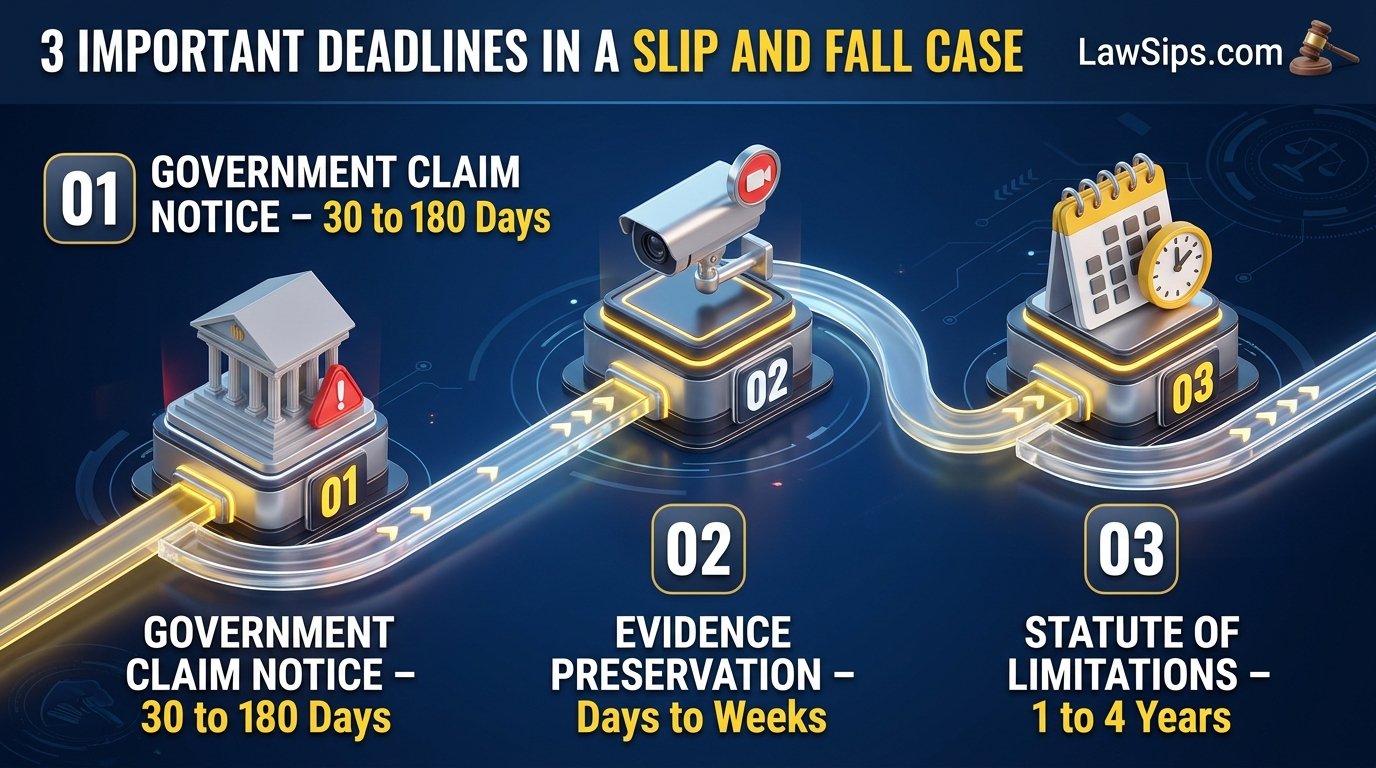
Every slip and fall claim needs four elements: a duty of care, a breach of it, causation, and damages. Three of them are usually straightforward after a real fall; the fight concentrates on what the owner knew.
Notice comes in three forms. Created notice means the owner or an employee made the hazard: a leaking freezer case, a freshly mopped floor left unsigned, stock left in an aisle.
Actual notice means the owner really knew: a customer complaint, an employee report, a maintenance request that sat ignored. It is the strongest position a claimant can hold.
Constructive notice means the hazard lasted long enough, or returned often enough, that a reasonably careful owner inspecting the property would have found and fixed it. Most store cases live here, and here is where evidence quality rules.
The contrast is best taught by LegalClarity’s average settlement analysis, which makes it vivid: video of employees walking past a puddle for an hour builds a powerful case, while a spill thirty seconds old is nearly unwinnable.
Nevada’s courts framed the doctrine in Sprague v. Lucky Stores, a grocery case cited on one Las Vegas firm’s slip and fall page alongside the state’s statutes. The question is never whether the floor was wet, but what the store’s own systems should have caught.
The Mode of Operation Exception
Self-service businesses get a special rule in a number of states. When the way a store operates foreseeably creates recurring hazards, produce dropped at displays, drinks spilled at self-serve stations, the claimant may not have to prove exactly how long one spill sat there.
The focus shifts to whether the store’s inspection and cleanup system was reasonable. Whether your state applies the rule, and to which hazards, is a case specific question a local lawyer answers at intake.
Who Counts as What: Visitor Status
The duty owed to you depends partly on why you were on the property. Invitees, shoppers and guests a business serves, get the highest duty: inspect, fix, or warn.
Licensees, social guests and others present with permission, are owed warnings about known hidden dangers. Trespassers are owed the least, generally freedom from intentional or reckless harm, with strong exceptions for children around attractive hazards like pools.
A few states have folded these categories into a general reasonableness standard. California states the base duty in Civil Code section 1714, the citation a California firm page in this research leads with.
The Clock: Three Deadlines, Not One
Ask a room of fall victims about deadlines and they name one number, usually wrong. There are three clocks, running at three speeds, and the fastest two get the least advertising.
|
Clock |
What it is |
Typical scale |
|---|---|---|
|
Government claim notice |
Written notice required before suing a public body for a fall on its property |
Often 30 to 180 days |
|
Evidence survival |
Surveillance overwrite cycles, log retention, scene changes |
Days to a few weeks |
|
Statute of limitations |
The deadline to file the lawsuit itself |
Commonly 1 to 4 years by state |
The first clock gets an unusually honest treatment on a Massachusetts firm’s premises liability page, which leads with the warning that one deadline is 30 days. That is a Massachusetts premises claim reality, and the same pattern repeats in tort claims acts across the country.
Statutes of limitation, for contrast, run in years: one year in Louisiana, two in states such as California, Texas, Florida, Nevada, and Indiana, three in New York and Massachusetts, four in Utah. These are general figures; your state’s exact statute controls.
The second clock explains attorney urgency better than any slogan. A preservation letter demanding the video, sweep logs, and incident records goes out in the first days because stores overwrite footage on short cycles, and a case’s notice evidence can die before your bruises fade.
The Fault Map: What Your Own Mistakes Cost You
Insurers defend falls by sharing them: you were looking at your phone, wearing the wrong shoes, walking past a sign. Your state’s fault system converts that argument into arithmetic, in four patterns.
|
System |
Rule |
Where (examples) |
|---|---|---|
|
Pure comparative |
Recovery reduced by your fault percentage, at any level |
California, New York, Florida |
|
Modified comparative, 51 percent bar |
No recovery if you are 51 percent or more at fault |
Nevada, Texas, Illinois (bar at more than 50 percent in IL formulation) |
|
Modified comparative, 50 percent bar |
No recovery at 50 percent or more at fault |
A smaller group of states |
|
Contributory negligence |
Any fault of yours bars recovery entirely |
Maryland, Virginia, North Carolina, Alabama, District of Columbia |
The framework behind these rows is set out in the Legal Information Institute’s comparative negligence entry. The practical translation: a 20 percent fault finding turns a $100,000 case into $80,000 in comparative states, and turns it into zero in contributory ones.
Maryland’s rule gets explained to local readers in exactly those terms on a Maryland firm’s slip and fall page: even 1 percent fault can bar recovery there.
That is why the same fall, with the same injuries, is a different legal object in Baltimore than in Buffalo.
One research warning belongs here. An indexed guide in this topic defines contributory negligence as barring recovery only above 50 percent fault, which is simply wrong; that describes modified comparative negligence. Check any source that blurs the two before trusting its other numbers.
The Defenses You Will Hear
You should have watched where you were going. This is the fault argument in its street clothes, answered by the scene itself: displays are designed to draw the eye up, and a shopper is not negligent for shopping.
The hazard was open and obvious. Sometimes decisive, often not: an owner who should foresee that people will be distracted, or must use the only path past a hazard, can remain liable despite its visibility, and comparative states may only discount it.
We had no idea it was there. This is the notice defense, and it is why your case is built from the store’s own records: logs, schedules, prior complaints, and the hazard’s physical state all testify about what reasonable inspection would have shown.
Your injury is from something else. Causation defense, answered by the medical timeline: same day examination, consistent complaints, and treating records that connect the diagnosis to the fall’s mechanics.
What a Case Is Worth, Honestly
Start with the fact the calculator sites skip: no government agency publishes slip and fall settlement statistics. Every average online is an estimate built from attorney case data or jury verdict databases, and the honest ones say so.
LegalClarity’s average settlement analysis is the honest kind: it puts most settlements between $10,000 and $50,000 as an estimate, with minor sprains settling below that band and fractures with surgery, head injuries, and spinal damage running far above it, sometimes into six or seven figures.
What actually moves your number, in rough order: how strong the notice evidence is, how serious and well documented the injuries are, your medical costs and lost income, your fault share under your state’s system, and the insurance limits available.
Two quieter value items deserve naming. Many property policies carry medical payments coverage, medpay, which pays initial medical bills regardless of fault, usually in small amounts, without any negligence fight at all.
And per person settlement math follows the same waterfall wherever money is divided or deducted, which settlement payout per person explains in the class action context: fees, costs, and liens come out before any net figure exists.
One scale note belongs with the money talk: falls are a mass injury event in the United States, and the CDC’s falls overview documents that about 1 in 4 adults aged 65 and older reports a fall each year.
That volume is why the claims system processes so many of them, and why insurers defend them so routinely.
Why Calculators Cannot Price Your Fall
Online settlement calculators ask for your bills and output a number with decimal confidence. The inputs that actually decide value, the notice evidence’s strength, your state’s fault bar, the available insurance limits, are the ones no form can score.
Two identical fractures, one on hour old video of an ignored spill in a pure comparative state, one on a fresh spill in a contributory state, differ by the entire recovery, not by a percentage point.
Use calculators, if at all, as arithmetic practice for the fee and fault deductions. The valuation itself comes from records, doctrine, and a lawyer who has tried cases in your venue.
What It Costs: The Fee, the Costs, and the Net
Slip and fall attorneys work on contingency: no upfront fee, no hourly billing, and no fee at all if there is no recovery. The percentage is where firms actually differ, and the honest ones publish theirs.
Meesha Moulton’s Las Vegas page states its own terms plainly: 33.33 percent before litigation and 40 percent after a lawsuit is filed. A Utah firm’s FAQ in this research gives the market range as usually 33 to 40 percent.
Treat those as the working band, always confirmed against your own written agreement.
Separate from the fee are case costs: filing fees, medical records, expert witnesses, depositions, investigators. Firms typically advance them and deduct them from the recovery, and on a modest settlement the costs policy can move your net more than a point of fee.
Three questions settle the money before you sign anything:
- What percentage applies at each stage: settlement, after filing, after trial?
- Are costs deducted before or after the fee is calculated, and who pays them if the case is lost?
- What is the firm’s policy on liens, the medical and insurer claims that also wait in line for the recovery?
The filing mechanics behind a formal claim, insurer notices, releases, and disbursement, overlap with how to file a claim for settlement, which walks the settlement claim process end to end.
The First 72 Hours: Evidence That Decides Cases
Hour zero is medical. Get examined the same day; some injuries, concussions and spinal problems among them, declare late, and an early record ties what is found to the fall.
Report the fall before you leave if you possibly can, and ask that an incident report be made. Get a copy, or photograph it; note the name of anyone who refuses.
Photograph everything: the hazard from several angles, the wider scene, your injuries, and your footwear. Get witness names and numbers, because the store will have its witnesses organized before you do.
Keep the shoes and clothing, unwashed and unworn. Insurers argue footwear in nearly every case, and the physical shoes answer better than any description.
Then preserve what you cannot hold. A written demand to keep the surveillance video, sweep logs, and maintenance records, sent within days, is standard attorney work and the practical reason the first consultation should not wait for the weekend to pass.
Two traps close the section. Do not give the insurer a recorded statement before you understand the notice and fault questions it is designed to build, and do not sign a quick release for an early offer while treatment is still unfolding.
At the scene itself, be factual and brief. Say what happened and where, decline to speculate about how long a spill sat there or whether you saw it, and never apologize in ways that get written down as fault admissions.
If staff press you to sign anything beyond the incident report’s factual summary, decline politely and photograph what you are shown instead. Your signature belongs on documents your own lawyer has read, and there will be time for all of them later.
Choosing the Attorney: The Vetting
Verify before you interview. Your state bar’s official lookup confirms the license, standing, and discipline history of any lawyer in minutes. A lawyer who cannot be found there does not get a consultation.
Prefer concentration over advertising. Premises liability is a proof specialty: notice doctrine, store inspection systems, building codes. Ask what share of the lawyer’s practice is injury work and what share of that is premises cases.
Ask who handles your file. At high volume settlement mills, the named attorney markets and case managers rotate; at smaller practices the lawyer you meet runs the case. Neither is automatically wrong, but you should know which you are buying.
Ask about trial, specifically. Most cases settle, but insurers price files by what a jury might do, and a lawyer who files and tries cases when offers are inadequate negotiates from a different position than one who never does.
Use the market’s one generosity: consultations are free nearly everywhere in this field. Two or three of them cost you afternoons and return fee comparisons, strategy differences, and a realistic read of your notice evidence.
Red flags, collected plainly: guaranteed outcomes or dollar promises, pressure to sign today, upfront fees demanded on a contingency case, no written fee agreement, and dismissal of the notice question when you raise it.
Special Cases That Change the Rules
Falls on Government Property
Sidewalks, public buildings, transit property, and public schools add the tort claims act layer: a written notice of claim on a deadline measured in weeks or a few months, before the lawsuit clock even starts.
Identify the owner early; the same sidewalk can belong to a city, a transit agency, or the shop in front of it.
Falls at Work
A fall on the job runs on two tracks. Workers compensation pays medical care and partial wages regardless of fault and bars suing your employer.
But if a third party’s property or negligence caused the fall, a landlord, a cleaning contractor, a delivery site owner, a separate premises claim can run alongside it. our employment lawyer near me guide maps the employment side of that split.
Landlords, Stairs, and Codes
Tenant cases turn on control and complaints: broken stairs, failed lighting, and ice on common walkways, measured against housing and building codes. Your own written maintenance requests are often the actual notice evidence, which is why tenants should make them in writing from the first day.
How a Case Actually Runs: Intake to Resolution
Most claimants picture a courtroom; the real sequence is paperwork with deadlines. Intake screens the case on the notice facts and the clocks, because a case filed after the government notice or the statute has run is not a case at all.
Investigation follows immediately: the preservation letters, the incident report, the logs, the site inspection, and the medical records collection. This stage is where premises cases are quietly won, because evidence quality is set here and rarely improves later.
Treatment and documentation run in parallel, often for months. The claim’s value cannot be honestly assessed until the medical picture stabilizes, which is why responsible lawyers resist early numbers and why early insurer offers exploit the gap.
Demand and negotiation come next: a package presenting the liability evidence, the records, the bills, and the wage proof, followed by rounds of offers. Most valid cases resolve here, at values driven by the notice evidence assembled in stage two.
Suit and litigation are the lever when negotiation undervalues the claim: filing, discovery, depositions, expert work, mediation, and, rarely, trial. The credible willingness to run this stage is priced into every earlier offer, which is the practical content of the vetting questions above.
Stores and the Wet Floor Sign
A warning sign helps the defense; it does not end the case. When was it placed, was it visible from your approach, did it cover the real hazard, and was the hazard something a sign cannot excuse, like a recurring leak or a broken step?
Those questions, not the sign’s existence, decide its weight.
Frequently Asked Questions
What does a slip and fall attorney do?
Builds a premises liability claim: investigates the hazard and the owner’s notice of it, preserves video and sweep logs, documents injuries and losses, negotiates with the insurer, and files suit if the offer is inadequate. The fee comes from a recovery, not upfront.
How much does a slip and fall attorney cost?
Usually nothing upfront. Contingency means a percentage of the recovery, commonly about a third before suit and up to 40 percent if litigated, as firms state in their own terms. Case costs are separate; ask who advances them and how they are repaid.
Do I need a lawyer for a slip and fall?
Not legally, but the claim turns on proving notice, which insurers contest hard, and on deadlines that include very short government notices. Fractures, surgery, disputed fault, or any fall on public property are where an attorney’s evidence and deadline work matters most. Consultations are typically free.
What makes a slip and fall case valid?
Four elements: duty, breach, causation, damages. The contested one is usually notice: the owner created the hazard, actually knew about it, or should have discovered it through reasonable inspection (constructive notice). Without notice, a bad injury on someone’s property is still not a claim.
What is premises liability?
The negligence law holding property owners and occupiers responsible for injuries from unsafe conditions on their property. Slip and fall is its most common claim; negligent security, pool accidents, and falling merchandise are siblings. California states the general duty in Civil Code section 1714.
What is the difference between actual and constructive notice?
Actual notice means the owner really knew: a complaint, an employee report, an ignored maintenance request. Constructive notice means the hazard lasted long enough that reasonable inspection would have caught it. Constructive notice is proved circumstantially, through the hazard’s condition, inspection schedules, and video.
How long do I have to file a slip and fall lawsuit?
Your state’s personal injury statute of limitations, commonly one to four years: one in Louisiana, two in states like California, Texas, Florida, Nevada, and Indiana, three in New York and Massachusetts, four in Utah. Confirm your exact statute; government claims run far faster.
What if I fell on government property?
Tort claims acts require a written notice of claim on short deadlines, often 30 to 180 days, before any lawsuit deadline applies. Missing the notice usually ends the claim entirely.
This is the most time sensitive category of fall case, and identifying the owning agency is step one.
Can I sue if I was partly at fault for my fall?
In most states yes, with a reduction. Pure comparative states reduce by your percentage at any level; modified states bar recovery at 50 or 51 percent fault; contributory jurisdictions (Maryland, Virginia, North Carolina, Alabama, DC) bar recovery at any fault at all.
How much is my slip and fall case worth?
There is no official average: no agency publishes settlement statistics, so online averages are estimates. LegalClarity estimates most settlements between $10,000 and $50,000, with severe injuries far above. Notice strength, medical costs, lost income, fault share, and insurance limits move your number more than any average.
What damages can I recover in a slip and fall case?
Economic: past and future medical bills, lost wages and earning capacity, out of pocket costs. Non-economic: pain and suffering, disability, scarring, loss of enjoyment. Some property policies also carry medpay coverage paying initial bills regardless of fault, separate from a liability recovery.
Will my slip and fall case go to trial?
Most settle. But the credible possibility of trial prices the settlement, because insurers value what a jury might do with the notice evidence. Cases with strong video or ignored complaint records settle better; constructive notice cases are likelier to be litigated.
What should I do right after a slip and fall?
Get medical care, report the fall and ask for an incident report, photograph the hazard, your injuries and your footwear, collect witness names, and keep the shoes unwashed. Then have the surveillance video preserved in writing quickly, because stores overwrite footage on short cycles.
What evidence helps a slip and fall case most?
Surveillance video showing the hazard and its duration, sweep and inspection logs, the incident report, prior complaints about the same hazard, day of photographs, and complete medical records.
Video of staff passing a puddle for an hour is powerful; a spill thirty seconds old is nearly unwinnable.
The store says it has no video. Is my case over?
Not necessarily, but act fast: systems overwrite in days to weeks, and an early written preservation demand creates consequences if footage is destroyed later. Sweep logs, employee testimony, the hazard’s own condition, and prior incident history can still carry the notice proof.
What if there was a wet floor sign?
It helps the defense but does not end the case. Was it placed before your fall, visible from your approach, and covering the actual hazard? And was the hazard something a sign cannot excuse, like a recurring leak or a broken step?
Juries see the whole scene, not just the sign.
Can I sue a grocery store for a fall?
Yes, if the store was negligent: it created the spill, knew of it, or failed to inspect reasonably. Some states apply the mode of operation rule to self-service stores, easing the notice proof where the business model itself creates recurring hazards.
Grocery falls are common and heavily contested.
What is the mode of operation rule?
A doctrine in a number of states for self-service businesses: when the owner’s method of operation foreseeably produces recurring hazards, the claimant need not prove exactly how long the specific hazard existed. The focus shifts to whether the store’s inspection and cleanup system was reasonable.
I fell at work. Is it workers compensation or a slip and fall case?
Often both tracks. Workers compensation covers on the job injuries regardless of fault and bars suing your employer. But if a third party’s property or negligence caused the fall, a landlord, contractor, or site owner, a separate premises claim can proceed alongside the compensation claim.
Can I sue my landlord for a fall in my apartment building?
Tenants regularly do, for conditions the landlord controlled or had a duty to repair: broken stairs and handrails, failed lighting, ice on common walkways, code violations. Your written maintenance requests matter enormously, because they create actual notice. Keep every request in writing.
What if I fell on a sidewalk?
Responsibility varies by city: the adjacent owner, or the city itself, and city claims trigger the short tort claims notice deadlines. Photograph the defect’s size and deterioration, and identify the responsible party quickly, because the clock may be the 30 to 180 day kind.
How long does a slip and fall case take?
Clear liability cases with finished treatment can resolve in months; contested cases needing suit commonly run one to two years or more, driven by treatment duration, negotiation, and court schedules. Settling before the medical picture completes risks undervaluing future care.
Should I give the insurance company a recorded statement?
Generally you are not required to, and adjuster questions are designed to build the fault and notice defenses. Consult a lawyer first; consultations are typically free. If you do speak, stick to verifiable facts and never guess at times, distances, or how long a hazard existed.
The insurance company offered me a quick settlement. Should I take it?
Quick offers arrive before the medical picture exists, and signing a release ends the claim permanently, including for later discovered injuries. Early offers price your uncertainty, not your damages. A lawyer’s review against your records is usually free relative to the gap involved.
What is a contingency fee agreement?
The contract paying the lawyer a stated percentage of any recovery instead of hourly fees, with nothing owed if there is no recovery. It should state the percentage at each stage, who pays and advances costs, and what happens if you change lawyers.
Get it in writing and compare two firms.
What is the difference between attorney fees and case costs?
Fees pay the lawyer’s time: the contingency percentage. Costs are the case’s expenses: filing fees, records, experts, depositions, investigators, usually deducted from the recovery on top of the fee. On a modest settlement, the costs policy can change your net more than a point of percentage.
How do I choose the right slip and fall attorney?
Verify the license and discipline record on your state bar’s lookup. Prefer lawyers concentrated in injury and premises work over generalists and settlement mills.
Interview at least two: ask who handles your case, the fee and cost terms, how often they file suit, and how they will preserve your video and logs in the first two weeks.
What are red flags when hiring a slip and fall lawyer?
Guaranteed outcomes or dollar promises, pressure to sign immediately, upfront fees on a contingency case, no written fee agreement, a lawyer you never meet while case managers rotate, and refusal to engage with the notice problem in your case.
Huge advertised recovery totals deserve one follow-up question: how many were premises cases?
Do slip and fall lawyers offer free consultations?
Yes, near universally: every firm page in this research leads with a free consultation or case evaluation, because contingency practice screens cases at intake. Use it.
Two or three consultations cost only time and return fee comparisons, strategy differences, and a realistic read on your notice evidence.
What should I bring to a slip and fall consultation?
The incident report if you have it, photographs, witness names, medical records and bills so far, pay records if you missed work, any letters from the property or its insurer, a written timeline, and the shoes you wore.
Anything showing how long the hazard existed is gold, because notice is the lawyer’s first question.
Can a slip and fall case be settled without a lawsuit?
Yes, most are. A documented demand package, liability evidence, medical records, bills, and wage proof, followed by negotiation resolves the majority of valid claims.
Filing suit is the lever when the insurer disputes notice or fault or undervalues damages, and lawyers who file when needed negotiate differently.
What is an incident report and why does it matter?
The property’s own record of your fall, made by staff at the time: location, condition, witnesses, sometimes admissions about the hazard. It anchors the facts before memories shift.
Get a copy or photograph it; if the property refuses, note who refused and when, and let your lawyer obtain it in the claim process.
I fell but was not hurt badly. Do I still have a case?
Minor injury claims exist but are worth modest amounts, since damages drive value. Get checked medically anyway: concussions and spinal injuries can declare late, and an early record protects your health and any later claim.
If bills are small, the property’s medpay coverage may handle them without a negligence fight.
What if the fall aggravated an old injury?
You can still recover for the aggravation: defendants take claimants as they find them, and a pre-existing condition made worse is compensable for the worsening.
Records before and after the fall become central, so clear physician documentation of the change matters enormously against the insurer’s everything is old argument.
Can I sue for a fall on ice or snow?
Yes, with variations: some jurisdictions apply a natural accumulation rule limiting liability for natural snow and ice, while negligent clearing, unnatural accumulations, and code required removal create liability. Timing evidence, when the storm ended and when clearing happened, plus local removal ordinances, decide these cases.
What if my child was injured in a fall?
Children’s claims proceed through a parent or guardian, settlements usually need court approval, and deadlines for minors are tolled in many states until majority, with exceptions. Do not rely on tolling: government notice deadlines can still run, and evidence disappears on the adult schedule.
Can I recover if I was trespassing?
It is harder: owners owe trespassers a much lower duty, generally freedom from intentional or reckless harm, with important exceptions for children around attractive hazards like pools and construction sites. A few states have replaced the status categories with a general reasonableness standard altogether.
What is the open and obvious defense?
The owner’s argument that the hazard was so apparent a reasonable person would have avoided it.
It is not absolute: if the owner should have foreseen distraction, or that people would encounter the hazard anyway along a required path, liability can remain, and in comparative states obviousness may only reduce recovery.
How are pain and suffering calculated in a slip and fall?
There is no formula with legal force. Insurers and lawyers argue from severity, treatment length and invasiveness, permanence, and daily life impact, sometimes using medical cost multipliers as negotiation shorthand. Documentation decides: consistent treatment records and activity limitations outweigh any multiplier table or online calculator.
What role does surveillance video play?
Often the decisive one. Video shows the hazard’s origin and duration (constructive notice), the fall’s mechanics (causation), your conduct (fault), and whether staff inspected as claimed. It is also perishable: stores overwrite systems quickly, so immediate written preservation demands are standard attorney work.
A family member died from a fall. What claims exist?
A wrongful death claim by the estate or statutory beneficiaries, plus a survival claim for the decedent’s own damages before death. Falls are a leading cause of injury death for older adults in CDC data.
Deadlines still apply, including short government notices where public property is involved.
Is this legal advice for my slip and fall?
No. This page is general information about how slip and fall claims and attorney hiring work in the United States, drawn from public legal sources. Your state’s statute, fault rule, and notice deadlines, applied to your facts, are questions for a licensed attorney in your state.
Conclusion
Slip and fall attorney is a search for proof, not for a slogan.
The claims that pay are the ones where notice can be shown, the deadlines that matter most are the quiet ones measured in days, and the fee you agree to is a written percentage, not a promise.
Run the vetting before the evidence runs out: verify the license, compare two consultations, and ask each lawyer to explain your notice problem back to you. The one who can is the one the search was for.

Dilawar is a dedicated writer and contributor at Lawsips.com, focusing on legal information, business law, consumer rights, legal awareness, and everyday legal matters. He is passionate about simplifying complex legal topics and providing readers with clear, practical, and easy-to-understand information. His goal is to help readers stay informed about legal developments, understand their rights, and make better decisions through informative and well-researched articles.