
When Will My Settlement Pay? The Two Clocks Behind Every Payout Date

When will settlement pay is really two questions, and mixing them up is why most answers online feel wrong. If you filed a claim in a class action, you are waiting on a court, and the honest unit is months.
If you settled your own case with a lawyer, you are waiting on paperwork, and the honest unit is weeks.
Class action claimants typically receive money 3 to 18 months after the claim deadline, depending on where the case sits among five gates: validation, approval, the appeal window, the effective date, and distribution. Individual settlements typically land 4 to 8 weeks after the release is signed.
Nobody legitimate can give you a personal date today, and anyone who does is guessing or selling.
What you can get is better: your case’s current gate, what normal looks like at that gate, and the document, the settlement agreement’s payment clause, that holds your case’s real number.
This page runs both clocks in the open, with the rules that drive them and the ranges reported by the administrators’ and firms’ own guides labelled as what they are. General information only, not legal advice, researched in November 2026.
First, Which Clock Are You On: Class Action or Your Own Case
Every settlement wait runs on one of two clocks. Find yours before reading any number below, because each clock’s numbers are nonsense on the other.
|
Class action clock |
Individual case clock |
|
|---|---|---|
|
Who you are |
One claimant among thousands or millions |
The plaintiff in your own case |
|
Who controls the wait |
A federal or state court, then an administrator |
Your lawyer, the insurer, and lienholders |
|
What starts the clock |
The settlement’s effective date |
Your signed release |
|
Typical total |
About 3 to 18 months after the claim deadline |
About 4 to 8 weeks after signing |
|
Who you call |
The settlement administrator |
Your lawyer’s office |
|
Payment form |
Check or digital payment from the administrator |
Disbursement from a trust account |
Class action markers: you received a notice, filed a proof of claim, and have a claim confirmation number. Your money depends on a judge, an appeal window, and thousands of other people’s claims being validated beside yours.
Individual markers: you signed a settlement agreement and a release, you have your own attorney, and the defendant is usually an insurance company. No judge approves your deal, no strangers share the fund, and liens, not courts, cause most delays.
Readers land on the wrong clock constantly: a class member expecting six weeks because a law firm’s page said so, or an injury client bracing for a year because a class action guide said so. The fork above ends that in ten seconds.
The Class Action Clock: Five Gates Between Filing and Money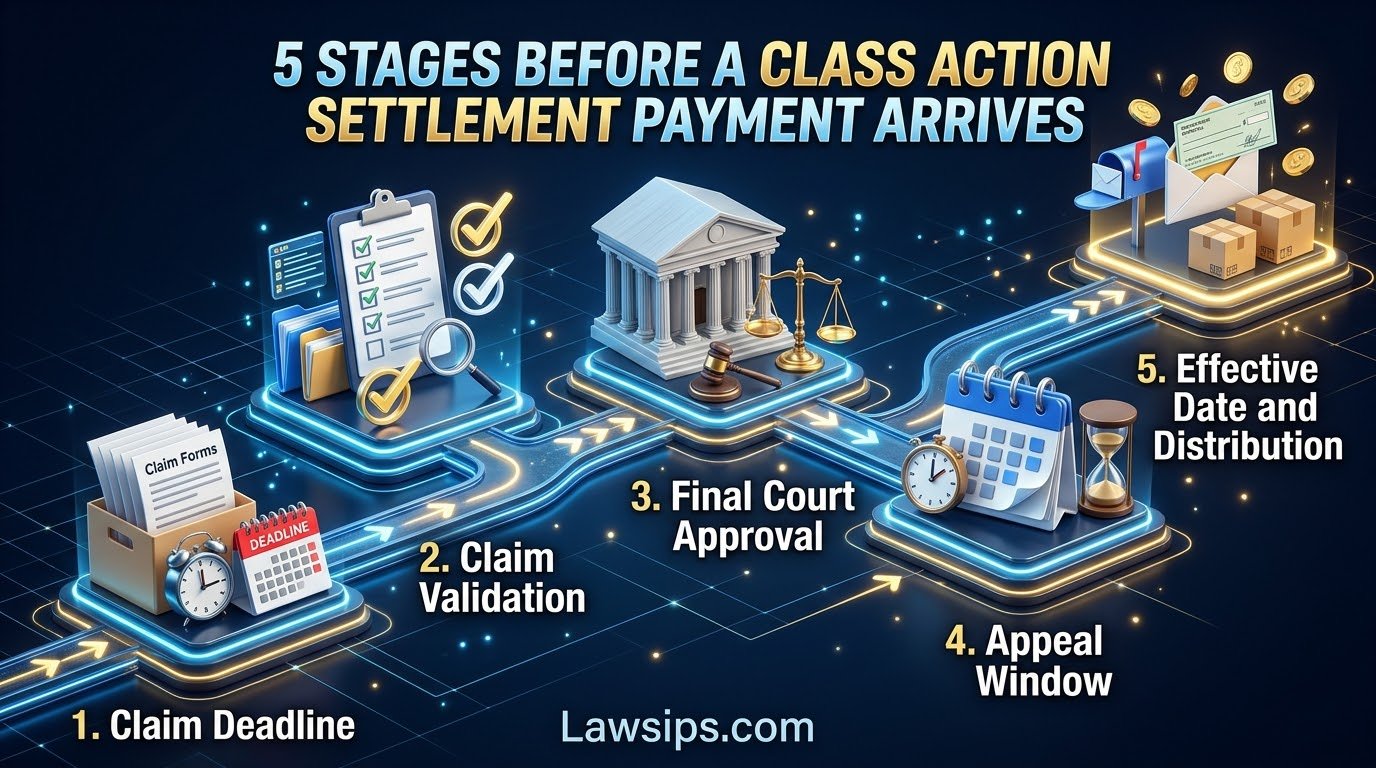
Class action money passes through five gates, in order, and it cannot skip one. Here they are with what usually happens at each.
|
Gate |
What happens |
Typical time |
|---|---|---|
|
Claims close; the class list is fixed |
A fixed date |
|
Administrator audits claims for eligibility, duplicates, fraud |
Weeks to months |
|
Judge holds the fairness hearing and approves (or not) |
Often 0 to 3 months after the deadline |
|
30 days for anyone to appeal the judgment |
30 days, if unused |
|
The payment clock starts; checks and digital payments go out in batches |
About 30 to 90 days after the effective date in many agreements |
The Owed stage by stage class action timeline lays out the same stage structure.
Its type table adds the pattern experience teaches: flat, no proof consumer settlements cluster at the fast end (about 3 to 6 months after the deadline), while privacy and data breach cases run 6 to 18 months, mostly at gates 2 and 3.
Gate 2 deserves respect because it is invisible. Validation is where the administrator counts the only number that matters for your amount: how many valid claims exist.
Your share cannot be computed until that count is final, which is why the amount question and the timing question are the same question wearing two coats.
This site’s explainer on settlement payout per person walks the division itself. The timing translation is simple: distribution is scheduled only after validation closes, so a silent month at gate 2 is the system working, not failing.
Gate 3 has a rule behind it, not just a habit. In federal court, a class settlement binds absent class members only after the judge finds it fair, reasonable, and adequate at a fairness hearing.
The text of Federal Rule of Civil Procedure 23 at Cornell Law carries the requirement at subsection (e), and it is why no administrator may pay anyone, however early they filed, before the order exists.
Gate 3 Explained: Final Approval, the 30 Day Appeal Window, and the Effective Date
Three terms decide your date, and most waiting pain comes from confusing them. In order:
Final approval is the judge’s order after the fairness hearing. It feels like the finish line and is not: it opens the appeal window.
The appeal window is the period when an unhappy objector (or party) may appeal the judgment. In federal court that notice is generally due within 30 days of the judgment, under The text of Federal Rule of Appellate Procedure 4 at Cornell Law.
The window runs 60 days when the United States is a party. Administrators treat the settlement as unripe until the window closes clean.
The effective date is the defined moment the settlement becomes binding and the payment clock starts: typically when the appeal window expires unused, or when a filed appeal is finally resolved. Agreements define it precisely because money hangs on the definition.
The arithmetic that follows is mechanical, and it is the most useful paragraph on this page for a class member.
Approval, plus 30 quiet days, equals the effective date in an unappealed case. The effective date, plus the agreement’s payment window, equals distribution. Two dates and one clause: that is the entire forecast model.
Appeals break the model honestly. Guide strands put an appeal’s added cost at about 6 to 18 months to resolve.
The Owed stage by stage class action timeline allows 1 to 3 years when an objector appeal runs its full appellate course.
Both are printed here as strands because they measure different things, a resolved appeal versus a worst case cycle, and merging them would invent a precision nobody has.
Why Nobody Can Just Tell You the Date
Readers reasonably ask why the administrator, of all people, will not commit to a date. The answer is structural, and knowing it ends a lot of frustrated phone calls.
Until the effective date exists, the start of the payment window does not exist, and the effective date depends on a court and possibly an appeals court, neither of which works for the administrator.
After the effective date, the administrator still cannot date your individual payment until validation fixes the claim count and the batch schedule is set.
What an administrator can honestly give, and the good ones do, is stage information: approval entered, window closed, validation complete, distribution begun. Each stage announcement collapses the uncertainty by one gate, which is why the official site’s updates page, read monthly, is worth more than any hotline guess.
Hold any source to that standard. A page or person who names your month without knowing your gate is performing confidence, not reporting it, and in a space full of scams, performed confidence is the tell.
Find Your Real Date: The Payment Clause in Your Settlement Agreement
Averages describe other people’s cases. Your case’s timing sits in one paragraph of one document, and you can read it in five minutes.
Every settlement agreement contains a payment clause: the administrator shall distribute within a stated number of days after the effective date.
The OpenClassActions review of real settlement payment clauses did the unfashionable work of reading real agreements, and its October 2026 review found clauses requiring payment within 60 days, 75 days, and 150 days of the effective date across three settlements.
That spread, 60 to 150, is the honest width of normal. It also tells you why no website can date your check from a search box: the controlling number is in your case’s contract, not in any average.
Find yours in four steps:
- Open the official settlement website from your notice.
- Download the settlement agreement from its documents page.
- Search the document for the words effective date and days after.
- Add the clause’s days to the effective date once it is known, and you have your case’s real window.
Pair the clause with the docket. The final approval order’s entry date starts the 30 day appeal count, so a reader with the order date and the clause can forecast within weeks, which is as precise as this subject honestly gets.
The Individual Clock: Release to Money in About Four to Eight Weeks
Your own case runs on signatures and clearing times, not hearings. The pipeline, with the ranges law firm guides consistently report:
The release. You sign a document giving up the claim in exchange for the agreed sum. Nothing moves before this signature exists, which is why lawyers chase it first.
The insurer issues the check. Typically 2 to 4 weeks after the insurer receives the signed release. Many states impose prompt payment duties, commonly 30 to 60 days once a claim is complete, which disciplines this stage.
The trust account. The check goes to your lawyer’s client trust account, never straight to you, and sits until it clears.
Under the federal funds availability rules (Regulation CC), banks may hold the portion of a large deposit above $6,725 for up to seven business days, so a big check deposited Monday may not fully clear until the following week.
Liens are resolved. Anyone the settlement must repay gets repaid from it first: medical providers, health insurers, and government programs.
Medicare is the heavyweight: its Benefits Coordination and Recovery Center issues a conditional payment letter, which firm guides report can take up to 65 days to arrive, and finalizing the amount commonly adds two to four months.
Disbursement. You sign a statement approving the accounting, fees, costs, and lien payments, and the firm pays your net, by check or wire, usually within days to two weeks of that signature.
Add it up for a simple case and the total is the familiar 4 to 8 weeks.
Add a Medicare lien or a disputed bill and the same pipeline honestly runs to several months, with the lien stage, not the lawyer, holding the clock.
Readers whose cases fit this clock and who want the claim side of the system can start from how to join a class action lawsuit and how to file a claim for settlement for how class claims differ.
Timing by Settlement Type: The Pattern Table
Type predicts speed better than size does. The strands below come from the timing guides that track this professionally, printed with their scopes intact.
|
Settlement type |
Typical wait after the claim deadline |
Why |
|---|---|---|
|
Flat payment consumer (no proof) |
About 3 to 6 months |
Fixed amounts, light validation |
|
Automatic payment (no claim form) |
Often the fastest after approval |
No claims to audit |
|
Wage and hour |
Months, then payroll speed |
Employer records identify payees |
|
Privacy and website tracking |
About 6 to 18 months |
Huge classes, fraud screening |
|
Data breach with loss claims |
About 6 to 18 months, sometimes more |
Documentation review per claim |
|
Cases with an objector appeal |
Add 6 to 18 months, up to 1 to 3 years |
The effective date waits for the appeal |
Two lessons hide in the rows. First, documentation is destiny: every page of proof a claim requires adds a review queue between you and the count that unlocks distribution.
Second, the appeal row is the only one that can double a wait by itself, which is why hearing coverage and objector news matter more to your date than any administrator announcement.
Treat the table as a prior, not a verdict. Your case’s clause and docket outrank it the moment you have read them, which is exactly the order this page teaches: type for a first guess, documents for the real one.
Worked Examples: Two Cases, Two Forecasts
Abstract gates become obvious when they wear dates. Both examples are illustrative composites built from the ranges and clauses in the research, not reports of real cases.
Example A: a flat payment consumer settlement, no appeal. Claims close March 1. The fairness hearing runs May 12 and the judge approves from the bench.
The 30 day appeal window closes unused on June 11, making the effective date June 12 under the agreement’s definition.
The payment clause requires distribution within 60 days, so checks and digital payments roll out across July and early August. Total from deadline: about five months, squarely inside the 3 to 6 month strand.
Example B: a data breach settlement with documented losses and one appeal. Claims close January 15 after a long filing window. Validation of loss documentation runs into spring.
The hearing lands June 3 and approval follows, but an objector appeals in late June. The effective date freezes.
The appeal resolves the following spring (about 10 months, inside the 6 to 18 month strand), the mandate issues, the effective date arrives, and the agreement’s 75 day clause puts distribution in early summer.
Total from deadline: roughly 17 months, unremarkable for its type, and miserable for every claimant who was quoted the fast strand in January.
The difference between A and B is not competence or honesty. It is two structural facts, documentation and an appeal, visible in advance to anyone reading the case’s own papers. That visibility is the entire skill this page exists to transfer.
Delay Diagnosis: Which Gate Is Your Case Stuck At
Do not ask how long settlements take. Ask where yours is standing.
|
Symptom |
Likely gate |
Normal? |
Your move |
|---|---|---|---|
|
Deadline passed weeks ago, no news |
Validation or awaiting hearing |
Yes |
Check the official site monthly |
|
Hearing happened, still nothing |
Appeal window running |
Yes |
Count 30 days from the order |
|
Someone objected loudly |
Appeal risk or filed appeal |
Serious |
Watch the docket, expect months |
|
Site says distribution started, no check |
Batches and mail transit |
Usually |
Wait 2 to 3 weeks, then call |
|
Check arrived but looks wrong |
Payment lifecycle |
Fixable |
Administrator, reissue path |
|
Your lawyer has the check, you do not |
Liens or trust clearing |
Often |
Ask for the lien status in writing |
The table’s deeper point: at most gates your move is information hygiene, not pressure. Keep your address current with the administrator, keep your confirmation number, and answer any deficiency notice the day it arrives, because an uncured deficiency is the one delay that is actually your fault.
Scam defense belongs in a waiting page, because waiting people are targets. Nobody can expedite a court gated distribution, no fee unlocks a batch, and no actor asks for bank logins by text. The administrator’s phone line and the official site are the whole universe of status.
After the Check Exists: Void Dates, Lost Checks, Reissues, and Leftovers
Payment is an event with a lifecycle, and the last risks are clerical.
Void dates. Settlement checks carry a void after date, typically 90 to 180 days from issue; two of the agreements in the clause review specified 90 and 120 days. A check deposited after that date will not clear. Calendar the date the day the envelope arrives.
Lost or never arrived. Confirm distribution began, confirm the address on file, then ask the administrator for a stop payment and reissue. Reissues take weeks, not days, because the original must be voided first. Starting early is the whole game.
Moved house. Forwarding catches some mail and returns the rest. An address update with the administrator takes minutes and remains available long after claim deadlines close; it is the highest value action a waiting claimant owns.
Leftovers. Uncashed check money does not vanish. Many agreements fund a second distribution to claimants who participated, and only the remainder passes to court approved cy pres recipients or escheats to the state as unclaimed property.
Owners can often still claim escheated money. If you missed a first check by years, the state’s unclaimed property office is a legitimate last stop.
Method speed. Where a settlement offered a choice, digital payments land in days while paper adds one to three weeks of printing and mail. If your case has not distributed yet and the administrator allows a payment method change, that election is worth more than any phone call.
What You Can Actually Do While You Wait
The wait is structural, so the useful actions are few, specific, and worth listing plainly.
- Find your gate. Official site first, docket second, in that order.
- Read your payment clause. Five minutes, real window, no averages.
- Protect your findability. Current address, working email, correct name spelling with the administrator.
- Keep the paper. Confirmation, notice, class member ID, and what you filed, in one folder.
- Set a monthly check. Gates move in weeks and months; daily refreshing buys only anxiety.
- Cash on arrival. The void date starts at issue, not at your convenience.
For readers still deciding whether to enter a settlement at all, the maintained trackers at open class action settlements and class action settlements you can claim list what is open now, each with its own deadline and its own future place on the clocks above.
1. When will my class action settlement pay?
In stages, not on a promiseable date.
Most class action payments land about 3 to 18 months after the claim deadline: final approval, a 30 day appeal window, the effective date, then distribution within the window the agreement sets.
Simple consumer cases run fast; privacy and data breach cases run slow.
2. How long after final approval do settlement checks go out?
If nobody appeals, guides commonly put distribution at about 60 to 120 days after final approval, and the agreement’s payment clause controls: three agreements reviewed in October 2026 required payment within 60, 75, and 150 days of the effective date.
An appeal adds months, because the effective date waits for it to end.
3. Why hasn’t my settlement paid yet?
One of five gates is still closed: the fairness hearing has not happened, the appeal window is still open, an appeal is pending, claims are still being validated, or distribution has started but runs in batches.
Find your gate on the official settlement website; that answer beats any average.
4. What is the effective date of a settlement?
The date the settlement becomes binding and the payment clock starts, as defined in the agreement.
It typically arrives after the court enters the final approval order and the time to appeal expires with no appeal, or after any appeal is resolved.
Payment deadlines are usually counted from this date.
5. What is a fairness hearing?
The hearing, required in federal class actions under Rule 23(e), where the judge decides whether the settlement is fair, reasonable, and adequate.
Final approval is granted at or after this hearing.
No class member is paid before it, however early they filed.
6. How long is the appeal window after final approval?
In federal court, a notice of appeal is generally due within 30 days after the judgment is entered, under Federal Rule of Appellate Procedure 4 (60 days when the United States is a party).
Administrators do not treat the settlement as effective until that window closes clean.
7. What happens if someone appeals my settlement?
Distribution waits.
The effective date does not arrive while an appeal is pending, because the approval could be reversed.
Guide strands put the added time at about 6 to 18 months for an appeal to resolve, and one timeline guide allows 1 to 3 years when an objector appeal runs its full course.
8. Can the settlement pay before final approval?
No.
Court approval is a legal precondition of distribution in a class action.
Anyone telling you payments have begun before a final approval order exists is misinformed or running a scam.
9. Does the claim deadline start the payment clock?
No, and this is the most common misunderstanding in settlement waiting.
The deadline closes the class list; the payment clock starts at the effective date, which sits after the hearing and the appeal window.
Months routinely separate the two.
10. Why do some people get settlement checks before others?
Distribution usually runs in batches, and payment method matters: digital payments land in days while mailed checks take one to three weeks in transit.
Claim type can also sequence a distribution.
A neighbor’s check is evidence the process started, not that yours is lost.
11. How long are settlement checks valid?
Typically 90 to 180 days from the issue date printed on the check; two agreements reviewed in 2026 specified 90 and 120 days.
Cash or deposit promptly.
After the void date the check will not clear, and you must ask the administrator for a reissue, which takes additional weeks.
12. My settlement check expired. What can I do?
Contact the administrator, not your bank.
Administrators routinely reissue expired checks to verified claimants after a stop payment on the original.
If years have passed, unclaimed funds may have moved to a second distribution, to cy pres, or to the state as unclaimed property, where a claim may still be possible.
13. My settlement check never arrived. What should I do?
First confirm distribution actually began (official site or administrator line) and that your address on file is current.
Then ask the administrator to confirm the mailing date and method; if enough time has passed, request a stop payment and reissue.
Keep your claim confirmation number for every call.
14. I moved after filing my claim. Will my payment find me?
Only if the administrator has your new address.
Mail forwarding catches some checks and returns others.
Update your address with the administrator as soon as you move; address updates stay open long after claim deadlines close.
15. Who sends the settlement check, the court or the administrator?
The administrator.
Courts approve settlements; administrators validate claims, run distributions, and answer status questions.
Calling the court about a missing check reaches people who cannot help you.
16. How can I check the status of my settlement payment?
Start at the official settlement website named in your notice, which posts distribution updates.
Then the administrator’s phone line, with your claim confirmation number ready.
For the court side, the case docket (via PACER) shows whether a final approval order has been entered.
17. Can I do anything to speed up my settlement payment?
For a class action, no one can accelerate court gates, and anyone charging to try is selling fiction.
What you can do: keep your address current, answer any deficiency notice immediately, choose digital payment when offered, and cash the check before its void date.
18. What is a deficiency notice?
A letter or email from the administrator saying your claim is incomplete or unverifiable, with a deadline to fix (cure) it.
Answer it exactly as instructed and on time; an uncured deficiency converts an approved wait into a denial.
19. Why does claim validation take so long?
Administrators audit for duplicates, fraud, and eligibility across sometimes millions of claims, and the pro rata math cannot run until the valid claim count is final.
Validation is also what protects your share from being diluted by invalid claims.
20. What does pro rata have to do with timing?
Your amount cannot be computed until claims close and are validated, so amount and date are the same problem.
Only after the count is fixed can the administrator divide the net fund and schedule distribution.
21. When will my personal injury settlement pay?
On a completely different clock.
For a straightforward case, law firm guides put the total at about four to eight weeks from signing the release: the insurer issues the check in about two to four weeks.
Your lawyer then holds it in a trust account until it clears, liens are resolved, and you sign a disbursement statement.
Liens and disputes stretch it to months.
22. How long after signing a release do you get paid?
The insurer typically takes two to four weeks to issue the check after receiving the signed release, and the full path to money in hand usually runs four to eight weeks in simple cases.
State prompt payment rules often require insurers to act within 30 to 60 days once a claim is complete.
23. Why is my lawyer holding my settlement money?
By law, settlement funds sit in a client trust account until the check clears and every deduction is resolved: fees, costs, and liens.
Banks may hold the portion of a large deposit above 6,725 dollars for up to seven business days under Regulation CC, and Medicare or medical liens must be settled before disbursement.
24. How do Medicare liens delay a settlement?
Medicare must be repaid from settlements covering medical care.
Its Benefits Coordination and Recovery Center issues a conditional payment letter stating what Medicare claims; firm guides note the letter can take up to 65 days to arrive, and negotiating the final amount commonly adds two to four months.
25. Do settlement checks come from the insurance company?
In individual cases, effectively yes: the insurer issues the check, usually payable to you and your lawyer or to the lawyer’s trust, after the release is processed.
In class actions, no: the defendant funds a settlement account and the administrator pays claimants.
26. Are settlement payments taxed?
It depends on the claim type.
Personal physical injury compensation is generally excluded from federal income tax, while many class action payments (privacy, consumer, wage claims) may be taxable, and administrators sometimes issue 1099 forms.
This is general information, not tax advice; a tax professional can apply it to your payment.
27. Will I get a check or a digital payment?
Whichever the settlement offers and you elected.
Many recent settlements let claimants choose PayPal, Venmo, a prepaid card, or direct deposit at filing; paper checks are the default when no election is made.
Wage and hour settlements often pay through payroll, with tax withholding.
28. What is a second distribution?
If enough first round checks go uncashed, many agreements send the leftover money out again to claimants who did participate, before any remainder goes to cy pres or escheats.
Not every settlement has one; the agreement and the administrator’s updates say whether yours does.
29. What happens to unclaimed settlement money?
It follows the agreement: often a second distribution to participating claimants, then cy pres (court approved charitable or public interest recipients), or escheatment to the state as unclaimed property.
It does not quietly return to the defendant in most modern agreements.
30. How long does a wage and hour settlement take to pay?
Often faster than consumer class actions once approved, because employers pay identified workers through payroll.
The same gates apply first, though: final approval, the appeal window, and the effective date.
Withholding taxes apply to the wage portion.
31. Why do data breach settlements take so long?
Scale and scrutiny: millions of claims to validate, fraud screening (these settlements attract industrial scale fake claims), and longer documentation review for loss claims.
Guide ranges put privacy and data breach payouts at about 6 to 18 months after the deadline.
32. Which settlements pay fastest?
Small, flat payment consumer settlements with simple validation: guides put them at about 3 to 6 months after the deadline.
Fixed amounts and no document review remove the two slowest stages.
33. Can a settlement be approved but never pay?
Rarely, appeals can overturn an approval, and a defendant can sometimes exercise a walk away right if too many class members opted out (a blow up clause).
If approval is reversed, the case returns to litigation or renegotiation, and payment timelines reset entirely.
34. The administrator’s site says payments began but I have nothing. Why?
Batches and mail.
Distributions roll out over days to weeks, and mailed checks add transit time.
If several weeks pass after the announced start, call the administrator with your confirmation number and verify the address and payment method on file.
35. Should I pay for post settlement funding while I wait?
Funding advances exist only for individual cases with a lawyer, and they are expensive money: fees compound against your settlement.
For class action claimants, no legitimate funding product exists because there is no individual receivable to lend against.
Treat any offer aimed at class members as a scam signal.
36. How will I know when my settlement starts paying?
The administrator announces distribution on the official website and often by email to claimants.
Set a monthly check on that page once final approval is granted; until then, docket milestones (hearing date, approval order) are the only real news.
37. What should I keep while I wait?
Your claim confirmation, a copy of what you filed, the notice with your class member ID, and the administrator’s contact details.
These four items turn any future status problem from a research project into a five minute call.
38. Is it normal for a settlement to take over a year?
Yes, for class actions it is unremarkable: deadline, months to a hearing, an appeal window, validation across a large class, then distribution.
From filing to money, one to two years happens in big cases without anything being wrong.
39. What if the settlement website goes quiet for months?
Silence usually means a gate is pending (a hearing date not yet reached, an appeal running), not that the settlement vanished.
Check the docket for the latest order, and the administrator’s line for anything the site has not posted.
40. Do interest or penalties apply when a settlement pays late?
Class action timing is set by the agreement and court orders rather than by a lateness penalty, and administrators distribute under court supervision.
Individual cases differ: state prompt payment laws can impose consequences on insurers who sit on completed claims.
41. What is the single best way to estimate my payment date?
Read your own settlement’s documents in this order: the final approval order (has it been entered), the appeal window (has it closed clean), the agreement’s payment clause (how many days after the effective date).
And the administrator’s latest update (has distribution begun).
Those four answers date your case better than any average on the internet.
42. What should I do right now if I am waiting on a settlement?
Three things.
Find your case’s current gate on the official site.
Confirm the administrator has your current address and your preferred payment method.
Then set a monthly calendar check and stop refreshing daily; the timeline is structural, and your one job is to be findable and cashed on time when the gate opens.
Conclusion
When will settlement pay stops being a mystery the moment you know your clock and your gate. Class members: approval, thirty quiet days, the effective date, then your agreement’s own payment window. Individual claimants: release, insurer, trust account, liens, disbursement.
The numbers worth keeping are structural, not magical. Class action money typically arrives 3 to 18 months after the deadline; your own case typically pays in 4 to 8 weeks.
Between those ranges sit documents you can read and gates you can watch, which beats refreshing a mailbox on hope.
Your closing checklist is the waiter’s whole job description: know your gate, keep your address current, keep your confirmation, and cash the check before its void date.
LawSips keeps the rest of the settlement landscape, deadlines, amounts, and open claims, tracked with the same discipline, so the next wait starts informed instead of anxious.

Dilawar is a dedicated writer and contributor at Lawsips.com, focusing on legal information, business law, consumer rights, legal awareness, and everyday legal matters. He is passionate about simplifying complex legal topics and providing readers with clear, practical, and easy-to-understand information. His goal is to help readers stay informed about legal developments, understand their rights, and make better decisions through informative and well-researched articles.