
Workers Compensation Lawyer: Fees, Benefits, and How to Choose One

A workers compensation lawyer costs nothing upfront, nothing by the hour, and nothing at all if your case recovers nothing.
That sentence is why this page can be honest about everything else: the fee is a state capped percentage of what the lawyer wins for you, and a judge has to approve it.
Workers compensation is fifty state systems wearing one keyword. Fees, deadlines, benefit caps, and even who picks your doctor are set by your state, so this page teaches the national frame once and then shows its numbers as state strands, labelled, never blended.
Hire one at four moments: your claim is denied, your checks stop, your impairment rating comes in low, or a settlement offer lands before you know what your case is worth. Everything below serves those four moments and the system behind them.
This is general legal information, not legal advice, researched in November 2026. State board rules control your case; a consultation, which is free, is where your state’s numbers replace the strands here.
What a Workers Compensation Lawyer Actually Does
Strip away the advertising and the job is four kinds of work, all inside a state administrative system most people meet for the first time while injured.
Claims work. Filing and perfecting the claim with the state board, assembling the medical record, and making sure the average weekly wage, the number every check is computed from, includes the overtime, bonuses, and second job income insurers routinely miss.
Disputes work. Challenging denials, stopped checks, treatment refusals, and low impairment ratings, through conferences, mediation, and formal hearings before a workers compensation judge, who is an administrative law judge, not a courtroom jury trial.
Valuation work. Pricing a settlement against your rating, your wage, and your expected future treatment, before you sign away benefits, and often future medical care, for a lump sum.
Screening work. Checking every file for what comp does not cover: a third party who caused the injury and can be sued for full damages, retaliation by the employer, and the federal systems (federal employees, longshore, railroad) that are not state comp at all.
The LegalClarity guide to filing a workers comp claim walks the claim process itself step by step, and its account matches this division: the lawyer’s value concentrates where the insurer’s process resists, at denials, ratings, and settlements, not in filing a clean claim nobody contests.
The scale explains why the specialty exists. The Bureau of Labor Statistics strand most guides cite puts about 2.6 million nonfatal workplace injuries and illnesses reported by private employers in 2023, with 5,283 fatal work injuries the same year.
A system processing injuries at that volume runs on forms, deadlines, and defaults, which is precisely the terrain lawyers are for.
What It Costs: Contingency Fees, State Caps, and Case Costs
The fee model is the most regulated in American law, and it works entirely in the injured worker’s favor at the start.
Contingency only. The lawyer takes a percentage of the benefits or settlement actually recovered. No recovery, no fee. Consultations are free at nearly every firm, because the model lets lawyers screen cases at their own risk instead of yours.
The range. Guides across this market put the typical fee at about 10 to 25 percent.
The Super Lawyers guide to workers comp attorney costs states the same contingency structure and works a clean example: at Pennsylvania’s standard 20 percent, a $20,000 settlement carries a $4,000 fee, deducted from the award, never billed to you separately.
State caps and approval. In nearly every state the percentage is capped by law and the fee must be approved by a judge or the board before it is paid.
Your fee agreement states your state’s number in writing; if a firm will not put it in writing, that is your answer about the firm.
|
State |
Fee structure (strand) |
|---|---|
|
Florida |
Statutory formula: 20% of first $5,000, 15% of next $5,000, 10% of remainder |
|
Texas |
Capped at 25% of the recovery |
|
Pennsylvania |
20% standard, judge approved |
|
Georgia |
Capped at 25% |
|
Illinois |
20% for most cases |
|
California |
Board commonly approves about 9 to 15% |
|
New York |
No fixed percentage; the board sets the fee from the award |
The text of Florida Statute 440.34 on attorney fees is the primary text behind the Florida row, and it rewards a look: a legislature wrote those tiers into law, which is how regulated this fee is compared with ordinary personal injury practice.
Case costs are separate. Records, independent examinations, depositions, and expert opinions cost money apart from the fee. Firm reported strands put straightforward cases at about $1,500 to $5,000, and complex contested cases above $10,000.
Ask how costs are advanced and repaid in your agreement; reputable firms explain it without being asked twice.
A warning this page is positioned to give. Search results for this topic include content farm pages printing fee structures that do not exist, including a sliding formula attributed to California and a fixed percentage for New York.
California fees are set by board approval in the 9 to 15 percent practice range, and New York’s board sets each fee. If a page’s state numbers cannot be traced to a statute or a board, do not plan around them.
The System You Are Hiring Into: No Fault, Four Benefits, Exclusive Remedy
Three ideas organize everything a comp lawyer does, and ten minutes with them makes the rest of this page predictable.
No fault. You do not prove your employer was careless. If the injury arose out of and in the course of employment, benefits follow, with narrow defenses (intoxication is the classic one).
In exchange, benefits are formula based, not jury based: there is no pain and suffering in this system.
Four benefits. Every state system pays some version of the same four: medical care for the injury (authorized treatment, generally without deductibles); wage replacement, most often about two thirds of your average weekly wage, with state minimums and maximums.
Then permanent disability compensation after maximum medical improvement, driven by an impairment rating; and vocational rehabilitation when you cannot return to your old job.
Families of workers killed on the job receive death benefits, support for dependents plus a burial allowance.
Exclusive remedy. Workers comp is generally your only claim against your employer for a work injury. You cannot set it aside and sue for negligence because the number looks bigger.
The exceptions, intentional harm and third party fault, get their own section below because they are where the larger recoveries hide.
The Workmans Compensation Lawyer national guide builds its national treatment on the same skeleton, and the agreement across independent guides is the tell: whatever a page adds beyond this frame is state detail or salesmanship, and you now know how to tell them apart.
One number in the frame deserves its own sentence, because lawyers audit it constantly. Maximum weekly benefits vary enormously by state and update yearly.
A current firm published example is Missouri’s temporary total disability maximum of $1,294.71 per week for injuries on or after July 1, 2026. Your state’s cap, not a national figure, is what your checks obey.
When You Need One: The Four Triggers (and When You May Not)
Most accepted claims pay without a lawyer ever appearing. Representation earns its percentage at specific pressure points, and naming them honestly is what makes this page a guide instead of an advertisement.
Trigger 1: your claim is denied. A denial letter converts your case into litigation inside the board’s process, with appeal windows measured in days. This is the clearest hire now signal in the field.
Trigger 2: your checks stop, shrink, or never start. Stoppages follow IME reports, return to work releases, and paperwork failures, and each cause has a different fix. Reinstatement is procedural and time sensitive.
Trigger 3: your impairment rating comes in low. After maximum medical improvement, a few rating points are thousands of dollars and the anchor of every settlement number. Rating fights are evidence fights, and they are a lawyer’s home ground.
Trigger 4: a settlement offer is on the table. An offer prices your future, including medical care you have not needed yet. Once signed and approved, it is nearly impossible to undo. Review before signature is the cheapest lawyering in this entire system.
When you may not need one yet: an accepted claim, treatment authorized, checks arriving at the correct rate, and a cooperative return to work path. Keep the consultation for the first trigger that fires. Knowing the triggers in advance is most of the protection.
Deadlines That Decide Cases: Notice, Filing, and Appeal Windows
Comp cases are lost to calendars more often than to arguments. The windows below are typical strands; your state’s numbers control, and a lawyer confirms them at the first meeting.
|
Deadline |
Typical window |
Consequence of missing it |
|---|---|---|
|
Report the injury to your employer |
Commonly within about 30 days |
A top denial reason |
|
File the formal claim with the state |
Commonly 1 to 2 years from injury |
Claim barred entirely |
|
Appeal a denial or award |
Often 15 to 30 days per stage (one state example: 20 days) |
Decision becomes final |
|
Death benefit claim by family |
State set, strict |
Benefits lost |
Two habits follow. Report in writing, immediately, even when the injury seems minor, because the notice date is evidence. And treat every letter from the insurer or the board as a clock starting, because in this system, it is.
The compensation system is not the only clock an injured worker may face. Where a third party caused the injury, that lawsuit carries its own statute of limitations.
Where an employer is involved beyond comp, The employment lawyer cost guide on this site explains the adjacent employment law costs and timelines on this site.
The general claim mechanics in how to file a claim for settlement and the class context in how to join a class action lawsuit round out the procedural picture for readers meeting legal deadlines for the first time.
Denied, Delayed, or Cut Off: The Playbook
Denials are not verdicts; they are opening positions with a process attached. The reasons cluster, and each has its remedy.
|
Denial reason |
The response that answers it |
|---|---|
|
Reported too late |
Records, witnesses, and any written notice that predates the formal report |
|
Not work related |
Incident records, coworker accounts, medical causation opinion |
|
Pre existing condition |
Apportionment evidence: what the work injury added or aggravated |
|
Intoxication alleged |
Testing records, timing, and the state’s causation standard |
|
Contractor, not employee |
The state’s control test applied to the real working relationship |
|
Treatment or surgery refused |
Treating doctor’s documentation through utilization review and hearing |
The path itself is patterned: a hearing request to the board, often a mediation or settlement conference first, then a formal hearing where the judge weighs medical reports, ratings, and testimony.
Then board appeal, and finally court review on legal error. Most contested cases settle somewhere along that path, at numbers the hearing’s risks define.
What a lawyer changes here is not magic; it is evidence discipline. The treating doctor’s opinion, properly documented, against the insurer’s examiner; the wage record, fully counted; the incident, contemporaneously recorded. Cases in this system are won on paper assembled months before any hearing.
Settlements: What You Sign, What You Keep, What a Judge Must Approve
A comp settlement is a legal event disguised as a check. Three facts protect you.
A judge must approve it. Every settlement in this system passes board or judicial review for fairness, which is a real protection and also why settlements cannot close overnight.
The structure is the decision. Settlements come in two broad shapes (names vary by state): one that closes the case entirely, including future medical care, and one that settles the disability money and leaves future medical open.
Closing medical moves your future treatment costs onto you or other coverage, so a closed case should pay a premium for that risk. Signing the wrong shape is the most expensive mistake available to an injured worker.
Other systems are watching. A settlement closing future medical may require a Medicare set aside, funds reserved for injury related care. Workers comp can also offset Social Security disability benefits under federal rules.
Both are plannable in advance and painful in retrospect, and both belong in any settlement conversation above a modest size.
Valuation itself is formula anchored: your rating, your wage, your state’s caps, and your expected treatment, discounted by litigation risk.
This site’s explainer on settlement payout per person shows how pro rata and formula based division logic works across settlement types; in comp, the impairment rating plays the role the claim count plays there.
Beyond Comp: Third Party Claims, Retaliation, and the Federal Systems
Three doors lead out of the comp system’s limits, and screening for them is a stated part of the lawyer’s job.
Third party claims. A driver who hits your delivery van, a manufacturer whose machine failed, a property owner whose premises injured you: those parties can be sued for full damages, including pain and suffering, while comp pays benefits in the meantime.
The comp insurer usually claims reimbursement from that recovery. In many files this is the largest money available, and it evaporates if evidence, like the defective product, is not preserved early.
Retaliation. Firing, demoting, or disciplining a worker for filing a comp claim is unlawful and independently actionable. The protection depends on documentation: timelines, messages, and the suddenness of the employer’s new concerns. Report it early; memory fades and records get curated.
The federal carve outs. Federal employees claim under FECA through the Department of Labor’s OWCP, not state boards. Longshore and harbor workers claim under the LHWCA; railroad workers under FELA, which is a fault lawsuit, not a benefits system at all.
If your job touches federal service, a harbor, or a railroad, the state page you are reading is the wrong map, and a lawyer’s first job is handing you the right one.
How to Choose: Ten Questions and the Answers That Should Worry You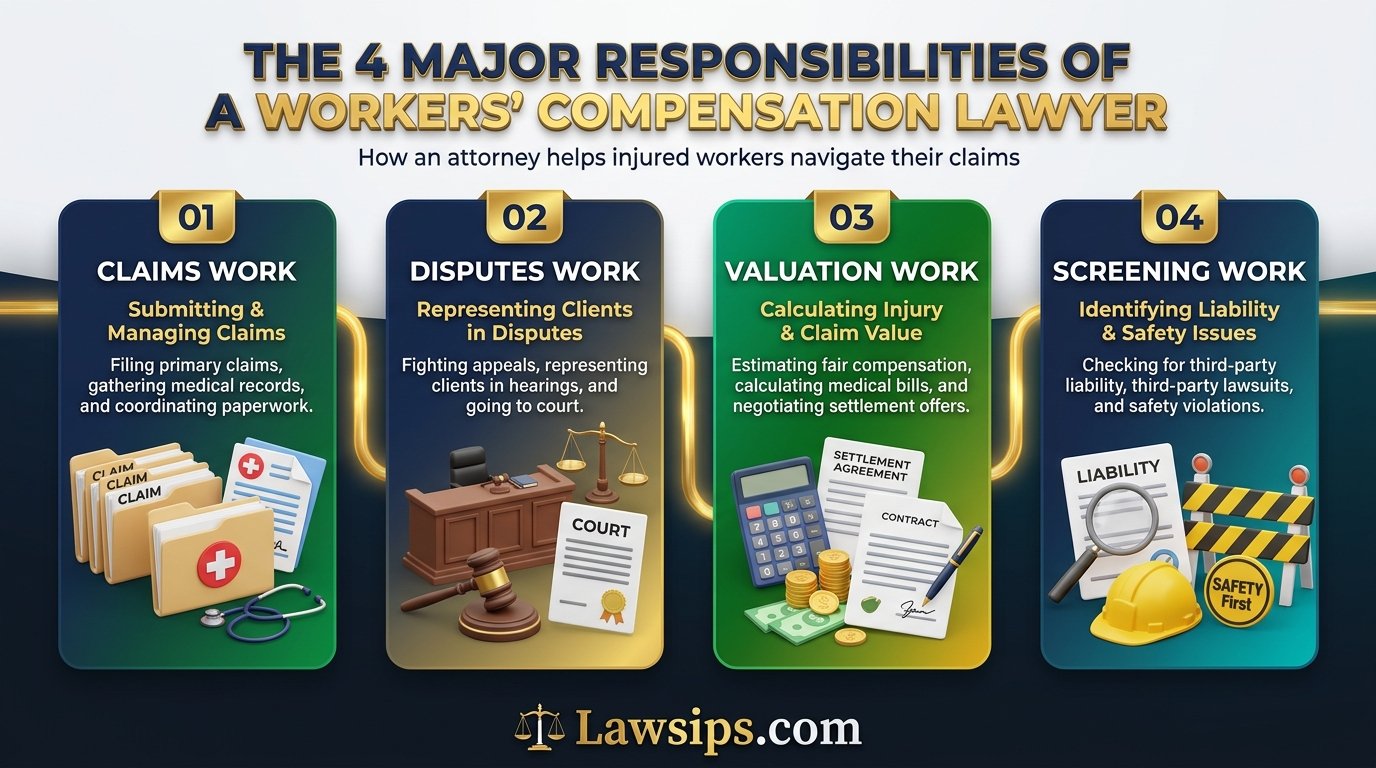
Directories rank by subscription and firms rank themselves. Use the consultation, which costs nothing, as the interview it actually is.
- What share of your practice is workers compensation? Worry if: comp is a sideline to a general practice.
- Who handles my case day to day, and who argues my hearing? Worry if: you cannot get a name.
- What is my fee, under this state’s cap, in writing? Worry if: the percentage is vague or exceeds the cap.
- How are case costs handled, and what do cases like mine usually cost? Worry if: costs are waved away as nothing.
- What deadlines is my case already carrying? Worry if: nobody asks for your denial letter.
- What is your honest read of my rating and my settlement range? Worry if: a big number arrives before your records do.
- How often will I hear from you, and how? Worry if: there is no cadence, only a promise to call back.
- Have you practiced before this board and these judges? Worry if: the firm is learning your local system on your case.
- Do you screen for third party claims and retaliation? Worry if: the answer treats comp as the whole world.
- What happens if I decide not to hire you today? Worry if: pressure replaces information. The honest answer is that your deadlines keep running, stated calmly.
Bring paper to that interview: the denial or approval letters, your claim number, medical restrictions, pay stubs for the wage calculation, and any settlement offer in writing. Consultations run on documents, and the worker who arrives with a folder gets a real evaluation instead of a sales conversation.
1. What does a workers compensation lawyer do?
Represents the injured worker inside the state workers compensation system: filing and perfecting the claim, gathering medical evidence, challenging denials and low impairment ratings, negotiating settlements, and arguing hearings before a workers compensation judge.
Most work on contingency, paid only from benefits or a settlement they actually secure.
2. How much does a workers compensation lawyer cost?
Almost always a contingency percentage of the benefits or settlement recovered, not an hourly bill.
Guides put the typical range at about 10 to 25 percent, capped by law in nearly every state and approved by a judge or the board.
Consultations are free at nearly every firm, and with no recovery there is generally no fee.
Case costs are separate and should be explained in writing.
3. What percentage does a workers comp lawyer take in my state?
The state sets it.
Florida uses a statutory sliding scale (20 percent of the first $5,000, 15 percent of the next $5,000, 10 percent of the remainder).
Texas caps fees at 25 percent.
Pennsylvania’s standard is 20 percent with judge approval.
Georgia caps at 25 percent.
Illinois at 20 percent for most cases.
California’s board commonly approves about 9 to 15 percent.
New York’s board sets each fee.
Your agreement must state yours.
4. Do workers comp lawyers charge upfront?
No, as a market standard.
Representation runs on contingency with a free consultation, and the fee comes out of the recovery at the end, after approval.
Ask about case costs separately: records, examinations, and depositions are billed apart from the fee in many agreements, with firm reported ranges around $1,500 to $5,000 in straightforward cases.
5. When should I hire a workers compensation lawyer?
At any of four triggers: your claim is denied; your checks are stopped, reduced, or never start; you reach maximum medical improvement with a rating that looks low; or a settlement offer is on the table.
Counsel is also wise when the insurer schedules an independent medical examination or disputes that the injury is work related.
A smooth, accepted claim paying correctly may not need one yet.
6. Can a workers comp lawyer get me more money?
A lawyer cannot change the benefit formulas, which state law sets, but representation regularly changes outcomes inside them: correct average weekly wage calculations, higher ratings supported by evidence, benefits restarted after wrongful stoppages.
And settlements valued against future medical instead of pressure.
No ethical lawyer guarantees a figure in advance.
7. What benefits does workers compensation pay?
Four categories in every state system: medical care for the work injury (authorized treatment, generally without deductibles); wage replacement, most often about two thirds of your average weekly wage as temporary total disability, with state minimums and maximums.
Permanent disability compensation is based on impairment after maximum medical improvement.
Vocational rehabilitation applies when you cannot return to your old job.
Families receive death benefits after a fatal work injury.
8. How much are workers comp checks?
Temporary total disability is typically two thirds of your average weekly wage, capped by your state’s maximum and floored by its minimum.
Caps vary enormously and update yearly; one current published example is Missouri’s maximum of $1,294.71 per week for injuries on or after July 1, 2026.
Lawyers audit the wage itself, because overtime, bonuses, and second jobs are often undercounted.
9. How long do I have to report a work injury?
Quickly, and in writing.
Most states require notice to the employer within about 30 days, and late notice is among the most common denial reasons.
Separately, the deadline to file a formal claim with the state commonly runs 1 to 2 years from the injury or its discovery.
Your state’s exact windows control; a lawyer checks them at the first consultation.
10. What if my workers comp claim was denied?
A denial starts an appeal clock; it does not end the case.
The standard path is a hearing request to the state board, often with mediation first, then a formal hearing before a workers compensation judge, with further appeal to the board and then to court on legal questions.
Windows are short, often 15 to 30 days at each stage, so move immediately.
11. Why was my workers comp claim denied?
The recurring reasons: the injury was not reported in time.
The employer or insurer disputes that it happened at work or is work related.
A pre existing condition is blamed.
Intoxication is alleged.
Forms or medical evidence are missing.
Or the worker is classified as an independent contractor.
Each reason has a specific evidence response, which is most of what a denial appeal is.
12. Can I sue my employer instead of filing workers comp?
Generally no.
Workers compensation is the exclusive remedy against your employer for a work injury: you receive no fault benefits, and in exchange you cannot sue the employer for negligence.
Two major exceptions exist: intentional harm by the employer (narrow everywhere), and injuries caused by a third party, who can be sued in a regular personal injury case alongside your comp claim.
13. What is a third party claim in workers comp?
If someone other than your employer or a coworker caused your injury (a negligent driver on a delivery route, a defective machine’s manufacturer, a property owner), you may pursue that party for full personal injury damages, including pain and suffering.
While comp pays benefits in the meantime.
The comp insurer typically claims reimbursement from the third party recovery.
Lawyers screen every case for this, because it is often the largest money in the file.
14. What is maximum medical improvement (MMI)?
The point where your treating doctor finds your condition has stabilized and is not expected to improve significantly with more treatment.
Temporary benefits usually end there, your permanent impairment is rated, and settlement framing begins.
Insurers push for early MMI declarations; disputes over timing are a core reason workers hire counsel.
15. What is an independent medical examination (IME)?
An examination by a doctor chosen and paid by the insurer, whose report can support cutting benefits, disputing treatment, or lowering a rating.
Despite the name, the examiner is not neutral in effect.
You must usually attend, but you can prepare and bring records; your lawyer’s job includes challenging a biased IME with your treating doctor’s evidence.
16. Who chooses my workers comp doctor?
It depends on the state.
In many states the employer or insurer directs you to its authorized providers, at least initially; in others you choose, may change once, or may predesignate your doctor.
Treating outside the authorized channel can leave you paying the bill.
The rule in your state is a first consultation question, because the treating doctor’s opinions drive the whole claim.
17. What is an impairment rating and why does it matter?
After MMI, a doctor assigns a percentage of permanent impairment, usually under the AMA Guides edition your state adopts, sometimes converted through a state schedule for specific body parts.
That percentage drives permanent partial disability money and anchors settlement value, so a few points are real money.
Rating disputes, and which doctor’s rating the judge believes, decide many contested cases.
18. My workers comp checks stopped. What should I do?
Treat it as an emergency with a paper trail.
Checks stop after IME reports, return to work releases, missed forms, or surveillance disputes.
Get the insurer’s stated reason in writing, note every deadline in the notice, and contact a lawyer immediately: reinstatement fights and penalties for wrongful stoppage are time sensitive, and the fix is procedural as much as medical.
19. Can my employer fire me for filing a workers comp claim?
Retaliation for filing is unlawful in every state’s scheme and often actionable as its own claim, but protection is not self executing: document the timeline, keep every communication, and report threats or sudden discipline to your lawyer early.
Being fired for documented, unrelated cause is a different matter, which is why the record matters.
20. Can I work light duty while on workers comp?
Usually yes, and refusing suitable light duty within your restrictions can reduce or end wage benefits.
Light duty pay below your old wage is typically supplemented by temporary partial disability benefits covering part of the difference.
The fights happen when the offered job exceeds your restrictions; that is a medical question to document, not a refusal to improvise.
21. Should I accept a workers comp settlement offer?
Not before it is valued properly.
Settlement trades future benefits, and often future medical care, for a lump sum, and a judge must approve it.
The valuation questions: your rating, your wage, your expected future treatment, Medicare’s interests, and whether keeping medical open beats closing it.
An offer made before MMI is priced before your impairment is even known, which is why early offers run low.
22. What is the difference between a compromise and release and a stipulation?
The names vary by state, but the structure is the national pattern: one settlement closes the case entirely, including future medical (in California, a compromise and release).
While the other settles the disability money and leaves future medical care open (a stipulation).
Closing medical shifts your future treatment costs to you or other coverage, so it should carry a premium; that trade is the heart of settlement advice.
23. Does a workers comp settlement affect Medicare or Social Security disability?
It can.
Settlements that close future medical may require a Medicare set aside, money reserved for injury related care Medicare would otherwise pay.
And workers comp benefits can offset Social Security disability benefits under federal rules.
Both interactions are manageable when planned and painful when discovered afterward, which is why larger settlements need counsel and sometimes allocation language in the documents.
24. How long does a workers comp case take?
Accepted claims pay on the system’s schedule (checks typically begin after a short state waiting period, often 3 to 7 days, sometimes retroactive).
Contested cases run months to the first hearing and longer through appeals; settlements can close at many points once MMI and the rating exist.
Anyone promising a fast total timeline for a contested case is selling, not advising.
25. What happens at a workers comp hearing?
A workers compensation judge (an administrative law judge) hears evidence: medical reports and ratings, wage records, and testimony from you and sometimes the doctors, then issues an award.
It is less formal than a court trial but a real evidentiary contest with deadlines for exhibits and witnesses.
Most cases settle at mediation or conference before a full hearing, on numbers the hearing’s risks define.
26. Do I need a lawyer for a hearing?
You may represent yourself, and some workers do for small disputes.
The other side will have counsel or a trained adjuster, the rules are real, and the record made at the hearing limits later appeals.
For denials, ratings, and settlements, representation is the norm for a reason; the contingency structure means evaluating that decision costs nothing.
27. What if my employer has no workers comp insurance?
Operating without required coverage is itself a legal violation in most states.
Many states maintain an uninsured employers fund that pays benefits and then pursues the employer, and the employer may also lose the exclusive remedy shield, opening a direct lawsuit.
Report the situation to the state board promptly; a lawyer can route the claim so the employer’s violation does not become your loss.
28. Are independent contractors covered by workers comp?
True independent contractors are generally outside the system, but misclassification is rampant: many workers called contractors are employees under the state’s control test.
If a claim is denied on classification grounds, the label on your paperwork is not the last word; agencies and judges apply their own tests, and a lawyer can contest the classification itself.
29. Can I get workers comp for a work from home injury?
Often yes, if the injury arose out of and in the course of employment during work activity at home.
These claims turn on detailed facts (what you were doing, when, and for whom), so document the circumstances immediately and report the same day.
Coverage fights here are fact fights, and early records win them.
30. Are mental stress claims covered?
It varies sharply by state.
Many states cover mental injuries only when tied to a physical injury or an extraordinary event.
Some recognize gradual stress claims.
First responders (police, firefighters, EMTs) benefit from presumption laws in a growing number of states that ease proof for PTSD and certain conditions.
State law controls entirely, so this is a consultation question, not a guess.
31. What are death benefits in workers comp?
When a work injury or occupational disease causes death, dependents (typically a spouse and minor children) receive ongoing support benefits, commonly a percentage of the worker’s wages under state formulas.
Plus a burial or funeral allowance (one benefits table in current guides puts burial at $5,000 to $15,000 depending on the state).
Deadlines for death claims are strict, and families should get counsel quickly.
32. How are workers comp lawyers different from personal injury lawyers?
Workers comp is an administrative benefits system: no jury, no pain and suffering, benefits fixed by formula, decided by specialized judges.
Personal injury is a fault lawsuit in court.
Some injuries need both (the third party case), and dual practice firms exist, but comp procedure, ratings, and settlement approval are their own specialty; ask any lawyer what share of their practice is comp.
33. What is a board certified workers comp specialist?
In states that run certification programs, a credential for lawyers who concentrate in workers compensation, pass an examination, and meet experience and continuing education requirements.
It is a meaningful vetting signal where it exists, though many excellent practitioners work in states without such programs.
Ask what share of the firm’s docket is workers comp either way.
34. What should I ask before hiring a workers comp lawyer?
What percentage of your practice is workers comp.
Who will actually handle my case and my hearing.
What is my fee under this state’s cap, in writing.
How are case costs handled and estimated.
How often will I hear from you.
What is your honest read of my rating and settlement range.
Have you handled cases before this board.
Evasiveness on the fee or the handler is a disqualifier.
35. Can I change workers comp lawyers?
Usually yes, though the outgoing lawyer may retain a claim on part of the fee for work performed, resolved between the lawyers rather than added to your bill in most states.
If communication has collapsed or deadlines were missed, a second consultation costs nothing and the file transfers.
Do not let frustration leave you unrepresented inside a deadline window.
36. Will hiring a lawyer upset my employer or hurt my job?
Employers and insurers deal with represented claimants constantly; it is the system’s normal state and asserting your rights is protected.
The practical change is that communications route through counsel, which usually professionalizes a tense claim rather than inflaming it.
Retaliation, if it happens, is documented and actionable, and counsel watches for it from day one.
37. What documents should I bring to a consultation?
The denial or approval letters, your claim number, the first report of injury if you have it, recent medical records or work restrictions, pay stubs showing pre injury earnings (for the average weekly wage), any settlement offer in writing.
And a simple timeline of the injury and treatment.
The consultation works on documents, not impressions, and missing pieces can be requested once you are represented.
38. Are workers comp settlements taxable?
Workers compensation benefits are generally excluded from federal income tax, including amounts received under a workers compensation act for occupational injury or sickness.
Settlement structures can complicate the picture at the edges, and state rules and allocations matter, so treat this as general information and confirm with a tax professional for large settlements.
39. What if I was hurt by a defective product at work?
That is the classic third party case: comp pays benefits now, and a products liability claim against the manufacturer pursues full damages.
Evidence rules make speed matter (the product should be preserved), so tell any lawyer you consult exactly what equipment was involved and whether it still exists.
40. Can I reopen a closed workers comp case?
Many states allow reopening or modification within a set period when the condition worsens or a settlement was based on a mistake of fact, and medical reopening rights differ from indemnity rights.
The windows are state specific and unforgiving.
If your condition has materially changed since closure, a consultation quickly establishes whether a door still exists.
41. How do I find the best workers comp lawyer near me?
Start with specialization and locality: a lawyer or firm whose practice is workers comp, who appears before your state board regularly, with reviews from injured workers (not only other lawyers), a written fee agreement at the state cap.
And a free consultation where your documents get read.
Directories help you build a shortlist; the consultation tells you who on it is real.
42. What is the first step to hiring a workers comp lawyer?
Book the free consultation and bring the paper: denial letter or claim documents, medical restrictions, pay records, and any settlement offer.
The lawyer confirms your deadlines, your state’s fee, and your honest options.
From there, representation usually starts with a signed contingency agreement and the firm notifying the insurer and the board, which immediately reroutes the pressure you have been carrying alone.
Conclusion
A workers compensation lawyer is a specialist you hire with money you do not yet have, at a percentage your state caps, under a judge’s supervision.
The system is built so that cost is never the reason to face a denial, a stopped check, or a settlement offer alone.
Keep the whole page in four lines. Contingency only: no recovery, no fee. State law first: every number that matters is your state’s number. Four triggers: denial, stopped checks, a low rating, an offer on the table.
Paper wins: wage records, medical opinions, and deadlines, assembled early.
If one of those triggers has already fired, the next step is the free consultation, documents in hand.
LawSips keeps the rest of the legal landscape, settlements, claims, and timelines, tracked with the same discipline, so whichever door your case walks through next, you arrive knowing its rules.

Dilawar is a dedicated writer and contributor at Lawsips.com, focusing on legal information, business law, consumer rights, legal awareness, and everyday legal matters. He is passionate about simplifying complex legal topics and providing readers with clear, practical, and easy-to-understand information. His goal is to help readers stay informed about legal developments, understand their rights, and make better decisions through informative and well-researched articles.