


Class action settlements 2026 produced a year unlike any before it. In a single summer, America saw its largest class settlement in history, its largest copyright payout ever, and a record state environmental deal.
The combined headline value runs into tens of billions. Yet the money flows to very different hands: borrowers, authors, states, merchants, and ordinary shoppers all appear on this year’s list.
That is why this page ranks 2026 by who receives the money, not just by fund size. A $23 billion fund you cannot claim matters differently from a $40 claim you can file tonight.
Read it in three layers. The landmarks explain the year, the still open list holds tonight’s opportunities, and the trends show where 2027 is heading.
Quick Answer: 2026 in One Screen
The biggest class action settlement of 2026 is Sweet v. McMahon, worth $23 billion plus in student loan relief. The most surprising is Anthropic’s $1.5 billion payment to authors.
| Question | Short answer |
|---|---|
| Biggest settlement of 2026 | Sweet v. McMahon, $23 billion plus in relief |
| Largest cash payout to a creative class | Anthropic, $1.5 billion, about $3,000 per book |
| Biggest environmental deal | New Jersey PFAS, $2.5 billion to the state |
| Biggest merchant fund paying | Visa Mastercard interchange, $5.54 billion |
| Consumer claims still open | Apple, GoodRx, CVS, and more into February 2027 |
| Typical consumer payment | $5 to $100, as always |
One honest warning frames everything below. Headline size is not personal money, and the sections ahead separate the two on every row.
The Biggest Class Action Settlements of 2026, Ranked
Ranking by fund size alone lies by omission. The table below keeps the size ranking but adds the column that matters: who actually receives the money.
| Rank | Settlement | Size | Who receives the money |
|---|---|---|---|
| 1 | Sweet v. McMahon | $23 billion plus in relief | Student loan borrowers, as debt discharge |
| 2 | Visa Mastercard interchange | $5.54 billion, plus a $38 billion fee deal | Merchants who accepted the cards |
| 3 | New Jersey PFAS | $2.5 billion | The State of New Jersey, for cleanup |
| 4 | Anthropic copyright | $1.5 billion | Authors and publishers, per covered book |
| 5 | Apple Intelligence | $250 million | iPhone buyers, up to $95 each |
| 6 | Visa Mastercard ATM surcharges | $167.5 million | Consumers, estimated up to $60 |
| 7 | Pork price fixing | $117 million | Grocery shoppers, pro rata |
| 8 | GoodRx privacy | $32 million | App and website users, up to $40 |
Notice the pattern across the top four. Governments, merchants, and defined professional classes take the billions, while open consumer claims live further down the table.
Sweet v. McMahon: The Largest Settlement in US History
In July 2026, the borrower defence case Sweet v. McMahon crossed a line no class action had crossed. Its relief tally passed $23 billion for more than 500,000 federal student loan borrowers.
The borrowers’ own counsel, the Project on Predatory Student Lending, announced it as the largest class action settlement in American history.
Their comparison set is sobering. Tobacco reached $246 billion combined, opioids around $58 billion, and the mortgage settlement $25 billion.
The trigger came on 17 July 2026. A Ninth Circuit panel refused the Education Department’s attempt to delay decision deadlines, which automatically unlocked relief for over 170,000 additional borrowers.
Who qualifies, and how the relief actually arrives
The class covers borrowers whose borrower defence applications were pending in the settlement’s windows. Borrowers tied to schools on the settlement’s Exhibit C list fall into an automatic relief group.
Relief arrives as debt discharge and refunds, processed through loan servicers over time. Nobody receives a $23 billion share or a cheque with their name on a fund; each borrower’s benefit equals their own covered loans.
That distinction is the year’s biggest lesson. The largest settlement in history pays by erasing debts one account at a time, quietly, across servicer systems.
Anthropic’s $1.5 Billion: The Year AI Paid Authors
On 20 July 2026, a federal judge in San Francisco gave final approval to Anthropic’s $1.5 billion copyright settlement. Class counsel called it the largest recovery in US copyright litigation history.
Authors had alleged that Anthropic trained its Claude AI on books downloaded from pirate libraries, including Library Genesis and Pirate Library Mirror. The case is Bartz v. Anthropic, docket 3:24-cv-05417-WHA.
The maths explains the settlement’s size. Copyright law allows statutory damages per work, and roughly 500,000 covered works multiplied that exposure far beyond $1.5 billion.
How to check whether your book is covered
The settlement pays about $3,000 per covered work on average, before fees, with reported values ranging widely per title. Eligibility turns on ownership and on timely US Copyright Office registration.
Authors should search the official works list named in the settlement notice. If your book was pirated and registered in time, a claim route exists; if it never appears on the list, the settlement cannot pay for it.
Beyond one company, 2026 set a price for training data. Every AI firm now knows what pirated books cost per title, and that number will shape the next decade of cases.
The $2.5 Billion PFAS Settlement That Pays a State, Not People
In August 2026, a federal court approved New Jersey’s $2.5 billion PFAS settlements with DuPont related companies and 3M. The state’s announcement described the DuPont side as the largest environmental settlement any single state has obtained.
PFAS are persistent industrial chemicals used in products from nonstick coatings to firefighting foam. The money funds investigation, remediation, drinking water projects, and natural resource restoration across contaminated sites.
Payments stretch across a 25 year schedule. This is infrastructure money on a generational clock, not a distribution event.
Why no claim form exists

Residents cannot apply, because the settlement compensates the state, not individuals. New Jersey readers who believe exposure harmed their health face a separate personal injury road, not this fund.
Keeping this row honest matters for the whole page. A $2.5 billion headline that no reader can claim must never sit disguised among claimable offers.
The Merchant Billions: Visa and Mastercard Interchange
The year’s largest fund actually paying out belongs to merchants. The $5.54 billion payment card interchange settlement began distributing money to businesses in early 2026.
The case accused Visa, Mastercard, and member banks of fixing swipe fees charged to merchants. It has run since 2005, which makes its 2026 payments a two decade story reaching the till.
A second, larger number shadows it. A $38 billion deal on future fee practices won preliminary approval in June 2026, and its fate will shape card costs for years.
Consumers should note the boundary. Shoppers cannot claim interchange money; the consumer facing card case is the separate ATM surcharge settlement closing in February 2027.
Still Open to Claim: Consumer Settlements Open Now
Beneath the landmarks, the year’s practical money is still moving. These consumer settlements remain open at the 29 October 2026 check, sorted by deadline.
| Settlement | Deadline | What you can claim |
|---|---|---|
| Pork price fixing | 29 Oct 2026 | Pro rata share, no receipts for most |
| Bestway above ground pools | 30 Oct 2026 | $40, no receipt |
| Levoit air purifier | 3 Nov 2026 | Up to $10 |
| CVS digital privacy | 16 Nov 2026 | $5 to $10, no proof |
| Teleflora spam texts | 17 Nov 2026 | Varies, per notice |
| LSC laboratory data breach | 24 Nov 2026 | Tiered, up to several hundred |
| Neutrogena Skin360 BIPA | 25 Nov 2026 | Pro rata, Illinois users |
| Dr. Squatch natural labelling | 27 Nov 2026 | Up to about $12 |
| Equifax hard inquiry | 29 Nov 2026 | Varies, per notice |
| Apple Intelligence | 21 Dec 2026 | $25 per phone, up to $95 |
| GoodRx privacy | 29 Dec 2026 | Up to $40, no proof |
| RealPage rent pricing | 29 Jan 2027 | Pro rata, renters |
| Visa Mastercard ATM surcharges | 10 Feb 2027 | Estimated up to $60 |
LawSips keeps the always current version of this table on its guide to the class action settlement 2026 claim season, with open claims, deadlines, and payouts maintained as cases move.
For the claim mechanics themselves, our walkthrough on how to file a claim for settlement money covers forms, claim IDs, and confirmation habits step by step.
Filing is always free on official settlement websites. Any page charging a fee to file is a scam, in 2026 as in every year before it.
The Autumn Wave in Detail: Four November Case Studies
November 2026 is the densest claiming month of the year. Four of its settlements show the range of what ordinary claims look like now.
CVS digital privacy: the five dollar reality
The $20.5 million CVS settlement pays $5 to $10 for website and app use before 27 July 2026. Millions of visitors share the fund, so division shrinks every share.
File it anyway if you qualify. The form takes two minutes, needs no proof, and small cheques are still money companies agreed to pay you.
Dr. Squatch: per unit maths in miniature
The $9 million labelling settlement pays about 50 cents per product, up to roughly $12 without receipts. It is the year’s clearest example of per unit pricing.
Trackers printed different caps for this one, between $2 and about $12. The official notice figure governs, and this page uses the cautious reading.
Skin360 BIPA: why Illinois pays more
Illinois’ biometric privacy law allows damages that dwarf other states’ rules. The $4.7 million Skin360 fund therefore pays shares far above website privacy norms.
Residency during the class period decides eligibility. A sworn statement carries the claim, and the claim ID is optional on the form.
Pork price fixing: the grocery antitrust farewell
The $117 million pork settlement closed on 29 October 2026, ending the year’s biggest grocery claim. Shoppers in 24 states claimed for 2014 to 2018 purchases, mostly without receipts.
Its closing marks a pattern. Food antitrust money arrives in waves years after the shopping itself, which is why old purchases still deserve a monthly list check.
Settlement Money and Taxes: The Question Everyone Asks
Every big year revives the tax question, and 2026’s landmarks sharpen it. Loan discharge, copyright payments, and consumer cheques are not taxed the same way.
Copyright payments look like income from creative work to most authors. Consumer privacy payments are usually small reimbursements, and discharge relief follows its own federal rules.
This page offers general information only. Anyone receiving a landmark scale payment should ask a tax professional before spending it, because the categories genuinely differ.
Two December Deadlines Worth Your Diary

Two rows of the open table deserve special attention, because they combine real money with enough remaining time to act calmly.
Apple Intelligence: the season’s biggest consumer fund
Buyers of seven eligible iPhone models, purchased in the US between June 2024 and March 2025, can claim $25 per phone.
The ceiling is $95 across devices. No receipt or claim ID is needed, just a serial number or Apple Account email.
The claim window closes 21 December 2026. File in November, while the form is quiet, rather than joining the Christmas week rush.
GoodRx privacy: the year’s best documented case
The $32 million GoodRx settlement closes claims, opt outs, and objections together on 29 December 2026. Its approval hearing follows on 11 February 2027 in Oakland.
One caution from October still applies. Claims filed during a mid October testing window were rejected, so early testers must file again properly.
Proposed, Approved, Paying: The Three States of Settlement Money
Half the confusion in 2026 coverage comes from one missing distinction. Settlements exist in three states, and only the third puts money in hands.
| State | Meaning | 2026 example |
|---|---|---|
| Proposed | Announced, but a court or process can still kill it | J&J talc, $8.9 billion |
| Approved | A judge has signed; claims or relief machinery runs | Anthropic, NJ PFAS |
| Paying | Money or discharge is actually moving | Interchange, Sweet relief, 3M earplugs |
Headlines rarely print the state. Readers who ask which state a fund is in before celebrating will never be fooled by a proposal again.
This page uses the discipline throughout. Every figure in the ranked table sits in the approved or paying columns, and proposals are labelled wherever they appear.
The Everyday Settlements Economy: Privacy’s Quiet Billions
Underneath the landmarks, privacy cases paid the year’s rent. Website tracking, app data sharing, and video privacy claims produced a constant stream of claimable funds.
CVS paid for website and app tracking allegations at $20.5 million. GoodRx’s $32 million case turned on health data shared with advertising partners, and Flo’s tracker case closed its window in October.
Individually these funds look small. Collectively they form the only settlement category where ordinary readers reliably find money every single month.
The mechanics favour claimants. Classes are defined by use, not purchase, so no receipts exist to demand, and sworn statements carry most claims.
Expect this economy to grow in 2027. Every website carries trackers, every app shares data, and 2026’s plaintiffs showed the template works at almost any scale.
How These Figures Were Checked
Accuracy is this page’s whole argument, so its method belongs in the open. Landmark figures come from the parties and courts closest to each case.
Sweet’s tally is the borrowers’ counsel figure, attributed wherever it appears. Anthropic’s per work maths comes from approval coverage quoting class counsel, and court milestones were matched against docket reporting searchable through PACER.
Live deadlines were checked against major settlement trackers on 29 October 2026. Where trackers disagreed, as they did on one data breach cap, this page prints the cautious version and says why.
Figures from content farm roundups were excluded entirely. Several publish round, unsourced fund numbers that no court notice supports, and repeating them would poison this page’s rankings.
The Mass Tort Backdrop: Billions Still Distributing
Alongside the class actions, mass tort programmes kept moving tens of billions in 2026. These are individual injury systems, not consumer claim forms, and the distinction matters.
| Programme | Reported scale | 2026 status |
|---|---|---|
| Opioid settlements combined | $50 billion plus | Paying states and local governments |
| Roundup (Bayer) | $10 to $11 billion | Paying across about 100,000 claims |
| PFAS water systems | $12.5 billion plus | Municipal claims settling |
| J&J talc | $8.9 billion proposed | Not approved, contested in bankruptcy |
| 3M earplugs | $6 billion plus | Paying veterans through 2026 |
Treat these figures as reported summaries, not consumer opportunities. Injury claimants in these systems work through lawyers and claim valuations, not two minute web forms.
One line deserves emphasis. The talc figure is a proposal under legal attack, and any page listing it as money being paid is misleading its readers.
Four Trends That Defined Settlements in 2026
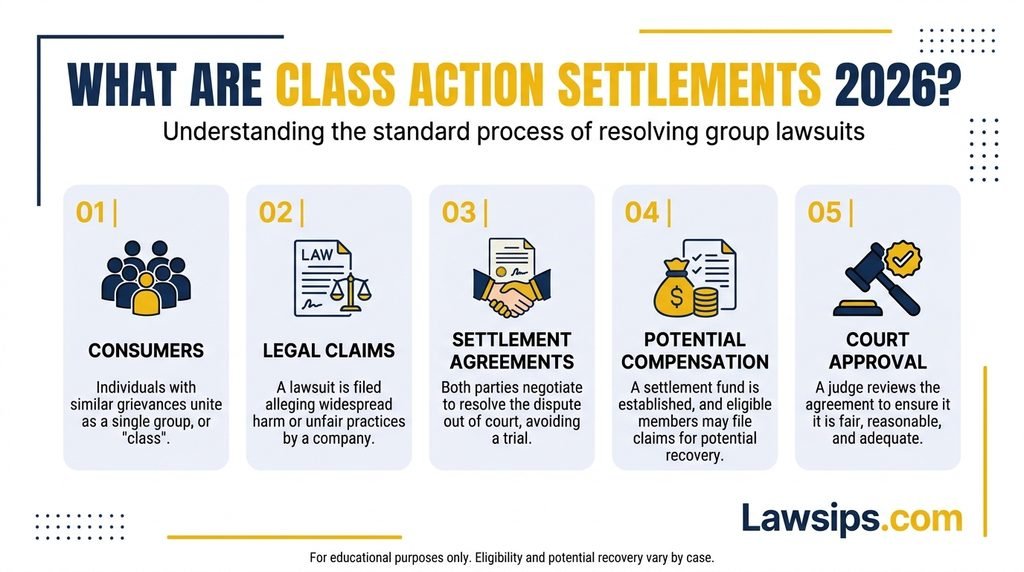
Years in this niche have themes, and 2026 had four. Together they predict where the next claims and the next billions will appear.
1. AI met a price tag
The Anthropic deal converted training data into a priced asset. Per work statutory damages gave authors leverage no negotiation could, and rival AI cases now bargain in its shadow.
2. Student debt became settlement currency
Sweet proved that debt discharge can outscale any cash fund. Relief measured in cancelled loans will anchor future education cases.
3. Environmental money went to governments
Between New Jersey’s deal and the water systems programmes, PFAS money flows to states and cities. Individual exposure claims remain separate, slower, and lawyer led.
4. Privacy kept its steady drumbeat
CVS, GoodRx, Flo, and a dozen smaller cases showed website tracking and app privacy as the reliable consumer category. Small payments, huge classes, constant deadlines: this is the everyday settlements economy.
How Much Did Ordinary People Actually Get in 2026?
Strip away the landmarks and the everyday numbers look familiar. Most consumer claimants in 2026 received between $5 and $100, exactly as in prior years.
| Claimant type | Realistic 2026 result |
|---|---|
| Website privacy claimant | $5 to $40 |
| Product labelling claimant | $5 to $50 |
| Data breach flat tier claimant | $25 to $100 |
| Data breach documented claimant | Several hundred, with records |
| Illinois biometric claimant | Often several hundred |
| Author in the Anthropic class | About $3,000 per covered work |
| Borrower in the Sweet class | Their covered loans, discharged |
Our analysis of the settlement payout per person shows why division, not fund size, decides your envelope. A $250 million fund shared by millions pays less per person than a $5 million fund shared by thousands.
The year’s real anomaly is the author row. Per work copyright maths briefly made a creative class the best paid ordinary claimants in America.
Class Action vs Mass Tort: Why the Money Behaves Differently
Confusion between these two systems distorts expectations every year. A short comparison keeps 2026’s numbers in their proper boxes.
| Feature | Class action | Mass tort |
|---|---|---|
| Structure | One class, one deal | Many individual claims, coordinated |
| Who is paid | Class members who claim, or are identified | Individual claimants, valued case by case |
| Typical consumer result | $5 to $100 | Injury based, from hundreds to six figures |
| How you join | Claim form or automatic inclusion | Usually through a law firm |
| 2026 examples | Sweet, Anthropic, CVS, GoodRx | Roundup, talc, 3M earplugs |
New claimants should start with our overview of how to join a class action lawsuit, because the two systems ask for entirely different first steps.
Closed and Paying in 2026: The Rear View
Not every 2026 story is a deadline. Several major funds closed their windows this year and moved into the validation and payment stages.
The NAR homebuyer settlement, at $120.3 million, took claims until 27 October 2026. The Flo period tracker privacy fund closed its window in mid October, after months of app privacy coverage.
Earlier in the year, tracker rankings highlighted large open funds in data breach and social privacy cases. Hyundai and Kia anti theft settlements and TikTok and Instagram privacy funds featured prominently.
Each has since moved along its own payment road. Their claim windows were this year’s spring and summer story, before the autumn wave took over.
The lesson of the rear view is timing. Every fund on this year’s closed list was once an open row on a page like this one, with months of warning.
A 2026 Timeline: The Year in Milestones
| Month | Milestone |
|---|---|
| Early 2026 | Visa Mastercard interchange fund begins paying merchants |
| June 2026 | $38 billion card fee deal wins preliminary approval |
| 17 July 2026 | Ninth Circuit refuses to delay Sweet relief deadlines |
| 20 July 2026 | Anthropic $1.5 billion wins final approval |
| 23 July 2026 | Sweet announced as largest class settlement in US history |
| 7 August 2026 | New Jersey PFAS $2.5 billion approved |
| October 2026 | Pork, Bestway, and TransUnion deadlines close the autumn wave |
| December 2026 | Apple and GoodRx claim windows close |
| February 2027 | GoodRx approval hearing; ATM surcharge deadline |
Eight weeks in July and August carried the year. Three of the largest settlements in American history reached their defining moments before Labor Day.
Local Money: The Renter and Driver Cases
Two 2026 stories remind readers that geography pays. National lists bury local settlements, yet local classes are smaller and shares run larger.
The RealPage rent pricing settlement, open until 29 January 2027, is the year’s renter case. It challenges algorithmic rent pricing used by large landlords, and eligibility turns on where you rented and when.
New York drivers hold the TLC licence suspension claim, listed around $200 per person from a fund trackers put at $140 million. Its deadline falls on 28 December 2026.
The habit to build is filtering by your own map. Your state, your city, and your landlord or employer decide more of your eligibility than any national headline.
Why July 2026 Will Be Remembered
Legal years rarely get a signature month, but July 2026 earned one. Three decisions inside three weeks reset what class actions can do.
On 17 July, appellate judges refused to slow the largest settlement in history. On 20 July, a trial judge approved the largest copyright payout ever.
On 23 July, the Sweet tally was announced to the public. By August, a state environmental record followed, and the year had its shape.
Writers will cite July 2026 for years. It is the month class actions produced two all time records and a new price for training data.
How This Page Will Be Updated
A year hub decays by design, so its maintenance is part of the promise. This page will be revised as statuses change through the year end.
December’s revision will close the open table as Apple and GoodRx pass, and February’s will record the GoodRx hearing result. Proposed cases will move sections if courts approve or kill them.
The rule for every revision stays fixed. Figures change only with a source, and proposals never wear the costume of payments.
Stay Safe: 2026 Settlement Scams

Every landmark spawns imitators within days. The Anthropic and Sweet stories both attracted fake check your eligibility pages harvesting personal data.
Protect yourself with four habits that never change. Type official addresses yourself, never pay to file, cross check cases in court records, and distrust urgency invented by a message.
The Federal Trade Commission’s consumer guidance remains the fastest sanity check for suspicious refund and settlement contacts. If a page wants bank logins or card numbers, it is not a settlement site.
Borrowers need one extra warning. Sweet relief flows through official servicers and the Education Department, never through paid helpers promising faster discharge.
What to Watch in 2027
The 2026 map points clearly at next year’s fronts. Four stories deserve a place on every reader’s watchlist.
| Watch item | Why it matters |
|---|---|
| Social media youth harm trials | Bellwether results could force the next tech mega settlement |
| Talc’s bankruptcy endgame | Approval or collapse decides an $8.9 billion question |
| More AI training cases | Anthropic set the per work price; rival cases will test it |
| GoodRx hearing, 11 February 2027 | The first landmark approval hearing of the new year |
Our companion page on open class action lawsuits tracks cases still moving toward settlement, which is where 2027’s headlines currently live.
How 2026 Compares With the Giants of History
Sweet’s announcement placed it in a very small club. The comparison below uses the figures its own counsel cited, and it shows how unusual 2026 was.
| Settlement | Era | Scale |
|---|---|---|
| Tobacco master settlement | 1998 | $246 billion combined |
| Opioid settlements | 2021 onwards | About $58 billion combined |
| National Mortgage Settlement | 2012 | $25 billion |
| Sweet v. McMahon | 2026 | $23 billion plus |
| Anthropic copyright | 2026 | $1.5 billion, a category record |
Two 2026 entries in a table of all time landmarks is remarkable. One year rarely produces a single settlement of this weight, let alone two different kinds.
For the longer history of how these cases work and pay, read our guide to class action lawsuit settlements and their most famous examples.
Mistakes Readers Made With 2026 Settlements
The year’s losses were mostly avoidable, and they repeat the same few patterns worth naming before 2027 begins.
- Assuming big means claimable: readers hunted for PFAS and interchange claim forms that never existed for individuals.
- Missing autumn deadlines: the October wave closed on people who had saved articles instead of filing them.
- Trusting ceiling headlines: a $95 maximum became, in retelling, a $95 promise.
- Paying fake helpers: impostor services charged borrowers and authors for free, official processes.
- Skipping the works and class lists: eligibility in 2026 turned on lists, and guesses wasted claims.
The single habit that fixes most of these is reading the who receives line first. Our list of class action settlements you can claim is built on exactly that order.
Three Readers, Three Routes Through 2026
Different readers need different doors into this page. Find yours below and take the shortest honest route to value.
If you wrote a book: go straight to the Anthropic section, then to the official works list. Your registration dates decide everything, so check before assuming either way.
If you hold student loans: read the Sweet section for the class windows and Exhibit C logic. Relief flows through official channels only, and no helper can speed it.
If you simply shop and scroll: work the open table top to bottom. Your money is in the November and December rows, and it expires on schedule.
What 2026 Proved About Class Actions
Step back and the year teaches four durable lessons that will outlive every deadline on this page.
First, scale has moved upward. The largest settlement in history and the largest copyright payout ever landed within four days of each other in July.
Second, the form of payment is diversifying. Debt discharge, per work royalties, state infrastructure funds, and merchant refunds all outrank the classic consumer cheque this year.
Third, lists decide eligibility. Exhibit C schools, the Anthropic works list, class period dates: 2026 rewarded people who checked lists and punished people who guessed.
Fourth, accuracy became the scarce asset. In a year when farms published invented funds weekly, the pages that attributed figures and flagged proposals earned the trust, and the rankings followed.
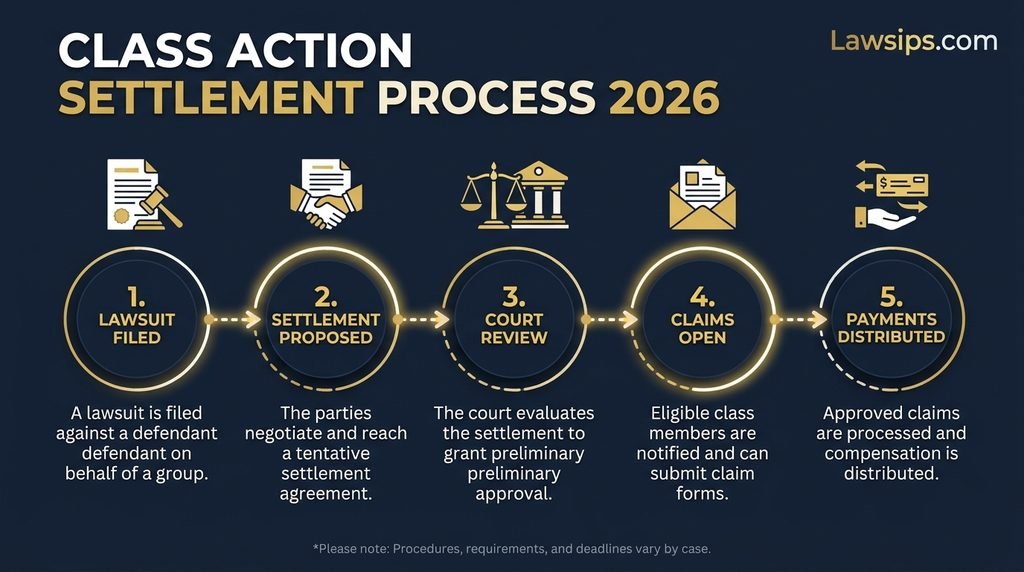
Key Takeaways
- Sweet v. McMahon is 2026’s giant: $23 billion plus in borrower relief, announced as the largest class settlement in US history.
- Anthropic priced AI training data at about $3,000 per covered book in a $1.5 billion record copyright deal.
- New Jersey’s $2.5 billion PFAS money goes to the state, with no individual claim form.
- Consumer claims are still open into February 2027, led by Apple, GoodRx, RealPage, and the ATM surcharge case.
- Ordinary payments stayed ordinary: $5 to $100 for most people, whatever the headlines said.
- Proposed is not approved: the talc $8.9 billion remains a fight, not a fund.
Frequently Asked Questions
What is the biggest class action settlement of 2026?
Sweet v. McMahon, at $23 billion plus in student loan relief. The borrowers’ counsel announced it in July 2026 as the largest class action settlement in American history.
Is Sweet really the largest settlement ever?
Its counsel ranks it among the giants, behind tobacco’s $246 billion combined deal and the opioids’ roughly $58 billion, and beside the $25 billion mortgage settlement. It is the largest against the federal government.
Do Sweet borrowers receive cash cheques?
No. Relief means federal loan discharge and defined refunds, delivered through servicers. Each borrower’s benefit equals their own covered loans.
Who qualifies for Sweet relief?
Borrowers with borrower defence applications in the settlement’s windows. Those tied to Exhibit C schools receive automatic relief, and other groups follow decision deadlines.
What happened in the Sweet case in July 2026?
On 17 July 2026, a Ninth Circuit panel denied the Education Department’s attempt to delay deadlines. That ruling triggered relief for over 170,000 additional post class borrowers.
What is the Anthropic settlement about?
Authors alleged Anthropic trained Claude on pirated books from Library Genesis and Pirate Library Mirror. The $1.5 billion settlement won final approval on 20 July 2026.
How much does the Anthropic settlement pay per book?
About $3,000 per covered work on average, before fees. Reported per work values range widely, from a few hundred dollars to six figures for some titles.
How do I check if my book is covered?
Search the official works list named in the settlement notice. Eligibility also requires timely registration with the US Copyright Office, so check both conditions.
Is the Anthropic deal the largest copyright payout ever?
Yes, according to class counsel and coverage of the approval. At $1.5 billion it is described as the largest recovery in US copyright litigation history.
Do New Jersey residents get PFAS settlement money?
No. The $2.5 billion goes to the state for cleanup, drinking water, and restoration over 25 years. No individual application exists.
Can consumers claim the Visa Mastercard interchange settlement?
No. Interchange money belongs to merchants who accepted the cards. The consumer card case is the separate ATM surcharge settlement closing in February 2027.
Did the interchange settlement start paying in 2026?
Yes. The $5.54 billion damages fund began paying merchants in early 2026, and a separate $38 billion fee practices deal won preliminary approval in June 2026.
What consumer settlements can I still claim in late 2026?
Apple Intelligence, GoodRx privacy, CVS privacy, Dr. Squatch, Skin360, RealPage, and the ATM surcharge case remain open at the October check. Deadlines run from today into February 2027.
Which open settlement pays the most per person?
Documented tiers and credit reporting estimates lead: TransUnion’s estimate runs $350 to $1,000. Typical consumer payments remain $5 to $100.
Is the J&J talc settlement paying claims in 2026?
No. The $8.9 billion figure is a proposal contested through bankruptcy proceedings. It is not an approved settlement, whatever some pages imply.
Are Roundup and 3M earplug settlements still paying?
Yes, both mass tort programmes continued distributing in 2026. They pay injury claimants through legal processes, not consumer claim forms.
Why do the biggest settlements rarely pay individuals?
Government and mass tort funds pay states, cities, and injury classes. Consumer funds divide across millions of people, so pro rata shares stay small.
What is the difference between a class action and a mass tort?
A class action settles one defined class in a single deal. A mass tort coordinates many individual injury claims, each valued on its own facts.
What does final approval mean?
It is the judge’s ruling that the settlement is fair and binding. Anthropic reached it on 20 July 2026, months after preliminary approval.
How long after approval do payments start?
Timelines vary from months to years. The interchange fund took two decades from filing to payment; consumer cases usually pay within 6 to 18 months of their deadlines.
What settlements should I watch in 2027?
The social media youth harm trials, talc’s endgame, follow on AI training cases, and GoodRx’s February 2027 approval hearing top the list.
How do I verify a 2026 settlement is real?
Find it in court records, on its official settlement website, and across independent trackers simultaneously. One source alone is never enough for money claims.
Conclusion
Class action settlements 2026 delivered a landmark year and a normal year at once. History was made in July courtrooms, while ordinary claimants collected the same modest cheques as always.
Hold both truths together. Honour the scale of Sweet and Anthropic, then go and file the Apple, GoodRx, and CVS claims that actually put money in a reader’s pocket.
Return through the year end as December deadlines close, because class action settlements 2026 will keep moving until the final February hearings. For the newest filings and guides, follow the LawSips homepage.
One final habit separates readers who collect from readers who only read. Check the open list monthly, file the week you find a fit, and let the landmark billions inspire the habit rather than replace it.

Dilawar Mughal is an SEO expert with 8 years of hands-on experience helping websites grow their organic traffic, rankings, and revenue. He specializes in content-driven SEO, local SEO, and Pinterest SEO, and builds practical, results-focused strategies for businesses and publishers.