
Forbes Website Tracking Settlement: $10M Fund, Claim by November 9, 2026

If you lived in California and visited a Forbes website between December 20, 2023 and June 11, 2026, you may be owed a share of a $10 million fund.
The case is Berman, et al. v. Forbes Media LLC. The lawsuit alleges that trackers on Forbes websites collected visitors’ IP addresses and unique identifiers without consent and shared them with third parties. Forbes denies wrongdoing, and the court has not ruled on the merits.
There is exactly one official place to file: the court authorized settlement website run by Kroll Settlement Administration. Links, lookalikes, and paid filing services all compete for this search; this page keeps pointing at the one door the court opened.
No receipts, no browsing history, no subscription record. Filing takes minutes, costs nothing, and the rest of this page covers who qualifies, what you might receive, and what happens after you file, in that order.
This is general legal information, not legal advice, written on November 6, 2026, with the deadline three days out. Read the status box, check yourself against the class definition, and file today rather than on deadline day.
Forbes website tracking settlement claims close on Monday, November 9, 2026, and that date is the reason this page exists.
Status First: Claims Close November 9, 2026
Settlements reward the organized, so here is the whole case on one card before any explanation.
|
Item |
Detail |
|---|---|
|
Case |
Berman, et al. v. Forbes Media LLC |
|
Case number |
3:24-cv-09287-WHO |
|
Court |
U.S. District Court, Northern District of California |
|
Judge |
William H. Orrick |
|
Settlement fund |
$10,000,000 |
|
Claim deadline |
November 9, 2026 (online, or postmarked for mail) |
|
Final approval hearing |
December 2, 2026, 2:00 p.m. PT |
|
Administrator |
Kroll Settlement Administration LLC |
|
Official website |
MediaSiteTrackerSettlement.com |
|
Administrator phone |
(833) 930-0568 |
The court granted preliminary approval on June 11, 2026, which is why notices went out and claims are open. Final approval is not yet granted; that decision belongs to the December hearing, and payments wait for it.
The Top Class Actions November 2026 settlements roundup lists this settlement among the claims closing in November 2026, which is how many readers first hear of it. Roundups are good alarms and bad filing cabinets: they announce deadlines, but the claim itself lives only at the official site.
One date on the card has already passed, deliberately included so nobody wastes hope on it: the opt out and objection deadline was September 24, 2026. Those doors are closed. The claim door is the one still open, for three more days.
Is This Settlement Legit: The Case Identifiers
Settlement news travels through social posts and screenshots, and skepticism is healthy. Legitimacy in this world is not a vibe; it is a set of identifiers that either check out or do not.
This one checks out. A named case with named plaintiffs (Berman, et al.), a federal docket number, a sitting judge, a court that granted preliminary approval, and a professional administrator, Kroll Settlement Administration, whose business is running exactly these processes.
The Kroll notice announcing the Forbes settlement carries the administrator’s own announcement, issued in Kroll’s name, stating the class definition, the fund, and the deadlines in the formal language of the notice. When a settlement is real, its paper trail reads like that: boring, specific, and signed.
The official Forbes settlement website (MediaSiteTrackerSettlement.com) states its own authority: a federal court authorized the site, and it is the only authorized settlement website for this case. That sentence is the whole verification test. Any other page asking for your claim details is, at best, a middleman.
Do the five second check yourself before filing anywhere: case name matches, docket number matches, the court is the Northern District of California, the administrator is Kroll, and the address is the official one, typed by you, not tapped from a post.
What the Lawsuit Alleges: Trackers, IP Addresses, and California Privacy Law
The mechanics are simple, which is why the case matters beyond Forbes. Modern publisher websites carry small third party tools called trackers: tags and pixels that observe visits and report them to outside companies, mostly for advertising.
The complaint alleges that trackers on Forbes websites collected California visitors’ IP addresses and or unique identifiers and shared them with third parties, without the visitors’ consent, so the data could feed ad targeting systems.
The trackers named in the complaint are specific: the LinkedIn Insight Tag, Microsoft’s Universal Event Tracking tag, and the Adnx tracker from Xandr, the ad technology company Microsoft acquired in 2021. The settlement, though, covers tracker sharing on Forbes sites generally, not only those three.
The legal engine is California law: the official notice frames the claims under Section 638.51(a) of the California Invasion of Privacy Act and the California Unfair Competition Law. CIPA is an older wiretapping statute that plaintiffs have aimed at modern web tracking across a wave of publisher cases.
Forbes’s position is also on the record and belongs in any honest summary: Forbes denies these allegations and denies any wrongdoing. A settlement is a resolution, not a verdict; the court never decided whether the trackers broke the law.
What Forbes did agree to is disclosure: on the reported terms, clearer notice of its trackers in its privacy policy and disclosures within 60 days after the settlement takes effect. Settlements call that injunctive relief, and it is the part of the deal that outlives the checks.
Who Qualifies: California, Those Dates, Visits Not Subscriptions
The class definition is short enough to memorize, and every word of it does work.
You are a class member if you are a California resident, you accessed a website owned or controlled by Forbes between December 20, 2023 and June 11, 2026, and your IP address or unique identifiers were shared with third parties because of the trackers on those sites.
California means you were a California resident, in California, when you visited. The class is state bounded because the claims rest on California law.
Those dates define the class period. Visits before December 20, 2023 or after June 11, 2026 sit outside the definition, whatever else is true about them.
Visits, not subscriptions. The class is defined by accessing the websites, so free readers qualify on the same terms as paying subscribers. No account, no subscription record, and no proof of any visit is required to file; the claim form asks for a sworn statement of eligibility.
The exclusions are the standard ones: Forbes and its affiliates’ officers, directors, and employees, close relatives of Forbes officers and directors, the judge, and people who work for the class lawyers’ firms are not class members.
The size of this class explains the payment math in the next section: court reporting puts it at about 3.9 million people.
Almost none of them will file, and that ratio, claims filed against class size, is what turns $10 million into a per person figure.
Eligibility Edges: Movers, Workers, Estates
Real lives do not fit class definitions neatly, so the common edge cases get direct answers here, drawn from how the definition is written.
You moved away from California. Eligibility is fixed at the moment of the visit. If you lived in California and visited from California during the class period, moving afterward does not remove you. File with your current address so a payment can find you.
You read Forbes at work. The definition concerns the visitor and the access, not whose network carried it. A California resident reading Forbes on an employer’s California network accessed the site from California like anyone else.
You visited while traveling. The class is written around California residents accessing from California. A resident of another state who merely passed through sits outside the definition as written; the administrator can confirm hard cases by phone.
Multiple visits, multiple devices. Payment is per person, not per visit. One claim per class member, however many articles you read. Duplicate filings do not multiply a share and can flag a claim in review.
A class member has died, or is a minor. Estates and guardians can generally pursue claims on behalf of deceased or minor class members with documentation. Because the deadline is days away, call the administrator now and ask exactly what they need.
Your Rights and Options, As the Court States Them
The official notice reduces the settlement to four options, and at this point in the calendar only one of them is still alive. The table below follows the court’s own framing.
|
Option |
What it means |
Deadline |
|---|---|---|
|
Submit a claim |
The only way to receive a payment |
November 9, 2026 |
|
Exclude yourself |
Leave the class, keep the right to sue separately, get no payment |
September 24, 2026 (passed) |
|
Object |
Stay in the class but tell the court what you oppose |
September 24, 2026 (passed) |
|
Do nothing |
No payment, and you give up the right to sue over these claims |
No deadline |
Two clarifications keep readers out of the common errors. Objecting and claiming were compatible: an objector could still file a claim, and some did.
And doing nothing is not neutral: it surrenders both the payment and the underlying claims, the worst cell in the table, and the default destination of everyone who never hears about the case.
The exclusion row deserves one honest sentence for readers who wanted out and missed September: that right is gone.
The settlement, if finally approved, will bind every class member who did not exclude in time, which is precisely why courts require notice programs and why pages like this one repeat deadlines until they close.
How Much Will You Get: The Fund Waterfall and Honest Estimates
Nobody can tell you your amount, and the discipline of this page is to show you why, precisely, instead of inventing a number.
The $10 million is a gross fund. Before any class member is paid, the fund covers settlement administration costs first.
Then come court approved attorneys fees (class counsel can ask for up to 25 percent, $2,500,000, plus expenses, and the judge can award less) and $2,500 for each of the two class representatives.
The ClaimDepot Forbes settlement fund breakdown prints the same breakdown, and the arithmetic it implies is the point: what remains, the net fund, is divided equally, pro rata, among every valid claim filed on time.
|
If valid claims total |
Illustrative share of a $7M net fund |
|---|---|
|
39,000 (1 percent of the class) |
About $179 |
|
78,000 (2 percent) |
About $90 |
|
195,000 (5 percent) |
About $36 |
The table is an illustration with an assumed net fund, not a promise; the real net fund and claim count are unknown until the court rules on fees and claims close. It exists to show the shape: your share moves inversely with everyone else’s filing decision.
Published estimates are strands of the same arithmetic. The ClaimsHero Forbes settlement summary reports a $32 to $189 range attributed to court filings.
The MoneyPilot Forbes settlement estimate publishes $61 to $186 as its own estimate from the filings, showing its claim rate assumptions.
Both are estimates wearing their methods; neither is official, and the overlap between them is the honest takeaway.
This site’s explainer on settlement payout per person walks the same pro rata logic across settlements generally. The pattern to remember: no administrator publishes your number in advance, because the number does not exist yet.
How to File: Online or by Mail, Step by Step
Filing is deliberately easy; the settlement wants valid claims, not obstacle courses. Two routes, one deadline.
Online, the fast route:
- Type the official address, MediaSiteTrackerSettlement.com, into your browser yourself.
- Confirm the case name on the page: Berman, et al. v. Forbes Media LLC.
- Open the claim form and enter your contact details.
- Give the Class Member ID from your notice if you have one; the claim can be filed without it.
- Make the sworn eligibility statement: California resident, accessed Forbes sites in the class period.
- Submit, then save the confirmation and a screenshot with the date.
By mail, the paper route:
- Print the Proof of Claim form from the official site, or write to request one.
- Complete it with the same information as the online form.
- Mail it postmarked by November 9, 2026 to Berman, et al. v. Forbes Media LLC, c/o Kroll Settlement Administration LLC, P.O. Box 225391, New York, NY 10150-5391.
- Keep a copy and, if you can, proof of the postmark date.
The postmark rule is the mail filer’s friend: a form mailed on deadline day counts as on time even if it arrives later. Online filers get no such grace past the deadline, so file online today if you are reading this on the weekend.
If anything in the form confuses you, the administrator’s line is (833) 930-0568. That number reaches the people processing claims, which no filing service and no comment section can say.
For the general method behind these steps, this site’s guide to how to file a claim for settlement covers claim forms across settlements, and how to join a class action lawsuit explains how claims made classes like this one work.
Forbes specific facts, though, come from the notice and the official site alone.
Not the Forbes VPPA Settlement: Two Different Cases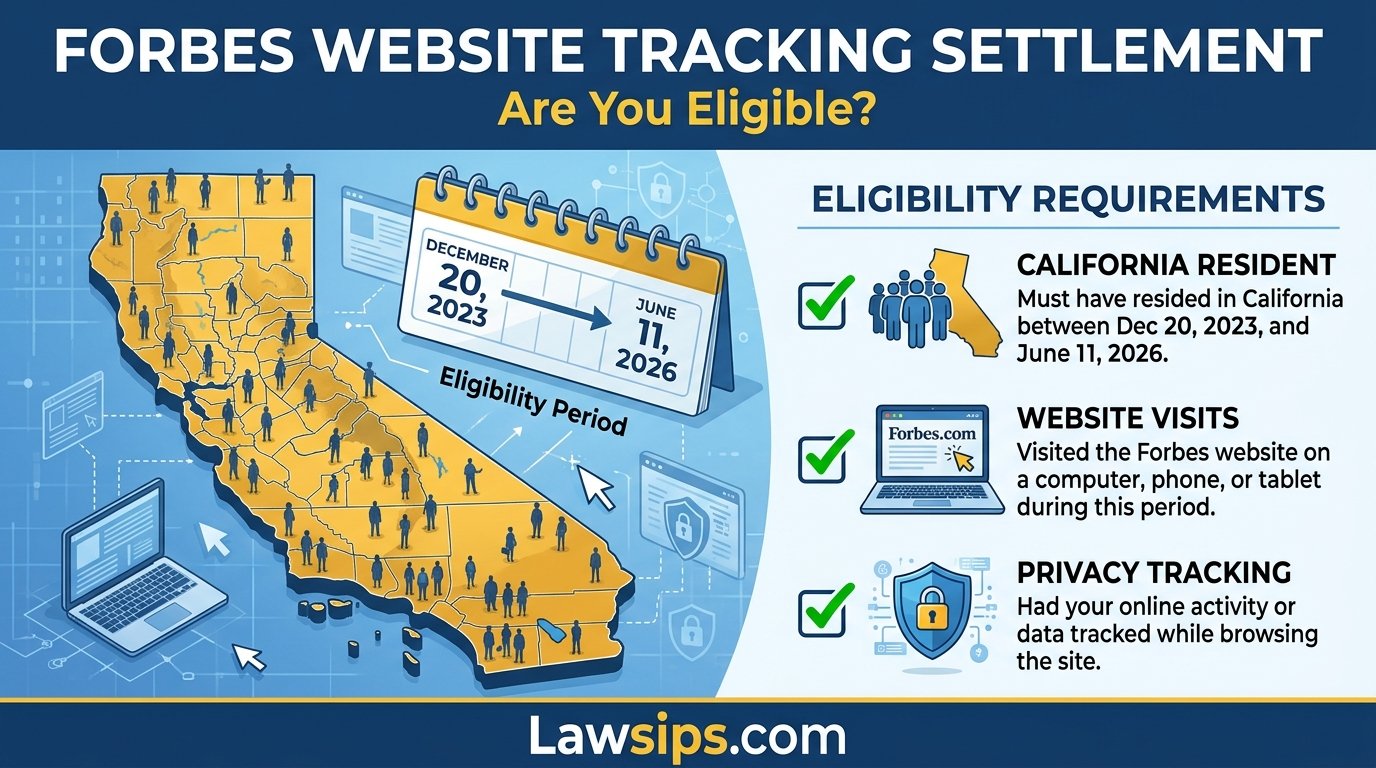
Forbes has settled two different privacy cases, and search results happily blur them. Filing energy spent on the wrong one is wasted, so the separation gets its own section.
This case is the website tracking settlement: trackers, IP addresses, California visitors, Berman v. Forbes Media, a $10 million fund, and a claim deadline of November 9, 2026.
The other case was the VPPA settlement: claims about video viewing and Facebook related data sharing under the federal Video Privacy Protection Act. Its claim deadline was November 4, 2025, more than a year ago. It is closed, and nothing filed there counts here.
If a page, post, or video about a Forbes settlement does not say which case it means, treat its dates as unreliable until you match them against the identifiers in the status box above.
Why This Case Exists: The California Tracker Wave
Forbes is not being singled out; it is being processed. In recent years, plaintiffs firms have aimed CIPA, a statute written for the wiretapping era, at the ordinary machinery of the modern web: analytics tags, advertising pixels, and session tools that report visitor identifiers to third parties.
The theory is consistent across the wave. An IP address or device identifier, the argument runs, is personal information about a visitor; a tracker that transmits it to an ad company without consent discloses a communication in ways the statute forbids.
Publishers answer that trackers are disclosed in privacy policies, are industry standard, and identify machines, not people.
Courts have not settled the theory nationally, which is exactly why these cases settle. A defendant weighs the cost and risk of litigating a novel claim across millions of visitors; plaintiffs weigh the risk of losing the legal theory entirely. The $10 million here is that calculation, priced.
For readers, the wave has a practical meaning: this will not be the last notice like this. The eligibility habit, check the class definition, file at the administrator’s site, keep the confirmation, transfers intact to the next publisher, retailer, or streamer whose trackers draw the same claim.
After You File: Hearing, Approval, and When Payments Arrive
Filing takes minutes; the machinery after it takes months, and knowing the sequence prevents both anxiety and scam vulnerability.
December 2, 2026, 2:00 p.m. PT: the final approval hearing in San Francisco. Judge Orrick decides whether the settlement is fair, reasonable, and adequate, and rules on the fee request and the two incentive awards.
After approval: an appeals window runs. If nobody appeals and the judgment stands, the settlement reaches its effective date, and only then does distribution begin. If someone appeals, payments wait for the appeal, which can add many months.
Distribution: Kroll validates claims, the net fund is divided pro rata, and payments go out by the method each claimant selected where a choice was offered, with mailed checks as the standard default.
Practical corollaries. Keep your address current with the administrator if you move; claims cannot be added after November 9, but addresses can be updated.
Keep your confirmation until money arrives. And treat any message promising to speed up your Forbes payment for a fee as what it is: a scam wearing the settlement’s clothes.
This page will be updated after the December hearing with the outcome and the fee award, because the fee decision is the last unknown in your payment arithmetic.
Scam Defense: Fake Sites, Paid Filers, and Aggregator Deadlines
Three hazards orbit every real settlement, and all three orbit this one.
Fake sites. Lookalike pages harvest personal data under settlement branding. The defenses are dull and total: one official address, typed by you; a process that never asks for bank logins, Social Security numbers, or payment; and identifiers you can cross check in seconds.
Paid filing services. Companies will file this same free form for a fee or a cut. That is legal and, for most people, unnecessary. If you use one regardless, verify it submits before November 9, and walk away from any service that guarantees an amount.
Aggregator deadlines. Filing services run their own intakes, and their calendars are not the court’s.
One service’s page announced its Forbes intake closed November 2, and another listed November 5, while the court’s deadline is November 9, 2026. Readers who met those banners first could reasonably believe filing had ended. It has not, on the official site, until Monday.
The wider habit protects you beyond this case. The maintained lists at open class action settlements and class action settlements you can claim track live deadlines across settlements, and every entry follows the same rule: the administrator’s site is the source; everything else is a signpost.
Deadline Weekend: The Filing Checklist
If you are reading this between Friday and Monday, skip the scholarship and work the list. Everything above exists to make these ten minutes go correctly.
- Confirm the class fit. California resident, in California, visited a Forbes owned site between December 20, 2023 and June 11, 2026. If all three are true, continue.
- Find your notice, if you got one. The Class Member ID speeds the form. No notice and no ID is not a barrier; file without it.
- Type the official address yourself. MediaSiteTrackerSettlement.com, entered by hand, not tapped from a post, a text, or a search ad.
- Match the identifiers. Case name Berman, et al. v. Forbes Media LLC on the page in front of you. Anything else is the wrong room.
- Complete the form and the sworn statement. Contact details accurate enough for a check to find you next year.
- Submit and capture proof. Confirmation page screenshotted, confirmation number written down, date noted.
- Paper filers: print, complete, and mail so the envelope is postmarked by Monday, November 9. A weekend mailbox run beats a Monday queue.
- Tell two people. Every eligible reader who never files raises the value of the claims that do, but the class notice system only works when readers pass it on.
Then stop. No service to pay, no account to create, no document hunt. The claim is in, and the next event belongs to the court on December 2.
1. What is the Forbes website tracking settlement?
A class action settlement in the case Berman v Forbes Media LLC, Case Number 3:24-cv-09287-WHO.
Plaintiffs alleged trackers on Forbes websites collected California visitors’ IP addresses and identifiers without consent and shared them with third parties.
Forbes denies wrongdoing and agreed to a $10 million fund.
2. When is the Forbes settlement claim deadline?
November 9, 2026.
Online claims must be submitted by that date, and paper claims must be postmarked by it.
The deadline is days away from this page’s publication, so file today rather than on deadline day.
3. Who qualifies for the Forbes settlement?
California residents who accessed a website owned or controlled by Forbes between December 20, 2023 and June 11, 2026, and whose IP address or unique identifiers were shared with third parties through trackers on those sites.
You must have been in California when you visited.
4. Do I need a Forbes subscription to qualify?
No.
The class is defined by visiting, not buying.
Free readers of Forbes websites are class members on the same terms as subscribers, and no subscription record is asked for on the claim form.
5. Do I need proof that I visited Forbes?
No.
The claim asks for a sworn statement that you are a California resident who accessed Forbes websites during the class period.
No receipts, account records, or browsing history are required.
6. How much money will I get from the Forbes settlement?
Nobody can state your amount yet.
Every valid claim gets an equal pro rata share of the net fund after fees, awards, and costs.
Published estimates are strands: $32 to $189 (court filings, via claims services) and $61 to $186 (one guide’s own estimate).
Your share depends on the final valid claim count.
7. Is the Forbes website tracking settlement legit?
Yes.
It is a court supervised settlement with a named case, docket number, judge, and court approved administrator (Kroll).
The court granted preliminary approval on June 11, 2026.
Verify by typing the official site address, MediaSiteTrackerSettlement.com, yourself.
8. What is the official Forbes settlement website?
MediaSiteTrackerSettlement.com, authorized by the court and run by Kroll Settlement Administration.
Type the address into your browser rather than following links from social posts or texts, because lookalike sites exist.
9. How do I file a claim for the Forbes settlement?
Complete the online Proof of Claim on the official site, or mail the paper form postmarked by November 9, 2026 to the Forbes settlement, care of Kroll Settlement Administration LLC, PO Box 225391, New York, NY 10150-5391.
Keep your confirmation or a copy of what you sent.
10. Can I file without a claim ID or notice?
Yes.
Notices carried a Class Member ID that speeds filing, but a claim can be filed without one.
If you lost yours, the administrator’s line, (833) 930-0568, can help.
11. What did Forbes allegedly do wrong?
The complaint alleges Forbes websites ran third party trackers, including the LinkedIn Insight Tag, Microsoft’s Universal Event Tracking tag, and Xandr’s Adnx tracker.
Those trackers allegedly collected visitors’ IP addresses and identifiers and shared them for ad targeting without consent, violating the California Invasion of Privacy Act.
Forbes denies the allegations.
12. Did Forbes admit wrongdoing?
No.
Forbes denies any wrongdoing, which is standard in settlements.
The settlement resolves the case without any court finding on whether the trackers broke the law.
13. What is the case name and number for the Forbes settlement?
Berman v Forbes Media LLC, Case Number 3:24-cv-09287-WHO, in the United States District Court for the Northern District of California, before Judge William Orrick.
14. Who is the settlement administrator?
Kroll Settlement Administration LLC.
Kroll runs the official site, processes claims, and answers questions at (833) 930-0568.
The administrator works for the settlement, not for Forbes marketing and not for any claim filing service.
15. When is the final approval hearing?
December 2, 2026 at 2:00 PM Pacific Time in San Francisco.
The judge will decide on final approval and on attorneys fees (requested up to $2,500,000, 25 percent of the fund, plus expenses) and incentive awards of $2,500 for each of the two class representatives.
16. When will Forbes settlement payments be sent?
Only after the court grants final approval and the settlement becomes effective, which includes time for any appeals.
No payment date has been announced.
Payments realistically follow the December 2, 2026 hearing by months, not days.
17. Can I still opt out of the Forbes settlement?
No.
The deadline to exclude yourself or object was September 24, 2026, and it has passed.
Class members who do nothing keep the settlement’s terms but receive no payment, because a filed claim is required to be paid.
18. What happens if I do nothing?
You remain bound by the settlement, including its release of the claims it resolves, but you receive no money.
Payment is not automatic in this settlement; only class members who file a valid, on time claim are paid.
19. I moved out of California. Do I still qualify?
Eligibility turns on where you were when you visited.
If you were a California resident accessing Forbes sites from California during the class period, moving away afterward does not remove you from the class.
File with your current mailing address.
20. I visited Forbes while traveling in California. Do I qualify?
The class covers California residents who accessed the sites while in California.
A non resident who merely passed through is outside the class definition as written.
For hard cases, the administrator can confirm how the definition applies.
21. I read Forbes at work in California. Does that count?
The definition is about the visitor and the access, not the network owner.
California residents who accessed Forbes websites from California, including on an employer’s network, fall inside the class language.
22. How many claims can I file?
One.
Payments are per class member, not per visit, per device, or per website.
Filing duplicates does not increase your share and can flag your claim during verification.
23. Can I file for a deceased family member?
Estates can typically pursue a deceased class member’s claim with documentation.
Contact the administrator for the exact requirements now, before the deadline, so paperwork does not cost the claim.
24. Can I file for my child?
A parent or guardian can generally file on behalf of a minor class member.
The administrator can confirm the signature and documentation rules that apply.
25. Is this the same as the Forbes VPPA settlement?
No.
That was a separate case about video viewing and Facebook related claims under the Video Privacy Protection Act, and its claim deadline was November 4, 2025.
This settlement covers website trackers and California visitors, with a November 9, 2026 deadline.
Different case, class, and fund.
26. Why do some sites say Forbes claims already closed?
Some claim filing services closed their own intake early, one showing November 2, 2026, and their pages read as if filing ended.
Those are service deadlines, not the court’s.
The court’s claim deadline is November 9, 2026, on the official administrator site.
27. Should I pay a service to file my claim?
Filing directly with the administrator is free and takes a few minutes.
Paid services file the same form and take a fee or a cut.
If you use one anyway, confirm it submits before November 9, and never pay a service that guarantees a specific payment amount.
28. How do I know a Forbes settlement site is fake?
Warning signs: a wrong case name, no docket number, requests for bank logins, Social Security numbers, or payment to file, and countdown pressure with no court information.
The real process asks for contact details and a sworn eligibility statement, costs nothing, and lives at the official address only.
29. What does pro rata mean for my payment?
The net fund is divided equally among all valid claims.
More claims means smaller shares; fewer claims means larger shares.
With about 3.9 million people in the class and typical claim rates in the low single digits, the arithmetic lands in the ranges the published estimates describe.
30. What comes out of the $10 million before class members are paid?
Administration costs, court approved attorneys fees (requested up to $2,500,000 plus expenses), and $2,500 incentive awards for each of the two class representatives.
The remainder is the net fund divided among valid claimants.
On the reported terms, money does not return to Forbes from the fund.
31. Does Forbes have to change anything besides paying?
Yes.
On the reported terms, Forbes agreed to give clearer notice of its trackers in its privacy policy and related disclosures within 60 days after the settlement takes effect.
That non cash term is called injunctive relief.
32. I already filed. How do I confirm my claim went through?
Online filers receive a confirmation; save it with a screenshot.
Mail filers should keep a copy and proof of postmark.
If you have no confirmation, call the administrator before the deadline, while a refile is still possible.
33. I made a mistake on my claim form. Can I fix it?
Contact the administrator promptly.
Administrators commonly issue deficiency notices with a chance to cure errors, but with the deadline this close, calling now beats waiting for a letter.
34. I changed my address after filing. What should I do?
Tell the administrator your new address, by phone or through the official site, so your payment is not mailed to the old one.
Address updates remain possible after the claim deadline; new claims do not.
35. Are settlement payments taxable?
Payments of this kind may be treated as taxable income depending on the claim’s nature, and administrators sometimes issue tax forms.
This page is general information, not tax advice; a tax professional can answer for your situation.
36. Will I get a check or electronic payment?
Claimants typically elect a payment method during filing where one is offered, with mailed checks as the standard default.
Follow the options presented on the official claim form.
37. What if more people file than expected?
Your share shrinks, because the fund is fixed and divided pro rata.
That is the entire reason honest pages print estimate ranges instead of amounts, and why the final figure is only known after claims close and are validated.
38. What if very few people file?
Each valid claim is worth more, on the same arithmetic.
Any remainder after distribution is handled under the settlement’s terms, which the administrator can describe.
On the reported structure, it does not return to Forbes.
39. Can the settlement still be rejected by the court?
Final approval is not a formality.
The judge can approve, adjust fees, or in principle decline approval on December 2, and objectors can appeal afterward, delaying payments.
These outcomes are uncommon but real, which is why no payment date exists yet.
40. How many people are in the Forbes settlement class?
Court reporting puts the class at about 3.9 million California visitors.
Only a fraction of any class typically files, which is why per person estimates assume claim rates in the low single digits of percent.
41. Where can I read the official notice and documents?
On the official settlement site, which posts the long form notice, the claim form, and key court documents.
The administrator’s phone line, (833) 930-0568, is the channel for anything the site does not answer.
42. What should I do right now?
Three things, in order.
Confirm you were a California resident who visited a Forbes site between December 20, 2023 and June 11, 2026.
File on the official site today, well before the November 9, 2026 deadline.
Save your confirmation, and tell any Californian who reads Forbes to check their eligibility too.
Conclusion
The Forbes website tracking settlement is real, it is California sized, and it is almost out of time.
The forbes website tracking settlement closes its claim window on November 9, 2026, and everything else about it, the $10 million fund, the December hearing, the pro rata arithmetic, happens only for people who file by Monday.
Your checklist is short. Confirm you were a California resident who visited a Forbes site between December 20, 2023 and June 11, 2026. File at the one official site, typed by you, and save the confirmation.
Tell the other Californians in your life who read Forbes, because most of the 3.9 million will never hear about this in time.
LawSips tracks the rest of the live settlement landscape with the same discipline: figures as strands, deadlines with statuses, and the administrator’s door marked on every page. When the December 2 hearing rules, this page gets its update, fee award and all.

Dilawar is a dedicated writer and contributor at Lawsips.com, focusing on legal information, business law, consumer rights, legal awareness, and everyday legal matters. He is passionate about simplifying complex legal topics and providing readers with clear, practical, and easy-to-understand information. His goal is to help readers stay informed about legal developments, understand their rights, and make better decisions through informative and well-researched articles.