CVS Digital Privacy Settlement: The Claim Window Is Closed, the Money Has Not Moved
CVS digital privacy settlement searches still land on pages written as if claims were open. They are not. The claim deadline passed on November 16, 2026, and the case now sits at the stage almost no coverage explains: approval first, payment much later.
This page is general information about the settlement, not legal advice. Every date and figure is tied to its source: the official settlement website, the administrator’s published materials, or named reporting.
Two facts organize everything else. First, the $20.5 million is a cap, not a pot: it is a maximum that covers claims, fees and costs together, in a claims-made structure where unclaimed money does not get redistributed to claimants.
Second, nothing has been paid yet. The court still has to grant final approval at a hearing on December 1, 2026, and payments follow 120 days after approval and any appeals. Anyone who filed is now in a waiting period measured in months. This page tracks that wait using the case’s own dates, documents and administrator channels, and it will be updated when the court rules.
CVS Digital Privacy Settlement: The Short Answer
The settlement is real, the claims are closed, and the money has not moved. If you filed by November 16, your next milestone is the December 1 approval hearing, not a payment date.
|
Question |
The answer |
|---|---|
|
Is it real? |
Yes: Brewer v. CVS Pharmacy and Criteo, a Florida state court class action |
|
Total amount |
$20.5 million Maximum Cash Payment cap |
|
Who was covered |
Anyone who accessed cvs.com, cvshealth.com or the CVS app in the US before July 27, 2026 |
|
Payments |
Up to $5 with no documentation; up to $10 with documentation; one per household |
|
Claim deadline |
Closed November 16, 2026 |
|
Next event |
Final approval hearing, December 1, 2026 |
|
Payment timing |
120 days after final approval and after any appeals are resolved |
The settlement also sits inside the wider landscape covered by the claim money from settlements guide on LawSips: many privacy settlements ran on similar clocks this year, and the pattern of deadline, hearing, long wait is the rule, not the exception.
What the Lawsuit Alleged
The official settlement site describes the case in its own words: a class action arising from the alleged disclosure of data of users of the CVS Digital Properties to Criteo or other technology providers or third parties, through technology embedded on those properties, in violation of state and federal law.
The CVS Digital Properties are three: www.cvs.com, www.cvshealth.com, and the CVS app. The data at issue, as the complaints framed it, included health or private information, browsing data and identifiers, passed to advertising and technology companies without users’ knowledge or consent.
The HIPAA Journal’s report on the settlement names the recipients described in the litigation: tracking tools transmitted users’ sensitive data to companies such as Criteo, Adobe Inc., Medallia and Quantum Metric, for advertising and marketing purposes.
The legal claims, per the same reporting and the case summaries, included negligence, breach of confidence, invasion of privacy, and violations of the federal Electronic Communications Privacy Act, alongside state statutory claims.
Two clarifications matter. This was not a data breach and not a hack: nobody broke into CVS systems. The allegation is that CVS’s own embedded technology shared the data. And both defendants deny that they violated any law; the official site states plainly that the settlement does not determine which party is correct and the court has not decided who is right.
Who Was in the Class
The official site states the class definition directly: if you accessed the CVS Digital Properties in the United States prior to July 27, 2026, you are a class member and were entitled to benefits under the settlement.
Three features of that definition are unusual and worth printing plainly. There is no purchase requirement: using the website or app was enough, whether or not anything was ever bought. There is no start date in the definition: it runs up to the July 27, 2026 cutoff, which is also the date the court granted preliminary approval. And it covers living individuals, in the notice’s wording.
Store shopping alone did not put anyone in the class. A person who only ever visited physical CVS stores, and never the websites or the app, was not covered by this settlement.
Eligibility questions of this shape, who counts and what use qualifies, are the same questions worked through generally in the how to check if you qualify for a class action guide.
The Class in Real Life: Four Cases
The regular online shopper. Someone who ordered from cvs.com monthly for years sits squarely inside the definition: repeated access before the cutoff, with email receipts available. This is the reader Cash Payment A was designed for.
The app only user. Someone who never opened the websites but used the CVS app to manage prescriptions is equally covered. The app is one of the three digital properties, and the definition does not rank them.
The one time visitor. A single visit to check a store’s hours in 2025 still counts as access. The definition sets no minimum use, which is why the no documentation tier existed at $5: most one time visitors could never document a visit years later.
The store only customer. A loyal in-store shopper who never used the websites or the app is outside the class, however many years they shopped. The case is about digital properties only, and this boundary is the one readers most often get wrong.
The Two Payments: Cash Payment A and Cash Payment B
|
Tier |
Amount |
What it required |
|---|---|---|
|
Cash Payment B |
Up to $5 |
No documentation at all |
|
Cash Payment A |
Up to $10 |
Documentation showing class membership, such as browser history, dated screenshots or email receipts for online orders |
The official site phrases the same split: a cash payment of up to five dollars without documentation, or up to ten dollars with proof of membership in the settlement class.
Three limits rode with both tiers. The amounts are maximums, not guarantees, and claims are subject to a pro rata decrease if the cap is exceeded, as the HIPAA Journal summary notes. Only one claim per household was allowed, with household defined by the mailing address. And both tiers required the claim to arrive by the deadline, online by 11:59 p.m. Eastern on November 16, 2026 or postmarked by that date for mail.
The no documentation tier is why this settlement appeared for months on lists of class action lawsuit no proof needed settlements. That listing was accurate while the window was open; the window is now closed, and the tier survives only as a fact about claims already filed.
The Money Structure: A Cap, Not a Pot
Most settlement headlines describe a fund: a fixed pot, divided among claimants. This settlement is built differently, and the difference decides what claimants actually receive.
The $20.5 million is a Maximum Cash Payment: a ceiling on what the defendants pay in total. Inside that ceiling sit, in order, the court approved attorneys’ fees and costs, service awards for the class representatives, and settlement administration costs, and then the cash payments to class members who filed valid claims.
The split between the defendants is reported by the HIPAA Journal and the New York Post: CVS pays $18.5 million and Criteo pays $2 million of the combined $20.5 million.
The claims-made structure has one more consequence, documented in an analysis of the filed settlement agreement: money that is not claimed does not roll to the people who did claim. Unclaimed amounts revert to the defendants under a separate agreement between them. A low claim count therefore does not raise anyone’s $5 or $10; it lowers what the defendants pay overall.
One further figure circulates from the same document analysis: attorneys’ fees of up to 37.5 percent of the cap were provided for in the agreement’s terms. That is the analysis’s reading of the filed documents, printed here as such; the court approves the actual fee award, and it has not done so yet.
The release is also wider than the two defendants. The agreement’s release, per the same analysis of paragraph 53, covers the defendants’ technology providers, including Medallia, Quantum Metric, Adobe, Braze and Branch Metrics, none of which is a defendant and none of which pays anything into the settlement.
The Dates That Matter
|
Date |
Event |
Source note |
|---|---|---|
|
March 17, 2026 |
All parties mediate (JAMS); negotiations continue for weeks |
HIPAA Journal; the mediation predates the lawsuit |
|
May 15, 2026 |
Consolidated complaint filed (Brewer, et al. v. CVS Pharmacy, Inc. and Criteo Corp., Case No. CACE-26-008094) |
Case summaries |
|
July 27, 2026 |
Preliminary approval granted; also the class cutoff date |
Official site class definition |
|
September 2026 |
Court ordered notice emails sent (“Legal Notice of Class Action Settlement”) |
Multiple reports |
|
November 1 or 2, 2026 |
Exclusion and objection deadline: see the strand note below |
Conflicting sources |
|
November 16, 2026 |
Claim deadline: online by 11:59 p.m. ET, or postmarked |
Official site |
|
December 1, 2026 |
Final approval (fairness) hearing, 9:30 a.m. ET, virtual by Zoom, Judge Shari A. Olefson |
Court schedule reporting |
|
After approval + appeals |
Payments within 120 days of final approval; checks void after 180 days |
Notice terms |
The exclusion date conflict, printed openly: the official settlement website states November 2, 2026 for both excluding yourself and objecting. The HIPAA Journal, Top Class Actions and the New York Post report November 1, 2026. Both dates have now passed, so the conflict changes nothing a reader can do; it is recorded here because a page that silently picks one date would be claiming a certainty the sources do not support.
The court is the Circuit Court of the 17th Judicial Circuit in and for Broward County, Florida. That a Florida state court, not a federal court, runs this case surprises many readers and is worth knowing before the hearing coverage begins.
How This Case Was Built: Mediation First, Lawsuit Second
The chronology of this case runs backwards compared with most class actions, and it explains the speed of everything that followed.
The parties mediated on March 17, 2026, with negotiations continuing for several weeks, according to the HIPAA Journal. The consolidated complaint in Brewer was not filed until May 15, 2026, two months after the mediation that produced the deal’s framework.
Multiple lawsuits had been filed over the alleged disclosures and were consolidated into a single complaint, because the claims and classes overlapped. Consolidation is why one case, one court and one settlement govern what began as separate filings.
Preliminary approval followed on July 27, 2026, barely ten weeks after filing. A normal contested privacy case measures that distance in years. Here, the argument happened at the negotiating table before the public case existed, and the court’s role since filing has been supervisory: approve the notice, run the deadlines, judge the fairness.
That structure also explains the settlement’s shape. A deal negotiated this early is priced on risk and certainty, not on a verdict, which is consistent with both sides’ positions: the plaintiffs avoided years of litigation over tracking law that courts are still defining, and the defendants bought an end to the claims, including claims against five of their technology providers.
What Happens Next: The December 1 Hearing and the 120 Day Clock
At the final approval hearing on December 1, 2026, the court decides whether the settlement is fair, reasonable and adequate, and whether to approve the attorneys’ fees, service awards and administration costs that come out of the cap.
Class members could attend and ask to speak about the settlement; that right is stated on the official site. Objections filed by the November deadline are part of what the court weighs.
If the court approves, the clock that matters starts: payments are distributed 120 days after final approval and after any appeals are resolved. An appeal, even an unsuccessful one, can hold payments for months, which is why reporting on this case puts realistic payment timing in spring 2027 at the earliest, and why no exact payment date exists today.
The administrator for the case is Simpluris. Questions go to the official channels: the settlement website, 1-888-654-1271, info@CVSDigitalPrivacySettlement.com, or by mail to CVS Digital Privacy Settlement, c/o Settlement Administrator, P.O. Box 1110, Costa Mesa, CA 92628.
The wider calendar of what is still open elsewhere sits on the open class action settlements page; this settlement no longer belongs on it, which is precisely the distinction readers need after a deadline passes.
Three Hearing Outcomes and What Each One Means
Approval as proposed. The court finds the settlement fair and approves the fees and awards as requested or close to them. The 120 day clock becomes the filer’s whole story: keep the address current and wait for spring.
Approval with changes. Courts can approve a settlement while trimming the attorneys’ fee request or questioning a term. Because fees sit inside the cap, a trimmed fee leaves more of the cap available to the claims side of the ledger. Filers do not need to do anything differently; the administrator implements the order.
Rejection or delay. If the court declines approval or continues the hearing, the settlement returns to the parties, and every downstream date moves. This outcome is uncommon for a deal that survived preliminary approval and a full notice program, but it is the reason no payment date can be promised in advance, and why this page will be updated when the outcome is known.
Whichever outcome arrives, it will be published: the administrator posts material developments on the official site, and the order itself becomes part of the public court record in Broward County. A reader who wants the primary source goes there, not to summaries, this one included.
If You Filed: Protecting Your Payment
Filing was the hard deadline; what remains is staying reachable and cashing in time.
Keep your address current with the administrator. Payments go to the address or account on the claim. A move between filing and payment is the most common way settlement money goes missing, and the fix is a short message to the administrator through the official site’s contact channels.
Know your payment method. The settlement pays by PayPal, Venmo, Zelle or check, per the notice terms summarized by SettlementNotices. Digital methods arrive without a mailbox; checks arrive with an expiry.
Cash the check inside 180 days. Checks under this settlement are void after 180 days. A check that sits in a drawer past that window is not a late payment; it is no payment.
Keep the claim confirmation. If a payment does not arrive in the expected window, the confirmation and the claim details are what the administrator’s support line will ask for first.
The Payment Window, Worked Through
Because readers plan around dates, here is the arithmetic the notice terms produce, labelled as arithmetic rather than as a promise.
If the court grants final approval on December 1, 2026 and no appeal is filed, the 120 day distribution clock points to roughly the end of March 2027 for payments to be sent. That is the earliest realistic window, and it is why AARP’s coverage of the case described money as unlikely before spring 2027.
If an appeal is filed, the clock waits for it. Appeals in class actions routinely add months, and the settlement’s own terms make payment wait for their resolution. A filer checking for money in January is not being ignored; the process has not reached them yet.
When payments do go out, they arrive by the method chosen on the claim: PayPal, Venmo or Zelle without a mailbox, or a paper check with the 180 day void window running from its issue. The administrator’s updates, posted on the official site, are the only status source worth checking; social media payment rumors in settlement cases are wrong more often than they are early.
If You Missed the Deadline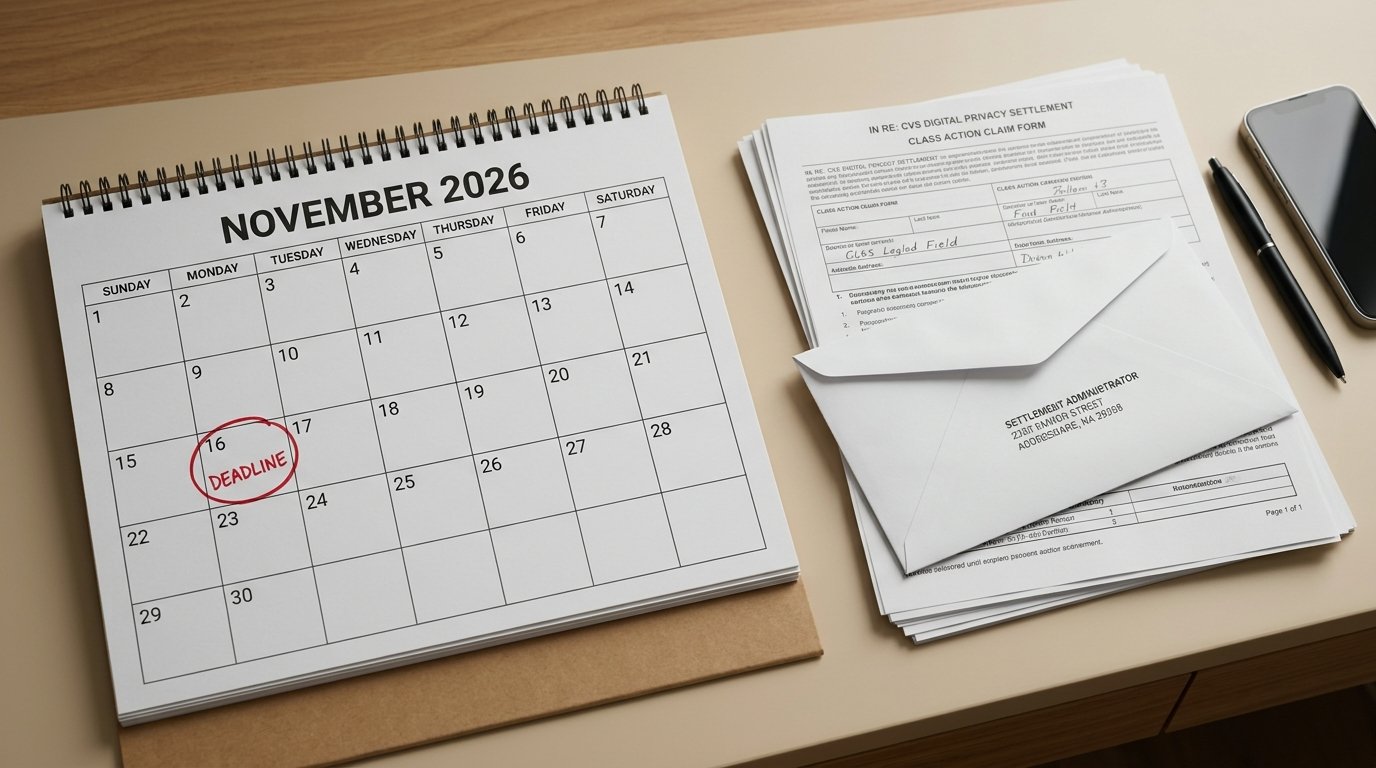
The honest answer is short: the claim deadline was final. November 16, 2026 was the only route to a cash payment, and late claims are not part of the settlement’s terms.
What doing nothing meant is stated on the official site with unusual bluntness: a class member who did nothing receives no share of the benefits and gives up the right to sue the defendants and the other released parties about the claims in this case.
The people who kept their right to sue individually are the ones who excluded themselves by the November exclusion deadline. Everyone else, filers and non-filers alike, is bound by the settlement once it is finally approved.
Missing one settlement is not the end of the pattern. Privacy settlements of this exact shape recur, and the transferable skill is the one in the claim money from settlements guide: check eligibility early, file the no proof tier the day you confirm you qualify, and never leave a claim to deadline week.
Is the CVS Settlement Email Real? The Five Point Match
Settlement emails keep circulating after deadlines, and copycats exist. A genuine notice for this case matches on five checkable points:
|
Check |
The genuine detail |
|---|---|
|
Case |
Brewer, et al. v. CVS Pharmacy Inc., et al., Case No. CACE-26-008094 |
|
Court |
Circuit Court of the 17th Judicial Circuit, Broward County, Florida |
|
Official site |
cvsdigitalprivacysettlement.com, typed into the browser by hand |
|
Administrator |
Simpluris; 1-888-654-1271; info@CVSDigitalPrivacySettlement.com |
|
Mailing address |
P.O. Box 1110, Costa Mesa, CA 92628 |
Two subtleties sit inside the match. The real notice emails, sent in September 2026 under the title “Legal Notice of Class Action Settlement”, included a login ID and PIN for the claim form. At the same time, deadline coverage documented that the official claim form itself was an open form that did not require a login ID or PIN, so people who never received a notice could still file the no documentation tier. Both things were true at once, and a message claiming either detail alone proves nothing.
The standing rule covers every settlement, not just this one: type the official address yourself rather than tapping a link in any email, and treat any page asking for banking passwords, gift cards or fees as a scam by definition. Real administrators never charge claimants.
Not This Case: Other CVS Lawsuits
CVS appears in several unrelated legal stories, and search results mix them freely. The opioids litigation, drug pricing cases, a Florida insulin suit and a supplement labeling case are different matters with no consumer claim form attached to them, as Settlement Insight’s case survey notes.
This page covers exactly one case: the digital privacy settlement over website and app tracking. If a headline says CVS and money, the first check is whether it names Brewer, Criteo, or the digital properties. If it names none of them, it is a different story.
The same discipline applies across the privacy cluster: the Flo period tracker settlement, for example, is a separate app privacy case with its own court, fund and closed deadline, and its facts do not transfer to this one. Bigger structural cases sit in a different category again, covered by the mass tort lawsuit explainer.
Mistakes and Myths
- “The $20.5 million will be divided among claimants.” No: it is a cap covering fees, costs and claims, and unclaimed money reverts.
- “CVS was hacked.” No: the claim is that embedded tracking technology shared data; no breach is alleged.
- “CVS admitted wrongdoing.” No: both defendants deny violating any law, and the court has not decided who is right.
- “I can still file because the site is up.” No: the site stays up for information and administration; the November 16 deadline closed filing.
- “Everyone in my house gets $10.” No: one claim per household, at the tier the filer qualified for.
- “Payments arrive right after the hearing.” No: 120 days after final approval, and only after any appeals resolve.
- “A settlement check never expires.” This one does: void after 180 days.
Key Takeaways
- Status: claims closed November 16, 2026; final approval hearing December 1, 2026; payments 120 days after approval and appeals.
- Structure: $20.5 million is a claims-made cap, not a fund; fees and costs come out first; unclaimed money reverts.
- Case: Brewer v. CVS Pharmacy and Criteo, Broward County, Florida; tracking technology, not a breach; both defendants deny the claims.
- Filed already? Keep your address current, know your payment method, and cash any check within 180 days.
- Missed it? The deadline was final, and doing nothing also gave up the right to sue over these claims; only timely exclusions kept that right.
- Checking an email? Run the five point match, case, court, official site typed by hand, Simpluris, and the Costa Mesa PO box, before trusting anything it says.
FAQs
What is the CVS digital privacy settlement?
A class action settlement in Brewer, et al. v. CVS Pharmacy, Inc. and Criteo Corp., resolving claims that tracking technology on CVS’s websites and app disclosed users’ data to Criteo and other third parties. Claims closed November 16, 2026.
Is the CVS digital privacy settlement real?
Yes. It is a court supervised settlement with a named case, a Florida state court, an appointed administrator, Simpluris, and an official website. The five point match in this article lets you verify any email against those fixed details.
What is the CVS settlement case name and number?
Brewer, et al. v. CVS Pharmacy, Inc. and Criteo Corp., Case No. CACE-26-008094. One legal article shows an “Alex Sisti, et al.” caption variant at a docket entry; the notice and administrator materials use Brewer.
Which court is handling the CVS settlement?
The Circuit Court of the 17th Judicial Circuit in and for Broward County, Florida, before the Honorable Shari A. Olefson. It is a state court case, not a federal one.
What did CVS allegedly do wrong?
The lawsuit alleges that tracking technology embedded in cvs.com, cvshealth.com and the CVS app disclosed health or private information, browsing data and identifiers to Criteo and other technology providers, without users’ knowledge or consent.
Is the CVS settlement about a data breach or hacking?
No. Nobody alleges a break in. The claim is that CVS’s own embedded tools shared the data with advertising and technology companies. That distinction is why the case is called a digital privacy settlement.
Who was included in the CVS settlement class?
All living individuals who accessed the CVS Digital Properties in the United States before July 27, 2026, in the notice’s wording. Using the websites or the app was what counted.
Did I need to buy anything to be in the CVS class?
No. The class definition requires access, not purchase. A person who browsed cvs.com or used the app without buying anything was covered on the same terms as a regular customer.
What are the CVS Digital Properties?
Three properties: www.cvs.com, www.cvshealth.com, and the CVS digital application (the CVS app), as the official settlement site defines them.
How much is the CVS settlement worth in total?
$20.5 million as a Maximum Cash Payment, split between the defendants as $18.5 million from CVS and $2 million from Criteo, per the HIPAA Journal and New York Post reporting.
Is the $20.5 million a fund or a cap?
A cap. It is the maximum the defendants pay in total, covering attorneys’ fees, service awards, administration costs and claimant payments together. It is not a pot divided among claimants.
What is Cash Payment A in the CVS settlement?
The documented tier: up to $10, for class members whose claims included documentation showing class membership, such as browser history, dated screenshots or email receipts for online orders.
What is Cash Payment B in the CVS settlement?
The no documentation tier: up to $5, available to any class member who filed a valid claim by the deadline, with no proof attached.
What proof counted for the $10 CVS payment?
Documentation showing access to a CVS digital property before July 27, 2026: browser history, dated screenshots, or email receipts for online orders are the examples the deadline coverage and notice summaries give.
Why could each household file only one CVS claim?
The settlement allows one claim per household, defined as everyone at the same mailing address. The rule treats the address as the claiming unit, so family members at one address shared a single claim.
What is the CVS settlement claim deadline?
November 16, 2026. Online claims had to be submitted by 11:59 p.m. Eastern Time, and mailed claims postmarked by that date. The deadline has passed.
Can I still file a CVS settlement claim now?
No. The November 16, 2026 deadline was the only route to a cash payment, and the settlement’s terms do not include late claims. The official site remains online for information and for people who already filed.
What happens if I missed the CVS deadline?
Per the official site, a class member who did nothing receives no payment and gives up the right to sue the defendants and released parties over these claims, once the settlement is finally approved. Only those who excluded themselves by the November deadline kept individual suit rights.
When is the CVS final approval hearing?
December 1, 2026, at 9:30 a.m. Eastern, held virtually by Zoom before Judge Olefson. Class members could ask to speak about the settlement at the hearing.
What will the judge decide on December 1?
Whether the settlement is fair, reasonable and adequate and should receive final approval, and whether to approve the attorneys’ fees, service awards and administration costs that are paid from the cap.
When will CVS settlement payments be sent?
120 days after final approval and after any appeals are resolved. With a December 1 hearing, realistic timing is spring 2027 at the earliest, and no exact date exists yet.
How will CVS settlement payments be delivered?
By PayPal, Venmo, Zelle or check, per the notice terms. The method follows the choice made on the claim form.
How long do I have to cash a CVS settlement check?
180 days. Checks under this settlement are void after 180 days, so a check that arrives should be deposited promptly rather than filed away.
Could my CVS payment be less than $5 or $10?
Yes. Both figures are maximums, and the HIPAA Journal summary notes claims are subject to a pro rata decrease if the cap is exceeded. The final amounts depend on the approved costs and the valid claims inside the cap.
What does pro rata reduction mean here?
If the money owed under the settlement’s terms exceeds what the cap leaves available after fees and costs, each payment is reduced proportionally rather than paid in full.
Where does unclaimed CVS settlement money go?
Back to the defendants. An analysis of the filed agreement describes a claims-made structure with reversion: unclaimed amounts return to CVS and Criteo under a separate agreement between them, instead of raising other claimants’ payments.
What comes out of the $20.5 million before claimants?
Court approved attorneys’ fees and costs, service awards for the class representatives, and settlement administration costs, in that order of business. Claimant payments come from what the cap leaves.
How much do CVS and Criteo each pay?
CVS pays $18.5 million and Criteo pays $2 million, per the HIPAA Journal and the New York Post. One legal summary noted the court documents it reviewed did not state the split, so the figures are attributed to their reporting.
Who is the CVS settlement administrator?
Simpluris. It runs the official website, the claim process and claimant communications for this settlement.
How do I contact the CVS settlement administrator?
Through the official website, by phone at 1-888-654-1271, by email at info@CVSDigitalPrivacySettlement.com, or by mail at P.O. Box 1110, Costa Mesa, CA 92628. Type web addresses by hand rather than following email links.
How can I tell a real CVS settlement email from a scam?
Match five points: the case name and number, the Broward County court, the official site typed by hand, Simpluris as administrator, and the Costa Mesa PO box. Any message asking for fees, gift cards or banking passwords is a scam by definition.
Did the real CVS notice email include a login ID and PIN?
Yes, the genuine September 2026 notice emails, titled “Legal Notice of Class Action Settlement”, included a login ID and PIN for the claim form, per multiple reports.
Did the claim form require a login ID or PIN?
No. Deadline coverage documented an open claim form that did not ask for a login ID or PIN, so class members who never received a notice could still file, including for the no documentation tier.
Did CVS admit wrongdoing in this settlement?
No. The official site states the defendants deny that they violated any law, agreed to settle to avoid the uncertainties and expense of continuing the lawsuit, and that the court has not decided who is right.
Which other companies are released by the CVS settlement?
The agreement’s release covers the defendants’ technology providers, including Medallia, Quantum Metric, Adobe, Braze and Branch Metrics, per an analysis of paragraph 53. None of them is a defendant and none pays into the settlement.
What laws did the CVS lawsuit claim were broken?
The federal Electronic Communications Privacy Act, state statutory claims, and common law claims for breach of confidence, invasion of privacy and negligence, per the case summaries and HIPAA Journal reporting.
When did preliminary approval happen in the CVS case?
The court granted preliminary approval on July 27, 2026, which is also the cutoff date in the class definition: access before that date is what made someone a class member.
Why did the parties mediate before the complaint was filed?
The parties attended JAMS mediation on March 17, 2026 and negotiated for weeks before the consolidated complaint was filed on May 15, 2026. Settling the framework first and filing into it is unusual but documented here by the HIPAA Journal’s timeline.
I moved after filing my CVS claim. What should I do?
Update your address with the administrator through the official site’s contact channels. Payments go to the address or account on the claim, and an unreported move is the most common reason settlement money never arrives.
I filed but never got a confirmation. What now?
Contact the administrator with your claim details through the official channels and keep any records of the submission. The confirmation and claim information are what the support process works from.
Are there other CVS settlements I can still claim?
Not for CVS itself as of this writing: the other CVS legal stories in the news, opioids, pricing, insulin, supplement labeling, have no consumer claim form, per Settlement Insight’s survey. Other companies’ open settlements are listed on the site’s open settlements page.
How is the CVS settlement different from the GoodRx settlement?
Both are privacy settlements, but they are separate cases: different defendants, courts, funds and dates. The GoodRx settlement is a $32 million matter with its own deadline of December 29, 2026, per the claim money guide’s verified record; nothing about the CVS case changes it.
Conclusion
The CVS digital privacy settlement is now a waiting case, not a claiming case: a $20.5 million cap, a December 1 approval hearing, and a 120 day clock that only starts once the court has approved the deal and any appeals have run their course.
If you filed, protect the payment: keep your address current with Simpluris, watch for the hearing outcome, and cash any check well inside its 180 days. If you did not file, the transferable lesson is the deadline itself, because the next privacy settlement will run on the same clock and reward the people who file early.
This page is general information about a public settlement, not legal advice. For advice about your own rights, consult a qualified attorney.

Dilawar is a dedicated writer and contributor at Lawsips.com, focusing on legal information, business law, consumer rights, legal awareness, and everyday legal matters. He is passionate about simplifying complex legal topics and providing readers with clear, practical, and easy-to-understand information. His goal is to help readers stay informed about legal developments, understand their rights, and make better decisions through informative and well-researched articles.