
Class Action Lawsuit Payout: The Five Variables That Decide Your Amount

Class action lawsuit payout numbers confuse everyone for the same reason: the number in the headline is the fund, and nobody is paid the fund. Your amount is the output of a formula, and the formula has five variables.
They are: the net fund left after court approved deductions, the allocation method the settlement chose, the claims rate, meaning how many eligible people actually file, your tier and proof, and the caps, floors, and leftover rules written into the agreement.
This page works the formula in order, then runs it on real cases, including the settlement that promised up to $125 and paid about $5. Every figure carries its source, because on this topic the source is part of the number.
One boundary before the arithmetic. This page sits inside the LawSips legal guides library and is general information, not legal or tax advice. Your settlement’s own plan of allocation governs your payment, and it outranks every summary, including this one.
The Short Answer: The Formula on One Screen
|
Variable |
What it is |
Where you find yours |
|---|---|---|
|
Net fund |
Gross fund minus fees, administration, notice, and service awards |
The final approval order and distribution report |
|
Allocation method |
Pro rata, flat, tiered, or points: how the net fund is divided |
The plan of allocation in the settlement agreement |
|
Claims rate |
The share of eligible people who file valid claims |
The FTC study for expectations; the distribution report for fact |
|
Your tier and proof |
Where your claim sits: no proof, documented, or documented losses |
The claim form’s tier definitions |
|
Caps and leftovers |
Maximums, minimums, second distributions, cy pres, escheat |
The agreement’s payment and residual clauses |
For the quick version of the amount question, settlement payout per person gives the per person ranges readers usually want first. This page is the layer underneath: why the number is what it is, and how to test any estimate you are shown.
Variable One: The Waterfall, Gross Fund to Net Fund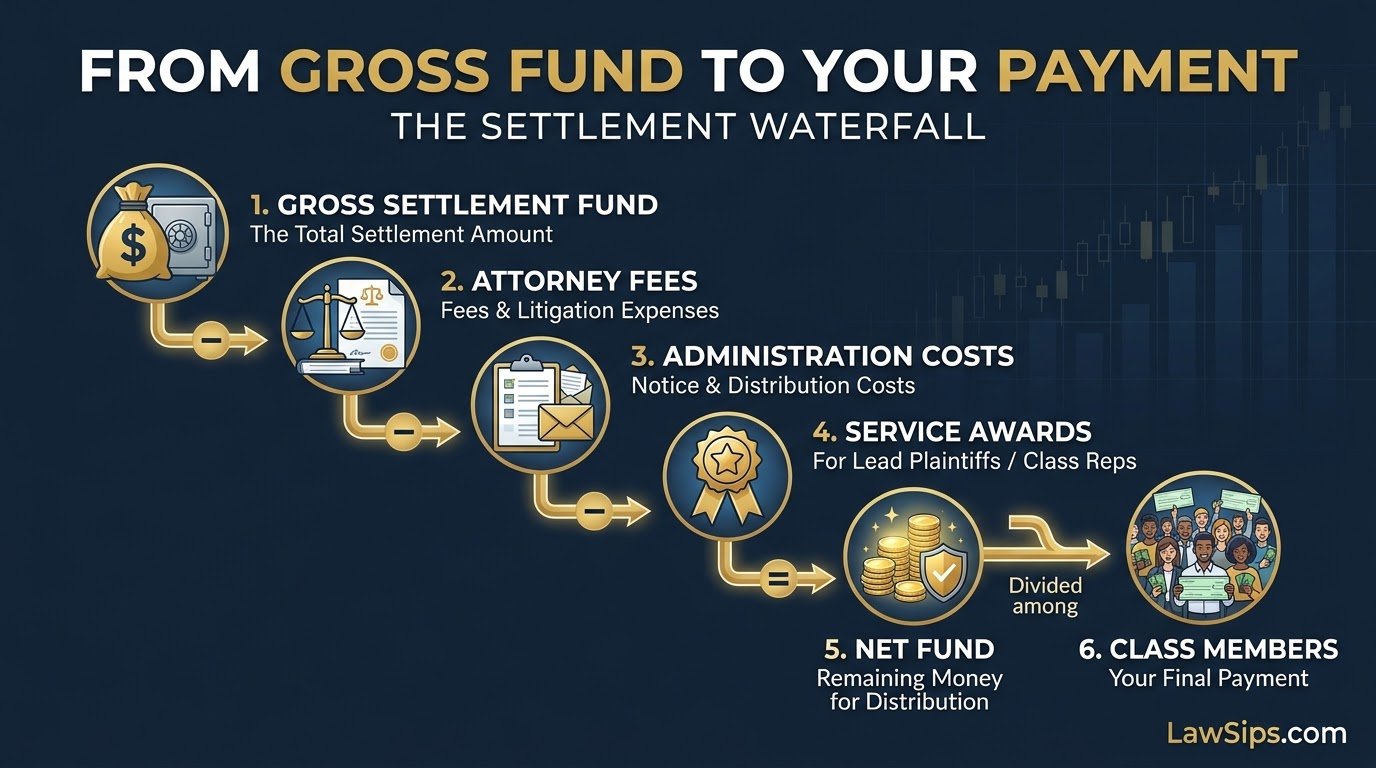
A settlement creates a common fund, one pot of money the defendant pays to end the case.
Before any class member receives a dollar, the court approved agreement pays four lines, in an order Owed’s worked example of why class action settlement checks are so small lays out cleanly.
First, attorneys’ fees and litigation costs. Class counsel is paid from the fund under Rule 23(h), and the judge approves the amount at the fairness hearing.
Research benchmarks cluster in a band the sources do not perfectly agree on, and this page prints the disagreement rather than smoothing it.
Fitzpatrick’s widely cited study found fee awards with a mean and median of roughly 25 percent of the fund. Typical consumer case awards are described across sources at 25 to 33 percent, with the Ninth Circuit using 25 percent as a benchmark.
A separate empirical line, reported in LegalClarity’s analysis of whether class action settlements are worth it, puts the mean nearer 22 percent.
Both figures stay on this page with their sources attached; your case’s actual percentage is the one in its fee petition and final approval order.
Second, notice and administration costs: the postcards, emails, claims website, call center, validation work, and check production. In a class of millions, this line alone runs to millions.
Third, service awards to the named plaintiffs who carried the case, modest beside the fund and scrutinized by the judge. Fourth, and only then, class members, dividing whatever the first three lines left.
The tracker arithmetic shows what the waterfall does to a headline: in Owed’s worked example, a $92 million fund becomes roughly $41 per person by the time fees, costs, and division finish. Nothing in that example went wrong; the math simply ran.
Variable Two: The Four Ways Money Is Divided
The plan of allocation, a section of the settlement agreement the court approves, chooses the division method. The four in live use pay the same two claimants very different amounts, which is why this document matters more than any press coverage.
|
Method |
What is promised |
When the amount is knowable |
Whom it favors |
|---|---|---|---|
|
Pro rata (loss based) |
A share proportional to your documented loss, or a rate per dollar of loss |
Only after claims close |
Claimants with large, documented losses |
|
Flat payment |
A fixed amount per valid claim |
At filing, until the fund is oversubscribed |
Everyone equally; fragile under heavy filing |
|
Tiered |
Different amounts by category: no proof, documented, documented losses |
Tier amounts early; final amounts after claims close |
Documented claimants, steeply |
|
Points based |
Points per factor (duration, units, severity); fund divided per point |
After claims close |
Long exposure and heavy users, continuously |
Pro rata needs a terminology ruling, because the sources use it two ways.
In its standard legal meaning, set out in LegalClarity’s pro rata payment explainer, it divides in proportion to documented loss: its example has $30 million available against $120 million in approved claims, paying 25 cents per dollar of loss to everyone, a figure called the recovery rate.
Some tracker writing uses pro rata loosely to mean equal shares among filers. Those are different machines paying different people, so the ruling is simple: your settlement’s plan of allocation defines the term, and no article’s usage, including this one’s summaries, overrides it.
Flat payments promise certainty and break under success: a fixed $25 holds until valid claims exceed the fund, at which point the agreement cuts everyone pro rata anyway. Tiered and points systems are the documented claimant’s friends, priced in variable four.
The wider machinery these methods sit inside, approval, fairness, and how settlements are structured, is mapped in class action lawsuit settlements. This page stays on the member’s side of the glass: what the method does to your number.
Variable Three: The Claims Rate, the Invisible Divisor
Most settlements divide the net fund among people who file valid claims, not among everyone eligible. That single design fact makes your check partly a function of strangers’ inattention.
The Federal Trade Commission measured it. Its 2019 staff study of 149 consumer class action settlements found a median claims rate of 9 percent and a weighted mean of just 4 percent. Most eligible people, in most settlements, never file.
Sparrow’s average payout analysis turns the divisor into one unforgettable contrast: a $65 million distributable fund split across all eligible people pays about $8 each, while the same fund split only among the roughly 400,000 who filed pays about $162 each.
Same fund, same fees; a twentyfold difference made entirely of filing.
The sensitivity runs in both directions, which the table makes plain for a single hypothetical $10 million net fund paid in equal shares:
|
If the claims rate is |
Filers out of 1,000,000 eligible |
Each filer receives |
|---|---|---|
|
4 percent (FTC weighted mean) |
40,000 |
$250 |
|
9 percent (FTC median) |
90,000 |
about $111 |
|
25 percent (a heavily publicized case) |
250,000 |
$40 |
Read the table as the whole topic in miniature. Publicity shrinks checks, obscurity inflates them, and the administrator cannot know your amount until the deadline closes the denominator.
One more study figure belongs here, because it answers the fear underneath the filing decision: in the FTC study, about 86 percent of submitted claims were approved. The screen removes duplicates and fabrications; honest claims mostly pass.
When the Denominator Is Known in Advance
Some settlements skip the claims rate gamble entirely. When the defendant’s own records identify the class, bank fee cases and account based settlements are the pattern, payment can be automatic: credited or mailed to every known member without a claim form.
Automatic distribution converts the denominator from an estimate into a census, which is why those settlements can publish an exact per person amount in the notice itself.
The trade is the mirror image of the claims made design: nobody’s share grows from others’ silence, because there is no silence to profit from.
When you read a notice, the first mechanical question is which of these two machines you are inside. Claims made means file, and file documented. Automatic means verify your address and wait.
Variable Four: Your Tier, Your Proof, Your Points
Within any method, where your claim sits is the variable you control most. Tiered settlements sort claimants by documentation, and the gaps between tiers routinely dwarf every other variable on this page.
The standard architecture has three floors. A no proof tier pays a small flat amount on your sworn statement alone. A documented tier pays a calculated amount against receipts, statements, or account records.
A documented loss tier reimburses actual out of pocket harm, often up to a stated cap, on real evidence.
Owed’s guide to how much no proof settlements pay summarizes the market honestly: typical no proof payouts run $5 to $100, while privacy, bank fee, and documented categories commonly reach $100 to $400, and a few statutory cases pay several hundred more.
The filing craft behind landing in the right tier, forms, proof, and deadlines, is covered step by step in how to file a claim for settlement.
The strategic point here is simpler: the receipt you keep today is a tier decision, made years before any settlement exists.
Variable Five: Caps, Floors, and What Happens to Leftovers
Caps limit the top: a per person maximum, or a sub fund ceiling for one payment type. The Equifax case below turns entirely on a capped sub fund, which is why caps deserve their own variable rather than a footnote.
Floors are rarer and friendlier: a guaranteed minimum per valid claim, sometimes funded by reducing the top tiers. When a notice promises a minimum, it is quoting this clause, and it can be relied on more than an estimate.
Leftovers follow the agreement’s residual clause, in three common directions. A second distribution pays claimants who cashed their first checks another round from what the uncashed left behind.
Or the residue goes cy pres, to court approved charities connected to the case, typically when another distribution would pay pennies per person.
Or it escheats to your state’s unclaimed property after a period, commonly around 6 to 12 months, where your name remains the key to recovering it.
Worked Example: Equifax, the $125 That Became $5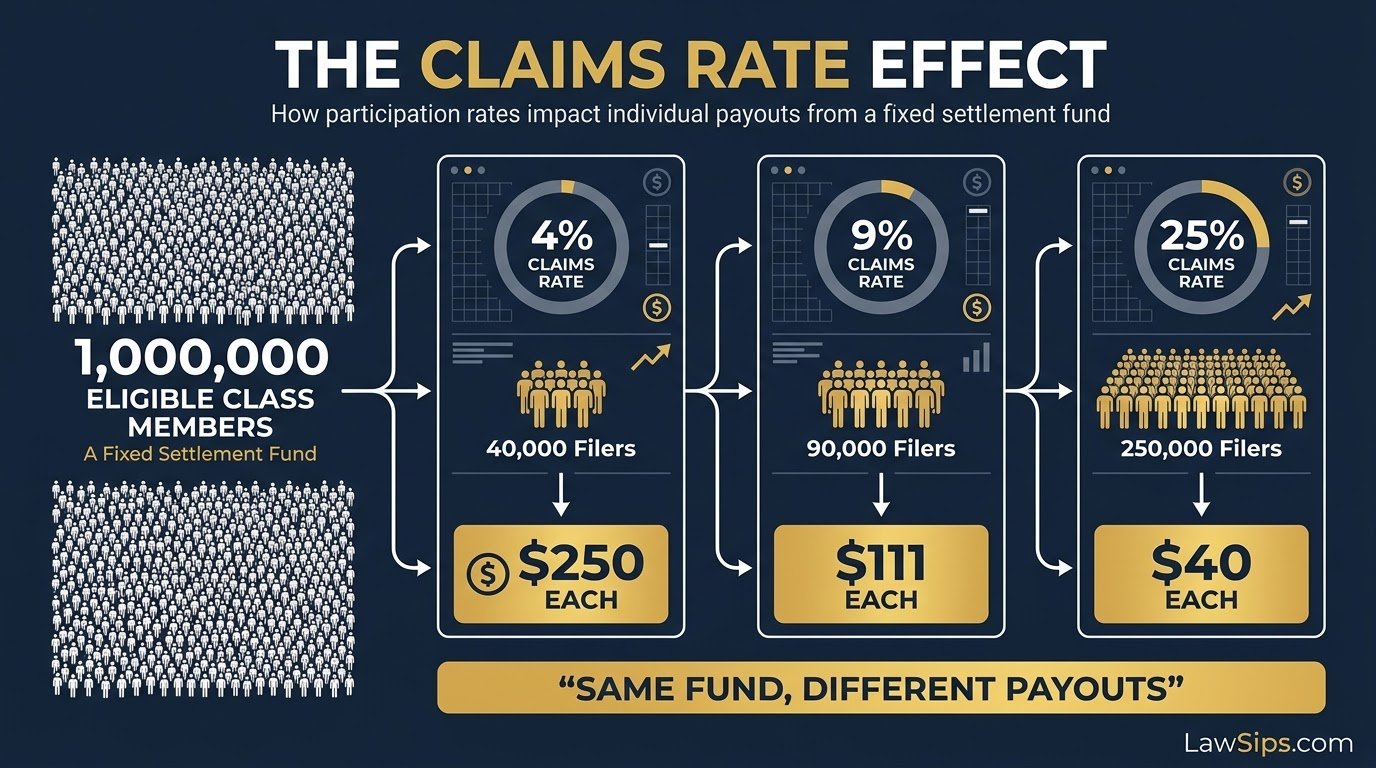
Every variable fires in this one case, which is why it is the teaching example. The 2019 Equifax data breach settlement covered about 147 million people and was announced in the hundreds of millions.
Its alternative compensation option promised up to $125 per claimant who chose cash instead of credit monitoring. Behind that promise sat a dedicated sub fund capped at $31 million.
Run the formula. At $125 a person, the sub fund could pay about 248,000 claimants in full. The eligible class was 147 million. The claims rate needed to break the promise was not the FTC’s median 9 percent; it was a fraction of one percent.
Claims poured in far past the cap. The FTC publicly warned claimants they would receive far less than $125 and steered people toward the monitoring option. The first cash payments finally went out in December 2022, over three years after the settlement was announced.
Reported payment amounts clustered in single digits, with $5.21 and $7.29 among the commonly reported figures. Meanwhile the same settlement’s documented loss tier paid real money, reimbursing proven out of pocket costs up to $20,000.
The lessons stack in formula order. The headline described the whole settlement, not the tier, and up to was a ceiling priced for a claims rate that never had a chance.
The claimants who documented losses were paid from a different machine than the claimants who clicked the famous button. Same settlement, same defendant, two payouts separated by documentation.
Worked Contrasts: When Payouts Are Large
Large per person payouts are structural, not lucky. They appear when per person harm is large and provable and the class is comparatively contained, or when a statute prices each violation.
Volkswagen’s diesel settlements paid eligible owners $5,100 to $10,000 each, per LegalClarity’s analysis of how much you can get from a class action lawsuit, because the structure was a buyback plus compensation: individual damages, administered at class scale, for owners whose loss was never in doubt.
The Illinois biometric Facebook settlement, a $650 million fund under a statute with per violation damages, produced checks of about $397 per claimant as LegalClarity reports. Statutory damages do what consumer overcharges cannot: they set a floor under per person harm before division begins.
Keep that case separate from the other Facebook settlement, the $725 million internet tracking deal, which averaged roughly $29 per person. Same defendant name, different law, different class, different formula output. Articles that merge them are telling you they did not read either agreement.
For the fund size ranking behind these contrasts, the class action settlements 2026 hub tracks the current settlement landscape, and open class action settlements and class action settlements you can claim list what is open to claim now.
The ranking is the beginning of a payout question, never its answer.
How to Estimate Your Own Payout Before the Deadline
Estimating is a skill with five inputs, and the trackers’ method, stated plainly, is this:
- Start with the gross fund from the settlement agreement, not the press release, and note any capped sub funds for your payment type.
- Subtract the waterfall: use the fee percentage in the fee petition if it is public, or the documented research band (roughly a quarter to a third), plus administration.
- Estimate the class size from the notice plan or credible coverage of the case.
- Apply a claims rate from the FTC’s observed range: 4 percent weighted mean, 9 percent median, higher for heavily publicized cases.
- Divide, then place yourself: the quotient is the equal share baseline; adjust for your tier, your documented units, and any cap that binds your category.
Treat the output as the center of a wide range, because the two live unknowns, final fees and the actual claims rate, both move it. Any website that prints your amount to the cent before the deadline is performing confidence, not arithmetic.
Membership mechanics, who is in the class and how claiming differs from joining, sit in how to join a class action lawsuit for readers still at that earlier question.
The Documents That Audit Your Payout
Three court documents contain every number in your formula, and almost no claimant reads any of them. They are public, and together they convert trust into verification.
The fee petition is filed before the fairness hearing and states what class counsel asks for, the percentage, the costs, and the justification. Comparing the petition with the headlines is the fastest fee education available in any live case.
The final approval order is the judge’s ruling on that petition and on the plan of allocation: the approved percentage, any trims, the service awards, and the distribution rules as they will actually run. It supersedes every earlier estimate, including the settlement website’s.
The final distribution report, filed by the administrator when payments are complete, closes the loop: valid claims received, the net fund as it truly stood, the rate or per person amount paid, and the residue’s destination.
Reading the three in order takes an evening and answers, with documents instead of opinions, the question this whole page exists for. When a payout disappoints, the report is where the disappointment gets explained, line by line, in numbers the court accepted.
After the Amount: Taxes and Timing
Taxes follow what the payment compensates, under the IRS framework summarized in Publication 4345: personal physical injury payments are generally excluded from income, while interest, punitive damages, and many wage and property recoveries are taxable, sometimes with a Form 1099 issued.
This page gives the map, not advice; a payment large enough to matter deserves a tax professional.
Timing is the sibling topic this page deliberately does not duplicate: once the amount exists, its journey through approval, the Effective Date, and batch distribution runs on the status track.
The December 2022 Equifax date is the standing warning that the journey can take years, entirely within the rules.
Frequently Asked Questions
How much money do you get from a class action lawsuit?
Usually far less than the headline. LegalClarity’s analyses put most payouts between $10 and a few hundred dollars, with $20 to $500 covering most consumer receipts. High harm cases pay far more: Volkswagen owners received $5,100 to $10,000, and Illinois biometric claimants about $397.
The formula, not the fund, sets your number.
How are class action payouts calculated?
In five steps: the gross fund is set; fees, administration, notice, and service awards come out, leaving the net fund; the plan of allocation picks a method (pro rata, flat, tiered, points); valid claims are counted after the deadline; and the net fund is divided by that method.
Until counting happens, every figure is an estimate.
What does pro rata mean in a class action payout?
Divided in proportion to your share. In loss based settlements it means proportional to documented loss: LegalClarity’s example pays 25 cents per dollar when $30 million covers $120 million in claims.
Some writers use it loosely for equal shares; your settlement’s plan of allocation defines which meaning applies to you.
Why is my class action payout so small?
Because the headline is the gross fund and you are paid from the net fund divided by every valid claim. Fees typically take a quarter to a third, administration takes more, and millions may share the rest.
One worked tracker example turns a $92 million fund into roughly $41 per person with nothing going wrong at all.
What is the average class action payout per person?
There is no official average, and circulating figures are estimates. LegalClarity’s ranges (most payouts $10 to a few hundred; typical receipts commonly $20 to $500) are the defensible summary.
One worked contrast shows why averages mislead: a single $65 million fund equals about $8 per eligible person or about $162 per actual filer.
What does up to $X mean in a settlement notice?
A ceiling, not an estimate, usually the top of a documented tier or a statutory cap.
Equifax is the cautionary case: up to $125 was offered against a $31 million sub fund, demand swamped it, the FTC warned payments would shrink, and many claimants received single digit amounts.
How do attorney fees reduce my payout?
Class counsel is paid from the fund under Rule 23(h) with court approval. Fitzpatrick’s study found fee awards averaging roughly 25 percent; typical awards are described at 25 to 33 percent; one empirical line puts the mean nearer 22 percent.
This page prints both research figures attributed; your case’s approved percentage is in its fee petition and final approval order.
What is the claims rate and why does it decide my check?
The share of eligible people who file valid claims. The FTC’s 2019 study of 149 settlements found a median claims rate of 9 percent and a weighted mean of 4 percent.
Because the net fund divides among filers only, a low claims rate raises each filer’s payment: your check is partly made of other people’s inattention.
Do payouts go up if fewer people file claims?
In pro rata and equal share settlements, yes: the same net fund divides among fewer valid claims. Flat payments hold their amount until the fund is oversubscribed, then get cut pro rata anyway.
This is why administrators refuse to promise amounts before the deadline, and why estimates always carry ranges.
What is a tiered class action payout?
Claimants are sorted into categories, usually by proof or severity, and each tier pays differently: a small flat amount with no proof, a calculated amount with documentation, and the highest tier for documented out of pocket losses.
Equifax paid documented losses up to $20,000 on its top tier while its no proof tier collapsed to single digits.
What is a points based settlement allocation?
Each claim earns points for factors like duration of exposure, amount purchased, or severity, and the net fund divides by total points, paying per point. It is pro rata with a scoring layer, common in product and wage cases where losses vary continuously.
The plan of allocation publishes the schedule; your documentation sets your points.
How much do lead plaintiffs get in a class action?
Named plaintiffs may receive a court approved service award for carrying the case, on top of their regular share.
Awards are modest next to the fund, commonly hundreds to tens of thousands of dollars depending on the case and the plaintiff’s work, and judges scrutinize them at final approval. They are paid from the fund before member payments.
When will my class action payout arrive?
After the distribution stage: final approval, the appeal window, the Effective Date, and the administrator’s batch schedule. Simple cases can pay within months of the claim deadline; appealed or complex ones run far longer.
Equifax’s first cash payments went out in December 2022, over three years after its 2019 settlement was announced.
Is a class action payout taxable?
It depends on what the payment compensates. Under the IRS framework in Publication 4345, personal physical injury payments are generally excluded, while interest, punitive damages, and many wage and property recoveries are taxable, sometimes with a Form 1099.
This page is general information; larger payments deserve a tax professional.
What happens to unclaimed class action money?
The agreement directs it: a second distribution to claimants who cashed their checks, cy pres payments to court approved charities, or escheat to state unclaimed property after roughly 6 to 12 months.
Your recovery route after a closed administration is usually your state’s unclaimed property database, searched by name.
Can my payout be higher than the estimate on the settlement website?
Yes, whenever claims come in below the administrator’s projection, because pro rata shares are calculated on actual valid claims. Second distributions can add more. Equifax ran the other way.
Estimates are planning figures built on assumed claims rates, not floors or ceilings, except where the agreement sets a real floor or cap.
Why did the settlement website estimate more than I received?
Because its estimate assumed a claims rate, and reality filed more claims, or review moved you to a lower tier than the estimate assumed, or approved fees and costs exceeded the planning figures.
The administrator’s final distribution report, filed with the court, shows the actual inputs: net fund, valid claims, and the per unit rate.
Do I get more if I have proof of purchase?
Usually yes. Tiered designs pay documented claims at calculated rates and no proof claims at small flat amounts, and points systems score documentation directly.
Tracker category summaries put typical no proof payouts at $5 to $100, with documented and statutory categories reaching $100 to $400 and beyond. Keep receipts and statements.
What is the difference between a flat payout and a pro rata payout?
A flat payout promises a fixed amount per valid claim and holds until the fund cannot cover it, then gets cut pro rata. A pro rata payout promises only a share or a rate, unknown until claims close.
Flat is predictable and fragile; pro rata is flexible and opaque. Many settlements blend them by tier.
How do administrators verify claims before paying?
Against the class definition: purchase or account records where they exist, duplicate and fraud screening, and deficiency notices for curable gaps.
The FTC study found about 86 percent of submitted claims were approved, so most honest claims survive; the screen exists for the fabricated minority that would otherwise dilute everyone.
What is a settlement rebate?
A tracker’s term for the per person cash or credit a consumer settlement pays, framed as a refund. It appears in no statute, but its typical range, $5 to $250 per Owed, matches consumer reality.
Use it as slang; treat the plan of allocation as the law of your payment.
Why do some class actions pay thousands per person?
When per person harm is large, provable, and the class is contained: buyback product cases, statutory damages regimes like Illinois biometric privacy (about $397 checks on a $650 million fund), and wage cases with records.
Volkswagen’s $5,100 to $10,000 combined a buyback with compensation, closer to individual damages than to consumer rebates.
Why do some payouts come to less than a dollar?
Massive classes, modest funds, equal division: a few million in net fund across tens of millions of eligible people yields cents. Coupon and credit settlements push effective value lower still.
Courts approve some of these for the practice change value rather than the cash, a debate the Class Action Fairness Act partly addresses for coupon deals.
Do class action payouts come as checks or digital payments?
Both, by your election at filing where offered: paper checks, direct deposit, or wallet payments. Digital arrives faster and cannot be lost in the mail; paper checks carry void dates, commonly 90 to 180 days. The method affects delivery, never the calculated amount.
What if my check is for the wrong amount?
Check the arithmetic against the settlement’s published rate first: tier, points, or per dollar rate times your documented units. If it still fails, contact the administrator with your claim ID; corrections happen, most often where documentation was misread.
Keep your claim confirmation and deficiency correspondence for that conversation.
Can I opt out to get a bigger payout on my own?
Opting out preserves your right to sue individually; it does not enlarge a class payout. It makes sense when your individual damages are large and provable enough to carry your own case’s cost and risk.
For typical consumer harms, the class payout, however small, is usually the only economically rational recovery.
How does the size of the class affect my payout?
Directly: the net fund is fixed, so every eligible person is a potential divisor. LegalClarity’s illustration: a $100 million fund across a million claimants is $100 per person before deductions.
Class size is published in the notice, which is why experienced readers estimate from class size and claims rate, not from the fund.
What is a second distribution?
A further payment round funded by what the first round left behind, mainly uncashed checks, paid to claimants who cashed theirs, when the agreement provides for it. Amounts are usually smaller than the first round.
Not every settlement has one; the alternatives are cy pres or escheat, per the agreement’s residual clause.
What does cy pres mean for my payout?
Leftover money goes to court approved charities or public interest uses related to the case, rather than to class members, typically when another distribution is impractical or too small per person to administer.
Cy pres does not reduce a properly calculated first distribution; it disposes of the residue other claimants left uncashed.
Are payouts different for documented losses like medical bills or fraud costs?
Yes, in most designs that offer them: documented out of pocket losses are reimbursed at higher, sometimes full, rates up to a cap, separate from the general per person payment. Equifax’s documented tier reached $20,000.
The proof burden is real: receipts, statements, and a narrative tying the loss to the defendant’s conduct.
How are securities class action payouts calculated?
Per share or per dollar of recognized loss, under a court approved plan of allocation with a loss formula tied to the stock’s price movements, minus fees and costs, divided pro rata among valid claims.
Recoveries are famously cents on the dollar of estimated damages, the recovery rate concept at industrial scale.
How are wage and hour class payouts calculated?
From payroll records: unpaid overtime or missed break premiums per week or pay period, often at statutory rates, allocated by weeks worked in the class period.
Because employer records exist, these are among the most calculation driven settlements, and long tenured employees receive meaningfully more than short tenured ones from the same fund.
Do business claimants get paid differently from consumers?
Often yes: sophisticated allocations weight categories separately, applying different recovery rates to commercial versus consumer claims. Businesses also file at higher rates with better documentation, changing their realized share. The plan of allocation’s category definitions are where the difference is decided.
What is the recovery rate in a settlement?
The share of documented loss actually repaid: net fund divided by total approved losses. LegalClarity’s example pays 25 cents per dollar ($30 million against $120 million in claims).
It is the most honest single number in any settlement, and the one headlines never print, because it admits total losses exceeded the fund, the normal condition of class settlements.
Can the court change the payout plan?
Yes. At the Rule 23(e) fairness hearing the judge reviews the plan of allocation, the fee request, and service awards, and can require changes, trim fees, or reject the settlement. Objectors may challenge the allocation between subgroups.
The final approval order, not the press release, fixes your payout’s rules.
How do I estimate my payout before the claim deadline?
Use the five input method: gross fund, minus a fee and cost estimate in the documented range; class size from the notice; a claims rate in the FTC’s observed range (median 9 percent, weighted mean 4 percent); divide; then adjust for your tier and any cap.
Treat the result as the center of a wide range, not a prediction.
Why do estimates on different websites disagree about the same settlement?
Because each assumes a different claims rate, fee outcome, and tier mix, and few publish their assumptions. A $50 estimate and a $12 estimate for the same fund can both be honest arithmetic on different denominators.
Prefer the source that shows its inputs, and distrust any figure printed without a claims rate behind it.
Does filing more claims increase total payout money?
No: the fund is fixed, so more claims divide it thinner. Filing increases your chance of being paid at all; an unfiled claim pays exactly zero with certainty.
Other people’s filing is arithmetic against your share, and yours is arithmetic against theirs, which is precisely why the claims rate stays low and the system still works.
What should I do if my payout seems unfairly low?
First verify the calculation against the plan of allocation and the distribution report. Then separate three cases: the math is right and the settlement is thin (common); your tier or documentation was misclassified (fixable with the administrator); or the check itself is wrong (correctable).
Post approval objection is almost never a route; classification errors are.
Do I need a lawyer to get my class action payout?
No. Claiming is designed for unrepresented people: a form, your documentation, and the deadline. A lawyer adds value at different margins: opt out decisions for large individual harms, and objections to an unfair allocation.
For the standard consumer claim, the administrator is your counterparty, not opposing counsel.
How do payouts work when the settlement is not cash?
Some settlements pay in credits, coupons, replacements, or services like credit monitoring (Equifax’s alternative to its swamped cash tier was ten years of monitoring).
Value them at what you would actually use, not the defendant’s stated retail value, which is the core of the coupon settlement criticism Congress addressed in the Class Action Fairness Act.
Is this legal or tax advice about my payout?
No. This page is general information about how class action payouts are calculated, drawn from public studies, court rules, and named settlements. Your settlement’s plan of allocation governs your payment, and a tax professional governs your return.
Read the agreement first; it outranks every summary, including this one.
Conclusion
Class action lawsuit payout is a formula wearing a headline. The fund gets the press release; the net fund, the allocation method, the claims rate, your tier, and the residual rules get your money.
Read any settlement in that order and the surprises mostly disappear: the up to figure becomes a ceiling, the estimate becomes a range with visible assumptions, and your own documentation becomes the one variable that was ever yours to move.

Dilawar is a dedicated writer and contributor at Lawsips.com, focusing on legal information, business law, consumer rights, legal awareness, and everyday legal matters. He is passionate about simplifying complex legal topics and providing readers with clear, practical, and easy-to-understand information. His goal is to help readers stay informed about legal developments, understand their rights, and make better decisions through informative and well-researched articles.