
Highest Paying Class Action Lawsuits: Biggest Funds, Real Class Actions, and What People Actually Got

Highest paying class action lawsuits is really three different questions wearing one headline. Biggest fund, biggest true class action, and biggest payment per person have three different answers.
Most ranked lists merge them into one table, and the merge is where the misinformation starts. Government deals get called class actions, and fund totals get read as personal windfalls.
The short version: the largest settlement fund in US history paid no individual a cent. The largest true class actions paid in loan cancellations and car buybacks, not simple checks.
What decides your own payment is a waterfall: court approved fees, administration costs, and the number of people who file, all taken before any pro rata split.
One boundary before the numbers. Everything here is general information, not legal advice, and no page can tell you what you personally will receive from any settlement.
More explainers in this series live in the LawSips legal guides library, where each legal topic gets the same treatment. Labels and dates first, headline numbers second.
The Short Answer: Three Rankings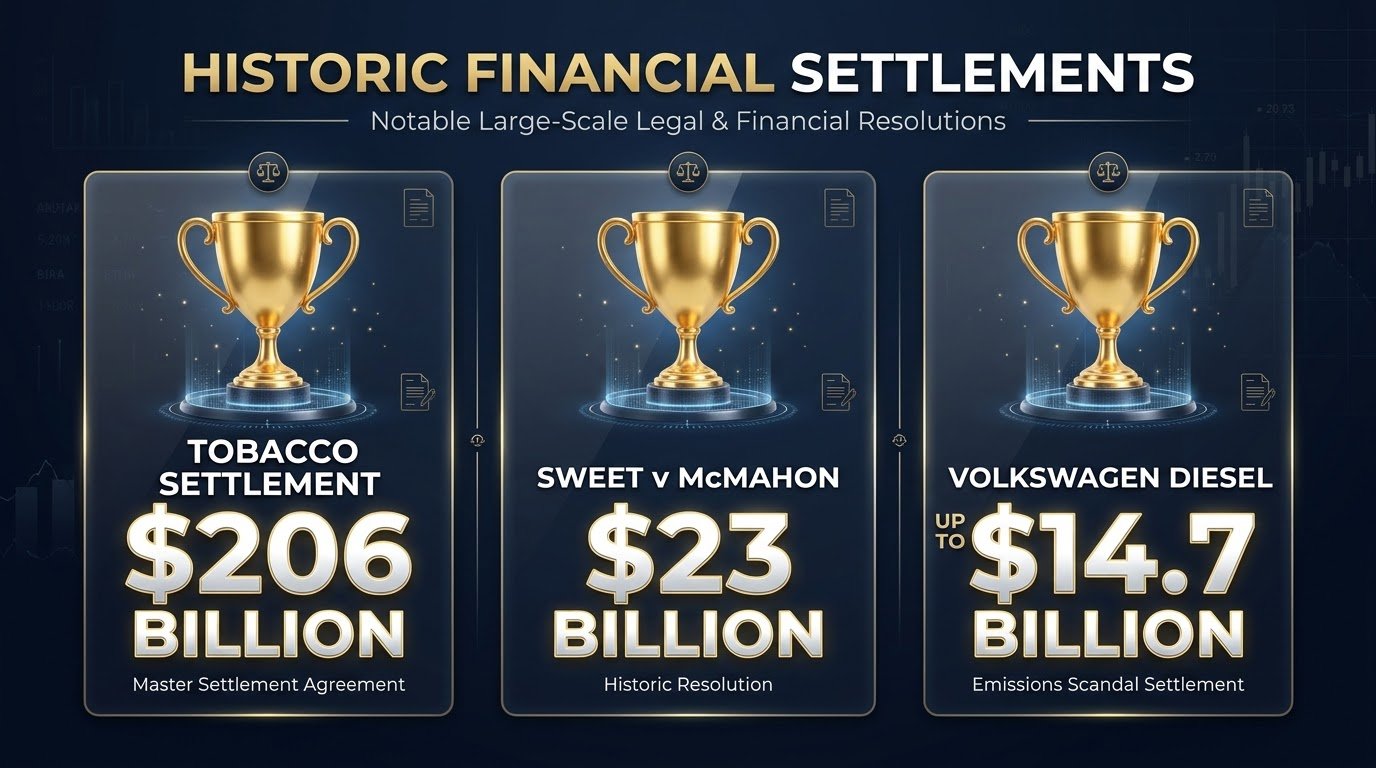
Ranked by total fund, the biggest US settlements are the tobacco agreement at about 206 billion dollars, the opioid agreements at about 26 billion, and the mortgage settlement at 25 billion.
Ranked by true class action, the leaders change completely. Settlement trackers put Sweet v McMahon first, then Volkswagen, then Enron, as the table below shows.
Ranked by payment per person, neither list predicts much. A bounded class with provable harm beats a giant fund shared by millions, every single time.
|
Ranking |
Leader |
Value |
What individuals received |
|---|---|---|---|
|
Biggest settlement fund |
Tobacco Master Settlement (1998) |
About $206 billion |
Nothing directly; money went to 46 states |
|
Biggest true class action |
Sweet v McMahon (2022) |
About $23 billion in loan relief |
Student loans cancelled, not cash |
|
Biggest consumer cash program |
Volkswagen diesel (2016) |
Up to $14.7 billion |
Buybacks plus compensation per vehicle |
|
Largest securities class action |
Enron (2008) |
$7.2 billion |
Per share recovery by recognized loss |
Ranking One: The Biggest Funds, Labeled Honestly
The tobacco Master Settlement Agreement of 1998 remains the largest civil settlement in American history. Four major tobacco companies agreed to pay about 206 billion dollars over 25 years.
The money went to 46 states, to cover public health care costs of smoking related illness. Civille’s list of the largest legal settlements in history names the four companies and the payment structure in its record of the deal.
No smoker filed a claim form, and no smoker received a check. The case is the single most instructive fact in this topic: fund size and personal payment are unrelated.
The opioid agreements of 2021 and 2022 follow the same pattern. Distributors and Johnson and Johnson committed roughly 26 billion dollars to states and local governments for abatement programs.
The National Mortgage Settlement of 2012 committed about 25 billion dollars from major mortgage servicers. Most of it funded state programs and borrower relief administered through the servicers, not individual claims.
Dave Abels’ ranking of the largest civil lawsuit settlements in US history ranks these announced totals together and flags the right caveat. Announced figures are paid over years, and different sources total the components differently.
|
Settlement |
Year |
Announced value |
Legal type |
Paid to |
|---|---|---|---|---|
|
Tobacco Master Settlement |
1998 |
About $206 billion |
Government enforcement |
46 states |
|
Opioid distributor and J and J deals |
2021 to 2022 |
About $26 billion |
Government enforcement |
States and localities |
|
National Mortgage Settlement |
2012 |
About $25 billion |
Government enforcement |
States, servicer relief programs |
|
BP government settlement |
2016 |
About $20.8 billion |
Government enforcement |
Federal and Gulf state governments |
Why the Labels Matter
A government enforcement settlement is negotiated by attorneys general on behalf of the public. There is no certified class, no claim form, and no individual payout mechanism.
A class action settlement is approved under Rule 23 of the Federal Rules of Civil Procedure. It binds a defined class, runs through a claims administrator, and pays class members who qualify.
When a list calls the tobacco deal the biggest class action, it teaches readers to expect claim forms that do not exist. The label is not pedantry; it is the difference between money you can claim and money you cannot.
Ranking Two: The Biggest True Class Actions
OpenClassActions’ ranked list of the biggest class action settlements makes the distinction most lists skip, and it changes the champion. Its top ranked true class action is a student loan case, Sweet v McMahon.
The settlement cancels roughly 23 billion dollars of federal student loans for about 450,000 to 500,000 borrowers whose borrower defense applications had stalled.
The Project on Predatory Student Lending, which represented the borrowers, calls it the largest class action settlement in American history. That characterization is theirs, and it is attributed as such here.
The relief is real but it is not cash. A cancelled loan is worth its balance to the borrower, yet nobody received a check, which is why per person rankings need care.
Volkswagen: The Cash Benchmark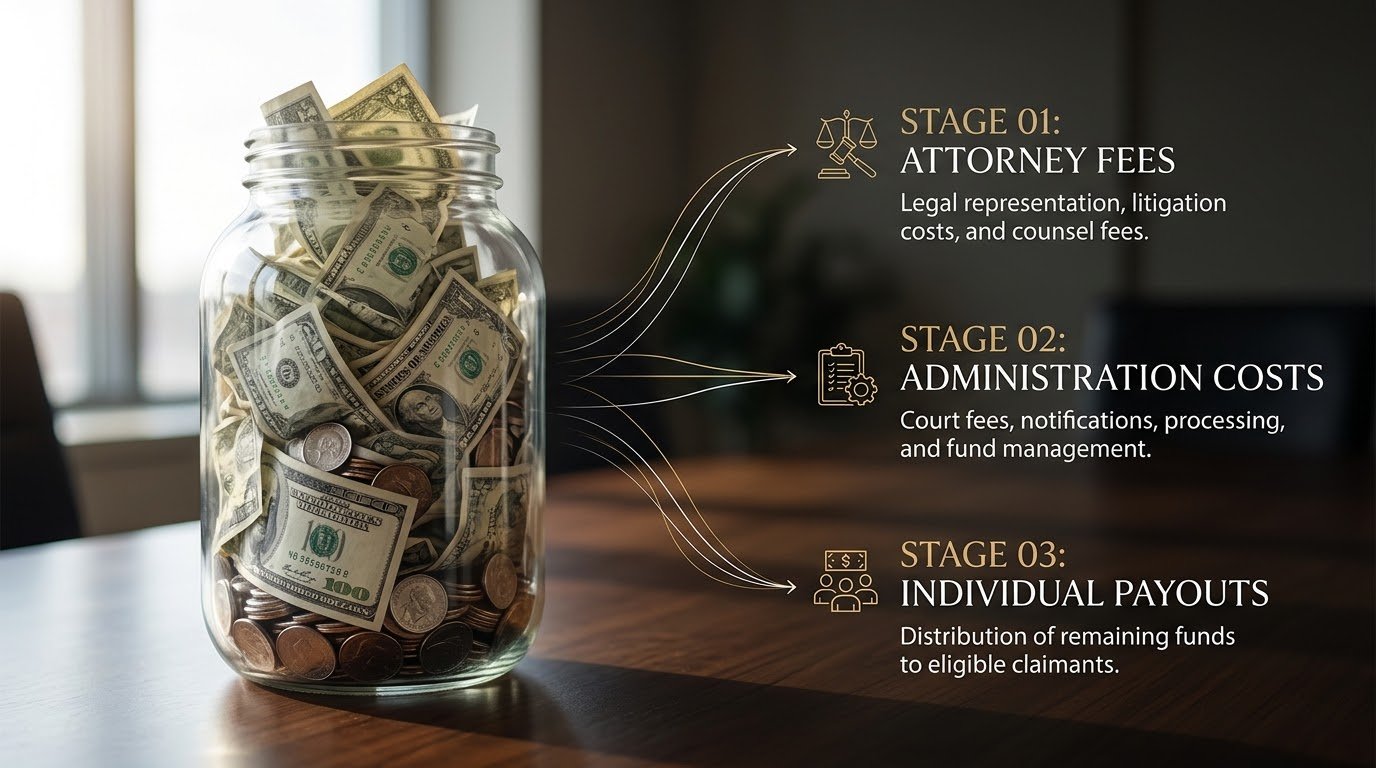
The 2016 Volkswagen diesel settlement totaled up to 14.7 billion dollars. About 10.03 billion funded buybacks and owner compensation for roughly 475,000 2.0 liter diesel vehicles.
Owners could sell the car back at its pre scandal value or accept an approved modification, plus a compensation payment. A further 4.7 billion funded environmental mitigation.
It remains the standard example of a class action that paid individuals well. The class was defined, the harm was measurable per car, and the benefit attached to each vehicle.
Enron: The Securities Record
The Enron securities settlement reached 7.2 billion dollars, approved in 2008. It compensated shareholders who lost money when the accounting fraud collapsed the company.
Settlement trackers still list it as the largest securities class action settlement on record. Recoveries were paid per share under a court approved plan of allocation, based on recognized losses.
One caution belongs in the open. A widely read competitor page claims Enron agreed to pay 40 billion dollars in 2003, which confuses market losses with the settlement and is simply wrong.
BP: Two Deals, Not One
BP is where most rankings quietly merge two different settlements. The roughly 20.8 billion dollar figure is the 2016 deal with the federal government and five Gulf states.
The actual 2012 class settlement for economic and property damage claims was uncapped. BP initially estimated about 7.8 billion dollars, and the eventual total ran higher.
Any list that cites 20 billion as BP’s class action has merged the two deals. The separation takes one sentence, and this page keeps it in every table.
Ranking Three: What People Actually Received
Per person outcomes follow a pattern, not the headlines. The master variable is class size, and the multiplier is whether the law sets damages per violation.
At the top sit injury grids, buybacks, and statutory damage cases. At the bottom sit national privacy and small overcharge cases with classes in the tens of millions.
LegalClarity’s guide to the biggest class action lawsuits and open claims tracks the reality layer across the big cases. Its summary of the Meta privacy distribution is the cleanest illustration of dilution in the entire topic.
|
Case or pattern |
Fund or structure |
Typical individual outcome |
Why |
|---|---|---|---|
|
Meta privacy settlement |
$725 million |
Roughly $29 average, as LegalClarity reports |
Class covered most US users of an era |
|
Equifax data breach |
About $700 million total value |
Base cash shrank sharply; documented losses paid in a higher tier |
Cash pool capped, claims flooded in |
|
Volkswagen diesel |
Up to $14.7 billion |
Buyback value plus compensation per vehicle |
Per unit benefit, defined class |
|
Illinois biometric (BIPA) pattern |
Statutory damages per violation |
Often hundreds per person in state classes |
Bounded class, damages set by statute |
|
NFL concussion grid |
Diagnosis based grid |
Top diagnoses in the millions, per the published grid |
Severe documented injury, small class |
Our own guide to settlement payout per person walks through the same arithmetic case by case. The pattern repeats so reliably that it works as a prediction tool for new settlements.
The Waterfall: Where a Settlement Fund Actually Goes
A settlement creates a common fund, one pot of money the defendant pays to end the case. Your check is drawn from what survives a fixed sequence of deductions.
Step one is attorney fees. Courts award them under Rule 23(h), most commonly as a percentage of the fund, and every award needs court approval.
Step two is costs. Notice campaigns, claims administration, and expert and filing costs come out of the same pot before class members see a cent.
Step three is the split. What remains divides pro rata among valid claims, or pays by tier or grid where the settlement is structured that way.
The full sequence is worked with real benchmarks in the Owed explainer on why class action settlement checks are so small. Its worked example is labeled illustrative, and this page borrows the method rather than pretending the example is a real case.
|
Stage |
Illustrative share of a $92 million fund |
What remains |
|---|---|---|
|
Gross settlement fund |
$92 million |
$92 million |
|
Attorney fees and costs at 30 percent |
Minus $27.6 million |
$64.4 million |
|
Split among 1.5 million valid claims |
Pro rata |
About $41 per person |
|
Split among 300,000 valid claims |
Pro rata |
About $205 per person |
The lesson is not the exact figures, which are illustrative. The lesson is that claims volume, not fund size alone, sets the size of your check.
What Lawyers Actually Take
Across the sources used here, court approved fees in consumer class actions typically run 25 to 33 percent of the fund. The Ninth Circuit starts from a 25 percent benchmark.
A widely cited empirical study by Vanderbilt professor Brian Fitzpatrick found fee awards with a mean and median of roughly 25 percent. Bigger funds usually carry smaller percentages.
Fees feel large because they are visible and your check is small. The court reviews them at the fairness stage, which is the structural protection readers rarely hear about.
The Claims Rate Nobody Expects
In a 2019 staff study, the Federal Trade Commission examined 149 consumer class action settlements. It found a median claims rate of 9 percent and a weighted mean of just 4 percent.
That means most eligible people never file. Low participation is why some settlements pay more per claimant than first estimated, and why so much money goes unclaimed.
It also means filing a valid claim puts you in a small minority. Statistically, the claim form is the highest value page in any settlement you qualify for.
Why Some Settlements Pay Thousands Per Person
Four structures produce real money. Small, well defined classes come first: fewer valid claims divide the same fund into larger shares.
Statutory damages come second. Laws like Illinois’ Biometric Information Privacy Act set damages per violation, so the fund is sized by law rather than by negotiation alone.
Per unit value comes third. Volkswagen paid per vehicle, so each owner received buyback value plus compensation instead of a diluted share of a national pot.
Injury grids come fourth. Pharmaceutical and concussion settlements pay by diagnosis and documentation, so severe, provable harm receives awards that dwarf consumer case averages.
Read any new headline through those four lenses. If none of them is present, expect the familiar outcome: a modest check, whatever the fund total says.
Why Most Class Action Checks Are Small
The mirror image has four causes. Diffuse harm leads: a privacy violation or a small overcharge is real, but it is worth little per person by design.
Enormous classes follow. When the class is most of the country, even a billion dollars becomes a few dollars each after the waterfall runs.
Coupon and credit relief comes third. Some settlements pay in discounts or monitoring rather than cash, and their real value depends on whether you use them.
Low documentation finishes the pattern. Base tiers pay everyone a little; the meaningful tiers require proof that many claimants never kept or never submit.
None of this means the case was pointless. Small recoveries across millions of people still price the misconduct, which is the deterrent logic the system runs on.
Class Action, Government Deal, or MDL: The Three Lanes
Confusion between three legal lanes drives most bad expectations. Each lane distributes money differently, and the headline rarely tells you which lane you are in.
|
Feature |
Class action |
Government enforcement |
Mass tort / MDL |
|---|---|---|---|
|
Who brings it |
Named plaintiffs for a class |
Attorneys general or agencies |
Individual plaintiffs, consolidated |
|
Who is paid |
Class members who qualify |
States and public programs |
Each plaintiff by own proof |
|
Typical per person result |
Small to moderate, grid cases higher |
Usually nothing directly |
Often highest for severe injury |
|
Your action |
File a claim by the deadline |
Usually none available |
Consult your own lawyer |
The practical rule is simple. If there is no claims administrator and no deadline, there is probably no individual payment waiting for you, whatever the headline number says.
For readers weighing the lanes on a live case, our explainer on how to join a class action lawsuit covers the joining mechanics. It also explains opt out rights and what they cost to exercise.
Mistakes and Myths That Distort This Topic
Myth one: the biggest fund pays the most per person. Tobacco, the biggest fund ever, paid individuals nothing. The correlation readers assume runs backwards as often as forwards.
Myth two: announced value equals money paid. Announced totals combine cash, future payments, and in kind relief like buybacks, loan cancellation, and credit monitoring.
Myth three: every billion dollar case has a claim form. Government deals have none. Checking for an administrator and a deadline takes one minute and settles the question.
Myth four: lawyers take whatever they want. Fees are requested, reviewed, and approved by the court, with published benchmarks. You can dispute the system, but the number is not arbitrary.
Myth five: online payout predictions are data. Sites that promise an exact personal figure before claims are counted are guessing, and some exist to harvest your details instead.
Claiming Safely: The Only Route That Pays
If a live settlement does include you, the process is short and free. These steps protect both your payment and your personal data.
- Find the official site. Use the address printed on the court approved notice, or reach it through the court record, never through a random advertisement.
- Confirm the case details. The site names the court, the case, the eligibility window, and the claim deadline. Missing details are a warning sign.
- File before the deadline. Our walkthrough of how to file a claim for settlement shows the form mechanics, including the difference between base claims and documented tiers.
- Keep your proof. Receipts, breach notices, and loss records decide tiers. Submitting them is the one lever that reliably raises a payment.
- Never pay to file. Filing is free. Any service charging a fee to submit a standard claim is selling you something the administrator gives away.
Current cases with open windows sit in class action settlements you can claim and the wider list of open class action settlements. Check deadlines there, because claim windows close quietly and permanently.
Spotting a Fake Settlement Site
Real notices never ask for payment, banking passwords, or gift cards. They name the case and court, state a deadline, and come from a court supervised administrator.
Fake sites imitate big headlines to harvest personal data. Verify by searching the case name with the court’s name, and type the official address yourself instead of clicking ads.
When doubt remains, the court docket is the ground truth. If a settlement cannot be found in court records, treat every claim about it as unproven.
The Records Checklist
Documentation is the difference between the base tier and the tier that matters. Keep these records when any incident first makes the news.
- Data breaches: the notice letter, dates of any identity theft, receipts and time logs for credit freezes, monitoring, and remediation.
- Products: purchase receipts, serial numbers, repair invoices, and photographs of the defect and any damage it caused.
- Vehicles: title, registration, service history, and recall or settlement notices tied to the vehicle identification number.
- Employment: pay stubs, schedules, and classification paperwork, which are the backbone of wage and hour settlements.
- Health and injury: medical records and bills, because grid based settlements pay strictly on documented diagnosis.
The guide to class action lawsuit settlements shows how these records map onto real case types. A folder built early costs nothing and can be worth orders of magnitude later.
Frequently Asked Questions
What is the highest paying class action lawsuit ever?
It depends on the ranking. The largest settlement of any kind is the 1998 tobacco agreement at about 206 billion dollars, but it was a government deal, not a class action.
Among true Rule 23 class actions, trackers rank Sweet v McMahon first at roughly 23 billion dollars in cancelled student loans, then Volkswagen and Enron.
What is the biggest class action settlement in US history?
For a genuine class action, Sweet v McMahon: roughly 23 billion dollars of federal student loans cancelled for about 450,000 to 500,000 borrowers.
The Project on Predatory Student Lending, which represented the borrowers, calls it the largest class action settlement in American history. That characterization is theirs and is attributed as such here.
How much was the tobacco settlement?
About 206 billion dollars, paid by the major tobacco companies to 46 states over 25 years under the 1998 Master Settlement Agreement.
It covered public health care costs of smoking related illness. No individual smoker received a check from it, which is the clearest lesson in this topic about the gap between fund size and personal payment.
What did Volkswagen owners actually get?
Owners of roughly 475,000 affected 2.0 liter diesels could sell the car back at its pre scandal value or accept an approved modification, plus a compensation payment.
About 10.03 billion dollars funded buybacks and owner compensation inside the wider 14.7 billion dollar settlement. Per vehicle value, not a diluted national split, is why owners did well.
What was the Enron settlement worth?
7.2 billion dollars, approved in 2008, and still the largest securities class action settlement on record according to settlement trackers.
It compensated shareholders under a plan of allocation based on recognized losses. One caution: a competitor page claims Enron settled for 40 billion dollars in 2003. That confuses market losses with the settlement and is wrong.
Was the BP oil spill settlement a class action?
Two deals are usually merged. The roughly 20.8 billion dollar figure is the 2016 settlement with the federal government and five Gulf states, a government deal.
The actual 2012 class settlement for economic and property damage was uncapped: BP first estimated about 7.8 billion dollars and the total ran higher. Lists citing 20 billion as the class action have merged the two.
What about the opioid settlements?
The distributor and Johnson and Johnson agreements total roughly 26 billion dollars from 2021 to 2022, paid to states and local governments for abatement programs.
Like tobacco, they are government enforcement settlements. They belong in any biggest settlements conversation, labeled correctly, and they pay no individual claimant directly.
How much do class action claimants actually get per person?
Usually a few dollars to a few hundred in consumer cases, because the net fund divides pro rata among everyone who files valid claims.
At the high end, small classes, documented losses, buybacks, and statutory damages pay thousands per person. Injury grids have paid the largest individual awards, into six and seven figures for the most severe diagnoses under their published grids.
Why are class action checks so small?
The waterfall. Attorney fees, typically 25 to 33 percent, come off the top, then notice and administration costs and any service awards.
What remains splits among valid claims. A worked example on a 92 million dollar fund leaves about 41 dollars each at 1.5 million claims, versus about 205 dollars at 300,000 claims. Claims volume sets your check.
How much do lawyers take from a class action settlement?
Courts award fees under Rule 23(h), most commonly as a percentage of the fund. Typical consumer case awards run 25 to 33 percent, and the Ninth Circuit starts from a 25 percent benchmark.
A widely cited study by Vanderbilt professor Brian Fitzpatrick found mean and median awards of roughly 25 percent. Every fee needs court approval at the fairness stage.
What is the claims rate and why does it matter?
The claims rate is the share of eligible class members who actually file. A 2019 FTC staff study of 149 consumer settlements found a median rate of 9 percent and a weighted mean of 4 percent.
Low participation leaves more per claimant and sends large sums unclaimed. Filing a valid claim makes you part of a small minority.
What made the Facebook privacy settlement pay so little?
Scale dilution. Meta’s 725 million dollar settlement covered most US Facebook users of an era, so after fees and costs the average payment came out at roughly 29 dollars per person, as LegalClarity reports.
The lesson generalizes: divide any headline by a realistic class size before imagining your share of it.
What happened with the Equifax settlement money?
The settlement offered free credit monitoring or an alternative cash payment first described at up to 125 dollars. Far more people chose cash than the capped pool expected, so base cash payments shrank sharply.
Claimants with documented out of pocket losses sat in a separate, higher tier. Proof changed the payout by orders of magnitude, which is the case’s lasting lesson.
Which class actions pay the most per person?
The pattern is consistent: small or well defined classes, severe or easily documented harm, and statutory or per unit damages.
Vehicle buybacks, Illinois biometric settlements, pharmaceutical injury grids, and the NFL concussion grid sit at the top. National privacy and small overcharge cases with classes in the tens of millions sit at the bottom.
Why do Illinois biometric settlements pay more per person?
The Illinois Biometric Information Privacy Act sets statutory damages per violation, and its classes are limited to Illinois residents.
Strong per violation damages divided among a bounded class produce payments in the hundreds of dollars in several well known settlements. Class definition and damages law, not headline size, drive individual outcomes.
What is the NFL concussion settlement worth to players?
It pays through a diagnosis based grid: awards scale with the qualifying diagnosis, the player’s age, and seasons played.
The most severe diagnoses, such as ALS, sit at the top of the published grid in the millions. Individual figures depend on medical documentation, never on a headline total, and most awards fall far below the grid maximum.
Are class action settlements taxable?
It depends on what the payment compensates, and this is general information only. Compensation for personal physical injuries is generally excluded from federal income tax.
Payments for lost wages, punitive damages, and interest are generally taxable, and property or privacy payments vary. Check the administrator’s tax FAQ for your settlement, and ask a tax professional about meaningful amounts.
How do I claim money from a class action settlement?
Through the official settlement administrator only. File the claim form on the court approved settlement website by the stated deadline, adding documentation if a higher tier exists.
Our walkthrough of how to file a claim for settlement covers the mechanics. Never pay a fee to file, and reach the site from the notice or court record rather than from an advertisement.
How do I know if a settlement notice is real or a scam?
Real notices come from a court supervised administrator, name the case and court, state a deadline, and never ask for payment, banking passwords, or gift cards.
Fake sites imitate big headlines to harvest data. Verify the case name against court records and type the official address from the notice yourself. If the case is not in the docket, treat it as unproven.
What does pro rata mean for my payment?
Your share is proportional: the net fund divides by the number or weighted value of valid claims. More claims means smaller payments; fewer claims can mean larger ones.
That is why administrators rarely promise an exact amount before the deadline passes. Any site guaranteeing your figure before the count exists is guessing or selling something.
What is the difference between a class action and a mass tort or MDL?
A class action binds a certified class to one result under Rule 23, with a common fund split among claimants.
Mass torts, usually consolidated as multidistrict litigation, keep claims individual: outcomes depend on each plaintiff’s own injury and proof. Serious injury MDL recoveries are often far larger per person, at the cost of individual litigation.
Should I opt out of a class action?
Opting out preserves your right to sue individually, at your own cost and risk. Staying in costs nothing and usually yields the class payment.
People weigh opting out when their individual damages are large and provable next to the class average. It is a consequential decision with a hard deadline, so get advice from your own lawyer before it passes.
How long do class action settlements take to pay out?
Years is the honest unit. Filing, certification, negotiation, preliminary approval, notice, the claim period, final approval, and appeals commonly run two to five years in major cases.
Distribution follows after appeals resolve. A claim filed on an open settlement typically pays many months after its deadline, not weeks, and record cases like tobacco paid across decades.
What happens to unclaimed settlement money?
The settlement’s court approved terms decide. Common paths are a second distribution to those who claimed, redistribution inside the class, or cy pres awards to related charities.
Some structures return residue to the defendant. The money never goes to the lawyers beyond their approved fee, and low claims rates are why residue planning exists in every large settlement.
What are service awards?
Court approved payments to the named plaintiffs who represented the class, recognizing their time and risk: depositions, document production, and public exposure.
They are typically modest four or low five figure sums, disclosed in the settlement papers. Headlines sometimes contrast them with the class average, which makes them look like jackpots they are not.
Do I need proof to claim?
Often not for the base tier, and yes for the money that matters. Many consumer settlements pay a base amount on attestation, with receipts and records unlocking higher tiers.
Equifax is the famous example: documented losses were treated entirely differently from the base cash alternative. Keeping records after any breach, defect, or overcharge is the practical takeaway.
What was the 3M settlement about?
The big list entry is 3M’s 10.3 billion dollar agreement over PFAS contamination of public drinking water systems, paid to water providers rather than as individual checks.
The separate 3M earplug litigation proceeded as an MDL with its own settlement structure. Same company, two different legal lanes, which is exactly the distinction this topic keeps testing.
What is a coupon settlement and why do courts restrict them?
A coupon settlement pays class members in discounts rather than cash. The Class Action Fairness Act of 2005 ties attorney fees on coupons to the value of coupons actually redeemed.
That rule followed abuse in which lawyers took cash fees on coupons nobody used. When a settlement offers you a discount code, CAFA is why the lawyers cannot be paid as if you received cash.
Which recent settlements can people still claim?
Open windows change constantly, so this page does not freeze a deadline list it cannot keep current. Current cases sit in class action settlements you can claim, each with its official route.
Always confirm the deadline on the administrator’s own site before filing. Historical rankings do not expire; claim windows do, and they close without extensions in almost every case.
What is the largest securities class action settlement?
Enron, at 7.2 billion dollars from 2008, remains the record for securities class actions according to settlement trackers.
Securities recoveries are usually expressed per share under court approved plans of allocation. Your outcome depends on your holdings, trading dates, and recognized loss, not on the fund total alone.
Can a class action settlement be appealed or reduced?
Yes. Class members may object at the fairness hearing, and parties or objectors can appeal final approval, which is one reason distribution waits.
Courts can also reduce requested attorney fees or reject a settlement as inadequate and send the parties back to negotiate. Final approval is a real checkpoint, not a rubber stamp.
Why do some settlements pay automatically without a claim form?
When the defendant’s records already identify who is owed and how much, courts sometimes approve automatic distribution. Account holders, subscribers, and employees are the common cases.
Automatic structures produce the highest participation. Where records cannot identify the harm, claims made structures are used instead, with the low filing rates the FTC documented.
What records should I keep to be ready for settlements?
For breaches: the notice, dates of any identity theft, and receipts for remediation. For products: receipts, serial numbers, and repair records.
For vehicles: title, registration, and service history. For jobs: pay stubs and schedules. Documentation is the difference between base tier and top tier in almost every structured settlement.
Did anyone get rich from a class action?
Individual windfalls are rare and structured, not lucky: top tier injury grid awards, documented loss claims, and statutory damage cases have produced five, six, and occasionally seven figure payments for severe, provable harm.
Named plaintiffs receive modest service awards, not jackpots. The reliable large payments are the court approved attorney percentages, which is why fee transparency belongs in every ranking.
What is the difference between announced and final settlement value?
Announced values are the parties’ headline at signing. They often combine cash, future payments, and in kind relief such as buybacks, loan cancellation, and monitoring.
Final paid value can differ with claims rates, appeals, and program uptake. This page labels its figures as announced totals unless a source states otherwise, and dates every figure it prints.
How are settlement amounts decided?
Through negotiation informed by litigation risk: the strength of the liability evidence, the damages model, the defendant’s resources and insurance, and comparable settlements.
Courts then test the result for fairness, adequacy, and reasonableness at final approval. No formula lets a reader predict an unannounced settlement accurately, so pre settlement payout predictions should be read as speculation.
What role do state attorneys general play?
They bring the government enforcement actions behind the largest dollar figures here: tobacco, opioids, and mortgage. They sue on behalf of the public, not for a certified class.
Their recoveries fund state programs, abatement, and sometimes restitution programs. An AG headline, however large, almost never means a claim form exists for individuals.
Are there class actions outside the United States?
Yes, but with different machinery. Canada and Australia run class action regimes, and the European Union has been expanding collective redress.
The record values in this topic are American, driven by US damages law, statutory damages statutes, and jury exposure. Every figure on this page is a US case in US dollars.
What should I do if I missed a claim deadline?
Usually the claim is gone. Deadlines in approved settlements are firm, and late claims are typically denied, though a few settlements allow late claims at reduced priority when their papers say so.
The defenses are prospective: open settlement mail, keep notices, and file early. If a large amount is at stake, a lawyer can confirm whether any late path exists.
Why do companies settle instead of fighting?
Certainty and cost. A settlement caps exposure a jury could set far higher, ends years of legal spend, and usually includes no admission of liability.
For plaintiffs’ counsel, it converts litigation risk into a certain fund. Cases often settle after key rulings clarify who holds the risk, which explains the timing of most announcements.
What is a claims administrator?
The neutral company appointed under the settlement to send notices, run the official claim website, verify submissions, and distribute payments after court approval.
It is not the plaintiff’s lawyer, the defendant, or a government office. Use only the administrator named in the court approved notice, because lookalike sites and paid filing services cluster around major settlements.
What makes a class action pay well per person, in one sentence?
A bounded class, provable individual harm or statutory damages, and a fund sized to the harm rather than to the headline.
When those three meet, checks are real. When the class is everyone and the harm is diffuse, the same billion dollars becomes the price of a sandwich.
Conclusion
Highest paying class action lawsuits reward the reader who asks which ranking, which lane, and what survives the waterfall. Those three questions sort every headline in this topic.
The biggest fund in history paid states, not people. The biggest true class actions paid in cancelled loans and bought back cars, and the biggest checks followed bounded classes and documented harm.
For the current year in the same frame, class action settlements 2026 tracks the newest landmark settlements. Bring the same three questions to it, and the numbers will read clearly.
Start with the cases you may actually belong to, file through official channels only, and keep your records. That is where whatever payment exists will be found.

Dilawar is a dedicated writer and contributor at Lawsips.com, focusing on legal information, business law, consumer rights, legal awareness, and everyday legal matters. He is passionate about simplifying complex legal topics and providing readers with clear, practical, and easy-to-understand information. His goal is to help readers stay informed about legal developments, understand their rights, and make better decisions through informative and well-researched articles.