
eBay Class Action Lawsuit: Five Cases, Three Eras, and the Scam Filter

eBay class action lawsuit is a search for a single case that does not exist. Behind the phrase sit five documented lawsuits, four settlements and one dismissal, spread across a decade of seller fee disputes and one data breach.
The honest headline for 2026 comes first. No headline consumer eBay settlement is open for claiming right now, per settlement tracking coverage, and anyone emailing you otherwise deserves suspicion before attention.
What the record does hold is worth knowing. Sellers won real refunds in the fee cases, breach victims learned a hard lesson about standing, and the largest eBay scandal of all was never a class action.
One boundary before the cases. Everything here is general information, not legal advice, and no closed case on this page can be joined, claimed, or revived.
This page sits inside the LawSips legal guides library, where each case is documented with its court, its docket number, and its outcome. Dates attached to their cases, never recycled.
The Short Answer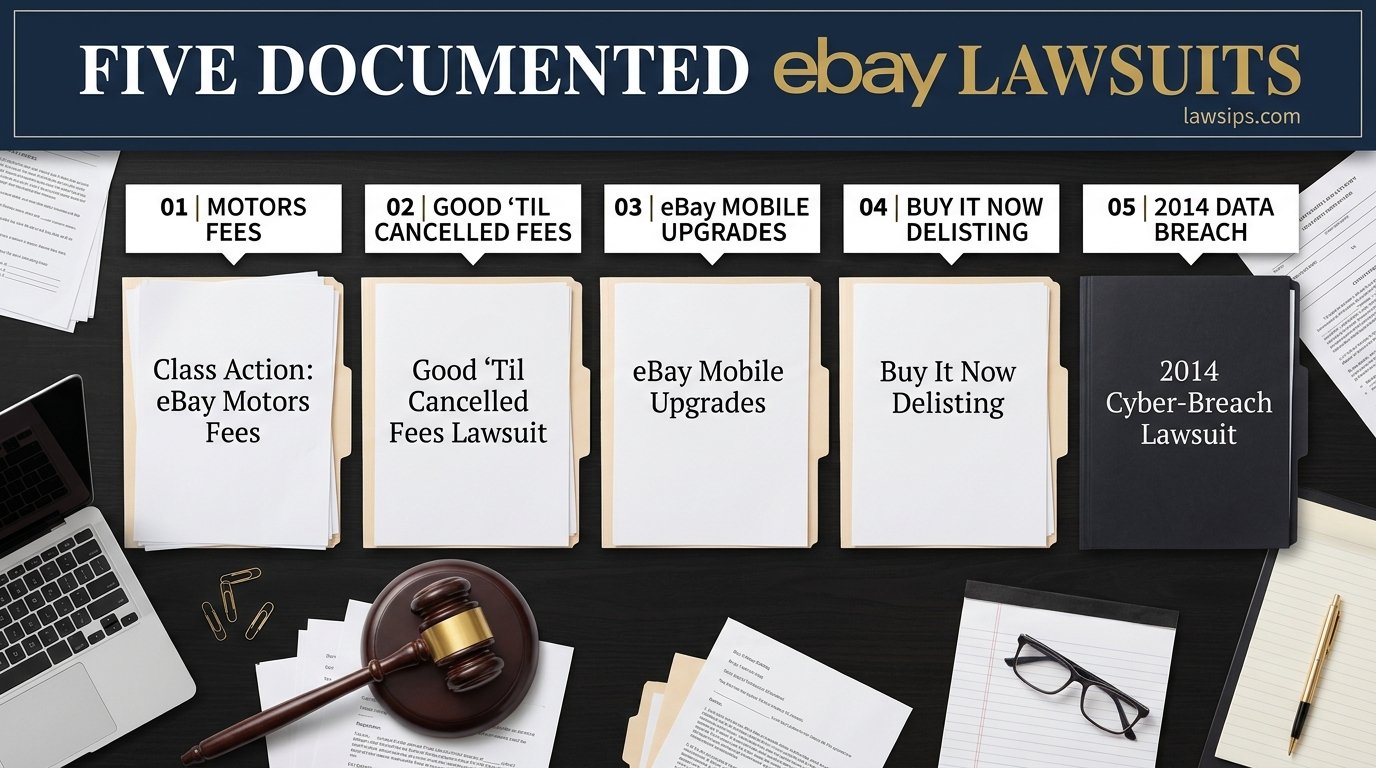
There is no single eBay class action lawsuit. There are five: Motors final value fees, Good Til Cancelled recurring fees, eBay Mobile upgrades, Buy It Now delisting, and the 2014 data breach.
Four were seller fee cases, and all four share one theme: eBay charged fees other than as described. Three settled for 30 million, 6.4 million, and 1.2 million dollars; the mobile case changed the app.
The fifth, the breach case, was dismissed in 2015 because the court found no certainly impending injury. The famous stalking scandal was a criminal prosecution, not a class action at all.
So the useful skills on this keyword are reading a case map and filtering a notice. Both are taught below, with the dockets attached, so you can check every claim on this page yourself.
The Case Map
|
Case |
Court |
Allegation in one line |
Outcome |
|---|---|---|---|
|
Yingling v. eBay (Motors fees) |
Northern District of California |
Fee page promised one charge, eBay took the higher final value fee |
$30M settlement, 2011 |
|
Noll v. eBay (Good Til Cancelled) |
Northern District of California |
Recurring 30 day listing fees not properly disclosed |
$6.4M settlement |
|
Keirsey v. eBay (eBay Mobile) |
Northern District of California |
Mobile flow auto added paid upgrades sellers never chose |
Listing flow rebuilt; case from 2012 |
|
Rosado v. eBay (Buy It Now) |
Northern District of California |
Listings delisted on a click, listing fees kept |
$1.2M settlement, 2016 |
|
Green v. eBay (data breach) |
Eastern District of Louisiana |
2014 breach exposed user data |
Dismissed 2015, no standing |
Read the map as the whole topic in miniature. Seller fees built the canon, the breach tested its limits, and everything else people attach to this keyword is commentary.
Era One: The Fee Disclosure Cases
Four lawsuits, four different fee mechanics, one allegation underneath: the fee eBay described and the fee eBay charged were not the same fee. That pattern is the expert thread competitors never name.
Fee cases make strong class actions for a structural reason. A fee schedule applies identically to thousands of sellers, and eBay’s own records prove who paid what, so common proof carries the class.
Yingling: The 30 Million Dollar Motors Settlement
Two sellers, Brice Yingling of Alamo Auto Sports and Andy Scott, filed in 2009 over eBay Motors Parts and Accessories fees. Their claim was precise and document based.
A page on eBay Motors set a second fee, called a Transaction Services Fee or Successful Listing Fee. Sellers alleged eBay instead charged a Final Value Fee, the charge reserved for regular core listings.
The case settled for 30 million dollars, preliminarily approved in December 2010. Big Class Action’s contemporaneous report of the Motors settlement preserves the terms as announced at the time.
The class covered sellers who paid final value fees on Parts and Accessories listings between April 21, 2005 and August 26, 2009, excluding Store Inventory Format listings.
Payments were proportional: an estimated 6.67 percent refund of the final value fees each member had paid, net of earlier refunds. Percentage refunds, not flat checks, are the fee case signature.
Noll: The 6.4 Million Dollar Good Til Cancelled Settlement
Richard Noll and Rhythm Motor Sports sued in 2011 over Good Til Cancelled listings, the fixed price format that renews automatically every 30 days until the item sells or the seller cancels.
The allegation was disclosure. Plaintiffs said eBay never properly explained that insertion fees and optional feature fees would recur with every 30 day renewal, rather than being charged once at listing.
eBay denied the allegations but settled for 6.4 million dollars, preliminarily approved on January 29, 2015. The full case record, caption included, is held in the Top Class Actions Good Til Cancelled settlement record.
An estimated 1.2 million sellers were eligible class members. Recoveries were estimated at roughly 9 percent of disputed fees, meaning the post initial period fees, less amounts already credited or refunded.
The case also shows litigation’s attrition. A 2012 ruling trimmed the fraud based claims for lack of specific misrepresentations, and the contract core survived to settlement.
Keirsey: The eBay Mobile Upgrades Case
Tasha Keirsey’s 2012 complaint targeted the eBay Mobile listing flow. Sellers listing from phones were charged for optional upgrades they said they never asked for and were never told about.
The complaint’s second allegation reaches further. When eBay discovers its systems are improperly charging fees, plaintiffs argued, it does not proactively disclose the errors or account for the money collected.
eBay’s response is visible in the product itself. The mobile update that followed let sellers select or decline each option, with every optional fee broken out on the final review page.
That is the fee era’s quiet legacy. Whether or not a given case paid much, the flows sellers use today were redesigned under litigation pressure.
Rosado: The 1.2 Million Dollar Buy It Now Settlement
Luis Rosado filed in 2012 over a small, vivid wrong. A buyer clicked Buy It Now on his listing, never completed the purchase, and eBay delisted the item anyway for the rest of its paid term.
The listing fees were not refunded. Multiplied across sellers, the claim became a class action under California’s False Advertising Law, Unfair Competition Law, and Consumer Legal Remedies Act.
The settlement fund was 1.2 million dollars, non-reversionary. The approving court weighed it against estimated damages of up to 5.5 million and called the result fair, adequate, and reasonable.
Approved claims were valued at 5 dollars for a non-vehicle listing and 10 dollars for a vehicle listing, one of each per claimant. The maximum any seller could receive was 15 dollars.
The dates matter, because they are the ones recycled elsewhere as if current. The claim deadline was December 8, 2015; final approval came in June 2016; checks began arriving in September 2016.
LegalClarity’s eBay settlement explainer states the correct status plainly: the settlement is closed. Its warning deserves repeating here: a notice arriving now about this settlement is almost certainly a scam.
What the Four Fee Cases Changed
Read together, the four cases trace one corporate habit being corrected in stages. A fee described loosely in 2005 became a refund in Motors; a renewal left unexplained became a settlement in Noll.
The mobile case shows the correction moving inside the product. Itemized optional fees on a review screen are a litigation artifact, as much as any check the case produced.
And Rosado shows the doctrine’s floor. Even a 1.2 million dollar fund over a 4 dollar fee dispute survived judicial scrutiny, because the practice, not the amount, was the wrong.
For sellers, the practical inheritance is documentation. Every winning case ran on eBay’s own fee records, which is why the platform’s statements, not sellers’ memories, decided who was paid.
Era Two: The Breach Case That Failed
In February and March 2014, attackers accessed an eBay database holding names, encrypted passwords, dates of birth, email addresses, physical addresses, and phone numbers. eBay disclosed the breach that May and urged password resets.
Collin Green sued for all affected US users. On May 4, 2015, the Eastern District of Louisiana dismissed the case entirely, before certification, before any settlement discussion.
The reason was standing. Under the Supreme Court’s Clapper decision, a threatened injury must be certainly impending; Green alleged a statistically certain risk of identity theft, and the court held that risk was not an injury in fact.
Two facts drove the result. No financial information was accessed, and no plaintiff showed actual misuse of the data. The injury, the judge wrote, rested on whether third parties decided to do anything with it.
Mitigation spending failed too. Money spent monitoring against a speculative future harm does not manufacture standing, a ruling breach plaintiffs across the country still have to answer.
Top Class Actions’ report of the Green dismissal preserves the ruling in the judge’s own words. The case is this page’s standing lesson: a huge breach and a viable class action are different things.
Era Three: The Scandal That Is Not a Class Action
The eBay story most people picture is the cyberstalking scandal. In 2019, eBay security personnel harassed Ina and David Steiner, the Massachusetts couple behind a newsletter critical of the company.
Seven former employees and contractors pleaded guilty to federal charges. Some went to prison. No class was ever certified, because there was nothing collective to certify: two victims, one campaign.
In January 2024, eBay itself entered a deferred prosecution agreement with the Department of Justice, admitted responsibility for six felony offenses, and paid a 3 million dollar criminal penalty.
The Steiners’ own civil lawsuit followed. The Automated Reseller’s account of the stalking settlement reports a 55.7 million dollar settlement finalized in 2026, with eBay’s share at 52.15 million and contributions from former executives.
That figure rests on that single source in this research and is printed as reported, not verified. The structural point needs no figure at all: an individual civil case, however large, has no claim form for anyone else.
Why does a two victim case belong on this page at all? Because it is the matter readers most often mistake for a class action, and the mistake sends them hunting for a fund that does not exist.
It also carries the era’s only admission. The fee settlements were denials with checks attached; the stalking resolution was a corporate admission with a monitor, a different species of outcome entirely.
Why the Checks Were Small
New readers often judge these cases by the check size. The per person record below is the full documented picture, and it teaches the arithmetic better than any estimate.
|
Case |
What a member actually got |
Why that shape |
|---|---|---|
|
Rosado (Buy It Now) |
$5 per non-vehicle claim, $10 per vehicle claim, $15 maximum |
A $1.2M fund valued by listing type |
|
Yingling (Motors) |
About 6.67 percent of final value fees paid |
Pro rata refunds from a $30M fund |
|
Noll (Good Til Cancelled) |
Roughly 9 percent of disputed fees |
Pro rata refunds from a $6.4M fund |
|
Green (breach) |
Nothing |
Case dismissed; no fund existed |
Fees and administration come off the top of every fund. In Rosado, the court approved 300,000 dollars in attorneys’ fees, exactly 25 percent of the fund and the standard benchmark it cited.
Our breakdown of settlement payout per person shows the same waterfall across settlements generally. Small checks are what millions of valid claims do to a fixed fund, not evidence a case was fake.
The fee cases’ real returns were partly non cash. Motors sellers got a fee page dispute settled at scale, GTC sellers got disclosure tested, and mobile sellers got a rebuilt listing flow.
The Scam Filter: Is Your eBay Settlement Notice Real?
Because no headline eBay settlement is open, this keyword’s live risk is phishing. Fake notices borrow real case names, including Rosado, and route victims to lookalike claim sites.
Real settlement notices share three traits. They come from a court appointed administrator, they never charge a fee to claim, and the case checks out somewhere the sender does not control.
Run these three checks before clicking anything:
- Find the case on a tracker. A real case appears on recognized settlement trackers and legal news, not only in your inbox.
- Identify the administrator. Legitimate claim sites belong to known administrators such as Epiq, Kroll, JND, or Angeion, on their own domains.
- Confirm the docket. The case name and number resolve in court records. Rosado is 5:12-cv-04005 in the Northern District of California; a notice that cannot produce a docket is decoration.
|
Signal |
Real notice |
Fake notice |
|---|---|---|
|
Sender |
Court appointed administrator |
Unknown sender, lookalike domain |
|
Cost to claim |
Always free |
Asks for a fee, gift cards, or banking login |
|
Dates |
Match the court’s orders |
Urgent, shifting, or years out of date |
|
Case details |
Name, number, and court stated |
Vague promises, no docket |
|
Where it verifies |
Administrator site and trackers |
Only the link in the message |
Owed’s eBay settlement guide reaches the same conclusion from the tracker side. Its 2026 status check finds no famous eBay settlement with a nationwide claim form open to general users.
The Clause That Decides the Future
One reason the eBay canon is historical sits in the User Agreement itself. eBay’s terms contain an arbitration agreement with a jury trial waiver and a class action waiver.
In plain terms, most disputes must go to individual arbitration, not court, and not as a class. New class actions against eBay meet that clause before they ever meet the merits.
The 30 Day Opt Out
The agreement gives new users one narrow exit. You may reject the arbitration agreement by mailing a written opt out notice, postmarked no later than 30 days after first accepting the User Agreement.
The notice goes to eBay’s litigation department in Draper, Utah, at the address the agreement specifies. The window is short, the method is postal, and almost nobody sends it.
Whether arbitration or court fits a future dispute is a legal question, not a settings toggle. Our explainer on how to join a class action lawsuit covers how class membership works when a case does exist.
If a New eBay Settlement Opens: Your First Five Steps
New complaints against marketplaces are filed every year, and some settle quietly. When a real eBay settlement opens, the sequence is always the same:
- Confirm it on the administrator’s own website, reached by your own search, not by a message link.
- Read the class definition against your account history: account type, dates, and the specific fees or conduct involved.
- File the official claim form before the deadline. Filing is free, and our walkthrough of how to file a claim for settlement shows the standard shape of the process.
- Save your records: the notice, your confirmation number, and any fee or listing records the settlement names.
- Calendar the dates: claim deadline, opt out deadline, and the fairness hearing, which are three different dates.
For money that is claimable today across all defendants, open class action settlements and class action settlements you can claim track the live list. eBay simply is not on it at the moment.
The Records That Make a Claim Easy
Seller cases pay from platform records, so the best preparation is keeping yours. Download your monthly financial statements and fee invoices while they are easy to reach, not after a notice arrives.
Save three things: transaction reports showing final value fees by listing, store subscription invoices, and any fee credit memos. Together they reconstruct your class period exposure in an afternoon.
Keep your account email current as well. Notices go to the address on the account, and the Rosado class was identified largely from eBay’s own records and contact data.
None of this guarantees a future case exists. It guarantees that if one opens, you are a records check away from knowing whether you are in it and what it might pay.
Mistakes That Waste Time or Worse
Mistake one: hunting claim forms for closed cases. Rosado closed a decade ago. A site offering to file you into it is selling fiction, and the Rosado dates prove it.
Mistake two: treating the stalking case as a class action. It was a criminal prosecution plus one couple’s civil suit. There is no fund, no class, and no form.
Mistake three: trusting a recycled date. At least one page in this search re-dates the Rosado deadlines to 2025 and 2026. The documented dates are 2015 and 2016; a wrong decade is a scam signal by itself.
Mistake four: paying to claim. Legitimate administrators never charge class members to file. A fee request ends the inquiry.
Mistake five: ignoring the arbitration clause. Sellers planning around a future eBay class action are planning around a clause designed to prevent one. Know your agreement version before counting on a lane.
Frequently Asked Questions
Is there an eBay class action lawsuit I can join right now?
As of this research in November 2026, no headline consumer eBay settlement is open for general claiming, per settlement tracking coverage. The famous eBay class actions are closed historical cases.
A genuinely new case would surface on a court appointed administrator’s site and the major trackers first, so verify there before believing any notice.
What is the eBay class action lawsuit about?
There is no single one. The record is a series of seller fee cases (Motors final value fees, Good Til Cancelled recurring fees, Buy It Now delisting, mobile upgrades) plus a data breach case that was dismissed.
Each had its own class, class period, and outcome, which is why they must be read case by case.
Is the eBay Buy It Now settlement still open?
No. The Rosado v. eBay settlement closed years ago: the claim deadline was December 8, 2015, final approval came in June 2016, and checks began arriving in September 2016. Anyone offering to file you into it now is not describing a real process.
How much did the Rosado Buy It Now settlement pay?
Approved claims were valued at 5 dollars for a non-vehicle listing and 10 dollars for a vehicle listing, one of each per claimant, for a maximum of 15 dollars. The gross fund was 1.2 million dollars, from which attorneys’ fees and administration were also paid.
Who qualified for the Rosado settlement?
US eBay sellers who paid listing fees for a Buy It Now listing between July 30, 2008 and September 10, 2015, whose item was delisted after a buyer clicked Buy It Now without completing the purchase, and whose fees were never refunded.
All three conditions had to hold together.
What was the eBay Motors class action settlement?
Yingling and Scott v. eBay alleged eBay charged Motors Parts and Accessories sellers a Final Value Fee where its fee page promised a different, lower charge. eBay settled in 2011 for a 30 million dollar fund, the largest eBay seller fee settlement on record.
Who qualified for the eBay Motors fee settlement?
Sellers who paid final value fees on Parts and Accessories listings between April 21, 2005 and August 26, 2009, excluding Store Inventory Format listings. Payments were proportional, estimated at about 6.67 percent of the final value fees each member had paid, net of prior refunds.
What was the Good Til Cancelled class action settlement?
Noll v. eBay alleged eBay never properly disclosed that insertion and optional feature fees on Good Til Cancelled listings recurred every 30 days. eBay settled for 6.4 million dollars, with an estimated 1.2 million sellers eligible and recoveries estimated at roughly 9 percent of disputed fees.
Who qualified for the Good Til Cancelled settlement?
US residents who placed Good Til Cancelled listings during the class periods (for Stores listings, March 30, 2010 through June 19, 2012) and were charged the disputed fees: insertion and optional feature fees incurred after the initial 30 day period, less amounts already credited or refunded.
What was the eBay Mobile class action lawsuit?
Keirsey v. eBay, filed in 2012, alleged the eBay Mobile listing flow automatically added optional upgrades sellers had not chosen or been told about, inflating listing fees. It also alleged eBay did not proactively disclose known overcharge errors.
eBay later updated the flow to itemize optional fees before submission.
What happened to the eBay data breach class action?
It was dismissed. In Green v. eBay, decided May 4, 2015, the court held the named plaintiff lacked Article III standing because he alleged a risk of future identity theft rather than an actual or certainly impending injury. The case never became a payout settlement.
What data was exposed in the 2014 eBay breach?
Attackers accessed a database in February and March 2014 containing names, encrypted passwords, dates of birth, email addresses, physical addresses, and phone numbers, per the case coverage. eBay stated no financial information was accessed, a fact the court weighed in its standing analysis.
Why was the data breach case dismissed?
Under the Supreme Court’s Clapper standard, a threatened injury must be certainly impending to confer standing.
The court found increased identity theft risk too speculative where no financial data was taken and no misuse was shown, and held that voluntary mitigation costs do not create standing when the harm is not imminent.
Is the eBay cyberstalking case a class action?
No. The stalking scandal produced a federal criminal prosecution of former employees and eBay’s 2024 deferred prosecution agreement with the DOJ, plus an individual civil lawsuit by the targeted couple, Ina and David Steiner.
There is no class to join and no claim form for the public.
What happened in the eBay cyberstalking case?
Seven former eBay security staff and contractors pleaded guilty to harassing the Steiners in 2019. eBay admitted responsibility under a deferred prosecution agreement in 2024 and paid a 3 million dollar criminal penalty.
The Steiners’ civil case was reported settled in 2026 for 55.7 million dollars, a figure carried by seller press coverage and labeled as reported here.
Did eBay admit wrongdoing in these settlements?
In the civil fee settlements, eBay denied the allegations and settled to avoid litigation cost and uncertainty, the standard pattern. The exception is the criminal stalking matter, where the deferred prosecution agreement involved eBay admitting responsibility for its employees’ conduct.
I got an email about an eBay settlement. Is it a scam?
Be skeptical. With no headline eBay settlement currently open, a notice demanding urgent action is almost certainly phishing. Real notices come from a court appointed administrator, never ask you to pay to claim, and can be confirmed on the administrator’s own site or the court docket.
How can I verify an eBay class action is real?
Three checks: the case appears on a recognized settlement tracker; the claim site belongs to a known administrator such as Epiq, Kroll, JND, or Angeion; and the case name and number resolve on the court’s docket (PACER).
A lookalike domain, a shortened link, or a fee to file fails the test immediately.
Do I need proof to claim in an eBay settlement?
In the historical seller cases, eBay’s own records identified most class members, and Rosado claims were valued by listing type rather than receipts. Where proof is needed, the settlement notice says exactly what counts. Never invent documentation; administrators cross-check claims against platform records.
Why were the eBay seller fee cases filed?
One recurring theme: disclosure. Motors sellers said the fee page promised one charge and eBay took another; GTC sellers said recurring fees were not explained; mobile sellers said upgrades were added silently; Buy It Now sellers said delisted listings kept their fees.
The mechanics differ; the theme does not.
What is a final value fee and why was it litigated?
A final value fee is the percentage eBay charges on a completed sale.
It was litigated in the Motors case because sellers alleged the Parts and Accessories fee page set a different charge, a Transaction Services or Successful Listing Fee, than the final value fee eBay actually applied.
What are insertion fees and optional feature fees?
Insertion fees are the per listing charges for posting an item; optional feature fees pay for upgrades such as enhanced visibility. In the GTC case, the dispute was that both recurred every 30 days on auto renewing listings without, plaintiffs said, proper disclosure.
What is a Good Til Cancelled listing?
A fixed price listing that automatically renews every 30 days until the item sells or the seller cancels it. That renewal is what made its fees recurring, and what turned a disclosure question into a class action covering an estimated 1.2 million sellers.
Can buyers bring an eBay class action, or only sellers?
Either can in principle, and buyer side cases exist across marketplaces. The durable eBay record is seller fee litigation, because fee schedules give thousands of sellers an identical, provable claim. The larger gate for everyone is eBay’s arbitration clause and class action waiver.
Does eBay’s user agreement block class actions?
For most users, largely yes. The eBay User Agreement contains an arbitration agreement with a class action waiver: disputes go to individual arbitration, not court, and not as a class. That clause, not the merits, is what most new eBay disputes meet first.
How do I opt out of eBay’s arbitration clause?
New users may reject the arbitration agreement by mailing a written opt out notice, postmarked no later than 30 days after first accepting the User Agreement, to eBay’s litigation department in Draper, Utah, at the address the agreement specifies.
The window is short and the method is postal by design.
Can I still sue eBay individually?
Individual routes survive in narrow lanes: the arbitration clause itself for most claims, small claims court where the agreement and local rules allow, and individual suits for users who opted out in time.
Which lane applies depends on your agreement version and claim, a question for a consumer attorney.
How much do eBay class action payouts usually pay?
The documented record is modest: 5 to 15 dollars per claimant in Rosado, and percentage refunds in the fee cases (about 6.67 percent of final value fees in Motors, roughly 9 percent of disputed fees in GTC).
Small per person outcomes are the arithmetic of large classes, not a sign a case failed.
Why are eBay class action payouts so small?
The fund is fixed, fees and administration come off the top, and the remainder divides across everyone who claims. A 1.2 million dollar fund across a seven year class of sellers cannot produce large individual checks.
The value of such cases sits in the refund principle and the practice changes, not the check size.
When did eBay pay the Buy It Now settlement checks?
Checks began arriving in late September 2016, after final approval that June. The claim deadline had been December 8, 2015. Any source presenting those dates as upcoming is recycling a closed case, which is itself a useful scam signal.
Are there any eBay settlements open in 2026?
No headline consumer eBay settlement with a general claim form is open as of this research, per settlement tracking coverage.
New complaints are filed against marketplaces every year and some settle quietly, so the live check is always the same: administrator sites and recognized trackers, not inboxes.
What should I do if a new eBay settlement opens?
Confirm the case on the administrator’s own website, read the class definition against your account history, and file the official claim form before the deadline. Save the notice, your confirmation, and any listing or fee records.
Filing is free; anyone charging you to file is not part of the process.
Do I need a lawyer to join an eBay class action?
No. Class counsel represents the class, and members file a claim form, which is the entire job in most settlements. A lawyer of your own matters only at decision points: opting out to sue individually, or objecting to a settlement you believe is unfair.
How do I find old eBay settlements I might have missed?
Settlement archives on Top Class Actions and similar trackers list the closed eBay cases with their class periods. Finding one is informational only: a closed settlement’s deadlines are final, and there is no late entry route. The useful forward habit is monitoring open settlement lists.
What if I missed an eBay settlement deadline?
Generally, the claim is gone. Courts enforce claim deadlines, and closed funds are distributed or resolved as the settlement directs, sometimes with leftover funds going to court approved charities (cy pres). This finality is why current notices deserve attention the week they arrive.
Can eBay close my account for joining a class action?
Nothing in the settlement record suggests account retaliation for claiming; class membership comes from eBay’s own records and claiming is a court supervised process. Account standing is governed by the User Agreement.
If an account action ever followed a claim, that sequence is worth a consumer attorney’s look.
What is the difference between an eBay class action and the government cases against eBay?
A class action is a civil suit by users seeking refunds or damages, ending in settlement or judgment for the class. The stalking matter was a criminal prosecution by the Department of Justice, ending in guilty pleas and a corporate deferred prosecution agreement.
Only the civil class route ever produces claim forms for users.
Did eBay pay a fine over the stalking scandal?
Yes. Under the January 2024 deferred prosecution agreement, eBay paid a 3 million dollar criminal penalty and accepted enhanced compliance monitoring. That penalty is separate from the Steiners’ civil settlement, reported at 55.7 million dollars in 2026, and from the guilty pleas of the seven individuals.
Where are eBay class actions usually filed?
The seller fee canon sits in the US District Court for the Northern District of California, near eBay’s San Jose base: Rosado, Noll, Yingling, and Keirsey were all filed there. The breach case, Green, was filed in the Eastern District of Louisiana.
Forum follows the user agreement and the plaintiffs’ filing choices.
What laws were the eBay seller cases brought under?
Chiefly California consumer statutes: the Unfair Competition Law, the False Advertising Law, and the Consumer Legal Remedies Act, alongside breach of contract, breach of the covenant of good faith and fair dealing, and unjust enrichment claims. Fee disclosure promises were the factual core in each.
How big is eBay, for context on these classes?
Scale explains the small checks: JD Supra’s coverage of the breach litigation described eBay as having more than 120 million active users worldwide at that time, and eBay reported over 10 billion dollars of 2024 revenue in competitor coverage.
Figures like these are context, labeled with their sources and dates, not current statistics.
Is this legal advice, and where can I check a case myself?
No. This page is general information about public cases, not legal advice for your account or claim. To check any case yourself, use the case name and number on PACER, the administrator’s official settlement site, or recognized trackers.
For a live deadline or a decision like opting out, consult a licensed consumer attorney promptly.
Conclusion
eBay class action lawsuit resolves, on inspection, into five cases and three lessons. The fee cases taught that described fees and charged fees must match, and paid real refunds when they did not.
The breach case taught the harder lesson: scale is not standing, and a risk of future harm is not yet an injury a court can pay for. The stalking scandal taught the difference between a prosecution and a class.
For settlements that are genuinely open today, start with open class action lawsuits and the current class action settlements 2026 hub, and browse class action lawsuit settlements for how these cases end.
And keep the scam filter beside the case map. On this keyword, the next eBay settlement email you receive is far more likely to be the lesson than the payout.

Dilawar is a dedicated writer and contributor at Lawsips.com, focusing on legal information, business law, consumer rights, legal awareness, and everyday legal matters. He is passionate about simplifying complex legal topics and providing readers with clear, practical, and easy-to-understand information. His goal is to help readers stay informed about legal developments, understand their rights, and make better decisions through informative and well-researched articles.