
Settlement Check Status: The Two Lanes, the Seven Stages, and Every Fix

Settlement check status means two completely different things depending on how your case settled. Class action money moves through a court appointed administrator over months; an individual settlement moves through your lawyer’s trust account over weeks.
Most status confusion is a lane error. A class action claimant refreshing a portal is watching a court calendar, while an injury client calling a law firm is watching a bank and lien process. The channels, the clocks, and the fixes differ.
This page routes you first, then decodes every stage in your lane. Which system holds your money decides where your status actually lives and who can move it.
One boundary before the routing. Everything here is general information, not legal or tax advice, and no page can give you the payment date for your specific settlement.
This page sits inside the LawSips legal guides library, where settlement topics are documented with their rules and sources attached. Dates and ranges carry their sources, because on this topic an unsourced number is how bad pages are made.
The Short Answer: Which Lane Is Your Money In?
|
Question |
Lane A: class action |
Lane B: individual settlement |
|---|---|---|
|
Who pays you |
A claims administrator (Epiq, Kroll, JND, Angeion, Simpluris, Verita, Rust) |
Your own attorney, from a client trust account |
|
Where status lives |
The official settlement website and its claim portal |
Your law firm, by phone, email, or client portal |
|
Typical total wait |
Months: often 3 to 18 months after the claim deadline, as trackers report |
Weeks: about 2 to 6 for a straightforward case |
|
What moves it |
Court milestones: final approval, appeal window, Effective Date |
A signed release, the insurer’s check, bank clearance, lien resolution |
|
Your ID |
Claim ID or notice ID |
Your case or claim number at the firm |
If you filed a claim form on a settlement website, you are in Lane A for everything below. If you signed a release with a lawyer’s help, you are in Lane B.
Both lanes end the same way: money you can spend. They just keep it in different buildings while you wait, and each building has its own front desk.
Lane A: How a Class Action Claim Becomes a Check
A class action settlement pays nobody when the claim deadline passes, and nobody when the judge approves it either. Payment waits for a legal sequence to finish, and your status is simply your claim’s position in that sequence.
The Milestone Clock, Stage by Stage
|
Stage |
What is happening |
Typical duration |
|---|---|---|
|
Claims open, then deadline |
Claims collected; review pool forms |
Set by the court’s order |
|
Claim review |
Eligibility, duplicates, fraud screening, deficiency notices |
Often 30 to 90 days after the deadline |
|
Final approval hearing |
Judge tests the deal under Rule 23(e): fair, reasonable, adequate |
Scheduled months after the deadline |
|
Appeal window |
Objectors may appeal under FRAP Rule 4 |
30 days federal; 60 when the US is a party |
|
Effective Date |
The settlement becomes binding; the payment clock starts |
Defined in the agreement itself |
|
Distribution |
Administrator pays in batches, by check or digital payment |
Agreement deadlines of 60, 75, or 150 days appear in real settlements |
The last row deserves emphasis. OpenClassActions’ Effective Date analysis read actual settlement agreements and found payment due within 60 days of the Effective Date in one, 75 in another, and 150 in a third. Distribution timing is a contract term, not a law.
Owed’s settlement timeline guide converts the same sequence into the range claimants actually feel: most people are paid 3 to 18 months after the claim deadline, with simple flat payment cases at the fast end and appealed cases running past two years.
That is a tracker reported range, printed as one.
The Effective Date: The Date That Actually Starts Payment
Final approval gets the headlines, but the Effective Date starts the clock. It is defined inside each settlement agreement, usually as the point when the approval order is final and the time to appeal has run out.
Two settlements approved on the same day can pay months apart because their Effective Date definitions differ. One real agreement makes it the day after the order when nobody objected; another waits for every appeal window to expire.
So the status question that matters is never “was it approved?” It is “has the Effective Date occurred, and what does the agreement allow after it?” The settlement site’s banner and the agreement itself answer both.
Why Nobody Can Give You a Date
Claimants ask administrators for the one thing the system cannot produce: a personal payment date. Three separate dependencies make it impossible until the final weeks.
The court controls the first dependency, because approval hearings get scheduled, continued, and occasionally reopened for more information. The appeal window controls the second, and a single filing resets it.
The administrator controls only the third: validation and batching. Even there, the claims rate changes the math until the deadline passes, because every pro rata amount depends on how many valid claims exist.
That is why honest sources give ranges and milestones instead of dates. A site that promises your check on a specific day is either guessing or selling something, and the docket can tell you which in about a minute.
Lane B: The Attorney Trust Account Path
An individual settlement has no administrator, no portal, and no Effective Date. LegalClarity’s guide to tracking a settlement check maps the lane from the other side: your attorney’s office is the single best source for your status, because the money physically passes through the firm.
The sequence runs on paper and banking rails. You sign a release, the defendant’s insurer issues a check (typically within two to four weeks of receiving the release), and the check is made out to the firm or its trust account, not to you.
Your lawyer deposits it into a client trust account, a segregated account the firm may not mix with its own money. The bank then holds the funds until the check clears.
Under Regulation CC, larger amounts can be held longer: legal guidance summarizing the Federal Reserve’s rules notes amounts above $6,725 may be held up to seven business days for most checks.
Only then does the firm settle the file’s deductions: liens, medical bills, case costs, and the agreed fee. Before or with your payment, you receive a disbursement statement itemizing every one of them.
For a simple case with no liens and a cooperative insurer, LegalClarity puts the whole journey at two to three weeks, and about two to six weeks as the typical band. Lien negotiation is what stretches it.
One protection in this lane deserves plain words. Under the profession’s conduct rules, your lawyer must notify you promptly when settlement funds arrive and provide a full accounting when you ask. Silence for weeks after a settlement is final is a red flag, not a norm.
The Status Decoder: What Your Portal Is Telling You
Portal wording varies by administrator, but the stages underneath do not. MoneyPilot’s status code decoder decodes seven claim status codes as a claimant meets them; the table below adds the legal milestone and the action each one calls for.
|
Status you see |
What it means |
What moves it |
What to do |
|---|---|---|---|
|
Received |
Claim logged, not yet reviewed |
The claim deadline passing |
Save your claim ID and confirmation |
|
Under Review |
Validation: eligibility, duplicates, fraud screening |
Administrator’s review of the full class |
Wait; review commonly runs 30 to 90 days post deadline |
|
Deficient |
Something is missing or inconsistent |
Your cure, inside the cure period |
Fix exactly what the notice names, before its date |
|
Approved |
You are in the payment pool |
The Effective Date |
Nothing; payment still waits for distribution |
|
Processing or Scheduled |
Your batch is being prepared |
The distribution calendar |
Watch the site banner for the mailing window |
|
Issued or Paid |
Payment sent by your chosen method |
Mail or payment network time |
Allow 1 to 3 weeks for a paper check |
|
Reissue or Escheated |
First payment failed or went uncashed |
Your request, or the state’s process |
Ask for reissue, or search unclaimed property |
Two decoder lessons matter most. Approved is not paid: it means your claim survived review, while the money still waits on court milestones no administrator controls.
And silence is structural. Administrators generally do not send progress updates unless something is wrong with your claim, so a quiet portal usually means a healthy claim in a slow queue.
How to Check Your Status, Lane by Lane
For Lane A, work these five channels in order. Each one answers a different question, and together they take minutes.
- Read the settlement site’s status banner. The official site posts the current milestone (final approval granted, appeal pending, payments issued) at the top, with the next date. This is the fastest true answer in either lane.
- Use the portal lookup. Enter your claim ID or notice ID for your individual status. The two IDs differ: the notice ID came with your notice; the claim ID arrived with your filing confirmation.
- Check the docket. PACER carries the federal record, and CourtListener republishes many dockets free. Look for the final approval order and any notice of appeal; an appeal explains a frozen timeline instantly.
- Contact the administrator through the official site. Use only the phone, email, or address published there. Have your claim ID ready; staff can confirm receipt and deficiency, though replies are often templated.
- Verify your own file. Correct address and email on record, confirmation saved, payment method noted. Half of all status problems are file problems wearing a status costume.
For Lane B, the checklist is shorter and more personal:
- Ask the five questions: Has the insurer mailed the check? Has it arrived at the firm? Has it cleared? Are liens still being negotiated? What is the expected disbursement date?
- Ask whether the firm offers a client portal. Some firms expose financial milestones online; if yours does, it replaces most status calls.
- Request the disbursement statement when payment is near. It is your entitlement, and reading it against your fee agreement is the Lane B equivalent of checking a portal.
The full filing side of Lane A, from notice to claim form, lives in how to file a claim for settlement. Our explainer on how to join a class action lawsuit covers how membership and claiming differ, which is where many status questions quietly begin.
A Live Example: Reading One Real Case’s Status
Status language gets concrete fast on a real docket. The AT&T telecom data settlement, a 177 million dollar deal in the Northern District of Texas, received final approval on October 2, 2026.
Its administrator is Kroll Settlement Administration, working through the case’s official settlement website. Under the court approved terms, payouts must be distributed within 60 days of the settlement’s Effective Date.
Read that as a claimant: approval is done, so the live questions are the appeal window and the Effective Date arithmetic. Assuming no appeal, reporting on the case projects first payments around December 2026 into early 2027.
Those projections are reporting, not promises, and this example is dated November 2026. Any named case’s status belongs to its own site and docket on the day you read it, which is the habit this page is really teaching.
When the Check Goes Missing: The Failure Protocol
Payment dates on settlement sites are estimates, not guarantees. The protocol used by administrators and trackers alike starts with patience and ends with the state.
Give an announced distribution 30 to 45 days before treating a missing payment as a problem. Mail runs slow, batches run slower, and most late checks are simply in a later batch.
Then work in order: check the site’s payment updates, confirm your portal shows issued, verify the address the administrator holds, and contact the administrator. A mailed but unreceived check can be stopped and reissued, typically in 30 to 60 days.
Owed’s settlement check guide adds the verification habit that belongs in every missing check case: confirm the payment against the administrator’s own records, using contact details from the official website, before assuming anything about what was sent.
Expired, Undeliverable, and Escheated: The Three Exits
Exit one: the check expired. Settlement checks typically carry a void after 90 to 180 days line. Administrators often reissue once if you ask before the final distribution closes, so an expired check is a phone call, not a funeral.
Exit two: the check was undeliverable. Administrator guidance names stale addresses the number one reason class members never see their money. A forwarding order does not update the claim record; only the administrator can.
Exit three: the money escheated. Uncashed funds that outlive the administration are handled as the agreement directs: a second distribution, cy pres charities, or transfer to your state’s unclaimed property after roughly 6 to 12 months.
State databases are searchable free, and your name is the only key you need.
Real or Fake: Verifying a Check and a Website
Status anxiety and scam anxiety are the same anxiety in this topic, because fake settlement sites harvest exactly the people checking on real money.
A real check comes from a court appointed administrator, in a plain envelope carrying the case name. It never arrives with instructions to deposit it and send part of the money back, buy gift cards, or share banking credentials.
Run the two minute check before depositing anything:
- Find your original notice and match its case name and administrator against the check.
- Reach the official settlement site by your own search, never by a link in a message, and confirm the administrator matches.
- Call the administrator on the number published on that site, never a number printed on the check itself, and confirm check number, amount, and payee.
- Deposit normally and note the hold: larger checks may be held several business days, which is banking, not a problem with the check.
Payment Methods Compared
|
Method |
Speed after distribution |
Expiry risk |
Main failure mode |
|---|---|---|---|
|
Direct deposit or ACH |
Fastest: about 1 to 3 business days |
None once sent |
Wrong account details at filing |
|
Digital wallet (PayPal, Venmo, Zelle) |
Days |
Expires if unaccepted in about 30 to 90 days |
Unclaimed payment email missed |
|
Prepaid card |
Days to weeks by mail |
Card terms apply |
Card lost or discarded as junk |
|
Paper check |
1 to 3 weeks by mail |
Void after about 90 to 180 days |
Stale address, lost mail, junk mail look |
Owed’s settlement timeline guide makes the practical point plainly: digital options arrive days earlier than checks and cannot be lost in the mail, but they carry their own deadline. Whichever method you chose at filing is the one to watch.
Our breakdown of settlement payout per person explains why the amount on any of these rails is smaller than the headline fund suggested. The rail decides when; the waterfall decided how much, long before.
Mistakes That Stall a Payment
Mistake one: checking the wrong lane. Portal refreshing does nothing for a trust account file, and calling a law firm does nothing for an administrator claim. Route first, always.
Mistake two: reading Approved as Paid. Approved puts you in the pool. The Effective Date and the distribution calendar decide the rest, and neither shows in your portal status.
Mistake three: letting a deficiency notice sit. Cure periods in real agreements run as short as 15 to 21 days. An uncured deficiency is the one status problem entirely within your power to prevent.
Mistake four: moving quietly. The administrator mails to the address on the claim, years after you filed it. Update the record when you move, not when the check fails to arrive.
Mistake five: trusting a lookalike. A status check that starts from a message link can end at a phishing site. The official site, reached by your own search, is the only front door.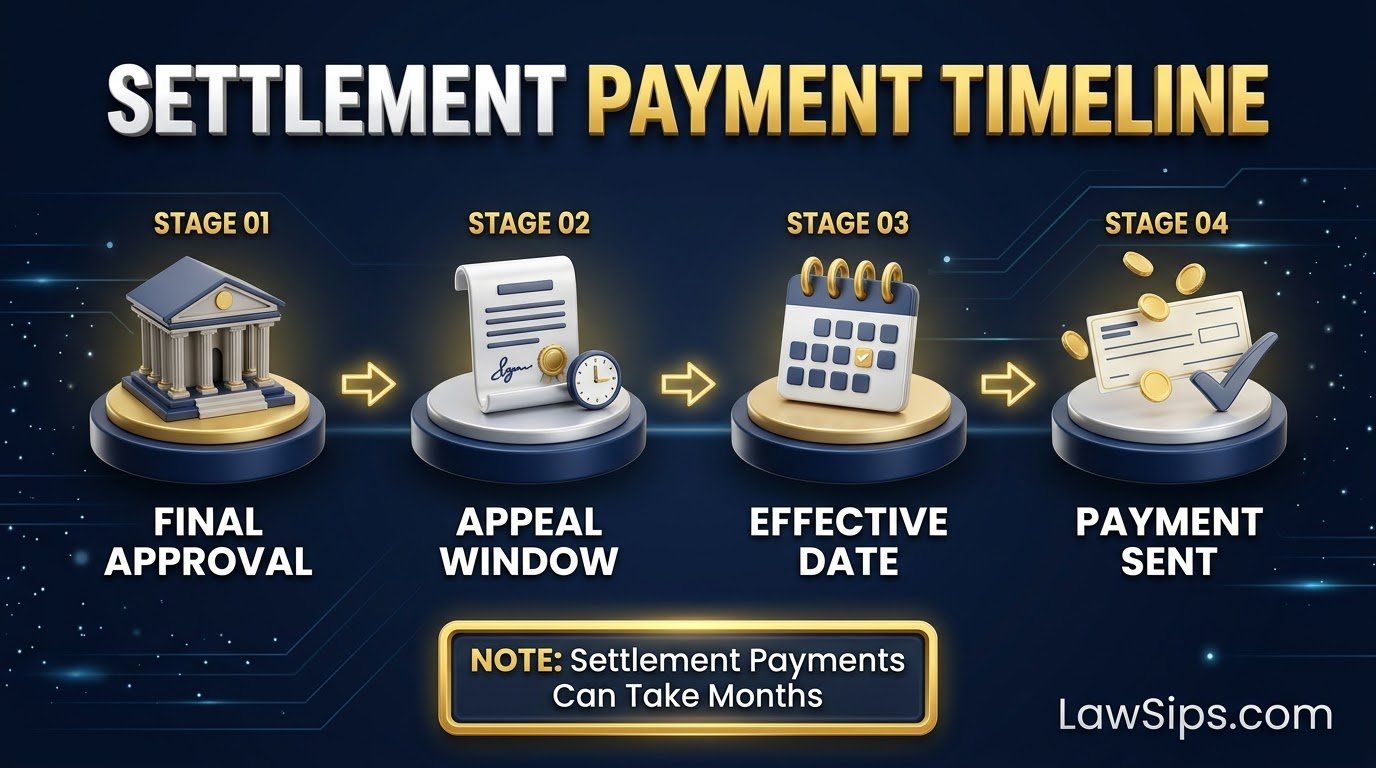
Frequently Asked Questions
How do I check my settlement check status?
Start with the official settlement website for your case, named in your notice. Read its status banner, then use the claim status lookup with your claim ID or notice ID.
If the portal tells you nothing new, contact the administrator through that site, and check the court docket (PACER or CourtListener) for approval and appeal events.
Where is my settlement check?
Almost always, it does not exist yet. Checks are created only at distribution, which waits for final approval, the close of the appeal window, and claim validation.
If your settlement site has announced a distribution and 30 to 45 days have passed, contact the administrator; a mailed but missing check can be stopped and reissued.
How long does it take to get a settlement check after filing a claim?
Tracker consensus puts most class action waits at roughly 6 to 18 months from filing, and 3 to 18 months measured from the claim deadline. Simple flat payment cases land at the fast end; appealed cases can pass two years.
All such ranges are reported estimates, never promises for a specific case.
How long after final approval are settlement checks mailed?
Not immediately. The appeal window runs first (30 days in federal court, 60 when the US is a party), the settlement reaches its Effective Date, and then the agreement’s distribution deadline applies: agreements reviewed in October 2026 allowed 60, 75, or 150 days.
Uncontested cases typically pay about three to six months after the approval order.
What is the Effective Date of a settlement?
The date the settlement becomes fully binding and the payment clock starts, defined in the settlement agreement itself. In most agreements it arrives after the final approval order is entered and the time to appeal it has expired, or any appeal has been resolved.
Distribution deadlines count from this date, not from the hearing.
What does claim status Received mean?
Your claim is logged but not yet reviewed. Nothing is wrong and nothing is required. Save your claim ID and confirmation, and check back after the claim deadline, when review actually begins in earnest.
What does claim status Under Review mean?
The administrator is validating your claim: eligibility against the class definition, completeness, and screening for duplicates and fraud. Review of a full class commonly takes 30 to 90 days after the claim deadline.
Early and late filers are reviewed in the same pool and paid at the same time.
What does a deficient claim notice mean?
Your claim is missing something the administrator needs: a document, a corrected field, or proof the notice specifies. Deficiency notices come with a cure period, 15 or 21 days in two real agreements, so act inside it. An uncured deficiency usually means no payment.
What does claim status Approved mean?
Your claim passed validation and you are in the payment pool. It does not mean a check exists yet: distribution still waits for the Effective Date and runs in batches, so approved claimants are paid across days or weeks, not on one morning.
What does payment status Issued or Paid mean?
Your payment has been sent by the method you selected: check mailed, or digital payment transmitted. Paper checks typically take one to three weeks in the mail. If a full month passes with nothing, contact the administrator about a stop payment and reissue.
Can I track my settlement check like a package?
No. Settlement checks travel as ordinary first class mail without tracking numbers. What you can track is the process, not the envelope: the settlement site’s status banner, your portal status, and the court docket.
Administrators can confirm a mailing date and check number, which is the closest thing to tracking that exists.
Why is my settlement check taking so long?
Usually because the legal clock, not the mail, is running: final approval scheduling, the appeal window, claim validation across a large class, and pro rata calculation all precede distribution. A single objector appeal freezes everything, commonly adding 6 to 18 months.
Check the docket to see which stage your case is actually in.
What is the appeal window and why does it delay payment?
After a judge approves a settlement, objectors have a deadline to appeal: generally 30 days in federal court under Federal Rule of Appellate Procedure 4, and 60 days when the United States is a party.
Administrators wait it out because paying early risks clawing back money if an appeal succeeds.
What if someone appeals my settlement?
Distribution pauses until the appeal resolves. Appeals commonly add 6 to 18 months, occasionally more. There is nothing for individual claimants to file or fix; the case’s status banner and docket are the places to watch, and the settlement’s Effective Date simply moves with the outcome.
My settlement check never arrived. What do I do?
Wait until 30 to 45 days past the announced distribution date, then work in order: check the site’s payment updates, confirm your portal status shows issued, verify the address the administrator holds, and call or email the administrator.
A mailed but unreceived check can be stopped and reissued, typically taking 30 to 60 days.
Can an expired settlement check be reissued?
Often once, if you ask before the settlement’s final distribution closes. Settlement checks are typically void after 90 to 180 days, so deposit promptly.
After the administration fully closes, uncashed funds are handled as the agreement directs, frequently escheating to the state or going to a court approved charity (cy pres).
What happens to uncashed settlement checks?
They do not vanish. Depending on the agreement, leftover money funds a second distribution to claimants who cashed their checks, goes to cy pres charities, or escheats to state unclaimed property after roughly 6 to 12 months.
Your state’s unclaimed property database is the recovery route, and searching it by your name takes two minutes.
How do I update my address with the settlement administrator?
Use the contact form, email, or phone line on the official settlement website, and give your claim ID and both addresses.
Undeliverable mail is the most common reason class members never receive money, per administrator guidance, so update before distribution, not after a check goes to your old home.
I moved after filing my claim. Will I still get paid?
Only if the administrator can reach you. File a change of address with the administrator directly; a postal forwarding order helps but expires and does not update the claim record. Digital payment elections sidestep the address problem entirely, which is one reason administrators encourage them.
What is the difference between a claim ID and a notice ID?
A notice ID identifies you as a potential class member and appears on the mailed or emailed notice, often used to file the claim. A claim ID (or confirmation number) is issued when your claim is actually submitted.
Portals accept one or the other depending on the administrator; your filing confirmation email is the document to keep.
I lost my claim confirmation number. Can I still check my status?
Usually yes. Many portals can look you up with the email address used at filing plus your name or ZIP code, and administrators can retrieve a claim ID by phone.
Search your inbox for the settlement name and the administrator’s name first; confirmation emails often sit unfiled.
Do settlement checks expire?
Yes. Paper checks typically carry a void after period of 90 to 180 days printed on their face. Digital payments expire too if not accepted, commonly within 30 to 90 days.
The deadlines are real and administrator enforced, so act on any payment notice the week it arrives.
How long do I have to accept a digital settlement payment?
Commonly 30 to 90 days from the payment email, after which the unaccepted payment is cancelled and may be reissued as a paper check or returned to the fund, per the settlement’s terms.
The exact window is in the payment email itself; treat it as a deadline, not a suggestion.
Which is faster, a settlement check or a digital payment?
Digital, by days to weeks. Direct deposit and wallet payments typically land one to three business days after distribution, while paper checks take one to three weeks in the mail and then may sit behind a bank hold.
Digital also removes the lost mail and stale address failure modes.
Why do settlement payments go out in batches?
Because administrators validate and pay a class in tranches, reconciling claims, running anti-fraud checks, and calculating pro rata amounts as they go. Two neighbors in the same settlement can legitimately be paid weeks apart.
Batch reality is why administrators advise patience measured in weeks after a distribution starts.
How do I verify a settlement check is real?
Find the original notice and confirm the administrator matches the official settlement website. Then call the administrator using the number on that website, never a number printed on the check itself, and confirm the check number, amount, and payee.
Real administrators never ask you to send money, gift cards, or banking credentials to release a payment.
What are the signs of a fake settlement check or site?
A fee to claim or to verify, urgency pressure, a lookalike domain, a check that arrives with instructions to deposit and return part of the money, and contact details that exist nowhere but the message you received. Each is disqualifying on its own.
Route every check through the official settlement site you found by your own search.
My settlement check is smaller than expected. Why?
Because the per person amount is calculated at the end, not promised at filing: the net fund after fees and administration divides pro rata across valid claims, and a high claims rate shrinks every share.
The settlement site’s FAQ usually publishes the final per person figure once distribution begins.
Will I get a second settlement check?
Sometimes. If enough first round checks go uncashed, some agreements fund a supplemental or second distribution to claimants who cashed theirs. Others route leftovers to cy pres or the state.
The settlement agreement and the site’s updates say which; there is no general entitlement to a second payment.
Is my settlement check taxable?
It depends on what the payment compensates: the IRS treats settlement proceeds differently for personal physical injury, lost income, property, and punitive damages, among other categories. IRS Publication 4345 summarizes the rules.
This page is general information only; your tax situation deserves a tax professional, especially for larger payments.
How does a personal injury settlement check work differently?
There is no administrator or portal. After you sign a release, the insurer sends the check, typically within two to four weeks, to your attorney’s client trust account.
The firm waits for it to clear, resolves any liens, gives you a disbursement statement, and pays your net share. Straightforward cases complete in about two to six weeks.
Why is my lawyer holding my settlement money?
Because the money sits in a regulated client trust account until the check clears and deductions are settled: liens, medical bills, case costs, and the agreed fee. Bank holds under Regulation CC can keep large checks pending up to seven business days.
Your lawyer must notify you promptly when funds arrive and account for them on request under professional conduct rules.
How long can a bank hold a settlement check?
Under Regulation CC, most checks clear on standard schedules, but larger amounts can be held longer: amounts above $6,725 may be held up to seven business days for most checks, per Federal Reserve guidance summarized by legal sources.
Holds apply to the deposit, not to your right to the money, and your bank must tell you the release date.
What is a disbursement statement?
The written accounting your attorney provides at or before paying you: the gross settlement, every deduction (fees, costs, liens, bills), and your net amount. Read it against your fee agreement before signing off.
It is the personal injury lane’s equivalent of a settlement site’s payment summary, and you are entitled to it.
What delays a personal injury settlement check?
Lien resolution is the classic delay: Medicare, Medicaid, health insurers, and hospitals may claim part of the recovery, and negotiating those claims takes weeks to months. Insurer processing, court approval for minors or incapacitated plaintiffs, and structured settlement setup add time as well.
Ask your firm which specific item is open on your file.
Can I check my class action status on the court docket?
Yes. PACER carries the federal docket for a fee, and CourtListener republishes many dockets free. Look for the final approval order, any notice of appeal, and distribution orders. The docket shows the legal milestones; only the administrator’s portal shows your individual claim’s status.
Who do I contact about my settlement: the court, the lawyers, or the administrator?
The administrator, for anything about your claim, address, or payment. Class counsel handles legal questions about the settlement itself, and the court does not answer claimant calls at all. Every official settlement site lists the administrator’s phone, email, and mailing address for exactly this purpose.
What if the settlement website says distribution is complete but I got nothing?
Act quickly: confirm your portal status, verify the address on file, and contact the administrator about a stop payment and reissue before the administration closes. If the window has closed, search your state’s unclaimed property database under your name; distributed but unclaimed money often lands there.
Why did my neighbor get a settlement check and I did not?
Three usual reasons: they were in the class definition and you were not; they filed and your claim was never submitted or was deficient and uncured; or your payment is in a later batch or went to an old address.
Check your status on the portal first; it distinguishes among all three faster than speculation.
Does the settlement administrator send status updates by email?
Generally no, unless something is wrong with your claim. Administrators post updates on the settlement website and wait to be contacted, which is why the status banner and the portal are the reliable channels.
Follow up emails about deficiency or payment do occur, so keep the filing email address active and check its spam folder.
What should I save to make checking my status easy?
Four items: the original notice (case name, administrator, often your notice ID), the claim confirmation email with your claim ID, a note of the payment method you selected, and the official settlement website address. With those, any status question takes minutes instead of an afternoon.
Is this legal or tax advice for my settlement?
No. This page is general information about how settlement payments move and how to check on them, drawn from public administrator guidance, court rules, and regulator publications.
For a question about your specific claim, deadline, lien, or tax treatment, the administrator and a licensed attorney or tax professional are the right channels.
Conclusion
Settlement check status is a routing question before it is a timing question. Administrator money answers to court milestones and an Effective Date; attorney money answers to a release, a bank hold, and a lien list.
Once you know your lane, the stages decode themselves, and the fixes are few and known: cure the deficiency, keep the address current, respect the void date, and ask the right front desk.
For cases still gathering claims, open class action settlements and class action settlements you can claim track what is open now, and the class action settlements 2026 hub follows this year’s settlements.
The wider mechanics of how these cases end sit in class action lawsuit settlements and open class action lawsuits.
And when your own payment lands, smaller than the headline promised, the waterfall already has its explanation written. Bring your claim ID, check the banner first, and let the docket tell you which clock is running.

Dilawar is a dedicated writer and contributor at Lawsips.com, focusing on legal information, business law, consumer rights, legal awareness, and everyday legal matters. He is passionate about simplifying complex legal topics and providing readers with clear, practical, and easy-to-understand information. His goal is to help readers stay informed about legal developments, understand their rights, and make better decisions through informative and well-researched articles.